Etsy Listing Photo Rules 2026: One Real Photo
Etsy listing photo rules changed in October 2026: one unedited photo of the actual item. What it rules out, the carve-outs, and how to fight a removal.
- 1.What Changed on 22 October 2026
- 2.What "Unedited" Rules Out, and What It Still Allows
- 3.The Carve-Outs: Print-on-Demand, Digital Files and Patterns
- 4.Why the Honest Photo Is the One That Gets You Flagged
- 5.Two Removals That Look Identical and Are Not
- 6.The Policy Route: Appealing an Image Removal
- 7.The Copyright Route: What the Statute Actually Gives You
- 8.What Sellers Report When They Appeal
- 9.The Evidence to Build Before You Need It
- 10.What to Do This Week
- 11.Related Articles
- 12.FAQ

Key takeaways
- The requirement is new and it has no deadline. Etsy announced updated Listing Image Requirements on 22 October 2026: most listings need at least one unedited photo of the actual item against a real background. No effective date or grace period was given.
- "Unedited" is narrower than most sellers assume. Reporting on the policy puts no cropping, resizing, straightening, lighting or exposure adjustment, and no background change, on the required file. Edits stay allowed on every other photo.
- Print-on-demand and digital sellers are not shut out. Authorised stock mockups survive for production-partner goods; pattern listings need a real photograph of a finished result instead.
- The honest photo is the most scrapeable one. Etsy's duplicate-image systems flag the Etsy listing rather than the copy, and sellers whose photographs were lifted onto other marketplaces report being told there was no appeal.
- A policy removal and a copyright report are different machines. Only the copyright one runs on statutory clocks: restoration in not less than 10 nor more than 14 business days under 17 U.S.C. §512(g)(2).
You photographed the thing you made, on the table you made it on, and the listing is gone. Or the opposite: your lighting is tidy, your backgrounds are clean, every shot is cropped square, and now a policy update says one of those files has to be the raw one. The Etsy listing photo rules changed on 22 October 2026, and they arrived with no stated deadline, no grace period, and a promise that removals would expand in the coming months. Shops with hundreds of listings have an open-ended obligation and no date to work back from.
We read the three independent reports that quote the new wording, the Creativity Standards reporting going back to 2023, and the text of 17 U.S.C. §512 at the Legal Information Institute, then fetched the four pages ranking for this term. Every one is a specification guide about pixels and file formats, three predate the policy change, and not one tells you what happens when a photograph is the reason your listing came down.
That is the gap this piece fills: what the rule requires, which edits it rules out, why your most compliant photograph is the one most likely to get you flagged, and the two separate routes back.
What Changed on 22 October 2026
Etsy published a post titled "Creativity and Trust in the Age of AI", written by James Ossman, its vice president of customer operations. The load-bearing sentence, quoted identically by three outlets, is that sellers will need to include at least one unaltered photo of the actual item against a real background. It amends the Listing Image Requirements inside the House Rules, alongside broader changes to how Etsy treats generative AI.
One caveat belongs here rather than in a footnote. Etsy's own policy pages return 403 to automated clients, so we could not read the amended text directly. Everything below is attributed to reporting that quotes it, and three outlets agree word for word on the requirement: PPC Land, Value Added Resource and Digital Commerce 360. Where they diverge, we say so.
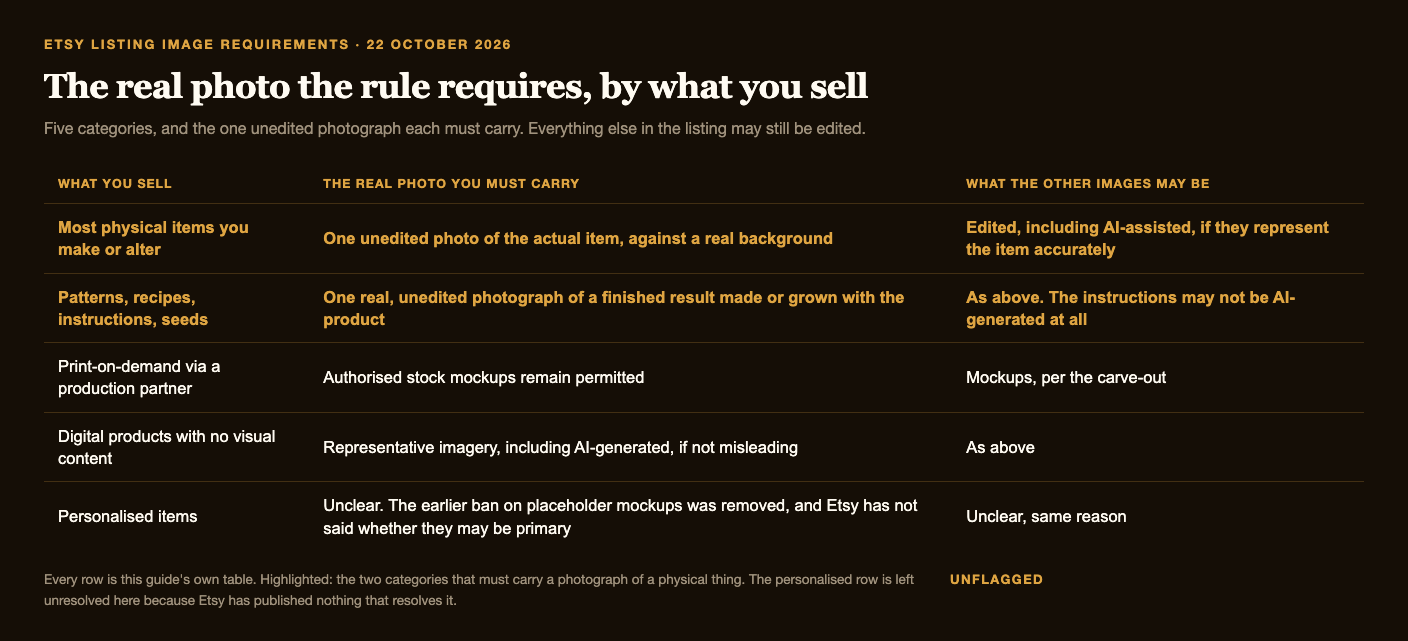
The requirement is not uniform. It lands differently depending on what you sell, and the differences are the part sellers are getting wrong.
| What you sell | The real photo you must carry | What the other images may be |
|---|---|---|
| Most physical items you make or alter | One unedited photo of the actual item, against a real background | Edited, including AI-assisted, if they represent the item accurately |
| Patterns, recipes, instructions, seeds | One real, unedited photograph of a finished result made or grown with the product | As above. The instructions may not be AI-generated at all |
| Print-on-demand via a production partner | Authorised stock mockups remain permitted | Mockups, per the carve-out |
| Digital products with no visual content | Representative imagery, including AI-generated, if not misleading | As above |
| Personalised items | Unclear. The earlier ban on "Your Text Here" placeholder mockups was removed, and Etsy has not said whether they may be primary | Unclear, same reason |
What "Unedited" Rules Out, and What It Still Allows
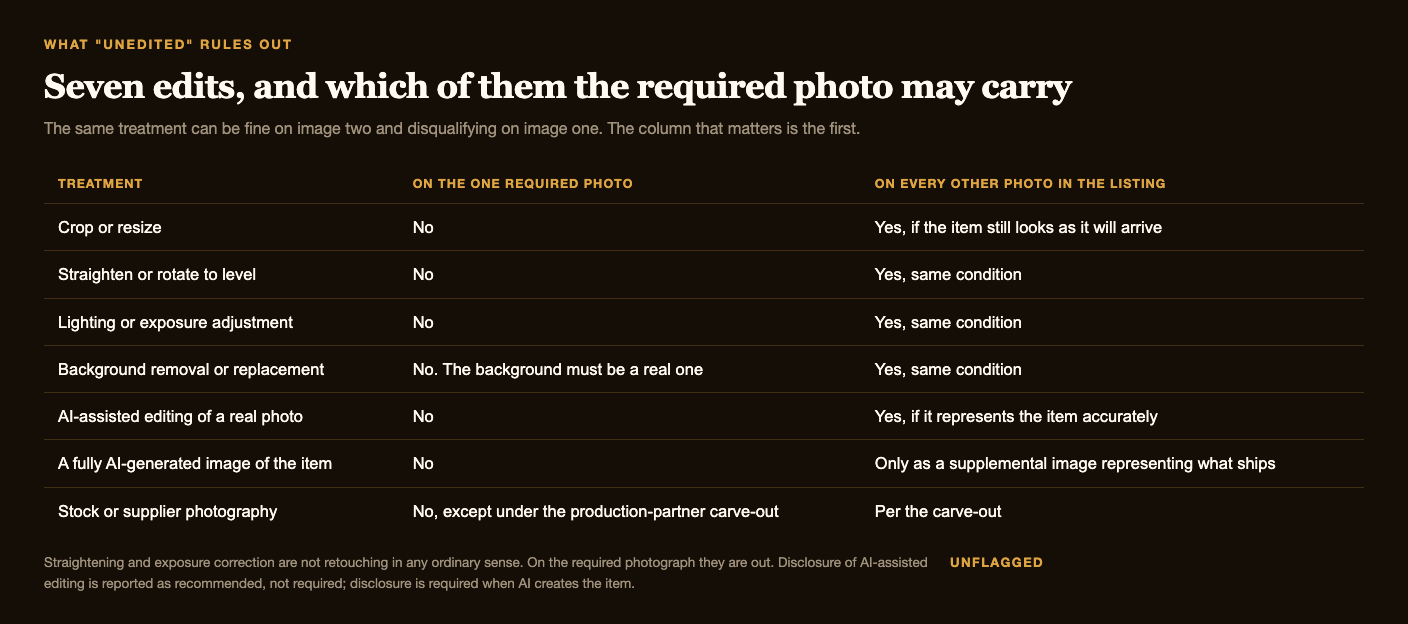
This is where the Etsy listing photo rules catch careful sellers rather than careless ones, because "unedited" is doing more work than it looks. Per Value Added Resource's reporting, the prohibited treatments on that one required file include no cropping, no resizing, no straightening, no lighting or exposure adjustments, and no background changes.
Read that list again if you shoot product for a living. Straightening and exposure correction are not retouching in any ordinary sense; they are what you do before showing a file to anyone. On the required photograph, they are out.
| Treatment | On the one required photo | On every other photo in the listing |
|---|---|---|
| Crop or resize | No | Yes, if the item still looks as it will arrive |
| Straighten or rotate to level | No | Yes, same condition |
| Lighting or exposure adjustment | No | Yes, same condition |
| Background removal or replacement | No. The background must be a real one | Yes, same condition |
| AI-assisted editing of a real photo | No | Yes, if it represents the item accurately. Disclosure is reported as recommended, not required |
| A fully AI-generated image of the item | No | Only as a supplemental image representing what ships |
| Stock or supplier photography | No, except under the production-partner carve-out | Per the carve-out |
The disclosure row is one where sources genuinely disagree. Reporting on the policy describes disclosure of AI-assisted photo editing as recommended practice, while several vendor blogs assert it is mandatory and cite nothing from Etsy's text. Not in dispute: disclosure is required when AI is used to create the item. On the timing of that separate requirement, vendor sources offer January 2026 and April 2026 and cannot be reconciled, so we assert no date. Our guide to selling AI art on Etsy covers the disclosure side.
The Carve-Outs: Print-on-Demand, Digital Files and Patterns
Print-on-demand shops read a rule demanding an unedited photo of the actual item as the end of the business model, since nobody holds inventory of a shirt printed when it sells. That reading is wrong: sellers using production partners to print their original designs on standard blanks may continue to use authorised stock mockups. If that is your model, the image rule is roughly where it was, and your exposure sits in the production-partner declarations we cover in Etsy print on demand.
Digital products split in two. A download whose substance is visual, a print or a clipart pack, shows itself, so representative imagery and the product are the same thing. One with no visual content, a spreadsheet template or a planner, may use representative imagery including AI-generated images, provided it is not misleading. The risks that actually bite digital sellers are elsewhere, in digital downloads Etsy compliance risks.
Patterns, recipes and instructional products get the strictest version, plus a second prohibition unrelated to photography: the instructions themselves may not be AI-generated, and must be the seller's own work. The listing must also carry a real, unedited photograph of a finished result made or grown using the product. A pattern listing illustrated only with a rendering of the garment, however accurate, is now short of the standard twice over.
The quiet one in the announcement. Etsy also stated that bot-generated listings without human involvement are not allowed, and that it will show sellers a notice when it detects AI-generated images at upload time, with plans to extend that detection to listings already live. A new buyer-facing report option for misleading AI imagery exists too, though reporting says those reports will initially gather information rather than trigger immediate enforcement. If you bulk-create listings with any kind of automation, that is the sentence to re-read.
Why the Honest Photo Is the One That Gets You Flagged
Here is the part no competing page mentions. Since 2023, by Value Added Resource's account, Etsy has run automated systems that flag listing images also appearing on other marketplaces. Sellers call it the AliExpress bot, and the intent is defensible: a dropshipper reselling a factory product uses the factory's photographs, and so do fifty other dropshippers. Matching images are good evidence of resale.
The failure mode is equally obvious once you see it. When somebody lifts your photograph onto AliExpress, Temu or Shein, the match is now true, and the system cannot tell who published first. What it has is an Etsy listing it controls and a foreign listing it does not, and sellers report that the Etsy listing is what comes down. On Etsy's first-quarter 2024 earnings call, chief executive Josh Silverman addressed this directly, as reported by Value Added Resource: "You can appeal that, but our default now is we take that down."
Now set the new requirement beside that machine. An unedited photograph of the actual item against a real background is, by construction, the most distinctive and obviously genuine image in your listing, and the one a scraper wants, because it looks like a real product in a real place rather than a mockup. The rule that proves you made the thing maximises your exposure to the system that assumes you did not.
That is not an argument against complying, but for complying and keeping provenance. Sellers who treat the duplicate-image flag as a reseller's problem are hurt most, holding no dated evidence of authorship when it arrives. The wider pattern of what gets listings pulled is in why Etsy deactivated your listing.
Two Removals That Look Identical and Are Not
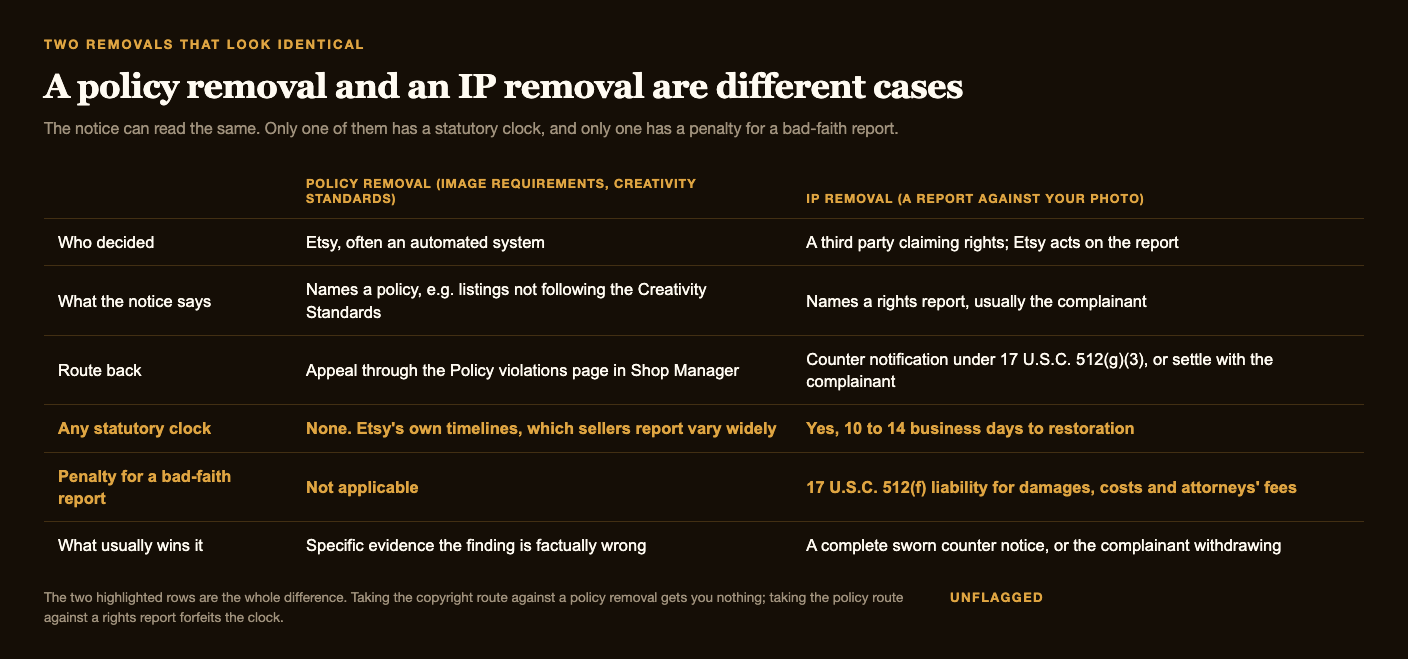
A removal notice about a photograph can come from either of two separate processes. They look similar and have different decision-makers, evidence and routes back. Choosing wrong wastes the only move you get.
A policy removal is Etsy applying its own House Rules: the image requirements above, or the Creativity Standards, or the duplicate-image systems. Etsy decides, Etsy reviews, and there is no statute anywhere in it. An intellectual property removal is Etsy responding to a report from someone claiming rights in the photograph or in what it depicts. In the United States that runs on the notice-and-takedown framework of 17 U.S.C. §512, and it has machinery a policy removal simply does not have.
| Policy removal (image requirements, Creativity Standards) | IP removal (a report against your photo) | |
|---|---|---|
| Who decided | Etsy, often an automated system | A third party claiming rights; Etsy acts on the report |
| What the notice says | Names a policy, e.g. listings not following the Creativity Standards | Names a rights report, usually the complainant |
| Route back | Appeal through the Policy violations page in Shop Manager | Counter notification under §512(g)(3), or settle it with the complainant directly |
| Any statutory clock | None. Etsy's own timelines, which sellers report vary widely | Yes, 10 to 14 business days to restoration |
| Penalty for a bad-faith report | Not applicable | §512(f) liability for damages, costs and attorneys' fees |
| What usually wins it | Specific evidence the finding is factually wrong | A complete sworn counter notice, or the complainant withdrawing |
So read the notice before writing anything. Shop Manager shows which finding a removed listing was judged against, and Etsy listing removed walks through reading it. If it names a policy, skip the copyright section below; if it names a rights report, skip the appeal one.
The Policy Route: Appealing an Image Removal
Appeals for policy removals go through the Policy violations page in Shop Manager, the stated route in the reporting on the October announcement and the same page that carries Creativity Standards findings.
What carries a policy appeal is specificity about a factual error, not a general assertion of good faith. The finding is a claim about your listing, so answer that claim and nothing else. If the finding is that your images appear elsewhere, the fact in dispute is who published first, and the answer is dated evidence of authorship: original camera files with embedded capture dates, work-in-progress shots, supply orders, a video of you making the item. If the finding is that no photograph of the actual item is present, add one and say which file is which.
Three things not to do. Do not edit and resurrect a deactivated listing hoping it quietly comes back; sellers consistently report a second removal. Do not relist the same images while an appeal is open, because repeat findings escalate and a shop with multiple violations loses Star Seller eligibility and moves closer to suspension. And do not argue the policy is wrong; even where it is, an appeal reviewer cannot act on that.
Our Etsy appeal letter template gives the structure, and common Etsy policy violations covers the patterns behind most findings.
The Copyright Route: What the Statute Actually Gives You
If the removal came from a copyright report against your photograph, you are in a different system, and it is the only part of this subject with hard numbers in it.
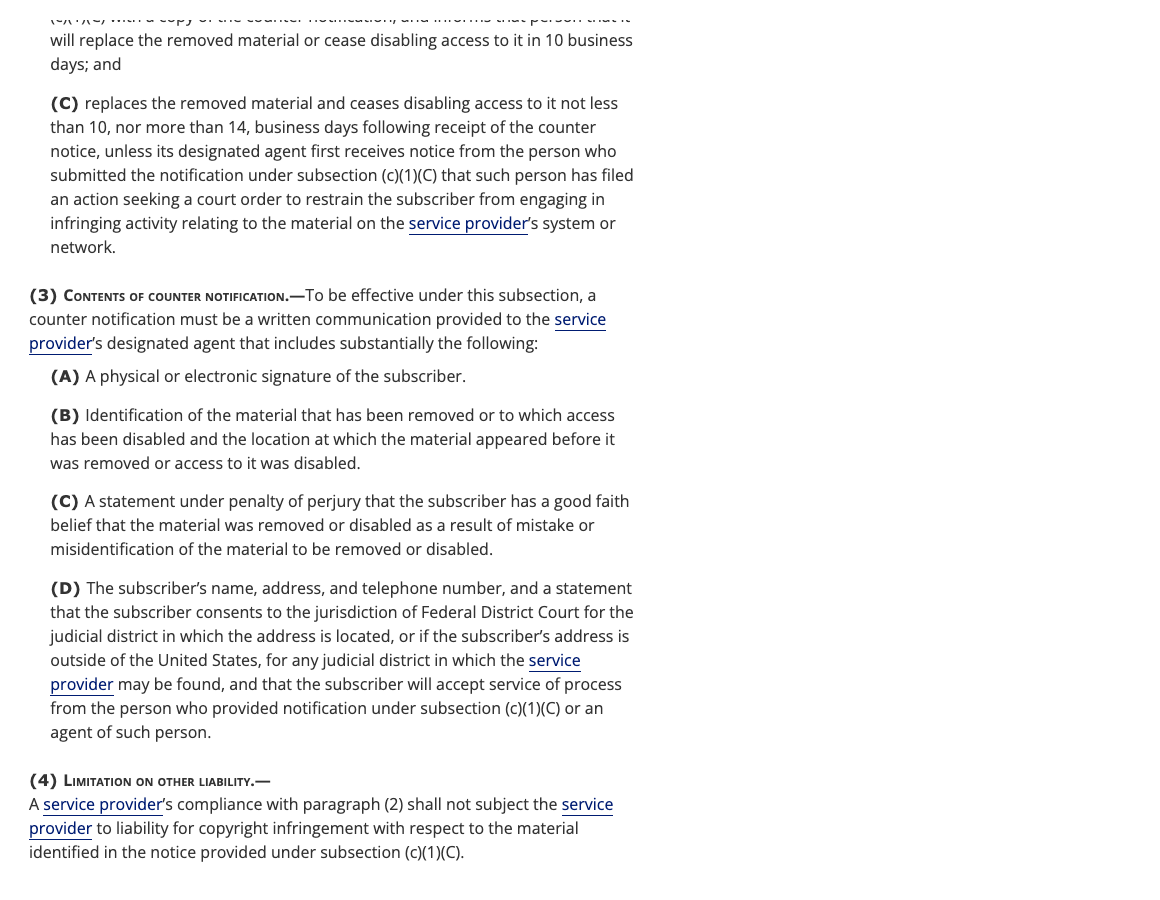
Under 17 U.S.C. §512, a subscriber whose material has been removed may send a counter notification. Section 512(g)(3) sets out its contents and 512(g)(2) the clocks, and those clocks are the point: a policy appeal can sit unanswered for months, and this cannot.
| Step or element | What the statute requires | Timing |
|---|---|---|
| Signature | Your physical or electronic signature | - |
| Identification | The removed material, and where it appeared before removal | - |
| Sworn statement | Under penalty of perjury, a good faith belief the material was removed as a result of mistake or misidentification | - |
| Contact and consent | Name, address, telephone, consent to federal district court jurisdiction, agreement to accept service of process from the complainant | - |
| Provider notifies complainant | Promptly sends a copy and states it will restore the material | States restoration in 10 business days |
| Restoration | Material replaced, unless the complainant first notifies that it has filed a court action to restrain you | Not less than 10, nor more than 14, business days after receipt |
| Bad-faith reports | §512(f) liability for knowingly materially misrepresenting infringement | Damages, costs and attorneys' fees |
Read the sworn statement and the jurisdiction consent carefully before using this. A counter notice is made under penalty of perjury and commits you to accepting service of process from the person who reported you. That is the correct move when the photograph is genuinely yours and the report is wrong, and a bad one if you are unsure.
Two limits, stated plainly. §512 is United States law describing what a service provider must do to keep its safe harbour, not a description of Etsy's internal workflow, so check Etsy's own intellectual property policy for how it handles counter notices in practice: our Etsy DMCA takedown guide covers that, and Etsy's intellectual property policy explained the wider framework. Second, the simplest resolution is often not statutory at all: complainants do sometimes withdraw once contacted directly.
What Sellers Report When They Appeal
The gap between the stated route and seller experience is wide, and pretending otherwise would not help.
Cindy Baldassi, a consultant who had spent over a year helping sellers appeal duplicate-image removals when Value Added Resource reported on it, described four recurring support outcomes: told they could not appeal, sometimes by several agents in turn; told the case had gone to Trust and Safety, with no reply following for months; told to retake the photographs and relist, which concedes the product was fine while costing the listing's reviews and search history; and told the item was removed because its photograph appears elsewhere, sometimes with a link to a listing showing a different product entirely.
Her own case is instructive. She assembled over two hours of proof, including supply orders and a video of herself making the item, and was told nothing could change the decision; her escalations went unanswered and the video was never reviewed. Days later the listing was reinstated with a brief apology and no explanation. In a separate forum case, three listings of a pin designer with over 100,000 sales were wrongly flagged after the designs were copied onto AliExpress, Shein and Temu, the first taking about a month to reinstate.
The practical reading is not that appeals never work, but that they are won on documentation you already have rather than what you assemble afterwards, and escalation is slow and inconsistent.
The Evidence to Build Before You Need It
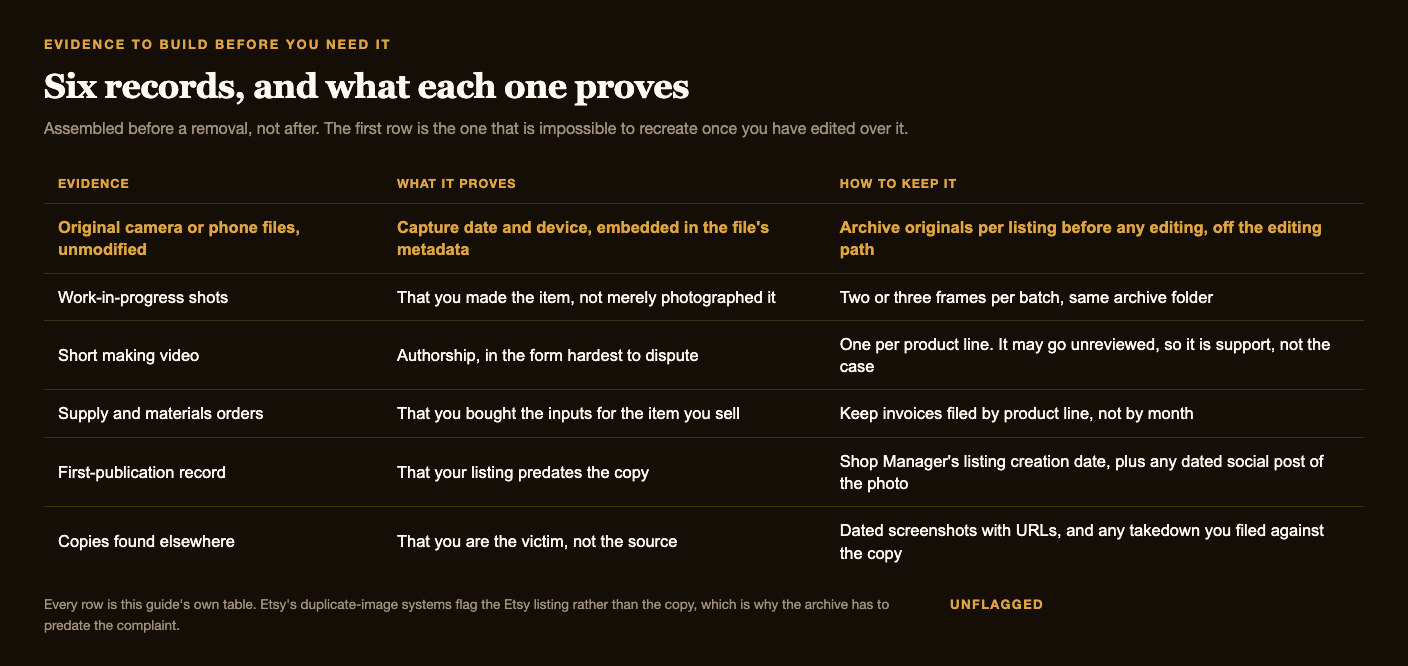
Provenance is the asset: cheap to keep, impossible to fabricate afterwards. Build it as a habit and a duplicate-image flag becomes an afternoon rather than a month.
| Evidence | What it proves | How to keep it |
|---|---|---|
| Original camera or phone files, unmodified | Capture date and device, embedded in the file's metadata | Archive originals per listing before any editing, off the editing path |
| Work-in-progress shots | That you made the item, not merely photographed it | Two or three frames per batch, same archive folder |
| Short making video | Authorship, in the form hardest to dispute | One per product line. It may go unreviewed, so it is support, not the case |
| Supply and materials orders | That you bought the inputs for the item you sell | Keep invoices filed by product line, not by month |
| First-publication record | That your listing predates the copy | Shop Manager's listing creation date, plus any dated social post of the photo |
| Copies found elsewhere | That you are the victim, not the source | Dated screenshots with URLs, and any takedown you filed against the copy |
Stripping metadata from listing images is a common privacy habit that costs you the cheapest provenance you have, so keep the originals even if you upload cleaned files. Photographs are protected as creative works in their own right, which is why a lifted product photo is actionable at all; the Copyright Office's photograph registration guidance covers group options for large bodies of work.
What to Do This Week
Ordered by payoff, assuming existing listings and no deadline to work to.
First, audit your best sellers, not the whole catalogue: the rule applies to everything, but enforcement is described as expanding gradually and your revenue is concentrated. For each, confirm a photograph of the actual item against a real background that you have not cropped, straightened, relit or background-swapped. If every shot has been through an editor, you need one new file, not a reshoot.
Second, archive the originals for those listings before you touch anything. That habit converts a future duplicate-image flag from a month into an afternoon.
Third, fix pattern and instructional listings, which fail twice: they need a real finished-result photograph, and the instructions must be your own work rather than AI-generated.
Fourth, if you sell personalised goods, keep a genuine photograph of a completed example as your required file. The reporting is unresolved on whether placeholder mockups may be primary, and a real photograph satisfies the rule under either reading.
The text beside the photo is its own exposure. An unedited photograph does not rescue a description still claiming handmade production you no longer do, or omitting an AI-creation disclosure. Unflagged screens submitted listing text for potential concerns and explains the wording that needs review. It does not inspect images, search live trademark registers, establish compliance or predict removal, so the image checklist above stays a manual job. See what the review covers and what it costs.
The uncomfortable part of this update is that it asks for your least polished photograph at the moment Etsy's duplicate-image systems are least forgiving, with no date by which to comply. The sellers who come out of it well will treat the raw file as evidence rather than as a concession.
Related Articles
- Why Etsy Deactivated Your Listing, reading a removal notice correctly before you act on it
- Etsy Appeal Letter Template, the structure for a specific, evidenced appeal
- Etsy DMCA Takedown, how a rights report against your listing is handled
- Etsy Mystery Box Rules 2026, where the actual-item photograph rule does the same work
- Etsy Product Photography, the conversion side once compliance is settled
- Common Etsy Policy Violations, the patterns behind most findings
FAQ
Does the unedited photo have to be my first listing image?
No. Reporting on the policy says it does not have to be first in the carousel. Putting your clearest shot first is still better commercially, since Etsy auto-crops thumbnails square.
When does the new Etsy listing photo rule take effect?
Etsy announced it on 22 October 2026 and gave no effective date or grace period for existing listings. Enforcement was described as expanding over the following months, with upload-time notices first and detection on live listings later.
Can I still use mockups if I sell print-on-demand?
Yes. Sellers using production partners to print their original designs on standard blanks may continue to use authorised stock mockups; the carve-out is explicit in the reporting. Your exposure sits in production-partner declarations instead.
Why was my listing removed when the photograph is genuinely mine?
Most likely a duplicate-image finding. Etsy has run automated systems since 2023 that flag listing images also appearing on other marketplaces, aimed at resellers. If somebody copied your photo onto AliExpress, Temu or Shein, the match is real and the system cannot tell who published first. Appeal with dated proof of authorship.
Do I have to disclose that I edited a photo with AI?
Sources disagree. Reporting on the policy calls disclosing AI-assisted photo editing recommended rather than required, while several vendor blogs call it mandatory without citing Etsy's text. Disclosure is required when AI is used to create the item itself, a separate rule.
Is a photo removal the same as a copyright takedown?
No, and the difference decides your next move. A policy removal is Etsy applying its own rules, appealed through the Policy violations page in Shop Manager with no statutory timeline. A copyright report runs on the 17 U.S.C. 512 framework, where a counter notification carries fixed clocks of 10 to 14 business days.
Should I send a DMCA counter notice?
Only when the photograph is clearly yours and the report is mistaken. A counter notice under 17 U.S.C. 512(g)(3) is sworn under penalty of perjury and commits you to accepting service of process from the complainant, so it is a real escalation. Section 512(f) makes a knowingly false report actionable by either side.
Scan Your Listings Free
Screen submitted listing text for potential concerns. 5 preliminary screens daily, shared network limits; no signup required.
Start Free ScreenRelated Articles
How to Check Your Etsy Listings for Trademark Violations (2026 Guide)
Learn how to scan your Etsy listings for trademark violations before they get flagged. Step-by-step guide to protecting your shop from takedowns and suspensions.
Read moreEtsy Shop Suspended? How to Write a Winning Appeal Letter
Your Etsy shop got suspended. Here's exactly how to write an appeal letter that gets your shop reinstated, with templates and strategies that actually work.
Read more50 Words That Are Trademarked on Etsy (Stop Using These Now)
A comprehensive list of commonly trademarked words and phrases that Etsy sellers use without realizing they're violating trademark law. Check your listings now.
Read more