Etsy Print on Demand: Complete Beginner Guide (2026)
Print on demand is the lowest-risk way to start selling on Etsy. No inventory, no upfront costs, no shipping headaches. You design it, a partner prints and ships it, and you keep the profit. This guide covers everything you need to launch your first POD shop in 2026 — from choosing the right partner to avoiding the trademark traps that shut down thousands of sellers every month.
What Is Print on Demand?
Print on demand (POD) is a business model where you sell custom-designed products without holding any inventory. You create designs, upload them to blank products like t-shirts, mugs, or phone cases, and a third-party partner handles printing, packaging, and shipping directly to your customer.
You never touch the product. You never visit a warehouse. You never stand in line at the post office. Your entire job is two things: design and market.
This makes POD the most accessible e-commerce model for beginners. The barrier to entry is essentially zero — no bulk orders, no minimum quantities, no financial risk beyond the $0.20 Etsy listing fee. If a design doesn't sell, you lose nothing. If it goes viral, your POD partner scales production automatically.
On Etsy specifically, POD is massive. The platform's buyer base actively searches for unique, personalized products — exactly what print on demand delivers. Categories like custom t-shirts, personalized mugs, and niche wall art are dominated by POD sellers, many of whom earn full-time incomes.
How Print on Demand Works on Etsy
The POD workflow on Etsy is straightforward. Once you connect a POD partner to your Etsy shop, the entire fulfillment process is automated. Here's exactly how it works:
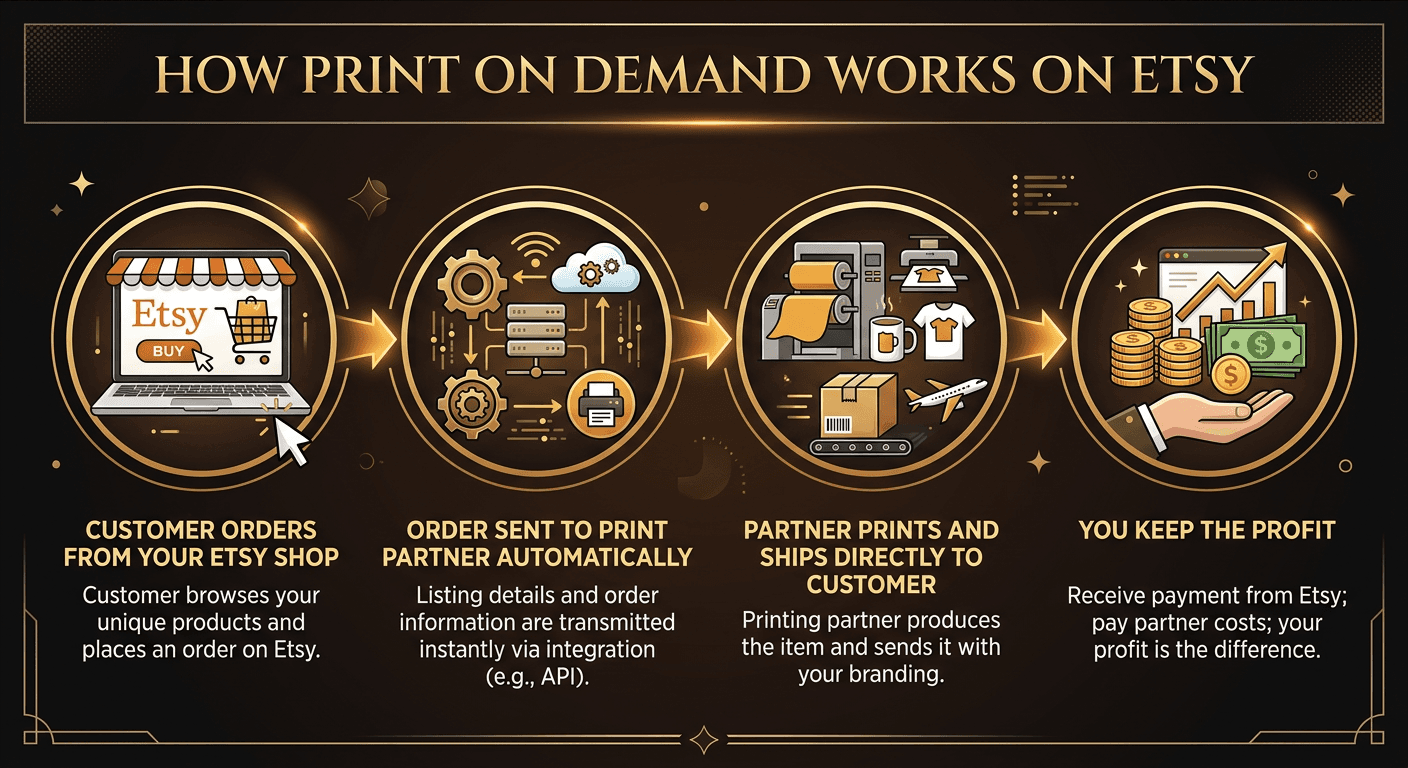
A buyer finds your listing on Etsy and places an order. They pay your retail price. The experience is identical to any other Etsy purchase — the customer has no idea it's print on demand.
Your POD partner (Printify, Printful, etc.) automatically receives the order details. No manual forwarding needed. The integration handles everything including the customer's shipping address.
The POD partner prints your design on the product, packages it (often with your branding if you choose), and ships it directly to the customer. Tracking information is sent back to Etsy automatically.
You keep the difference between your retail price and the POD partner's production cost (minus Etsy fees). A t-shirt that costs $8 to produce, sold at $24.99, nets you roughly $12-14 profit.
Top POD Partners Compared
Choosing the right print on demand partner is one of the most important decisions you'll make. Each platform has different strengths, and the best choice depends on what you're selling and where your customers are located.
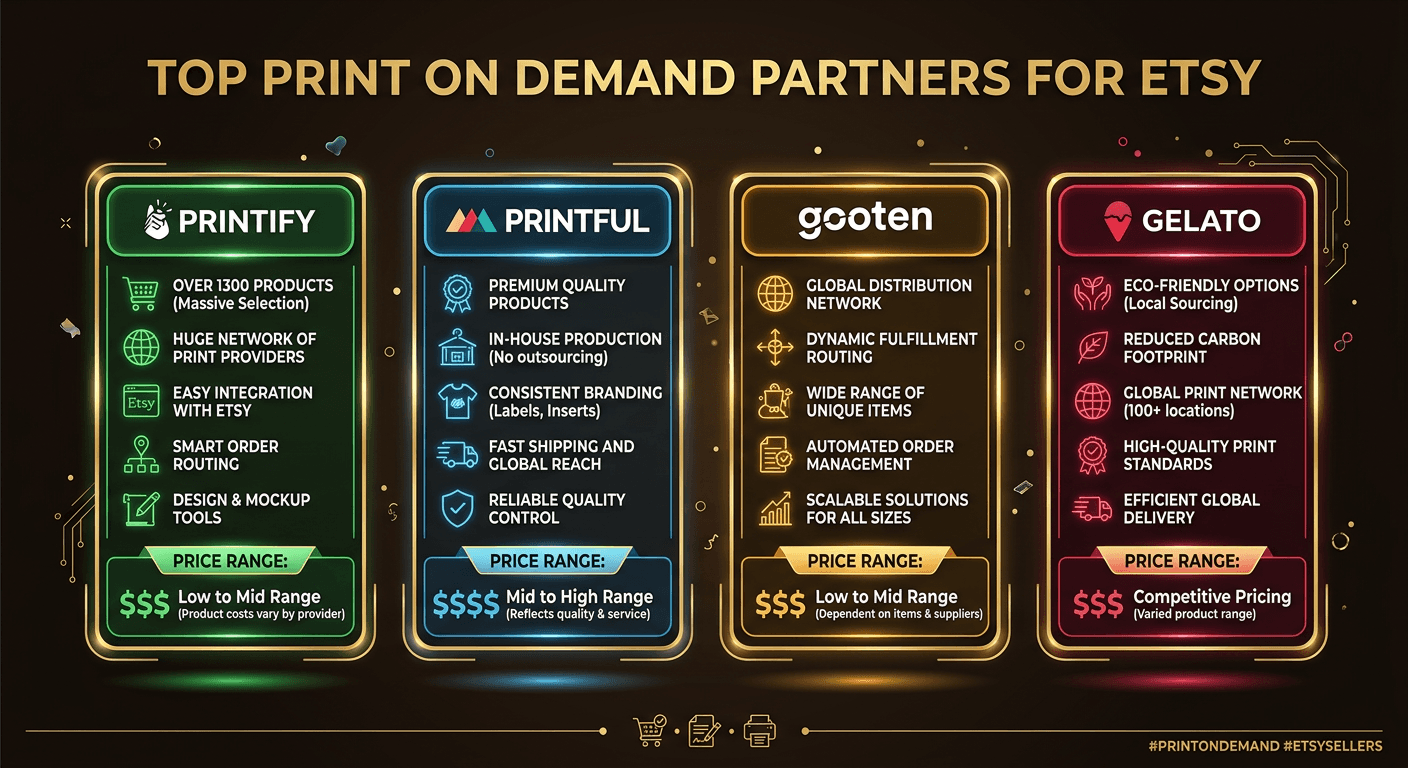
The most popular POD platform for Etsy sellers, and for good reason. Printify connects you to a network of over 90 print providers worldwide, giving you access to 1,300+ products at the most competitive prices in the industry. The direct Etsy integration is seamless — listings sync automatically and orders route to the closest printer.
Printful operates its own fulfillment centers rather than using third-party printers, which means more consistent quality control. Their print quality is noticeably better on apparel, and they offer premium branding options like custom pack-ins, labels, and branded packaging. Higher base prices, but worth it if quality is your differentiator.
Gooten's strength is its global manufacturing network. With print partners on every continent, they offer some of the fastest international shipping times. Their smart routing technology automatically selects the closest printer to your customer, reducing delivery times and shipping costs for international orders.
If sustainability is part of your brand, Gelato is the clear winner. They produce locally in 32 countries to minimize shipping distances and carbon emissions. Their GelatoConnect program ensures ethical manufacturing standards. Products are printed on FSC-certified materials where available. Increasingly popular with eco-conscious Etsy buyers.
How to Start Your Etsy POD Shop
Getting your first print on demand product live on Etsy takes about an hour. Here's the step-by-step process:
1. Create Your Etsy Seller Account
Go to etsy.com/sell and click "Get Started." Choose your shop language, country, and currency. Pick a shop name that reflects your niche — something memorable and searchable. You'll need to set up billing and a payment method to receive funds. For a full breakdown of what Etsy charges, check our complete guide to Etsy fees.
2. Connect Your POD Partner
Sign up for your chosen POD platform (Printify is the easiest for beginners). Navigate to their integrations page and connect your Etsy shop with one click. This creates the automated pipeline: when someone buys on Etsy, the order flows directly to your POD partner without you doing anything.
3. Design Your Products
Upload your designs to the POD platform's mockup generator. Select the products you want to sell (start with 2-3 product types in your niche). Adjust placement, sizing, and colors. Order at least one sample of each product to verify quality before selling — this also gives you real product photos instead of mockups.
4. List with SEO in Mind
Publish your products to Etsy through the POD platform. Optimize every listing with keyword-rich titles, all 13 tags, detailed descriptions, and high-quality mockup images. Etsy SEO is how buyers find you — read our 2026 Etsy SEO guide for the complete playbook.
Finding a Profitable Niche
Here's the truth about Etsy print on demand: 80% of your success is determined by your niche. The most talented designer in the world will fail selling generic "funny quote" t-shirts because the market is saturated beyond belief. The average designer with a specific niche will outperform them every time.
A profitable POD niche has three qualities: passionate buyers who identify with the topic, low enough competition that you can rank, and products that people actually want to buy (not just like on social media). For a broader list of opportunities, see our Etsy niche ideas guide.
How to Validate a Niche
- •Search Etsy: Type your niche keyword and check the number of results. Under 50,000 results is ideal. Over 200,000 is too competitive for a beginner.
- •Check bestsellers: Look at the top-selling listings in your niche. Are they POD products? How many sales and reviews do they have? If the top sellers have thousands of sales, there's proven demand.
- •Use eRank or Marmalead: These Etsy SEO tools show you search volume, competition scores, and trending keywords. Look for keywords with high search volume but low competition.
- •Go micro: Instead of "dog lover," try "golden retriever mom." Instead of "nurse," try "NICU nurse." The more specific you get, the less competition you face and the more your target audience feels seen.
Profitable niche examples for 2026: pet breed-specific gifts, healthcare profession humor, outdoor hobby subcultures (fly fishing, rock climbing, bird watching), teacher grade-specific products, first-generation college graduates, and new homeowner celebrations.
Design Tips for POD Products
Etsy's 2026 creativity standards are clear: original designs are required. The days of slapping generic clip art on a t-shirt and calling it a product are over. Etsy is actively removing listings that lack creative originality, and AI-detection tools are part of their review process.
That said, you don't need to be a professional graphic designer. Modern design tools make it possible for anyone to create professional-quality products:
Recommended Design Tools
- •Canva Pro ($13/month): Best for beginners. Pre-made templates, easy drag-and-drop, and direct export in print-ready formats. Their t-shirt and mug templates are surprisingly good starting points.
- •Kittl: Purpose-built for print on demand. Professional typography tools, vintage effects, and POD-specific templates. The quality jump from Canva is significant.
- •Midjourney / AI tools: Useful for generating unique illustrations and patterns, but you must significantly modify AI outputs to meet Etsy's originality standards. Use AI as a starting point, not the finished product.
Design principles that sell: bold, readable text (especially for apparel), high contrast colors, designs that look good at thumbnail size, and personalization options whenever possible. Personalized products convert at 2-3x the rate of non-personalized alternatives on Etsy.
Pricing and Margins
Getting your pricing right is the difference between a hobby and a business. You need to account for three costs: the POD partner's production cost, Etsy's fees, and your desired profit margin.
Pricing Formula
Retail Price = (Product Cost + Shipping) ÷ (1 − Desired Margin − Etsy Fee %)
Example: A Printify t-shirt costs $8.50 to produce with $3.99 shipping. Etsy takes roughly 12-15% in combined fees (transaction fee, payment processing, listing fee). If you want a 40% margin:
Product cost + shipping: $12.49
Etsy fees (~13%): $3.68
Your profit (40%): $11.32
Retail price: $28.29 → Round to $28.99
Typical POD margins on Etsy range from 30-50%. Premium or personalized products can command higher prices and margins above 50%. For a detailed breakdown of every fee Etsy charges, see our Etsy fees guide.
Pro tip: don't compete on price. POD sellers who race to the bottom always lose because your production costs are fixed. Instead, compete on design quality, niche specificity, and personalization. Charge more, sell to fewer but more passionate buyers, and protect your margins.
Trademark Risks for POD Sellers
This is the section most POD guides skip, and it's the one that matters most. Print on demand sellers face the highest trademark risk of any category on Etsy. The reason is simple: POD products are the most common vehicle for fan art, brand-name references, and trademarked phrases.
Every month, thousands of Etsy POD shops are suspended or permanently shut down for intellectual property violations. The most common infractions:
- ×Fan art on products: Drawing your own version of a Disney, Marvel, or anime character doesn't make it legal. Fan art is copyright infringement, period.
- ×Brand names in text designs: Putting "Nike" or "Stanley" on a t-shirt or mug is trademark infringement, even if it's a joke or parody.
- ×Trademarked phrases: Phrases like "Just Do It," "That's Hot," and "Let's Go Brandon" are trademarked. Using them on products gets listings removed immediately.
- ×Brand names in tags/titles: Even if your design is original, using trademarked terms in your listing tags or title (like "Disney style" or "Nike inspired") triggers automated takedowns.
The consequences are severe: first offense usually means listing removal and a warning. Second offense often results in a shop-wide review. Third offense can mean permanent suspension with no appeal.
Before you publish any POD listing, run every word through a trademark check. Our Etsy trademark checker guide walks you through the process, and our complete list of trademarked words on Etsy gives you 500+ terms to avoid.
Common Mistakes to Avoid
After analyzing thousands of failed POD shops, these are the mistakes that kill businesses before they ever gain traction:
Generic Designs
"Best Dad Ever" on a mug has been done ten million times. Generic motivational quotes, overused humor, and cliché sayings will never rank on Etsy because you're competing against sellers with thousands of reviews. Your designs need to speak to a specific audience, not everyone.
Ignoring Trademarks
"I didn't know it was trademarked" is not a defense. Etsy doesn't care about intent — they care about the DMCA takedown notice from a brand's legal team. One trademark violation can undo months of work building your shop.
Poor Mockups
Low-quality mockup images kill your click-through rate. Buyers scroll past blurry, poorly lit, or obviously fake product images. Use lifestyle mockups that show your product in context, and always order samples for real photography when a design starts selling.
No Niche Focus
Shops that sell everything — dog shirts, nurse mugs, gaming posters, wedding signs — confuse Etsy's algorithm and confuse buyers. Pick one niche, dominate it with 50-100 designs, then expand. Niche shops build repeat customers and higher conversion rates.
Neglecting SEO
A beautiful design nobody can find is worthless. Every listing needs optimized titles, all 13 tags filled, keyword-rich descriptions, and proper categorization. Read our Etsy SEO tips for 2026 to get this right from day one.
POD Sellers Face the Highest Trademark Risk on Etsy
Print on demand shops are the #1 target for trademark takedowns. Every design, every phrase, every word in your listing is a potential violation waiting to happen. Don't find out the hard way — scan your listings before Etsy does.
Unflagged checks your product titles, tags, and descriptions against live trademark databases and flags risky terms before you publish. Catch violations in seconds instead of losing your shop overnight.