Etsy DMCA Takedown: How to Respond and Prevent Future Notices
A DMCA takedown on Etsy can hit without warning. One day your listing is live, the next it's gone and there's a strike on your account. Whether the claim is legitimate or a competitor gaming the system, you need to know exactly what to do, how fast to act, and how to keep it from happening again.
What Is a DMCA Takedown on Etsy?
The Digital Millennium Copyright Act (DMCA) gives copyright holders a legal mechanism to request the removal of content that infringes on their original work. On Etsy, this means a copyright owner can file a DMCA takedown notice if they believe a seller's listing uses their copyrighted material without permission.
This is different from a trademark infringement complaint, which targets unauthorized use of brand names and logos. A DMCA takedown specifically targets copyrighted creative works: photographs, illustrations, graphic designs, written descriptions, patterns, and other original content.
When Etsy receives a valid DMCA notice, they are legally required to act on it. As an online service provider, Etsy relies on the DMCA's safe harbor provisions to avoid liability for user-uploaded content. To maintain that protection, they must promptly remove allegedly infringing material when notified.
Common scenarios that trigger DMCA takedowns on Etsy include using another seller's product photos, copying listing descriptions, selling items with copyrighted artwork, using stock images without proper licensing, and reproducing patterns or templates created by someone else.
The DMCA Process Timeline
Understanding the timeline helps you respond strategically rather than reactively. Here is how the entire DMCA process unfolds on Etsy, from the initial complaint to final resolution.
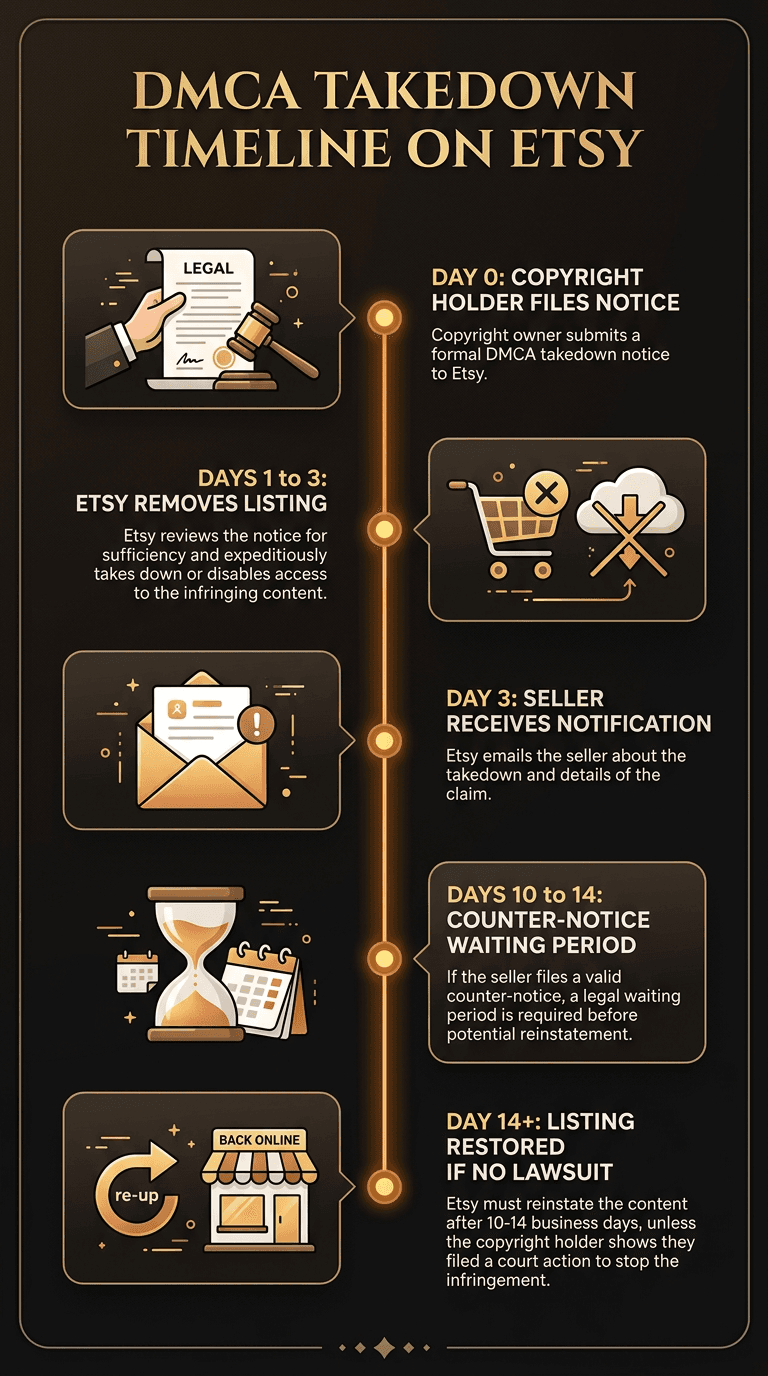
Step 1: Copyright holder files a DMCA notice. The copyright owner submits a formal takedown request through Etsy's intellectual property reporting form or via direct communication to Etsy's designated agent. The notice must meet specific legal requirements to be valid.
Step 2: Etsy reviews and removes the listing (1–3 business days). Once Etsy receives a notice that appears to be complete and valid, they remove the accused listing. Etsy does not evaluate whether the claim is actually correct. They are required to act on facially valid notices to maintain their safe harbor protection.
Step 3: Seller is notified. You receive an email from Etsy informing you that your listing has been removed due to a DMCA complaint. The email includes a copy of the takedown notice (with the claimant's contact information) and instructions for filing a counter-notice.
Step 4: Counter-notice window (10–14 business days). If you believe the takedown is wrong, you have the right to file a counter-notice. Once Etsy receives your counter-notice, the original claimant has 10 to 14 business days to file a federal lawsuit seeking a court order to prevent restoration.
Step 5: Resolution. If the claimant does not file a lawsuit within the 10–14 day window, Etsy is required to restore your listing. If they do file suit, the listing stays down and the dispute moves to federal court.
What a Valid DMCA Notice Must Contain
Not every complaint is a valid DMCA notice. Under 17 U.S.C. Section 512(c)(3), a DMCA takedown notice must contain six specific elements. If any are missing, the notice may be deficient, and Etsy is not obligated to act on it.
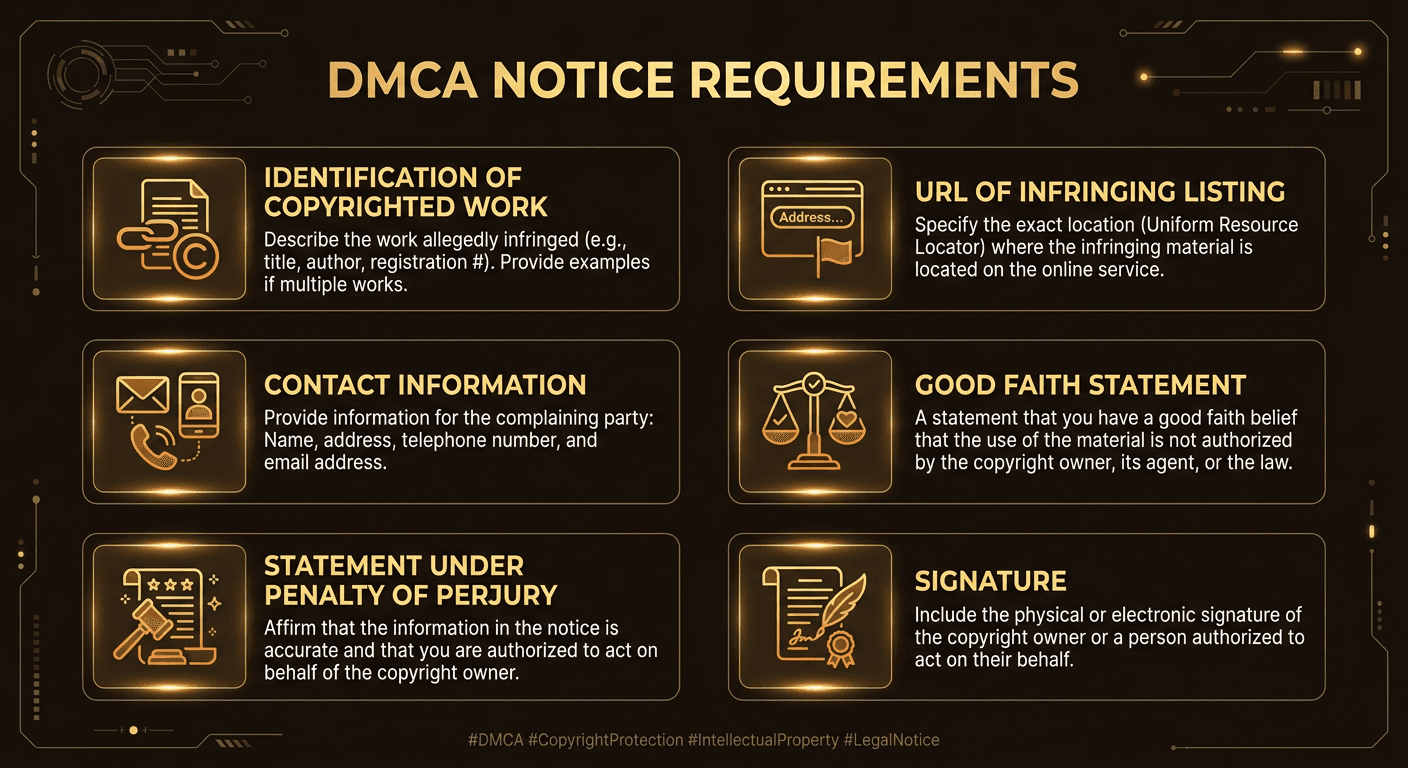
The 6 Required Elements
- Physical or electronic signature of the copyright owner or their authorized agent.
- Identification of the copyrighted work claimed to be infringed. The claimant must identify the original work they own.
- Identification of the infringing material and information sufficient to locate it. On Etsy, this means the specific listing URL or listing ID.
- Contact information for the complaining party, including address, phone number, and email.
- A good faith statement that use of the material is not authorized by the copyright owner, its agent, or the law.
- A statement of accuracy under penalty of perjury that the information in the notice is accurate and that the complaining party is authorized to act on behalf of the copyright owner.
When you receive a DMCA notice, check it against these six elements. If the notice is missing required components, such as no identification of the original work or no statement under penalty of perjury, you may have grounds to challenge it. However, Etsy often acts on notices even if they are technically incomplete, so your primary remedy is the counter-notice process.
What to Do When You Receive a DMCA Notice
Getting a DMCA takedown email from Etsy is stressful, but how you respond in the first 48 hours matters. Do not ignore it, and do not panic. Follow this structured approach.
1. Read the notice carefully
Identify who filed the complaint and what specific copyrighted work they claim you infringed. Look for the listing URL that was removed and the description of the original work. Save a copy of the entire notice for your records.
2. Evaluate the claim honestly
Ask yourself: did you actually use someone else's copyrighted work? This includes using their photos, copying their design, reproducing their pattern, or repurposing their written content. If the answer is yes, the best course of action is to accept the takedown, remove any other listings that use the same material, and move forward with original content.
3. Check for legitimacy issues
If you believe the claim is wrong, gather your evidence. Do you have proof that you created the work yourself? Do you have a license or permission to use the material? Is the claimant actually the copyright owner? Was the notice missing required elements? Document everything.
4. Decide whether to file a counter-notice
If the claim is baseless or fraudulent, filing a counter-notice is your legal right. But it comes with real consequences. A counter-notice requires you to provide your personal information to the claimant and consent to federal court jurisdiction. Only proceed if you are confident in your position.
5. Audit your other listings
One DMCA notice should prompt a full review of your shop. If you used the same type of content in other listings, such as stock photos without proper licenses or designs from free download sites, proactively remove them before more notices arrive. Multiple strikes compound quickly under Etsy's repeat infringer policy.
How to File a Counter-Notice
A DMCA counter-notice is your legal mechanism to dispute a takedown you believe was filed incorrectly. It is not a casual appeal. It is a legal document with real consequences, and you should understand what it involves before submitting one.
When to file a counter-notice
File a counter-notice when you created the work yourself and can prove it, when you have a valid license or permission to use the material, when the claimant does not actually own the copyright, or when the takedown was clearly filed in bad faith by a competitor. Our guide on competitor trademark reports covers how to identify and respond to bad-faith filings.
What your counter-notice must include
- Your physical or electronic signature
- Identification of the material that was removed and where it appeared
- A statement under penalty of perjury that you have a good faith belief the material was removed by mistake or misidentification
- Your name, address, and phone number
- A statement consenting to the jurisdiction of the federal district court for the district in which your address is located
- A statement that you will accept service of process from the person who filed the original DMCA notice
Risks to understand
Filing a counter-notice is not risk-free. Your personal contact information, including your legal name and physical address, will be shared with the original claimant. The claimant then has 10 to 14 business days to file a federal lawsuit. If they do, you will need to defend yourself in court. If they do not file suit within that window, Etsy restores your listing.
Additionally, if your counter-notice contains a false statement under penalty of perjury, you can face legal consequences. Only file a counter-notice if you genuinely believe you have the right to use the material in question.
Repeat Infringer Policy
The DMCA requires online platforms to adopt and implement a policy for terminating the accounts of repeat infringers. Etsy takes this seriously. Multiple DMCA takedowns on your account create a compounding risk that goes well beyond individual listing removals.
How Strikes Escalate
- First DMCA notice: Listing removed. Warning email sent. Your account is flagged internally.
- Second DMCA notice: Listing removed. Formal warning. Your account is placed under review. Additional listings may be scrutinized.
- Third or subsequent notices: Account suspension becomes likely. Etsy may permanently close your shop and restrict you from opening new accounts.
The exact threshold for permanent suspension is not publicly disclosed by Etsy. Factors that influence the outcome include how quickly the strikes accumulate, whether the same copyright holder filed multiple complaints, the severity of the infringement, and your overall account history.
If your shop is suspended due to repeated DMCA violations, the path to reinstatement is difficult. You can explore the Etsy suspension appeal process, but Etsy is under no obligation to reopen a shop that has been closed for repeat copyright infringement.
Fraudulent and Abusive DMCA Notices
Not every DMCA notice is filed in good faith. Some sellers use the DMCA process as a competitive weapon, filing takedown notices against rivals to get their listings removed. This is illegal, but it happens frequently enough that you need to know how to handle it.
Signs of a fraudulent DMCA notice
- The claimant sells similar products on Etsy or other platforms
- The "original work" they claim to own was created after your listing went live
- The claimant cannot produce evidence of original creation
- The notice targets your best-selling listings specifically
- The claimant has a history of filing takedowns against multiple competitors
How to fight back
File a counter-notice immediately. Document the timeline showing your work was created first. Gather screenshots, original design files with metadata, purchase receipts for licenses, and any other evidence of your ownership. Report the abusive claimant to Etsy's trust and safety team.
Under 17 U.S.C. Section 512(f), anyone who knowingly makes a material misrepresentation in a DMCA notice can be held liable for damages, including costs and attorney fees. If you can demonstrate that a competitor filed a fraudulent takedown, you may have grounds for legal action against them.
Keep in mind that proving bad faith requires clear evidence. The claimant might genuinely believe they hold the copyright even if you disagree. Consult with an intellectual property attorney if the situation involves significant revenue or multiple fraudulent claims.
How to Prevent DMCA Takedowns
The best way to deal with DMCA takedowns is to never receive one. These practices will dramatically reduce your exposure to copyright claims.
Use only original work
Create your own product photos, write your own descriptions, and design your own graphics. Original content cannot be legitimately taken down via DMCA (though fraudulent claims can still occur). If you use a camera, save the original RAW files. If you design digitally, save your project files with creation timestamps.
Get proper licenses
If you use stock photos, fonts, design elements, or templates, make sure your license covers commercial use on Etsy. Many free resources are licensed for personal use only. Read the license agreement, save a copy, and note the specific terms that authorize your use case.
Document your creative process
Maintain records that prove you created your work. Save design files with timestamps, keep sketches and drafts, screenshot your design software with layers visible, and date your work. If you ever need to file a counter-notice or defend against a fraudulent claim, this documentation is your strongest evidence.
Run reverse image searches
Before listing a product, run your images through Google Reverse Image Search or TinEye. If your design closely resembles existing copyrighted work, modify it until it is clearly distinguishable. This also helps you spot if someone has already copied your work.
Avoid "free download" design sites
Many sites that offer free SVGs, clipart, and design bundles contain copyrighted material uploaded without authorization. Using these designs on Etsy puts you at risk even if you downloaded them in good faith. Stick to reputable sources with clear commercial licenses, or create everything from scratch.
Protect Your Etsy Shop Before the Next Notice
Unflagged scans your listings for copyright risks, flags potential issues, and helps you stay compliant before a DMCA takedown ever reaches your inbox.
Start Protecting Your Shop