Selling AI Art on Etsy in 2026: Disclosure Rules Explained
Etsy allows AI art, but non-disclosure now triggers suspensions. The exact attribution settings, disclosure wording, and audit steps that keep shops safe.
- 1.Etsy Did Not Ban AI Art. It Banned Pretending
- 2.What Actually Changed, and When
- 3.The Three Things To Get Right Before You List
- 4.What Gets Pulled and What Survives
- 5.The Copyright Trap Nobody Warns You About
- 6.How to Write a Disclosure That Passes
- 7.A 10-Minute Audit for Shops Already Selling AI Art
- 8.Where AI Art Fits in a Compliant Catalogue
- 9.Frequently Asked Questions
- 10.Check Before Etsy Does
Etsy Did Not Ban AI Art. It Banned Pretending
Here is the sentence that costs sellers their shops: "I made this." If the primary visual came out of an image generator and you ticked that box anyway, you have a disclosure problem, and in 2026 that is an enforcement problem.
Selling AI art on Etsy is allowed. Prints, wall art, sticker sheets, greeting cards, planner covers, digital downloads — all of it can be generated with AI and legitimately sold. What is not allowed is passing machine-generated work off as hand-created work, and Etsy's automated moderation is now catching that difference at scale.
We went through Etsy's Creativity Standards, the January 2025 US Copyright Office report on AI works, and a stack of seller reports about no-warning removals. The pattern is consistent enough to act on. This guide is the compliance version of that research: what to tick, what to write, what gets pulled, and what to fix today if you already have AI listings live.
What Actually Changed, and When
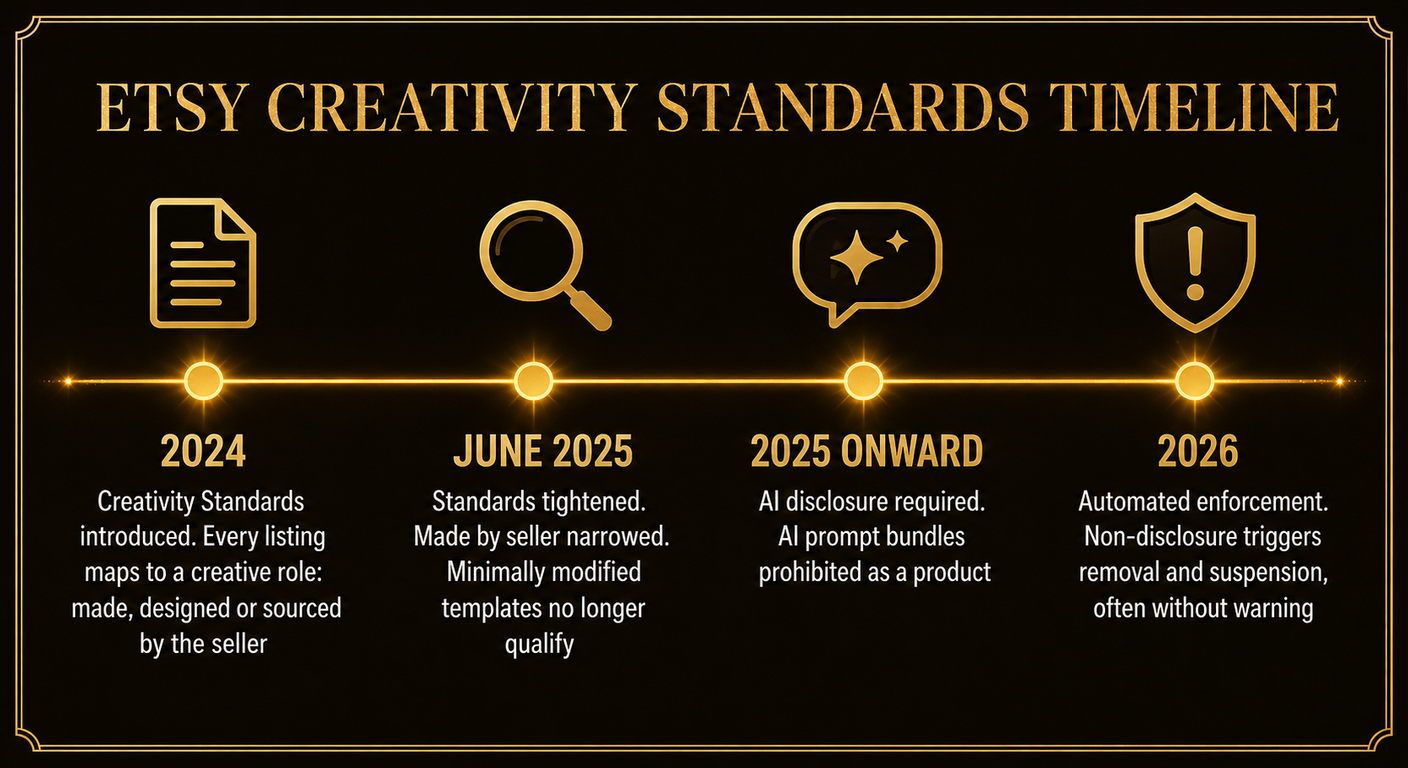
Sellers keep describing this as a sudden 2026 crackdown. It is not sudden. It is the third step of a policy that has been tightening for two years, and the enforcement finally caught up with the rule.
| When | What changed | Practical effect |
|---|---|---|
| 2024 | Creativity Standards introduced | Every listing must map to a creative role: made, designed, or sourced by the seller |
| June 2025 | Standards tightened | "Made by seller" narrowed sharply. Minimally modified purchased designs and templates no longer qualify |
| 2025 onward | AI disclosure required | AI involvement must be disclosed, and AI prompt bundles are prohibited as a product |
| 2026 | Automated enforcement | Non-disclosure became an active removal and suspension trigger, frequently without warning |
The rule that trips people up is the creative-role one. Etsy's framework asks whether you made the item, designed it, or sourced it. AI-generated artwork does not sit under "made by" in Etsy's sense, because you did not physically produce the work. It sits under designed by, and only when you contributed genuine creative direction rather than typing a prompt and hitting download.
That is the whole policy in one line: pick the honest role, then say so out loud. Everything below is mechanics.
The Three Things To Get Right Before You List
Every removal we have seen traces back to one of three fields being wrong. Fix these and you have handled the overwhelming majority of your exposure.
| # | What to set | Why it matters |
|---|---|---|
| 1 | Attribution: "Designed by" rather than "Made by" | This is the field moderation checks first. A generated image filed as hand-made is a direct standards violation |
| 2 | An explicit AI statement in the listing description | Disclosure has to be visible to the buyer, not buried in a policy tab or an image caption |
| 3 | A described human contribution | "Designed by" requires meaningful creative input. Say what yours was |
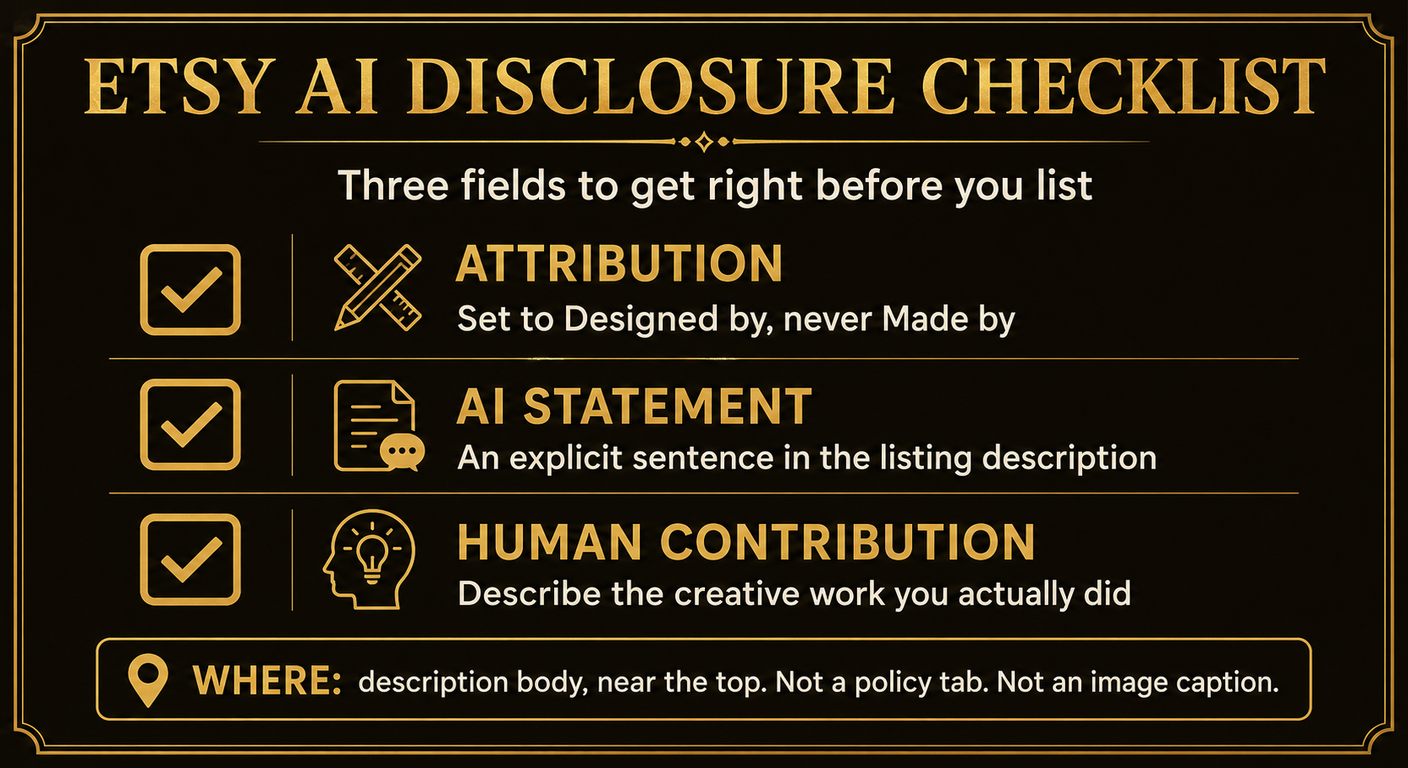
Field number three is the one sellers skip, and it is the one that separates a compliant listing from a technically-disclosed one. Etsy's standard is not "you used AI"; it is "you played a real creative role and disclosed the AI." If your description discloses the tool but describes no work of your own, you have documented a policy problem in your own copy.
Etsy's product interface changes, so confirm the current field names against the Creativity Standards policy page before a bulk edit. The three obligations underneath the interface have been stable.
What Gets Pulled and What Survives
Removals are not random. Sorted by what we could actually corroborate across seller reports, the risk profile looks like this.
| Listing pattern | Risk | Why |
|---|---|---|
| Generated image, "Made by seller", no disclosure | Severe | Two violations in one listing. This is the classic no-warning removal |
| AI prompt packs or prompt bundles | Severe | Prohibited outright as a product category |
| Generated character or logo lookalikes | Severe | A prompt does not launder a trademark. The rights holder still files |
| 20 to 30+ new AI listings uploaded per day | High | Upload velocity is itself a moderation signal, disclosed or not |
| Disclosed AI base, no described human input | Moderate | Satisfies disclosure, fails the creative-role test |
| Disclosed AI base, edited, composed, described | Low | This is the compliant path |
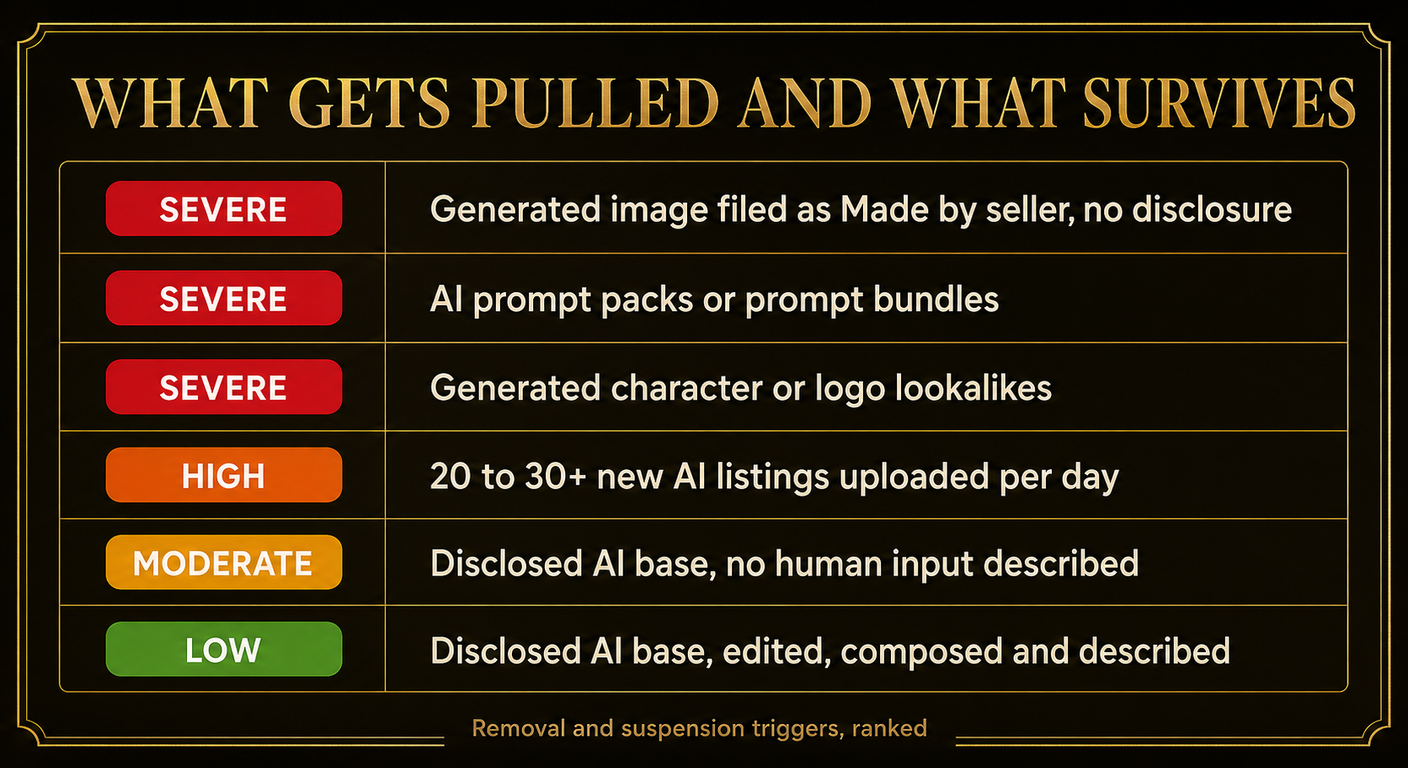
Notice that the trademark row has nothing to do with AI policy. If you prompt your way to a design that resembles a protected character, mascot, or brand mark, you are exposed to the same takedown you would face if you had drawn it by hand. Our guide to avoiding copyright infringement on Etsy covers that side, and it is the failure mode most likely to end in a permanent ban rather than a removal.
The volume row surprises people. Shops that go from four listings a week to forty a day get looked at, because that curve is what a bulk-generated catalogue looks like from the outside. Pace your uploads.
The Copyright Trap Nobody Warns You About
This is the part that gets left out of every "can you sell AI art on Etsy" article, and it is the part with money attached.
The US Copyright Office published its report on the copyrightability of AI-generated material on 29 January 2025, after taking more than 10,000 public comments. Its conclusions, in plain terms:
- Purely AI-generated output is not copyrightable. Human authorship is the requirement, and a machine output has none.
- Prompts alone are not authorship. Detailed prompts, iterated prompts, clever prompts: still not enough on their own.
- Hybrid works are protected only in their human parts. Your edits, arrangement, and original additions can be protected. The generated base is not.
- Using AI as a tool does not poison the work. AI for ideation or editing does not make an otherwise human work uncopyrightable.
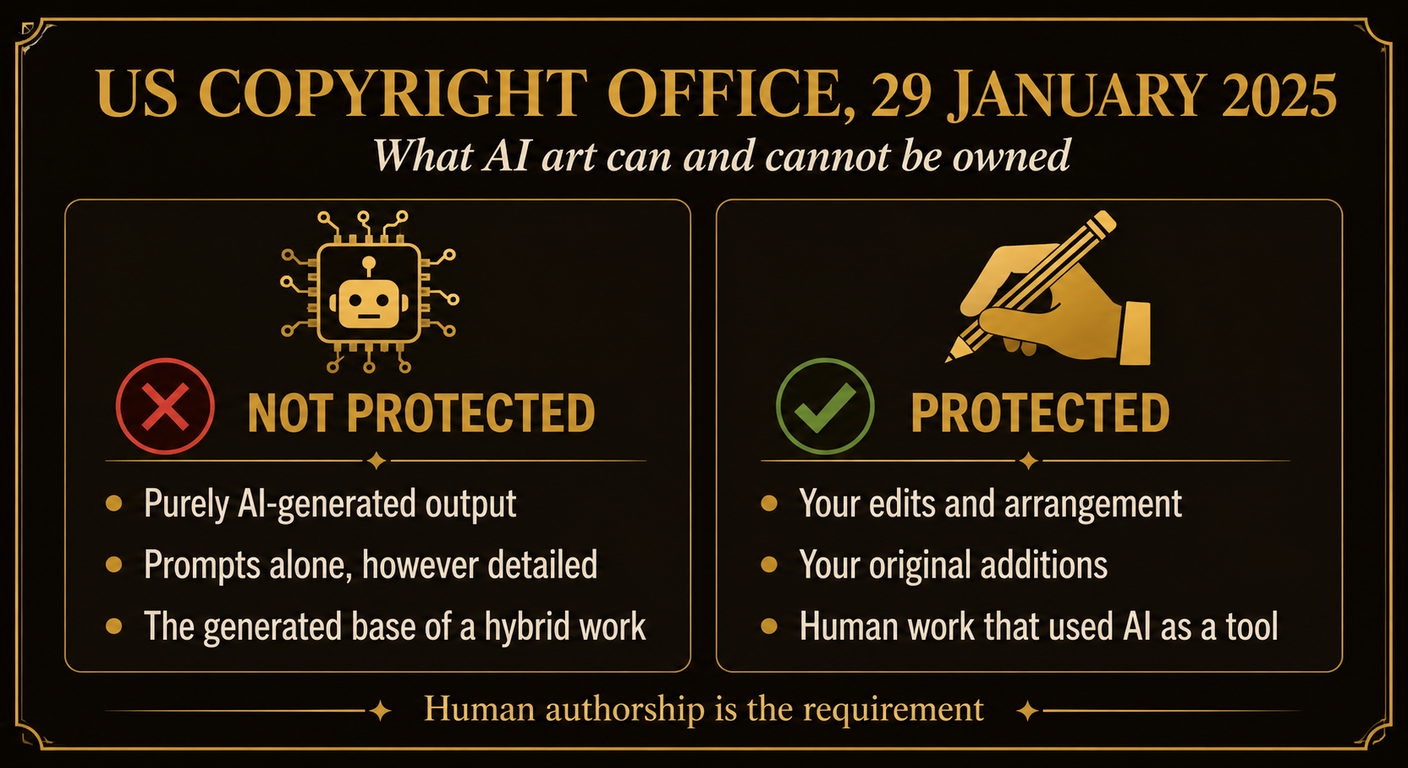
Read that alongside the Etsy rules and a nasty asymmetry appears. You can be removed for using AI art badly, but you often cannot defend the AI art you use well. If a competitor copies your undisclosed-base generated print and lists it themselves, you may have no copyright to assert against them, because you may not own one.
The commercial argument for real creative input is stronger than the compliance argument. Meaningful human work is simultaneously what satisfies "Designed by" and what gives you something you can actually own and enforce.
You can read the Office's reasoning yourself in Copyright and Artificial Intelligence, Part 2. It is more readable than most government reports, and worth thirty minutes if AI output is a meaningful share of your catalogue.
How to Write a Disclosure That Passes
Most failed disclosures fail for being vague. "AI was used in this design" names a tool and claims no work. Here is the structure that covers both obligations at once.
The artwork in this listing was created with the assistance of AI image generation. I developed the concept and colour direction, generated and selected from multiple variations, then edited the final piece by hand: cleaning up detail, adjusting composition and colour, and preparing the print-ready files at the sizes listed above.
Three components, in order: the AI was used, here is what I contributed, here is what the buyer receives. Put it in the description body, near the top, in the same voice as the rest of your copy. Do not tuck it under the shipping details.
Then make it true. If that paragraph describes work you did not do, you have written a confession rather than a disclosure, and an appeal reviewer reading your listing will notice the gap before you do.
Two habits worth adopting alongside it. Keep your working files, because edit history is the fastest way to demonstrate creative input if a listing is ever questioned. And write the disclosure once as a template you paste, so it never gets skipped on the listing you create at midnight.
A 10-Minute Audit for Shops Already Selling AI Art
If you have AI listings live right now, do this before your next upload. It is the same sequence we would run on a shop that came to us after a first removal.
- Filter your catalogue by production method. Every listing with a generated primary image that is set to "Made by seller" is an immediate fix. Start there, not with the disclosure text.
- Search your descriptions for an AI statement. Any AI listing without one is exposed. Paste your template in.
- Read your creative-input sentence. If it does not exist, or describes nothing beyond prompting, either add the actual work or change what you are claiming.
- Scan titles, tags, and descriptions for brand and character terms. Generated designs pick up trademarked references from prompts constantly. This is the highest-severity category on the list.
- Check your prompt-adjacent products. Prompt packs, prompt bundles, and prompt guides need to come down.
- Slow your upload rate. If you have been publishing in daily batches of twenty or more, spread them out.
- Re-check after Etsy policy updates. The standards moved twice in two years. Our rundown of Etsy's 2026 policy changes tracks what has shifted.
Sellers with a few hundred listings should expect this to take an afternoon rather than ten minutes, and it is still the cheapest afternoon available. The alternative price is a suspension, and what happens when Etsy suspends your shop includes held funds for as long as the review runs.
Where AI Art Fits in a Compliant Catalogue
Our read, after all of this: AI is a fine starting point and a poor finished product. The shops that get through 2026 without incident treat generated output as raw material — a base they edit, compose, and build on — and describe that honestly in every listing.
That is also just better business. It clears the "Designed by" bar, it produces something you may be able to protect, and it does not depend on a moderation model failing to notice what you did. If you want the wider toolkit, our roundup of AI tools for Etsy sellers covers the categories worth automating, and the compliance risks specific to digital downloads apply to every AI print you sell as a file.
Frequently Asked Questions
Can you sell AI-generated art on Etsy in 2026?
Yes. Etsy permits AI-generated artwork provided you attribute it correctly, disclose the AI use in your listing description, and contributed genuine creative input. What is prohibited is undisclosed AI presented as hand-made work, and selling AI prompt bundles as a product.
Do I choose "Made by" or "Designed by" for AI art?
Designed by. Under Etsy's Creativity Standards, "made by" describes work you physically produced. A generated image was not produced by you, so filing it as hand-made is a direct standards violation and is the single most common reason AI listings get pulled.
Will Etsy suspend me without warning for AI listings?
It happens. Sellers have reported listing removals and account-level action with no prior notice, most often where AI use was undisclosed or attribution was wrong. Etsy is not obliged to warn before enforcing, which is why the audit above is worth running before you are the test case.
Do I own the copyright to art I generated with AI?
Probably not to the generated portion. The US Copyright Office concluded in January 2025 that purely AI-generated material is not copyrightable and that prompting alone is not authorship. Your own edits, arrangement, and original additions can be protected, which is another reason to do substantive work on top of any generated base.
How do I write an Etsy AI disclosure?
State plainly that AI image generation was used, describe your specific creative contribution beyond prompting, and place it in the visible listing description rather than a policy section or image caption. Keep the wording as a template so it is applied consistently to every AI listing.
Can I get in trouble for AI art that resembles a brand?
Yes, and this is the more serious risk. Trademark and copyright enforcement applies to the output regardless of how it was produced. A generated design resembling a protected character, logo, or mascot draws the same takedown as a hand-drawn one, and repeat infringement is a common route to permanent closure.
Check Before Etsy Does
Disclosure fixes are cheap. Suspensions are not, and the review that follows one runs on Etsy's timetable rather than yours.
Unflagged scans your listings for the things that actually trigger enforcement: trademark exposure in titles, tags and descriptions, policy conflicts, and attribution that does not match what you are selling. Run a free scan to see where your AI listings stand, then create an account for ongoing monitoring as the standards keep moving.
Scan Your Listings Free
Check your Etsy listings for trademark violations in seconds. 3 free scans, no signup required.
Start Free ScanRelated Articles
Etsy Production Partner Rules 2026: Register or Get Flagged
Etsy requires every production partner to be declared. Who counts, how to register one in Shop Manager, and the attribution setting that flags shops.
Read moreHow to Check Your Etsy Listings for Trademark Violations (2026 Guide)
Learn how to scan your Etsy listings for trademark violations before they get flagged. Step-by-step guide to protecting your shop from takedowns and suspensions.
Read moreEtsy Shop Suspended? How to Write a Winning Appeal Letter
Your Etsy shop got suspended. Here's exactly how to write an appeal letter that gets your shop reinstated, with templates and strategies that actually work.
Read more