Etsy Mystery Box Rules 2026: Why Yours Gets Removed
Etsy mystery box rules explained: why the standards exclude unknown-contents boxes, what a qualifying curated box needs, and how to fix a removal.
- 1.What Etsy's Standards Actually Say About Mystery Boxes
- 2.Two Requirements a Mystery Box Cannot Meet
- 3.What a Qualifying Curated Box Looks Like
- 4.eBay Allows This Listing. Etsy Does Not.
- 5."$100 Value for $30" Is a Separate Legal Problem
- 6.Is a Mystery Box a Game of Chance?
- 7.How to Rewrite the Listing So It Survives
- 8.If Etsy Already Removed Your Listing
- 9.Related Articles
- 10.FAQ
Key takeaways
- The Etsy mystery box rules name the product, not just the behaviour. The Creativity Standards list "mystery box" among generic concepts that do not qualify as gift basket themes, defining it as a box with unknown contents or a single type of item in bulk. The term is in the policy text.
- The rule that ends the argument is the description requirement. A curated gift basket or box must list every item it contains in the listing description. A box whose selling point is that the buyer does not know what is inside cannot satisfy that and remain the same product.
- The photo rule is a second, independent barrier. Etsy requires original photographs of the actual item the buyer receives. That blocks the stock-image or sealed-box shot even for a seller who lists the contents.
- eBay allows the identical listing. Its chance-listings policy permits grab bags given general information about contents and no singling out of high-value items unless every buyer gets them. Sellers port the listing to Etsy and lose it.
- "$100 value for $30" is a separate problem with its own guide. 16 CFR 233.2(b) treats a "Retail Value" figure as a claim about the prevailing price in the buyer's area, not an isolated one, and a varying box makes it unverifiable by construction.
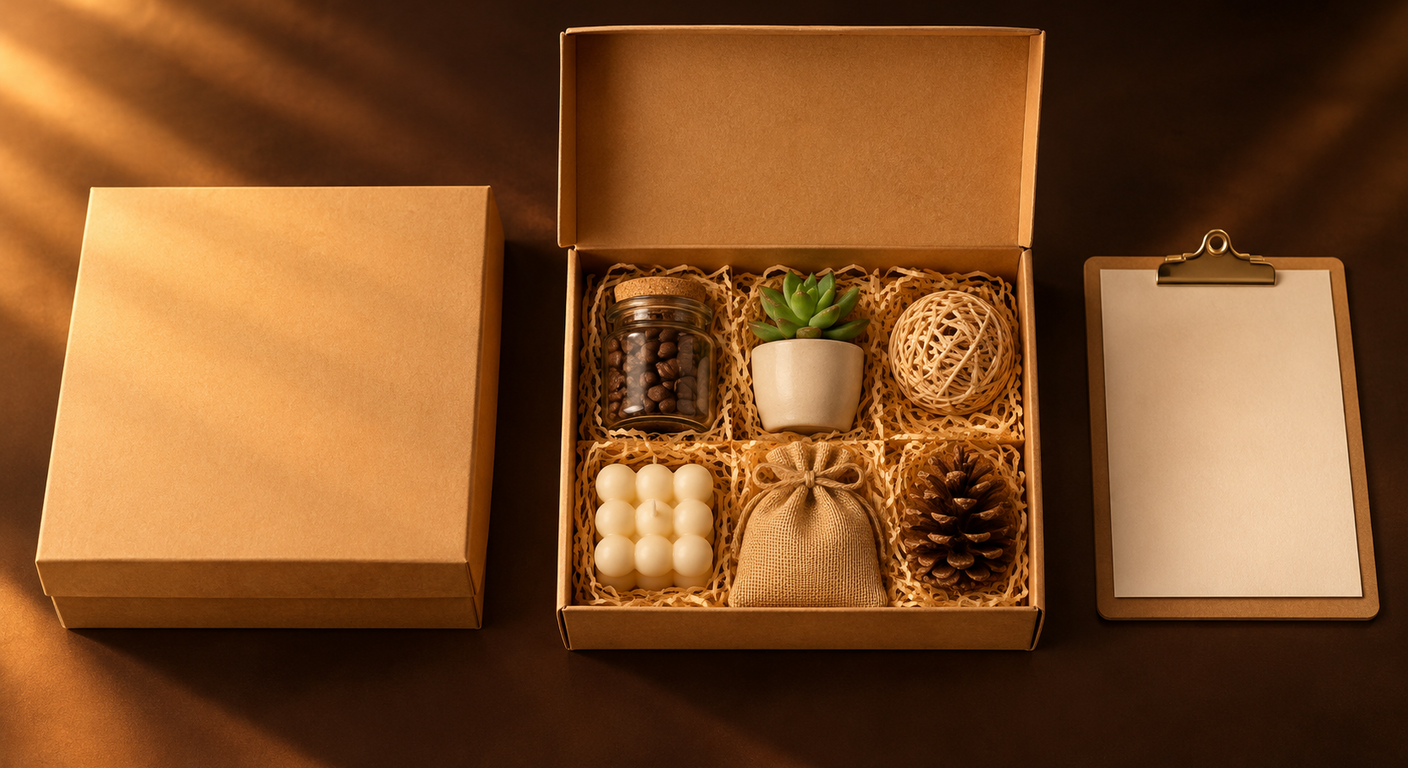
Your mystery box was the best listing in the shop, and one morning it was gone. The removal notice pointed at the Creativity Standards, which you had read, and you could not find the sentence you broke, so you rewrote the description and relisted, and lost that one too. The Etsy mystery box rules are not hiding in the fine print of a policy about handmade goods: the policy names this product by name, in a section about gift baskets, and then sets a requirement the product cannot meet without becoming a different product. We read the gift-basket language, the 2024 Government Publishing Office edition of the FTC's pricing guides, and eBay's published chance-listings policy, and checked all four guides ranking for this term. None of them cites a single policy section or statute, and none mentions that the thing you are trying to sell is listed in the rule as an example of what fails.
This piece is about where the line actually sits, why two separate requirements put a true mystery box on the wrong side of it, and what a box you can still sell looks like.
What Etsy's Standards Actually Say About Mystery Boxes
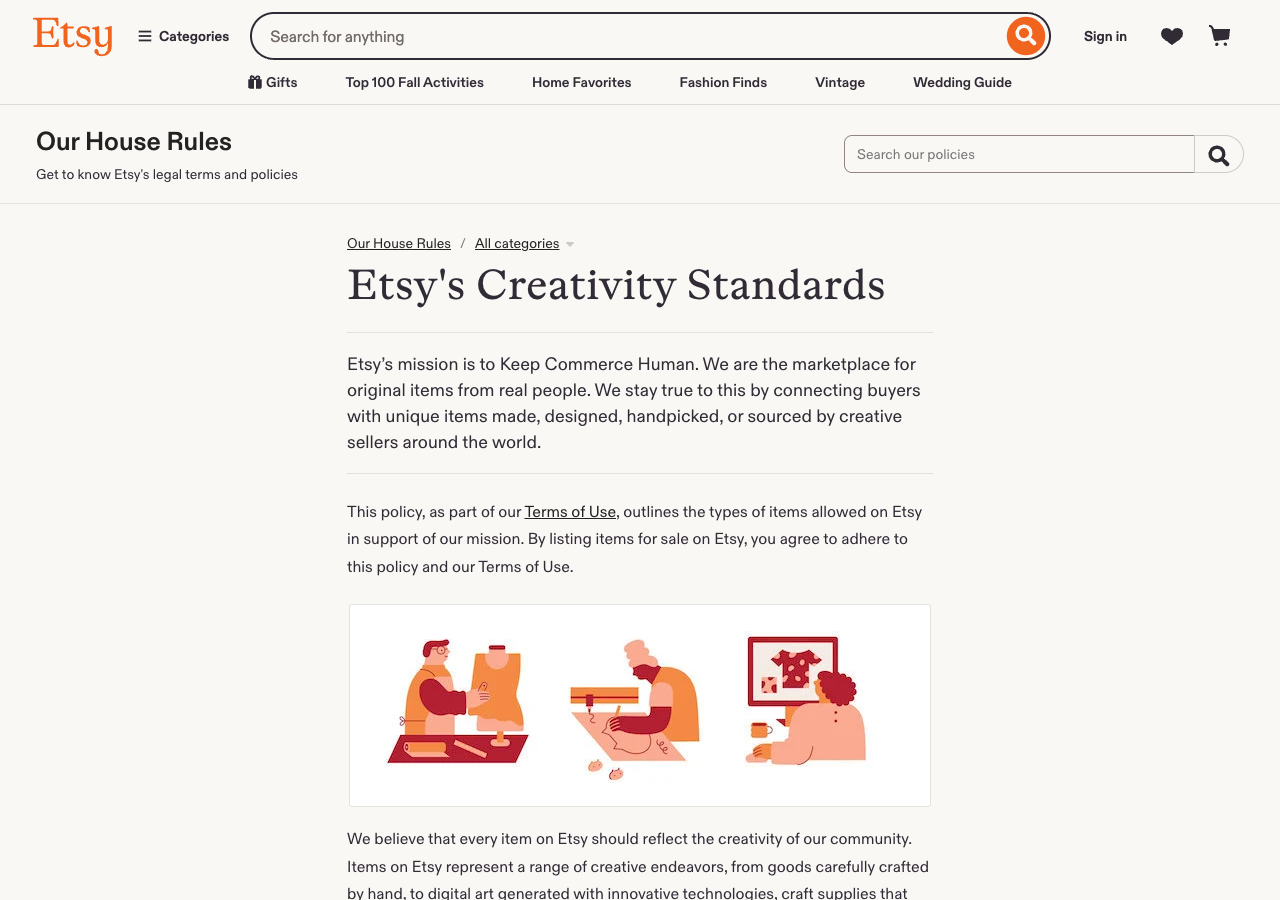
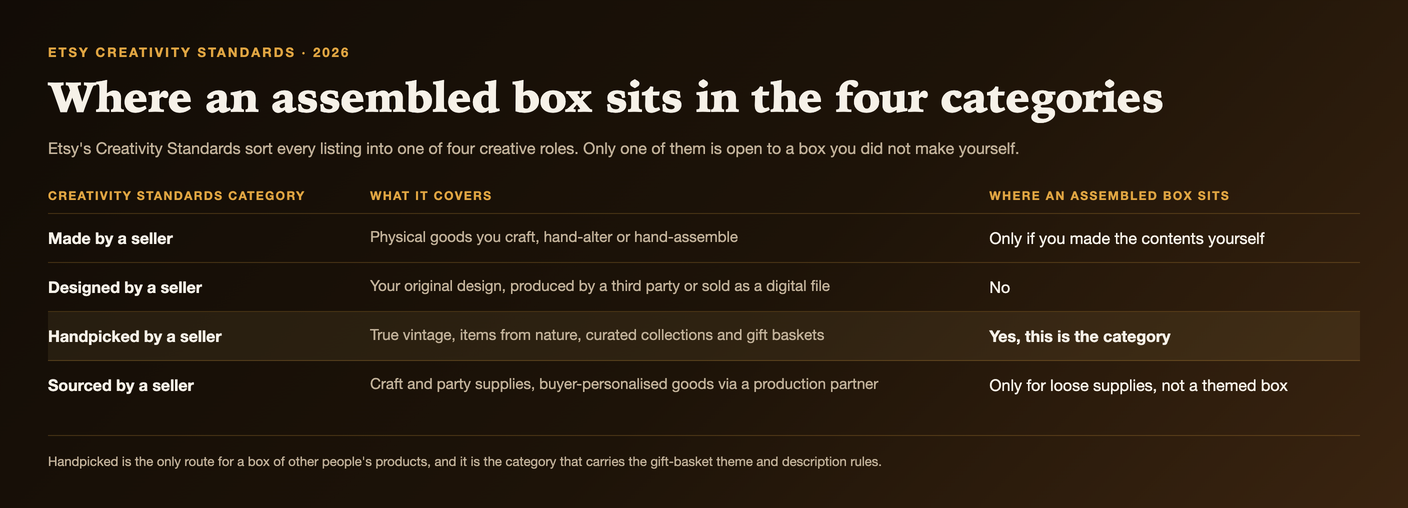
Etsy's Creativity Standards sort every listing into one of four origin categories. A box you assembled from things you bought is not handmade and not your design, so it lands in the third: Handpicked by a Seller, which covers true vintage, finds from nature, and curated collections. That is the right category, and it is also where the gift-basket language lives.
| Creativity Standards category | What it covers | Where an assembled box sits |
|---|---|---|
| Made by a seller | Physical goods you craft, hand-alter or hand-assemble | Only if you made the contents yourself |
| Designed by a seller | Your original design, produced by a third party or sold as a digital file | No |
| Handpicked by a seller | True vintage, items from nature, curated collections and gift baskets | Yes, this is the category |
| Sourced by a seller | Craft and party supplies, buyer-personalised goods via a production partner | Only for loose supplies, not a themed box |
Inside that category, a gift basket qualifies on the strength of its theme. The standards' own example of a passing listing is a "Book Lover" basket holding an assortment of different items that the seller handpicked, curated and creatively packaged to reflect the theme. The work being recognised is the selection.
Then comes the sentence that decides this. Generic concepts, the standards say, do not qualify as gift basket themes, and the examples given are "candy", "clothes", and "mystery box", which the policy defines in the same breath as boxes with unknown contents or containing a single type of item in bulk. Etsy's own help material carries the matching removal reason, "Gift basket items don't meet Etsy's requirements", and treats a box of unknown items as outside what it will list.
One caveat on sourcing, because it matters for how much weight to put on exact wording. Etsy's policy pages cannot be read directly by an automated tool, so the quoted phrases above come from the indexed policy text and are independently reproduced by at least one seller-education site quoting the same passage. The substance is corroborated; treat the punctuation as approximate and check the live standards before you write your own listing copy.
Two Requirements a Mystery Box Cannot Meet
Being an unqualifying theme is the headline, but it is survivable. A seller can rename the box and give it a real theme. The two requirements below are the ones that do not bend, and they are why renaming alone keeps failing.
The first is the description requirement. A curated gift basket or box must list every item it contains in the listing description. Read that against the product: a mystery box is sold on the proposition that the buyer does not know what is in it. Satisfy the requirement and you have published the contents, which is a themed bundle with a full item list. Refuse it and the listing is non-compliant. There is no wording that holds both, which is why the rewrite-and-relist cycle does not converge. This is a definitional conflict, not a disclosure standard you can meet more carefully.
The test to apply to your own draft. Write out the complete item list the policy asks for. Now ask whether the listing still has a reason to exist. If publishing the contents removes the appeal, you are not selling a curated box, you are selling the concealment, and that is the part Etsy's gift-basket language does not accommodate.
The second barrier is photographic, and it survives even a seller who publishes the full list. Etsy requires original photographs of the actual product the buyer will receive, which rules out stock imagery and mockups of goods you do not have. A sealed carton with a question mark is not a photograph of the item; a picture of a representative assortment is a photograph of something a given buyer may not receive. Sellers in the community forums report exactly this: a listing kept failing over the imagery after the description had been fixed. If every box differs, no single honest photograph covers the listing, and the way out is to stop making every box different.
Those two requirements between them are the whole mechanism. One forbids concealing the contents in words, the other forbids concealing them in pictures.
What a Qualifying Curated Box Looks Like
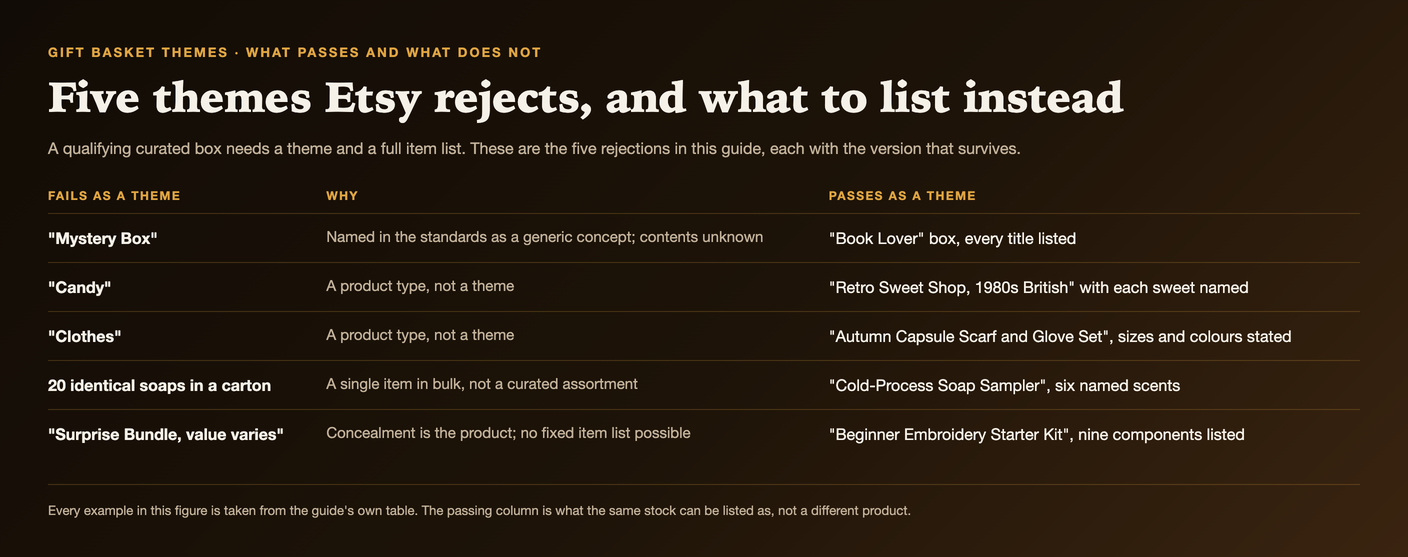
The policy is not hostile to boxes. It is hostile to unspecified ones. A themed, fully-listed, identically-packed box is an ordinary Handpicked listing, and the difference between that and a removed listing is often four edits.
| Fails as a theme | Why | Passes as a theme |
|---|---|---|
| "Mystery Box" | Named in the standards as a generic concept; contents unknown | "Book Lover" box, every title listed |
| "Candy" | A product type, not a theme | "Retro Sweet Shop, 1980s British" with each sweet named |
| "Clothes" | A product type, not a theme | "Autumn Capsule Scarf and Glove Set", sizes and colours stated |
| 20 identical soaps in a carton | A single item in bulk, not a curated assortment | "Cold-Process Soap Sampler", six named scents |
| "Surprise Bundle, value varies" | Concealment is the product; no fixed item list possible | "Beginner Embroidery Starter Kit", nine components listed |
Notice the pattern in the right-hand column. Each theme names an occasion, era, recipient or craft rather than a product category, each box holds an assortment of different things rather than one thing repeated, and each one can be photographed once because every unit is packed the same. Those three properties are what the policy is actually testing for, and a listing with all three has no mystery-box problem to solve.
The commercial objection is fair: concealment sells, and a published item list converts worse. That is a real trade-off and worth saying plainly rather than pretending the compliant version is just as good. What it is not is a close call about interpretation. Renaming a mystery box to "surprise bundle" changes no requirement, because the standards define the disqualifying thing by its contents being unknown, not by the word in the title.
eBay Allows This Listing. Etsy Does Not.
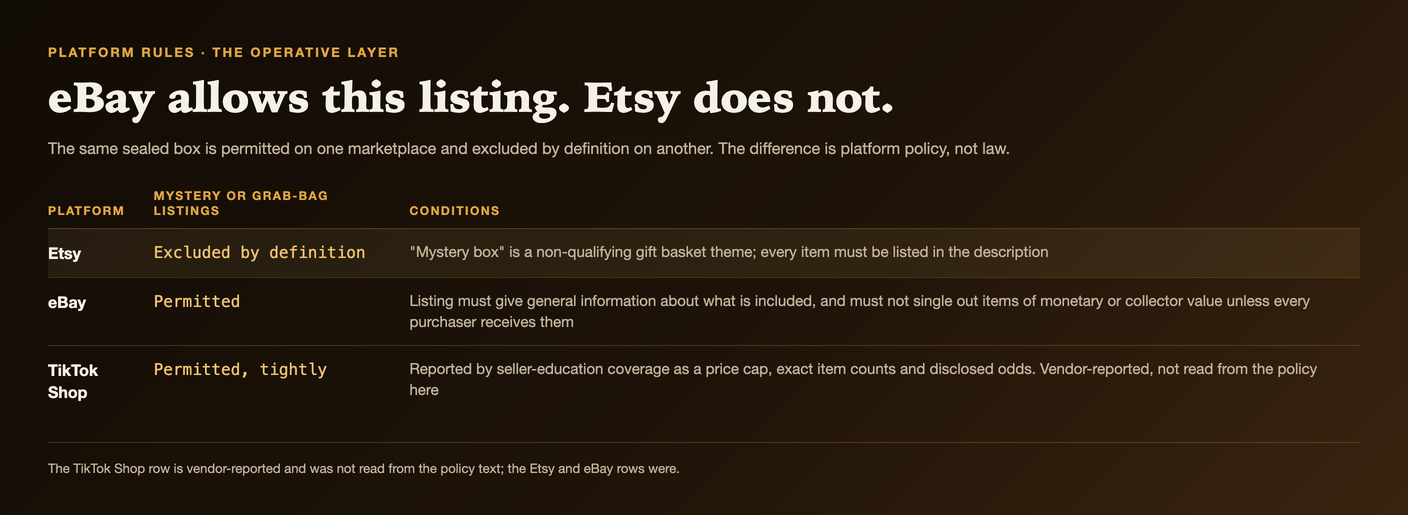
This is the part that catches experienced sellers, and no guide in this niche covers it. A multi-platform seller builds one grab-bag listing, runs it successfully for a year somewhere else, copies it to Etsy, and loses it. The listing did not get worse. The rule is different, and in the direction that is hardest to notice, because the stricter platform is the smaller one.
| Platform | Mystery or grab-bag listings | Conditions |
|---|---|---|
| Etsy | Excluded by definition | "Mystery box" is a non-qualifying gift basket theme; every item must be listed in the description |
| eBay | Permitted | Listing must give general information about what is included, and must not single out items of monetary or collector value unless every purchaser receives them |
| TikTok Shop | Permitted, tightly | Reported by seller-education coverage as a price cap, exact item counts and disclosed odds. Vendor-reported, not read from the policy here |
eBay's chance-listings policy is worth reading beside Etsy's, because the two platforms resolve the same tension in opposite directions. eBay asks for general information about contents, which a grab bag can give, and then polices the specific abuse it cares about, dangling a rare high-value item that almost nobody receives. Etsy asks for a complete item list, which a grab bag cannot give, and so never reaches the question of what you dangled.
The practical consequence: a listing audited against eBay's rule will read as careful and honest and still fail on Etsy, and the seller will reasonably conclude the removal was a mistake. It was not. Treat cross-platform listing copy as needing a per-platform compliance pass rather than a translation, the same way you would treat Etsy's prohibited items list as its own document.
"$100 Value for $30" Is a Separate Legal Problem
Suppose you solve all of the above: a real theme, every item listed, one photograph, identical boxes. There is one line of mystery-box copy that carries its own exposure, and it is the one almost every such listing uses. Advertising a retail value above your price is a pricing claim governed by the FTC's pricing guides, and the paragraph that speaks to it is 16 CFR 233.2(b).
"Retailer Doe advertises Brand X pens as having a 'Retail Value $15.00, My Price $7.50,' when the fact is that only a few small suburban outlets in the area charge $15. All of the larger outlets located in and around the main shopping areas charge $7.50... The advertisement here would be deceptive, since the price charged by the small suburban outlets would have no real significance to Doe's customers, to whom the advertisement of 'Retail Value $15.00' would suggest a prevailing, and not merely an isolated and unrepresentative, price in the area in which they shop."
16 CFR 233.2(b), Government Publishing Office edition, 1 January 2024
Two things follow for a box. First, a "retail value" figure is read as the prevailing price where your buyer shops, so totalling the highest price you can find for each component is the exact error the paragraph describes. Second, and particular to this product, the claim is unverifiable by construction when contents vary: the buyer cannot check the figure against what arrived, and you cannot substantiate it for a box you packed differently. A fixed, fully-listed box at least makes the claim checkable.
Note what this is not. Part 233 is a set of Guides, administrative interpretations rather than a rule with its own per-violation penalty, so the live risk on a small shop is a state consumer-protection claim or a removed listing rather than a federal fine. We work through the sibling paragraphs on struck-through prices and comparable value in Etsy sale price rules, and the related question of what the word "free" commits you to in Etsy free shipping rules. The full text of 233.2 runs to three paragraphs.
Is a Mystery Box a Game of Chance?
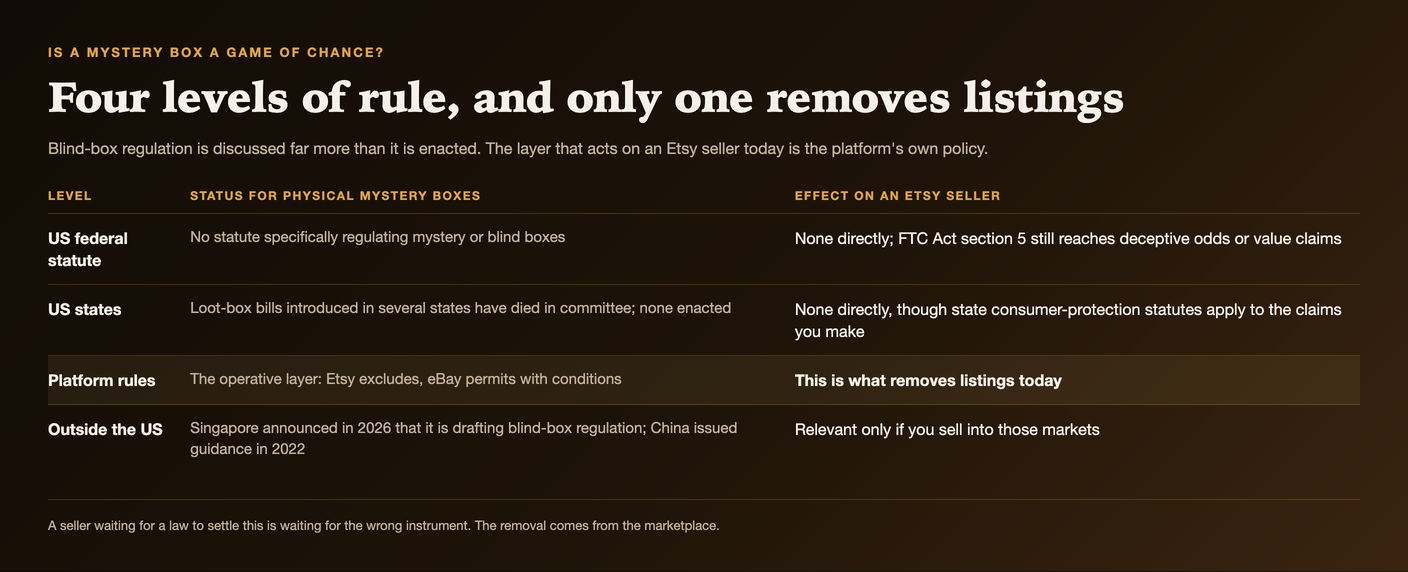
This is the question sellers ask third, and the honest answer is that it is unsettled and mostly not where the risk lives. It is worth stating clearly because the vendor commentary on this topic is confident in both directions.
| Level | Status for physical mystery boxes | Effect on an Etsy seller |
|---|---|---|
| US federal statute | No statute specifically regulating mystery or blind boxes | None directly; FTC Act section 5 still reaches deceptive odds or value claims |
| US states | Loot-box bills introduced in several states have died in committee; none enacted | None directly, though state consumer-protection statutes apply to the claims you make |
| Platform rules | The operative layer: Etsy excludes, eBay permits with conditions | This is what removes listings today |
| Outside the US | Singapore announced in 2026 that it is drafting blind-box regulation; China issued guidance in 2022 | Relevant only if you sell into those markets |
So the gambling framing is largely a distraction for a handmade-marketplace seller. Nothing in the enacted US law reaches your box, and the thing that actually removed your listing was a marketplace policy about gift baskets. We have deliberately left out one widely-repeated claim that a particular state statute makes such sales gambling regardless of a free-entry alternative, because we could not verify it against the statutory text and the sources repeating it disagree with each other.
The one place the chance framing does bite: if your copy states or implies odds, or promises that some boxes contain a high-value item, you have made a factual claim you must be able to support. That is the same standard as any other advertising claim, and it is independent of whether anyone calls it gambling.
How to Rewrite the Listing So It Survives
If you want to keep selling a box, the work is to convert concealment into curation. These are the edits, in the order that resolves the dependencies, and all of them are listing-side changes you can make today.
| Element | What got it removed | What to publish instead |
|---|---|---|
| Title | "Mystery Box, Surprise Gift Bundle" | "Retro Sweet Shop Gift Box, 1980s British Sweets, 8 Items" |
| Theme | Implied by the word "mystery" | An era, occasion, recipient or craft, stated explicitly |
| Description | "A selection of items chosen just for you" | Every item named, with quantities, in a list |
| Variation | Contents differ per order | Every box packed identically, or one listing per fixed configuration |
| Photography | Sealed carton, or a stock assortment shot | Your own photograph of the actual packed box and its contents |
| Value claim | "Worth over $100" | Remove it, or state the prevailing retail price you can substantiate |
The variation row is the one sellers resist and the one that unlocks the rest. Fixed contents make the item list writable, make a single photograph honest, and make a value figure checkable, so one decision clears three requirements. If you genuinely need multiple assortments, run them as separate listings or as variations whose options are each fully described, rather than as one listing that resolves randomly.
One thing not to do: relist the same concealed box with softer wording and hope the classifier misses it. Repeat removals on the same shop escalate, and the pattern is a worse position than a single removal you addressed, as we cover in why Etsy deactivated your listing.
If Etsy Already Removed Your Listing
Start by reading the stated reason rather than inferring it. Shop Manager shows which policy a removed listing was judged against, and "Gift basket items don't meet Etsy's requirements" is a different conversation from a trademark or handmade-policy removal. Appealing the wrong finding wastes the appeal.
If the removal was a gift-basket finding and your box genuinely had unknown contents, an appeal arguing that the removal was mistaken is unlikely to succeed, because the policy names the product. The stronger move is to build the compliant version using the table above and list it fresh, while leaving the removed listing alone. Do not edit and resurrect a deactivated listing; sellers consistently report that this does not work and simply produces a second removal.
If the removal looks like a genuine misclassification, for example a fully-itemised themed box flagged as a mystery box, that is worth appealing, and specificity is what carries it: quote your own item list, point to the photograph of the actual packed box, and state that contents do not vary. Our Etsy appeal letter template covers the structure, and the broader pattern of what gets shops into trouble is in common Etsy policy violations.
Before you relist, check the copy you are about to publish. Unflagged screens submitted listing text for potential concerns, including value and pricing claims, and explains the wording that needs review. It does not establish compliance or predict removal. See what the scanner checks and what it costs.
The uncomfortable summary is that the most profitable version of this product is the one Etsy will not host, and the compliant version is a themed bundle competing on curation instead of on suspense. Sellers who make that switch early keep the listing. Sellers who keep rewording the mystery lose it repeatedly, and each loss costs more than the last.
Related Articles
- Etsy Sale Price Rules 2026, the struck-through price and comparable-value paragraphs in full
- Etsy Free Shipping Rules 2026, what the word "free" commits you to
- Why Etsy Deactivated Your Listing, reading the removal notice correctly
- Common Etsy Policy Violations, the patterns behind most removals
- Etsy Appeal Letter Template, structure for a specific, evidenced appeal
- Etsy Handmade Policy, how the origin categories work for assembled goods
FAQ
Can you sell mystery boxes on Etsy?
Not as a box with unknown contents. The Creativity Standards name "mystery box" as a generic concept that does not qualify as a gift basket theme, and separately require that every item in a curated box be listed in the description. A themed box whose contents are fully published is allowed; the concealment is the part that is not.
Why was my mystery box listing deactivated when it had been live for months?
Enforcement here is largely automated and sweeps retroactively, so age is not protection. The usual stated reason is that gift basket items do not meet Etsy's requirements. Check the policy named in Shop Manager rather than assuming a trademark finding.
Can I call it a "surprise box" or "grab bag" instead?
Renaming does not help. The standards define the disqualifying product by its contents being unknown or being one item in bulk, not by the word used in the title. A "surprise box" with undisclosed contents is the same listing under a different name.
Do I really have to list every single item?
For a curated gift basket or box, yes. It is also the requirement that makes a true mystery box impossible, since publishing the list removes the reason the product existed. If you cannot write the list, it is not a curated box in the policy's sense.
Can I advertise the retail value of my curated box?
Only a figure you can support. Under 16 CFR 233.2(b) a "retail value" is read as the prevailing price where your buyer shops, not the highest price you can find per component. For a varying box it cannot be substantiated at all, so drop it.
Is selling a mystery box actually illegal?
No US federal or state statute specifically regulates physical mystery boxes, and loot-box bills in several states have died in committee. What removes listings is platform policy, not law. Ordinary advertising law still applies to any claim you make about odds, contents or value.
How do I photograph a box if the contents are a surprise?
You cannot, compliantly, and that is the second barrier. Etsy requires original photographs of the actual product the buyer receives, which excludes mockups and stock shots. The workable answer is to fix the contents so that one honest photograph covers every unit.
Scan Your Listings Free
Screen submitted listing text for potential concerns. 5 preliminary screens daily, shared network limits; no signup required.
Start Free ScreenRelated Articles
Selling AI Art on Etsy in 2026: Disclosure Rules Explained
Etsy allows AI art, but non-disclosure now triggers suspensions. The exact attribution settings, disclosure wording, and audit steps that keep shops safe.
Read moreHow to Check Your Etsy Listings for Trademark Violations (2026 Guide)
Learn how to scan your Etsy listings for trademark violations before they get flagged. Step-by-step guide to protecting your shop from takedowns and suspensions.
Read moreEtsy Shop Suspended? How to Write a Winning Appeal Letter
Your Etsy shop got suspended. Here's exactly how to write an appeal letter that gets your shop reinstated, with templates and strategies that actually work.
Read more