Etsy Listing Removed: Why It Happens and What to Do Next
You just got the email no Etsy seller wants to see: your listing has been removed. Maybe it was your best seller. Maybe you don't even understand what went wrong. Either way, that sinking feeling is real — and so is the fear that this could snowball into something worse. This guide breaks down why Etsy removes listings, how to find out the exact reason, whether you can appeal, and the steps you need to take right now to protect the rest of your shop.
5 Reasons Etsy Removes Listings
Etsy doesn't remove listings on a whim. Every takedown is tied to a specific policy violation — even when the notification email is frustratingly vague about the details. Understanding the five most common reasons puts you in a stronger position to respond effectively and prevent it from happening again.
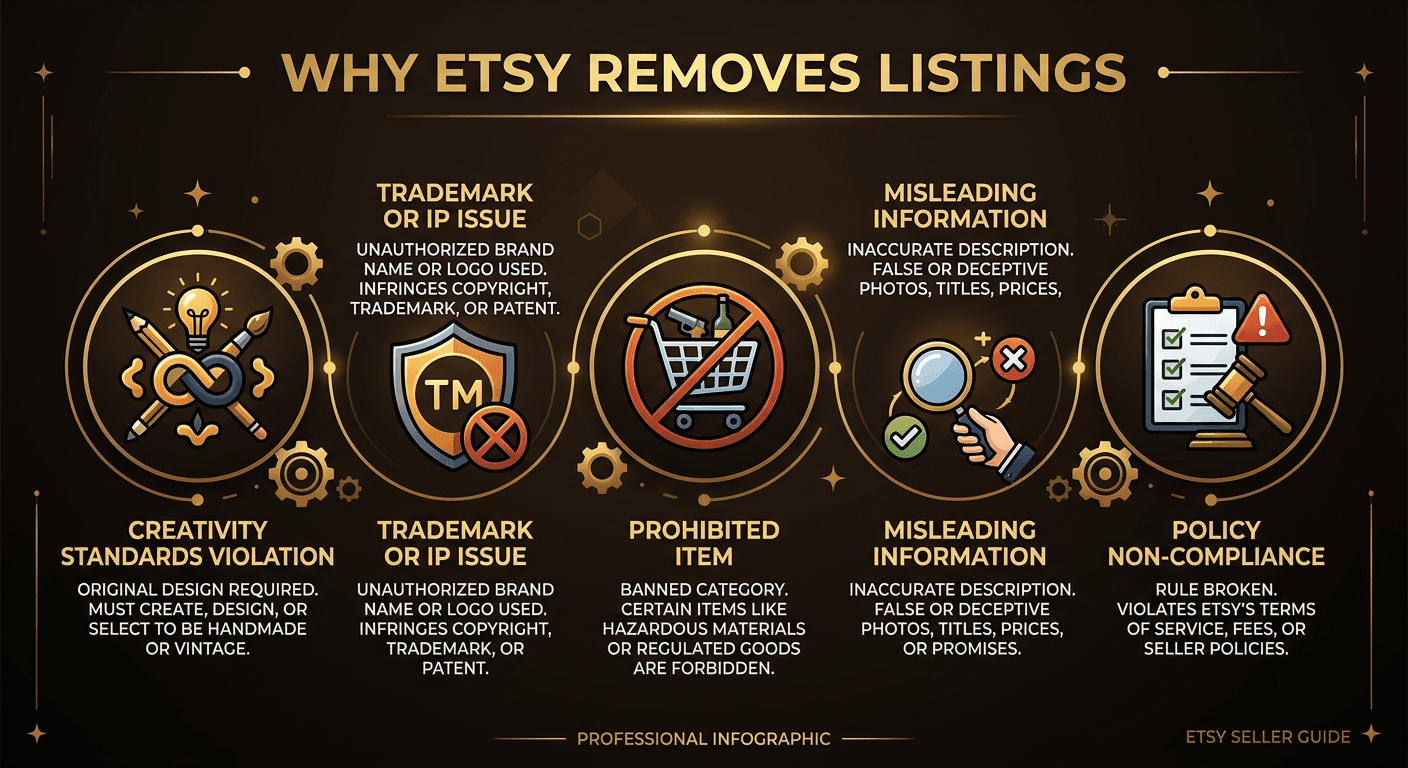
- Creativity Standards Violation — Etsy's 2026 creativity standards require that all items marketed as handmade involve meaningful creative input from the seller. Listings that rely entirely on print-on-demand templates, dropshipped goods resold without modification, or mass-produced items without a clear handmade element get flagged. If your listing doesn't demonstrate original design work, hand assembly, or a documented production partner relationship, it's at risk. This is the fastest-growing category of listing removals in 2026.
- Trademark & IP Issue — Using a brand name, logo, or trademarked phrase in your listing title, tags, description, or images triggers automatic detection or manual reports from rights holders. Even “inspired by” language referencing a protected brand counts. Abbreviations and creative misspellings of trademarked terms don't bypass Etsy's systems either. If a brand owner files a trademark infringement complaint, the listing comes down immediately — often before you even know about it.
- Prohibited Item — Etsy maintains a detailed list of items that cannot be sold on the platform. This includes weapons, certain supplements, tobacco products, hazardous materials, and items that violate local regulations. The list evolves regularly, and items that were permitted last year may not be today. Sellers who don't stay current on listing compliance get caught off guard.
- Misleading Information — Listings that misrepresent materials, dimensions, origin, or functionality violate Etsy's accuracy policy. Common examples include claiming an item is “solid gold” when it's gold-plated, listing incorrect dimensions, using photos of a different product, or failing to disclose that an item is digital rather than physical. Buyer reports of “not as described” also trigger reviews.
- Policy Non-Compliance — This catch-all category covers everything from missing production partner disclosures to improperly categorized listings, fee avoidance schemes, keyword stuffing in tags, and violating Etsy's rules around external links or contact information in descriptions. Etsy's automated scanning tools flag these continuously, and manual reviews can be triggered by competitor or buyer reports.
In many cases, sellers violate a policy without realizing it. You listed a product the same way for two years with no issues, and then one day it's gone. That's because Etsy updates its enforcement tools and policies regularly. A listing that was compliant six months ago may not be today.
How to Find Out Why Your Listing Was Removed
Etsy's removal notifications are notorious for being vague. You'll get an email that says something like “your listing has been removed for violating our policies” — without telling you which policy or what specifically was wrong. Here's how to get the actual answer.
Two places to check:
1. Your Email (Including Spam)
Etsy sends a notification to the email on your account whenever a listing is removed. Search your inbox for “listing removed” or “listing deactivated” from Etsy. These emails sometimes land in spam or promotions folders, so check there too. The email will identify the listing and give a general reason for the removal, such as “intellectual property concern” or “creativity standards.”
2. Policy Violations Page in Shop Manager
Log into your Etsy account and go to Shop Manager. Under the “Your account” section, you'll find a Policy Violations page. This is where Etsy logs every enforcement action taken against your shop, including listing removals, warnings, and any active appeals. The violations page sometimes includes more detail than the email — including which specific policy section was referenced. If you're unsure what a violation means, cross-reference it with Etsy's current seller policies.
If neither source gives you a clear answer, you can contact Etsy Support directly through your Shop Manager. Be specific in your request: mention the listing ID, the date it was removed, and ask for the exact policy section that was violated. Etsy's support team is often more detailed in direct replies than in automated notifications.
Can You Appeal a Removed Listing?
Yes — in most cases, you can appeal. But the process depends on why the listing was removed, and the window is not open forever.
Appeal Eligibility by Removal Type:
- Creativity standards violation — You have 90 days from the date of removal to submit an appeal. You'll need to provide evidence that your item involves meaningful creative input — photos of your production process, documentation of original designs, or proof of a legitimate production partner relationship.
- Trademark/IP issue — If your listing was removed due to a rights-holder complaint, you can submit a counter-notification if you believe the claim is invalid. This is a more formal legal process. Read our guide on Etsy trademark infringement for the full counter-notification steps.
- Prohibited item — Appeals for prohibited items are rarely successful unless Etsy's automated system misclassified your product. If your item genuinely does not fall into a prohibited category, provide detailed evidence including ingredients, materials, or certifications.
- Misleading information — Fix the listing to be accurate, then relist. In most cases, Etsy doesn't require a formal appeal for this category — they want you to correct the issue and move on.
- Policy non-compliance — Similar to misleading information. Correct the non-compliant element (add disclosures, fix categories, remove external links) and relist. If the listing was permanently removed, contact Etsy Support with documentation showing the issue has been resolved.
The strongest appeals include concrete evidence: photos of your workspace or production process, screenshots of original design files, invoices from production partners, or trademark search results showing your terms are not protected. Vague promises to “do better” don't work. Etsy wants proof. For help structuring your appeal, see our appeal letter guide.
Step-by-Step: What to Do Right Now
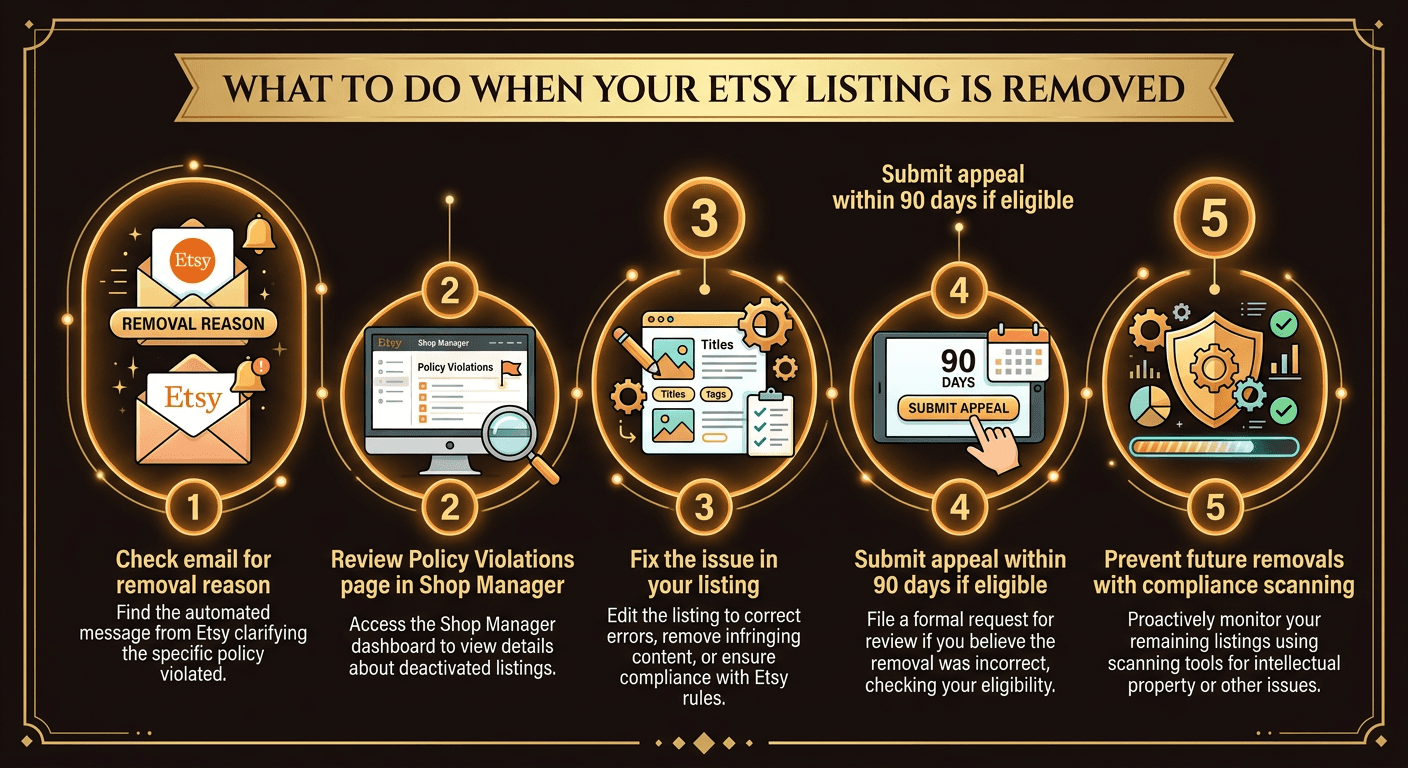
Don't panic, and don't immediately relist the same item. That's the fastest way to make things worse. Follow this process instead.
Step 1: Read the Removal Notice Carefully
Check your email and your Shop Manager's Policy Violations page. Identify exactly which listing was removed and the stated reason. Don't skim — read every word. The difference between “creativity standards” and “intellectual property” changes your entire response strategy.
Step 2: Identify and Fix the Issue
Once you know the reason, fix it. If it's a trademark issue, remove all trademarked terms from your title, tags, and description. If it's a creativity standards violation, document your creative process. If it's misleading information, update the listing to be fully accurate. Don't just fix the flagged listing — check all your other listings for the same problem.
Step 3: Gather Your Evidence
If you plan to appeal, collect everything you need before submitting. This includes photos of your production process, original design files with metadata showing creation dates, production partner invoices or agreements, trademark search results from the USPTO database, or any other documentation that proves compliance.
Step 4: Submit Your Appeal (If Applicable)
Go to your Policy Violations page in Shop Manager and look for the appeal option next to the removed listing. Structure your appeal clearly: acknowledge the issue, explain what you've done to fix it, attach your evidence, and describe the steps you're taking to prevent recurrence. Keep it professional and factual — no emotional language. One strong appeal beats three weak ones.
Step 5: Prevent Recurrence
Audit your entire shop for similar issues. If one listing was flagged for a trademark term, search all your listings for that term and any other branded language. If you got hit for creativity standards, review every listing against Etsy's current requirements. The sellers who get suspended are the ones who fix one listing and ignore the other 50 with the same problem.
What Happens If Multiple Listings Get Removed
A single listing removal is a warning shot. Multiple removals are an escalation path that leads directly to account suspension. Here's how Etsy's enforcement escalation typically works:
First removal
Warning notice. Listing taken down. You're asked to review your policies. No immediate impact on your shop beyond the lost listing.
Second or third removal
Elevated warning. Etsy may restrict your ability to create new listings temporarily. Your shop's internal trust score drops, making future listings more likely to be flagged by automated scans.
Repeated removals (4+)
Account-level action. This can range from a temporary suspension to a permanent ban, depending on the severity of the violations. At this stage, your entire shop — all listings, funds, and data — is at risk. See our full suspension recovery guide if you're already there.
The key takeaway: treat every single listing removal as serious, even if it feels minor. Every removal is a data point on your account that Etsy uses to decide whether to trust you as a seller. Fix the root cause, not just the symptom.
How to Prevent Listing Removals
The best way to deal with a listing removal is to never get one in the first place. Proactive compliance is dramatically easier than reactive damage control. Here are the three habits that keep compliant shops running without interruption.
Run a Compliance Scan on Every Listing
Before you publish any listing, run it through a compliance check. This means scanning your title, tags, and description for trademarked terms, verifying your item doesn't fall into a prohibited category, and confirming all required disclosures are present. Manual checks work but are error-prone — automated scanning tools catch what human eyes miss. Our listing compliance checker guide covers exactly what to look for.
Check Trademarks Before Using Any Brand-Adjacent Language
If you're selling anything that could be associated with a brand — even tangentially — search the USPTO trademark database first. Common words like “Stanley,” “Cricut,” and “Yeti” are all trademarked. Using them in your listing, even to describe compatibility, can trigger a takedown. Learn more about trademark infringement risks on Etsy.
Stay Current on Policy Changes
Etsy updates its seller policies multiple times per year. The 2026 creativity standards alone triggered tens of thousands of listing removals from sellers who didn't adapt. Subscribe to Etsy's seller newsletter, follow the Etsy Community forums, and review the latest compliance requirements regularly. The sellers who get blindsided are the ones who stopped paying attention.
Stop Losing Listings to Preventable Violations
Unflagged scans your Etsy listings for trademark violations, prohibited items, creativity standards issues, and policy risks before Etsy's enforcement bots find them. Already lost a listing? Our AI appeal generator helps you build a documented, professional appeal in minutes — not days.
Frequently Asked Questions
Can I relist an item after Etsy removes it?
It depends on why the listing was removed. If the removal was due to a correctable issue like missing disclosures or misleading information, you can fix the problem and relist. However, if the listing was removed for a trademark or IP violation, relisting the same item without significant changes will result in another removal and could escalate to a full shop suspension.
How long do I have to appeal a removed Etsy listing?
For creativity standards violations, you have 90 days from the date of removal to submit an appeal through your Shop Manager. For other types of removals, the appeal window may vary. Check the specific notice Etsy sent you for the exact deadline. Filing sooner is always better, as it shows Etsy you take compliance seriously.
Does a removed listing affect my Etsy shop standing?
Yes. Each removed listing counts as a policy violation on your account. While a single removal typically results in a warning, multiple removals within a short period can trigger an escalation to account-level restrictions or a full suspension. Etsy tracks your violation history and uses it to determine the severity of enforcement actions.
Will Etsy tell me exactly which policy I violated?
Etsy sends a notification email that identifies the listing and the general category of the violation, such as trademark infringement, prohibited item, or creativity standards non-compliance. However, the explanation is often vague. You can find more details by checking the Policy Violations page in your Shop Manager, which sometimes includes the specific policy section referenced.
Can Etsy remove a listing without warning?
Yes. For serious violations like trademark infringement, prohibited items, or counterfeit goods, Etsy can and does remove listings immediately without prior warning. For less severe issues, Etsy may send a warning first and give you time to fix the problem. Automated scanning tools run continuously, so removals can happen at any time of day.
How do I prevent my Etsy listings from being removed?
Regularly audit your listings for trademark terms, prohibited items, and policy compliance. Use a listing compliance scanner to catch issues before Etsy does. Stay updated on Etsy policy changes, especially the 2026 creativity standards. Ensure all product descriptions are accurate and all required disclosures are included. Proactive compliance is the most reliable way to prevent listing removals.