How to Start an Etsy Shop in 2026: Complete Step-by-Step Guide
Starting an Etsy shop has never been more accessible — or more competitive. This guide walks you through every step from creating your account to publishing your first listing, with honest advice on fees, SEO, and the mistakes that sink most new sellers before they make their first sale.
1. Why 2026 Is Still a Great Time to Start on Etsy
If you've been thinking about opening an Etsy shop, you might wonder whether you've missed the window. You haven't. Etsy now has over 90 million active buyers searching for unique, handmade, and personalized products — and that number keeps growing. The platform has become the default destination for buyers who want something they can't find on Amazon.
Several factors make 2026 especially promising for new sellers. First, Etsy's startup costs remain the lowest of any major marketplace. You can open a shop and list your first products for under $5 — no monthly subscription required. Second, Etsy has gone fully mobile-first, meaning more than 65% of purchases now happen on phones. If your listing photos look great on a small screen, you have a real advantage over established sellers who haven't updated their images.
Third — and this is big — Etsy has integrated ChatGPT-powered checkout and conversational shopping. Buyers can now describe what they're looking for in natural language, and Etsy's AI matches them with relevant listings. This changes the SEO game significantly. Sellers who write natural, descriptive titles and descriptions (instead of keyword-stuffed gibberish) are getting discovered by an entirely new channel of traffic that didn't exist a year ago.
The competition is real — there are over 9 million active sellers. But most of them have poor SEO, mediocre photos, and no compliance awareness. If you start with a solid foundation, you're already ahead of the majority.
2. What You Can Sell on Etsy
Etsy has specific rules about what's allowed on the platform. Not everything goes. Understanding these categories before you invest time in product development will save you from listing removals and policy violations down the road.
Allowed Product Categories
- •Handmade items — Products you design and/or make yourself. You can use production partners, but you must disclose them and the design must be yours.
- •Vintage items — Items that are at least 20 years old (pre-2006 as of 2026). Clothing, furniture, collectibles, jewelry — anything genuinely vintage qualifies.
- •Craft supplies — Materials, tools, and components used in crafting. Beads, fabric, patterns, molds, stamps, and similar items.
- •Digital downloads — Printable art, planners, SVG cut files, digital planners, templates, presets, and educational content. One of the fastest-growing categories on Etsy.
- •Print-on-demand (POD) — T-shirts, mugs, tote bags, and other items printed by a third-party partner using your original designs. You must list a production partner in your shop settings.
Reselling mass-produced goods you didn't design is not allowed. Neither are prohibited items like weapons, drugs, or counterfeit products. For the full list, read our guide on Etsy prohibited items.
3. Step-by-Step Shop Setup
Setting up your Etsy shop takes about 15–30 minutes if you have your product photos and details ready. Here's the exact process.
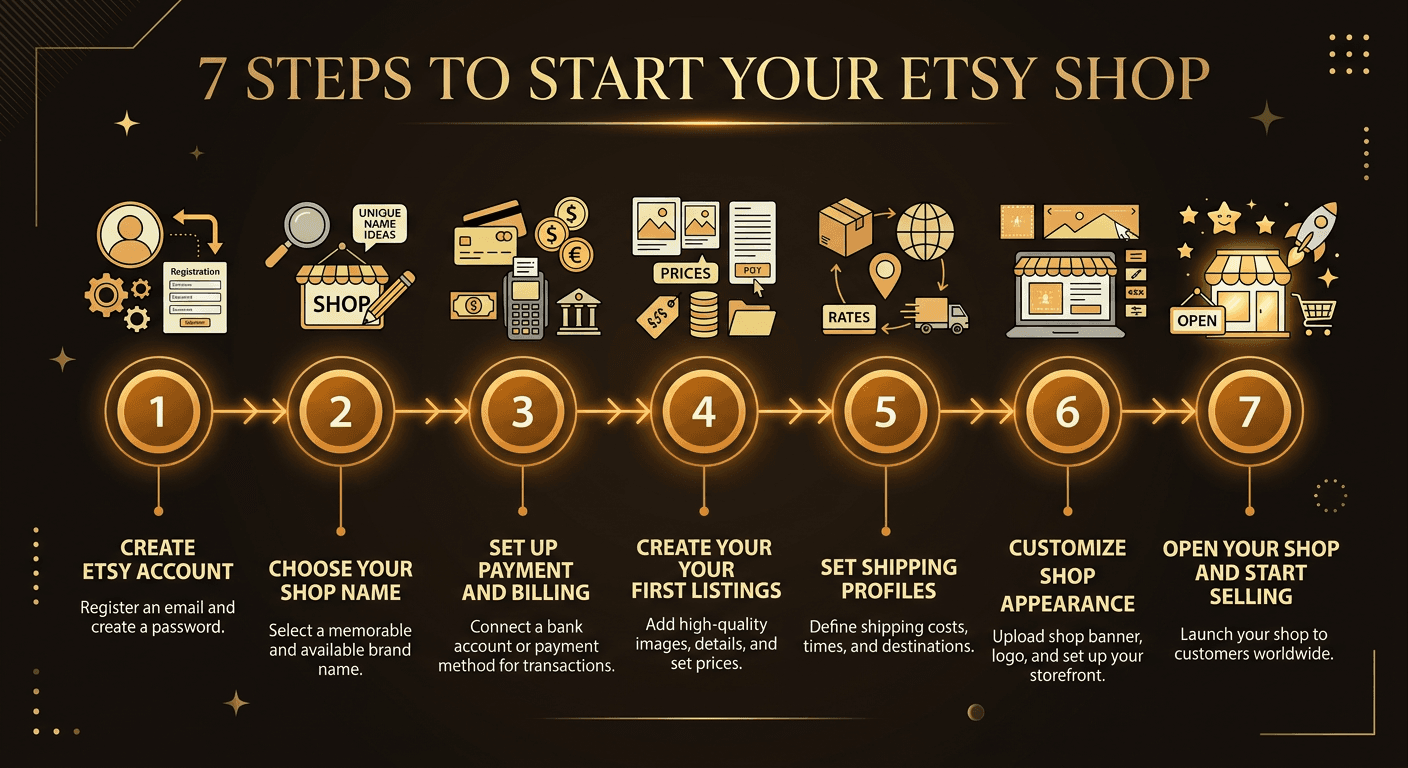
Step 1: Create Your Etsy Account
Go to etsy.com/sell and click “Get started.” You can sign up with an email address, Google account, or Apple ID. If you already have an Etsy buyer account, you can use that same account to open a shop — no need to create a new one.
Step 2: Choose Your Shop Name
Your shop name must be 4–20 characters, with no spaces or special characters. It needs to be unique across all of Etsy. Pick something memorable and relevant to your niche. Avoid trademarked brand names — using someone else's trademark in your shop name is a fast track to suspension.
You can change your shop name once after opening, so don't agonize over perfection. Just make sure it's professional and easy to spell.
Step 3: Set Up Payment & Billing
Etsy needs two things: where to send your money (your bank account for deposits) and how to charge you for fees (a credit card on file). Etsy Payments is required in most countries — it handles credit cards, debit cards, Apple Pay, Google Pay, and Etsy gift cards for your buyers. You'll receive deposits on a regular schedule based on your country.
Step 4: Create Your First Listing
Etsy requires at least one listing before your shop can open. We'll cover the details of creating a great listing in the next section, but the basics are: upload photos, write a title and description, set a price, choose a category, and add tags. Take your time here — your first listing sets the tone for your entire shop.
Step 5: Set Up Shipping Profiles
Create shipping profiles for your products. You can offer free shipping (recommended — Etsy's algorithm favors it), flat-rate shipping, or calculated shipping based on weight and dimensions. For digital downloads, select “Digital item” and skip this step entirely. Set realistic processing times — underpromising and overdelivering helps your review scores. For a complete walkthrough of carrier options, free-shipping thresholds, and international logistics, see our Etsy shipping tips guide.
Step 6: Customize Your Shop Appearance
Add a shop icon (your logo), a cover photo (banner), and write your shop announcement and About section. These aren't optional if you want to look professional. Buyers check your shop page before purchasing — an empty About section signals “this seller might not be serious.” Include your story, your process, and what makes your products unique. For a deeper look at building a cohesive visual identity, read our Etsy shop branding guide.
Step 7: Open Your Shop
Review everything, then click the button to open. Your shop is now live and your listings are visible in Etsy search. It can take a few hours to a few days for your listings to start appearing in search results as Etsy indexes them.
4. Creating Your First Listing
Your first listing is the most important one you'll ever create. Not because it'll be your bestseller — it probably won't — but because it forces you to learn the mechanics of Etsy's listing system. Here's what matters most.
Title (SEO Is Everything)
Your title can be up to 140 characters. Front-load it with your primary keyword — the phrase buyers are actually searching for. Write naturally, not like a robot. “Personalized Name Necklace, Custom Gold Bar Pendant, Gift for Her” is better than “Necklace Gold Custom Name Bar Pendant Personalized.” Etsy's AI-powered search now rewards titles that read like real descriptions.
Photos
You get 10 photo slots. Use all of them. Your first photo is your thumbnail — it needs to stop scrollers. Use natural light, a clean background, and show scale. Include lifestyle shots (the product in use), detail shots, and size reference images. Etsy now supports video too — add a short clip if you can. Listings with video get significantly more views. For product photography tips, read our Etsy product photography guide.
Tags
You get 13 tags per listing. Use all 13 — every empty tag slot is a missed search opportunity. Each tag can be up to 20 characters. Use multi-word phrases rather than single words. “gift for mom” is better than “gift.” Don't repeat your exact title in tags — use variations and synonyms to cast a wider net.
Pricing
Price based on your costs, not your feelings. Calculate materials + labor + Etsy fees + shipping + profit margin. A common formula: (Materials + Labor) × 2 + Fees = Minimum Price. Don't race to the bottom — Etsy buyers expect to pay more than Amazon prices because they're buying unique and handmade. Underpricing signals low quality. For a detailed fee breakdown, see our guide on Etsy fees explained.
Description
Write for humans first, search engines second. Lead with the most important information: what it is, what it's made of, sizing or dimensions, and what's included. Use short paragraphs. Address common questions preemptively. Include keywords naturally — don't stuff them. Etsy's AI reads your description to understand your product, so clarity matters more than keyword density. For a deeper dive, see our Etsy description tips.
Categories & Attributes
Choose the most specific category available. Etsy uses categories and attributes as additional search signals — a listing in “Jewelry > Necklaces > Pendant Necklaces” will rank better for pendant-related searches than one filed under just “Jewelry.” Fill in every attribute Etsy offers (material, color, occasion, style) because these drive filtered search results.
5. Startup Costs Breakdown
One of Etsy's biggest advantages over platforms like Shopify or Amazon is how little it costs to get started. There's no monthly subscription for a basic shop. Not sure Etsy is the right fit? Our Etsy vs Shopify guide breaks down exactly when each platform makes sense. Here's exactly what you'll pay.
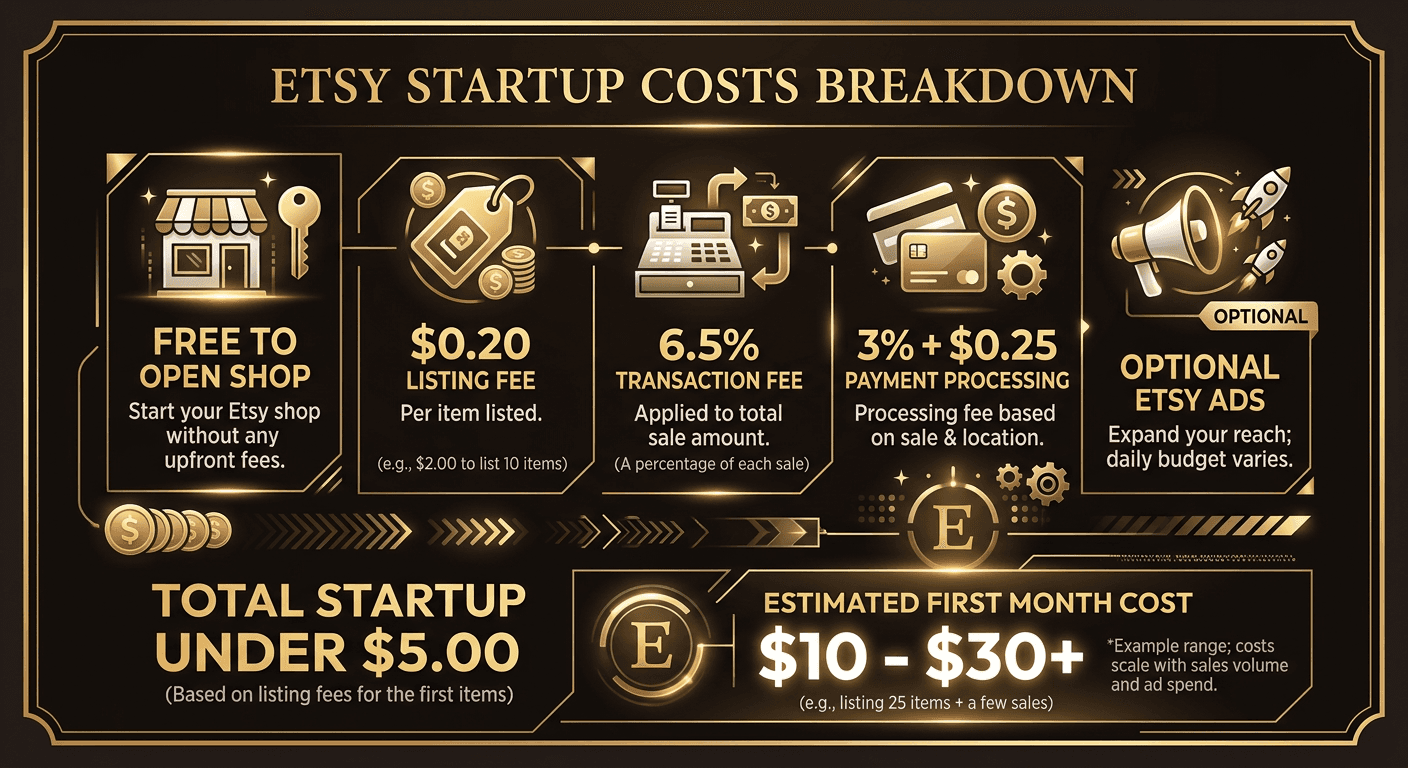
Listing Fee
Per listing, lasts 4 months or until sold
Transaction Fee
Percentage of sale price + shipping
Payment Processing
Via Etsy Payments (varies slightly by country)
Offsite Ads Fee
Only charged when a sale comes from Etsy's offsite ad
Etsy Ads (Optional)
On-platform advertising, you set the daily budget
The bottom line: If you list 20 products to start, your upfront cost is just $4.00 in listing fees. Transaction and processing fees only apply when you make a sale. You can literally start an Etsy shop for under $5. For a deep dive into every fee, read Etsy Fees Explained 2026.
6. Common Beginner Mistakes
Most new Etsy shops fail not because of bad products, but because of avoidable mistakes in setup and strategy. Here are the ones we see most often.
Underpricing
New sellers constantly price too low, thinking it will attract buyers. It doesn't. It attracts bargain hunters who leave bad reviews, and it leaves you with no margin after fees. Etsy takes roughly 10–15% of every sale in combined fees. If you're not accounting for that, you're losing money on every order.
Keyword Stuffing
Titles like “Necklace Gold Silver Custom Name Pendant Gift Birthday Anniversary Wedding Bridesmaid Mom” don't rank well in 2026. Etsy's search algorithm now penalizes unnatural keyword cramming. Write titles that a human would actually read and understand.
Bad Photos
Dark, blurry, cluttered photos kill your conversion rate. Etsy is a visual marketplace. If your photos don't look professional, buyers will scroll right past — no matter how great your product is. You don't need expensive equipment. A smartphone, natural light, and a clean background are enough.
No Niche
Shops that sell “everything” — candles, jewelry, stickers, and home decor all in one store — confuse buyers and dilute your search rankings. Pick a niche. Browse our Etsy niche ideas for inspiration, then be the best at one thing. You can always expand later after you've built a reputation.
Ignoring Policies
Not reading Etsy's seller policies is the fastest way to get suspended. Using trademarked terms in your titles, selling prohibited items, or making health claims about your products can get your shop shut down without warning. Read the policies before you list anything.
7. Essential Tools for New Sellers
You don't need 15 tools on day one. But a few key tools will make a massive difference in how quickly you grow — and whether you avoid the compliance traps that shut down thousands of new shops every month.
At minimum, new sellers should consider: a compliance scanner to avoid trademark violations, a keyword research tool to find what buyers are actually searching for, and an analytics tool to understand what's working and what isn't. Browse PopularAiTools.ai to discover AI-powered tools that can automate parts of your workflow. If you sell internationally or want to accept cryptocurrency payments, services like Kardd help you find crypto-friendly payment options without KYC requirements.
We've compared every major Etsy seller tool across six categories. For the full breakdown with pricing, pros, and cons, read our Best Etsy Seller Tools 2026 guide.
8. Etsy SEO Basics
Etsy SEO determines whether buyers find your products. Unlike Google SEO, Etsy's search algorithm is relatively straightforward — but most sellers still get it wrong.
The core ranking factors in 2026 are: keyword relevance (title, tags, categories, and attributes), listing quality score (based on clicks, favorites, and purchases), recency (newer and recently renewed listings get a temporary boost), and customer experience (reviews, response time, shipping speed).
Quick SEO Checklist for New Listings
- •Front-load your primary keyword in the title
- •Use all 13 tags with multi-word phrases
- •Choose the most specific category and fill all attributes
- •Write natural, descriptive titles (not keyword soup)
- •Include keywords naturally in your description
- •Add video to boost listing quality score
- •Offer free shipping when possible
For a deep dive into every ranking factor and optimization technique, read our complete Etsy SEO Tips 2026 guide.
9. Compliance From Day One
This is the section most “how to start an Etsy shop” guides skip entirely. And it's the reason thousands of new sellers lose their shops within the first 90 days.
Etsy's enforcement has gotten significantly stricter in 2025–2026. Automated systems now scan listing titles, tags, descriptions, and even images for trademark violations, policy breaches, and prohibited content. One bad listing can trigger a takedown. Multiple takedowns can lead to a permanent suspension — no appeal, no second chance.
Common Compliance Mistakes New Sellers Make
- •Using brand names in titles or tags (e.g., “Disney inspired” or “Yeti tumbler”)
- •Selling fan art or designs based on copyrighted characters
- •Using trademarked phrases in tags without realizing they're protected
- •Making health or medical claims about products (candles, essential oils, supplements)
The fix is simple: scan every listing for trademark and compliance issues before you publish it. Use a tool like an Etsy trademark checker to cross-reference your titles and tags against trademark databases. Catching a violation before it goes live costs you nothing. Getting caught by Etsy can cost you your entire business.
Start Your Etsy Shop on Solid Ground
Unflagged scans your listings for trademark violations, policy breaches, and compliance risks before Etsy's automated systems catch them. Whether you're launching your first shop or scaling to hundreds of listings, protect your business from day one.
Frequently Asked Questions
How much does it cost to start an Etsy shop?
You can start an Etsy shop for under $5. Etsy charges $0.20 per listing (which lasts 4 months or until it sells), and there are no monthly subscription fees for a basic shop. Your main costs at launch are listing fees for your first batch of products. Transaction fees (6.5%) and payment processing fees (3% + $0.25) only apply when you make a sale.
Do I need a business license to sell on Etsy?
In most cases, you do not need a business license to start selling on Etsy as a hobbyist or sole proprietor. However, requirements vary by country, state, and city. In the US, you may need a business license once you exceed certain revenue thresholds or if your local jurisdiction requires one. Check your local regulations before scaling up.
What sells best on Etsy in 2026?
The top-selling categories on Etsy in 2026 include digital downloads (planners, wall art, SVG files), personalized jewelry, custom wedding items, print-on-demand apparel, stickers, home decor, and craft supplies. Digital products are especially popular because they have no shipping costs and unlimited inventory.
How long does it take to get your first sale on Etsy?
Most new Etsy sellers get their first sale within 2 to 6 weeks, though some get sales within days if they target low-competition niches with strong SEO. The key factors are keyword optimization in your titles and tags, quality photos, competitive pricing, and having enough listings (aim for at least 15–20) to increase your shop's visibility in search.
Can I run an Etsy shop while working a full-time job?
Yes, many successful Etsy sellers run their shops as a side hustle alongside full-time employment. Digital downloads and print-on-demand products are especially suited to part-time sellers because they require minimal ongoing fulfillment work. Plan to spend 5–10 hours per week on your shop when starting out — creating listings, responding to customers, and optimizing SEO.
What happens if my Etsy listing violates a trademark?
If your listing violates a trademark, Etsy can remove the listing immediately and issue a warning. Repeated violations can lead to a permanent shop suspension with no appeal. This is why it is critical to scan your listings for trademark issues before publishing. Tools like Unflagged check your titles, tags, and descriptions against trademark databases so you can fix problems before they cost you your shop.