Etsy Trademark Checker: How to Scan Your Listings Before Etsy Does
One trademarked word in your title is all it takes. A single listing with “Disney” or “Stanley Cup” buried in the tags can trigger a takedown, a suspension, or worse — a permanent ban with your funds frozen. Here's how to catch those risks before Etsy's enforcement bots do.
Why Etsy Sellers Need to Check Trademarks Before Listing
If you sell on Etsy, you're running a business on someone else's platform. And that platform has rules — specifically around intellectual property — that can shut you down overnight. No warning email. No “please fix this.” Just a suspension notice and frozen funds.
Trademark violations are the number one reason Etsy shops get suspended. Not customer complaints. Not shipping delays. Trademarks. And the brutal part? Most sellers who get hit had no idea they were violating anything.
Think about it: you make beautiful handmade tumblers. You title your listing “Yeti-Style Insulated Tumbler” because that's what buyers search for. Seems harmless, right? Except “Yeti” is a registered trademark, and their legal team actively monitors Etsy for exactly this kind of usage. One automated complaint and your listing is gone — possibly your entire shop.
The same story plays out with Disney, Barbie, Cricut, Stanley Cup, Shein, Lululemon, Carhartt, and dozens of other brands that aggressively enforce their marks on e-commerce platforms. Even the word “Onesie” is trademarked by Gerber. “Velcro” is trademarked. “Chapstick” is trademarked. See our full list of trademarked words on Etsy — terms you'd use in everyday conversation can end your Etsy business.
The consequences stack up fast:
- Listing removed — Your traffic, reviews, and SEO ranking for that listing disappear instantly.
- Shop suspension — Repeat offenses or a single high-profile brand complaint can freeze your entire shop.
- Funds frozen — Etsy can hold your payment balance for up to 180 days during a suspension.
- Permanent ban — Severe or repeated violations can get you permanently removed from the platform.
- Legal action — In rare cases, brand owners pursue sellers directly for damages.
An Etsy trademark checker exists to prevent all of this. It scans your listings before you publish them, catches the risky terms, and gives you safe alternatives — so you never have to learn about trademark law the hard way.
How Trademark Scanning Works
A trademark checker does in seconds what would take you hours of manual research. Here's the process under the hood: your listing text goes in, and a risk assessment comes out.
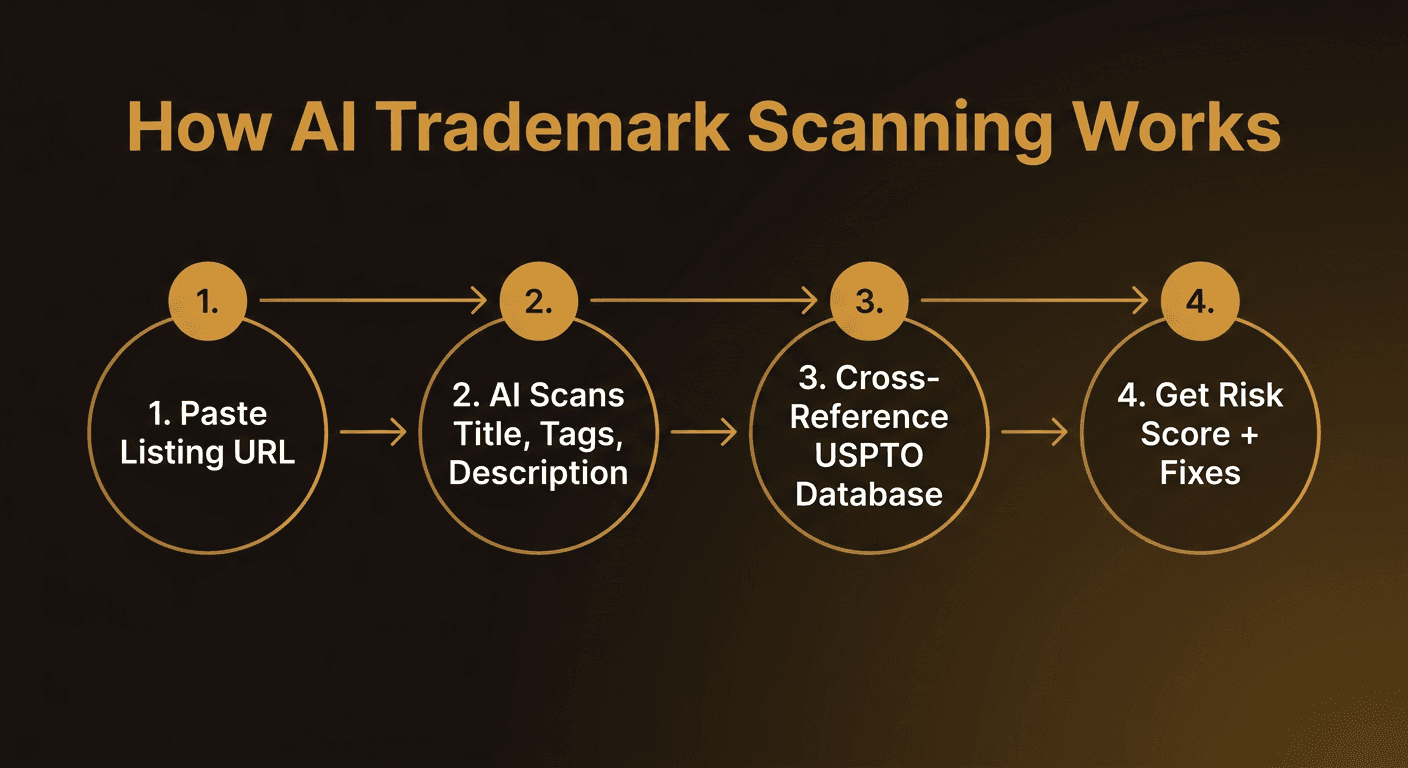
The scanning process works in three stages:
Stage 1: Text Extraction & Parsing
The scanner breaks your listing into individual components — title, tags, description, and even image alt text. Using brand names in tags is one of the most common mistakes. Each component is tokenized so that multi-word trademarks like “Stanley Cup” and “Pottery Barn” are caught as phrases, not just individual words.
Stage 2: Database Cross-Reference
Every extracted term is checked against the USPTO federal trademark database, known common law marks, and — critically — a list of brands with active Etsy enforcement histories. A brand that has filed 100 DMCA takedowns on Etsy in the past year is far more dangerous than one that has never enforced.
Stage 3: Risk Scoring & Recommendations
The scanner assigns a risk level to each flagged term based on trademark status, enforcement history, and context. It then suggests alternative phrasing so you can keep your listing live and searchable without the legal exposure.
What a Trademark Checker Looks For
Not all trademark risks are obvious. A good Etsy trademark checker goes beyond just matching brand names — it identifies several categories of risk that most sellers don't even know exist.
- Registered trademarks (USPTO) — Federally registered marks like Disney, Nike, Yeti, Cricut, and Barbie. These have the strongest legal protection and the most aggressive enforcement teams.
- Common law trademarks — Marks that aren't federally registered but are still legally protected through use in commerce. A local brand with a strong online presence can still file a valid takedown.
- Genericized trademarks — Terms like “Onesie,” “Velcro,” “Chapstick,” and “Band-Aid” that feel generic but are actually registered marks. These trip up sellers constantly.
- Character and franchise names — Names like “Elsa,” “Baby Yoda,” “Hogwarts,” and “Pokemon” are protected even when the parent brand name isn't used.
- Enforcement history patterns — Some brands are more aggressive than others. Disney, Louis Vuitton, and Cricut are known for mass takedown campaigns on Etsy. Understanding how competitor trademark reports work helps you assess which risks are most urgent.
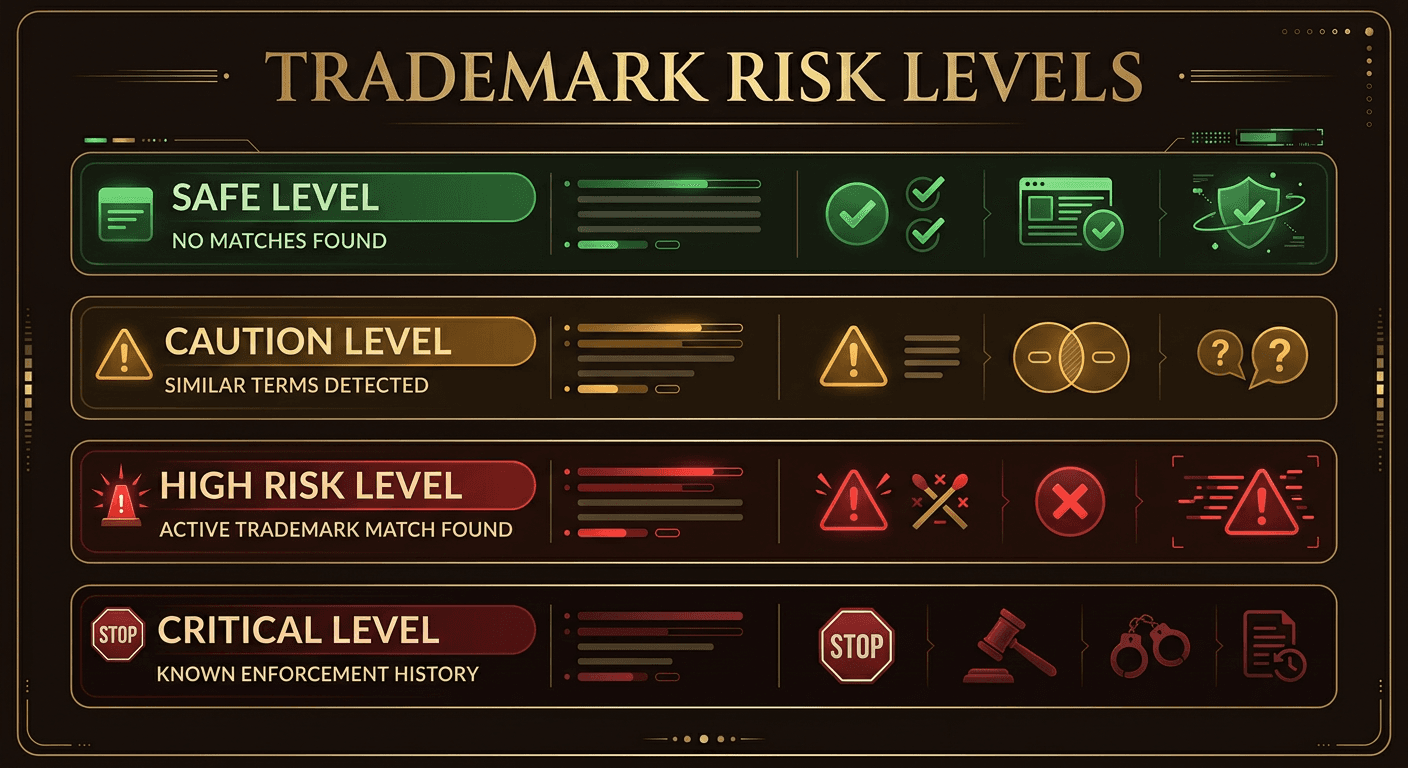
The 4 Risk Levels: From Safe to DMCA
Not every flagged term carries the same weight. A good trademark checker categorizes risks so you can prioritize what to fix immediately versus what to keep an eye on.
SAFE
No trademark issues detected. Your listing uses generic, descriptive terms that don't match any registered or common law marks. You're good to publish.
CAUTION
A potential issue was found — possibly a genericized trademark, a weak mark, or a term that's trademarked in a specific category. Review the suggestion and decide if a swap makes sense.
HIGH RISK
A registered trademark with known enforcement activity was found in your listing. Remove or replace this term before publishing. Using it is likely to result in a takedown.
DMCA
This brand has an active enforcement history with recent DMCA takedowns on Etsy. Using this term is almost certain to result in listing removal and may trigger a shop-level suspension. Remove immediately.
Before & After: Real Listing Fixes
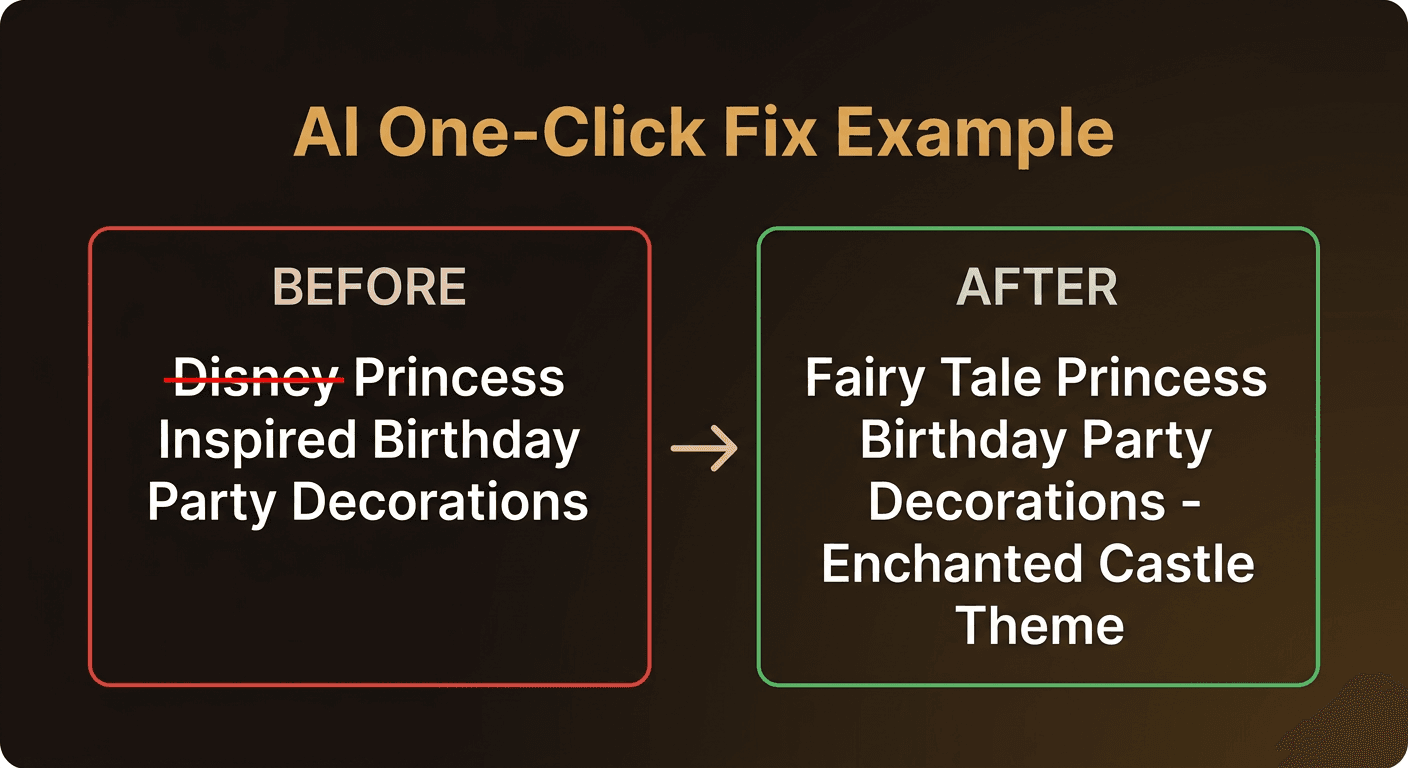
The best way to understand what a trademark checker does is to see it in action. Here are real examples of risky listings transformed into safe, search-friendly alternatives.
Before (Risky)
“Disney Princess Inspired Birthday Decorations”
After (Safe)
“Fairy Tale Princess Birthday Decorations — Enchanted Castle Theme”
Before (Risky)
“Yeti-Style Insulated Tumbler 30oz Stainless Steel”
After (Safe)
“Vacuum Insulated Tumbler 30oz — Double-Wall Stainless Steel Travel Cup”
Before (Risky)
“Barbie Pink Custom Name Sign for Girls Room”
After (Safe)
“Hot Pink Custom Name Sign for Girls Room — Retro Doll Aesthetic”
Before (Risky)
“Stanley Cup Tumbler Boot Silicone Protector”
After (Safe)
“Silicone Boot for 40oz Tumbler — Non-Slip Base Protector”
Notice the pattern: the safe versions describe the productinstead of referencing the brand. You lose nothing in search relevance because buyers also search for the generic terms. And you gain peace of mind knowing your listing won't disappear tomorrow.
How to Use a Trademark Checker (Step-by-Step)
Using an Etsy trademark checker takes less time than writing a single listing. Here's how to scan your listings with Unflagged:
- Paste your listing — Copy your title, tags, and description into the scanner. Or connect your Etsy shop to scan all listings automatically.
- Run the scan — The AI analyzes every word and phrase against trademark databases, enforcement histories, and Etsy-specific risk patterns.
- Review your risk report — Each flagged term shows its risk level (Safe, Caution, High Risk, or DMCA), the trademark owner, and why it's risky.
- Apply the suggested fixes — One-click replacement suggestions swap risky terms for safe, SEO-friendly alternatives.
- Publish with confidence — Your listing is clean. No trademark land mines. No 3am suspension emails.
The entire process takes about 30 seconds per listing. For a full shop audit of 100+ listings, the batch scanner runs in under two minutes.
Manual vs Automated Checking
You can check trademarks manually using the USPTO's free TESS database. But there are significant limitations you should understand before relying on it alone.
Manual (USPTO TESS)
- • Free to use
- • Only covers federally registered U.S. marks
- • Requires exact search formatting
- • No enforcement history data
- • No common law trademark coverage
- • 5-10 minutes per term searched
- • No automated suggestions or fixes
Automated (Unflagged)
- • Scans entire listing in seconds
- • Cross-references multiple databases
- • Includes enforcement history tracking
- • Catches common law and genericized marks
- • Provides safe replacement suggestions
- • Batch scanning for full shop audits
- • Ongoing monitoring for new trademark risks
Manual checking has its place — it's a good habit to search USPTO when you're unsure about a specific term. But for daily listing work with dozens or hundreds of products, automated scanning is the difference between spending hours on research and spending seconds.
What to Do If Your Listing Gets Flagged
If Etsy has already flagged or removed a listing for a trademark violation, don't panic — but do act fast. Here's your action plan:
- Don't relist the same item — Re-publishing a removed listing with the same violation is the fastest path to a full shop suspension.
- Audit your entire shop immediately — If one listing had a trademark issue, others probably do too. Run every listing through a scanner before Etsy finds the rest.
- Remove all risky listings proactively — Taking them down yourself looks far better than having Etsy remove them. It demonstrates good faith.
- Rewrite and republish — Create new listings with safe, descriptive titles. You can sell the same product — you just can't reference the brand.
- Document everything — Keep records of what you removed and when. If you do get suspended, this documentation strengthens your appeal letter.
If the situation has already escalated to a shop suspension, you'll need to write a formal appeal. Our guide on Etsy suspension appeal letters covers the exact template and process.
Prevention Is Better Than Cure
The sellers who never get suspended aren't luckier than you. They just scan before they list. It's that simple.
Building a trademark check into your listing workflow takes 30 seconds and saves you from the hours, days, or weeks of dealing with a takedown or suspension. Think of it like spell-check for legal risk — you wouldn't publish a listing without reading it first, so don't publish without scanning it either.
Here's what a solid prevention routine looks like:
- Scan every new listing before publishing — make it a non-negotiable step.
- Run a monthly full-shop audit — new trademarks get registered every week, and a term that was safe six months ago may not be safe today.
- Set up monitoring alerts — automated tools can notify you when a new trademark registration affects your existing listings.
- Describe products, not brands — train yourself to write listings that describe what your product is rather than what it looks like.
- When in doubt, leave it out — if you're not sure whether a term is trademarked, use a different word. The SEO benefit of using a brand name is never worth the risk of losing your shop.
Your Etsy shop is your business. Protect it the same way you'd protect any other business asset — with the right tools and a consistent process.
Scan Your Listings Before Etsy Does
Unflagged's trademark checker scans your titles, tags, and descriptions against the USPTO database, common law marks, and Etsy enforcement histories — in seconds. Catch the risks. Fix the words. Keep your shop open.
Frequently Asked Questions
What is an Etsy trademark checker?
An Etsy trademark checker is a tool that scans your listing titles, tags, and descriptions for trademarked terms. It cross-references databases like the USPTO to identify brand names, registered marks, and common law trademarks that could trigger takedowns or shop suspensions on Etsy.
Can I use brand names in my Etsy listings?
Generally, no. Using trademarked brand names like Disney, Yeti, Stanley, Cricut, or Barbie in your Etsy listings can result in DMCA takedowns, listing removals, or full shop suspensions — even if your product is not a counterfeit. The only exception is if you are an authorized reseller or the term is used in a purely descriptive, non-trademark sense.
How do I check if a word is trademarked before listing on Etsy?
You can manually search the USPTO TESS database at tess2.uspto.gov, but this only covers federally registered U.S. marks and requires exact search formatting. Automated tools like Unflagged scan your entire listing against multiple databases, check for common law marks, and return a risk score with suggested fixes — all in seconds.
What happens if Etsy finds a trademark violation in my listing?
Etsy's response depends on severity. A first offense typically results in the listing being removed with a warning. Repeated violations or high-profile brand complaints can lead to full shop suspension. In serious cases involving counterfeit claims, Etsy may permanently close your account and freeze your funds for up to 180 days.
Is “inspired by” safe to use in Etsy listings?
No. Phrases like “Disney inspired,” “Yeti style,” or “looks like Stanley” still contain the trademarked term and can trigger enforcement. Brand owners and Etsy's automated systems scan for these exact patterns. The safe approach is to describe your product's features without referencing any brand — for example, “fairy tale princess theme” instead of “Disney princess inspired.”
How often should I scan my Etsy listings for trademark risks?
You should scan every new listing before publishing and run a full shop audit at least monthly. New trademarks are registered every week, and terms that were safe six months ago may now be protected. Automated monitoring tools can alert you when your existing listings develop new risks due to newly registered trademarks.