Etsy Shipping Tips 2026: Save Money and Rank Higher
Shipping is one of the biggest levers you have as an Etsy seller — it affects your search ranking, your Star Seller status, your profit margins, and whether a buyer clicks “Add to cart” or moves on. In 2026, Etsy's algorithm actively penalizes listings with high shipping costs, making your shipping strategy more important than ever. Here's how to get it right.
Why Shipping Matters More Than Ever
Shipping used to be an afterthought for many Etsy sellers — pick a flat rate, slap on a label, and move on. That approach doesn't work anymore. In 2026, Etsy's search algorithm actively factors shipping cost into listing visibility. Listings with shipping prices above $6 for US domestic orders receive reduced visibility in search results. That means your shipping price directly affects how many buyers see your products.
Beyond the algorithm, shipping affects your Star Seller status. One of the four requirements is that 95% of your orders ship on time with tracking. Miss that threshold and you lose the badge, which can hurt buyer confidence and conversion rates.
Then there's the buyer experience itself. High shipping costs are the number one reason shoppers abandon carts on Etsy. According to Etsy's own seller data, listings with free shipping convert at a measurably higher rate than identical listings with added shipping charges. When you combine algorithm penalties, Star Seller requirements, and buyer psychology, it's clear that your shipping strategy is no longer optional — it's a competitive advantage.
4 Shipping Strategies Compared
There's no single “best” shipping strategy. The right choice depends on your product weight, price point, and target market. Here's how the four main options stack up.
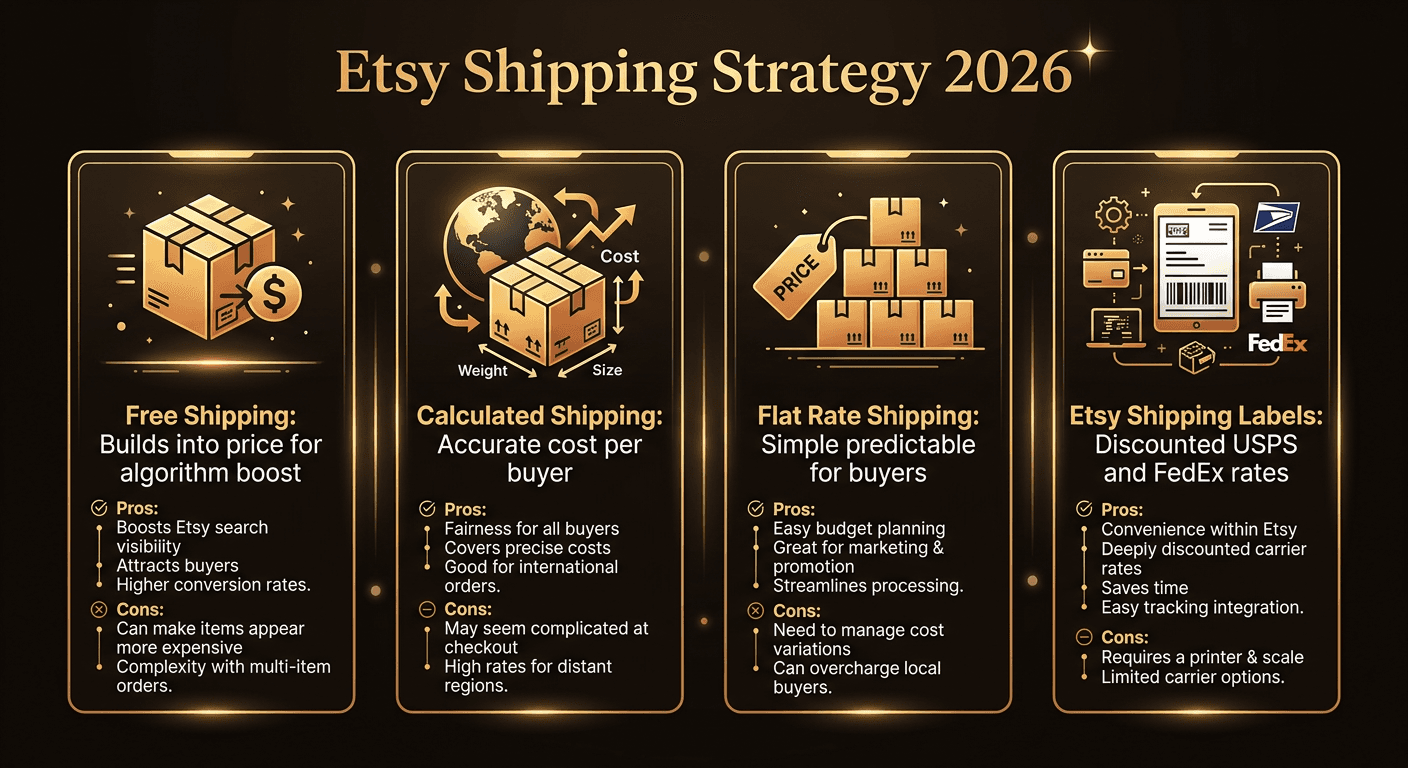
1. Free Shipping (Built Into Price)
You add the average shipping cost to your item price and set shipping to $0. Buyers see “Free shipping” in search results, which is a powerful conversion trigger. Etsy gives these listings the strongest algorithm boost.
Best for: Lightweight items where shipping cost is a small percentage of the item price. If your product is $30 and shipping is $4, pricing at $34 with free shipping works well. If your product is $8 and shipping is $6, the $14 price tag may look uncompetitive.
2. Calculated Shipping
Etsy calculates the shipping cost at checkout based on the buyer's location, your item's weight and dimensions, and your origin zip code. The buyer sees the exact shipping cost before purchasing. You never overpay or underpay.
Best for: Heavy, oversized, or variable-weight items where a flat rate would either lose you money or overcharge nearby buyers. Calculated shipping is also smart for sellers who ship to a wide range of distances.
3. Flat Rate Shipping
You set a fixed shipping price that every buyer pays regardless of location. Simple, predictable, and easy to manage. Buyers know exactly what they'll pay before clicking through to your listing.
Best for: Products with consistent size and weight where shipping costs don't vary much by destination. Keep flat rates at or below $6 for US domestic to avoid the algorithm penalty.
4. Etsy Shipping Labels
Etsy has negotiated bulk discounts with USPS, FedEx, and other carriers. When you buy labels through Etsy, you get rates that are typically 30–50% cheaper than retail counter prices. Tracking uploads automatically, which saves time and helps meet Star Seller requirements.
Best for: Every seller, regardless of which pricing strategy you use. Etsy shipping labels are a cost-saving tool, not a pricing strategy — you can combine them with free, calculated, or flat rate shipping.
Many successful sellers combine strategies. For example, free shipping on lightweight items and calculated shipping on heavier products. The key is understanding your Etsy fees and building shipping costs into your overall pricing model so you're never losing money.
The $6 Shipping Threshold
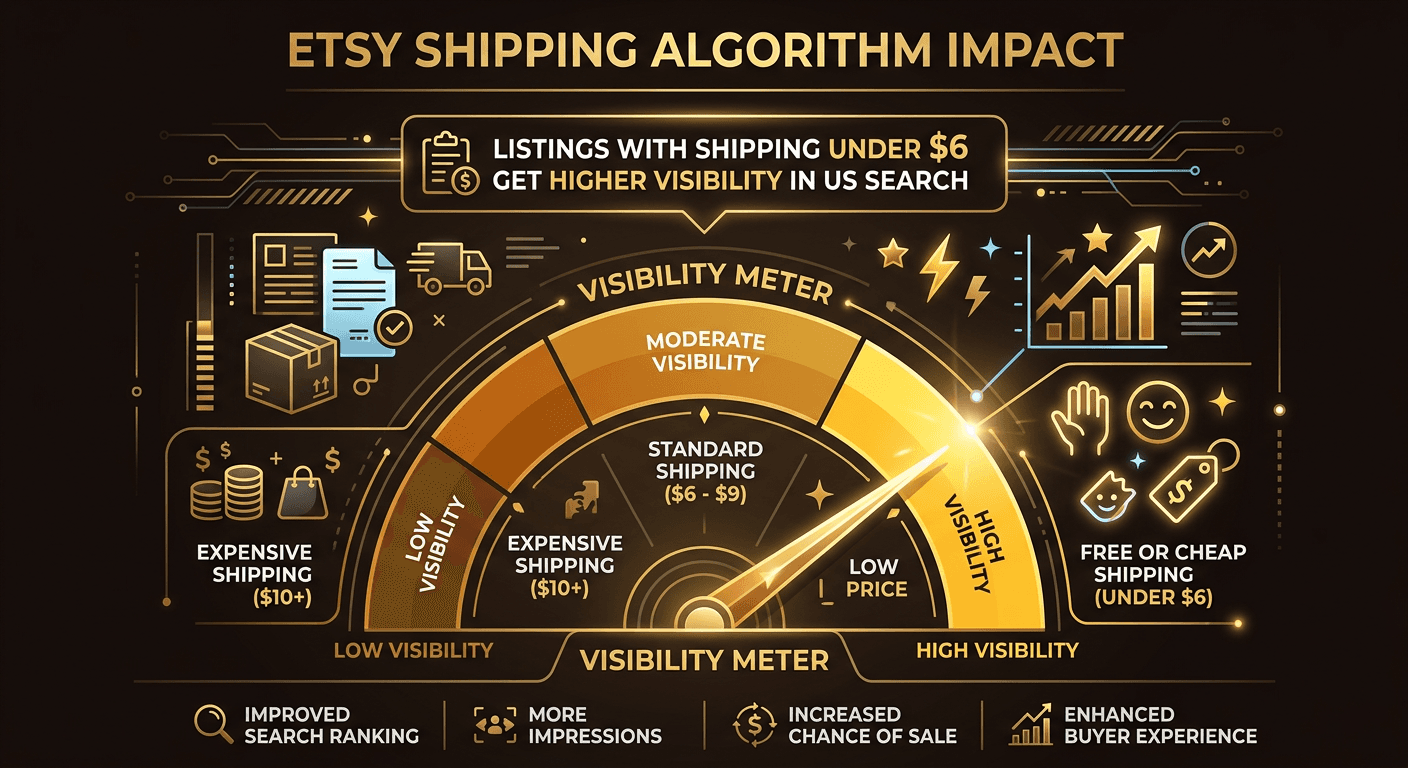
Etsy's algorithm penalizes US domestic listings that charge more than $6 for shipping. This isn't speculation — Etsy has publicly stated that shipping cost is a factor in search ranking, and listings with lower shipping costs (or free shipping) receive a visibility boost.
The $6 threshold is the current inflection point where the penalty becomes noticeable. Listings at $5.99 and below perform significantly better in search than listings at $7 or $8. Free shipping performs best of all.
How to work around it if your actual shipping costs exceed $6:
- Build it into the price. If shipping costs $9, add $9 to your item price and offer free shipping. Your total price stays the same but your search visibility improves.
- Use lighter packaging. Switch from boxes to poly mailers where possible. Use tissue paper instead of heavy packing materials. Every ounce saved reduces your actual cost.
- Offer a shipping upgrade. Set your base shipping at $5.99 (standard) and offer an expedited upgrade at a higher price. This keeps your default below the threshold while giving buyers the option to pay more for faster delivery.
- Use Etsy shipping labels. The discounted rates may bring your actual cost below $6, making it feasible to charge at or below the threshold without losing money.
The threshold applies specifically to US domestic shipping. For international orders, Etsy is more lenient because buyers expect higher shipping costs. But even internationally, lower shipping prices help conversion rates.
Etsy Shipping Labels
Etsy shipping labels are one of the most underused tools on the platform. Sellers who buy labels through Etsy get access to pre-negotiated carrier rates that are significantly cheaper than walking into a post office or UPS store.
How it works: When an order comes in, go to your Orders & Shipping page in Shop Manager. Click “Buy a shipping label” next to the order. Etsy shows you rates from USPS, FedEx, and other available carriers. Select your preferred option, pay for the label (it's deducted from your payment account), print it, and ship your package.
Key benefits:
- Discounted rates. Typically 30–50% less than retail prices. USPS First Class and Priority Mail are especially well-priced.
- Automatic tracking. When you buy a label through Etsy, the tracking number is automatically added to the order and shared with the buyer. No manual entry needed.
- Ship-date tracking. Etsy records exactly when you purchased the label, which counts toward your on-time shipping metric for Star Seller.
- Insurance options. You can add shipping insurance directly when purchasing the label, protecting high-value items without a separate transaction.
Even if you prefer a third-party shipping tool like Pirate Ship, compare its rates to Etsy's before committing. Etsy's rates are competitive for most standard shipments, and the automatic tracking integration alone can save you significant time.
Shipping Profiles
If you sell more than a handful of products, shipping profiles are essential. A shipping profile is a reusable set of shipping settings — processing time, shipping costs, carrier options, and destination rules — that you can apply to multiple listings at once.
Instead of setting up shipping individually for each listing, you create a profile once and assign it to every listing that shares the same shipping characteristics. When you need to change your processing time or update your rates, you edit the profile and every assigned listing updates automatically.
How to organize profiles: Group products by size and weight. A shop selling handmade jewelry might have three profiles: “Small items (earrings, rings)” with free shipping, “Medium items (necklaces, bracelets)” with $4.99 shipping, and “Large items (gift sets)” with calculated shipping. Each profile handles domestic and international rates separately.
Shipping profiles also help with Etsy SEO indirectly. When your shipping settings are consistent and professional, you avoid the pricing inconsistencies that confuse buyers and hurt conversion rates. A well-organized shop with logical shipping profiles signals trustworthiness to both Etsy's algorithm and your customers.
International Shipping
International orders expand your market significantly, but they come with complexity. The biggest challenges are unpredictable costs, customs paperwork, and unreliable tracking in some countries.
Use calculated shipping for international. Flat rate rarely works for international orders because shipping costs vary wildly by destination. A package to Canada might cost $12, while the same package to Australia costs $35. Calculated shipping ensures the buyer pays an accurate rate and you don't absorb unexpected costs.
Customs forms matter. Fill out customs declarations accurately. Include a clear description of the item, the quantity, and the actual value. Don't mark items as “gift” or understate the value — this can cause packages to be seized or returned and may violate import regulations.
Exclude problem countries. If you've had repeated delivery issues, lost packages, or unreliable tracking in certain countries, it's better to exclude them from your shipping destinations than to risk bad reviews and lost inventory. You can manage excluded countries in your shipping profile settings.
GPSR for EU buyers. The General Product Safety Regulation (GPSR), which took effect in the EU in 2024, requires sellers to include specific product safety information on listings sold to EU buyers. This includes a responsible person within the EU, product identification, and safety warnings where applicable. Non-compliance can result in listings being removed from EU search results.
Packaging Tips
Good packaging serves three purposes: protecting the product, creating a positive unboxing experience, and keeping shipping costs low. In 2026, a fourth factor has become increasingly important — sustainability.
- Protect the product first. Use appropriately sized boxes or mailers. Over-packaging adds weight and cost. Under-packaging leads to damaged items, refund requests, and bad reviews. Bubble wrap, tissue paper, and corrugated inserts each have their place depending on item fragility.
- Include a thank-you card. A small branded card with a handwritten or printed “thank you” note adds a personal touch that buyers remember. Include your shop name, a brief note, and optionally a discount code for their next purchase. This simple gesture drives repeat business and positive reviews.
- Create an unboxing experience. The moment a buyer opens their package is your last chance to make an impression. Clean, branded tissue paper, a sticker seal, and neat presentation cost pennies but can be the difference between a 4-star and a 5-star review.
- Sustainable packaging is trending. Buyers increasingly prefer recyclable and compostable packaging materials. Kraft paper, recycled cardboard, and biodegradable packing peanuts signal that your brand cares about the environment. Some buyers specifically mention sustainable packaging in positive reviews, which helps your Etsy sales.
Keep packaging costs under control by ordering supplies in bulk. Poly mailers, tissue paper, and thank-you cards are significantly cheaper when bought in quantities of 100 or more. Factor these costs into your pricing so they don't eat into your margins.
Shipping and Star Seller
The shipping metric is one of the four pillars of Etsy's Star Seller program. To maintain the badge, 95% of your orders must ship on time and include valid tracking information. This is evaluated over a rolling three-month window.
“On time” means within your stated processing time. If your listing says 1–3 business days, the order needs to ship within 3 business days. Set processing times that you can consistently meet, even during busy periods. It's better to set 3–5 days and ship in 2 than to set 1–2 days and occasionally miss the deadline.
Tracking is non-negotiable. Orders without tracking don't count toward the 95% threshold. Even if you ship on time, missing tracking means the order counts against you. Etsy shipping labels solve this automatically since tracking uploads the moment you purchase the label.
If you're struggling with the shipping metric, audit your process. Common fixes include buying shipping labels the same day an order comes in, batching your shipments at a consistent time each day, and padding your processing times by one business day. Small operational changes make a big difference over a three-month window.
Common Shipping Mistakes
Even experienced sellers make these errors. Avoiding them can save you money, protect your Star Seller status, and prevent negative reviews.
Undercharging for Shipping
Eating shipping costs to keep prices low seems smart until you calculate how much it costs over hundreds of orders. If you're losing $2 per shipment and sell 200 items a month, that's $400 in lost profit monthly. Know your actual shipping costs and price accordingly — either in the shipping charge or built into the item price.
Skipping Tracking
Sending packages without tracking to save a few dollars is a false economy. Without tracking, you have no proof of delivery if a buyer claims the package never arrived. You also lose credit toward your Star Seller on-time shipping metric. The cost of one “item not received” claim far exceeds the cost of adding tracking to every shipment.
Late Shipments
Consistently shipping 1–2 days late might seem minor, but it compounds. Late shipments trigger “shipping delay” notifications to buyers, damage your Star Seller metrics, and can lead to negative reviews. If you regularly ship late, extend your processing time rather than continuing to miss deadlines.
Poor Packaging
A product that arrives damaged leads to a refund request, a potential negative review, and a replacement shipment — tripling your cost. Invest in proper packaging materials upfront. It's cheaper to spend $0.50 on bubble wrap than $15 on a refund and replacement. Test your packaging by shipping a sample to yourself and seeing how it arrives.
Protect the Listings Your Shipping Investment Supports
You're optimizing shipping to rank higher and sell more — but a single trademark complaint or policy violation can take your listings down overnight. Unflagged scans your shop for compliance risks before Etsy catches them, so your optimized listings stay live and keep generating sales.
Start Free Compliance ScanFrequently Asked Questions
What is the Etsy $6 shipping threshold?+
Etsy reduces search visibility for US domestic listings that charge more than $6 for shipping. Listings with shipping at or below $6, or with free shipping, receive an algorithm boost in search results. The threshold was introduced to encourage competitive shipping prices and improve buyer experience.
Should I offer free shipping on Etsy in 2026?+
Free shipping gives you the strongest algorithm boost and appeals to buyer psychology, but it only works if you can build the shipping cost into your item price without making it look overpriced compared to competitors. If your product costs $15 and shipping is $8, a $23 listing with free shipping may not convert as well as a $15 listing with $8 shipping in some categories. Test both approaches and compare your conversion rates.
How do Etsy shipping labels save money?+
Etsy negotiates discounted rates with USPS, FedEx, and other carriers. When you purchase shipping labels through Etsy, you get these bulk-negotiated rates which are typically 30–50% cheaper than retail counter prices. Tracking information also uploads automatically, which saves time and helps you meet Star Seller requirements.
What is the best shipping strategy for Etsy?+
The best strategy depends on your products. For lightweight items under 1 pound, free shipping built into the price works well because the cost is small and the algorithm boost is significant. For heavier or variable-weight items, calculated shipping ensures you never lose money. For items with consistent size and weight, flat rate shipping keeps things simple for both you and the buyer.
Does shipping affect Etsy Star Seller status?+
Yes. One of the four Star Seller requirements is that 95% of your orders must ship on time with valid tracking information. Late shipments or missing tracking numbers directly hurt your Star Seller status. Using Etsy shipping labels helps because tracking uploads automatically and the ship-by date is clearly tracked in your dashboard.
How do I handle international shipping on Etsy?+
Use calculated shipping for international orders so rates adjust automatically based on the buyer's location. Fill out customs forms accurately with item descriptions and values. Consider excluding countries where you've had delivery issues or where tracking is unreliable. For EU buyers, be aware of GPSR (General Product Safety Regulation) requirements that took effect in 2024 and require specific product safety information on listings.