Etsy Shop Branding: How to Stand Out in 2026
Over 9 million active sellers compete on Etsy. Your products might be exceptional, but without a cohesive brand identity, you look like every other shop. Branding is what turns a one-time buyer into a repeat customer — and it's what lets you charge more for the same type of product.
1. Why Branding Matters on Etsy
Etsy search results are a wall of thumbnails. When a shopper sees 20 similar products on the same page, the deciding factor is rarely the product itself — it's the shop behind it. A branded shop communicates professionalism, trustworthiness, and quality before the buyer ever reads a single word in your description.
Branding does three things that directly impact your revenue:
- •Builds trust instantly. A cohesive visual identity signals that you take your business seriously. Buyers feel more confident purchasing from a shop that looks established and intentional, even if you launched last week.
- •Creates recognition. When a buyer sees your listing in search results and recognizes your visual style from a previous purchase or browse, they're significantly more likely to click. Brand recognition compounds over time and reduces your dependence on Etsy's algorithm.
- •Justifies premium pricing. Two sellers can offer nearly identical products, but the one with a polished brand can charge 20–50% more. Buyers associate strong branding with higher quality — and they're willing to pay for it.
If you're just getting started, our guide to starting an Etsy shop covers the foundation. Branding is what turns that foundation into a business that scales.
2. Shop Icon
Your shop icon is the first brand element buyers encounter. It appears next to your shop name in search results, on your shop page, on every listing, and in buyer messages. Think of it as your Etsy logo.
Shop Icon Specs and Best Practices
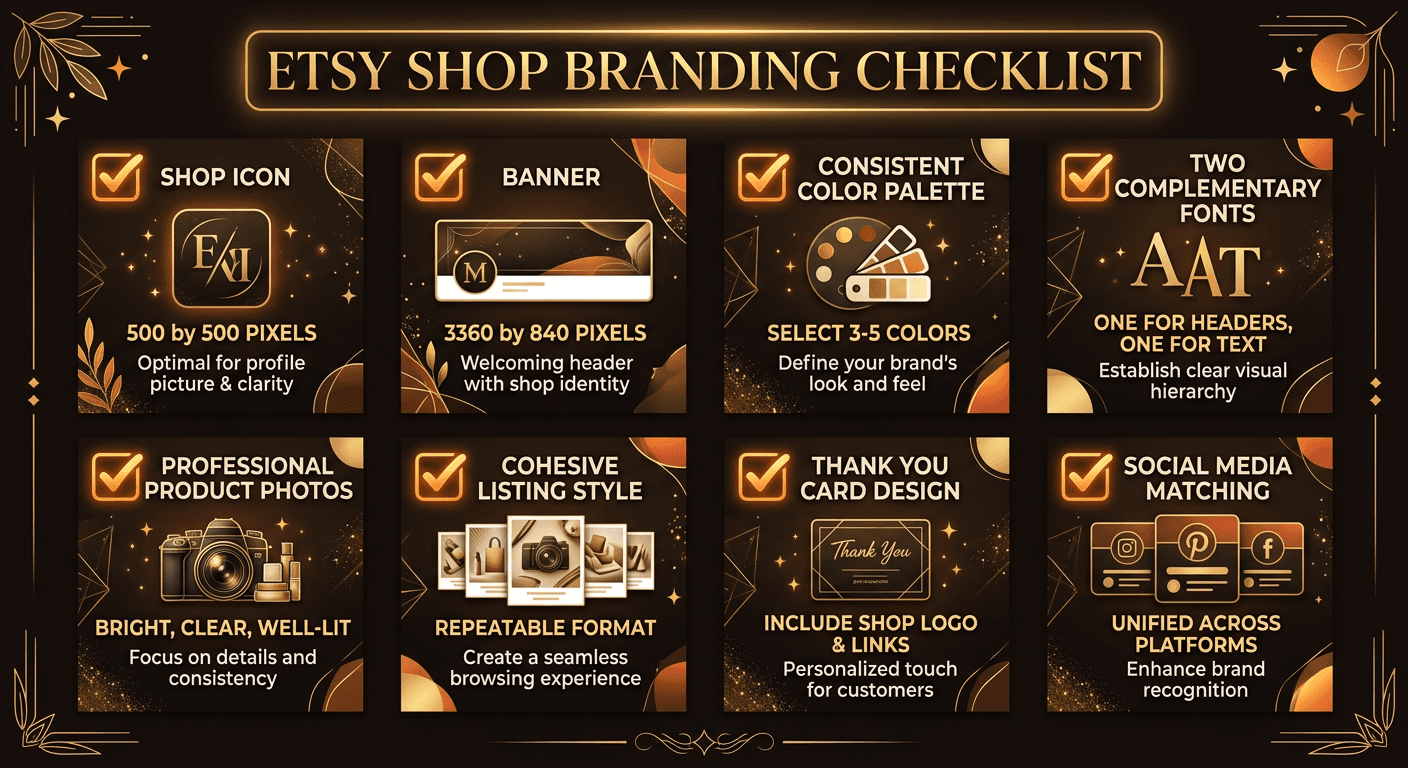
- •Size: 500 x 500 pixels. Etsy displays it as a circle, so keep your design centered and away from the edges. Anything near the corners will be cropped.
- •Keep it simple. A clean logo, your initials in a branded font, or a simple icon that represents your niche. The icon displays as small as 30 pixels on some screens — intricate details will be invisible.
- •Test at thumbnail size. After creating your icon, shrink it to 30–40 pixels on your screen. If you can still identify it and it looks clean, it works. If it turns into an unreadable blob, simplify.
- •Use your brand colors. Your icon should use the same color palette as your banner and listing images. Consistency across every touchpoint is what builds brand recognition.
Canva's free tier has hundreds of logo templates sized specifically for Etsy. Search "Etsy shop icon" in Canva to find templates that are already 500 x 500 pixels and circular.
4. Color Palette
Color is the fastest way to create brand recognition. When a buyer sees a consistent color palette across your icon, banner, listing photos, and packaging, your shop feels intentional and professional. When every listing has random colors, your shop feels disorganized.
How to Choose Your Brand Colors
- •Pick 2–3 colors max. One primary color that defines your brand, one secondary color for accents and contrast, and optionally a neutral (white, cream, charcoal) for backgrounds. More than three colors creates visual chaos.
- •Match your niche. Earthy tones work for handmade and natural products. Bold, saturated colors work for fun and playful products. Muted pastels work for minimalist and modern aesthetics. Black and gold work for luxury and premium positioning.
- •Use consistently everywhere. Once you lock in your palette, apply it to your shop icon, banner, listing image overlays, packaging materials, social media profiles, and thank-you cards. Consistency is what transforms colors into a brand.
Use Coolors.co to generate harmonious palettes instantly. Press the spacebar to generate new combinations, then lock the colors you like and generate variations around them. Save your final palette and reference the hex codes for every design you create.
5. Typography
Fonts communicate personality before a single word is read. A hand-lettered script says "handmade and personal." A clean sans-serif says "modern and minimal." A bold slab serif says "established and reliable." Your font choices should align with the feeling you want your brand to convey.
Typography Rules for Etsy Branding
- •Choose 2 complementary fonts. One for headings and titles (this is your "brand font"), and one for body text and descriptions. Pair a decorative or display font with a clean, readable font. Never use more than two.
- •Prioritize readability. Your heading font can be expressive, but your body font must be easy to read at small sizes. Script and decorative fonts as body text are a common mistake that makes listing images and shop sections unreadable.
- •Use commercially licensed fonts only. This is a compliance issue many sellers overlook. Using a font without a commercial license in your product listings, banners, or packaging is a copyright violation. Google Fonts are free for commercial use. Many fonts from other sources require a paid license. Check before you use. For more on intellectual property risks, see our guide on Etsy copyright violations.
Browse Google Fonts and filter by category (serif, sans-serif, display, handwriting) to find fonts that match your brand's personality. Download them and install in Canva for use across all your designs.
6. Product Photography Style
Your product photos are where branding becomes tangible. It's not just about taking good photos — it's about taking photos that are visually consistent across every single listing. When a buyer scrolls through your shop and every product photo has the same style, background, and lighting, your shop feels curated and trustworthy.
Building a Consistent Photography Style
- •Consistent backgrounds. Choose one background style and use it for every listing. White backgrounds give a clean, modern look. Wood surfaces feel rustic and handmade. Colored paper in your brand color creates instant visual cohesion. Whatever you choose, stick with it.
- •Consistent lighting. Natural window light produces the most flattering results for most products. Shoot at the same time of day and in the same location to ensure your lighting is consistent across all listings. If you use artificial lighting, keep the same setup for every shoot.
- •Consistent angles. Decide on a standard set of angles for your product shots: a hero shot (front-facing, slightly angled), a flat lay, a lifestyle shot, and a detail close-up. Using the same angle patterns across listings makes your shop look curated.
- •Consistent editing. Apply the same brightness, contrast, and warmth adjustments to every photo. If you use presets or filters, use the same one across all listings. Avoid over-editing — buyers want to see what they're actually getting.
For a deep dive into photo techniques, lighting setups, and the 8-photo checklist that maximizes conversions, read our full Etsy product photography guide.
7. Shop Announcement and About Section
Your shop announcement is the first text buyers see on your shop page. Your about section is where they go to learn your story. Together, these two sections are your best opportunity to build an emotional connection with buyers and differentiate your shop from competitors selling similar products.
Shop Announcement
Use your announcement to communicate what's happening in your shop right now. Current promotions, new product launches, restocks, processing times, or holiday shipping deadlines. Keep it short — 2 to 3 sentences max. Update it regularly so it always feels fresh and current.
About Section
This is where you tell your story. Why did you start this shop? What makes your products special? What's your process? Buyers on Etsy actively seek out handmade, personal, and small business stories. A compelling about section turns browsers into buyers. Include a photo of yourself or your workspace to make it feel personal and authentic.
8. Packaging and Unboxing
The unboxing experience is your final branding touchpoint — and it's the moment with the highest emotional impact. A buyer has been waiting for their order, and the packaging is the first physical thing they touch. Done right, it drives 5-star reviews, social media shares, and repeat purchases.
Affordable Branded Packaging Ideas
- •Thank-you cards. The single highest-ROI packaging addition. A small card with your brand name, a personal thank-you message, and your social media handles. Print at home or order bulk from Canva Print or Vista Print. Cost: under $0.10 per card.
- •Branded tissue paper. Wrapping products in tissue paper in your brand color elevates the unboxing experience instantly. You can also get custom tissue paper with your logo printed on it through services like noissue or Packlane.
- •Stickers. Custom stickers with your shop logo are inexpensive and versatile. Use them to seal tissue paper, decorate the outside of packages, or include as a freebie. Buyers love stickers — many will stick them on laptops, water bottles, or notebooks, giving you free advertising.
- •Start simple, scale later. You do not need custom mailer boxes on day one. Start with a thank-you card and tissue paper. As your shop grows and margins increase, add stickers, custom stamps, and eventually branded packaging.
9. Free Branding Tools
You do not need a graphic designer or expensive software to build a professional Etsy brand. These three free tools cover everything you need. If you do want professional help, freelance design marketplaces like Skiln connect you with specialists who understand e-commerce branding.
Canva (Free Tier)
The all-in-one design tool for Etsy sellers. Create shop icons, banners, listing image overlays, social media graphics, thank-you cards, and packaging inserts. Canva has pre-sized templates for Etsy, so you never have to guess dimensions. The free tier is more than sufficient for most sellers. The Pro tier adds brand kits, background removal, and thousands more templates.
Coolors.co (Free)
A palette generator that creates harmonious color combinations in seconds. Press spacebar to generate a new palette, lock the colors you like, and export hex codes. You can also extract a color palette from any image — upload a photo of a product you love and Coolors will pull the dominant colors from it.
Google Fonts (Free)
Over 1,500 font families, all free and commercially licensed. Filter by category, preview with custom text, and download directly. Every font on Google Fonts is safe to use in your Etsy listings, banners, packaging, and product designs without any licensing concerns.
10. Branding Mistakes to Avoid
These are the most common branding mistakes we see across Etsy shops. Each one undermines your brand identity and can cost you sales, trust, or even your shop.
Inconsistency
The single biggest branding killer. Different colors in your banner than your listing images. Different fonts on your thank-you card than your product labels. Random photo styles across listings. Inconsistency makes your shop look like a flea market, not a brand. Every element should feel like it belongs to the same family.
Using Copyrighted Logos or Fonts
This is not just a branding mistake — it's a compliance risk that can get your shop suspended. Using trademarked logos, unlicensed fonts, or copyrighted images in your branding materials can result in DMCA takedowns, listing removals, or a full account suspension. Always verify that every asset you use is properly licensed for commercial use. Read our copyright violation guide to understand the risks.
Over-Designing
More design elements do not mean better branding. Banners crammed with text, gradients, shadows, borders, and five different fonts look cluttered and amateurish. The strongest brands on Etsy use restraint. Clean layouts, generous white space, and 2–3 colors maximum. If something doesn't serve a purpose, remove it.
Copying Another Shop's Brand
It's fine to draw inspiration from successful shops, but copying their logo, banner layout, or color scheme is counterproductive. Buyers will recognize the similarity, and you'll always be the knockoff. Worse, if the original shop has trademarked their branding elements, you could face legal action. Build something original that reflects your unique story and products.
Build Your Brand on a Safe Foundation
A strong brand is worthless if your shop gets suspended. Unflagged scans your listings for trademark violations, copyright risks, and policy breaches before Etsy catches them — so you can focus on building your brand while we protect your business.
Scan Your Listings Free