Etsy Fees Explained 2026: How Much Does Etsy Actually Take?
Between listing fees, transaction fees, payment processing, offsite ads, and a handful of charges most sellers don't even know exist, Etsy can take 20–30% of every sale you make. Here's exactly where your money goes — and how to keep more of it.
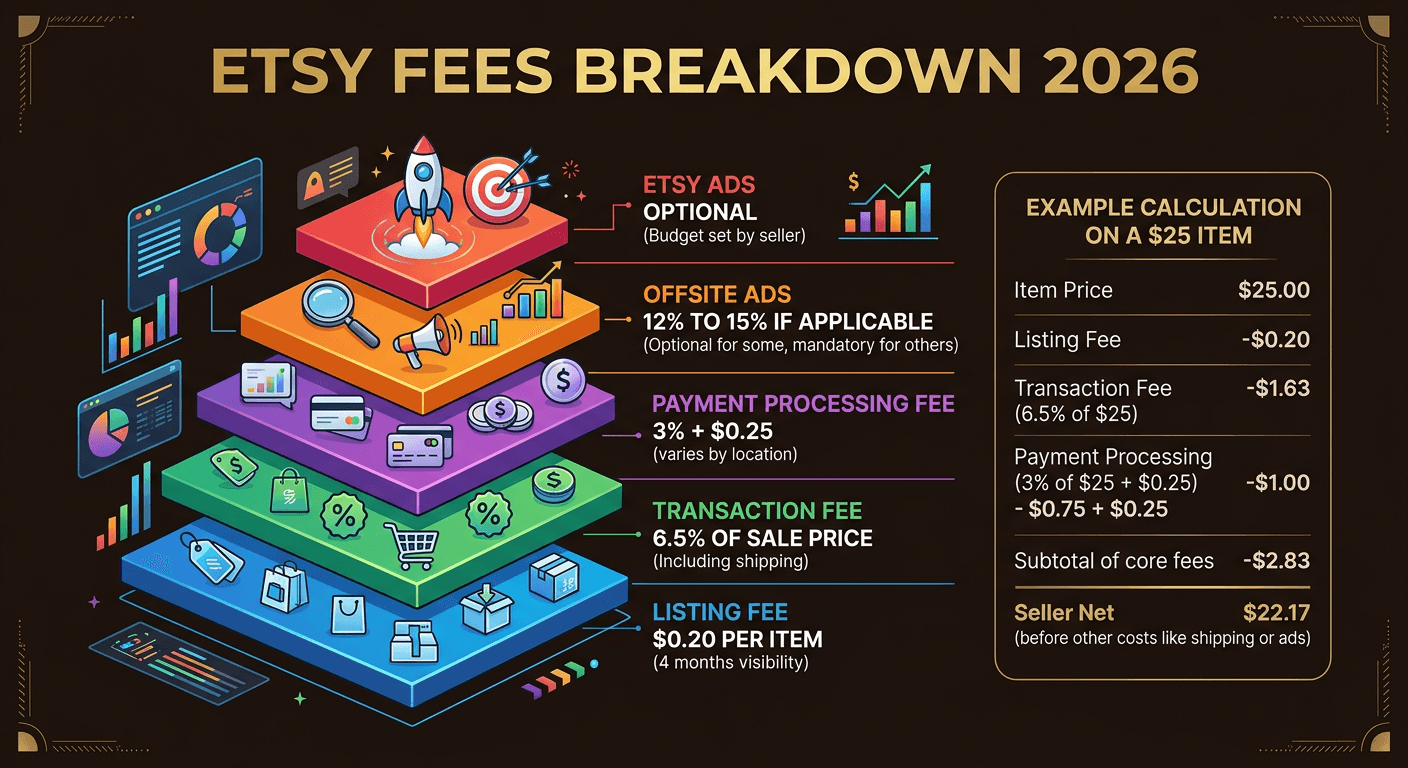
The Big Picture: How Much Does Etsy Take?
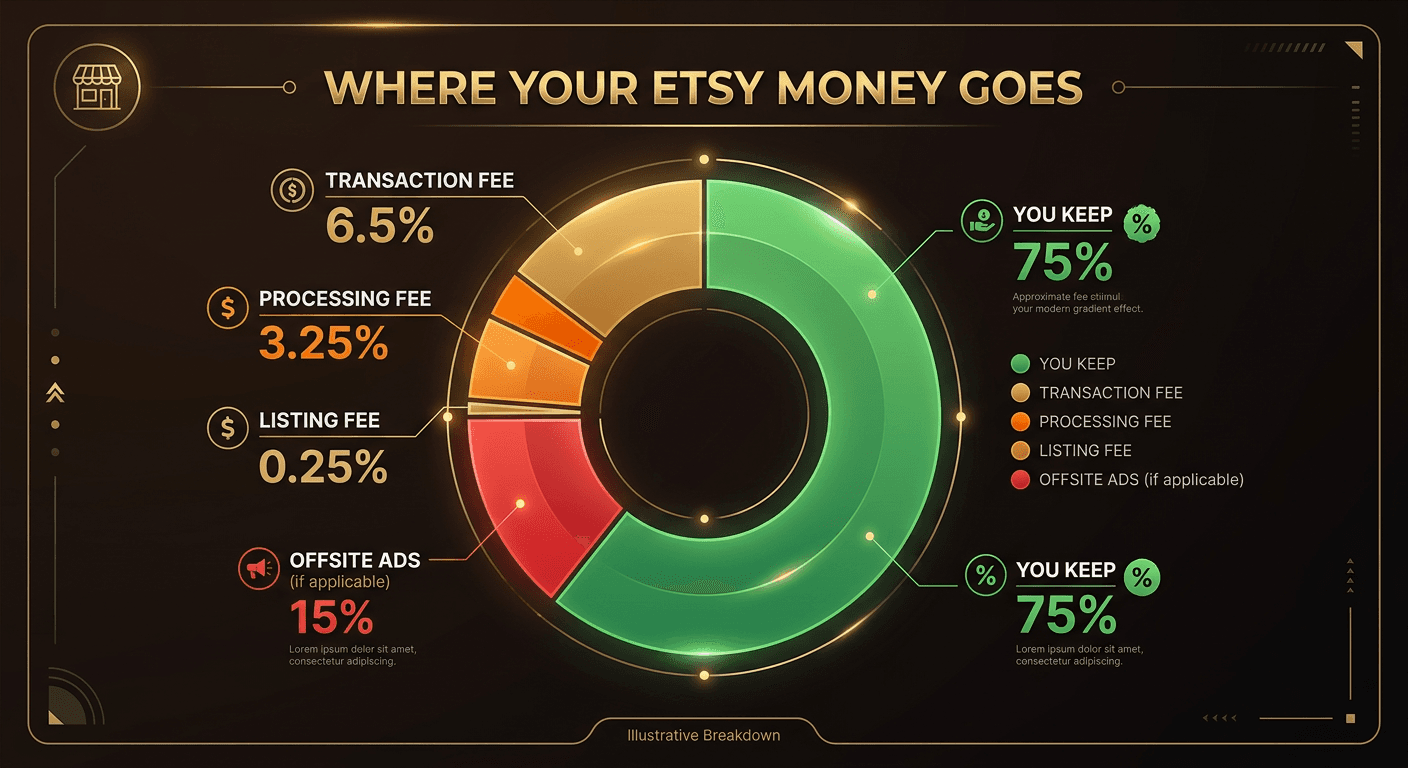
If you're new to selling on Etsy — or you've been selling for years without really digging into your fee statements — the total cut Etsy takes might shock you. On an average sale, Etsy collects between 20% and 30% of the total transaction value once you stack every fee together.
That number isn't a single fee. It's the combined weight of five separate charges that Etsy applies to every order: a listing fee, a transaction fee, a payment processing fee, and potentially an offsite advertising fee. Each one is small enough to seem harmless on its own. Put them together, and they eat a significant chunk of your revenue.
The exact percentage you pay depends on several factors: your item price, your shipping strategy, whether a buyer clicked an offsite ad before purchasing, and which country you're selling from. Lower-priced items get hit hardest because the fixed-cost components (like the $0.25 payment processing charge) represent a larger share of the sale.
Let's break down every single fee so you know exactly where your money goes.
Listing Fee — $0.20 Per Listing
Every item you list on Etsy costs $0.20. This fee is charged the moment you publish a new listing, and it applies regardless of whether the item ever sells. Listings are active for four months. If the listing expires without selling, you'll pay another $0.20 to renew it — either manually or through Etsy's auto-renewal setting.
Here's where it gets expensive for high-volume sellers: when a multi-quantity listing sells one unit, Etsy automatically renews the listing and charges another $0.20. If you have a listing with 100 units in stock and you sell all 100, you've paid $20.00 in listing fees alone on that single product — $0.20 for the initial listing plus $0.20 for each of the 99 auto-renewals after each sale.
Key detail: Digital download listings work the same way. Each sale triggers a $0.20 renewal fee, even though there's no physical inventory to restock. If you sell 500 copies of a digital template, that's $100.00 in listing fees on a single product.
Transaction Fee — 6.5% of the Total Sale
Etsy charges a 6.5% transaction fee on the total order amount. This is not just the item price — it includes shipping charges and any gift wrapping fees. So if you sell a $25 item with $5 shipping and $3 gift wrap, Etsy takes 6.5% of $33, not 6.5% of $25.
This is Etsy's core revenue fee and the one that hits sellers hardest on a per-sale basis. At 6.5%, it's significantly higher than many competing marketplace fees. For reference, eBay's final value fee ranges from 3–15% depending on the category, and Amazon's referral fee is typically 8–15%. Etsy's flat 6.5% on everything (including shipping) makes it one of the more expensive platforms for low-margin products.
The transaction fee applies to every sale, with no volume discounts or tier reductions. Whether you sell one item a month or a thousand, the rate stays at 6.5%.
Payment Processing — 3% + $0.25
Etsy Payments is the mandatory payment processing system for most sellers. The fee in the United States is 3% of the total sale amount plus a flat $0.25 per transaction. This covers credit card processing, buyer payment methods, and Etsy's payment infrastructure.
Payment processing rates vary by country. In the UK, the rate is 4% + £0.20. In Canada, it's 3% + CAD $0.25. In Australia, it's 3% + AUD $0.25. European Union sellers typically pay 4% + €0.30. Check Etsy's current fee schedule for your specific country, as rates are updated periodically.
The $0.25 fixed component is what makes this fee disproportionately expensive for low-priced items. On a $5 item, the $0.25 alone represents 5% of the sale price, pushing your total payment processing cost above 8%. On a $100 item, that same $0.25 is just 0.25%, making the effective rate closer to 3.25%.
Offsite Ads Fee — 12–15%
Etsy's Offsite Ads program promotes your listings on Google, Facebook, Instagram, Pinterest, and other external platforms. When a buyer clicks one of these ads and purchases from your shop within 30 days, Etsy charges an additional fee on that sale.
The rate depends on your annual revenue:
- Under $10,000/year: 15% offsite ads fee — and you can opt out of the program entirely
- Over $10,000/year: 12% offsite ads fee — participation is mandatory and you cannot opt out
This is the fee that catches successful sellers off guard. Once you cross the $10,000 threshold, you're locked into the program. If a buyer found your listing through an Etsy offsite ad and purchases a $50 item, you owe an additional $6.00 on top of all other fees. Combined with the transaction fee and payment processing, a single offsite-ad sale can cost you over 25% in total fees.
For a deeper dive into how offsite ads work and strategies for managing them, read our full guide on Etsy Offsite Ads.
Etsy Ads (Optional PPC)
Etsy Ads is Etsy's optional pay-per-click advertising platform that promotes your listings within Etsy's own search results. Before investing, read our analysis on whether Etsy Ads are worth it. Unlike Offsite Ads, Etsy Ads is entirely voluntary — you choose whether to participate, set your own daily budget (minimum $1/day), and can pause or stop at any time.
The cost-per-click (CPC) varies based on competition for your keywords, your listing's category, and demand. Most sellers report CPCs ranging from $0.15 to $0.50, though competitive niches can run higher. You only pay when someone clicks your ad — impressions are free.
The critical distinction: Etsy Ads costs come from your set daily budget and are charged separately from your per-sale fees. Offsite Ads fees are charged as a percentage of completed sales. You can run Etsy Ads without Offsite Ads (if eligible to opt out), and vice versa. Many sellers confuse the two programs, which leads to unexpected charges on their fee statements.
Real Example: Fee Calculation on a $25 Item
Let's see exactly how much you keep on a typical sale. Imagine you sell a handmade item for $25.00 with $5.00 shipping. The buyer did not click an offsite ad. Here's the breakdown:
That's the best case — no offsite ads, no Etsy Ads spend, no currency conversion. Now let's add an offsite ad click at the 15% rate:
With offsite ads, Etsy takes over a quarter of your total sale. On a $30 transaction, you lose $7.80 in fees before you account for material costs, packaging, or your time.
How to Reduce Your Etsy Fees
You can't eliminate Etsy's fees entirely, but you can structure your shop to minimize their impact. A solid Etsy pricing strategy that accounts for every fee category is essential. Here are the strategies that actually work:
Build Shipping into Your Item Price
Since the 6.5% transaction fee applies to shipping charges, offering “free shipping” by building the cost into your item price doesn't reduce fees — but it does improve your search ranking. Etsy's algorithm prioritizes listings with free shipping, which means more organic traffic and fewer sales coming through paid channels. More organic sales means fewer offsite ads fees.
Opt Out of Offsite Ads (If Eligible)
If your shop earned less than $10,000 in the past 12 months, go to Shop Manager → Settings → Offsite Ads and turn them off. The 15% fee on referred sales is the single largest per-sale cost you can eliminate. Only keep offsite ads on if you've tracked the data and confirmed they're generating profitable sales you wouldn't have gotten organically.
Optimize for Organic Search Instead of Paid
Every sale that comes through Etsy's organic search avoids the offsite ads fee entirely. Invest time in optimizing your Etsy SEO — strong titles, relevant tags, competitive pricing, and excellent product photography. The better your organic ranking, the less you depend on paid advertising and the lower your effective fee rate.
Price Above $20 When Possible
The $0.25 fixed payment processing fee and the $0.20 listing fee hit low-priced items hardest. On a $5 item, these fixed costs alone represent 9% of the sale. On a $50 item, they represent less than 1%. If your product allows it, consider bundling items or creating premium versions to push average order value above $20, where the effective fee rate drops significantly.
Manage Multi-Quantity Listings Carefully
For digital downloads and print-on-demand products, consider whether a lower quantity setting makes sense. Instead of listing 999 units, set a lower number and manually replenish. This gives you more control over renewal fees and forces you to periodically review each listing's performance.
Fees vs. Suspension: The Real Cost
Sellers spend hours optimizing for fees — shaving a few percentage points here and there. But there's a cost that dwarfs any fee calculation: losing your shop entirely.
A suspended Etsy shop doesn't just lose revenue for a few days. It loses all revenue — every listing goes dark, every active order gets thrown into limbo, and your search ranking evaporates. Sellers who have built their shop over years can see their entire income stream disappear overnight because of a compliance violation they didn't know existed.
The most common causes of suspension — trademark infringement, prohibited items, policy violations — are all preventable. Compliance scanning costs a fraction of what a single month of lost sales would cost you. Think of it as the cheapest insurance your shop can buy.
If you want to understand how suspensions work and what triggers them, read our guides on how to protect your Etsy shop and learn what happens when sellers focus on growth without compliance. Fees are a cost of doing business. A suspension is a cost of going out of business.
Don't Let a Suspension Cost You More Than Fees Ever Could
Etsy fees are predictable. Suspensions aren't. Scan your listings for compliance risks before Etsy finds them first — trademark issues, prohibited items, and policy violations that can shut your shop down without warning.
Scan Your Listings NowFrequently Asked Questions
How much does Etsy take from each sale?
Etsy takes roughly 20–30% of each sale when you combine all fees. This includes a $0.20 listing fee, a 6.5% transaction fee on the total sale price (item + shipping + gift wrap), payment processing fees of 3% + $0.25, and potentially a 15% offsite ads fee if the buyer clicked an Etsy ad before purchasing. The exact percentage depends on your item price, whether offsite ads applied, and your country's payment processing rate.
What is the Etsy transaction fee for 2026?
The Etsy transaction fee for 2026 is 6.5% of the total order amount, which includes the item price, shipping cost, and any gift wrapping charges. This fee is charged on every sale regardless of your shop size or Etsy Plus status.
Can I avoid Etsy offsite ads fees?
If your shop earned less than $10,000 in the past 12 months, you can opt out of the Etsy Offsite Ads program in your shop settings. However, if your shop earned $10,000 or more, participation is mandatory and you cannot opt out. Sellers in the mandatory tier pay a reduced rate of 12% instead of 15%.
Are Etsy listing fees refundable?
No, Etsy listing fees are non-refundable. The $0.20 fee is charged when you publish or renew a listing, regardless of whether the item sells. If a multi-quantity listing sells one unit, the listing auto-renews for another $0.20. If you deactivate a listing early, the fee is not refunded.
Does Etsy charge fees on shipping?
Yes. Etsy charges the 6.5% transaction fee on the total order amount, which includes shipping costs. This is why some sellers build shipping costs into their item price and offer free shipping — though the fee applies to the total regardless of how you structure your pricing.
What happens to my Etsy fees if my shop gets suspended?
If your Etsy shop is suspended, you lose all revenue from that shop immediately. Any outstanding fees still need to be paid, and funds in your payment account may be held for up to 180 days. You cannot open a new shop to avoid unpaid fees. Keeping your shop in compliance is far cheaper than dealing with suspension consequences.