Etsy vs Shopify: Which Is Better for Sellers in 2026?
Etsy gives you 90 million buyers on day one. Shopify gives you total control over your brand. Choosing between them isn't about which is “better” — it's about which fits where you are right now and where you're headed.
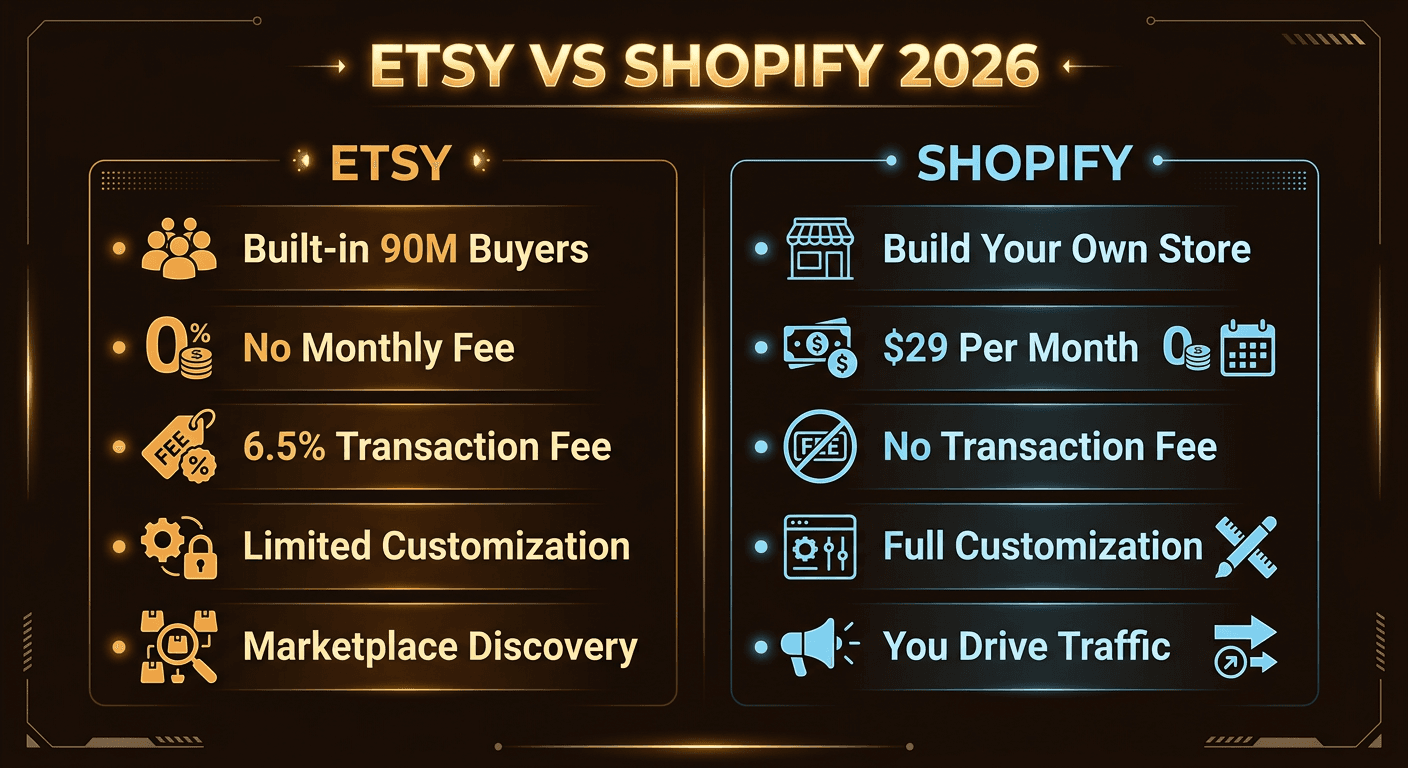
Overview: Marketplace vs Standalone Store
The Etsy vs Shopify debate comes down to one fundamental difference: Etsy is a marketplace, and Shopify is a standalone store builder.
Think of Etsy like renting a booth in a busy shopping mall. The foot traffic is already there — 90 million active buyers browse Etsy every year. You set up your products, and shoppers can find you through Etsy's search engine without you spending a cent on advertising. The tradeoff? You play by the mall's rules, pay their fees on every sale, and your “store” looks like every other booth.
Shopify is more like opening your own storefront on a street you choose. You control the design, the branding, the customer experience, and the data. But nobody knows your store exists unless you drive them there through SEO, social media, ads, or word of mouth.
Neither platform is universally “better.” The right choice depends on your experience level, budget, product type, and long-term goals. Many of the most successful sellers use both — and we'll explain exactly how that works later in this guide.
If you're just getting started on Etsy, our complete guide to starting an Etsy shop walks you through the entire setup process.
Etsy Pros
1. 90 Million Built-In Buyers
Etsy's biggest advantage is its massive, ready-made audience. Over 90 million active buyers visit Etsy specifically looking to purchase handmade, vintage, and unique items. You don't need to build an audience from scratch — the buyers are already there, credit cards in hand.
2. No Monthly Fee
Etsy doesn't charge a monthly subscription. You pay $0.20 per listing and fees when you make a sale — that's it. This makes Etsy virtually risk-free for new sellers. You can list 10 products for $2.00 and start testing whether your products have demand before investing serious money. For a full breakdown, see our Etsy fees explained guide.
3. Instant Traffic
List a product on Etsy with the right keywords and you can get views within hours. Etsy's search engine does the heavy lifting of matching buyers to your products. No SEO expertise required, no ad budget, no social media following needed — Etsy's algorithm handles discovery for you.
4. Trust and Credibility
Buyers trust Etsy. The platform has built-in purchase protection, reviews, and a reputation for quality handmade goods. When a buyer purchases from your Etsy shop, they trust the transaction because they trust the platform — even if they've never heard of your brand before.
5. Easy Setup
You can open an Etsy shop and list your first product in under 30 minutes. No design decisions, no domain registration, no hosting configuration. Fill in your shop name, upload photos, write descriptions, set prices — done. The learning curve is almost flat compared to building a standalone store.
Etsy Cons
1. 6.5% Transaction Fee
Every sale on Etsy costs you 6.5% in transaction fees — on top of payment processing and the $0.20 listing fee. On a $50 item, that's $3.25 to Etsy before you factor in the 3% + $0.25 payment processing fee. For high-volume sellers, these per-sale fees add up fast and eat significantly into margins.
2. Limited Customization
Your Etsy shop looks like every other Etsy shop. You can add a banner and logo, but the layout, navigation, and shopping experience are all controlled by Etsy. You can't create custom landing pages, run A/B tests on your design, or build a checkout flow that matches your brand identity.
3. You Don't Own the Customer
This is Etsy's most critical limitation. When someone buys from your Etsy shop, they're Etsy's customer — not yours. You can't export email addresses for marketing, you can't retarget buyers with ads, and you can't build a direct relationship outside of Etsy's messaging system. Every repeat sale depends on the buyer finding you again on Etsy.
4. Intense Competition
Etsy has over 7 million active sellers. For popular categories like jewelry, stickers, and digital downloads, you're competing with thousands of other shops selling similar products. Etsy's algorithm also promotes multiple sellers for the same search term, meaning your product sits right next to your competitors.
5. Platform Risk (Suspension)
Etsy can suspend your shop with little or no warning. IP complaints, policy violations, or even algorithmic false positives can shut down your entire business overnight. If Etsy is your only sales channel, a suspension means zero revenue until you resolve it. Learn how to protect your Etsy shop from suspension before it happens.
Shopify Pros
1. Full Branding Control
With Shopify, your store is 100% yours. Choose from thousands of themes, customize every pixel with CSS, build custom landing pages, and create a shopping experience that reflects your brand identity. Your store at yourbrand.com looks and feels completely different from every other Shopify store — buyers see your brand, not Shopify's.
2. Own Your Customer Data
Every customer who buys from your Shopify store is your customer. You get their email address, purchase history, and browsing behavior. Build email lists, create loyalty programs, run retargeting ads, and nurture repeat business — all things you simply cannot do on Etsy.
3. No Per-Sale Platform Fee
Shopify doesn't charge a per-transaction platform fee. You pay your monthly subscription and payment processing (2.6–2.9% + $0.30 via Shopify Payments). There's no equivalent to Etsy's 6.5% transaction fee. For sellers doing $5,000+/month in revenue, this difference alone can save hundreds of dollars.
4. Unlimited Customization
Shopify's app ecosystem has over 8,000 apps for everything from email marketing to inventory management, upselling, reviews, subscriptions, and dropshipping. If you can imagine a feature, there's probably a Shopify app for it. You can also add custom code for anything the apps don't cover.
5. Multiple Sales Channels
Shopify connects directly to Amazon, Facebook Shops, Instagram Shopping, TikTok Shop, Pinterest, Google Shopping, and more — all managed from one dashboard. You can even integrate with Etsy, using Shopify as your central hub while selling across every platform simultaneously.
Shopify Cons
1. $29–$299/Month Subscription
Unlike Etsy, Shopify costs money whether you sell anything or not. The Basic plan starts at $29/month, Shopify plan is $79/month, and Advanced is $299/month. Add in paid apps ($5–$100+/month each) and a premium theme ($150–$350 one-time), and your fixed costs can climb quickly before you make a single sale.
2. You Drive All Traffic
Shopify doesn't have a built-in marketplace. No one will find your store by browsing Shopify the way they browse Etsy. You need to invest in SEO, content marketing, social media, paid ads, email marketing, or influencer partnerships to get visitors. This takes time, money, and marketing expertise.
3. More Technical
While Shopify is user-friendly compared to WooCommerce or custom builds, it still has a steeper learning curve than Etsy. You need to choose a theme, configure shipping zones, set up payment gateways, install apps, manage DNS settings for custom domains, and handle basic analytics. It's not hard, but it's not 30 minutes either.
4. Longer to Build an Audience
On Etsy, you can get sales within your first week. On Shopify, it can take months of consistent marketing before you see reliable traffic and sales. Building an audience from zero requires patience, content creation, and often an advertising budget. Most Shopify sellers don't hit consistent revenue for 3–6 months.
Feature Comparison Table
| Feature | Etsy | Shopify |
|---|---|---|
| Monthly Cost | $0 (pay per listing) | $29–$299/month |
| Transaction Fee | 6.5% per sale | 0% (Shopify Payments) |
| Payment Processing | 3% + $0.25 | 2.6–2.9% + $0.30 |
| Customization | Limited (banner, logo) | Full (themes, custom code) |
| Built-In Traffic | 90M+ active buyers | None — you drive all traffic |
| SEO Control | Basic (titles, tags) | Full (meta, URLs, blog, sitemap) |
| Analytics | Basic Etsy Stats | Advanced + Google Analytics |
| Customer Ownership | No — Etsy owns the data | Yes — full ownership |
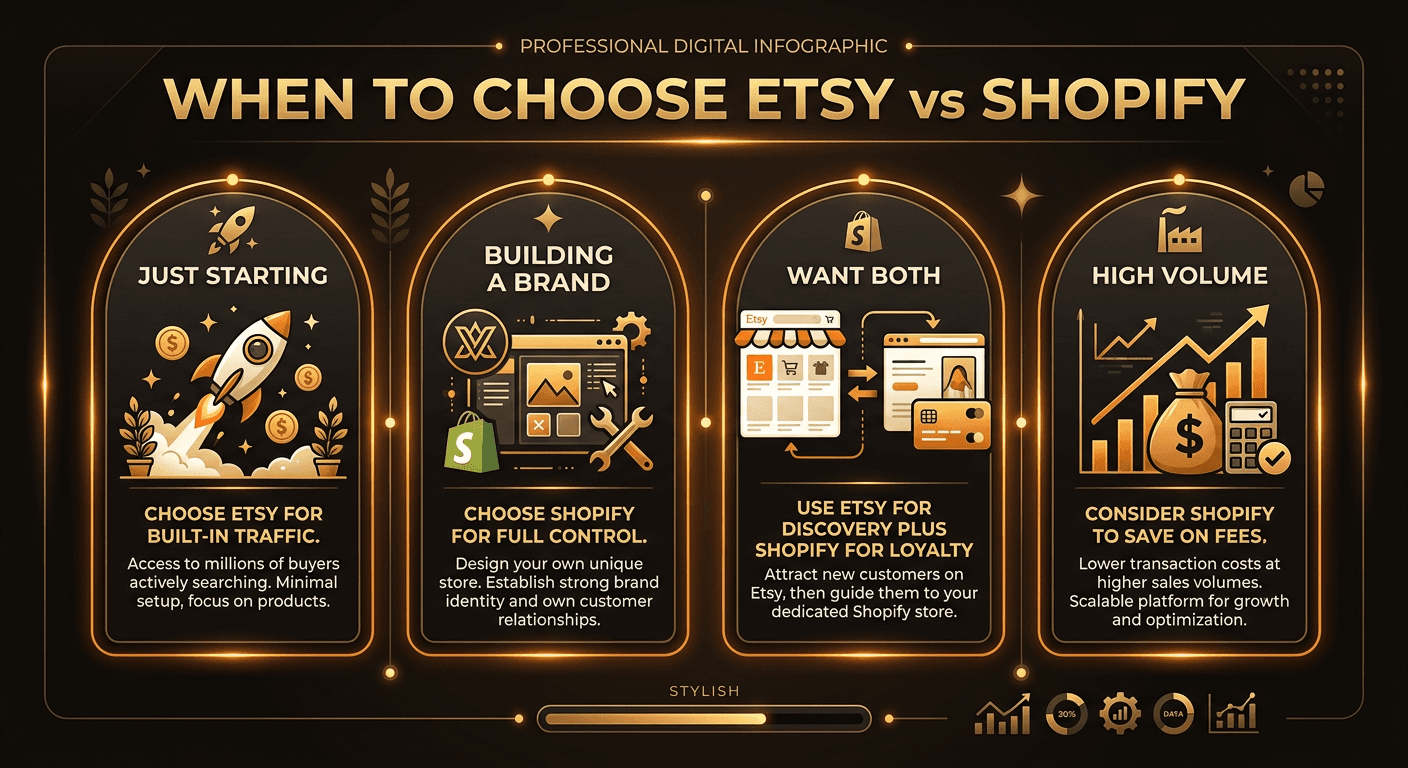
When to Choose Etsy
Etsy is the right choice when you need to validate your product idea quickly, reach buyers without a marketing budget, and start generating revenue from day one. Choose Etsy if:
- You're just starting out and don't have an audience, email list, or social following yet. Etsy's marketplace gives you immediate exposure to millions of buyers.
- You sell handmade, vintage, or unique items that fit Etsy's buyer expectations. Etsy shoppers actively seek out one-of-a-kind products and are willing to pay premium prices for craftsmanship. If you sell handmade goods specifically, also consider reading our Etsy vs Amazon Handmade comparison.
- You're testing product-market fit and want to see if people actually want what you're selling before investing in a full store. Etsy's low listing fee means you can test 20 different products for $4.00.
- You want built-in buyer trust without having to earn it from scratch. Etsy's review system, purchase protection, and brand recognition give buyers confidence to purchase from unknown sellers.
When to Choose Shopify
Shopify makes sense when you're ready to build a real brand, own your customer relationships, and scale beyond what a marketplace allows. Choose Shopify if:
- You're building a brand that you want customers to remember by name. On Shopify, buyers associate their experience with your brand — not with a marketplace.
- You're doing high volume and Etsy's 6.5% transaction fee is cutting deeply into your margins. At $5,000/month in revenue, you're paying $325/month in Etsy transaction fees alone — far more than Shopify's monthly subscription.
- You want full control over your store design, checkout experience, email marketing, upsells, and customer journey. Shopify lets you optimize every touchpoint.
- You have marketing skills (or budget) to drive traffic through SEO, social media, content, paid ads, or email. Shopify rewards sellers who can bring their own audience.
Best Strategy: Use Both
Here's what the most successful sellers figured out: the Etsy vs Shopify question is a false choice. The winning strategy is to use both platforms together, each playing to its strengths.
The Dual-Platform Strategy
- Etsy for discovery: Use Etsy as your top-of-funnel channel. Let Etsy's 90 million buyers find your products organically. This is your discovery engine — new customers who have never heard of your brand find you through Etsy search.
- Shopify for brand building: Once a customer discovers you on Etsy, include a card in their order directing them to your Shopify store for exclusive products, discounts, or loyalty rewards. Now they're your customer — you have their email, you can retarget them, and future orders have no 6.5% Etsy fee.
- Repeat customers on Shopify: Build email sequences, run loyalty programs, and offer subscribe-and-save options on your Shopify store. The lifetime value of a customer who buys from your own store is significantly higher than a one-time Etsy buyer.
- Risk mitigation: If Etsy suspends your shop, your Shopify store keeps running. If your Shopify traffic dips, Etsy still sends you buyers. Two channels means no single point of failure.
This dual-platform approach is exactly why understanding how Etsy fees work matters so much — once you see how much Etsy takes per sale, you'll understand the incentive to move repeat buyers to your own store.
Platform Risk: Why It Matters More Than You Think
This is the section most Etsy vs Shopify comparisons skip, but it's arguably the most important factor in your decision.
On Etsy, you don't own your business — you rent it. Etsy can suspend your shop for policy violations, intellectual property complaints, or even algorithmic mistakes. When that happens, you lose access to your listings, your revenue, and your customer communication — sometimes permanently.
Suspensions happen more often than most sellers realize. A single trademark complaint on one listing can trigger a full shop suspension. An accidental policy violation you didn't know about can lock you out overnight. And Etsy's appeals process is notoriously slow and opaque.
On Shopify, you own everything. Shopify doesn't police your product categories or penalize you for marketplace-style policy violations. Your domain, your customer list, your store design, and your revenue stream are all under your control. Shopify can't “suspend” your store the way Etsy can.
If you rely on Etsy for any significant portion of your income, protecting your shop from suspension isn't optional — it's essential. Compliance scanning catches trademark issues, policy violations, and risky listings before Etsy does, so you can fix problems proactively instead of reacting to a suspension notice. Learn how to protect your Etsy shop with a practical prevention strategy.
Selling on Etsy? Protect Your Shop
Whether Etsy is your primary channel or part of a dual-platform strategy, one suspension can wipe out months of work. Unflagged scans your listings for trademark risks, policy violations, and compliance issues — before Etsy flags them.
Scan Your Listings Free