Etsy Purchase Protection 2026: Who Pays What
Etsy Purchase Protection changed on 9 July 2026: the case window fell to 30 days and every eligible order now draws up to $250. Here is who pays what.
- 1.What Etsy Purchase Protection Actually Covers
- 2.What Changed in Etsy Purchase Protection on 9 July 2026
- 3.Who Pays: The $250 Line, Worked Through
- 4.The Eligibility Test Every Order Is Scored Against
- 5.Damaged in Transit: Once, Then Once a Year
- 6.The Clause That Costs the Most: Shop in Good Standing
- 7.A Chargeback Closes the Case and Takes the Cover With It
- 8.The First 48 Hours of a Case
- 9.What This Changes About How You Ship
- 10.Frequently Asked Questions
- 11.Related Reading
- 12.The Refund Rules Are Published. Your Listing Risk Is Not.
Key takeaways
- Etsy Purchase Protection is not insurance. It is a conditional refund, scored per order. Etsy pays the buyer up to $250 including shipping and tax and you keep your earnings, but only when the order passed every eligibility test at the moment it shipped. Nothing you do after the case opens can add eligibility back.
- Since 9 July 2026 the cap works in your favour on big orders. Coverage used to be confined to orders totalling $250 or less. Now any eligible order draws up to $250, so a $400 order gets $250 from Etsy and leaves $150 with you, where before it got nothing.
- The case window fell from 100 days to about 30. Buyers wait until 7 days past the latest estimated delivery date and then have roughly a month to open a case, which kills most of the disputes that used to arrive a season after the sale.
- Damage cover is once, then once per calendar year. The second damaged parcel in the same year is yours to refund no matter how well you packed it, and no amount of photographic evidence changes that arithmetic.
- A shop that is not in good standing is not covered on anything. Eligibility requires that you are not in violation of Etsy policy, so one trademark takedown quietly strips the refund cover from every order in your queue, including the ones already in transit.
A buyer opens a case, Etsy refunds them, and the money leaves your account. Somewhere in the help centre is a programme that was supposed to stop exactly that. Etsy Purchase Protection covers up to $250 on an eligible order, Etsy has put more than $25 million a year behind it since August 2022, and most sellers learn how it works on the day it turns out not to apply to them. The gap between a refund Etsy absorbs and one you fund is a short list of conditions, almost all of which were decided weeks before the case existed.
We read the current Purchase Protection Program for Sellers policy, the Cases Policy version that took effect on 9 July 2026, Etsy's April 2026 announcement of the changes, and the three vendor guides ranking for this term right now. Two of those three were last updated in 2022 and still tell sellers that buyers have 100 days to open a case. They do not. That number changed this year, along with the cap rule and the definition of a late parcel, and for anyone shipping more than a few orders a week the changes are worth real money.
What follows is who pays in each scenario, what voids the cover before a buyer has typed a word, and the part nobody else writes about: how a policy violation on one listing removes Purchase Protection from orders that have nothing to do with it.

What Etsy Purchase Protection Actually Covers
The programme exists to absorb the disputes that are not really about you. A parcel vanishes in the carrier network, an item turns up smashed, a buyer insists the mug is the wrong blue when the photo shows exactly that blue. In each of those, Etsy may refund the buyer directly and leave your earnings alone.
Four situations are named. A buyer never received the package. The item arrived 7 or more days after its estimated delivery date. The item arrived damaged, for the first eligible case and then once per calendar year. Or the buyer claims the item does not match the listing when the listing and photos say otherwise.
There is no enrolment and no fee. Qualifying orders are covered automatically, and nothing starts until a buyer sends a Help with Order message or opens a case. That last detail matters more than it sounds: the clock on your part of the process starts with the buyer's message, not with the case.
One condition sits outside all of this and catches people with real insurance. If you hold third-party cover, carrier cover, or payment-processor cover, Etsy asks you to claim on that first. Purchase Protection is meant to be the backstop, not the first call.
What Changed in Etsy Purchase Protection on 9 July 2026
Etsy announced a set of changes to the programme on 7 April 2026 and the current policy version has been in force since 9 July 2026, superseding a version that ran through 8 July. Etsy's own seller-facing and legal pages have given slightly different effective dates through this year, so if you are arguing a case that straddles the summer, check which version the order fell under rather than assuming.
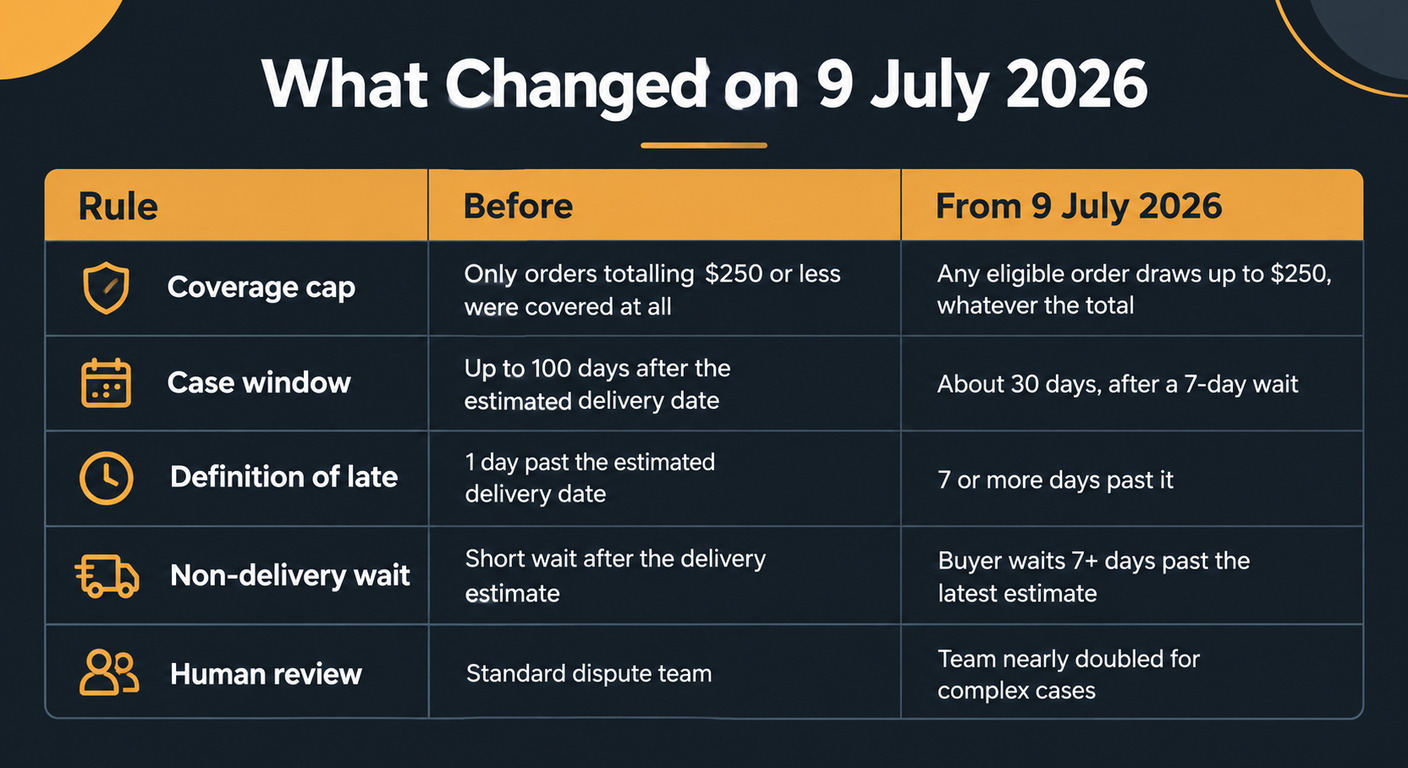
| Rule | Before | From 9 July 2026 | Who it helps |
|---|---|---|---|
| Coverage cap | Only orders totalling $250 or less were covered at all | Any eligible order draws up to $250, whatever the total | Sellers of higher-value work |
| Case window | Up to 100 days after the estimated delivery date | About 30 days, after a 7-day wait | Sellers, heavily |
| Definition of late | 1 day past the estimated delivery date | 7 or more days past it | Sellers shipping internationally |
| Non-delivery wait | Short wait after the delivery estimate | Buyer waits 7+ days past the latest estimate | Sellers, and the carrier's chance to deliver |
| Human review | Standard dispute team | Team nearly doubled for complex cases | Anyone who has ever been auto-resolved against |
The cap change is the one worth reading twice, because it inverts the old logic. Under the previous rule a $400 order was outside the programme entirely; the whole refund was yours. Now the same order is eligible and Etsy pays $250 of it. Sellers who deliberately kept order totals under $250 to stay inside the programme can stop doing that.
The window change is quietly enormous. Under the old rule a buyer could open a non-delivery case on a sale from three months earlier, long after the tracking had aged out of the carrier's system and you had any hope of proving anything. That tail is now closed.
One honest caveat on the 30 days: Etsy's wording describes it both as 30 days after the estimated delivery date and as 30 days from the point the case becomes eligible. The practical effect is the same order of magnitude, roughly five weeks from the delivery estimate rather than fourteen, but do not plan a records-retention policy around the exact day.
Who Pays: The $250 Line, Worked Through
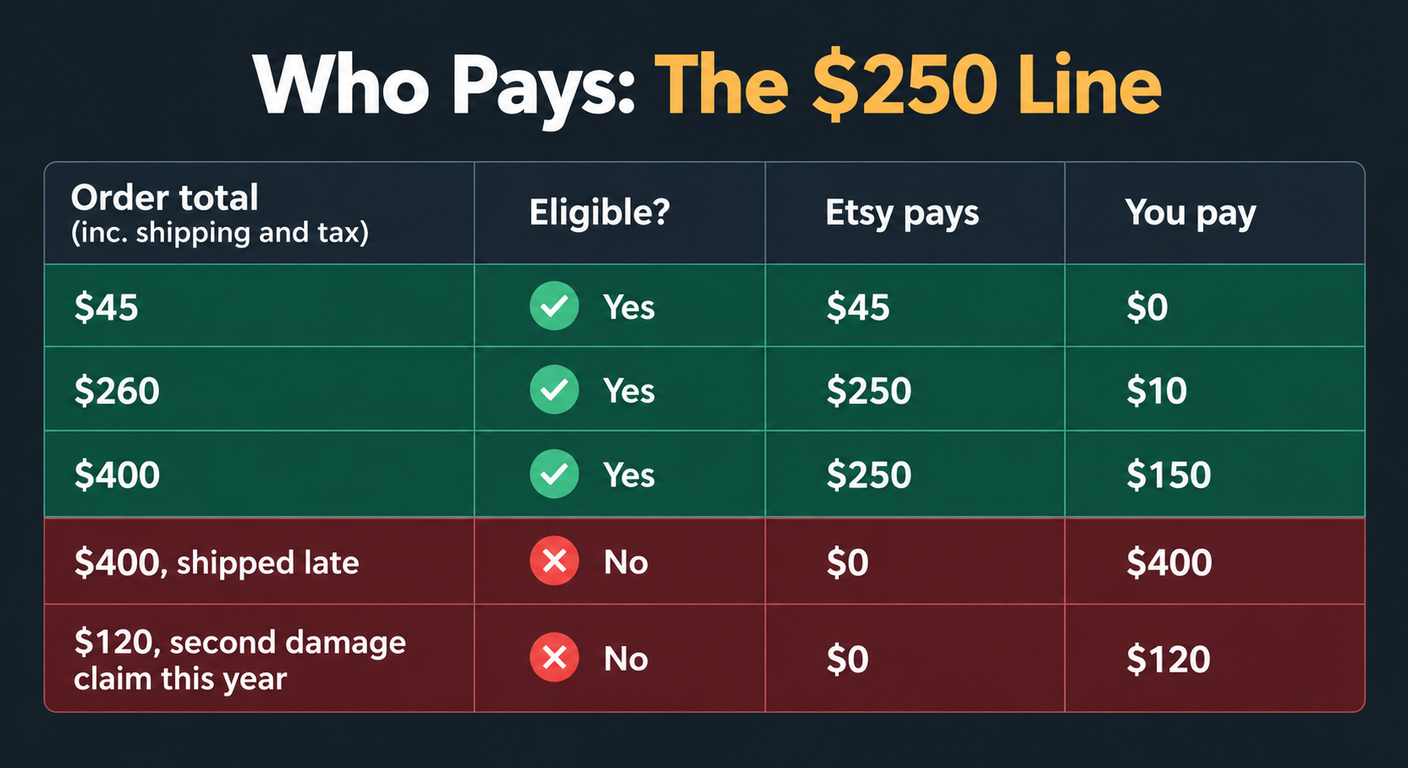
The cap is $250 including shipping and any tax collected on the Etsy platform. That inclusion catches people. A $230 item with $30 shipping is a $260 order, and $10 of it is yours.
| Order total (inc. shipping and tax) | Eligible? | Etsy pays | You pay | You keep your earnings? |
|---|---|---|---|---|
| $45 | Yes | $45 | $0 | Yes |
| $260 | Yes | $250 | $10 | Yes, less the $10 |
| $400 | Yes | $250 | $150 | Yes, less the $150 |
| $400 | No, shipped late | $0 | $400 | No |
| $120, second damage claim this year | No, annual limit used | $0 | $120 | No |
Read the bottom two rows together, because they are the whole argument. Eligibility is binary and it is decided by facts that were fixed before the dispute started. A $400 order that shipped a day late is not partially covered; it is not covered. The processing time you set is therefore not a customer-service nicety, it is the deductible on this policy.
Where an order falls outside the programme, Etsy still has the power to resolve the case. The Cases Policy reserves Etsy's right to refund the buyer and recoup the funds from your account, which in practice means a negative balance or a deduction from your next deposit. If that leaves your account short, you are into payment reserve territory, which is its own slow problem.
The Eligibility Test Every Order Is Scored Against
Nothing here is difficult. All of it is boring, and boring is exactly why it gets skipped on the day you ship forty parcels before a deadline.
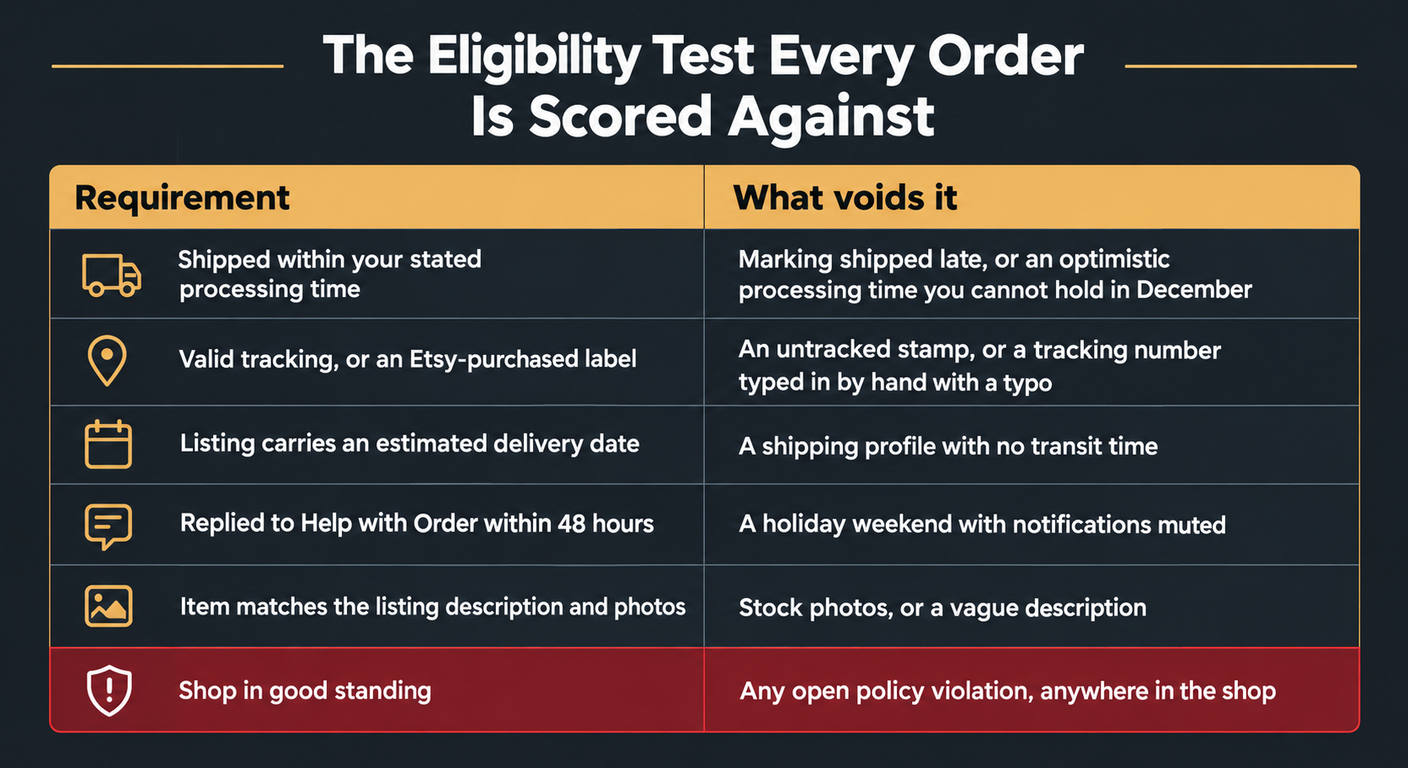
| Requirement | Where it is set | What voids it |
|---|---|---|
| Shipped within your stated processing time | Listing, shipping profile | Marking shipped late, or an optimistic processing time you cannot hold in December |
| Valid tracking, or an Etsy-purchased label | Order fulfilment | An untracked stamp; a tracking number typed in by hand with a typo |
| Listing carries an estimated delivery date including transit | Shipping profile | A profile with no transit time, so Etsy cannot compute a date |
| Replied to Help with Order within 48 hours | Messages | A holiday weekend with notifications muted |
| Item matches the listing description and photos | The listing itself | Stock photos, an old photo of a revised product, a vague description |
| Shop in good standing | Your whole account | Any open policy violation, anywhere in the shop |
Two of these are worth setting once and forgetting. Buy labels through Etsy where your carrier is supported, so tracking is attached automatically and never mistyped. And put a real transit time in every shipping profile, because a profile without one produces no estimated delivery date, and an order with no estimated delivery date cannot be scored against a late-delivery rule at all.
The 48-hour rule is the one that catches hobby sellers and anyone in a timezone away from their buyers. It is not a response to the case, it is a response to the buyer's first Help with Order message, which arrives as an ordinary message and looks like nothing.
Damaged in Transit: Once, Then Once a Year
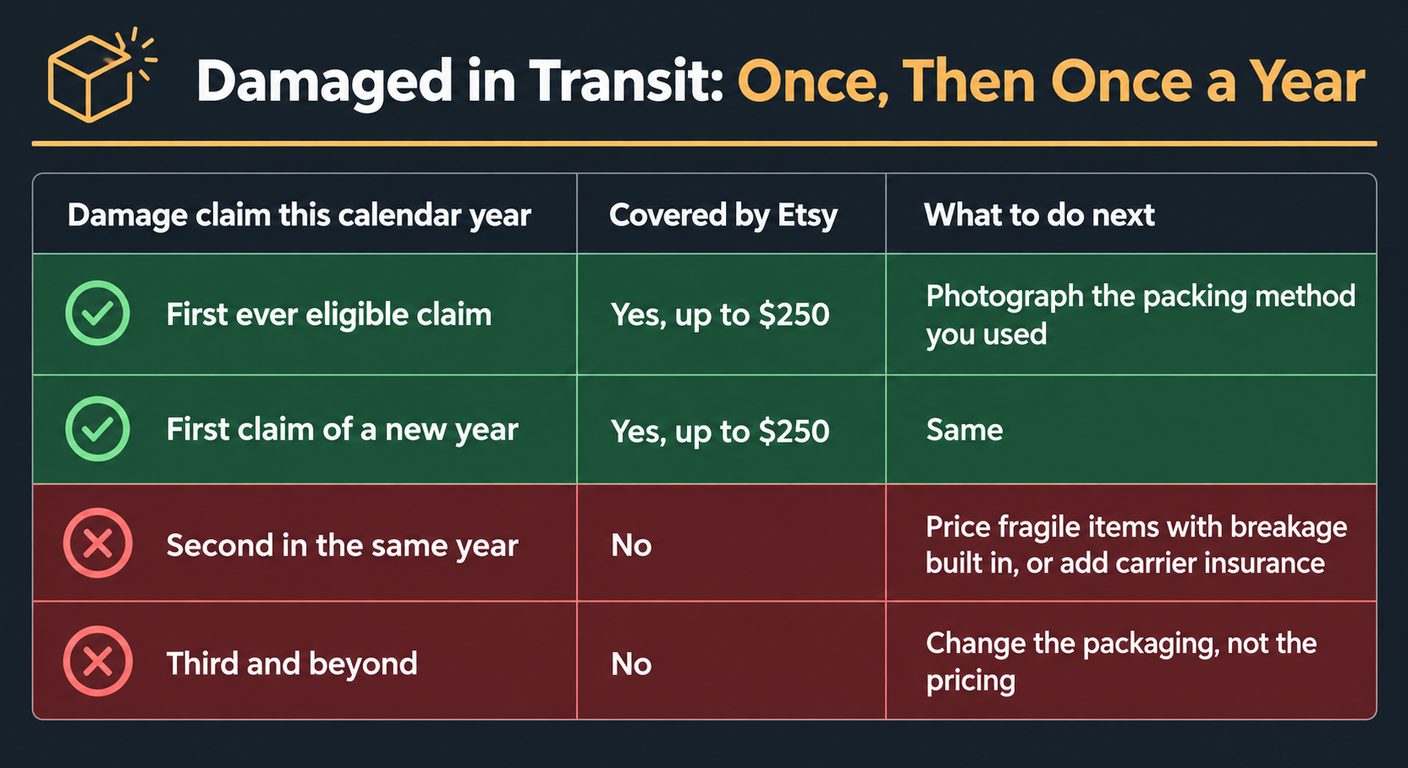
Damage is the category where sellers most often assume they are covered and most often are not. Etsy supports you on the first eligible damaged case, and then once for each calendar year after that. Every further damaged parcel in the same year is refunded by you.
This is a deliberate design, not an oversight. Repeated damage claims are a packaging signal rather than a carrier accident, and the programme is built to nudge rather than to subsidise. If you have used your annual damage cover by March, you are self-insuring nine months of fragile shipments, and the only lever left is the box.
| Damage claim this calendar year | Covered by Etsy | What to do next |
|---|---|---|
| First ever eligible claim | Yes, up to $250 | Photograph the packing method you used, so you can tell what changed later |
| First claim of a new year | Yes, up to $250 | Same |
| Second in the same year | No | Price fragile items with breakage built in, or add carrier insurance |
| Third and beyond | No | Change the packaging, not the pricing |
Carrier insurance is the sane answer for anything genuinely fragile and above about $80. It also satisfies Etsy's expectation that you claim on your primary cover first, which means you are not spending your once-a-year allowance on a parcel a carrier would have paid for.
The Clause That Costs the Most: Shop in Good Standing
This is the line every competing guide mentions in passing and nobody thinks through. Purchase Protection eligibility requires that your shop is in good standing, which means not in violation of Etsy's policies. A shop with an open violation is not covered, and the violation does not have to have anything to do with the order in dispute.
Work through what that means. A single trademark complaint against one listing puts the shop out of good standing. Every order currently in transit, every order a buyer might open a case on next week, and every order you ship while the matter is open loses its refund cover at the same moment. You do not get a notice saying so. You find out one case at a time, weeks later, when a refund you expected Etsy to absorb comes out of your balance instead.
That converts a listing problem into a cash-flow problem, and it is why the compliance basics are worth more than they look. The obvious cost of a takedown is one listing and one strike. The unobvious cost is that your entire order book is now uninsured, and it stays uninsured until the matter closes.
It stacks with everything else too. Orders that go wrong during a violation period produce cases you fund, cases feed into the metrics behind Star Seller status and suspension risk, and a shop already under review is not the place to be accumulating unresolved disputes. If it goes further than that, a suspension does not cancel your open orders: you still have to fill or refund every one of them, without the programme behind you.
A Chargeback Closes the Case and Takes the Cover With It
If a buyer opens a case and then files a chargeback with their card issuer, the Etsy case is closed. The dispute moves to the card network, and the programme that was about to pay $250 is no longer part of the conversation.
| Etsy case | Card chargeback | |
|---|---|---|
| Who decides | Etsy, increasingly with human review | The card issuer |
| Purchase Protection applies | Yes, if eligible | No |
| Evidence you can file | Messages, tracking, listing photos | Whatever Etsy submits on your behalf |
| Typical timeline | Days to weeks | Weeks to months |
| Your control over it | Meaningful | Almost none |
The practical conclusion is uncomfortable but clear. A case you resolve quickly and generously is usually cheaper than the chargeback it turns into. A buyer who feels ignored for three days does not escalate within Etsy, they phone their bank, and that route is worse for you on every axis in that table.
This is also where a published, specific returns policy earns its keep. Clear terms give you something to point at in the first message, and a buyer who has been shown the terms and offered a remedy rarely reaches for the card issuer. Our guide to Etsy return policies covers what to write.
The First 48 Hours of a Case
Most of the outcome is set in the first two days, and most sellers spend them deciding whether to be annoyed.
| When | Do this | Why it matters |
|---|---|---|
| Hour 0 to 2 | Reply to the Help with Order message, even just to acknowledge it | The 48-hour response requirement is an eligibility condition, not a courtesy |
| Hour 2 to 6 | Pull the tracking event history and screenshot it | Carrier records age out; the case may run for weeks |
| Hour 6 to 24 | Check the order against the eligibility list above, honestly | Tells you whether you are arguing for a $250 payout or a full refund |
| Hour 24 to 48 | Offer a concrete remedy: reship, refund, or wait a defined number of days | Defined offers prevent chargebacks; silence causes them |
| After 48 hours | Let it escalate to Etsy with your evidence attached | The review team is larger since April 2026; documented cases fare better |
Keep every exchange inside Etsy Messages. A resolution agreed by email or on Instagram did not happen as far as the case reviewer is concerned, and reviewers work from the record in front of them.
What This Changes About How You Ship
Four habits follow from all of the above, and none of them is expensive.
Set processing times you can hold in your worst week, not your best one. Shipping inside your stated window is the single condition most often broken, and it voids everything else. A processing time two days longer than you need costs you almost no conversions and buys you the entire programme.
Stop capping order values at $250. That behaviour made sense until 9 July 2026 and makes none now. Bundle, offer the larger set, sell the commission, and take the $250 of cover with it.
Treat your damage allowance as a budget line. One free claim a year, spent early, means self-insuring the rest. Carrier insurance on genuinely fragile items keeps the allowance in reserve.
Keep the shop in good standing as a revenue decision, not a compliance chore. Every day with an open violation is a day your whole order book ships uninsured, and that is a far larger number than the one listing at issue.
Frequently Asked Questions
Does Etsy Purchase Protection cost sellers anything?
No. There is no fee and no enrolment, and Etsy has funded the programme at more than $25 million a year since it launched in August 2022. The cost is indirect: meeting the eligibility conditions means realistic processing times, tracked shipping and fast replies, all of which take some effort to maintain.
How much does Etsy pay on a covered order?
Up to $250 per eligible order, including shipping and any tax collected on the Etsy platform. Since 9 July 2026 an order larger than $250 is still eligible and still draws $250, with the balance falling to you. Before that date orders over $250 were outside the programme entirely.
How long does a buyer have to open an Etsy case in 2026?
About 30 days, after waiting 7 or more days past the latest estimated delivery date. The old window was 100 days after the estimated delivery date. Etsy describes the new one both as 30 days from the delivery estimate and as 30 days from the point the case becomes eligible, so treat it as roughly five weeks rather than a precise deadline.
Why was my order not eligible for Purchase Protection?
Almost always one of six things: it shipped outside your stated processing time, it had no valid tracking or Etsy-purchased label, the shipping profile produced no estimated delivery date, you did not reply to the buyer within 48 hours, the item did not match the listing, or your shop was not in good standing. Eligibility is decided on the facts at the time, and cannot be repaired after the case opens.
Does a policy violation affect my Purchase Protection?
Yes, and this is the most expensive thing on the list. Good standing is an eligibility condition, so an open violation anywhere in the shop removes coverage from every order, including ones already in transit and unrelated to the violation. Resolving the violation restores eligibility for orders going forward.
What happens if a buyer files a chargeback instead of a case?
The Etsy case closes and the dispute moves to the card issuer, where Purchase Protection does not apply and you have very little control over the outcome. This is the main reason to answer the first message quickly and offer a definite remedy: a resolved case is almost always cheaper than the chargeback it would have become.
Am I covered every time a parcel arrives damaged?
No. Etsy covers your first eligible damaged case and then one per calendar year. Further damage claims in the same year are yours to refund. For fragile items above roughly $80, carrier insurance is the better first line, and claiming on it also satisfies Etsy's expectation that you use your primary coverage first.
Related Reading
- What actually happens when Etsy suspends your shop
- Etsy payment reserve: why your money is on hold
- Star Seller status and suspension risk
- The complete guide to Etsy seller compliance
- Etsy policy changes in 2026, and what they mean for sellers
- Etsy EU compliance: why your listings are hidden
The Refund Rules Are Published. Your Listing Risk Is Not.
Everything above is knowable in advance. The cap, the window, the eligibility list and the damage limit are all written down, and a seller who spends an evening on them will never be surprised by a refund again. The part that is not published is what is sitting in your own listings: which title contains a mark somebody owns, which description contradicts Etsy's handmade or production partner rules, which tag would fail a review today. That is the risk that takes good standing away, and good standing is what the whole programme rests on.
Unflagged scans your listings for what actually triggers enforcement: trademark exposure in titles, tags and descriptions, attribution that conflicts with Etsy's handmade and production partner rules, and policy problems that are invisible from inside your own shop. Run a free scan to see where you stand, or create an account for ongoing monitoring. Plans and limits are on the pricing page.
Keep the primary sources to hand and check them before you argue a case. Etsy's Purchase Protection Program for Sellers policy is the binding text on coverage and eligibility, the Cases Policy sets the timing and Etsy's power to resolve a case on your behalf, and Etsy's own launch announcement for the programme records the original commitment. Both etsy.com policy pages block automated fetching, so open them in a browser while signed in.
Scan Your Listings Free
Check your Etsy listings for trademark violations in seconds. 3 free scans, no signup required.
Start Free ScanRelated Articles
How to Check Your Etsy Listings for Trademark Violations (2026 Guide)
Learn how to scan your Etsy listings for trademark violations before they get flagged. Step-by-step guide to protecting your shop from takedowns and suspensions.
Read moreEtsy Shop Suspended? How to Write a Winning Appeal Letter
Your Etsy shop got suspended. Here's exactly how to write an appeal letter that gets your shop reinstated, with templates and strategies that actually work.
Read more50 Words That Are Trademarked on Etsy (Stop Using These Now)
A comprehensive list of commonly trademarked words and phrases that Etsy sellers use without realizing they're violating trademark law. Check your listings now.
Read more