Etsy Payment Reserve 2026: Why Your Money Is On Hold
Etsy is holding part of every sale. Which of the three holds you have, what releases the funds, and the one lever that lifts a reserve in 24 hours.
- 1.Which Etsy Hold You Actually Have
- 2.How an Etsy Payment Reserve Works
- 3.Why Etsy Put a Reserve on Your Shop
- 4.How Much Etsy Holds, and Why Sources Disagree
- 5.The Fastest Way Out: Tracking, Then Star Seller
- 6.There Is No Appeal, and Support Cannot Lift It
- 7.When a Reserve Is a Warning About Something Worse
- 8.Managing Cash Flow While the Reserve Runs
- 9.Related Reading on Unflagged
- 10.Frequently Asked Questions
- 11.Get Ahead of the Problem That Does Not Fix Itself

Key takeaways
- Three different mechanisms hold Etsy money and they are not the same thing: the new-seller schedule hold, the payment account reserve, and the risk hold that follows a suspension. The fix for one does nothing for the others.
- An Etsy payment reserve holds a percentage of each physical-item sale until tracking shows the order in transit, or until roughly 45 days pass without tracking. Most reserves lift within 90 days.
- Etsy does not publish a fixed rate. 30% is the figure most commonly reported since Etsy reduced reserves in June 2023, but 25% and 75% both appear in seller accounts, so treat any single number as an estimate.
- Star Seller is the fastest documented exit. Earning the badge at the monthly review removes an existing reserve within 24 hours, and shops that already hold it do not get reserves placed.
- There is no appeal. Etsy Support agents cannot lift a reserve, even one applied in error. Shipping behaviour is the only lever you control.
Which Etsy Hold You Actually Have
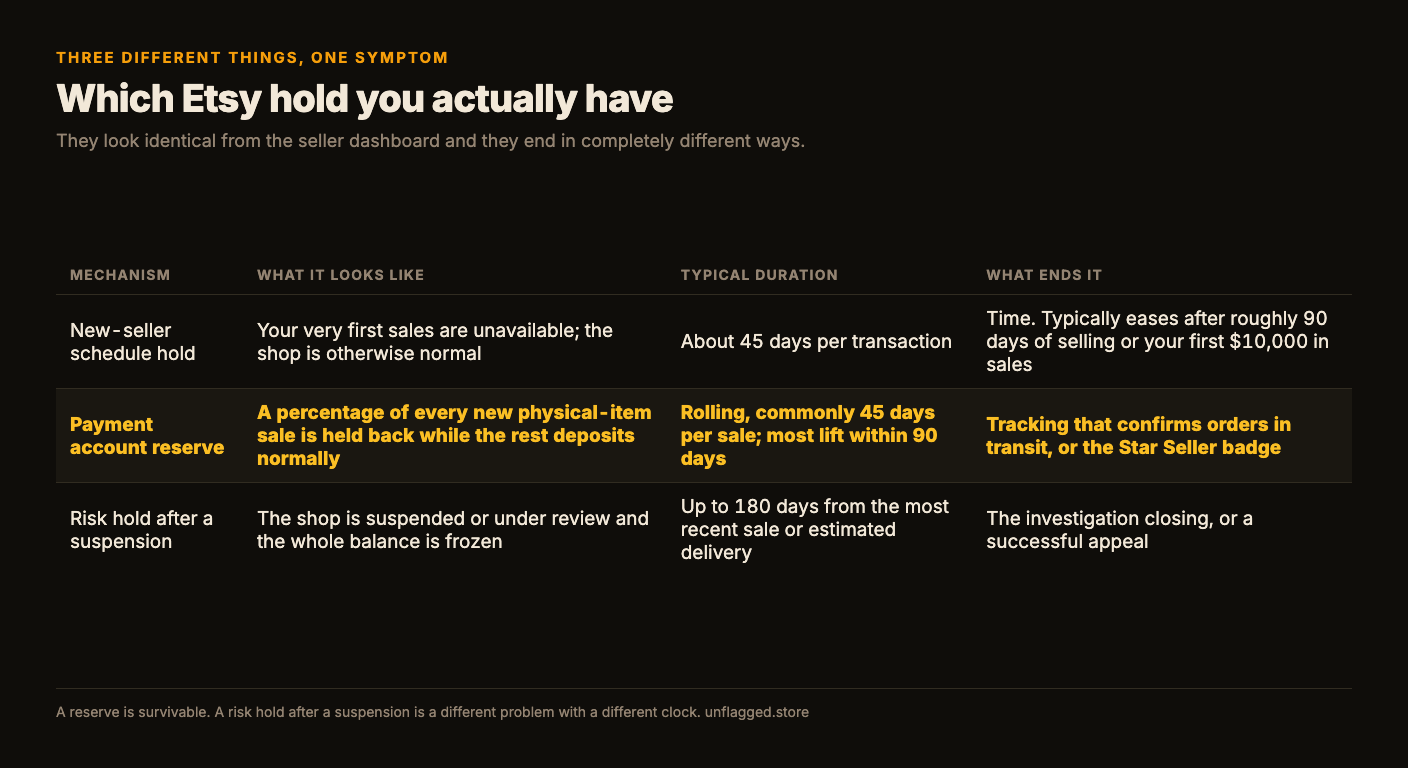
Your dashboard says the money is there and your bank says it is not, and somewhere in between sits a line about funds being unavailable. Sellers lose weeks to this because they treat every held deposit as the same problem. It is not. An Etsy payment reserve is one of three separate mechanisms, and the action that clears one will do nothing at all for the other two.
We went through Etsy's Payments Policy, the help centre article on reserves, and what sellers report on the ground, and the three cases separate cleanly. Work out which row you are in before you do anything else, because the wrong diagnosis costs you the one thing you actually have, which is time.
| Mechanism | What it looks like | Typical duration | What ends it |
|---|---|---|---|
| New-seller schedule hold | Your very first sales are unavailable; the shop is otherwise normal | About 45 days per transaction | Time. Typically eases after roughly 90 days of selling or your first $10,000 in sales |
| Payment account reserve | A percentage of every new physical-item sale is held back while the rest deposits normally | Rolling, commonly 45 days per sale; most lift within 90 days | Tracking that confirms orders in transit, or the Star Seller badge |
| Risk hold after a suspension | The shop is suspended or under review and the whole balance is frozen | Up to 180 days from the most recent sale or estimated delivery | The investigation closing, or a successful appeal |
The tell is simple. If part of each sale still deposits, you have a reserve. If nothing moves and your listings are down, you are in the third row and the money is the second problem, not the first. Our guide to deactivated versus suspended shops covers how to tell those apart.
How an Etsy Payment Reserve Works
A reserve is not a penalty and it is not a fine. Etsy is holding a slice of your incoming sales as a float against refunds, chargebacks and fees, on the reasoning that if an order goes wrong there needs to be money on hand to make the buyer whole. The reserved funds are genuinely yours, and Etsy will draw on them only if your available balance cannot cover a refund or a fee.
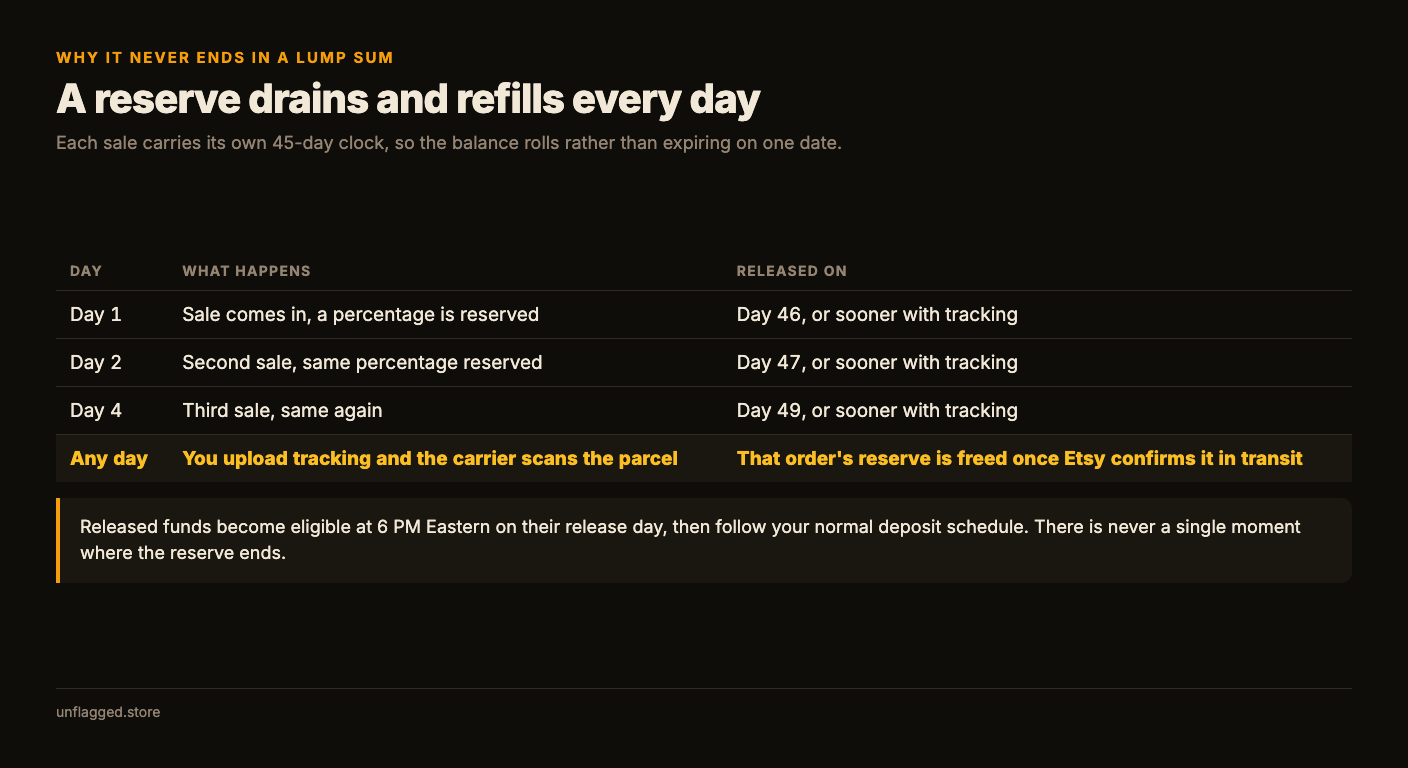
The mechanic that confuses people is that it rolls. Each sale carries its own clock rather than the account having one release date.
| Day | What happens | Released on |
|---|---|---|
| Day 1 | Sale comes in, a percentage is reserved | Day 46, or sooner with tracking |
| Day 2 | Second sale, same percentage reserved | Day 47, or sooner with tracking |
| Day 4 | Third sale, same again | Day 49, or sooner with tracking |
| Any day | You upload tracking and the carrier scans the parcel | That order's reserve is freed once Etsy confirms it in transit |
So there is never a single moment where the reserve ends and a lump sum lands. It drains and refills continuously, which is why sellers who wait passively feel like nothing is happening. Released funds become eligible at 6 PM Eastern on their release day, then follow your normal deposit schedule from there.
The practical consequence: tracking is not paperwork, it is the release mechanism. An order shipped with a real, scannable tracking number frees its own reserve early. An order shipped without one sits the full period regardless of how happy the buyer is.
Why Etsy Put a Reserve on Your Shop
Etsy will not tell you which specific trigger fired, which is the single most frustrating part of this for sellers who have done nothing wrong. What Etsy does publish is the risk factors the system weighs, and they are mundane operational signals rather than accusations of misconduct.
| Trigger | What Etsy sees | What actually fixes it |
|---|---|---|
| Orders shipped without tracking | No proof the buyer will receive anything | Buy labels through Etsy so tracking attaches automatically |
| Orders shipped past your processing time | Stated promises the shop is not meeting | Lengthen your processing times to what you actually hit |
| A sudden sharp increase in orders | A pattern that looks like either a viral hit or a compromised account | Nothing. Ship cleanly and it settles |
| A recent rise in refunds or cancellations | Money likely to flow back out | Fix the underlying listing or stock problem, not the refund rate |
| The shop is new | No history to price the risk against | Time plus a clean shipping record |
Notice what is absent from that list. None of these are policy violations. A reserve is a cash-flow judgement, not a compliance verdict, and a shop in perfect standing can pick one up after a good week. The sharp-increase trigger is the cruellest of them, because it fires precisely when a listing finally takes off and you most need the money to restock.
If your processing times are the problem, that is worth fixing properly rather than tactically. Our notes on shipping settings that keep a shop in good standing go through how the stated window interacts with your other metrics.
How Much Etsy Holds, and Why Sources Disagree
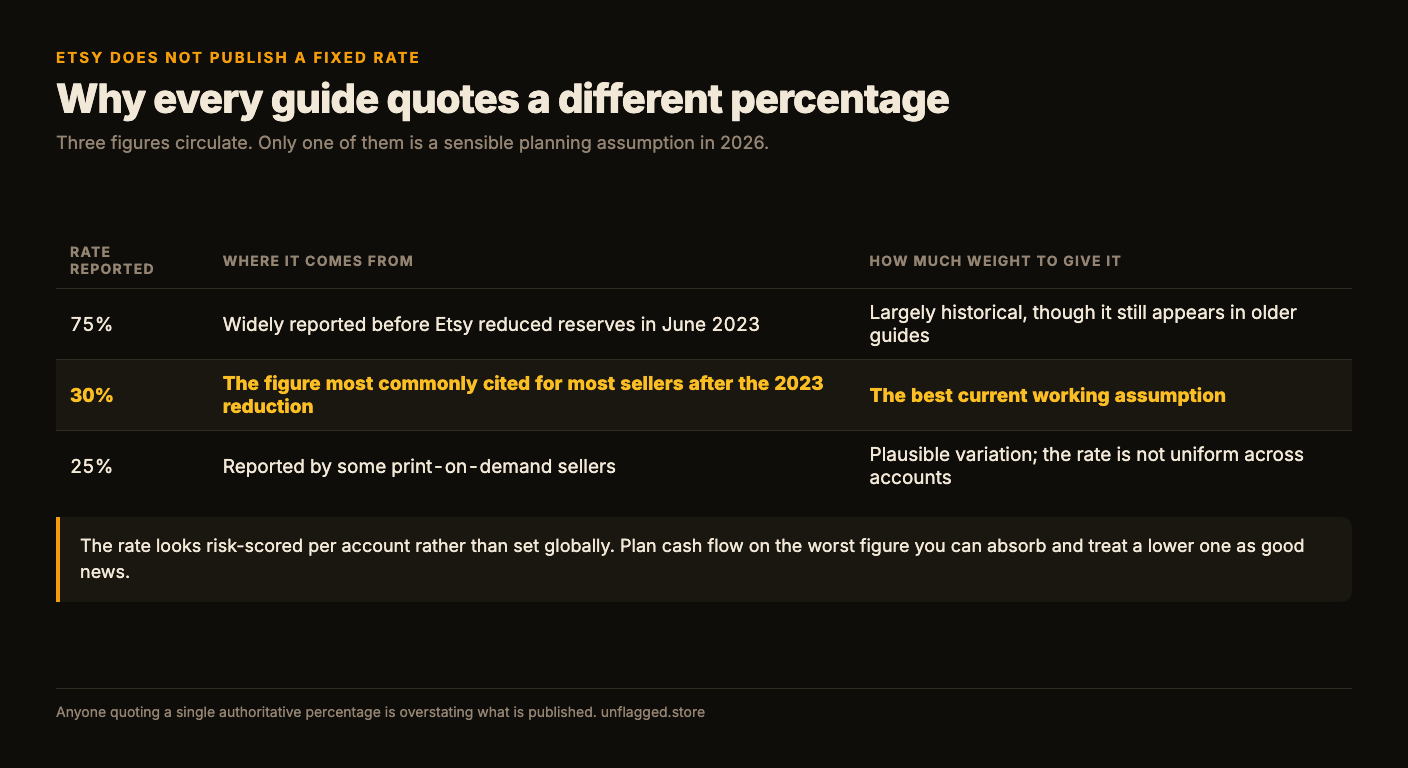
Here is where we have to be honest rather than confident. Etsy does not publish a fixed reserve rate, and the numbers in circulation do not agree with each other.
| Rate reported | Where it comes from | How much weight to give it |
|---|---|---|
| 75% | Widely reported before Etsy reduced reserves in June 2023 | Largely historical, though it still appears in older guides |
| 30% | The figure most commonly cited for most sellers after the 2023 reduction | The best current working assumption |
| 25% | Reported by some print-on-demand sellers | Plausible variation; the rate is not uniform across accounts |
The reasonable read is that the rate is risk-scored per account rather than set globally, and that 30% is a planning assumption rather than a promise. Anyone quoting you a single authoritative percentage is overstating what is actually published. Plan your cash flow on the worst figure you can absorb and treat a lower one as good news.
The Fastest Way Out: Tracking, Then Star Seller
Two levers work. Everything else is waiting.
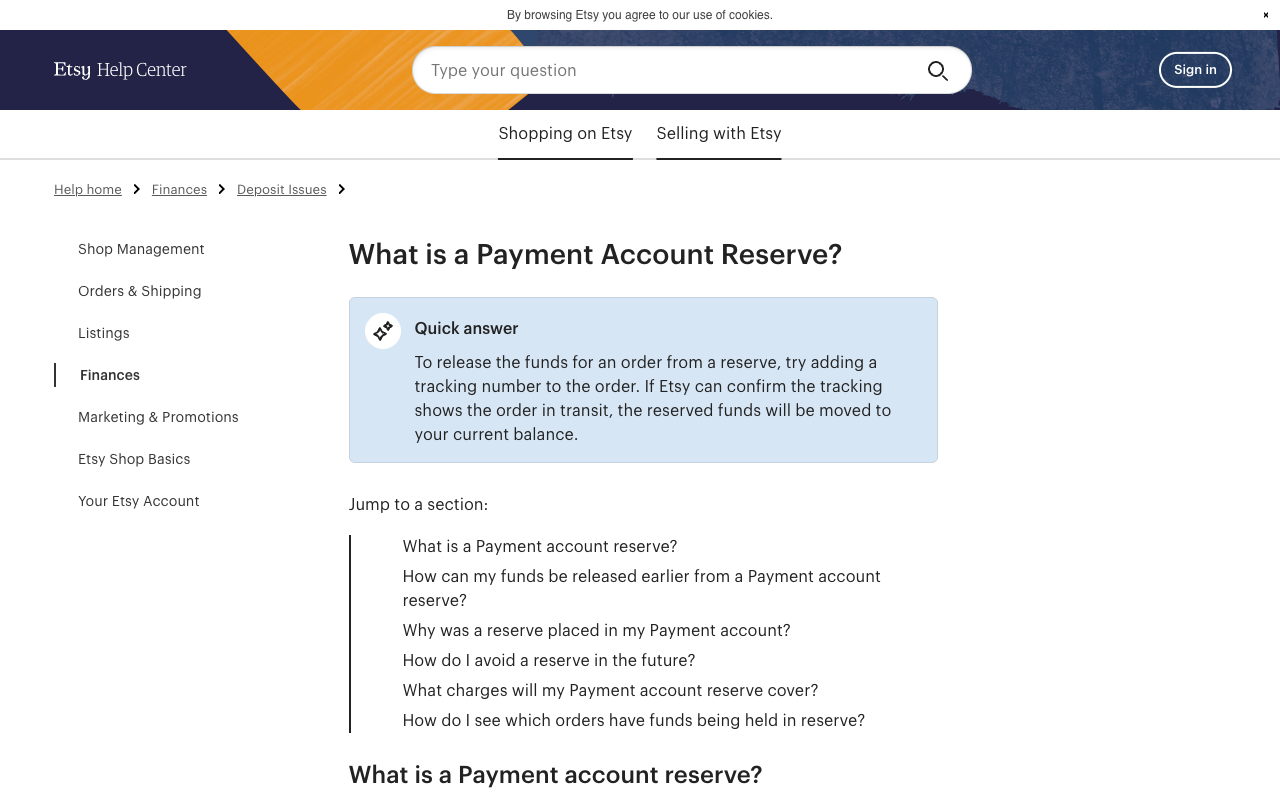
The first is tracking, covered above: every order that ships with a scannable number releases its own reserve early instead of serving the full term. If you are currently buying postage outside Etsy, moving to Etsy-purchased labels is the single highest-value change you can make this week, because the tracking attaches without you remembering to do anything.
The Star Seller lever. If you earn the Star Seller badge at a monthly review, any reserve on your payments account is removed within 24 hours. Shops that already hold the badge do not get reserves placed on them at all. This is the only documented mechanism that ends a reserve outright rather than draining it order by order.
That makes Star Seller worth chasing for a reason most guides miss. The badge is usually sold as a search-visibility perk, and its real value to a shop under a reserve is that it is the emergency exit. The criteria are the ordinary ones, message response speed, on-time shipping with tracking, ratings and order volume, assessed on a monthly cycle. We break the thresholds down in our guide to Star Seller requirements.
One caveat worth holding onto: the badge protects your money flow, not your listings. Star Seller status has no bearing on a trademark complaint or a policy takedown, a point we make at length in why good metrics do not protect you. Different systems, different triggers.
There Is No Appeal, and Support Cannot Lift It
This is the part sellers spend the most time on and get the least from, so it is worth saying plainly: Etsy Support agents cannot remove a payment account reserve. There is no formal appeal route, no escalation path, and no ticket that resolves it, including when the reserve appears to have been applied in error and none of the published triggers match your shop.
What this means in practice. Hours spent writing to Support about a reserve are hours not spent shipping orders with tracking, which is the thing that actually releases the money. The reserve is applied by an automated risk system and it clears on that system's terms.
We are not saying never contact Support. If your deposit has been delayed past the point the reserve rules explain, or funds have not released after tracking confirmed delivery, that is a genuine ticket about a specific transaction and it is worth raising. What does not work is asking for the reserve itself to be reconsidered.
When a Reserve Is a Warning About Something Worse
A reserve on its own is not a compliance problem. Where it becomes worth paying attention is when it arrives alongside something else, because the same operational signals that trigger a reserve also feed the review processes that take listings down.
The combinations we would treat as a warning rather than an inconvenience:
- A reserve appearing in the same week as a listing deactivation, which suggests the shop has drawn attention on more than one axis.
- A reserve alongside a spike in buyer disputes about item accuracy, which is a description problem before it is a payments problem.
- A reserve on a shop that recently changed what it sells, particularly into licensed or branded territory, where the risk is an intellectual property complaint rather than a shipping metric.
The distinction matters because the two problems have opposite time signatures. A reserve resolves itself if you ship well. A policy exposure does not resolve itself, it compounds quietly until a complaint lands, and by then your funds are in the 180-day row of that first table rather than the middle one. If a suspension notice has already arrived, our walkthrough of what the suspension email actually means is the better starting point.
Managing Cash Flow While the Reserve Runs
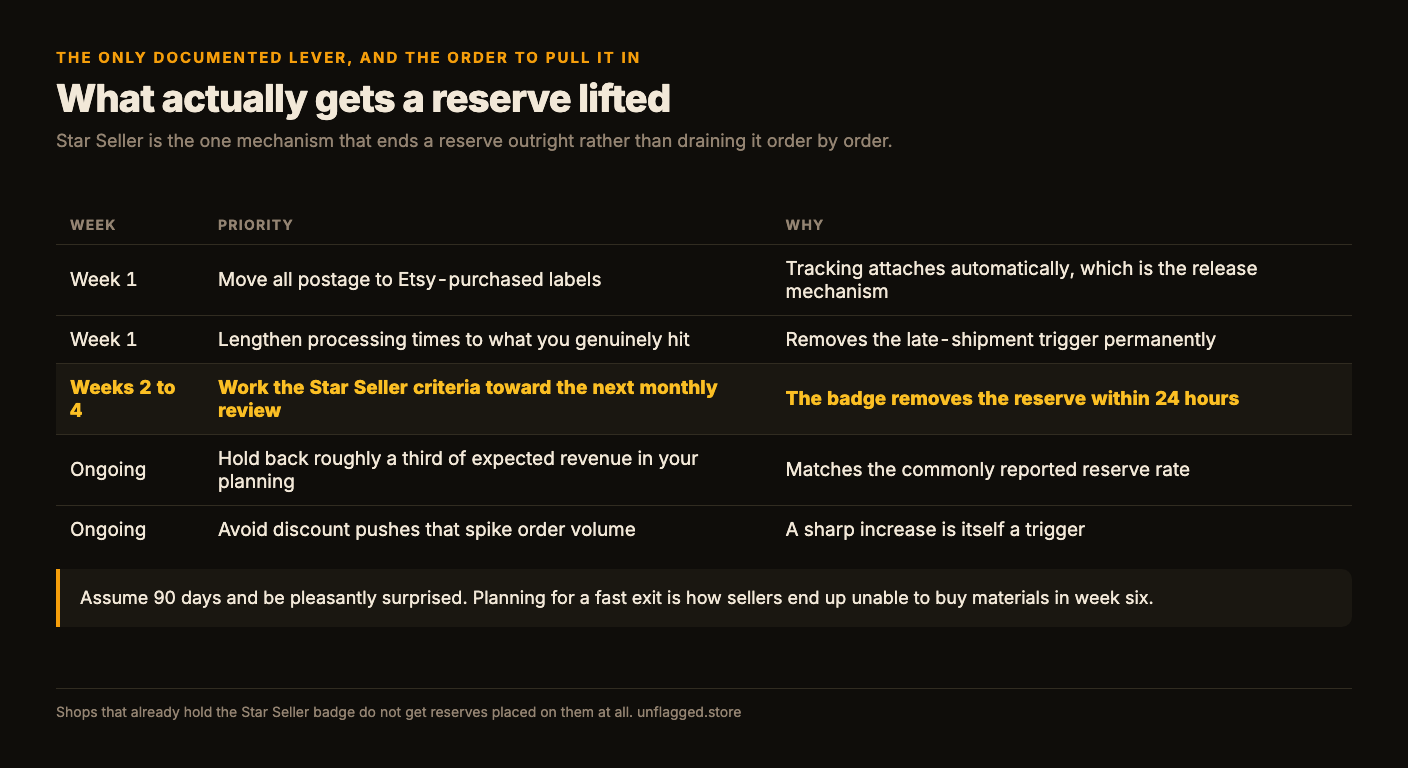
Assume 90 days and be pleasantly surprised. Planning for a fast exit is how sellers end up unable to buy materials in week six.
| Week | Priority | Why |
|---|---|---|
| Week 1 | Move all postage to Etsy-purchased labels | Tracking attaches automatically, which is the release mechanism |
| Week 1 | Lengthen processing times to what you genuinely hit | Removes the late-shipment trigger permanently |
| Weeks 2 to 4 | Work the Star Seller criteria toward the next monthly review | The badge removes the reserve within 24 hours |
| Ongoing | Hold back roughly a third of expected revenue in your planning | Matches the commonly reported reserve rate |
| Ongoing | Avoid discount pushes that spike order volume | A sharp increase is itself a trigger |
That last row is counterintuitive and sellers resist it, but running a promotion while under a reserve means a larger share of a larger number is held back, which tightens the squeeze rather than easing it. Restock and steady the operational metrics first, then push volume once the reserve has lifted.
Related Reading on Unflagged
- Etsy account suspended? The complete recovery guide
- Deactivated versus suspended: what the difference means for your funds
- Suspended but no email arrived? What to do next
- Etsy Star Seller: requirements, tips and whether it is worth it
- Why Etsy deactivated your listing, and how to fix it
- Can Etsy permanently ban your shop?
Frequently Asked Questions
How long does an Etsy payment reserve last?
Individual sales are typically held around 45 days if no tracking is supplied, and the reserve itself is usually removed within 90 days. Because it rolls per order rather than expiring on one date, funds trickle back continuously rather than arriving as a lump sum.
What percentage does Etsy hold in a reserve?
Etsy does not publish a fixed rate. Since the June 2023 reduction, 30% is the figure most commonly reported for most sellers, though 25% and the older 75% both appear in seller accounts. Plan against the highest figure you can absorb rather than treating any single number as guaranteed.
Can I appeal an Etsy payment reserve?
No. There is no appeal route, and Etsy Support agents are not able to remove a reserve, including one that appears to have been applied in error. The reserve is set by an automated risk assessment and clears on shipping behaviour rather than on request.
Does adding tracking release my reserved funds early?
Yes, and it is the main lever you control. Once Etsy confirms an order is in transit with valid tracking, that order's reserved portion is freed rather than serving the full holding period. Buying postage through Etsy attaches tracking automatically.
Does becoming a Star Seller remove a reserve?
Yes. Earning the badge at a monthly review removes any existing reserve from your payments account within 24 hours, and shops that already hold the badge do not have reserves placed on them. It is the only documented way to end a reserve outright.
Is a payment reserve the same as being suspended?
No. Under a reserve your shop stays open, your listings stay live, and most of each sale still deposits normally. A suspension freezes the account and the funds together, with a hold that can run up to 180 days from the most recent sale or estimated delivery date.
Why did I get a reserve when I have done nothing wrong?
Most reserve triggers are operational rather than disciplinary: missing tracking, shipping past your stated processing time, a rise in refunds, a new shop with no history, or a sudden sharp increase in orders. That last one fires when a listing takes off, so a good week genuinely can cause a reserve.
Do digital downloads get payment reserves?
Reserves are described in terms of physical-item sales, since the release mechanism depends on shipping confirmation. Sellers of digital products do nonetheless report holds on their accounts, so a digital-only shop should not assume it is exempt. Where there is nothing to ship, time rather than tracking is what releases the funds.
Get Ahead of the Problem That Does Not Fix Itself
A reserve is survivable. Ship with tracking, chase the badge, plan for 90 days, and the money comes back. It is the compliance side that does not drain on its own, and a shop already flagged as elevated risk has less room when a trademark or policy complaint lands on top.
Unflagged scans your listings for what actually triggers enforcement: trademark exposure in titles, tags and descriptions, attribution that does not match how your items are made, and policy conflicts that are invisible from inside your own shop. Run a free scan to see where you stand, or create an account for ongoing monitoring. Limits and plans are on the pricing page.
Etsy's own documentation is worth reading once in full: the Etsy Payments Policy sets out the reserve and hold provisions you agreed to, the help centre article on what a payment account reserve is covers the mechanics, and Etsy's seller handbook piece on how reserves keep the marketplace safe explains the reasoning.
Scan Your Listings Free
Check your Etsy listings for trademark violations in seconds. 3 free scans, no signup required.
Start Free ScanRelated Articles
How to Check Your Etsy Listings for Trademark Violations (2026 Guide)
Learn how to scan your Etsy listings for trademark violations before they get flagged. Step-by-step guide to protecting your shop from takedowns and suspensions.
Read moreEtsy Shop Suspended? How to Write a Winning Appeal Letter
Your Etsy shop got suspended. Here's exactly how to write an appeal letter that gets your shop reinstated, with templates and strategies that actually work.
Read more50 Words That Are Trademarked on Etsy (Stop Using These Now)
A comprehensive list of commonly trademarked words and phrases that Etsy sellers use without realizing they're violating trademark law. Check your listings now.
Read more