Etsy EU Compliance 2026: Why Your Listings Are Hidden
Etsy EU compliance in 2026: the DSA seller info check, GPSR safety fields and EPR numbers that hide your listings, plus the 90-day shop closure clock.
- 1.What Actually Hides Your Listings From EU Buyers
- 2.The DSA Seller Info Check And The 90-Day Clock
- 3.Who Etsy Counts As A Trader
- 4.GPSR: The Fields That Decide If A Listing Shows
- 5.Do You Actually Need An EU Responsible Person?
- 6.EPR Numbers And The August 2026 Packaging Rules
- 7.Turning Off EU Sales Is A Business Decision, Not A Fix
- 8.Fix It In This Order
- 9.Frequently Asked Questions
- 10.Related Reading
- 11.The EU Stack Is Predictable. Your Listings Are Not.
Key takeaways
- Three separate EU rules can hide your listings, and only one of them is about product safety. The Digital Services Act check hides the whole shop from EU search, GPSR hides individual listings from EU buyers, and a missing EPR number blocks the countries that ask for one.
- The DSA check runs on a 90-day clock that ends in a closed shop. Miss the deadline by 90 days and Etsy closes the shop. You can reopen it, but it sits in vacation mode until you confirm, and 90 days after that it closes again.
- While the check is open, listings cannot be bought and do not appear in search. You can still edit them. You cannot publish them. Most sellers read the banner as admin and lose weeks of EU traffic before they act.
- GPSR has applied since 13 December 2024 and Etsy enforces it at the field level. A physical product with no manufacturer or EU responsible person on file is hidden from EU buyers, and you only have to fill the shop-level field or the listing-level one, not both.
- Etsy's 20-year vintage line is not the GPSR antique exclusion. The regulation carves out antiques and collectors' items and sets no age threshold, so a 1980s lamp sold to be plugged in is a consumer product with an EU responsible person behind it.
Your sales from Germany, France and the Netherlands went to zero in a week and nothing in Shop Manager says suspended. Nothing says removed either. The listings are live, the photos are there, your US orders keep arriving, and somewhere near the top of the page is a banner asking you to confirm some information. Etsy EU compliance is the quietest enforcement on the platform, because none of it arrives as enforcement. It arrives as a form, and the penalty for ignoring the form is that a market of roughly 450 million people stops being able to see you.
We went through the text of the Digital Services Act and the General Product Safety Regulation on EUR-Lex, Etsy's own help pages for seller info, GPSR and Extended Producer Responsibility in France, Germany and Spain, the four vendor guides currently ranking for Etsy GPSR, and the seller threads from people who have already been through the 90-day loop. Almost everything published on this is about GPSR alone, which is one of three rules that hide listings and not the one that closes shops. What follows is all three, what each one actually does to your shop, what the timers are, and the order to fix them in.

What Actually Hides Your Listings From EU Buyers
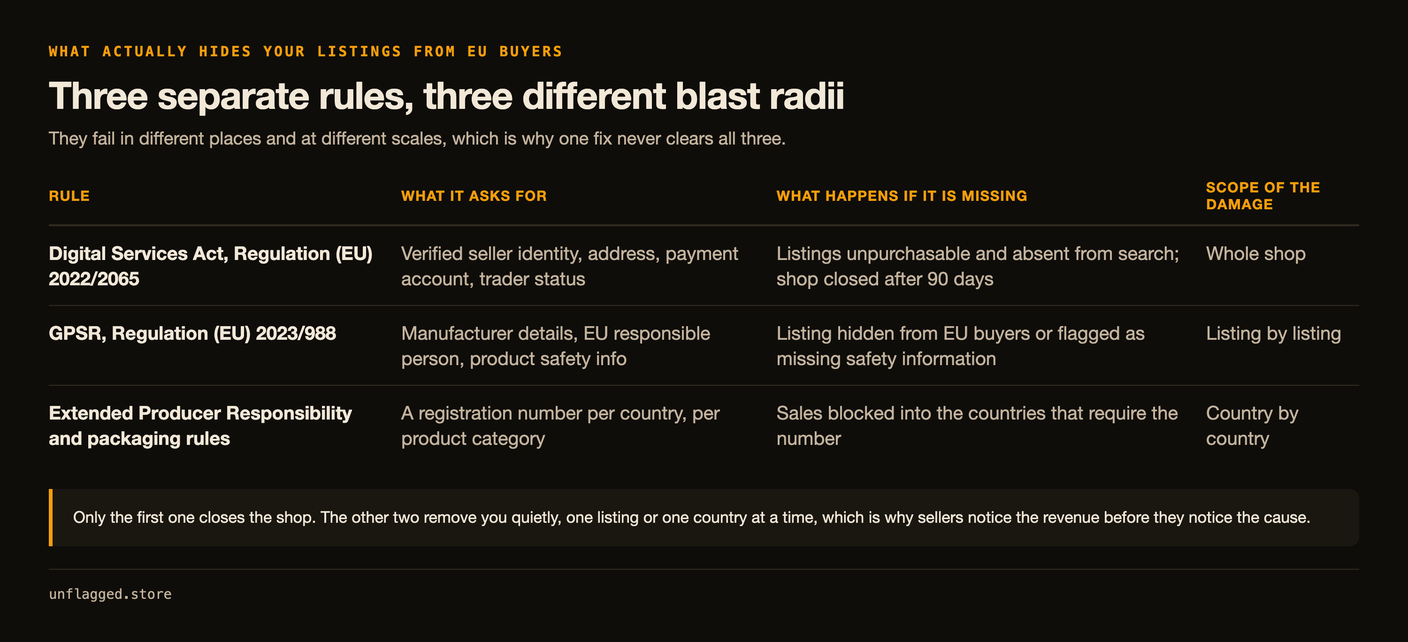
The first useful thing you can do is work out which rule you are looking at, because the three look identical from inside Shop Manager and behave completely differently. One is about who you are, one is about what you sell, and one is about what your parcel is made of.
| Rule | What it asks for | What happens if it is missing | Scope of the damage |
|---|---|---|---|
| Digital Services Act (Regulation (EU) 2022/2065) | Verified seller identity, address, payment account, trader status | Listings unpurchasable and absent from search; shop closed after 90 days | Whole shop |
| GPSR (Regulation (EU) 2023/988) | Manufacturer details, EU responsible person, product safety info | Listing hidden from EU buyers or flagged as missing safety information | Listing by listing |
| Extended Producer Responsibility and packaging rules | A registration number per country, per product category | Sales blocked into the countries that require the number | Country by country |
The DSA one is the emergency. GPSR is the slow bleed that most sellers notice first because it hits their best-selling listing. EPR is the one nobody has heard of until France stops converting. Take them in that order, because a shop closure makes the other two academic.
The DSA Seller Info Check And The 90-Day Clock
The Digital Services Act is the EU law behind the "confirm your seller info" banner, and the part that matters to you is Article 30, traceability of traders. It requires a marketplace to obtain a trader's identification details before letting them offer products to EU consumers, to make best efforts to assess whether that information is reliable against official databases and supporting documents, and to keep the data for the length of the relationship plus six months. Article 31 then requires the marketplace to make sure products are not offered at all while the information is incomplete.
Read that last clause again, because it is the whole mechanism. Etsy is not choosing to hide your listings as a punishment. The regulation tells Etsy it may not display them, and Etsy is the party that gets fined if it does. That is why support cannot wave it through and why there is no appeal to write.
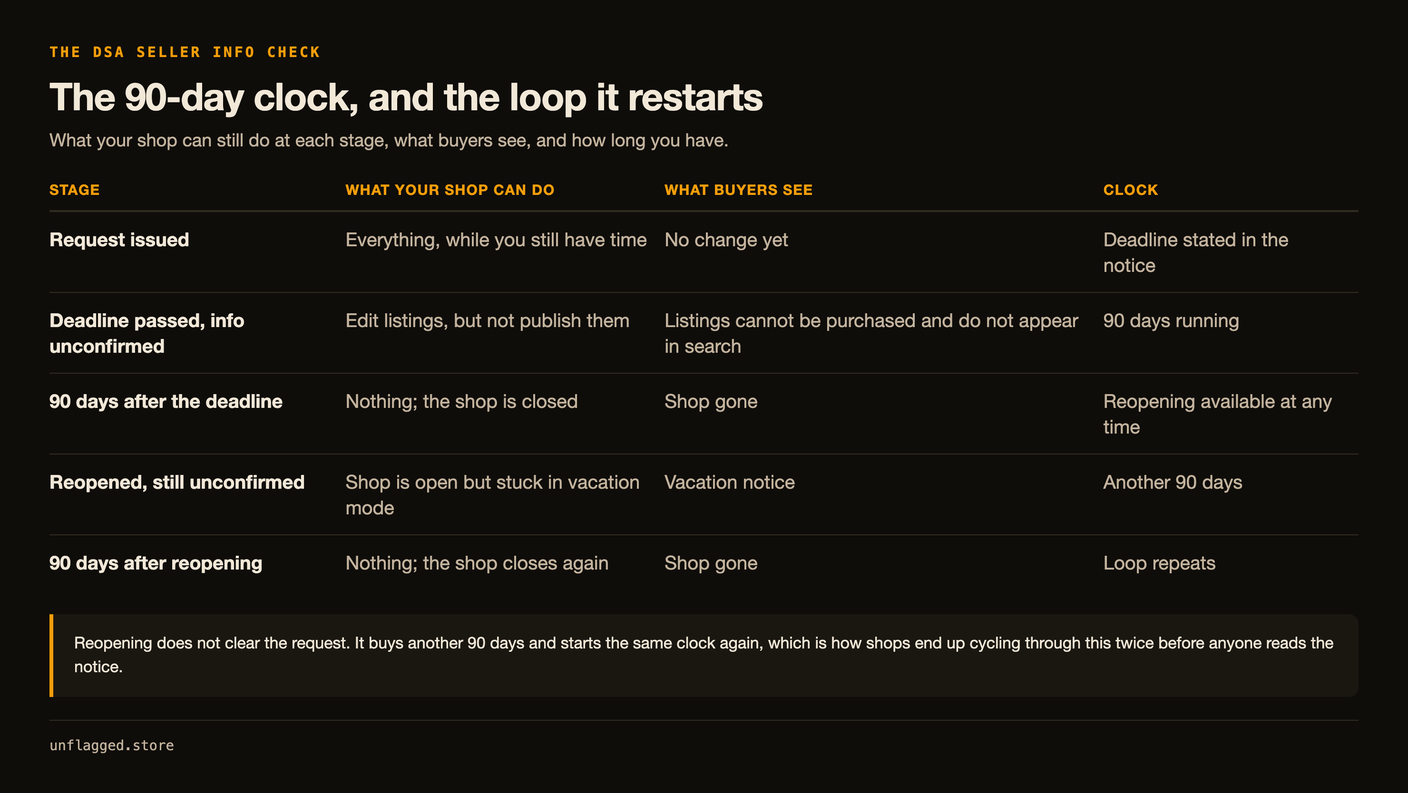
| Stage | What your shop can do | What buyers see | Clock |
|---|---|---|---|
| Request issued | Everything, while you still have time | No change yet | Deadline stated in the notice |
| Deadline passed, info unconfirmed | Edit listings, but not publish them | Listings cannot be purchased and do not appear in search | 90 days running |
| 90 days after the deadline | Nothing; the shop is closed | Shop gone | Reopening available at any time |
| Reopened, still unconfirmed | Shop is open but stuck in vacation mode | Vacation notice | Another 90 days |
| 90 days after reopening | Nothing; the shop closes again | Shop gone | Loop repeats |
That reopen-and-close loop is the detail that catches people. Sellers reopen the shop, see it come back, assume the problem is solved, and discover the same closure three months later with another quarter of EU sales gone. Reopening is not resolving. Only confirming the information is.
There is a second, faster variant that sellers report separately: a notice giving seven days to confirm seller information in order to keep getting paid. That one is about the payment account rather than search visibility, and it behaves much more like the identity verification hold than like the DSA check. If your banner mentions payment and a seven-day window, treat it as urgent and read that guide instead.
Sellers based in the European Economic Area have a further step layered on top: Etsy has been asking EEA-based shops to review and confirm their shop information and accept the Etsy Payments Ireland Limited terms, in a rollout that runs into early 2027. It arrives looking like a terms-of-service notice. It is part of the same traceability obligation.
Who Etsy Counts As A Trader
The DSA obligations attach to traders, not to everyone who sells. Etsy treats you as one if you sell to buyers in the EU or EEA and any of three things are true: you enrolled as a business seller, you are an incorporated business, or you set your seller status to "trader" in your shop's About section.
That third route is the one worth checking tonight, because it is a field you may have set years ago without much thought. Sellers flip it to trader because it sounds more professional, or because a tax guide told them to, and then inherit a verification obligation and a public-disclosure obligation that a private seller does not carry.
Do not lie in the other direction. Setting yourself to private seller while running an incorporated business, or while selling at business volume, is a misrepresentation on a field Etsy is legally required to verify. The realistic outcome is not that you escape the check. It is that the check comes back with a mismatch between your declared status and your company registration, which is the slowest failure mode there is. If you are a business, say so and complete the form.
Worth being precise about what this is not. A DSA hold is not a policy violation, it does not appear on your record as a strike, and it is a different animal from what happens when Etsy suspends a shop for a policy breach. Framing your support ticket as an appeal against a suspension sends it to the wrong queue and costs you a week.
GPSR: The Fields That Decide If A Listing Shows
The General Product Safety Regulation, Regulation (EU) 2023/988, replaced the old General Product Safety Directive and has applied since 13 December 2024. It covers consumer products made available on the EU and EEA market, and Northern Ireland. Etsy implements it as fields, and the fields are what your listing's EU visibility actually depends on.
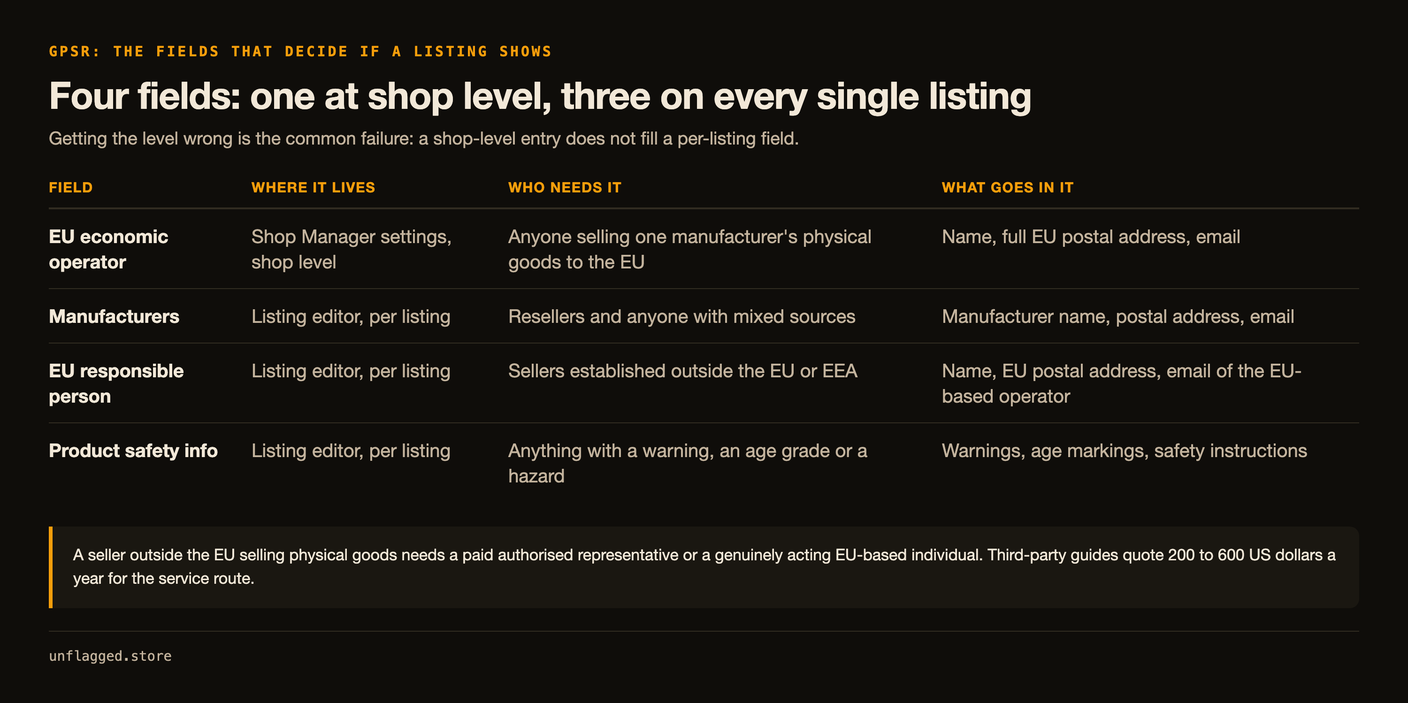
The rule sellers most often get wrong is that you do not have to fill both levels. A shop-level economic operator applies across your listings; a listing-level entry covers that listing. One or the other is enough, which matters a great deal if you resell items made by several different manufacturers and cannot use a single shop-wide answer.
| Field | Where it lives | Who needs it | What goes in it |
|---|---|---|---|
| EU economic operator | Shop Manager settings, shop level | Anyone selling one manufacturer's physical goods to the EU | Name, full EU postal address, email |
| Manufacturers | Listing editor, per listing | Resellers and anyone with mixed sources | Manufacturer name, postal address, email |
| EU responsible person | Listing editor, per listing | Sellers established outside the EU or EEA | Name, EU postal address, email of the EU-based operator |
| Product safety info | Listing editor, per listing | Anything with a warning, an age grade or a hazard | Warnings, age markings, safety instructions |
Etsy added the dedicated product safety section to the listing editor in April 2025, so listings created before that date can be missing fields you have never seen. Leave them empty and the listing can be hidden from EU buyers or shown with a notice that required safety information is missing, which converts about as well as you would expect. Where a national authority notifies Etsy that a product is non-compliant, Etsy can remove the listing outright, and repeat cases can escalate to the account.
Two scope questions come up constantly. Purely digital products such as PDFs, SVG cutting files and printable art are physical-product rules applied to something with no physical existence, and in practice they sit outside GPSR. Etsy's own guidance is drawn more broadly than that, so the honest answer is that the regulation and the platform do not read identically here; if your shop is digital-only, filling the fields costs you nothing and removes the argument. If you sell files plus a physical component, GPSR applies to the physical part, which is one of several reasons digital download shops carry more compliance risk than they look like they do.
Vintage is the more dangerous one. GPSR excludes antiques and collectors' items and deliberately sets no age threshold. Etsy's own vintage rule is 20 years. Those are not the same test, and treating Etsy's 20-year line as a GPSR exemption is how sellers end up with unlabelled 1980s electricals listed to EU buyers. An item marketed for everyday functional use is a consumer product whatever its age.
Do You Actually Need An EU Responsible Person?
Only if you are established outside the EU or EEA and you sell physical consumer products to buyers inside it. That is the whole test. A seller in Ireland does not need one. A seller in Ohio shipping candles to Dublin does.
The responsible person is an economic operator based in the EU whose name, postal address and email appear on the product, its packaging, the parcel or an accompanying document, and who can be reached by a market surveillance authority about your product. It is a real obligation with a real person behind it, not a box to fill with your own overseas address.
| Your situation | EU responsible person needed? | Typical route | Indicative cost |
|---|---|---|---|
| Established in the EU or EEA, selling your own goods | No, you are the operator | Your own details in the shop-level field | Nothing |
| Outside the EU, physical goods to EU buyers | Yes | Paid authorised representative service | Third-party guides quote 200 to 600 US dollars a year |
| Outside the EU, but a friend or relative in the EU agrees to act | Yes, and they must genuinely act | Named individual with a real EU address | Nothing, with real obligations attached |
| Digital downloads only | No physical product to be responsible for | Leave EU sales on, fields optional | Nothing |
| Outside the EU, EU sales switched off | No, while it stays off | Shop setting | The revenue you gave up |
Alongside that sit two obligations most guides skip. You keep technical documentation for the product for 10 years, and you report a serious safety incident involving your product through the EU Safety Business Gateway within two business days. Neither is triggered by a normal week of trading, but both are real and both belong in the folder you keep with your other EU paperwork.
EPR Numbers And The August 2026 Packaging Rules
Extended Producer Responsibility is the rule that makes whoever puts packaging, electricals, batteries or textiles onto a national market pay toward collecting and recycling them. It is national law, not one EU rule, which is why it arrives as a different number for every country. Etsy currently collects EPR numbers for France, Germany and Spain, asked per country and, within each country, per product category, in Shop Manager.
| Country | Register | Law | Categories Etsy asks about |
|---|---|---|---|
| France | Unique identification number issued via ADEME | AGEC anti-waste and circular economy law | Packaging, electricals, batteries, furniture, textiles, toys, sports and leisure, DIY and gardening |
| Germany | LUCID, run by the Central Agency Packaging Register (ZSVR) | VerpackG for packaging, ElektroG for electricals, BattDG for batteries | Packaging, electrical and electronic equipment, batteries |
| Spain | National producer register | Spanish packaging and waste rules | Packaging, with categories rolling out |
| Rest of the EU | Coming as national registers open | Packaging and Packaging Waste Regulation | Packaging, EU-wide |
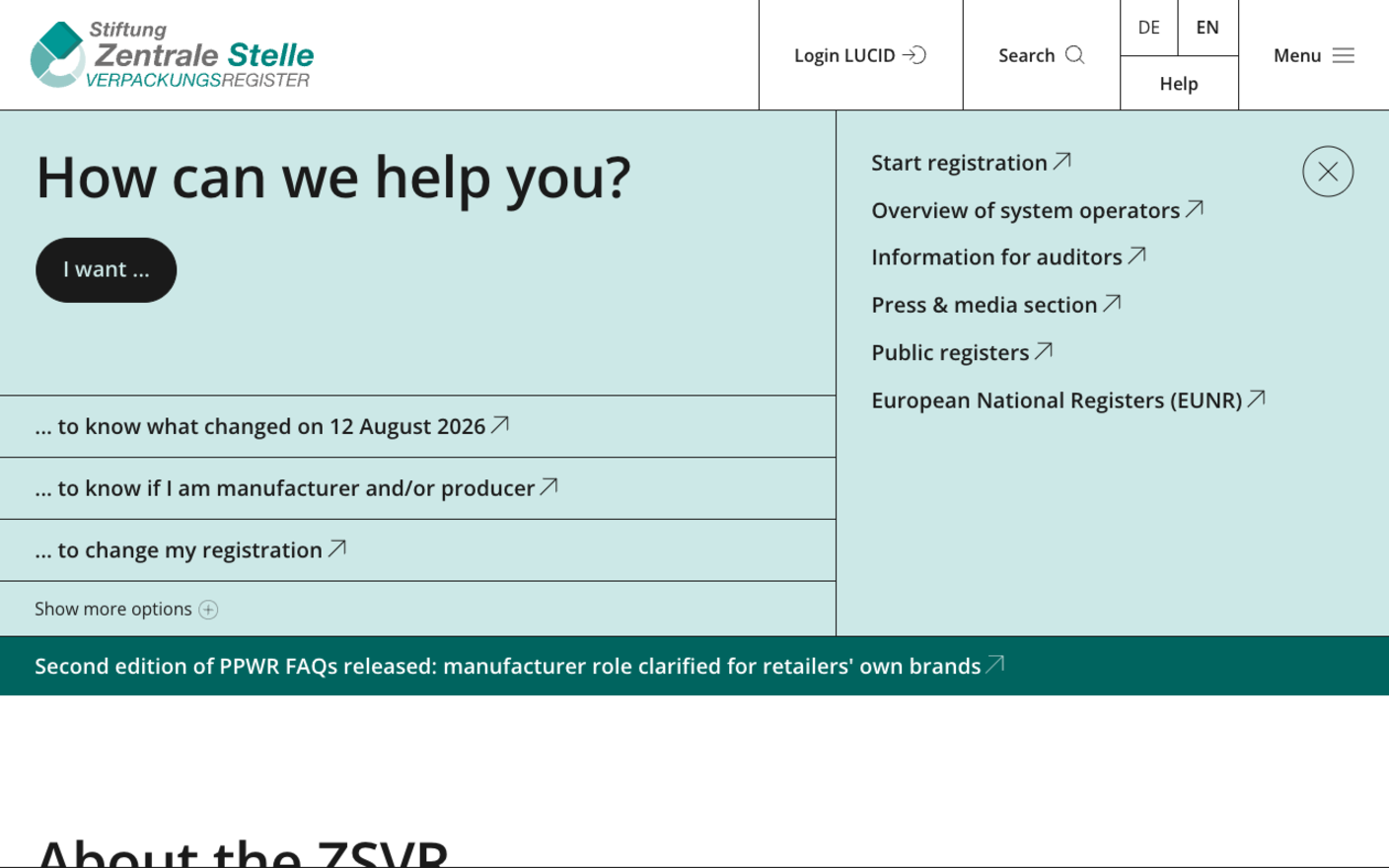
The date to know is 12 August 2026, when the EU Packaging and Packaging Waste Regulation started to apply. It pushes packaging registration and reporting from a three-country problem toward an EU-wide one as national registers come online. If you ship physical goods into the EU at any volume, this is the obligation most likely to be new to you in the next twelve months.
The practical read for a small shop: if France and Germany are not meaningful markets for you, this is a low priority and you can leave those countries switched off while you deal with the DSA and GPSR items above. If France is in your top five countries, a missing unique identification number is costing you sales today and no banner is telling you so.
Turning Off EU Sales Is A Business Decision, Not A Fix
Etsy gives you a shop setting that stops EU buyers ordering from you, and for a lot of small shops it is the correct answer. If the EU is two percent of your revenue and a responsible person costs several hundred dollars a year, the maths is not close. Switch it off, note why, and get on with your week.
What it does not do is make you compliant. GPSR attaches to products made available on the EU market, not to one platform's checkout setting. Switching off Etsy's EU sales does not cover goods you sell through your own site or another marketplace, does not reach EU buyers using a parcel-forwarding address, and does not touch stock already circulating in the EU. It is a tap, not an amnesty.
The one thing the toggle never fixes: the DSA seller info check. That runs on your identity as a trader, not on where your buyers are, and the 90-day closure clock keeps running whether or not EU sales are switched on. Sellers who turn the EU off and ignore the banner still lose the shop. Confirm the information first, then decide about EU sales.
Fix It In This Order
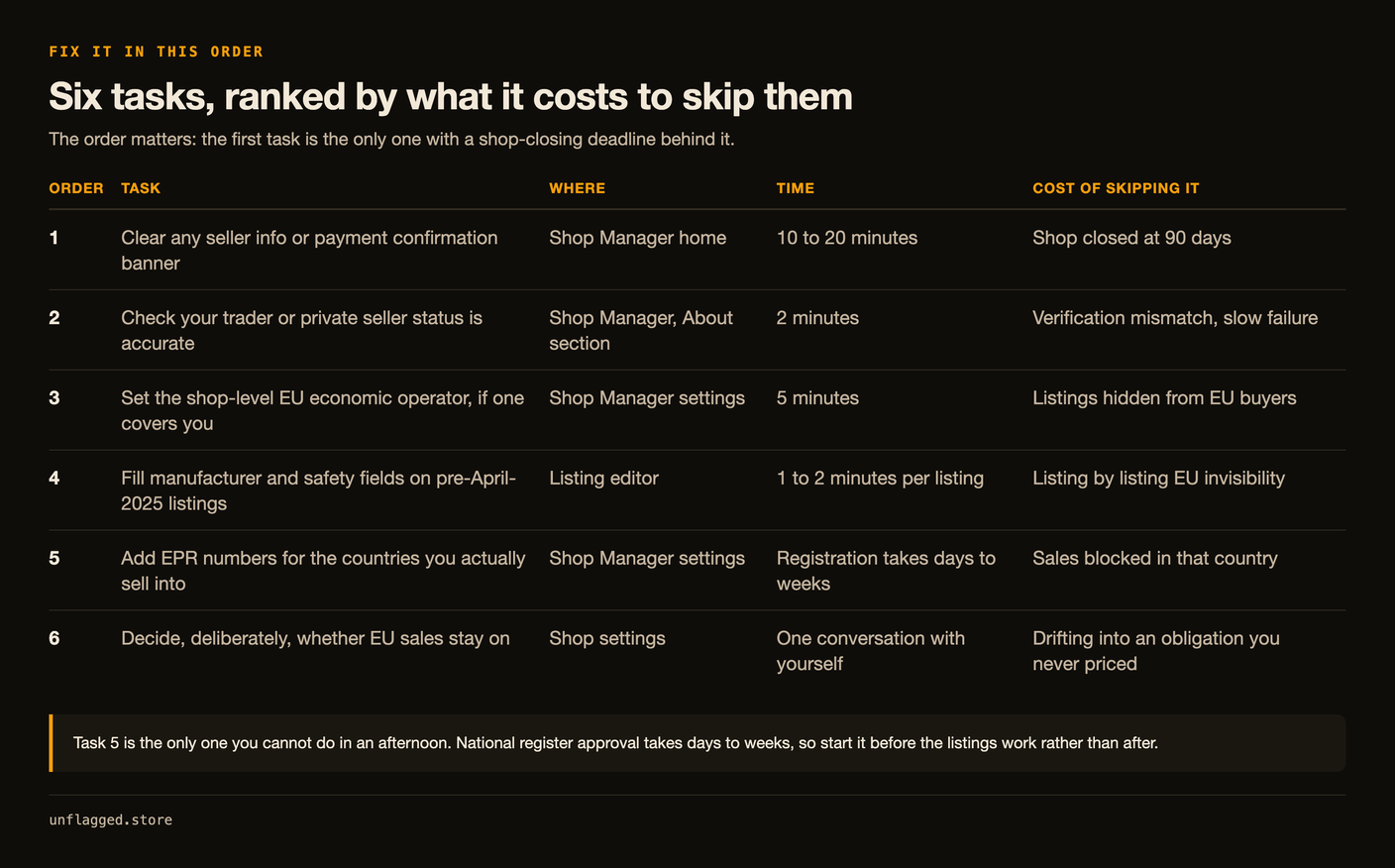
Most of this is twenty minutes of form-filling that has been sitting behind a banner you learned to scroll past. The order matters more than the speed, because the items at the top can close the shop and the items at the bottom cost you one country.
| Order | Task | Where | Time | Cost of skipping it |
|---|---|---|---|---|
| 1 | Clear any seller info or payment confirmation banner | Shop Manager home | 10 to 20 minutes | Shop closed at 90 days |
| 2 | Check your trader or private seller status is accurate | Shop Manager, About section | 2 minutes | Verification mismatch, slow failure |
| 3 | Set the shop-level EU economic operator, if one covers you | Shop Manager settings | 5 minutes | Listings hidden from EU buyers |
| 4 | Fill manufacturer and safety fields on pre-April-2025 listings | Listing editor | 1 to 2 minutes per listing | Listing by listing EU invisibility |
| 5 | Add EPR numbers for the countries you actually sell into | Shop Manager settings | Registration takes days to weeks | Sales blocked in that country |
| 6 | Decide, deliberately, whether EU sales stay on | Shop settings | One conversation with yourself | Drifting into an obligation you never priced |
If the shop has already closed, reopen it and then confirm, in that order, and expect it to sit in vacation mode until the confirmation clears. Do not open a second shop to trade through in the meantime. Etsy links accounts by payment details, address and device, and the usual result is two restricted shops instead of one. The same discipline underneath all of this is the one in the complete guide to Etsy seller compliance: does what Etsy holds about you match what is true?
Frequently Asked Questions
Why did my Etsy listings stop appearing for EU buyers?
Three causes account for nearly all of it: an unconfirmed Digital Services Act seller info check, which hides the whole shop from EU search, missing GPSR manufacturer or responsible person fields, which hide individual listings, or a missing EPR number for a country that requires one. Check Shop Manager for a confirmation banner first, since that is the one with a shop-closure deadline attached.
What happens if I ignore Etsy's request to confirm my seller info?
Your listings cannot be purchased and do not appear in search, and you can edit listings but not publish them. If the information is still unconfirmed 90 days after the deadline, Etsy closes the shop. You can reopen it at any time, but it stays in vacation mode until you confirm, and if it is still unconfirmed 90 days later it closes again.
Do I need an EU responsible person for my Etsy shop?
Only if you are established outside the EU or EEA and you sell physical consumer products to buyers inside it. Sellers based in the EU or EEA act as their own economic operator. Digital-download-only shops have no physical product to be responsible for. Third-party representative services are commonly quoted at 200 to 600 US dollars a year.
Does GPSR apply to vintage items on Etsy?
Often, yes. The regulation excludes antiques and collectors' items but sets no age threshold, so Etsy's 20-year vintage definition is not a GPSR exemption. An item sold to be used for its original everyday purpose, such as a 1980s lamp or a mid-century toaster, is treated as a consumer product regardless of age.
Do I have to fill both the shop-level and listing-level GPSR fields?
No. Filling either the shop-level economic operator field or the listing-level fields satisfies the requirement. Use the shop-level field when a single operator covers everything you sell, and the listing-level fields when you resell goods from several different manufacturers.
Does turning off EU sales make my shop compliant?
No. It stops EU buyers ordering through Etsy, which is a reasonable commercial decision for a shop with little EU revenue, but GPSR attaches to products made available on the EU market rather than to one platform setting. It also does nothing about the Digital Services Act seller info check, whose closure clock keeps running regardless of where your buyers are.
Is an EU compliance hold a strike against my Etsy shop?
No. These are account status and listing data problems, not policy violations, and they do not sit on your record the way a takedown or an intellectual property claim does. Once the information is confirmed and the fields are filled, the shop returns to normal standing with no lasting mark.
Related Reading
- Etsy identity verification: why your shop is on hold
- Etsy payment reserve: why your money is on hold
- What actually happens when Etsy suspends your shop
- Etsy policy changes in 2026, and what they mean for sellers
- Deactivated or suspended? The difference matters
- The complete guide to Etsy seller compliance
The EU Stack Is Predictable. Your Listings Are Not.
Everything above is knowable in advance. The thresholds are published, the fields are in Shop Manager, and the deadlines are printed on the notice. A seller who spends one evening on it never meets the enforcement side of it at all. The risks that are not predictable are the ones inside your listings, where a trademarked word in a tag or an attribution that does not match how an item is made takes a product down with no banner and no 90-day grace period.
Unflagged scans your listings for what actually triggers enforcement: trademark exposure in titles, tags and descriptions, attribution that conflicts with Etsy's handmade and production partner rules, and policy problems that are invisible from inside your own shop. Run a free scan to see where you stand, or create an account for ongoing monitoring. Plans and limits are on the pricing page.
The primary sources are worth keeping to hand: the Digital Services Act, Regulation (EU) 2022/2065 sets the traceability obligations in Articles 30 and 31, the General Product Safety Regulation, Regulation (EU) 2023/988 is the binding text behind the safety fields, serious incidents are reported through the European Commission's Safety Gate and Safety Business Gateway, and German packaging registration runs through the LUCID register at the Central Agency Packaging Register. Etsy's own help centre carries the seller-facing versions of all three.
Scan Your Listings Free
Check your Etsy listings for trademark violations in seconds. 3 free scans, no signup required.
Start Free ScanRelated Articles
How to Check Your Etsy Listings for Trademark Violations (2026 Guide)
Learn how to scan your Etsy listings for trademark violations before they get flagged. Step-by-step guide to protecting your shop from takedowns and suspensions.
Read moreEtsy Shop Suspended? How to Write a Winning Appeal Letter
Your Etsy shop got suspended. Here's exactly how to write an appeal letter that gets your shop reinstated, with templates and strategies that actually work.
Read more50 Words That Are Trademarked on Etsy (Stop Using These Now)
A comprehensive list of commonly trademarked words and phrases that Etsy sellers use without realizing they're violating trademark law. Check your listings now.
Read more