Etsy Policy Changes 2026: What Sellers Must Know Right Now
2026 is shaping up to be the most consequential year for Etsy sellers in the platform's history. A new CEO, overhauled creativity standards, AI disclosure rules, and a groundbreaking ChatGPT checkout partnership are rewriting the playbook. This living guide covers every major change and what it means for your shop.
Last updated: March 16, 2026
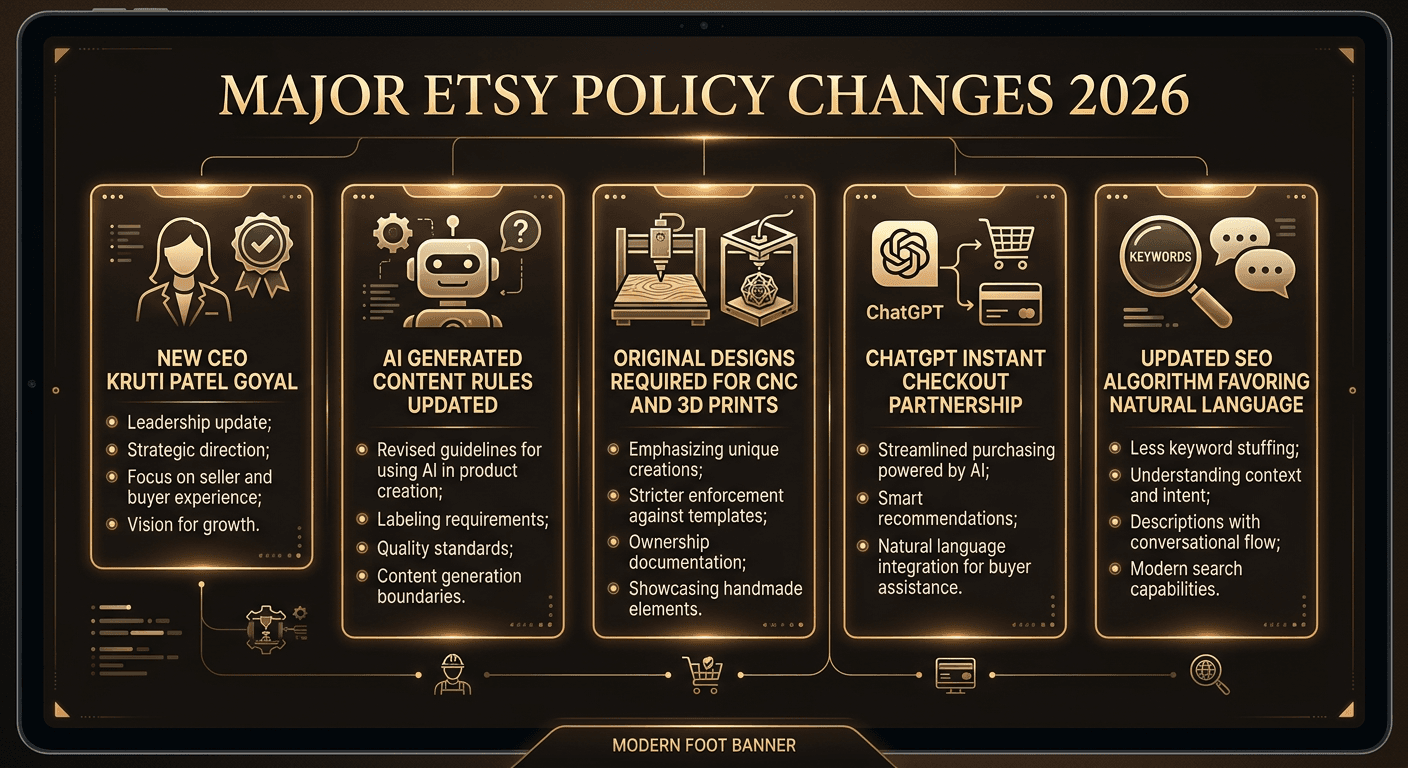
If you sell on Etsy, 2026 is the year you cannot afford to ignore policy updates. The changes rolling out this year are not incremental tweaks — they represent a fundamental shift in how Etsy defines handmade, regulates AI-generated content, and connects buyers with sellers through entirely new channels.
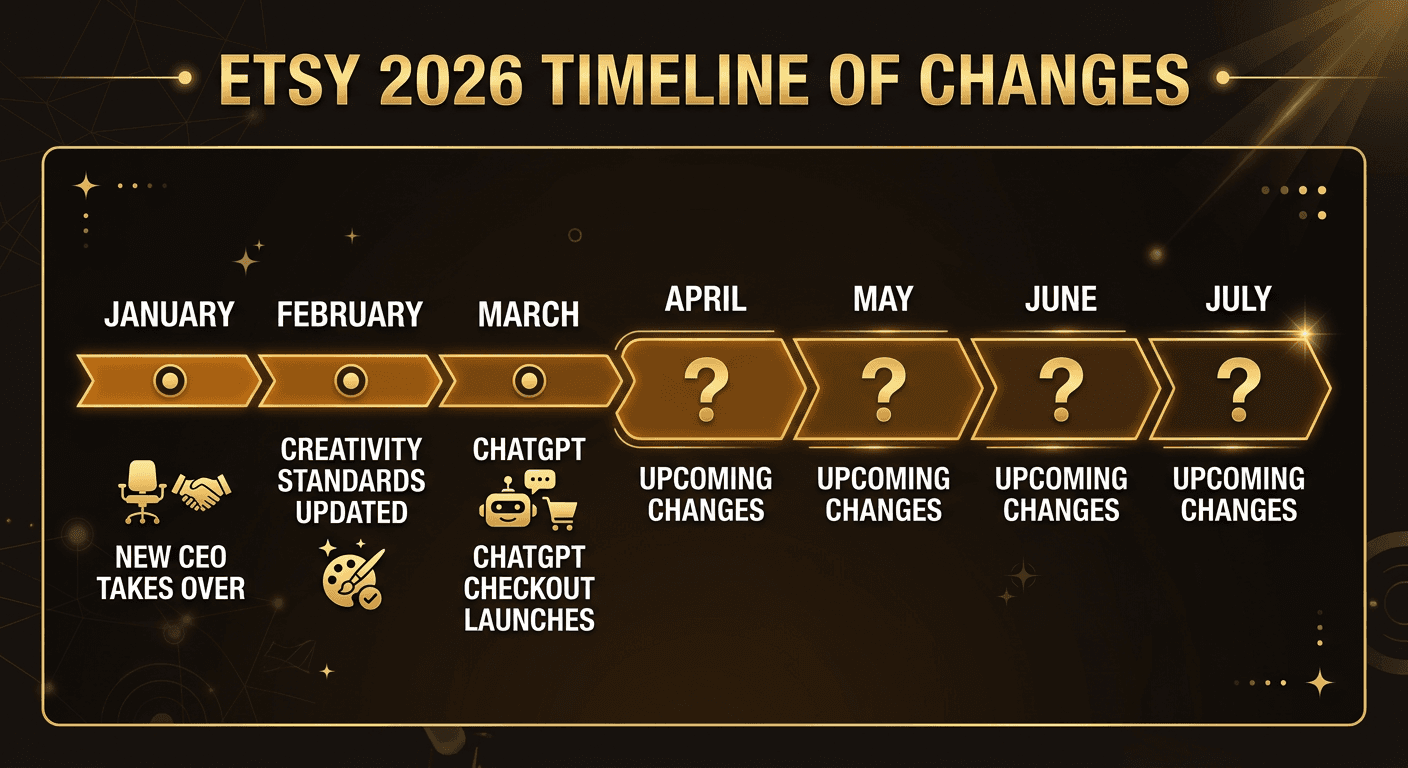
The appointment of a new CEO, Kruti Patel Goyal, on January 1 signaled that Etsy is entering a new era. Under her leadership, the platform has already introduced stricter creativity standards, new AI disclosure requirements, and a partnership with OpenAI that lets users buy Etsy products directly inside ChatGPT. Meanwhile, the SEO algorithm has been quietly overhauled, and EU sellers are facing new safety compliance obligations.
We built this guide as a living document. Every time Etsy announces a new policy change, we update this page. Bookmark it, check back often, and make sure your shop stays ahead of enforcement — not behind it.
New CEO: Kruti Patel Goyal
On January 1, 2026, Kruti Patel Goyal officially took the reins as Etsy's CEO, succeeding Josh Silverman who led the company through its pandemic-era boom. Goyal's appointment was not a surprise to industry insiders — she had been serving as CEO of Depop, the Gen Z-focused resale marketplace that Etsy acquired in 2021 for $1.6 billion.
Goyal's background is rooted in mobile-first commerce and younger demographics. At Depop, she doubled the platform's active user base and pioneered social-commerce features that blurred the line between shopping and content creation. Her approach to marketplace management is distinctly different from Silverman's — where he focused on operational efficiency and financial metrics, Goyal emphasizes community engagement, AI-powered personalization, and global expansion.
For sellers, the leadership change means several things. First, expect more aggressive AI integration across the platform — from search algorithms to listing recommendations. Second, Goyal's track record suggests a stronger push into international markets, which brings new compliance requirements (more on GPSR below). Third, the emphasis on “authentic creativity” that defined Depop's brand is now shaping Etsy's updated creativity standards.
What this means for sellers
- AI-powered tools will play a bigger role in how your listings are discovered and ranked
- International selling will get easier but comes with more regulatory obligations
- “Authentic handmade” enforcement will tighten, especially for digitally fabricated items
- Community and social features may become more prominent in search ranking signals
Creativity Standards Updated
Etsy's updated creativity standards represent the most significant change to the platform's handmade policy in years. The new rules, which began rolling out in Q1 2026, specifically target sellers who use laser cutters, 3D printers, and CNC machines — tools that have become increasingly popular in the Etsy maker community.
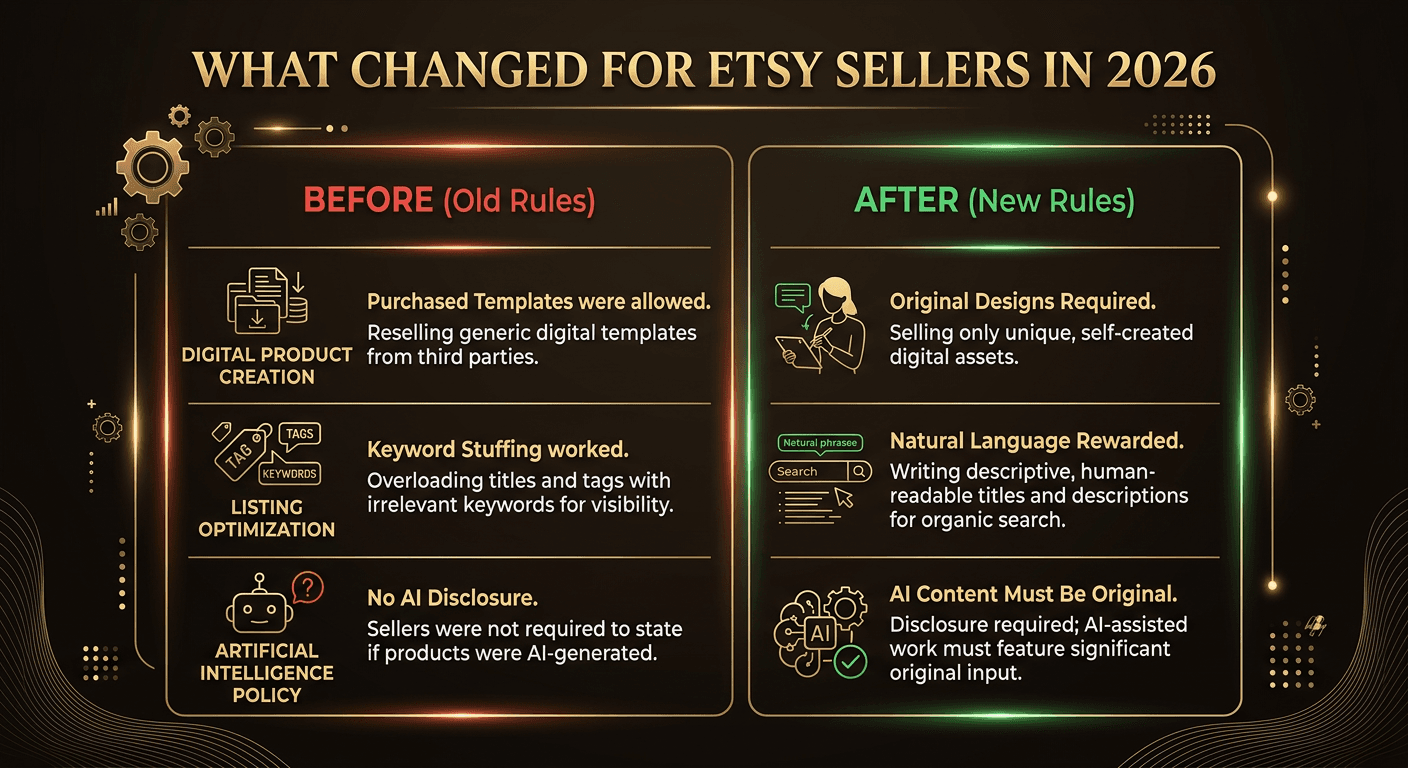
Under the previous policy, sellers could use purchased design templates with digital fabrication tools and still qualify as “handmade.” That loophole is now closed. Etsy now requires that designs used with laser cutters, 3D printers, and CNC machines be original work created by the seller. Buying an SVG file from another marketplace and cutting it on your Glowforge no longer meets the creativity standard.
Additionally, Etsy has removed language around “vintage scanned content” that previously allowed sellers to digitize old artwork and sell reproductions. The platform has also explicitly prohibited the resale of raw natural items — unprocessed stones, raw crystals, and unfinished natural materials that involve no creative transformation by the seller.
Key changes at a glance
- Laser/3D/CNC items: Must use original designs — purchased templates no longer qualify as handmade
- Vintage scanned content: Language removed from acceptable practices — digitized reproductions of old artwork face scrutiny
- Raw natural items: Reselling unprocessed natural materials without creative transformation is now prohibited
- Documentation: Sellers may be asked to prove their design process with original files, sketches, or creation videos
If you use digital fabrication tools, now is the time to audit your listings. Any product made from a purchased template should either be redesigned with your own original work or removed before enforcement catches up. Etsy has indicated that enforcement will be gradual but consistent — starting with reports from other sellers and eventually expanding to automated detection. Tools like Etsy listing compliance checkers can help you identify which listings may be at risk.
AI-Generated Content Rules
The explosion of AI image generators, AI writing tools, and AI design platforms has forced Etsy to take a definitive stance on AI-created products. In 2026, Etsy introduced new disclosure requirements that affect every seller using AI tools in their production workflow.
The core rule is straightforward: if AI played a significant role in creating your product, you must disclose it. This applies to AI-generated art and illustrations, AI-written product descriptions and copy used in physical products (mugs, t-shirts, posters), AI-designed patterns and templates, and AI-assisted jewelry and product designs. The disclosure must appear in the listing's production method section, not buried in the description.
Etsy has been careful to distinguish between AI as a “tool” and AI as the “creator.” Using AI to help brainstorm ideas, refine a color palette, or generate initial concepts that you substantially modify is treated differently from uploading a raw Midjourney output to a print-on-demand product. The former requires a brief disclosure; the latter faces increased scrutiny and potential removal if deemed to lack sufficient human creative input.
For sellers who use AI tools in their workflow, the safest approach is to be transparent. Add disclosure language to your listings, document your creative process, and ensure that your final products reflect meaningful human involvement. Etsy has signaled that enforcement will escalate throughout 2026, and sellers caught without proper disclosure could face listing removals and policy strikes. Check your listings against trademark and compliance guidelines to make sure you're covered on all fronts.
ChatGPT Instant Checkout
In one of the most significant partnerships in e-commerce history, Etsy became OpenAI's first commerce partner for ChatGPT instant checkout. Announced in early 2026, this integration allows US-based ChatGPT users to discover, browse, and purchase Etsy products directly inside the ChatGPT interface — without ever visiting Etsy.com.
Here's how it works: when a ChatGPT user asks for product recommendations (“find me a handmade leather journal under $50”), ChatGPT can now surface Etsy listings as shoppable results. The user sees product images, prices, and reviews, and can complete the purchase with a few clicks. The order flows through Etsy's existing checkout and payment infrastructure, so sellers fulfill orders exactly as they would any other Etsy sale.
What does this mean for sellers? Three things stand out:
1. A new discovery channel
Your listings can now be found by millions of ChatGPT users who may never have searched Etsy directly. This is essentially free traffic from a channel that didn't exist six months ago.
2. SEO matters more than ever
ChatGPT's product selection relies on the quality and relevance of your listing data — titles, descriptions, tags, and attributes. Well-optimized listings are more likely to surface in AI-powered recommendations.
3. Product quality signals gain weight
Reviews, completion rates, and shop ratings likely influence which listings ChatGPT recommends. Maintaining excellent customer service and product quality has a direct impact on this new visibility channel.
The ChatGPT checkout integration is currently limited to US buyers, but Etsy has indicated plans to expand to additional markets throughout 2026. Sellers in all regions can have their products surfaced — the checkout limitation applies only to the buyer's location.
SEO Algorithm Changes
Etsy's search algorithm has undergone a quiet but meaningful evolution in 2026. The most notable shift is a move away from rewarding keyword-stuffed titles and tags toward favoring natural, conversational language that matches how real buyers search.
Under the old approach, sellers would cram as many keywords as possible into their titles: “Handmade Leather Wallet Bifold Wallet Men Wallet Minimalist Wallet Gift for Him Groomsman Gift Anniversary Gift” worked because Etsy's algorithm treated titles as keyword bags. That strategy now actively hurts your rankings.
The updated algorithm uses natural language processing to understand search intent. A title like “Slim Leather Bifold Wallet — Handmade Minimalist Design for Men” now outperforms the keyword-stuffed version because it reads naturally and clearly communicates what the product is.
Etsy has also introduced an AI-powered title suggestion tool in the listing editor. When you create or edit a listing, Etsy now offers AI-generated title suggestions based on your product photos, category, and attributes. These suggestions follow the new natural language format and can serve as a helpful starting point — though you should always customize them to reflect your brand voice.
SEO best practices for 2026
- Write titles that read like natural phrases a buyer would actually type or speak
- Front-load the most important descriptive words in your title
- Use all 13 tags, but make each one a distinct phrase rather than single keywords
- Fill out every attribute field — attributes now carry more ranking weight than ever
- Write descriptions for humans, not algorithms — Etsy's NLP can understand context
- Test Etsy's AI title suggestions as a baseline, then customize for your brand
If you haven't updated your listing titles in a while, 2026 is the year to do a full audit. The sellers who adapt to natural language SEO early will have a significant advantage as the algorithm continues to evolve. Being aware of trademarked words to avoid on Etsy is also critical when rewriting your titles.
Policy Violation Dashboard
One of the most seller-friendly additions in 2026 is the new Policy Violation Dashboard, a self-service tool now available in Shop Manager. For years, sellers have complained about opaque enforcement — listings would disappear with vague explanations, and there was no centralized place to see your violation history or understand patterns.
The new dashboard changes that. It provides a complete history of every listing removal, the specific policy cited for each removal, links to the relevant section of Etsy's policies, and resources for how to bring your listings back into compliance. Sellers can see whether they're accumulating policy strikes and understand how close they may be to more serious enforcement actions.
The dashboard also includes a “Policy Resources” section with guides and examples for each policy category. If a listing was removed for a creativity standard violation, for instance, the dashboard links directly to the updated creativity standards documentation with examples of compliant and non-compliant listings.
While this is a welcome improvement in transparency, it's still reactive — you see violations after they happen. For proactive protection, pairing the dashboard with an external compliance scanning tool gives you the best of both worlds: prevention before violations occur and visibility after any enforcement action.
GPSR Compliance for EU Sellers
The General Product Safety Regulation (GPSR) is the European Union's updated framework for consumer product safety, and it has significant implications for Etsy sellers who ship to EU customers. While the regulation has been in development for several years, 2026 marks the year that enforcement has become practical — and Etsy has begun surfacing GPSR-related requirements in seller dashboards.
Under GPSR, products sold to EU consumers must include specific safety information, manufacturer or responsible person details within the EU, and compliance with relevant safety standards. This applies regardless of where the seller is based — if you ship to EU addresses, GPSR applies to you.
What non-EU sellers need to know
- Responsible person requirement: You must designate an EU-based “responsible person” for your products, or use a service that provides this
- Safety documentation: Products may need safety data sheets, conformity declarations, or testing certificates depending on the category
- Labeling: Products must include required safety markings and traceability information
- Alternative: Some sellers are choosing to exclude EU shipping rather than comply with GPSR, which is a valid option if EU sales represent a small portion of your revenue
Etsy has stated it will begin requiring GPSR compliance information for listings that are visible to EU buyers. Sellers who fail to provide the required information may see their listings hidden from EU search results. If you sell internationally, review Etsy's GPSR seller guide and decide whether compliance or EU shipping exclusion makes more sense for your business.
How to Stay Compliant
With so many policy changes happening simultaneously, staying compliant requires a systematic approach. Here's how to protect your shop in 2026:
Use Policy Radar
Unflagged's Policy Radar feature monitors Etsy's policies in real time and alerts you when changes affect your listings. Instead of manually checking the Seller Handbook every week, you get notifications when something relevant changes — with specific guidance on what to update in your shop.
Run regular compliance scans
At minimum, scan all your listings quarterly. After any major policy update (like the creativity standards change), run an immediate scan to catch newly non-compliant listings before Etsy does. An Etsy listing compliance checker automates this process and flags issues across your entire catalog.
Document your creative process
With the tighter creativity standards, keep records of your design process. Save original design files, take work-in-progress photos, and document how you create your products. If Etsy ever questions your listings, having this documentation ready can mean the difference between a quick resolution and a prolonged suspension.
Review your SEO quarterly
The algorithm changes mean your old keyword-stuffed titles are now working against you. Set a quarterly reminder to review and update your titles, tags, and descriptions to match the new natural language format. Check for trademarked words while you're at it.
Check your trademark exposure
Trademark violations remain the number one reason for listing removals and shop suspensions on Etsy. Use an Etsy trademark checker to scan your titles, tags, and descriptions for potential infringement issues.
Stay Ahead of Every Etsy Policy Change
Unflagged's Policy Radar monitors Etsy's policies in real time and alerts you when changes affect your shop. Combined with AI-powered compliance scanning, one-click fixes, and an appeal generator, it's the most complete protection for Etsy sellers in 2026.
Frequently Asked Questions
What are the biggest Etsy policy changes in 2026?
The biggest Etsy policy changes in 2026 include updated creativity standards requiring original designs for laser, 3D, and CNC items, new AI-generated content disclosure rules, the ChatGPT instant checkout partnership with OpenAI, SEO algorithm changes rewarding natural language over keyword stuffing, a new Policy Violation Dashboard in Shop Manager, and GPSR compliance requirements for EU sellers.
Who is Etsy's new CEO in 2026?
Kruti Patel Goyal became Etsy's CEO on January 1, 2026. She previously served as CEO of Depop and brings a background in mobile-first commerce and Gen Z marketplace strategy. Her leadership is expected to drive changes in AI personalization, global expansion, and stricter policy enforcement.
Can I sell AI-generated products on Etsy in 2026?
Yes, but Etsy now requires sellers to disclose when products are created using AI tools. This includes AI-generated art, designs, patterns, and written content. Listings must clearly indicate AI involvement in the production process. Failure to disclose can result in listing removal or shop suspension.
How does ChatGPT checkout work on Etsy?
Etsy partnered with OpenAI to become the first commerce partner for ChatGPT instant checkout. US-based ChatGPT users can browse and purchase Etsy products directly inside ChatGPT without leaving the app. For sellers, this means your listings may appear in AI-powered shopping recommendations, making SEO and product descriptions more important than ever.
What is the Etsy Policy Violation Dashboard?
The Policy Violation Dashboard is a new self-service tool in Etsy's Shop Manager that shows your complete listing removal history, the specific policies violated, and links to relevant policy resources. It helps sellers understand why listings were removed and how to prevent future violations.
How can I stay compliant with Etsy's 2026 policy changes?
To stay compliant, regularly review Etsy's Seller Handbook for updates, use the new Policy Violation Dashboard to track any issues, ensure all AI-generated content is properly disclosed, update your creativity documentation for handmade items, and use compliance scanning tools like Unflagged's Policy Radar to get real-time alerts when policies change.