Etsy Return Policy: Complete Seller Guide (2026)
Your return policy is one of the first things Etsy buyers check before placing an order. It affects your search ranking, your conversion rate, and how disputes get resolved. Here's everything you need to know about setting up, managing, and optimizing your Etsy return policy in 2026.
Why Return Policies Matter
Etsy requires every seller of physical items to display a return policy on their listings. This isn't optional — if you sell anything that ships in a box, you need a stated policy. But beyond the requirement, your return policy directly affects three things that determine whether your shop succeeds or struggles.
Search ranking. Etsy's algorithm gives a visibility boost to listings that accept returns. The logic is simple: Etsy wants buyers to feel confident purchasing, and a return policy reduces perceived risk. Listings with a clear return window consistently outperform identical listings with no-return policies in search results.
Buyer confidence. Most online shoppers check the return policy before buying, especially from a seller they've never purchased from before. A generous return window signals that you stand behind your products. Shops that accept returns typically see higher conversion rates because buyers feel protected.
Dispute resolution. When a buyer opens a case, Etsy's support team looks at your stated return policy to determine the outcome. A clear, well-written policy gives you a stronger position in disputes. A vague or missing policy usually means Etsy sides with the buyer.
The 3 Return Policy Options
Etsy gives you three choices when setting up your return policy. Each has trade-offs, and the right choice depends on what you sell and how much risk you're comfortable absorbing.
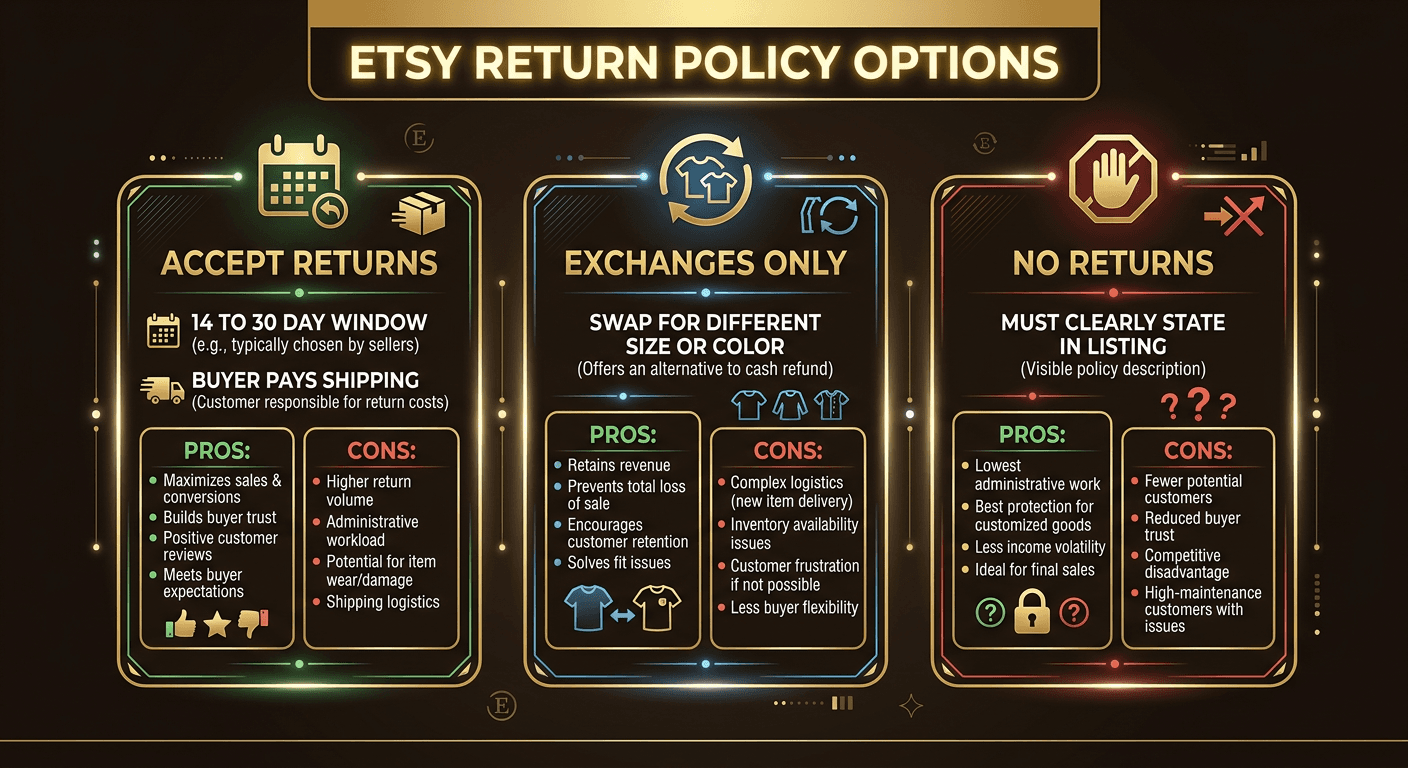
Option 1: Accept Returns (14–30 days)
This is the most buyer-friendly option and the one Etsy recommends. You set a return window (typically 14 or 30 days from delivery) and specify whether you or the buyer pays return shipping. This option gives you the best search visibility boost and highest conversion rates. The trade-off is that you'll occasionally need to process returns, but for most sellers the volume is low — typically under 3% of orders.
Option 2: Exchanges Only
With this option, buyers can request an exchange for a different item or variant but cannot get a refund. This works well for sellers who offer items in multiple sizes, colors, or styles. It keeps the sale while still giving buyers a way to resolve fit or preference issues. You get a smaller search boost than full returns, but it's better than no policy at all.
Option 3: No Returns
You can set a no-returns policy, but understand the trade-offs. You get no search visibility boost, and some buyers will skip your listing entirely when they see this. A no-returns policy also does not protect you from Etsy cases — if the item arrives damaged or doesn't match the description, Etsy will still require you to refund the buyer regardless of your stated policy. This option is most common for custom, personalized, and intimate items.
Our recommendation: Unless you sell custom or personalized items, accept returns with a 30-day window and buyer-paid return shipping. The search boost and conversion improvement almost always outweigh the occasional return.
How to Set Up Your Return Policy
Setting up your return policy takes about five minutes in Etsy's Shop Manager. Here's the step-by-step process.
- Step 1: Go to Shop Manager → Settings → Policy settings.
- Step 2: Under the “Returns & exchanges” section, click Edit.
- Step 3: Choose your policy type: accept returns, exchanges only, or no returns.
- Step 4: If accepting returns, set the return window (14 or 30 days) and specify who pays return shipping (buyer or seller).
- Step 5: Add any conditions or exclusions in the “Additional details” text box. This is where you note exceptions for custom items, sale items, or perishable goods.
- Step 6: Click Save. Your policy will apply to all existing and future listings automatically.
You can override the shop-wide policy on individual listings if needed. For example, you might accept returns on most items but exclude custom orders. To do this, edit the specific listing and scroll to the “Returns & exchanges” section to set a listing-level policy.
EU Requirements
If you sell to buyers in the European Union, you need to know about the EU Consumer Rights Directive. This law gives EU buyers a mandatory 14-day “right of withdrawal” for most online purchases — and it overrides your Etsy shop policy.
What this means in practice: even if your shop policy says “no returns,” EU buyers can return most items within 14 days of delivery for any reason, without needing to explain why. The buyer pays return shipping unless you agree to cover it, and you must issue a full refund (including the original shipping cost) within 14 days of receiving the returned item.
Exemptions: Custom and personalized items are exempt from the EU withdrawal right. Perishable goods, sealed hygiene products that have been opened, and digital downloads that the buyer has already accessed are also exempt.
If you ship to EU countries, the simplest approach is to set your shop-wide policy to accept returns within at least 14 days. This ensures you're compliant by default and avoids confusion when an EU buyer requests a return. Many sellers find that offering a 30-day window is even better — it exceeds the EU minimum, looks generous to buyers, and rarely results in more actual returns.
Handling Refund Requests
Not every refund request is the same. Knowing when to accept, when to push back, and how Etsy's case system works will save you money and stress. For a deeper dive on communicating with buyers during disputes, see our Etsy customer service guide.
When to Accept the Return
Accept the return when the item arrived damaged, doesn't match your listing description, or is defective. These are clear-cut cases where you're responsible, and fighting them wastes time and risks a negative review. Also accept returns that fall within your stated return window — you set the policy, so honor it. Processing these returns quickly and gracefully builds trust and often leads to repeat purchases.
When to Push Back
You have grounds to decline a return when the request comes after your return window has closed, the item was custom-made to the buyer's specifications, or the buyer simply changed their mind and your policy doesn't cover that. When declining, be professional and cite your specific policy. Provide screenshots of your listing showing the accurate description. Keep your tone factual, not defensive.
Etsy's Case System
If a buyer is unhappy with your response, they can escalate to an Etsy case. Etsy's support team will review the listing, the messages between you and the buyer, your stated return policy, and any evidence both sides provide. Cases that Etsy resolves against you count toward your shop's case rate, which can affect your Star Seller status and overall shop standing. Respond to cases within 48 hours and provide clear documentation.
Custom and Digital Items
Two categories of Etsy products are exempt from return requirements: custom/personalized items and digital downloads. Understanding these exemptions helps you set appropriate policies without overexposing your shop to return risk.
Custom and personalized items are exempt because they're made to a specific buyer's specifications and cannot be resold. This includes items with engraved names, custom dimensions, or buyer-supplied designs. If your listing clearly states the item is custom and the buyer provided specifications, you are not obligated to accept a return — even for EU orders. However, if the finished product doesn't match what the buyer requested, they can still open a case.
Digital downloads are exempt because the buyer receives the file instantly and cannot “return” a downloaded file. Etsy does not require a return policy for digital products. That said, some digital sellers choose to offer refunds as a goodwill gesture when a buyer is genuinely unhappy — the cost is zero since there's no physical product to recover, and it can prevent a negative review.
Important: Make sure your listing clearly identifies whether an item is custom, personalized, or digital. If the buyer argues it wasn't clearly disclosed, Etsy may side with them in a dispute. Include language like “This is a custom item made to your specifications and is not eligible for returns” in both your listing description and your shop policies.
Best Practices
Beyond choosing the right policy, how you handle returns day-to-day determines whether they're a minor cost of doing business or a constant source of frustration.
Communicate Clearly and Early
State your return policy in your listing description, not just in your shop policies section. Many buyers never scroll to the policies tab. A single line like “30-day returns accepted — buyer pays return shipping” sets expectations upfront and reduces disputes. Include care instructions or usage notes that prevent avoidable returns.
Request Photos of Damage
When a buyer reports a damaged or defective item, always ask for photos before issuing a refund. This serves two purposes: it verifies the claim is legitimate, and it gives you evidence to file a shipping insurance claim if applicable. Most honest buyers are happy to provide photos. If someone refuses to send pictures, that's a red flag.
Offer Partial Refunds When Appropriate
Not every return needs to be a full refund. If a buyer received an item with a minor flaw, a partial refund lets them keep the item at a discount while you avoid paying return shipping. Many buyers prefer this — they get a deal, you keep the sale, and nobody has to deal with shipping logistics. Always frame it as an option, not a pressure tactic: “I can offer a 20% refund if you'd like to keep the item, or a full refund with return shipping.”
Track Return Patterns
If you're seeing returns on the same item repeatedly, the problem isn't the return policy — it's the listing or the product. Look for patterns: are buyers citing size issues, color mismatches, or quality concerns? Use return data to improve your listings, photos, and product descriptions. Fixing the root cause costs less than processing repeated returns.
Returns and Reviews
How you handle returns has a direct impact on your review rating. A buyer who has a smooth return experience is far less likely to leave a negative review than one who felt stonewalled or ignored. In many cases, a buyer who received excellent service during a return will leave a positive review anyway — praising your communication and professionalism even though the product didn't work out.
The math is straightforward: a full refund on a $25 item costs you $25. A 1-star review can cost you dozens of future sales by dropping your average rating below the Star Seller threshold or scaring away potential buyers. When in doubt, err on the side of generosity.
For detailed strategies on getting better reviews and handling negative ones, check our Etsy reviews tips guide. The two topics are closely connected — your return policy is one of the biggest levers you have for maintaining a high review average.
One important note: never offer a refund in exchange for removing a review. This violates Etsy's terms of service and can result in account penalties. Instead, resolve the issue first, then politely let the buyer know they can update their review if they feel their experience has been resolved. Most buyers will update voluntarily when they feel genuinely taken care of.
Keep Your Shop Compliant While You Handle Returns
Returns are a normal part of selling on Etsy — but policy violations and trademark issues can shut your shop down entirely. Unflagged scans your listings for compliance risks so you can focus on running your business, not worrying about takedowns.
Start Free Compliance ScanFrequently Asked Questions
Are Etsy sellers required to accept returns?+
Etsy requires all sellers of physical items to display a return policy on their listings, but you are not required to accept returns. You can choose from three options: accept returns within a set window, offer exchanges only, or set a no-returns policy. However, offering at least a 14-day return window is strongly recommended because it builds buyer confidence and can improve your search ranking.
What is Etsy's return policy for EU orders?+
Under EU consumer protection law, buyers in the European Union have a mandatory 14-day right of withdrawal for most online purchases. This applies regardless of what your shop policy says. Sellers shipping to EU countries must honor this 14-day minimum return period. Custom and personalized items are exempt from this requirement.
Can buyers return custom or personalized items on Etsy?+
No. Custom and personalized items are exempt from Etsy's return requirements, including the EU 14-day withdrawal right. If an item was made to the buyer's specifications or clearly personalized, you are not obligated to accept a return. However, if the item arrives damaged or does not match the description, the buyer can still open a case through Etsy's resolution system.
Do digital downloads have to have a return policy on Etsy?+
Digital downloads are exempt from Etsy's return policy requirements. Since the buyer receives the file immediately upon purchase and cannot “return” a downloaded file, Etsy does not require sellers to offer refunds on digital products. Some sellers choose to offer refunds as a goodwill gesture, but it is not mandatory.
How do I handle a return request on Etsy?+
When a buyer requests a return, you will receive a notification in your Shop Manager. Review the request, check whether it falls within your stated policy, and respond within 48 hours. If you accept the return, provide clear instructions for shipping the item back. Once you receive the item, inspect it and issue the refund through Etsy's system. If you deny the request and the buyer disagrees, they can escalate to an Etsy case.
Does having a return policy affect Etsy search ranking?+
Yes. Etsy has confirmed that listings with a clear return policy, especially those that accept returns, receive a small boost in search visibility. Etsy's algorithm favors listings that reduce buyer risk, and a return policy signals that you stand behind your products. Shops that accept returns also tend to have higher conversion rates, which further improves search performance.