Etsy Production Partner Rules 2026: Register or Get Flagged
Etsy requires every production partner to be declared. Who counts, how to register one in Shop Manager, and the attribution setting that flags shops.
- 1.Etsy's Production Partner Rule, in One Sentence
- 2.Who Counts as a Production Partner (and Who Does Not)
- 3.The Attribution Setting That Does the Real Damage
- 4.How to Register a Production Partner in Shop Manager
- 5.What Buyers See, and How to Attach Partners to Listings
- 6.What Etsy Actually Does When You Do Not Declare
- 7.Declaring a Partner Does Not Fix a Borrowed Design
- 8.A 15-Minute Production Partner Audit
- 9.Related Reading on Unflagged
- 10.Frequently Asked Questions
- 11.Register the Partner Before Etsy Asks
Key takeaways
- A production partner is anyone outside your shop who physically makes your item from your design. Every print-on-demand service you use is one, without exception.
- Materials suppliers, your own shop members, and limited assistance providers (the workshop that fired your handmade mug) are not production partners. Registering them anyway muddies your own record.
- A listing with no partner attached defaults to "Made by a seller", which is a false handmade claim on every print-on-demand item in your shop.
- You choose the public label. "Printing partner" is a valid name, and there is a separate toggle for whether the partner appears on your About page.
- Non-disclosure escalates: warning and listing deactivation, then shop restrictions and search suppression, then suspension, plus a reseller label that is far harder to argue away than a missing form field.
Etsy's Production Partner Rule, in One Sentence
The suspension email never says "production partner". It says your shop violated Etsy's Handmade Policy, and by the time you read it your listings are already down and your payment account is on hold. That gap between the rule you broke and the words Etsy uses is why sellers keep losing shops over an administrative field they did not know existed.
Here is the rule: if a person or company outside your shop physically produces your item, you must declare them as an Etsy production partner and attach them to the listings they make. That is the whole obligation. We went through the registration flow field by field and cross-checked Etsy's Creativity Standards against what sellers report actually being enforced, and the pattern is consistent — this is a paperwork violation with a suspension-sized penalty.
It catches print-on-demand sellers hardest, because the entire model depends on somebody else pressing the shirt. But it also catches jewellers who outsource casting, ceramicists who use a production studio for volume runs, and anyone who scaled past what their own hands can make. The fix takes about fifteen minutes. Not doing it is the expensive option.
Who Counts as a Production Partner (and Who Does Not)
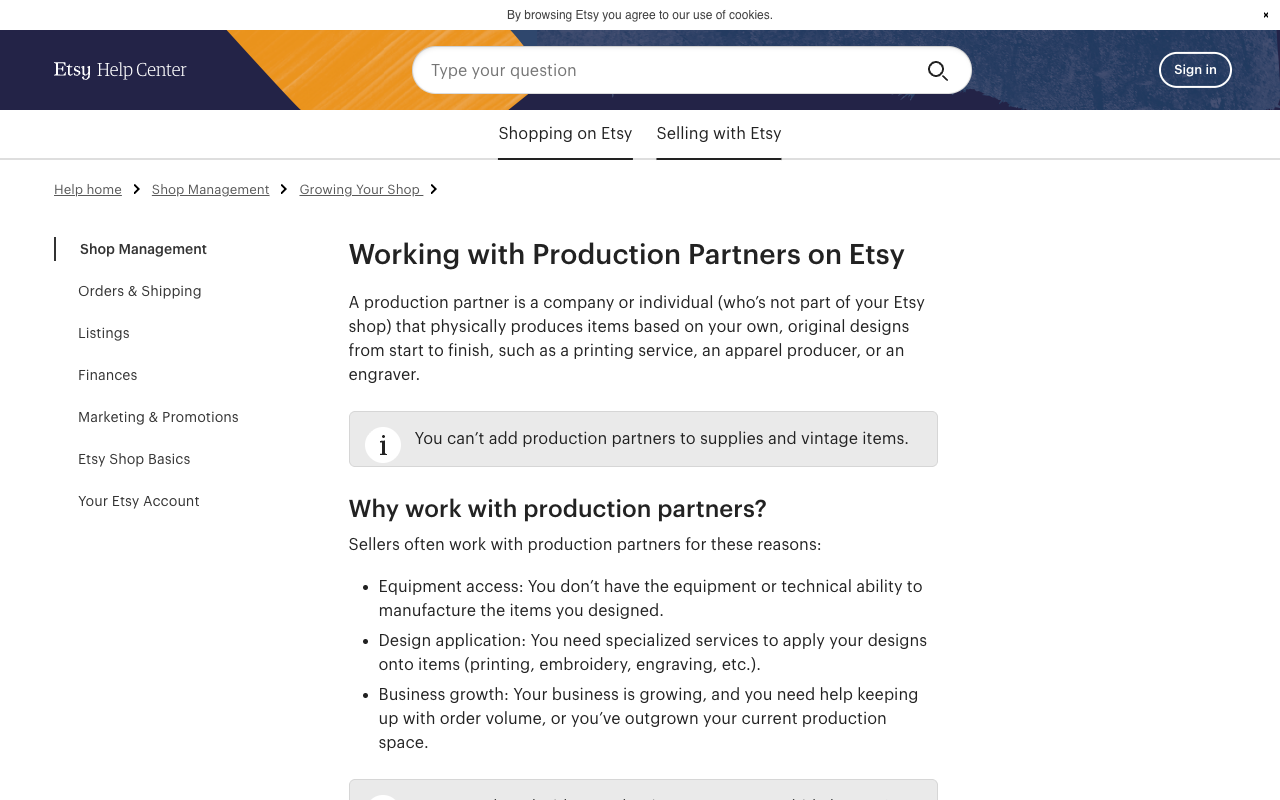
Etsy defines a production partner as an external individual or company, not part of your shop, that helps physically produce items based on your own original designs. A printing service, an apparel producer, an engraver. The test is not whether money changed hands, it is whether somebody outside your shop made the thing.
The confusion runs in both directions. Sellers under-declare because they think a print-on-demand app is a tool rather than a partner, and they over-declare by listing the supplier they buy blank tote bags from. This table settles most of it.
| Your situation | Production partner? | Why |
|---|---|---|
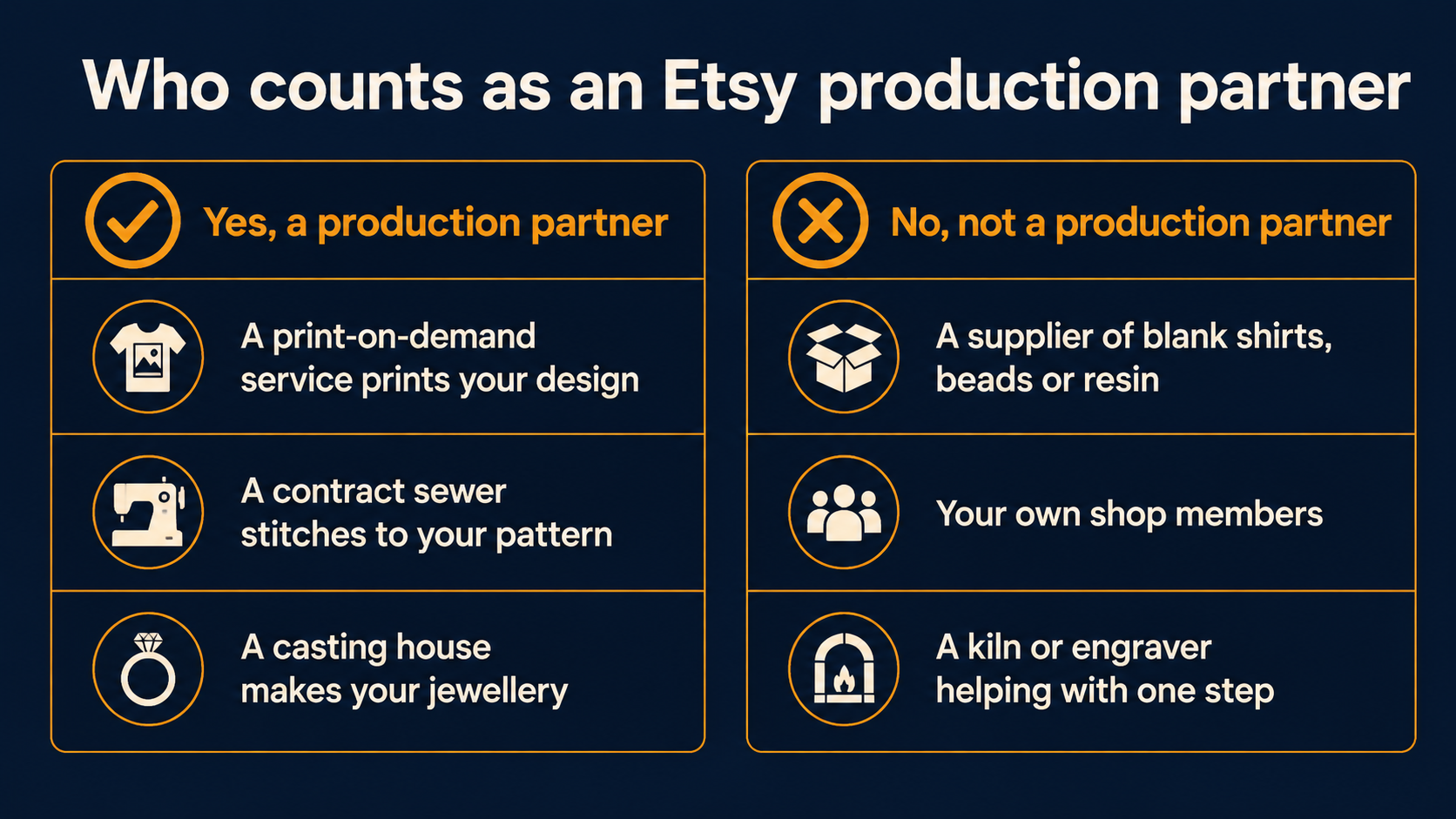
| Printful, Printify, Gelato, Gooten or CustomCat prints your design | Yes | An outside company physically makes the finished item |
| A contract sewer stitches garments to your pattern | Yes | Contracted maker, not a member of your shop |
| A casting house produces your jewellery from your model | Yes | Outside facility, full production of the item |
| You buy blank shirts, beads or resin to work with | No | Materials supplier, not involved in making your item |
| You, your co-owner, or a team member you added in Shop Manager | No | They are part of your shop, not external |
| A local kiln fires the mug you threw by hand | No | Limited assistance on one step of an item you primarily made |
| An engraver adds text to jewellery you fabricated | No | Same limited assistance exception |
| You buy finished goods wholesale and resell them | No | This is not a partner problem, it is a reselling ban |
That last row deserves a warning. Adding a production partner does not legitimise reselling finished goods you had no hand in designing. If the design is not yours, no field in Shop Manager rescues the listing, and our rundown of the policy violations sellers do not know about covers where that line sits.
The limited assistance exception is the one worth reading twice. If a partner touched one step of an item you primarily made yourself, they are not a production partner. If they made the item start to finish from your design, they are. Most disputes we see come down to sellers placing themselves in the first category when the honest answer is the second.
The Attribution Setting That Does the Real Damage
Registering the partner is only half of it. The other half is the item attribution on each listing, and this is where shops get flagged even when the partner is correctly registered at account level.
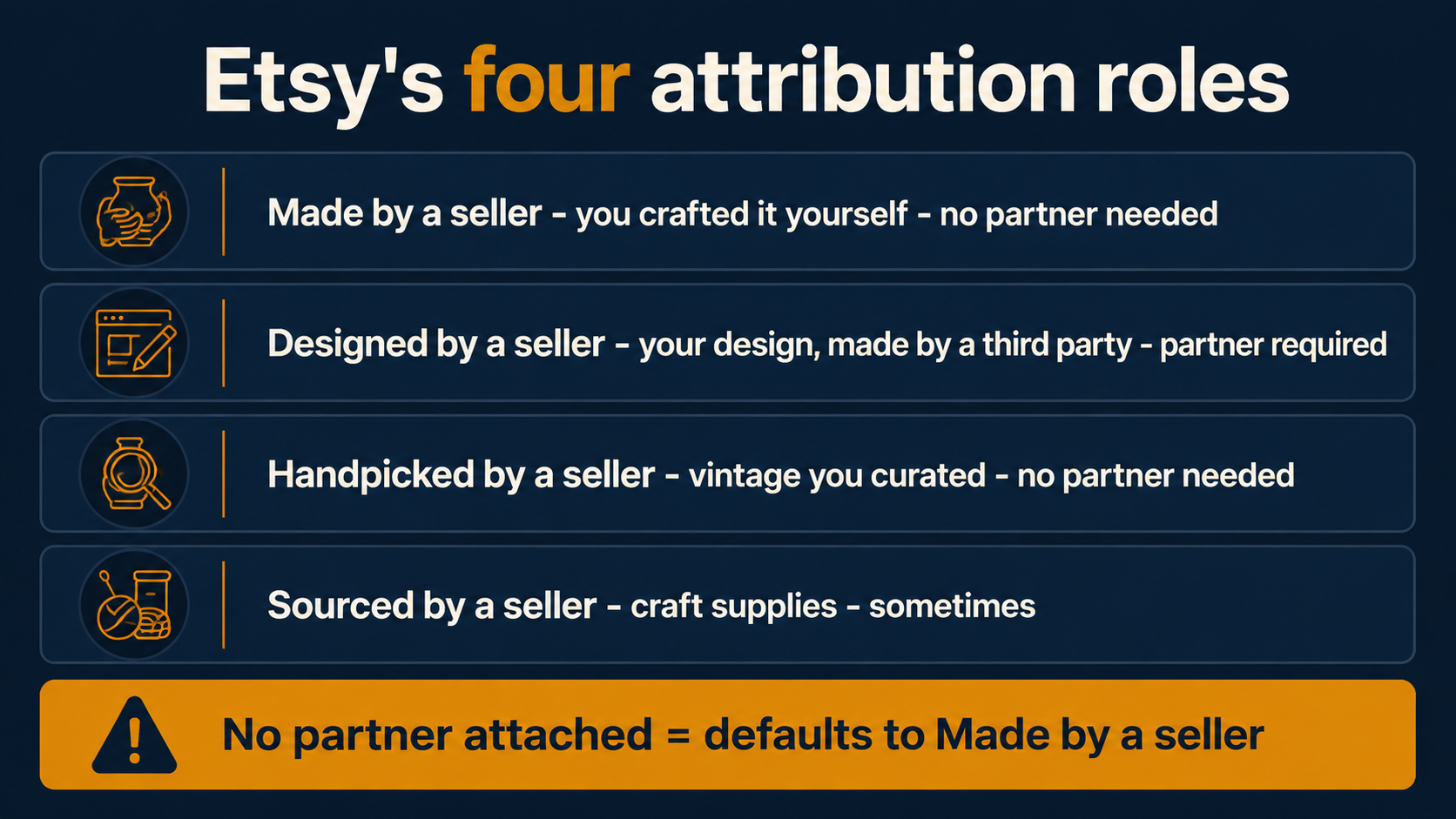
Etsy uses four creative roles. Most sellers have never consciously chosen between them, which is a problem, because the wrong one is a direct claim about how the item was made.
| Attribution | What it claims | Partner required? | The common mistake |
|---|---|---|---|
| Made by a seller | You crafted, altered or assembled it yourself, by hand or with tools you own | No | Left on print-on-demand listings, where it is untrue |
| Designed by a seller | Your original design, produced or printed by a third party, or sold as a digital file | Yes | Never selected, because it is not the default |
| Handpicked by a seller | Vintage goods you curated and sourced | No | Used for new items to dodge the handmade question |
| Sourced by a seller | Craft supplies obtained from elsewhere | Sometimes | Applied to finished products rather than supplies |
Now the trap. A listing with no production partner attached falls back to "Made by a seller". That is the default state, and it is the state every print-on-demand listing sits in until you actively change it. You do not have to lie to Etsy to end up making a false handmade claim. You only have to leave a form alone.
Since 2026 the same logic extends to generative AI. If an AI tool meaningfully shaped the image, the design or the description, the listing needs an AI disclosure and the attribution moves off "Made by". We covered the specifics in our guide to selling AI art on Etsy, and the two rules stack: an AI-designed shirt printed by Printful needs the disclosure and the partner and "Designed by".
How to Register a Production Partner in Shop Manager
The flow is short, and the fields matter more than their length suggests.
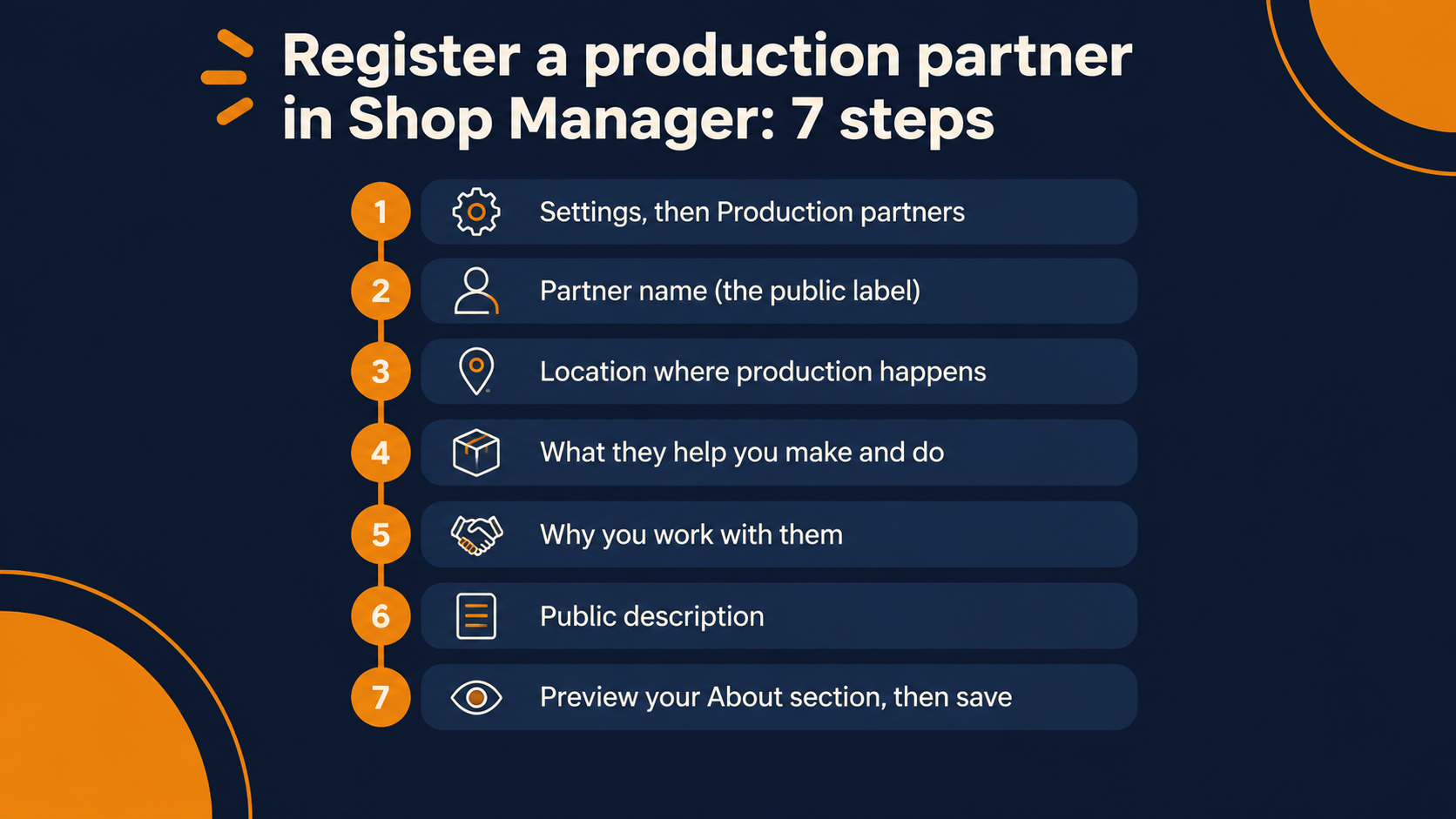
- Shop Manager, then Settings, then Production partners. Choose "Add a new production partner". This is account-level and only has to be done once per partner.
- Partner name. This is the label buyers can see, and it does not have to be the vendor's brand name. "Printing partner" or "Manufacturing partner" is acceptable.
- Location. The country where production actually happens. If your print-on-demand service routes orders to multiple facilities, pick the one that fulfils most of your volume rather than guessing.
- What they help you make, and what they do. Printing, packaging, shipping, assembly. Be accurate; this is the description Etsy compares against your listings if a reviewer ever looks.
- Why you work with them. A short menu. "I do not have the equipment or skills to make this item entirely by myself" is the honest answer for most print-on-demand shops and carries no penalty.
- Public description. A sentence in your own voice. Write it as though a buyer will read it, because one might.
- Preview the About section before you save. Anything not marked private appears on your public pages. Look at it once rather than discovering the wording later.
Register one partner per distinct producer. Sellers running two print-on-demand services and a local embroiderer need three entries, not a single catch-all, because each one gets attached to different listings.
What Buyers See, and How to Attach Partners to Listings
The visibility question is the one sellers actually stall on, so here is the plain answer. Whatever you type into the name field is what can appear in the production partner section of your listing and About page. There is also a toggle controlling whether a given partner shows on your About page at all — and hiding it does not un-declare it. Etsy still has the disclosure on file, which is the part that matters for compliance.
Our view is that hiding it is usually the wrong instinct. Buyers who care enough to look for a production partner tend to react worse to finding nothing than to finding an honest line about a printing partner in Ohio. Transparency is also cheaper than the alternative, and the alternative is the enforcement ladder in the next section.
Registration alone is not sufficient. Each listing has to be linked to the partner that makes it. Two ways to do that:
- On a single listing: in the listing editor, find the Production partners block inside Listing details and tick the relevant partner.
- In bulk: from your listings grid, select the affected listings, open Editing options, choose Change production partners, set the partner, and apply. This is how you fix a back catalogue of two hundred listings without losing an evening.
Bulk editing is the step most sellers skip. Registering the partner and updating only new listings leaves every older listing still claiming "Made by a seller", and older listings are exactly what an automated sweep pulls up. If you are unsure what else in your catalogue is exposed, our complete guide to Etsy seller compliance maps the rest of the surface.
What Etsy Actually Does When You Do Not Declare
Enforcement is graduated, and that is the useful thing to know, because it means an early warning is a chance rather than a verdict. Based on Etsy's stated policies and consistent seller reports, this is the shape of it.
| Stage | What Etsy does | What you can still do |
|---|---|---|
| First detection | Warning email, affected listings deactivated, shop stays open | Register the partner, re-attribute, relist. Usually recoverable the same day. |
| Repeat or unresolved | Temporary shop restrictions: new listings blocked, existing listings suppressed in search | Fix everything, not only the flagged listings, then appeal with evidence of the change. |
| Serious or continued | Shop suspension, funds held through review | A written appeal. See our Etsy appeal letter template. |
| Classified as a reseller | Handmade Policy action against the account itself | Hardest to reverse. You are now arguing about what your business is, not about a field. |
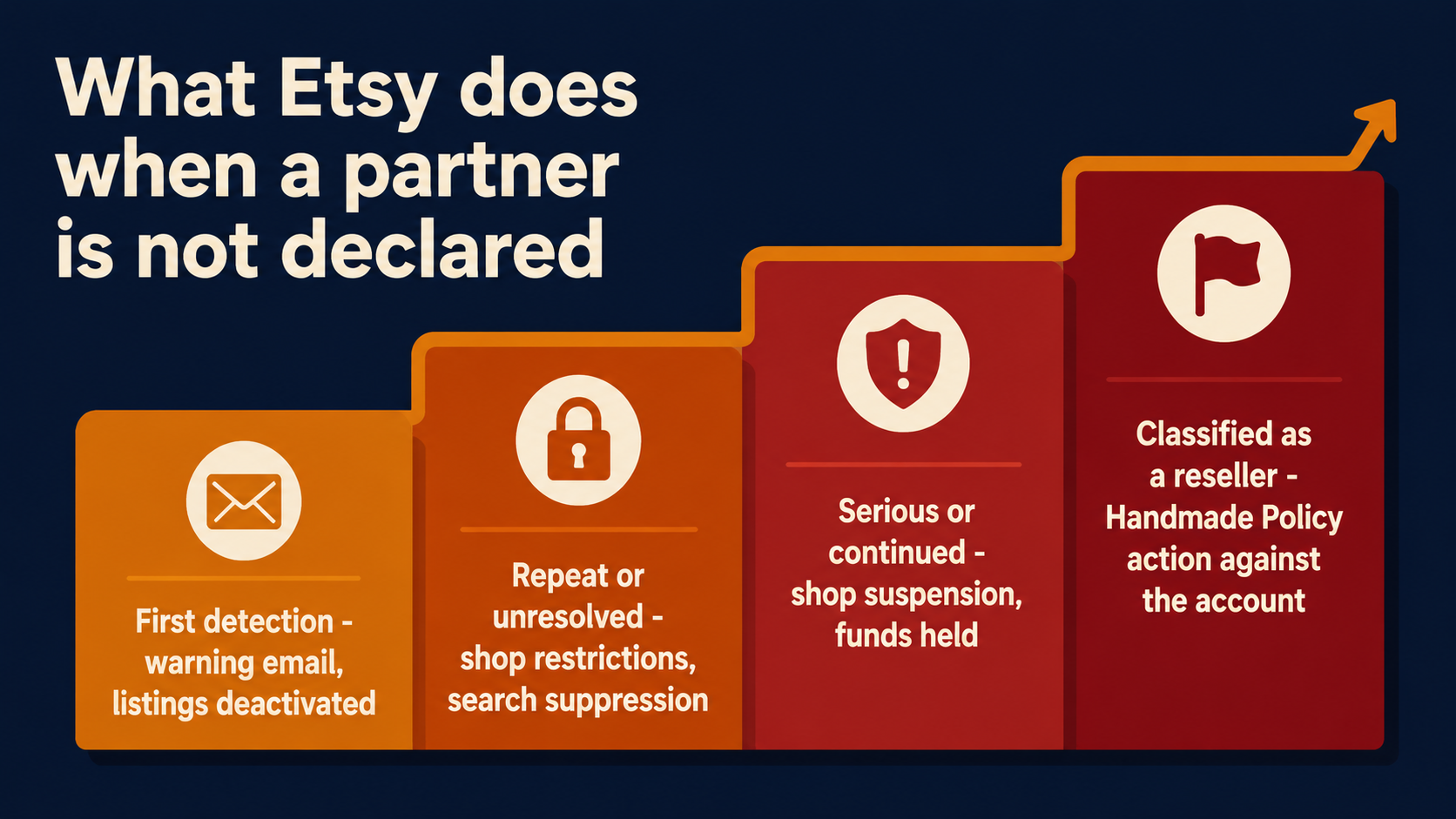
That final row is the real risk, and it is why "I will add the partner if they ask" is a bad plan. Without a declared partner, Etsy's automated systems see a shop selling items it plainly did not hand-make with no explanation on file. The label they reach for is reseller, and what happens when Etsy suspends your shop is considerably worse once that label is attached, because you are no longer correcting an oversight — you are contesting a characterisation.
Search suppression in the middle stage is also worth pricing properly. Nothing tells you it has happened. Your listings stay live, your traffic quietly halves, and sellers routinely spend weeks blaming their SEO for a compliance problem. If your views fell off a cliff without an algorithm update to blame, check your attribution before you rewrite your tags.
Declaring a Partner Does Not Fix a Borrowed Design
One more thing, because sellers who get the partner paperwork right sometimes assume they are now safe. They are safe from one specific violation. The design still has to be yours and still has to be clean.
Print-on-demand catalogues are unusually exposed here. The model rewards volume, volume comes from templates and trend-chasing, and trend-chasing is how protected phrases, characters and brand names end up on your shirts. A correctly declared partner does not make a trademarked slogan legal — it just means Etsy knows who printed it.
Run the design side separately: check titles, tags and descriptions against live trademark records before you publish, not after a takedown. Our guides to searching trademarks before you list and print-on-demand on Etsy cover the checks worth building into your upload routine.
A 15-Minute Production Partner Audit
If you sell anything you did not physically make, do this now rather than after an email arrives.
- List every outside producer you use. Print-on-demand services, contract makers, casting or printing houses. Include the one you used twice last year.
- Check Shop Manager, Settings, Production partners. Each producer on that list needs an entry. Add the missing ones now; it takes two minutes each.
- Filter your listings by attribution. Anything made by an outside producer and still marked "Made by a seller" is an active false claim. This is your priority list.
- Bulk-edit the back catalogue. Select those listings, change production partners, apply. Do not stop at listings created this year.
- Re-read your public description. It should match what the partner actually does. A description written for a printing service and now covering an embroiderer is a discrepancy waiting to be found.
- Remove anything registered in error. Materials suppliers and your own team members should not be listed as production partners.
- Check the AI disclosure at the same time. If generative AI shaped the design, that flag needs setting too, and the two failures compound.
- Scan the designs themselves. Titles, tags and descriptions against trademark records, because the paperwork fix does not touch this.
Shops with a few hundred listings should budget an afternoon rather than fifteen minutes. It is still the cheapest afternoon on offer, and unlike most compliance work it is genuinely finished when you finish it.
Related Reading on Unflagged
- Etsy's handmade policy: what counts as handmade in 2026
- Etsy policy changes in 2026, and what they mean for sellers
- Why Etsy deactivated your listing, and how to fix it
- The Etsy suspension email, decoded
- Compliance risks specific to digital downloads
- Can Etsy permanently ban your shop?
Frequently Asked Questions
Do I have to list Printful or Printify as a production partner?
Yes. Any print-on-demand service that prints your design onto a product is a production partner under Etsy's rules, with no exception for apps that integrate directly with your shop. The integration handles fulfilment; it does not handle your disclosure obligation.
Will buyers see who my production partner is?
They can see whatever you type into the name field, and you are allowed to use a descriptive label such as "Printing partner" rather than the vendor's brand name. There is also a toggle controlling whether a partner appears on your public About page. Hiding it does not cancel the disclosure — Etsy still holds it.
Is my materials supplier a production partner?
No. The company you buy blank shirts, beads or resin from supplies materials and is not involved in making your finished item. Listing suppliers as production partners is a common error that misdescribes how your shop actually operates.
What is a limited assistance provider?
Someone who helped with a single step of an item you primarily made yourself, such as a workshop that fired your hand-thrown mug or an engraver who added text to jewellery you fabricated. They do not need to be declared as production partners. If they made the item start to finish, they do.
What happens if I never declared a production partner?
Typically a warning email with the affected listings deactivated while the shop stays open. Repeat or unresolved cases escalate to shop restrictions and search suppression, and serious or continued non-compliance can end in suspension. Registering the partner and re-attributing your listings resolves most first offences.
Should the listing say "Made by" or "Designed by"?
"Designed by a seller" is correct whenever a third party produces or prints your original design, and for digital downloads. "Made by a seller" claims you crafted, altered or assembled the item yourself. A listing with no partner attached defaults to "Made by", which is why print-on-demand listings need changing rather than leaving alone.
Can I add a production partner to listings I already published?
Yes, and you should. Edit a single listing through the Production partners block in Listing details, or select multiple listings and use Editing options, then Change production partners, to update a back catalogue in one pass.
Does declaring a partner protect me from a trademark complaint?
No. Production partner disclosure answers who made the item, not whether the design was yours to sell. Trademark and copyright enforcement applies to the artwork regardless of who printed it, so the design checks have to run separately.
Register the Partner Before Etsy Asks
This is the rare compliance problem with a clean fix. Fifteen minutes in Shop Manager, a bulk edit, and the violation stops existing. Compare that with an appeal written against a suspension while your funds sit in review on Etsy's timetable.
Unflagged scans your listings for what actually triggers enforcement: attribution that does not match how your items are made, undeclared production, trademark exposure in titles, tags and descriptions, and policy conflicts you cannot see from inside your own shop. Run a free scan to see where your listings stand, then create an account for ongoing monitoring as the standards keep tightening. Pricing and limits are on the plans page.
The official rules are worth reading once in full: Etsy's Creativity Standards set out the four creative roles, the help centre article on working with production partners covers the registration mechanics, and Etsy's seller handbook piece on the production partner policy explains the reasoning behind it.
Scan Your Listings Free
Check your Etsy listings for trademark violations in seconds. 3 free scans, no signup required.
Start Free ScanRelated Articles
Selling AI Art on Etsy in 2026: Disclosure Rules Explained
Etsy allows AI art, but non-disclosure now triggers suspensions. The exact attribution settings, disclosure wording, and audit steps that keep shops safe.
Read moreHow to Check Your Etsy Listings for Trademark Violations (2026 Guide)
Learn how to scan your Etsy listings for trademark violations before they get flagged. Step-by-step guide to protecting your shop from takedowns and suspensions.
Read moreEtsy Shop Suspended? How to Write a Winning Appeal Letter
Your Etsy shop got suspended. Here's exactly how to write an appeal letter that gets your shop reinstated, with templates and strategies that actually work.
Read more