Etsy Handmade Policy: What Counts as Handmade in 2026?
Etsy was built on handmade. But the definition of "handmade" has stretched far beyond knitted scarves and hand-poured candles. In 2026, sellers use laser cutters, 3D printers, AI design tools, and production partners to create their products — and Etsy has updated its policies to keep up. This guide breaks down exactly what qualifies as handmade, what doesn't, and how to stay on the right side of enforcement.
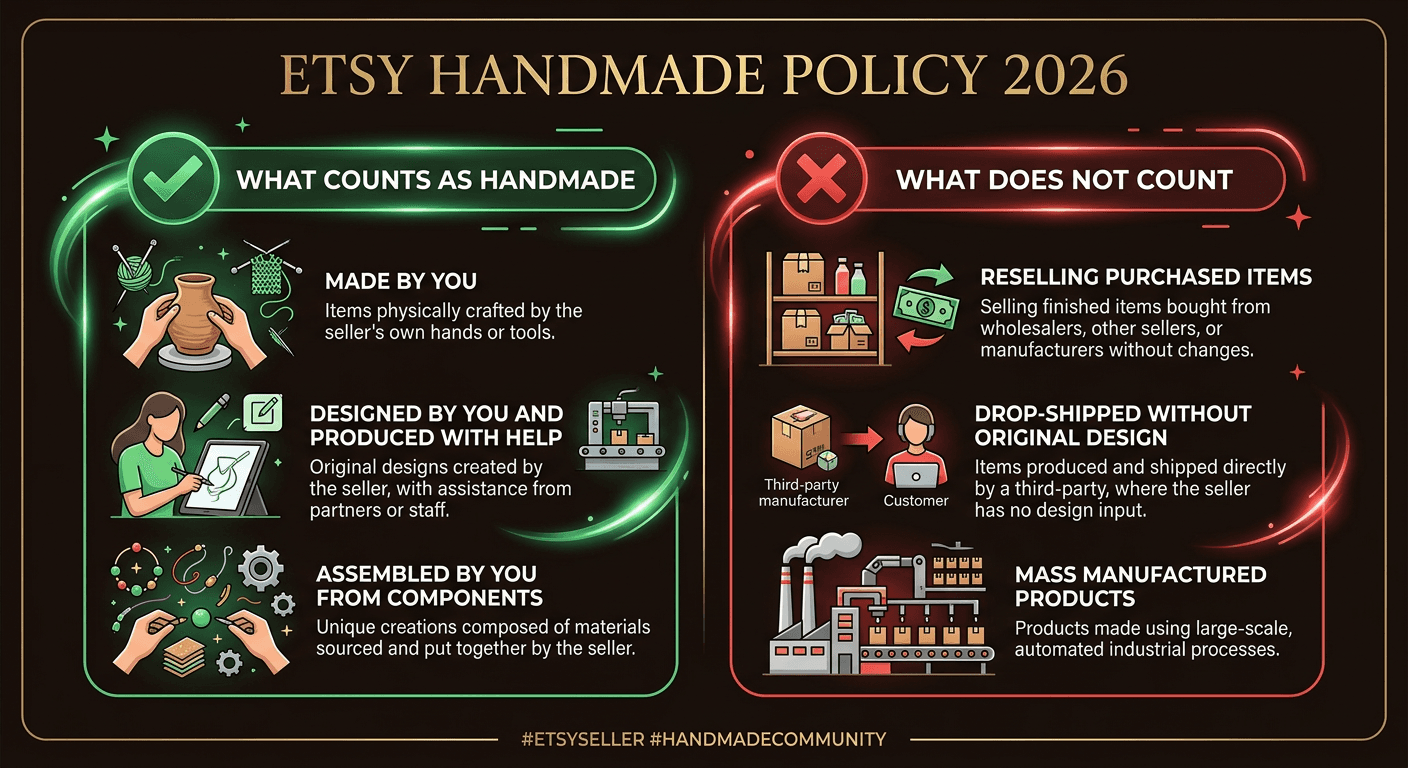
What Etsy Considers Handmade
Etsy's handmade policy is broader than most sellers realize. You don't need to hand-stitch every seam or sculpt every piece from raw clay. The platform recognizes three categories of handmade products:
Made by You
The most straightforward category. You physically create the product yourself — pottery thrown on your wheel, jewelry soldered at your bench, paintings on your canvas. The entire production process happens in your hands.
Designed by You, Produced with Assistance
You create the original design, but a production partner or tool handles the manufacturing. This includes print on demand products, laser-cut items from your designs, and products manufactured by a disclosed partner using your specifications. The key requirement: the intellectual and creative work must be yours.
Assembled by You from Components
You source pre-made components — beads, charms, findings, fabric — and assemble them into a finished product. Jewelry makers who buy gemstones and settings, then assemble unique pieces, fall into this category. The assembly and design choices must be meaningfully yours.
The common thread across all three categories is creative authorship. Etsy doesn't require you to make everything from scratch. They require you to be the creative force behind the product.
What Does NOT Count as Handmade
Understanding what Etsy explicitly prohibits is just as important as knowing what qualifies. These are the activities that will get your listings removed — or your shop suspended:
- ×Reselling purchased items: Buying finished products from a manufacturer or wholesale supplier and listing them as your own. This is the most common violation Etsy targets. It doesn't matter if you add custom packaging or a branded sticker — if you didn't make or design the product, it's not handmade.
- ×Drop-shipping without original design: Forwarding orders to a manufacturer who ships generic products directly to buyers. This is different from print on demand because there's no original design involved — you're simply acting as a middleman for mass-produced goods.
- ×Mass-manufactured products: Items produced in bulk by factories with no creative input from the seller. Even if you "designed" the product by choosing colors from a catalog, Etsy considers this mass manufacturing, not handmade production.
The gray area is real, and Etsy knows it. If your listings look like they could be from AliExpress or a wholesale catalog, expect scrutiny. Etsy's detection systems specifically look for product images that match known mass-produced items. For a deeper look at what gets flagged, read our guide on why Etsy listings get removed.
2026 Creativity Standards Update
Etsy's biggest policy shift in 2026 is the updated creativity standards for digitally manufactured products. As laser cutters, 3D printers, and CNC machines became mainstream seller tools, Etsy tightened the rules around what counts as "original design."
Original Designs Required
If you use a laser cutter, 3D printer, or CNC machine, the design file must be your original creation. You cannot download a free SVG from the internet, cut it on your Glowforge, and call it handmade. The creative work is in the design, not the machine operation.
No Purchased Templates
Buying design templates from Creative Market, Etsy itself, or any other marketplace and then producing products from those templates no longer qualifies under the handmade policy. Etsy now classifies this as using someone else's creative work, which places the product outside the handmade category.
Meaningful Modification Standard
Simply changing colors, scaling, or adding text to an existing template does not meet the bar. Etsy expects "meaningful creative modification" — the final product must be substantially different from the source material and reflect genuine artistic choices.
These updates affect tens of thousands of sellers who built businesses around purchased SVG files and template-based production. For the full breakdown of every policy change this year, see our complete guide to Etsy policy changes in 2026.
Production Partners
Etsy allows you to use production partners — third parties who help manufacture your products — but the rules around disclosure are strict and non-negotiable.
A production partner is anyone who helps produce your items. This includes print on demand services like Printify and Printful, contract manufacturers who produce your designs, local fabricators who cut or sew your patterns, and any other third party involved in physically creating the product.
Disclosure Requirements
- ✓Add each production partner in your Etsy shop settings with their name and location
- ✓Describe their role in the production process (printing, cutting, assembly, fulfillment)
- ✓Link each applicable listing to the correct production partner
- ✓Update your partner list whenever you switch or add new partners
Transparency is non-negotiable. Etsy audits shops for undisclosed production partners, and buyers can report sellers they suspect are hiding manufacturing relationships. An undisclosed production partner is treated the same as a handmade policy violation — it can result in listing removal and, for repeat offenders, shop suspension.
Print on Demand and Handmade
Print on demand is one of the most common questions around Etsy's handmade policy — and the answer is clear: POD is allowed as long as you designed it.
When you create an original design and upload it to a POD service like Printify, Printful, or Gooten, the resulting product qualifies as handmade under Etsy's "designed by you, produced with assistance" category. You are the creative force. The POD partner is the production partner.
POD Compliance Checklist
- ✓Design must be your original artwork — no purchased clip art, no stock graphics, no copied designs
- ✓Disclose your POD provider as a production partner in shop settings
- ✓Each listing using POD must be linked to the correct production partner
- ✓Avoid trademarked terms in designs, titles, and tags
What does not qualify: uploading generic text like "Best Mom Ever" onto a blank mug template and calling it original design. Etsy's creativity standards now evaluate whether the design demonstrates genuine creative effort. For a complete walkthrough of starting a POD business on Etsy, read our print on demand guide.
AI-Generated Products
AI-generated products are the most debated topic in the Etsy handmade community in 2026. Etsy has taken a nuanced position: AI is a tool, not a creator.
What Qualifies
AI-assisted products where the seller provides meaningful creative direction and substantially modifies the output. Using AI as a brainstorming tool, generating initial concepts that you then hand-refine, or using AI to enhance your existing artwork — these are acceptable uses. The seller must add genuine creative value beyond the prompt.
What Does Not Qualify
Purely AI-generated products with no meaningful human creative input. Typing a prompt into Midjourney or DALL-E, downloading the output, and uploading it directly to a POD product does not meet the handmade standard. The AI did the creative work, not you.
Disclosure Is Mandatory
Regardless of how you use AI, Etsy requires disclosure. If AI tools were involved in any part of your design process, you must indicate this in your listing. Failure to disclose AI involvement is treated as a policy violation — even if the final product would otherwise qualify as handmade.
The line between "AI-assisted" and "AI- generated" is subjective, and Etsy's enforcement teams make judgment calls. The safest approach: use AI as one step in a multi-step creative process, and document your workflow in case you need to defend a listing during review.
How Etsy Enforces the Handmade Policy
Etsy doesn't rely on an honor system. The platform uses multiple enforcement mechanisms to identify and remove non-handmade products:
Etsy's automated systems scan listing images against databases of known mass-produced products. They also analyze pricing patterns, listing velocity, and product descriptions for signals that suggest reselling rather than handmade production.
Buyers can report listings they believe are not handmade. These reports trigger manual reviews by Etsy's trust and safety team. A single credible report can put your entire shop under review.
Etsy's team conducts periodic manual reviews of shops, especially those that scale rapidly or operate in categories known for policy violations. During a manual review, every listing is evaluated against the handmade policy.
In 2026, Etsy added a new violation type specifically for products that fail the creativity standards — template-based designs, purchased SVGs, and unmodified AI outputs. These are flagged separately from traditional reselling violations.
The takeaway: don't assume Etsy won't notice. Their detection capabilities have improved significantly, and the combination of automated scanning and community reporting means non-compliant listings rarely survive long. For more on compliance scanning, check our Etsy listing compliance checker guide.
What Happens If You Violate the Policy
Etsy's enforcement follows a progressive discipline model, but the specifics depend on the severity and frequency of violations:
Step 1: Listing Removed
The offending listing is deactivated and you receive a notification explaining the specific violation. This is the most common outcome for first-time issues. The listing disappears from search immediately.
Step 2: 90-Day Appeal Window
You have 90 days to appeal through Etsy's resolution center. To win an appeal, you need to provide evidence that your product meets the handmade policy — process photos, design files, production partner documentation. Vague explanations rarely succeed.
Step 3: Shop-Wide Review
Multiple violations trigger a review of your entire shop. Etsy's team examines all active listings, not just flagged ones. During this review, your shop may face selling restrictions — you can't publish new listings until the review concludes.
Step 4: Suspension
Repeated violations or egregious offenses (like running a full reselling operation) result in shop suspension. Your shop goes offline, funds may be held, and reinstatement requires a formal appeal with documentation proving you've corrected the issues. Learn more in our listing removal guide.
How to Stay Compliant
Compliance isn't complicated. It requires intentionality, not perfection. Here's what successful sellers do to stay on the right side of Etsy's handmade policy:
Document Your Process
Keep records of your design process from start to finish. Save your original design files (with timestamps), take screenshots of your work in progress, and maintain version history. If Etsy ever questions a listing, you want irrefutable proof that the design is yours.
Keep Photos of Creation
For physical products, photograph your workspace, your materials, and your production process. Behind-the-scenes content isn't just good for social media — it's your best defense during a policy review. Show the raw materials, the in-progress shots, and the finished product side by side.
Be Transparent
Disclose everything. Production partners, AI tools, design assistance — transparency is always the safer choice. Etsy penalizes hidden relationships far more harshly than disclosed ones. A seller using a production partner with full disclosure is compliant. The same seller hiding that partner is violating policy.
Audit Your Listings Regularly
As policies change, previously compliant listings can become violations. Review your listings quarterly against the current handmade policy. Pay special attention to any listings that use templates, AI tools, or production partners — these are the categories Etsy updates most frequently.
Use a Compliance Tool
Manual auditing gets overwhelming once you have more than a few dozen listings. Automated compliance tools can scan your titles, tags, and descriptions for potential violations and flag issues before Etsy does — saving you from surprises that could cost you your shop.
Don't Wait for Etsy to Flag Your Listings
Handmade policy violations are one of the top reasons Etsy removes listings and suspends shops. Most sellers don't find out about a problem until the notification hits their inbox — and by then, the listing is already gone.
Unflagged scans your product titles, tags, descriptions, and metadata against Etsy's current policies and flags compliance risks before they become violations. Catch issues in seconds, not after your revenue disappears.