Etsy Processing Time Rules 2026: The FTC Clock
Etsy processing time is a federal deadline, not a shop setting. 16 CFR part 435 sets a 30-day default and the exact offer you owe when you miss it.
- 1.What Your Etsy Processing Time Actually Promises
- 2.When the Clock Starts, and What Stops It
- 3.How Long You Have, and What Stops the Clock
- 4.The Offer You Owe Before the Date Passes
- 5.Silence Flips Meaning at the 30-Day Line
- 6.Five Ways an Order Cancels Itself
- 7.What Counts as a Refund, and What Does Not
- 8.The Records That Decide the Argument
- 9.Where Etsy's Clock and the Federal One Diverge
- 10.The Routine That Survives Both
- 11.Related Articles
- 12.FAQ
Key takeaways
- The number in that dropdown is a federal promise. 16 CFR 435.2(a)(1) makes it an unfair or deceptive practice to solicit an order unless you had "a reasonable basis to expect" to ship inside the time you stated. State nothing and the default is thirty days.
- The clock does not start when the money arrives. 435.1(c) starts it at receipt of a properly completed order: payment plus "all of the information needed... to process and ship". An unanswered personalisation question is a clock that has not started.
- The violation is usually not being late. It is what you fail to offer. 435.2(b)(1) requires you to offer delay-or-cancel "without prior demand" and "in no event later than" the date you promised. Miss both and 435.2(c)(5) deems the order cancelled with a refund owing.
- Silence means opposite things either side of thirty days. A revised date thirty days out or less is opt-out: say nothing and the buyer has consented. Beyond thirty days, or indefinite, it flips to opt-in and silence cancels the order.
- Shop credit is not a refund, and that distinction has a price tag. Issuing gift cards instead of refunds was one of the counts behind the $9.3 million Fashion Nova settlement, the largest the FTC has taken under this Rule.
You set your processing time once, when you opened the shop, and picked the range that felt safe. Since then it has been a number you glance at while packing, and the only thing you have seen punish a late order is the Star Seller panel. There is a federal rule, in force since 1975 and extended to internet orders in 2014, that treats your Etsy processing time as a promise with a $53,088 per-violation ceiling behind it, and it does not care about your badge. We read all three sections of 16 CFR part 435 in the Government Publishing Office's own edition, pulled the current penalty figure from 16 CFR 1.98(d), and checked the four guides ranking for this term. None of the four mentions the Rule at all.
What follows is what the logistics guides leave out: when the clock starts, what stops it, the offer you owe the day you know you will be late, and the five ways an order cancels itself whether or not you notice.
What Your Etsy Processing Time Actually Promises
The platform treats processing time as an input: it feeds the "ship by" date and, added to carrier transit, the delivery estimate shown at checkout. That is the whole of what the competing guides cover.
The Rule treats the same number as a representation made at the moment of solicitation. 435.2(a)(1) reaches a seller who solicits an order "unless, at the time of the solicitation, the seller has a reasonable basis to expect that it will be able to ship any ordered merchandise to the buyer... within that time clearly and conspicuously stated". The test is applied to the state of your shop when the listing went up, not to how the order turned out.
| The same field, two readings | What Etsy does with it | What part 435 does with it |
|---|---|---|
| Processing time of "1-3 business days" | Computes a ship-by date and a delivery estimate | A clearly and conspicuously stated time, so it becomes your deadline |
| No processing time set | No ship-by date is shown to the buyer | The 30-day default under 435.2(a)(1)(ii) applies anyway |
| A date you cannot meet | Lowers your on-time rate | Needed a reasonable basis when the listing was soliciting orders |
| Missing the date | Counts against the Star Seller threshold | Triggers a mandatory offer, and a refund if you do not make it |
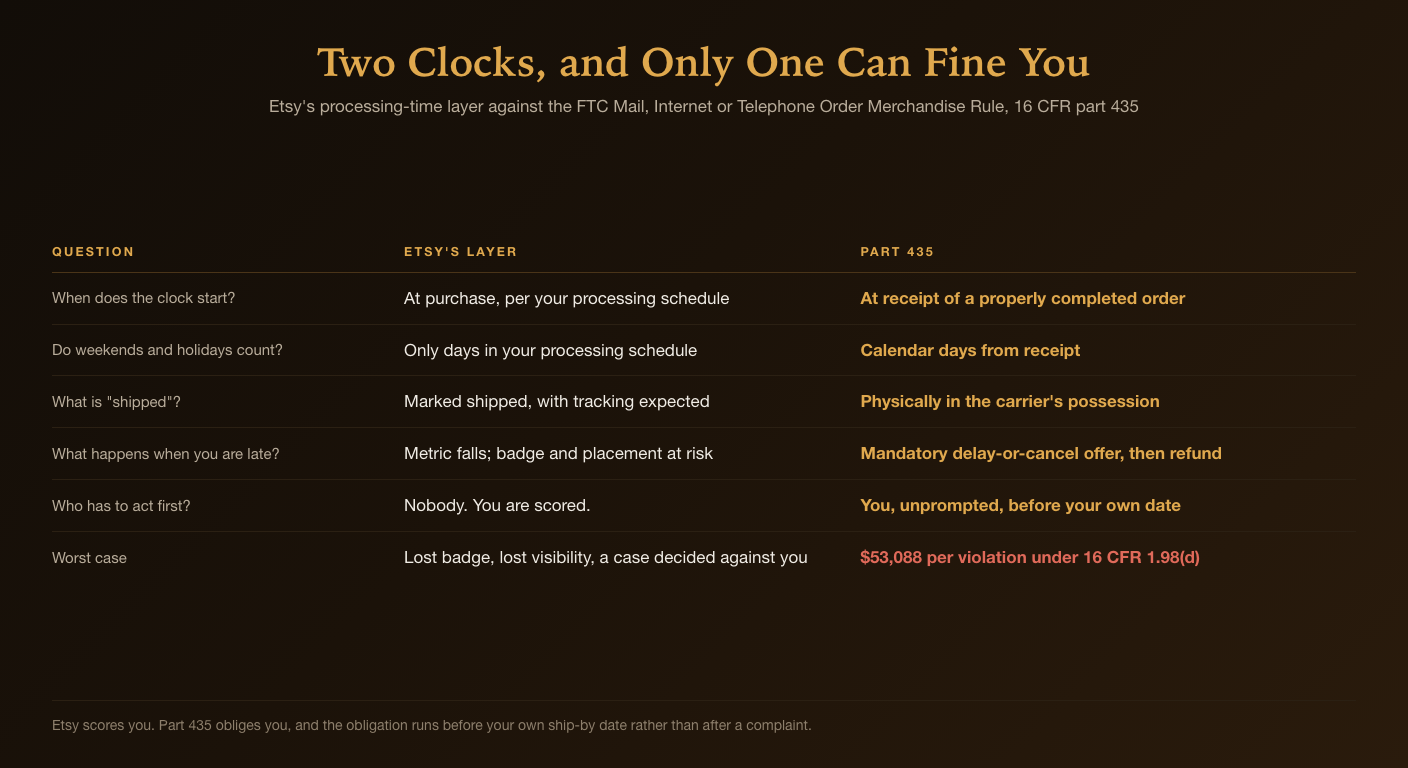
The practical difference is who acts first. Etsy scores you after the fact; the Rule obliges you to act, unprompted, before your own date passes.

When the Clock Starts, and What Stops It
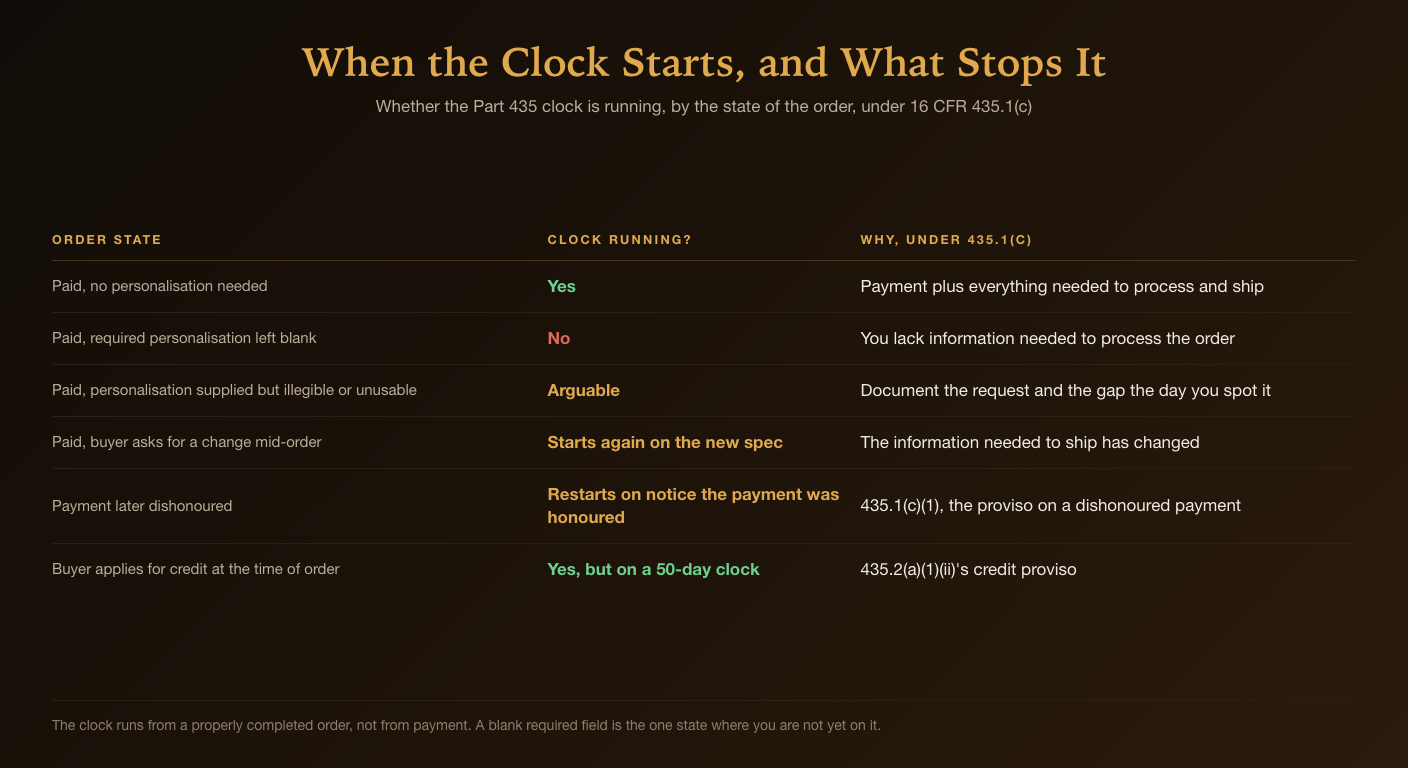
Nobody in this niche answers this, and it decides half of all disputes. The clock does not start at payment. 435.1(c) defines receipt of a properly completed order as the time the seller receives both the payment and "an order from the buyer containing all of the information needed by the seller to process and ship the order".
Read that against a personalised listing. If your item cannot be made without a name, a date, a photo or a size, and the buyer left that field blank or sent an unusable file, you do not have all the information needed to process and ship. The clock has not started. Every competing guide fields this question and answers it as a customer-service problem; it is a timing problem with a regulatory definition attached, and it belongs in how you handle custom orders rather than improvised per order.
| Order state | Clock running? | Why, under 435.1(c) |
|---|---|---|
| Paid, no personalisation needed | Yes | Payment plus everything needed to process and ship |
| Paid, required personalisation left blank | No | You lack information needed to process the order |
| Paid, personalisation supplied but illegible or unusable | Arguable | Document the request and the gap the day you spot it |
| Paid, buyer asks for a change mid-order | Starts again on the new spec | The information needed to ship has changed |
| Payment later dishonoured | Restarts on notice the payment was honoured | 435.1(c)(1), the proviso on a dishonoured payment |
| Buyer applies for credit at the time of order | Yes, but on a 50-day clock | 435.2(a)(1)(ii)'s credit proviso |
Two things follow. Ask for missing information the day the order lands, in the order messages, where it is timestamped. And never mark an unanswerable order as in production: the only record of why it took five weeks is the thread where you asked.
How Long You Have, and What Stops the Clock
If you state no shipping time clearly and conspicuously, 435.2(a)(1)(ii) gives you "thirty (30) days after receipt of a properly completed order from the buyer". That is why the Rule is still called the Thirty Day Rule, and it is a floor rather than a target: the Fashion Nova order required shipment within one day where no time was stated.
The exception is buried in a proviso and appears in none of the competing guides. Where "at the time the merchandise is ordered the buyer applies to the seller for credit to pay for the merchandise in whole or in part", you get fifty days rather than thirty. Do not plan around it; know it exists before you concede a point in a dispute. The better move is to state a time at all, because a number you chose and can meet is far easier to defend than a thirty-day silence.
Whichever applies, only one thing stops the clock. 435.1(e) is a single sentence: "Shipment shall mean the act by which the merchandise is physically placed in the possession of the carrier." Not label purchased. Not status changed. Not sitting in a mail sack in your hallway waiting for Monday.
Marking an order shipped to stop a ship-by date going red is a habit this niche quietly recommends, and it manufactures the exact evidence problem the Rule's records provisions are built around. If the label was bought on the 3rd and the carrier's first scan is the 9th, your own tracking contradicts your own timestamp, in a record you do not control.
The Offer You Owe Before the Date Passes
This is the heart of the Rule, and it has no coverage anywhere in the niche. When you cannot ship in time, 435.2(b)(1) makes it a violation "to fail to offer to the buyer, clearly and conspicuously and without prior demand, an option either to consent to a delay in shipping or to cancel the buyer's order and receive a prompt refund".
Three constraints sit on that offer. It must come without the buyer asking, "within a reasonable time after the seller first becomes aware" of the problem and "in no event later than" your original date. And under 435.2(b)(3) you must give the buyer "adequate means, at the seller's expense" to take the option, which rules out making them chase you.
What the notice has to say depends on the length of the delay, and the three shapes are genuinely different documents:
| Your situation | What the notice must contain | Rule |
|---|---|---|
| You have a firm new date, 30 days or less past the original | The cancel-and-refund right, the definite revised date, and an express statement that silence before shipment and before that date counts as consent | 435.2(b)(1)(ii) |
| You have a firm new date more than 30 days past the original | The same, except it must expressly say the order is automatically cancelled unless you ship within 30 days of the original date with no cancellation, or the buyer consents in writing within those 30 days | 435.2(b)(1)(iii) |
| You cannot give any date | A statement that you are unable to make any representation about the length of the delay, plus the reasons for it, plus the buyer's continuing right to cancel at any time before shipment | 435.2(a)(3), 435.2(b)(1)(iii) |
Note what 435.2(a)(2) and (a)(3) add. A revised date is itself a representation needing a reasonable basis, so a date invented to buy quiet is a second violation. And "I don't know when" is only available if you also say why.
Silence Flips Meaning at the 30-Day Line
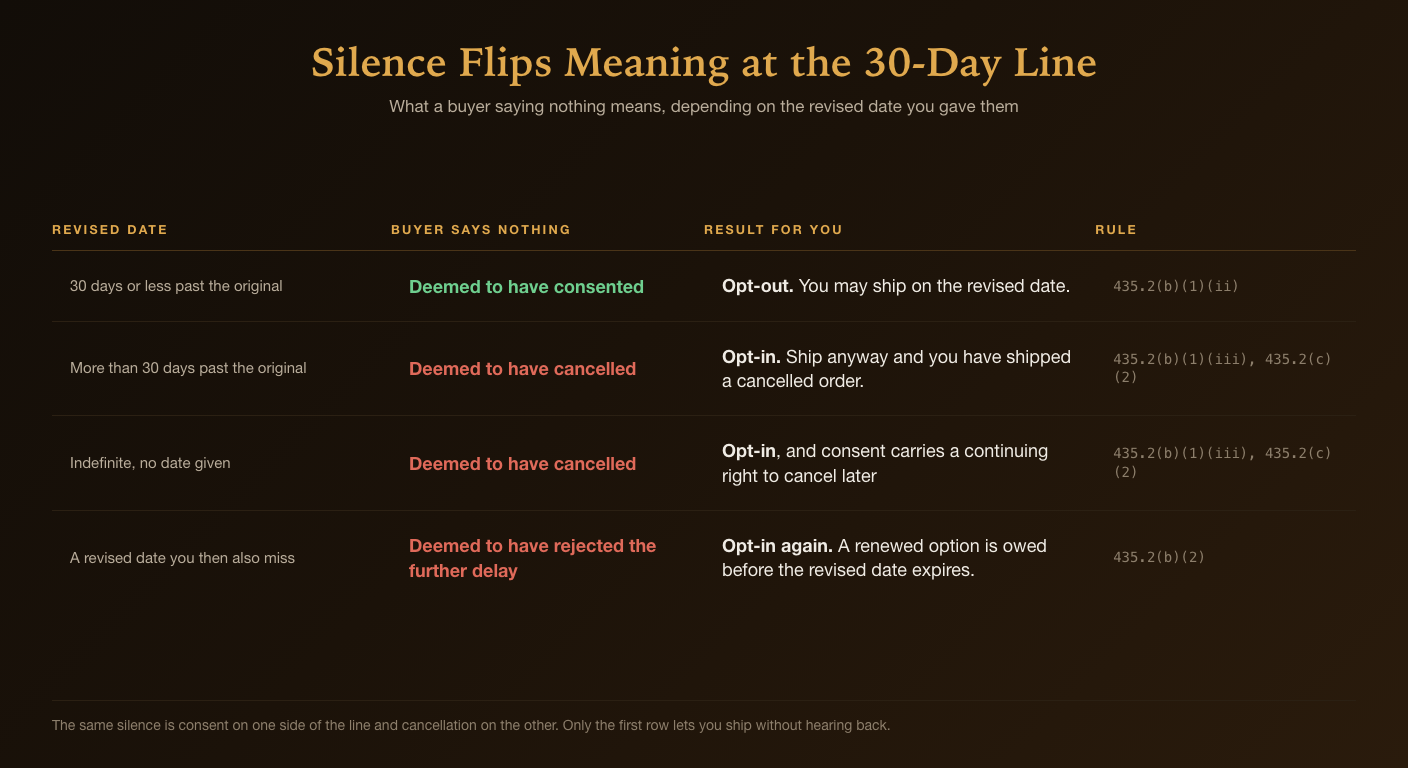
This is the most counter-intuitive thing in part 435, and getting it backwards costs real money. Whether a buyer's silence helps or hurts depends entirely on how far out your revised date is.
| Revised date | Buyer says nothing | Result for you | Rule |
|---|---|---|---|
| 30 days or less past the original | Deemed to have consented to the delay | Opt-out. You may ship on the revised date. | 435.2(b)(1)(ii) |
| More than 30 days past the original | Deemed to have cancelled | Opt-in. Ship anyway and you have shipped a cancelled order. | 435.2(b)(1)(iii), 435.2(c)(2) |
| Indefinite, no date given | Deemed to have cancelled | Opt-in, and consent carries a continuing right to cancel later | 435.2(b)(1)(iii), 435.2(c)(2) |
| A revised date you then also miss | Deemed to have rejected the further delay | Opt-in again. A renewed option is owed before the revised date expires. | 435.2(b)(2) |
So quote a revised date inside thirty days of your original one whenever you honestly can: that is the only configuration in which an unresponsive buyer works in your favour. Push past thirty days and you need a yes in writing within thirty days of the original date, or the order is gone. Under 435.2(b)(2), a second miss restarts the procedure, with a new definite date and a renewed option offered before the first revised date runs out.
Five Ways an Order Cancels Itself
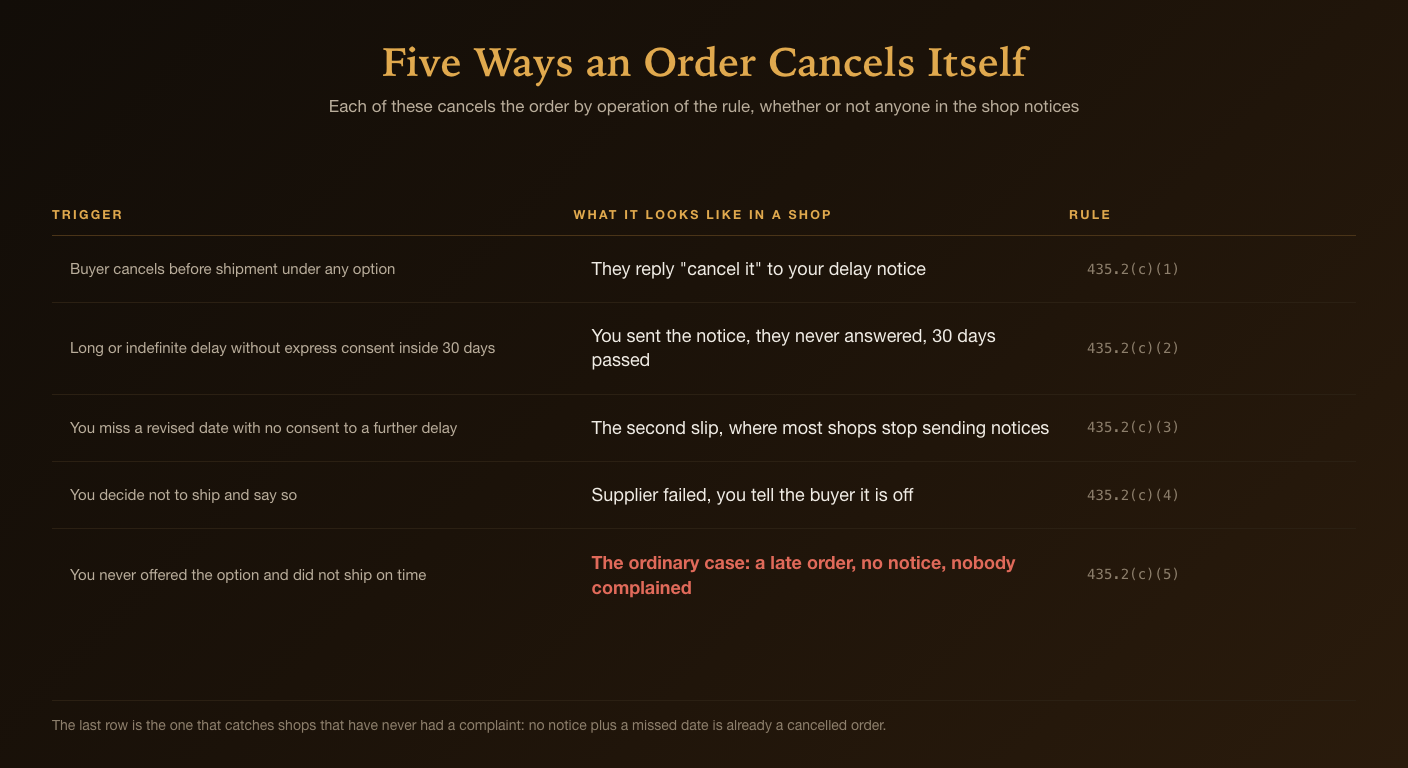
435.2(c) lists the circumstances in which you must "deem an order cancelled and... make a prompt refund". The verb matters: the order is cancelled by operation of the Rule, not by anyone's decision, and the refund is owed whether or not anyone is watching.
| Trigger | What it looks like in a shop | Rule |
|---|---|---|
| Buyer cancels before shipment under any option | They reply "cancel it" to your delay notice | 435.2(c)(1) |
| Long or indefinite delay without express consent inside 30 days | You sent the notice, they never answered, 30 days passed | 435.2(c)(2) |
| You miss a revised date with no consent to a further delay | The second slip, where most shops stop sending notices | 435.2(c)(3) |
| You decide not to ship and say so | Supplier failed, you tell the buyer it is off | 435.2(c)(4) |
| You never offered the option and did not ship on time | The ordinary case: a late order, no notice, nobody complained | 435.2(c)(5) |
That last row is the one to read twice. A quietly late order with no delay notice is not a grey area. It is a cancelled order you are holding the money for, and the buyer eventually receiving the item and liking it does not retroactively supply the offer you never made.
One carve-out works in your favour: under 435.2(b)(4) you may decide to treat the order as cancelled, tell the buyer within a reasonable time, and refund promptly. When a delay has become open-ended, that is often the cleaner exit.
What Counts as a Refund, and What Does Not
"Prompt refund" is defined in 435.1(b), and the number is seven working days from the date the buyer's right to a refund vests, sent "by any means at least as fast and reliable as first class mail". Where you cannot refund by the original payment method, the seven days run from discovering that and you must use cash, cheque or money order. On a credit sale where you are the creditor, one billing cycle applies instead.
Then there is the form. 435.1(d) sets out what a refund is for each payment type, and the thread through all of it is that the buyer gets their money back in the form they paid. A store credit is not on the list. Neither is a coupon or a replacement they did not ask for.
This is not a technicality nobody enforces. The FTC's largest settlement under this Rule, $9.3 million from Fashion Nova in 2020, included a count for exactly this: when the company did refund, it issued gift cards, which the Rule does not allow. The same order required Fashion Nova to ship within one day where it stated no time.
So if your instinct when an order goes wrong is to offer shop credit and keep the sale: you may offer it, you may not substitute it. Watch the balance too, because refunds against earnings you have already drawn is the shape that ends in a negative balance suspension.
The Records That Decide the Argument
Part 435 contains two rebuttable presumptions, and both run against the seller who kept nothing. 435.2(a)(4): in an FTC action, a seller's failure "to have records or other documentary proof establishing its use of systems and procedures which assure the shipment of merchandise in the ordinary course of business" within the applicable time "will create a rebuttable presumption that the seller lacked a reasonable basis for any expectation of shipment". 435.2(d) does the same for the notice and refund duties in paragraphs (b) and (c).
The absence of records is itself the finding. You are not asked to prove you shipped on time. You are asked to show the system that made on-time shipping the ordinary outcome, and the notices you sent when it failed. A shop with no evidence either way starts the argument having already lost both presumptions, which is why a dated log beats a good memory and why delay notices belong in Etsy's order messages rather than in a text or a DM.
The log that satisfies both is unglamorous: order date, the date it became properly completed, the promised date, the date the carrier took possession, and, where it slipped, the date and content of your notice. Five columns, and no marketplace tool keeps them for you.
Where Etsy's Clock and the Federal One Diverge
Both clocks measure your Etsy processing time, and they disagree in ways that matter on a Friday afternoon.
| Question | Etsy's layer | Part 435 |
|---|---|---|
| When does the clock start? | At purchase, per your processing schedule | At receipt of a properly completed order |
| Do weekends and holidays count? | Only days in your processing schedule | Calendar days from receipt |
| What is "shipped"? | Marked shipped, with tracking expected | Physically in the carrier's possession |
| What happens when you are late? | Metric falls; badge and placement at risk | Mandatory delay-or-cancel offer, then refund |
| Who has to act first? | Nobody. You are scored. | You, unprompted, before your own date |
| Worst case | Lost badge, lost visibility, a case decided against you | $53,088 per violation under 16 CFR 1.98(d) |
Two notes on the right-hand column. The penalty ceiling is the figure at 16 CFR 1.98(d), adjusted for inflation in January 2025, and it is the ceiling for a knowing violation in an action the Commission brings, not a fine that arrives in the post. Under 435.3 the Rule does not preempt state law giving buyers equal or greater rights, so your state's consumer statute sits on top of it, while a short list of orders is exempt outright: seeds and growing plants, C.O.D., and subscription shipments after the first.
In practice the platform layer is the one that changes your week, because it is the only automated one, and the metric it moves is your Star Seller standing. We describe that layer rather than quote it: etsy.com returns 403 to every automated request we make, and we will not reproduce policy text we cannot verify. Check the current terms in your own browser, including the Purchase Protection changes that redefined a late parcel this year.
The Routine That Survives Both
None of this requires a lawyer or new software. It requires one habit at the start of an order and one at the moment it slips.
- State a processing time on every listing. Your own number replaces a thirty-day silence, and a number you can meet is the easiest thing here to defend.
- Pad for the stage you do not control. If a production partner sits in the middle, the reasonable basis you need under 435.2(a)(1) is a basis for their timeline, not yours.
- Ask for missing personalisation the same day, in the order messages. That message is the evidence the clock had not started.
- Diary your promised date, not the buyer's delivery estimate. Nobody sends the notice late on purpose; they send it late because they were watching the wrong field.
- When you slip, send the offer the same day, and keep the revised date inside thirty days of the original. That is the only version where an unresponsive buyer counts as a yes.
- Refund in the form they paid, within seven working days. Offer credit if you like. Never substitute it.
- Keep the five-column log. It answers both presumptions and takes a minute per order.
Every obligation above is triggered by a date and a sentence in your listing. Unflagged screens the text you provide for potential policy concerns, with explanations and references. It does not verify your product, establish legal compliance or predict enforcement. See what the plans include, or read the operational side of the same setting in our Etsy shipping guide. Unflagged is our own product and we take no affiliate commission from anything named here. None of this is legal advice, and an FTC letter or a state consumer claim is a consumer-protection attorney rather than an afternoon of editing listings.
Related Articles
- Etsy Free Shipping Rules 2026: The FTC Guide - the other half of the shipping promise, and why "free" carries no penalty while "when" does
- Etsy Shipping Tips - the margin and logistics side of the same field
- Etsy Production Partner Rules 2026 - when the stage you do not control owns your deadline
- Etsy Purchase Protection 2026: Who Pays What - who funds the refund once a case opens
- Etsy Vacation Mode - the honest alternative to a processing time you cannot meet
- Etsy's Most Common Policy Violations - what actually gets listings pulled
FAQ
How long do I legally have to ship an Etsy order?
Whatever time you state clearly and conspicuously in the listing becomes your deadline under 435.2(a)(1)(i). State none and 435.2(a)(1)(ii) gives you thirty days from receipt of a properly completed order, or fifty where the buyer applied for credit at the time of ordering. Etsy's ship-by date is calculated separately and can fall earlier.
Does the clock start if a buyer has not filled in the personalisation?
No, if you genuinely cannot make the item without it. 435.1(c) starts the clock only when you have both payment and "all of the information needed by the seller to process and ship the order". Ask the same day, through Etsy's order messages, so the gap is timestamped. Do not rely on this where the personalisation was optional.
What do I have to send a buyer if I am going to be late?
A clear offer, before your promised date passes and without them asking, of a choice between consenting to the delay and cancelling for a prompt refund. It must carry a definite revised shipping date, or, if you genuinely cannot give one, a statement that you cannot and the reasons why, plus the means to cancel at your expense.
If the buyer never replies to my delay notice, can I still ship?
Only if your revised date was thirty days or less past the original one, and only if the notice expressly said that silence counts as consent. Beyond thirty days, or with no date at all, silence is treated as cancellation under 435.2(c)(2) and you need an express yes within thirty days of the original date.
Can I give Etsy shop credit instead of a refund?
You can offer it; you cannot substitute it. 435.1(d) defines a refund by payment type, returning the buyer's money in the form they paid within seven working days. Issuing gift cards in place of refunds was one of the counts in the FTC's $9.3 million Fashion Nova settlement in 2020.
Does marking an order shipped count as shipping it?
No. 435.1(e) defines shipment as the act by which the goods are "physically placed in the possession of the carrier". Buying a label and changing the order status is not shipment, and if the carrier's first scan is days later your own tracking is the record that contradicts you.
Are any Etsy shops outside this rule?
A few orders are. 435.3(a) excludes seeds and growing plants, C.O.D. orders, serial subscription deliveries after a compliant first shipment, and prenotification negative option plans. Everything else sold to a US buyer online is in scope, and 435.3(b) means a stronger state law applies on top.
Scan Your Listings Free
Screen submitted listing text for potential concerns. 5 preliminary screens daily, shared network limits; no signup required.
Start Free ScreenRelated Articles
How to Check Your Etsy Listings for Trademark Violations (2026 Guide)
Learn how to scan your Etsy listings for trademark violations before they get flagged. Step-by-step guide to protecting your shop from takedowns and suspensions.
Read moreEtsy Shop Suspended? How to Write a Winning Appeal Letter
Your Etsy shop got suspended. Here's exactly how to write an appeal letter that gets your shop reinstated, with templates and strategies that actually work.
Read more50 Words That Are Trademarked on Etsy (Stop Using These Now)
A comprehensive list of commonly trademarked words and phrases that Etsy sellers use without realizing they're violating trademark law. Check your listings now.
Read more