Etsy Free Shipping Rules 2026: The FTC Guide
Etsy free shipping rules in 2026: what the FTC free offer guide requires, why California bans handling fees in a listed price, and which rule has teeth.
- 1.What "Free" Promises on an Etsy Listing
- 2.The Markup Problem Etsy's Own Playbook Creates
- 3."Regular Price" in the Free Shipping Rules Means 30 Days
- 4.Where the Conditions Have to Appear
- 5.The Frequency Caps Nobody Applies to a Marketplace
- 6.Custom and Made-to-Order Shops Cannot Make This Offer
- 7.California Lets You Exclude Postage, Not Handling
- 8.The Shipping Promise With Real Penalties Is "When"
- 9.Selling Into the EU: Costs Before the Click
- 10.Etsy's Own Layer Is the One That Moves This Week
- 11.The Routine That Survives All of It
- 12.Related Articles
- 13.FAQ
Key takeaways
- A buyer may assume you did not just move the cost. 16 CFR 251.1(b)(1) gives them "a right to believe that the merchant will not directly and immediately recover, in whole or in part, the cost of the free merchandise or service by marking up the price of the article which must be purchased". Every free-shipping guide in this niche tells you to do that.
- "Regular price" here has a number: 30 days. Part 251 defines it as the price you openly and actively sold at "for a reasonably substantial period of time, i.e., a 30-day period", and where prices move it is the lowest price with substantial sales in that window.
- The two FTC pricing guides set opposite evidence tests. A crossed-out former price survives with no sales at it. A free offer does not: if no substantial sales were made at the regular price, 251.1(b)(2) says it "would not be proper".
- California lets you leave postage out of an advertised price. Not handling. The Attorney General's FAQ answers that in one line.
- The shipping promise with real penalties is not "free", it is "when". Part 251 is a Guide with no penalty attached. Part 435 is a rule, and a knowing violation reaches $53,088 under 16 CFR 1.98(d).
You switched free shipping on last spring because the search results told you to, added about six dollars to every item to cover it, and the shop has run that way since. Nothing has gone wrong, and the only number you have checked is the margin.
There is a federal guide in print since 1971 about what that word commits you to, and the Etsy free shipping rules that bind a shop are not Etsy's. They are four layers: an FTC guide that speaks directly to the markup you just made, a California statute that treats postage and handling differently, an FTC rule about delivery timing carrying a per-violation penalty the guide does not, and Etsy's own policy layer, the only automated one. We read all of 16 CFR part 251, pulled the handling-charge answer from the California Attorney General's FAQ, and checked the 2025 junk-fee rule to see whether it reaches a marketplace listing.
Here they are in the order they touch a shop, with what each actually requires.

What "Free" Promises on an Etsy Listing
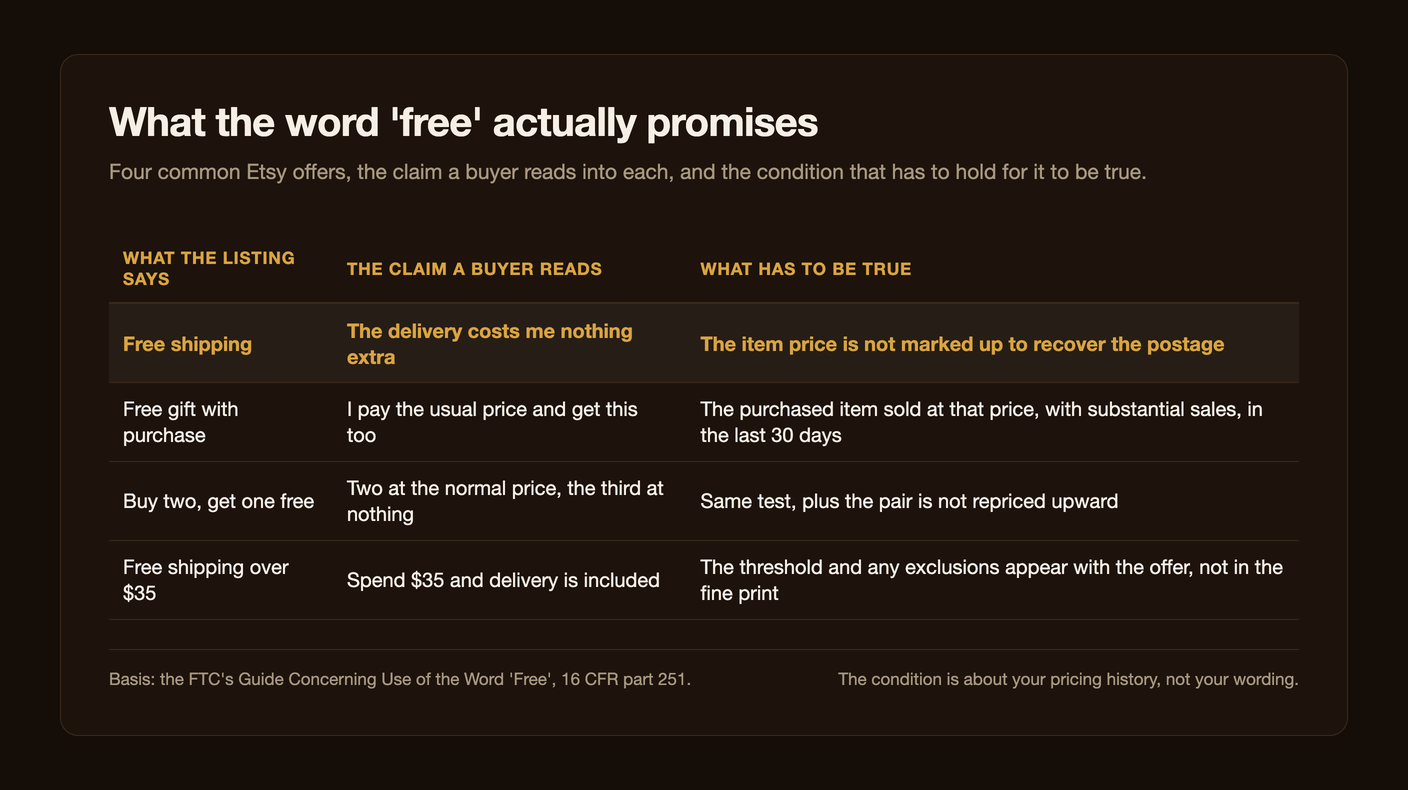
Three offers use the word and they are not the same claim. Free shipping is a service you normally charge for. A free gift is merchandise. "Buy two, get one free" is a quantity offer. Part 251 reaches all three: it covers "'Free' merchandise or service" and names "Buy 1-Get 1 Free", "2-for-1 Sale" and "50% off with purchase of Two" in its own list of covered language. What differs is what has to be true.
| What the listing says | The claim a buyer reads | What has to be true |
|---|---|---|
| Free shipping | The delivery costs me nothing extra | The item price is not marked up to recover the postage |
| Free gift with purchase | I pay the usual price and get this too | The purchased item sold at that price, with substantial sales, in the last 30 days |
| Buy two, get one free | Two at the normal price, the third at nothing | Same test, plus the pair is not repriced upward |
| Free shipping over $35 | Spend $35 and delivery is included | The threshold and any exclusions appear with the offer, not in the fine print |
One note on scope. Part 251 is a Guide published at 36 FR 21517 on 10 November 1971, and its machinery assumes packaged goods moving through resellers in a geographic trade area. The Commission has not published anything applying it to marketplace shipping. Its paragraphs about the article a buyer must purchase read straight onto a listing; the ones about trade areas and supplier promotions do not, and we flag which is which below.
The Markup Problem Etsy's Own Playbook Creates
Every guide to free shipping on Etsy gives the same instruction: work out your average postage, add it to your item prices, switch the setting on. A $35 bracelet becomes $42 and the shipping becomes free. The advice is commercially sound, and it is the single thing 251.1(b)(1) is about.
"Thus, a purchaser has a right to believe that the merchant will not directly and immediately recover, in whole or in part, the cost of the free merchandise or service by marking up the price of the article which must be purchased, by the substitution of inferior merchandise or service, or otherwise."
16 CFR 251.1(b)(1)
"Directly and immediately" is doing the work. A shop that has priced its goods at $42 for eight months and ships them at its own expense recovers nothing immediately: $42 is the regular price, and free shipping is what the shop does. A shop that raises $35 to $42 on the Tuesday and announces free shipping on the Wednesday has recovered the cost directly and immediately, and the word is doing work the price contradicts.
The practical line is the one that governs a sale badge in our walkthrough of Etsy sale price rules: the price has to settle before the claim goes up. Reprice, let those be the real prices for a month, then turn the setting on. The cost of getting it right is a four-week wait.
"Regular Price" in the Free Shipping Rules Means 30 Days
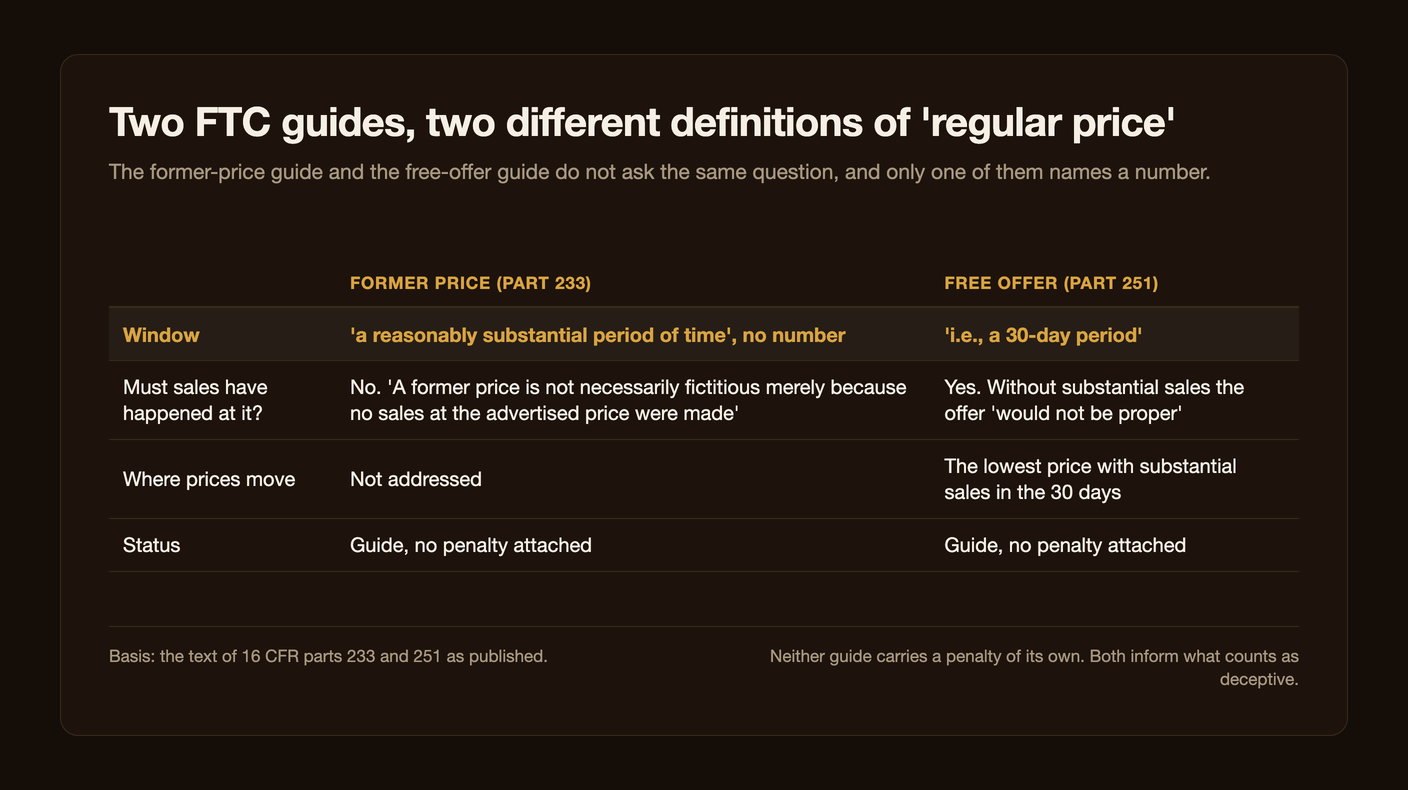
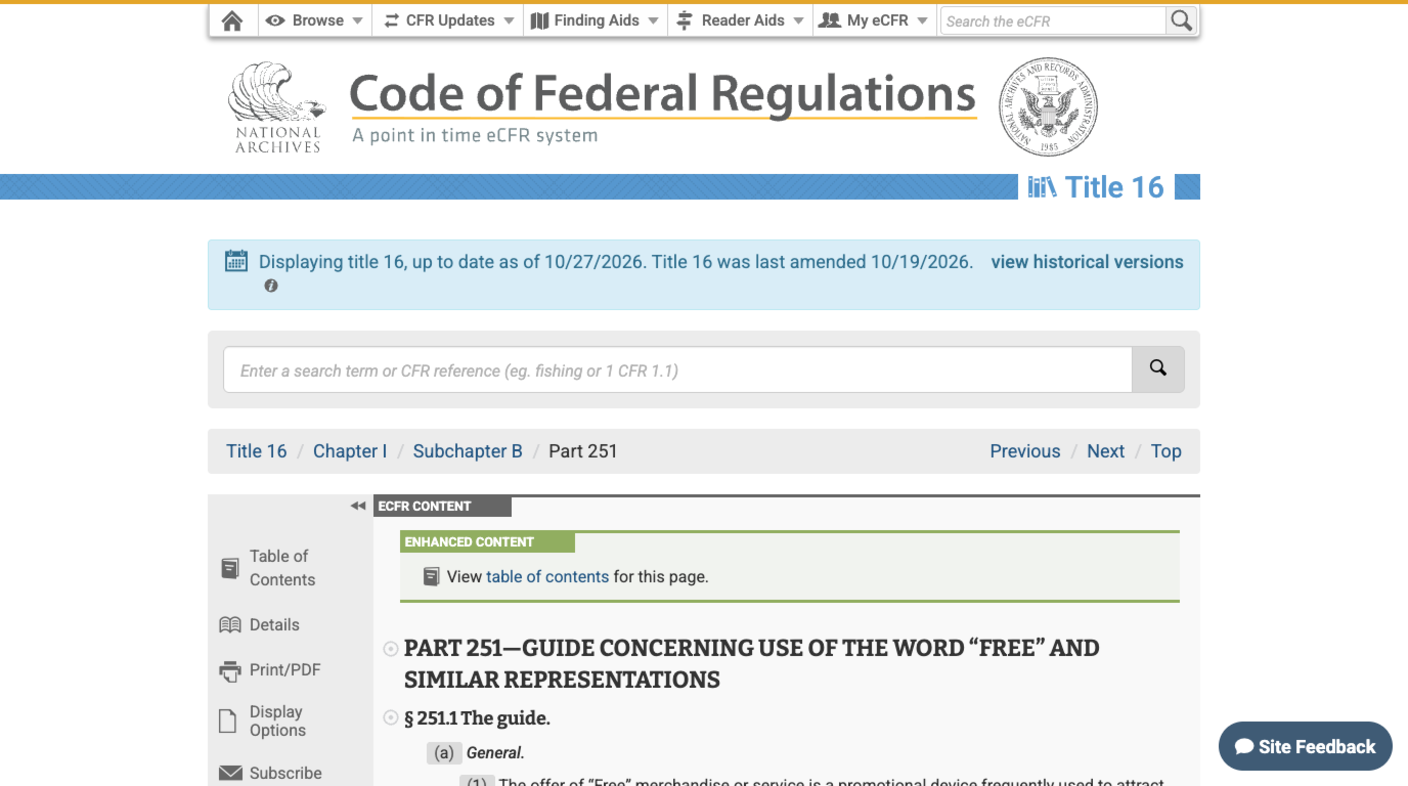
Part 251 does something part 233 never does: it puts a number on the window. The definition at 251.1(b)(2) is the price at which the seller "has openly and actively sold the product or service in the geographic market or trade area in which he is making a 'Free' or similar offer in the most recent and regular course of business, for a reasonably substantial period of time, i.e., a 30-day period."
Two riders follow, and both bite harder than the definition. Where prices fluctuate, "the 'regular' price shall be the lowest price at which any substantial sales were made" in that window, so your own sales and coupon runs set the floor. Then the closing line: "Except in the case of introductory offers, if no substantial sales were made, in fact, at the 'regular' price, a 'Free' or similar offer would not be proper."
| Former price (part 233) | Free offer (part 251) | |
|---|---|---|
| Window | "a reasonably substantial period of time", no number | "i.e., a 30-day period" |
| Must sales have happened at it? | No. "A former price is not necessarily fictitious merely because no sales at the advertised price were made" | Yes. Without substantial sales the offer "would not be proper" |
| Where prices move | Not addressed | The lowest price with substantial sales in the 30 days |
| Status | Guide, no penalty attached | Guide, no penalty attached |
That second row is the one to keep. A seller who has read the fake-discount commentary arrives believing an honestly offered price is enough. For a free offer it is not: somebody has to have bought at it. The printed CFR text runs four pages.
Where the Conditions Have to Appear
251.1(c) is the paragraph most likely to catch a careful shop, because it is about layout rather than honesty. Every term, condition and obligation on which receipt and retention of the free item depends "should be set forth clearly and conspicuously at the outset of the offer", and "should appear in close conjunction with the offer".
The Guide then rules out the workaround by name: disclosure in a footnote reached by an asterisk "is not regarded as making disclosure at the outset". Read onto a listing, if the title or first photo says FREE GIFT and the condition - a minimum spend, one per customer, while stocks last, domestic only - lives in paragraph nine of the description or in the shop announcement, the condition is in the footnote. The offer is at the top and the terms are not with it.
One carve-out exists and it is narrow: a bare notice that a free offer exists, pointing to where the terms are, is allowed, but only where the notice does not identify the free item. A title that names the gift has spent that allowance. The fix is the same discipline that keeps a listing clear of the automated review in Etsy's most common policy violations.
The Frequency Caps Nobody Applies to a Marketplace
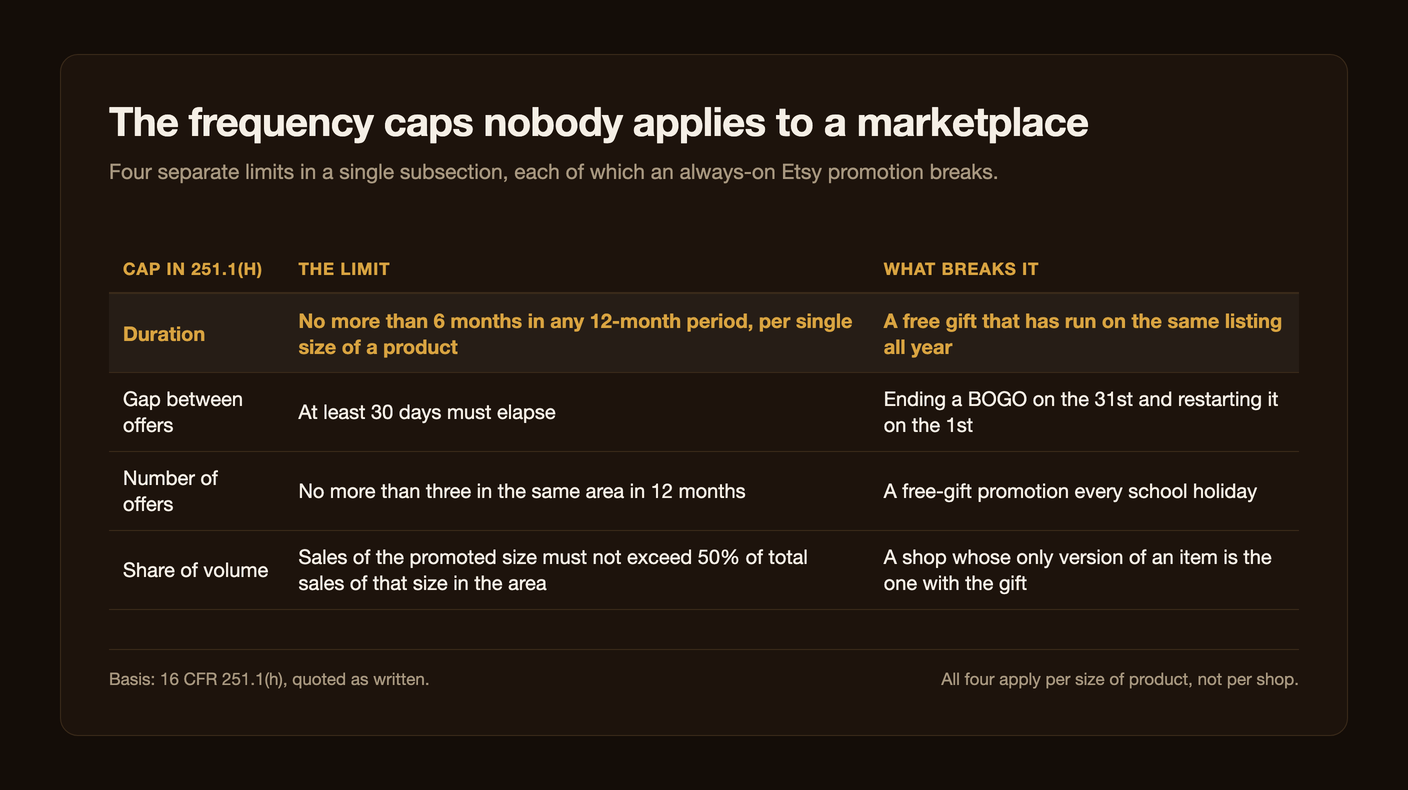
251.1(h) is the part no Etsy guide has quoted and the part whose application to a marketplace is genuinely unsettled. It exists so a free offer stays "special and meaningful", and it sets four limits at once.
| Cap in 251.1(h) | The limit | What breaks it |
|---|---|---|
| Duration | No more than 6 months in any 12-month period, per single size of a product | A free gift that has run on the same listing all year |
| Gap between offers | At least 30 days must elapse | Ending a BOGO on the 31st and restarting it on the 1st |
| Number of offers | No more than three in the same area in 12 months | A free-gift promotion every school holiday |
| Share of volume | Sales of the promoted size must not exceed 50% of total sales of that size in the area | A shop whose only version of an item is the one with the gift |
Read literally, a permanent "free gift with every order" banner fails all four. Whether that reading applies to an Etsy shop is the honest question: "trade area" and "a single size of a product" are 1971 concepts, and nothing we can find applies them to a marketplace storefront. We will not tell you a year-round free gift is unlawful on the strength of a Guide the Commission has not used that way.
The caps are useful for the diagnosis underneath them. An offer that never ends is not an offer, it is a price, which is the logic 233.1(a) uses when it says a permanently reduced price "is, in reality, probably just the seller's regular price". If your free gift is permanent, call it what it is: a set. That removes the part 251 question from the listing entirely.
Custom and Made-to-Order Shops Cannot Make This Offer
251.1(g) is short and structural. If a product "usually is sold at a price arrived at through bargaining, rather than at a regular price, it is improper to represent that another product or service is being offered 'Free' with the sale." The same follows "where there may be a regular price, but where other material factors such as quantity, quality, or size are arrived at through bargaining."
That describes a custom-order shop. If the price, size or finish is settled in messages, there is no regular price for the free item to sit beside. It is the shape of problem that defeats comparable-value claims on one-off pieces: the claim needs a benchmark the business model does not produce. 251.1(f) closes the neighbouring gap - a free offer on a launch is only proper if you expect in good faith to end it and then sell the item separately at the same price.
California Lets You Exclude Postage, Not Handling
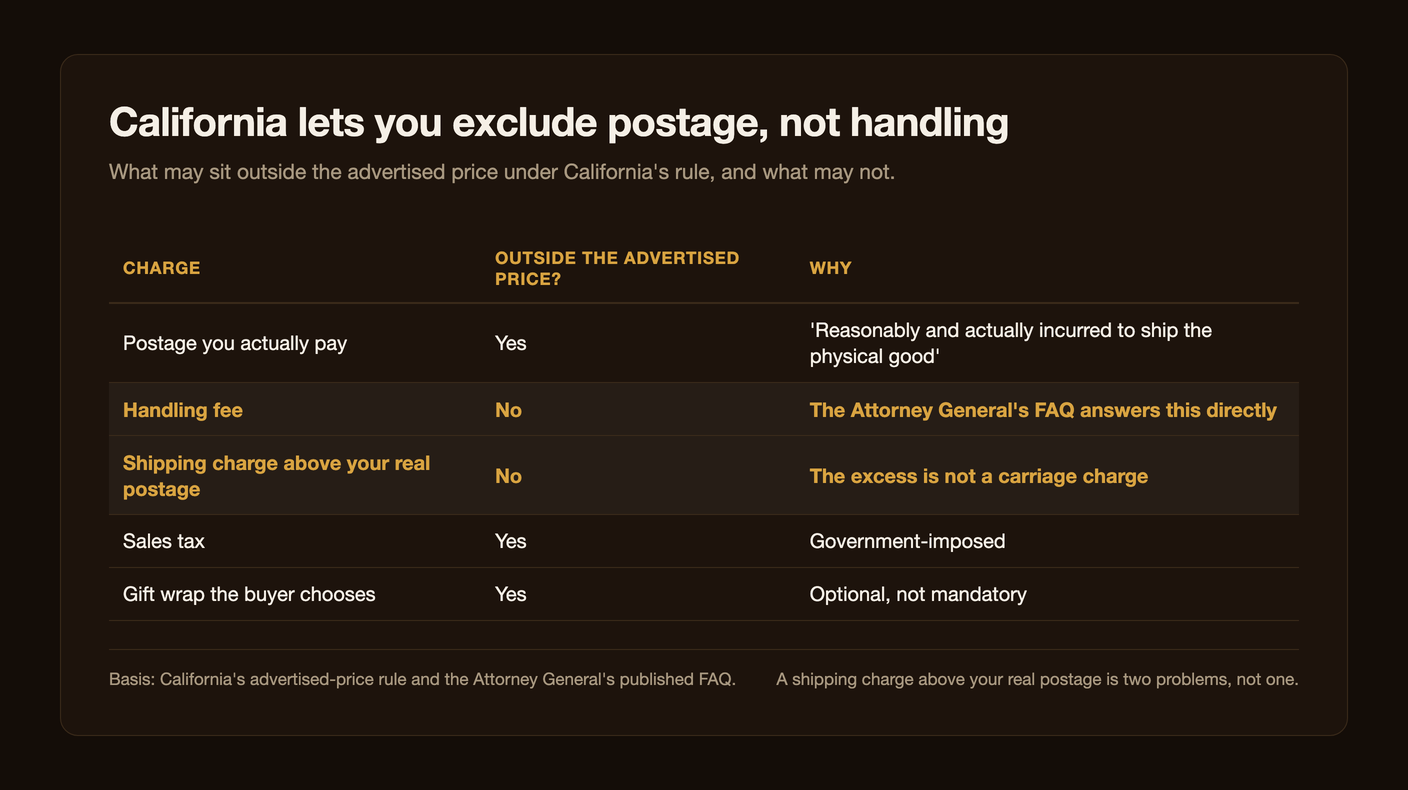
Here "free shipping" stops being about the word and becomes arithmetic. The Honest Pricing Law, SB 478, sits at Civil Code 1770(a)(29) and has applied since 1 July 2024. It prohibits advertising a price that excludes mandatory fees, and the Attorney General's FAQ puts the carve-out in one line: "A business can exclude shipping charges, but not handling charges." The statutory words are "postage or carriage charges that will be reasonably and actually incurred to ship the physical good to the consumer", and the FAQ adds that "like any other mandatory fee or charge, a handling charge must be included in the advertised price."
Etsy's shipping profiles let you set a handling fee. For a California buyer that amount belongs in the item price, and so does any part of a shipping charge above what the postage actually costs you: the exclusion is defined by what you incur, not by which field you typed it into.
| Charge | Outside the advertised price? | Why |
|---|---|---|
| Postage you actually pay | Yes | "Reasonably and actually incurred to ship the physical good" |
| Handling fee | No | The AG's FAQ answers this directly |
| Shipping charge above your real postage | No | The excess is not a carriage charge |
| Sales tax | Yes | Government-imposed |
| Gift wrap the buyer chooses | Yes | Optional, not mandatory |
Two points of context. A federal court in the Northern District of California held in 2026 that a $7 shipping and handling fee was not "mandatory" where the buyer could choose free in-store pickup instead, an avoidability argument unavailable to a shop with no shop. And the theory being litigated against retailers is a separately labelled fee that quietly reinstates shipping above a free-shipping threshold. If you run a threshold, the listing number has to be the whole story.
The Shipping Promise With Real Penalties Is "When"
Everything above comes from Guides. 16 CFR 1.5 calls industry guides "administrative interpretations", and no per-violation penalty attaches. There is an FTC shipping provision that is a rule, and it is about timing rather than price.
Part 435, the Mail, Internet, or Telephone Order Merchandise Rule, makes it an unfair or deceptive practice to solicit an order unless, at the time of solicitation, you have "a reasonable basis to expect" to ship within the time clearly and conspicuously stated, or, if you state none, "within thirty (30) days after receipt of a properly completed order". Miss it and 435.2(b)(1) requires you to offer the buyer a choice between consenting to the delay and cancelling for a prompt refund, which 435.1(b) defines as seven working days.
One subparagraph belongs in your records policy. Under 435.2(a)(4), a seller with no documentary proof of systems that assure shipment on time faces a rebuttable presumption that it never had a reasonable basis for the promise. The absence of records is itself the problem.
Because this is a rule, a knowing violation reaches the civil penalty ceiling at 16 CFR 1.98(d): $53,088 per violation, for penalties assessed after 17 January 2025. That asymmetry is worth internalising. The word "free" sits in a guide with no penalty; the processing time beside it sits in a rule with one, and the Star Seller metrics measure the one with teeth. The 2025 junk-fee rule neither helps nor hurts here: part 464 bans hidden and misleading fees, but 464.1 defines a "covered good or service" as live-event tickets or short-term lodging and nothing else. It reaches no Etsy listing, which is worth knowing because sellers have heard of it and assume it binds them.
Selling Into the EU: Costs Before the Click
For EU buyers the question is not what you call the charge but when they saw it. The Commission's consumer guidance says buyers "have to be clearly informed about the total price" and that "EU rules oblige traders to display correct and complete pricing information before a customer makes a purchase online".
Two mechanics matter. Any additional payment needs consent, and a pre-ticked box "does not constitute consent", so a default-selected insurance or priority upgrade is recoverable by the buyer. And a charge first shown after checkout is the guidance's own worked example of a breach. The rest of that regime is in our guide to Etsy EU compliance.
Etsy's Own Layer Is the One That Moves This Week
None of the four layers above is automated. Etsy's is, and it is the only one that can change your week. Etsy runs a free-shipping programme for US domestic orders over a threshold, ties search placement to shipping prices, and publishes seller policies on accurate listing information. We are describing that layer rather than quoting it, because etsy.com returns 403 to every automated request we make and we will not reproduce policy text we cannot fetch and verify. Check the current terms in your own browser before relying on any summary, including this one.
The consequence is the difference. A state-law claim is a letter years later. A policy breach is a listing deactivated in the week you planned a promotion around, and the appeal route in why Etsy removed your listing. Treat the platform layer as the binding constraint and the law as the floor beneath it.
The Routine That Survives All of It
This is a records-and-wording problem, not a pricing problem. Nobody will ask whether your free shipping was generous. They will ask what the item cost before you called the shipping free.
- Let a new price settle before the claim goes up. Reprice, run it a month, then switch free shipping on. That answers 251.1(b)(1) and the 30-day window together.
- Keep a dated price log. Date, price, and whether a promotion was running. It is the only evidence that answers "was this the regular price", and no marketplace tool keeps it for you.
- Move handling into the item price. California excludes postage actually incurred and nothing else, so a separate handling fee is a compliance problem wearing a convenience's clothes.
- Put every condition in the same sentence as the word. Minimum spend, exclusions, domestic-only, one per customer, in the title and first line of the description.
- If a free offer is permanent, retire the word. Sell the set and price it honestly.
- Never offer a free gift on a bargained custom order. 251.1(g) has no workaround; price the extra in instead.
- Treat processing time as the regulated field. State a time you can meet, keep the records that prove you could, and offer delay-or-cancel the moment you cannot.
Every layer above is decided on the words in your listing. Unflagged screens the text you provide for potential policy concerns, with explanations and references. It does not verify your product, establish legal compliance or predict enforcement. See what the plans include, or read the commercial side of the same decision in our Etsy shipping guide. Unflagged is our own product and we take no affiliate commission from anything named here. None of this is legal advice, and a demand letter is a consumer-protection attorney rather than an afternoon of editing listings.
Related Articles
- Etsy Sale Price Rules 2026: Fake Discounts - the other FTC pricing guide, with the opposite evidence test
- Etsy Shipping Tips - the margin side of the same setting
- Etsy Pricing Strategy - absorbing postage without wrecking the price
- Etsy Fees Explained - what the platform takes before postage
- Etsy Review Rules 2026: What the FTC Bans - the same Commission, a rule with penalties
- Etsy's Most Common Policy Violations - what actually gets listings pulled
FAQ
Is it legal to raise Etsy prices to cover free shipping?
Raising prices is legal. Raising them to recover the cost of something you call free is what 251.1(b)(1) addresses: a buyer has a right to believe the merchant will not "directly and immediately" recover that cost by marking up the article that must be purchased. Timing separates the two.
What counts as the regular price for an Etsy free gift offer?
Under 251.1(b)(2) it is the price you openly and actively sold at, in the same quantity and quality, over "a reasonably substantial period of time, i.e., a 30-day period". If your price moves it is the lowest price with substantial sales in that window. If no substantial sales happened at the regular price, the Guide says a free offer "would not be proper".
Can I put the free shipping conditions in my shop announcement?
Not as your only disclosure. 251.1(c) wants all terms "clearly and conspicuously at the outset of the offer" and "in close conjunction" with it, and says a footnote reached by an asterisk does not count. A minimum spend belongs in the same sentence as the word.
Does the FTC junk fee rule apply to Etsy sellers?
No. Part 464 took effect in 2025 and bans hidden and misleading fees, but 464.1 defines a covered good or service as live-event tickets or short-term lodging and nothing else. It reaches no marketplace listing. The layers that do reach you are the FTC's guides, your state's pricing statute and Etsy's policies.
Can I charge a handling fee if I advertise free shipping?
Be careful in California. SB 478 lets a business exclude "postage or carriage charges that will be reasonably and actually incurred", and the Attorney General's FAQ says a handling charge must be included in the advertised price. A handling fee is also the component most easily read as reinstating a shipping cost you said was free.
How long do I have to ship an Etsy order under federal rules?
If you state a processing time clearly, that is your deadline, and 435.2(a)(1) requires a reasonable basis for it when you take the order. State none and the default is 30 days from receipt of a properly completed order. Miss it and you must offer the buyer a choice: consent to the delay, or cancel for a refund within seven working days.
What is the penalty for a false free shipping claim?
Part 251 is a Guide, so no per-violation penalty attaches; exposure comes through section 5 generally, state consumer statutes and private suits. Part 435 is different: it is a rule, and a knowing violation reaches $53,088 per violation under 16 CFR 1.98(d). More likely than either, Etsy can deactivate the listing without anyone filing anything.
Scan Your Listings Free
Screen submitted listing text for potential concerns. 5 preliminary screens daily, shared network limits; no signup required.
Start Free ScreenRelated Articles
How to Check Your Etsy Listings for Trademark Violations (2026 Guide)
Learn how to scan your Etsy listings for trademark violations before they get flagged. Step-by-step guide to protecting your shop from takedowns and suspensions.
Read moreEtsy Shop Suspended? How to Write a Winning Appeal Letter
Your Etsy shop got suspended. Here's exactly how to write an appeal letter that gets your shop reinstated, with templates and strategies that actually work.
Read more50 Words That Are Trademarked on Etsy (Stop Using These Now)
A comprehensive list of commonly trademarked words and phrases that Etsy sellers use without realizing they're violating trademark law. Check your listings now.
Read more