10 Common Etsy Policy Violations Sellers Don't Know About
Most Etsy sellers think they're playing by the rules. But Etsy's policies are dense, frequently updated, and full of traps that even experienced sellers fall into. These 10 violations account for the majority of listing removals and shop suspensions — and most sellers have no idea they're breaking them until it's too late.
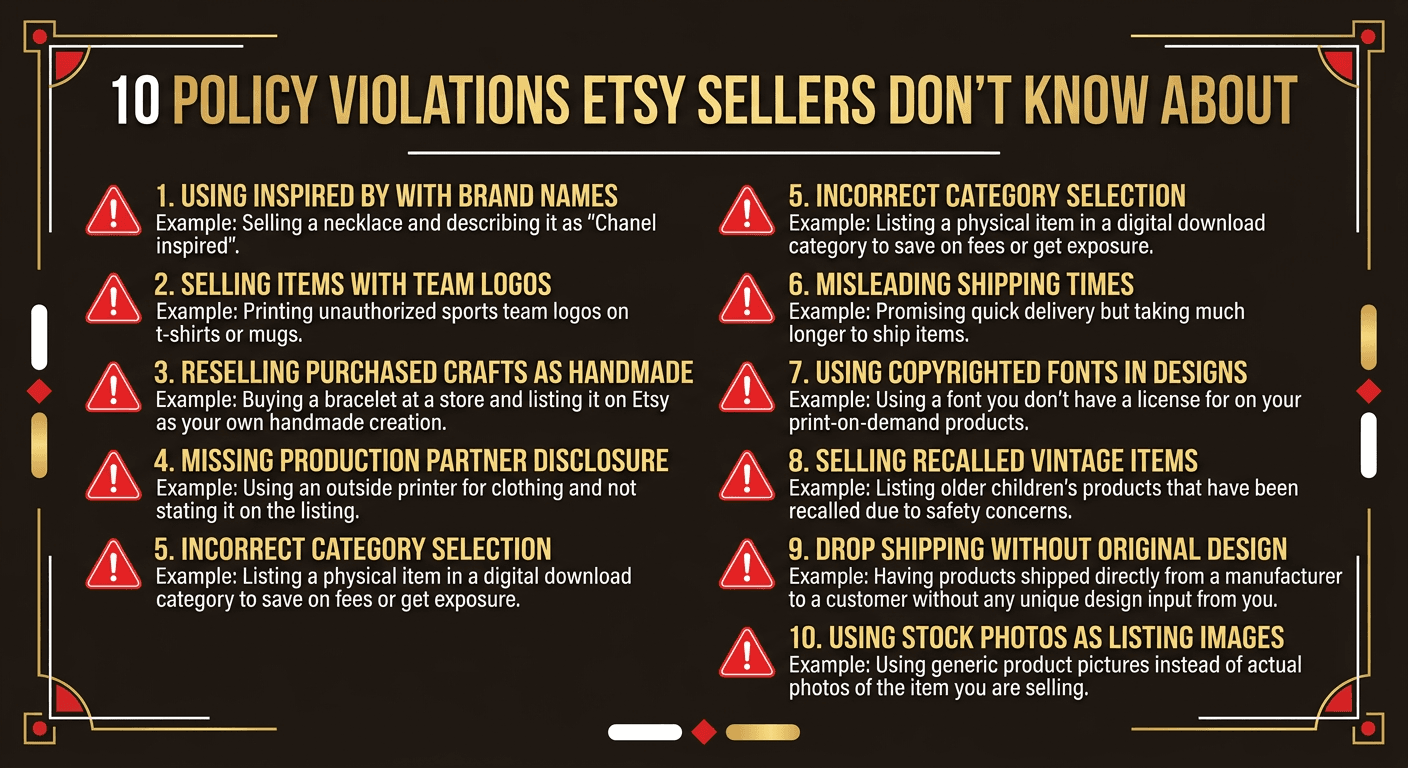
Etsy's seller handbook runs thousands of words. Their intellectual property policy alone has enough nuance to fill a law school textbook. The problem? Most sellers skim the rules when they open their shop and never look back.
Then a listing disappears. Or worse, a suspension email lands in their inbox — with zero warning.
We analyzed the most common reasons Etsy sellers lose listings and get suspended. Here are the 10 policy violations that catch sellers off guard, why they happen, and exactly how to fix them.
Using “Inspired By” with Brand Names
This is the single most common mistake new Etsy sellers make. You create a candle that smells like a high-end perfume, so you title it “Inspired by Chanel No. 5.” Or you design a minimalist tote and tag it “Nike-style athletic bag.”
Why sellers don't realize it's a problem: They think adding “inspired by” or “style” as a qualifier removes the trademark issue. It does not. You are still using a protected brand name to attract buyers to your listing, which constitutes trademark infringement under both Etsy's policies and federal law.
What happens if caught: The brand owner files a takedown request. Etsy removes the listing immediately and issues an intellectual property strike against your shop. Three strikes and your shop is permanently suspended. Some brands, like Disney and Nike, have automated monitoring systems that flag these listings within hours.
How to fix it: Describe your product using generic terms. Instead of “Chanel-inspired,” say “luxury floral perfume scent.” Instead of “Nike-style,” say “athletic minimalist design.” Never use a brand name in your title, tags, description, or image alt text.
Selling Items with Sports Team Logos
Team logos, mascots, and even specific color combinations associated with professional sports teams are trademarked. This applies to the NFL, NBA, MLB, NHL, FIFA, college teams, and even many minor league teams.
Why sellers don't realize it's a problem: Many sellers assume that “vintage” items are exempt, or that creating a “fan art” version of a logo makes it original work. Neither is true. A vintage t-shirt with an NFL logo from the 1990s is still using a trademarked design. And hand-painting the Dallas Cowboys star onto a wooden sign is still copyright violation.
What happens if caught: Sports leagues have aggressive legal teams. The NFL and NCAA in particular issue mass takedown requests on Etsy regularly. You'll receive an IP infringement notice, the listing gets removed, and a strike goes on your account. Leagues have also pursued legal action against repeat offenders.
How to fix it: If you want to sell sports-themed items, use generic terms like “football fan,” “game day,” or city-based references without team names or logos. Create original designs that evoke team spirit without reproducing any trademarked elements.
Reselling Purchased Crafts as Handmade
Buying jewelry from a wholesale supplier or craft market and listing it as “handmade” on Etsy is one of the fastest ways to get your shop suspended. This includes purchasing finished products from AliExpress, Alibaba, or local craft fairs and reselling them as your own work.
Why sellers don't realize it's a problem: Some sellers believe that because the items were originally handmade by someone, listing them in the handmade category is accurate. Others think that adding minor modifications like repackaging or adding a charm qualifies the product as handmade. Etsy's handmade policy is clear: you must be involved in the design or creation of every item you sell in this category.
What happens if caught: Etsy's Trust & Safety team investigates reports of reselling. If your product photos match wholesale listings found elsewhere online, your listings are removed and your shop can be suspended. Etsy also uses image recognition to identify duplicate product photos across the platform.
How to fix it: If you use components from other makers, disclose this and explain your creative contribution. Better yet, document your creation process with photos and videos. If you sell items you did not make, list them as vintage (if 20+ years old) or craft supplies instead.
Missing Production Partner Disclosure
If anyone other than you produces your items — whether it's a print-on-demand service like Printful, a local seamstress, or a contract manufacturer — Etsy requires you to disclose them as a production partner in your listing settings.
Why sellers don't realize it's a problem: Many POD sellers integrate services through Etsy's own marketplace and assume the integration handles the disclosure. It does not. You must manually add each production partner in your shop settings and select them for each applicable listing. The requirement also applies to sellers who hire assistants to help with production.
What happens if caught: Etsy flags shops that fulfill orders through third-party services without disclosure. The consequences range from a warning and required disclosure update to listing removal and suspension for repeat offenders. Buyers who realize their “handmade” item came from a print-on-demand factory often file reports directly.
How to fix it: Go to Shop Manager > Settings > Production Partners and add every company or individual involved in creating your products. Then select the appropriate partner for each listing. Being transparent about your process actually builds buyer trust.
Incorrect Category Selection
Listing a mass-produced item under “Handmade,” putting a 5-year-old item in “Vintage,” or categorizing a finished product as “Craft Supplies” — all of these are policy violations that can trigger listing removal.
Why sellers don't realize it's a problem: Category selection happens during listing creation, and many sellers choose categories based on where they think they'll get the most visibility rather than where the item actually belongs. Some sellers also don't realize that Etsy defines “vintage” as 20+ years old, not just “old-looking.”
What happens if caught: Miscategorized listings are removed without warning. If Etsy detects a pattern of intentional miscategorization, they treat it as an attempt to game the system, which leads to accelerated enforcement — including shop-level suspension rather than just listing-level action.
How to fix it: Audit every listing in your shop. Handmade means you designed or made it. Vintage means 20+ years old. Craft supplies means the buyer will use it to make something else. When in doubt, check Etsy's prohibited items guidelines for category-specific rules.
Misleading Shipping Times
Setting your processing time to 1–3 days when your actual turnaround is two weeks. Offering “free shipping” but inflating the product price to cover it while showing a higher value than the item is worth. Listing estimated delivery dates you consistently miss.
Why sellers don't realize it's a problem: Sellers set optimistic shipping times to compete for the Star Seller badge and better search placement. They don't realize that Etsy tracks their actual ship dates against stated processing times. Consistently shipping late is treated as a policy violation, not just a customer service issue.
What happens if caught: Buyers open “not as described” cases. Your Star Seller status is revoked. Etsy lowers your search ranking. Repeated cases lead to your shop being flagged, and extreme patterns of misleading shipping claims can result in listing removal or suspension.
How to fix it: Set realistic processing times and build in a buffer for busy periods. If you need 5–7 business days to make a custom item, say so. Buyers appreciate honesty, and Etsy rewards sellers who consistently ship on time.
Using Copyrighted Fonts in Digital Designs
This one catches digital product sellers completely off guard. You download a beautiful font, use it in your SVG files, printable wall art, or wedding invitation templates, and list them on Etsy. The problem? That font likely has a license that prohibits commercial use or distribution in digital products.
Why sellers don't realize it's a problem: Most sellers assume that if a font is free to download, it's free to use commercially. This is rarely the case. Many “free” fonts on sites like DaFont or Creative Market are free for personal use only. Even Google Fonts, while open-source, have specific license terms that sellers should verify. Font foundries actively monitor Etsy for unauthorized use.
What happens if caught: The font creator or foundry files a copyright violation claim. Your listing is removed, you receive an IP strike, and you may face a demand for retroactive licensing fees. Some foundries have pursued sellers for thousands of dollars in damages.
How to fix it: Only use fonts with explicit commercial licenses that cover digital product distribution. Keep proof of your font licenses on file. Free commercial-use fonts from Google Fonts or Font Squirrel (verified open-source section) are safe options. Always read the full license before using any font in a product you sell.
Selling Recalled Vintage Items
Vintage selling is a legitimate category on Etsy, but not every old item is safe to sell. Products that have been recalled by the Consumer Product Safety Commission (CPSC) are prohibited on Etsy regardless of their age or collectible status.
Why sellers don't realize it's a problem: Vintage sellers focus on rarity and collectibility, not regulatory compliance. A vintage children's toy from the 1970s might be highly sought after by collectors, but if it contains lead paint or small parts that triggered a recall, it cannot be sold on Etsy. Older cribs, vintage electronics with fire hazards, and certain vintage kitchen appliances also fall into this category.
What happens if caught: Etsy removes the listing immediately. If a buyer reports a safety issue after purchase, Etsy may suspend your shop pending a review. In extreme cases, selling recalled products can expose you to legal liability if a buyer is injured.
How to fix it: Before listing any vintage item, search the CPSC recall database at cpsc.gov. Pay special attention to vintage toys, children's products, small appliances, and anything electronic. If an item has been recalled, do not list it regardless of its value or demand.
Drop Shipping Without Original Design
Etsy is not a drop shipping platform. While you can use production partners to fulfill orders, the products must feature your original designs or creative input. Listing generic products from AliExpress, Alibaba, or wholesale suppliers without any original design contribution is a direct violation of Etsy's handmade policy.
Why sellers don't realize it's a problem: Drop shipping has been normalized by platforms like Shopify and Amazon. Sellers see tutorials about “Etsy drop shipping” and assume it's a legitimate business model on the platform. The line between “using a production partner” (allowed) and “drop shipping generic products” (not allowed) confuses many new sellers.
What happens if caught: Etsy has invested heavily in detecting drop shipped products. They use image matching to compare your listing photos against wholesale supplier catalogs. If your product photos match AliExpress listings, your shop is suspended — often permanently and without the option to appeal.
How to fix it: If you use a fulfillment service, ensure your products feature your original artwork, designs, or creative modifications. Take your own product photos. Disclose your production partner. The key question: did you design it? If not, it does not belong on Etsy.
Using Stock Photos as Listing Images
Your listing photos must accurately represent the actual product a buyer will receive. Using stock photography, manufacturer's photos, or images from other sellers is a policy violation that Etsy actively enforces.
Why sellers don't realize it's a problem: Sellers use stock photos because they look more professional than their own photography. Others use supplier photos as “placeholder” images until they can take their own. Some digital product sellers use stock mockups that are identical to mockups used by hundreds of other sellers, making their listings look like duplicates.
What happens if caught: Listings with stock photos are removed. If the photos belong to another seller or photographer, you may face a copyright claim in addition to the listing removal. Etsy's image matching algorithm flags listings with photos that appear across multiple shops or match known stock photo databases.
How to fix it: Invest in basic product photography. A smartphone, natural light, and a clean background are enough to start. For digital products, create your own unique mockups or purchase mockup templates with commercial licenses. Every photo in your listing should be original or properly licensed for commercial use.
The Pattern Behind These Violations
Look at this list again and you'll notice a pattern. Most of these violations fall into three buckets: intellectual property misuse (violations 1, 2, 7), handmade policy misunderstandings (3, 4, 9), and misrepresentation (5, 6, 8, 10).
Etsy's enforcement is getting stricter every year. They invested in AI-powered detection tools in 2025 and expanded their Trust & Safety team. What used to slide under the radar five years ago now gets flagged automatically. The sellers who thrive on Etsy in 2026 are the ones who understand the rules well enough to never need to worry about them.
If you're unsure whether any of your current listings might be at risk, the fastest way to find out is to run a compliance check before Etsy does it for you.
Are Your Listings Compliant?
Unflagged scans your Etsy listings for trademark risks, handmade policy violations, and category issues before Etsy's enforcement team does. Catch problems early and keep your shop safe.