Etsy Pricing Strategy: How to Price Your Products for Profit (2026)
Most Etsy sellers are leaving money on the table. They price based on gut feeling, copy competitors, or worse — race to the bottom. Here's how to build a pricing strategy that actually pays you what you're worth.
Why Most Sellers Underprice
If you're reading this, there's a good chance you're underpricing your products right now. You're not alone — it's the single most common mistake on Etsy, and it stems from three predictable places.
Fear of not selling. New sellers panic. They see established shops and think the only way to compete is to charge less. But buyers on Etsy aren't looking for the cheapest option — they're looking for something worth paying for. If they wanted cheap, they'd be on Amazon or Temu.
Copying competitor prices. You find a similar product priced at $15 and list yours at $14. But you have no idea if that competitor is profitable. They might be losing money on every sale. They might have lower material costs, faster production times, or be subsidizing their Etsy shop with a day job. Their price tells you nothing about what YOUR price should be.
Forgetting about fees. This is the silent killer. You price at $25 thinking you'll pocket most of it, then Etsy takes its listing fee, 6.5% transaction fee, 3% + $0.25 processing fee, and potentially a 15% offsite ads fee. Suddenly your $25 item nets you $16 — before materials and labor. That's not a business, it's a hobby that costs you money.
The Pricing Formula That Works
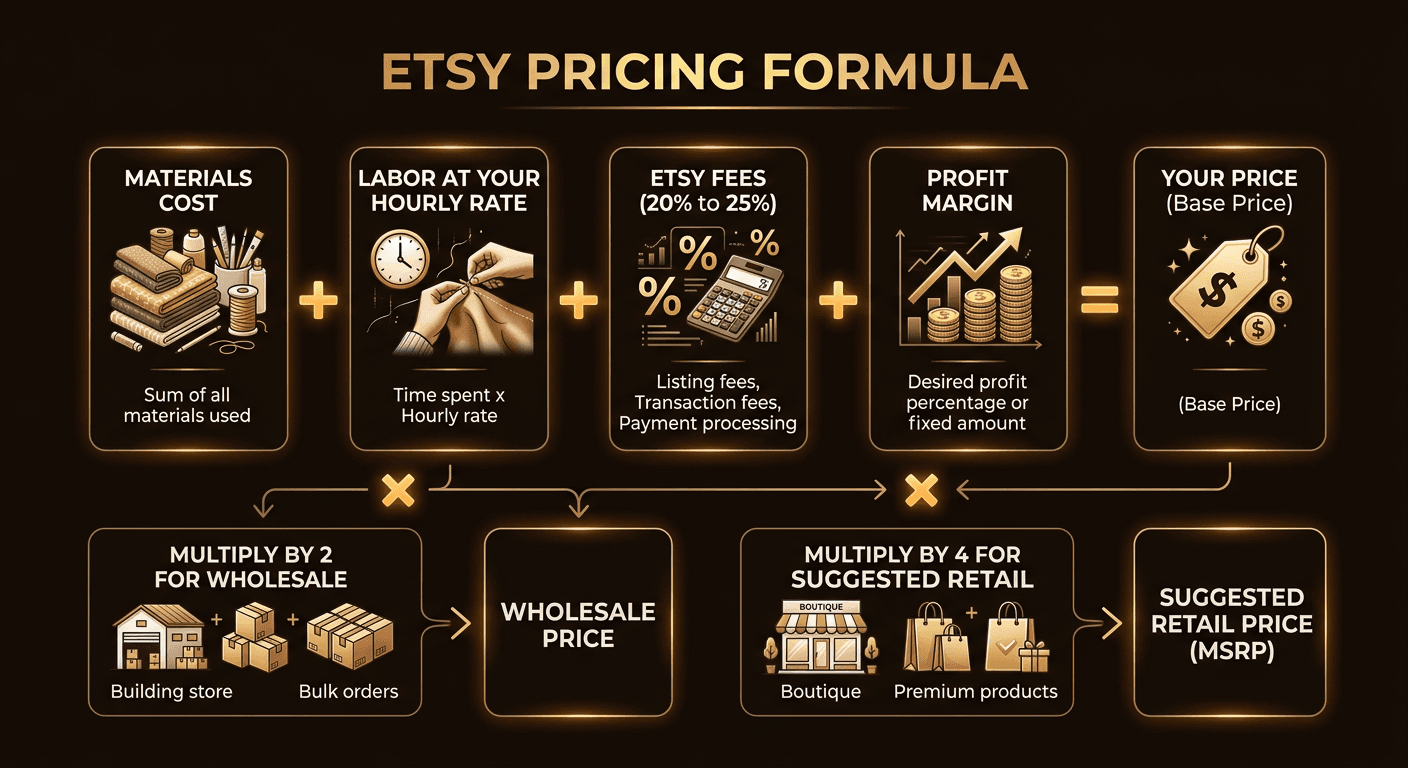
Forget guessing. Use this formula that professional product-based businesses have relied on for decades:
The 2x/4x Formula
(Materials + Labor) × 2 = Wholesale Price
Wholesale Price × 2 = Retail Price
This gives you a 4x markup from your base costs. That might sound like a lot, but here's where that money goes: Etsy fees eat 20–30%. Packaging and shipping supplies cost money. Overhead — your internet, workspace, tools, software — adds up. And you need an actual profit margin to reinvest in your business.
Example: You make candles. Materials cost $4 per candle. It takes you 30 minutes to make one, and you pay yourself $20/hour, so labor is $10. Base cost = $14. Wholesale = $28. Retail = $56. That's your starting point — not $18.99 because “that's what other candle sellers charge.”
If $56 feels too high for your market, that's a signal to either find cheaper materials, streamline production, or reposition your product as premium. It's not a signal to cut your price and work for free.
Account for ALL Etsy Fees
Your pricing formula means nothing if you don't factor in every fee Etsy charges. Here's the full breakdown:
- Listing fee$0.20 per listing
- Transaction fee6.5% of total sale
- Payment processing3% + $0.25
- Offsite ads (if triggered)12–15% of sale
On a $50 item, that's roughly $0.20 + $3.25 + $1.75 = $5.20 in base fees. If an offsite ad triggered the sale, add another $7.50 at the 15% rate. Your $50 item could net as little as $37.30 before materials and labor.
For a deep dive into every fee category, read our complete Etsy fees breakdown. And if offsite ads are eating into your margins, check out our guide to Etsy offsite ads to understand when you can opt out and when you can't.
Setting Your Hourly Rate
This is where most Etsy sellers shortchange themselves the most. Your time is not free. Every hour you spend making products, photographing them, packaging orders, and responding to messages is an hour you could spend doing something else.
How to calculate it: Start with what you'd need to earn per hour to make your Etsy shop worth the effort. For most sellers, that's somewhere between $15 and $50 per hour depending on skill level and product complexity.
Then time yourself. Actually use a stopwatch. Track how long each product takes from start to finish — not just the “fun” part of making it, but cutting materials, setting up, cleaning up, quality checking, photographing, and packaging.
Most sellers discover their products take 2–3x longer than they thought. A “quick 15-minute project” is usually 45 minutes when you account for everything. At $20/hour, that's the difference between $5 and $15 in labor costs per item. That difference alone can turn a profitable product into a money-losing one.
Don't forget to include time spent on shop management: listing creation, customer service, bookkeeping, marketing, and order fulfillment. Divide these overhead hours across your products or add a flat percentage to each item.
Pricing Psychology That Converts
Once you've calculated your price, it's time to position it. Small psychological tweaks can meaningfully impact your conversion rate without changing your margins.
Charm pricing. $29.97 converts better than $30.00. The left digit matters more than the right ones — $29.97 feels like “twenty something” while $30 feels like a jump to a new bracket. Use .97 or .95 endings on most products.
Bundle pricing. Offer a set of 3 for $75 when individual items are $30 each. Buyers feel like they're getting a deal, and your average order value jumps from $30 to $75. Your per-unit costs drop because you're only paying one set of processing fees and one shipping label.
Tiered offerings. Offer a basic, standard, and premium version of your product. The premium option makes the standard feel like a deal, and some buyers will always choose the top tier. This is called “anchoring” — the highest price sets the reference point.
Price anchoring in descriptions. Mention the value or comparable prices in your listing description. “Similar pieces sell for $80+ at craft fairs” makes your $45 Etsy price feel like a steal. Just make sure the comparison is honest.
Competitor Research Without Racing to the Bottom
You should absolutely research what competitors charge. But the goal isn't to match or beat their prices — it's to understand where you fit in the market and how to differentiate.
Search your main keywords on Etsy and sort by bestselling. Note the price range of the top 20 results. You'll usually see a wide spread. Some sellers charge $12, others charge $60 for seemingly similar products. The $60 sellers aren't crazy — they've positioned themselves on quality, presentation, and brand.
Look at what the higher-priced sellers do differently: better photography, more detailed descriptions, stronger branding, more reviews, faster shipping. Those are the levers you should pull — not the price lever.
If you're selling handmade jewelry and the market ranges from $15 to $75, aim for the upper third. Then justify that price with better photos, a compelling brand story, premium packaging, and excellent customer service. Buyers who shop on Etsy expect to pay more than Amazon — they're buying the story, the craft, and the experience. For more on growing your revenue, see our guide on increasing Etsy sales.
Free Shipping Math
Etsy's search algorithm gives a ranking boost to listings that offer free shipping, especially on orders of $35 or more. This is well-documented and significant enough that most successful sellers have moved to a free shipping model.
But free shipping isn't free for you. The key is building shipping costs into your product price. Here's how:
- Calculate your average shipping cost across all destinations (typically $4–$8 for small items within the US)
- Add that amount to your product price
- Set shipping to free in your listing
- Monitor your search ranking — you should see improvement within 1–2 weeks
Important note: Etsy charges its 6.5% transaction fee on the total sale including shipping. So whether you charge $30 + $5 shipping or $35 with free shipping, the transaction fee is the same: $2.28 either way. The difference is that the free shipping version ranks higher in search.
For international shipping, consider setting a flat rate or offering free domestic shipping only. International shipping costs are too variable to absorb cleanly into product prices without overcharging domestic buyers.
When to Raise Your Prices
Most sellers wait too long to raise prices. Here are the signals that you're underpriced:
- 1.You're selling out too fast. If items sell within hours of listing, demand exceeds your supply. Raise your price until the pace becomes sustainable.
- 2.Your profit margin is under 30%. After all fees, materials, and labor, if you're keeping less than 30 cents on every dollar, your pricing isn't sustainable.
- 3.You feel burned out. If the volume of orders makes your shop feel like a burden instead of a business, you need fewer orders at higher prices — not more orders at low ones.
- 4.Material costs went up. Supply chain costs increase constantly. If your materials cost more than when you set your prices, you need to adjust immediately.
- 5.You consistently get 5-star reviews. High ratings mean buyers believe your product is worth the price — and probably more.
Raise prices in increments of 10–20%. Monitor for 2–4 weeks. If sales volume drops significantly, you overshot. If sales stay roughly the same, you were underpriced and you're now making more money with the same effort.
Pricing for Different Product Types
Not all Etsy products are priced the same way. Your strategy depends on what you sell.
Handmade products. Use the full 4x formula. Materials + labor are your biggest costs, and the handmade premium justifies higher prices. Buyers expect to pay more for handmade — lean into that. Highlight the time, skill, and materials in your descriptions.
Digital downloads. Your cost per sale is near zero after creation, so price based on value and competition rather than cost-plus. A Canva template bundle that saves someone 10 hours of work is worth $15–$30, regardless of how long it took you to make. Volume is your friend here — lower prices with high volume can outperform high prices with few sales.
Vintage items. Price based on rarity, condition, and market demand. Research completed sales (not just active listings) on Etsy and eBay to find realistic market values. Vintage pricing is more art than formula — a $5 thrift store find can legitimately sell for $150 if it's rare and desirable.
Print on demand (POD). Your base cost is fixed by your POD provider. Add your desired profit margin on top. Since you can't reduce production costs, focus on designs that command premium prices. A generic “Live Laugh Love” shirt competes on price. A clever niche design for dog groomers or left-handed guitarists competes on uniqueness.
Common Pricing Mistakes That Kill Your Shop
Beyond underpricing, these mistakes actively damage your shop's performance:
Pricing too low tanks your search ranking. This is something most sellers don't know: Etsy's algorithm can suppress listings that are priced suspiciously low for their category. If every similar product is $25–$40 and yours is $8, Etsy may hide your listing because it looks like spam, a scam, or a quality issue. Low prices don't just hurt your profits — they hurt your visibility.
Changing prices too often. Constant price changes can confuse the algorithm and erode buyer trust. Set your prices strategically and stick with them for at least a month before evaluating. The exception is seasonal products where a limited-time price makes sense.
Ignoring your numbers. If you don't track costs, fees, and profit per item, you have no idea which products make money and which ones lose it. Use a spreadsheet or tool to calculate actual profit per sale after every fee is deducted. You might discover that your bestseller is actually your worst earner.
Not testing prices. A/B testing isn't easy on Etsy, but you can test by raising prices on a few listings and monitoring results over 2–4 weeks. Many sellers are shocked to find that a 20% price increase results in the same number of sales — meaning 20% more revenue for identical effort.
Protect Your Profits
Getting your pricing right is only half the battle. One policy violation or trademark issue can shut down your shop overnight — and all that pricing strategy becomes worthless. Unflagged scans your listings for compliance risks before they become problems.
Scan Your Shop Free