Etsy Shop Deactivated vs Suspended: What's the Difference?
Your Etsy shop is down and you're not sure why. Was it deactivated? Suspended? The difference matters — a lot. One means you're in control. The other means Etsy took action against you. Here's exactly what each status means, how to tell which one you're dealing with, and what to do next.
Why Sellers Confuse Deactivated and Suspended
Every week, thousands of Etsy sellers search “my Etsy shop is deactivated” when what they actually mean is suspended — or vice versa. Etsy doesn't make the distinction obvious. Both statuses result in your shop going offline, your listings disappearing from search, and your customers seeing a dead page. From the outside, they look identical.
But from the inside, these are two completely different situations with completely different implications for your business. One is a voluntary pause you can reverse in thirty seconds. The other is an enforcement action that could mean frozen funds, lost inventory, and months of appeals.
Understanding which status your shop is in is the first step toward fixing it. Let's break down exactly what each one means.
What “Deactivated” Actually Means
A deactivated Etsy shop is one that the seller chose to close. You did this yourself, either through Shop Manager or by contacting Etsy support. It's entirely voluntary, and it carries zero penalties.
When you deactivate your shop, your listings are hidden from Etsy search and your shop page shows as unavailable to visitors. But nothing is deleted. Your listings, photos, descriptions, reviews, sales history, and shop settings are all preserved. Think of it as putting your shop in a drawer — everything is still there, just out of sight.
Common Reasons Sellers Deactivate:
- Taking a break — Burnout is real. Some sellers need a few weeks or months away from the platform.
- Rebranding — Changing your shop name, aesthetic, or product line and want to relaunch fresh.
- Seasonal business — Sellers who only operate during holiday seasons or specific months.
- Moving platforms — Transitioning to Shopify, Amazon Handmade, or your own website.
- Personal reasons — Health, family, relocation, or other life events that require stepping away.
The key point: you can reopen a deactivated shop at any time. There's no approval process, no waiting period, and no questions asked. You flip the switch and your shop is back online.
What “Suspended” Actually Means
A suspended Etsy shop is one that Etsy forcibly shut down. You didn't choose this — Etsy's Trust and Safety team made the decision after determining that your shop violated one or more of their policies. This is an enforcement action, and it comes with serious consequences.
When your shop is suspended, you lose access to your listings, your shop page is taken down, and — critically — your funds are frozen. Any money in your Etsy Payments account is held for up to 180 days. You can't create new listings, edit existing ones, or contact buyers through Etsy's messaging system.
Common Reasons Etsy Suspends Shops:
- Trademark or IP violations — Using brand names, logos, or copyrighted designs without permission.
- Selling prohibited items — Items that violate Etsy's prohibited items policy.
- DMCA takedown notices — Rights holders filing copyright complaints against your listings.
- Unpaid fees or billing issues — Outstanding balances on your Etsy account.
- Multiple policy violations — Repeated warnings that went unaddressed. See our full list of common Etsy policy violations to make sure you're not unknowingly breaking the rules.
- Opening a second account after suspension — Etsy bans circumventing a previous suspension.
Suspensions can be temporary or permanent. Temporary suspensions usually come with a path to reinstatement through Etsy's appeal process. Permanent suspensions are reserved for severe violations like selling counterfeit goods or fraud. Even with a permanent suspension, you still have one shot at an appeal within 6 months. For a deep dive on what happens when Etsy takes action, read our guide on Etsy account suspensions.
Deactivated vs Suspended: Side-by-Side Comparison
Here's a quick reference table to see the differences at a glance.
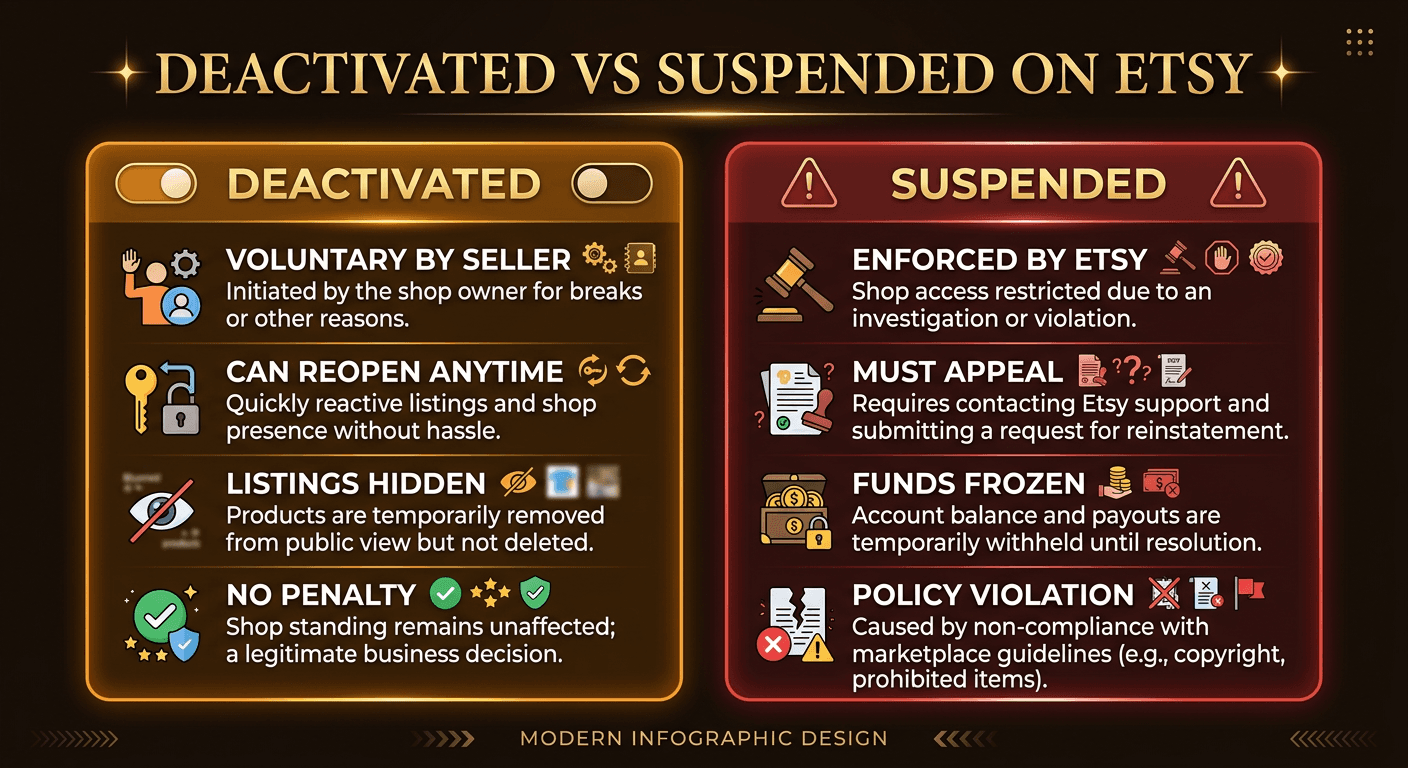
| Feature | Deactivated | Suspended |
|---|---|---|
| Who initiates it | You (the seller) | Etsy (enforcement) |
| Penalty involved | None | Yes — policy violation on record |
| Fund access | Full access to withdraw | Frozen for up to 180 days |
| Listings | Hidden but preserved | Removed — may be deleted |
| Reviews & history | Preserved | May be lost permanently |
| Recovery path | Reopen anytime in Shop Manager | Must file appeal with Etsy |
| Time limit to restore | No limit | 6 months to appeal |
| Can open a new shop | Yes | No — Etsy will ban it |
How to Reopen a Deactivated Etsy Shop
If you deactivated your shop voluntarily, getting it back online is straightforward. No appeal needed, no waiting for approval. Follow these steps:
- Log into your Etsy account — Use the same email and password you used before deactivating.
- Go to Shop Manager — Click your shop icon in the top-right corner and select “Shop Manager.”
- Navigate to Settings > Options — In the left sidebar, click Settings, then Options.
- Click “Reopen Your Shop” — You'll see this button at the top of the page. Click it, and your shop goes live immediately.
- Review your listings — All your previous listings will be restored. Check that photos, pricing, and descriptions are still accurate before buyers start finding them.
- Update your shop announcement — If you were away for a while, update your shop announcement to let customers know you're back.
That's it. The entire process takes under a minute. Your reviews, favorites, and search ranking history are all preserved — though be aware that if your shop was deactivated for a long time, your search ranking will take a few weeks to recover as Etsy's algorithm re-indexes your listings.
How to Appeal a Suspended Etsy Shop
If your shop was suspended by Etsy, the process is much more involved. You can't just flip a switch — you need to file a formal appeal and convince Etsy's Trust and Safety team that you deserve reinstatement.
The Appeal Process:
- Read your suspension email carefully — Identify the exact policy violation cited by Etsy.
- Gather evidence — Screenshots of removed listings, trademark search results, corrective actions you've taken.
- Write your appeal letter — Acknowledge the violation, explain what happened, detail corrective actions, and commit to compliance.
- Submit through Etsy's appeal form — Use the link provided in your suspension email.
- Wait 1-2 weeks — Etsy reviews appeals manually. There is no way to speed this up.
The quality of your appeal letter is the single biggest factor in whether you get reinstated. A vague, emotional appeal will get denied. A structured, professional one that shows corrective action has a much better shot. We wrote an entire guide on how to write an Etsy suspension appeal letter with templates you can customize.
Decision Tree: Is Your Shop Deactivated or Suspended?
Still not sure which situation you're in? Walk through these questions to figure it out.
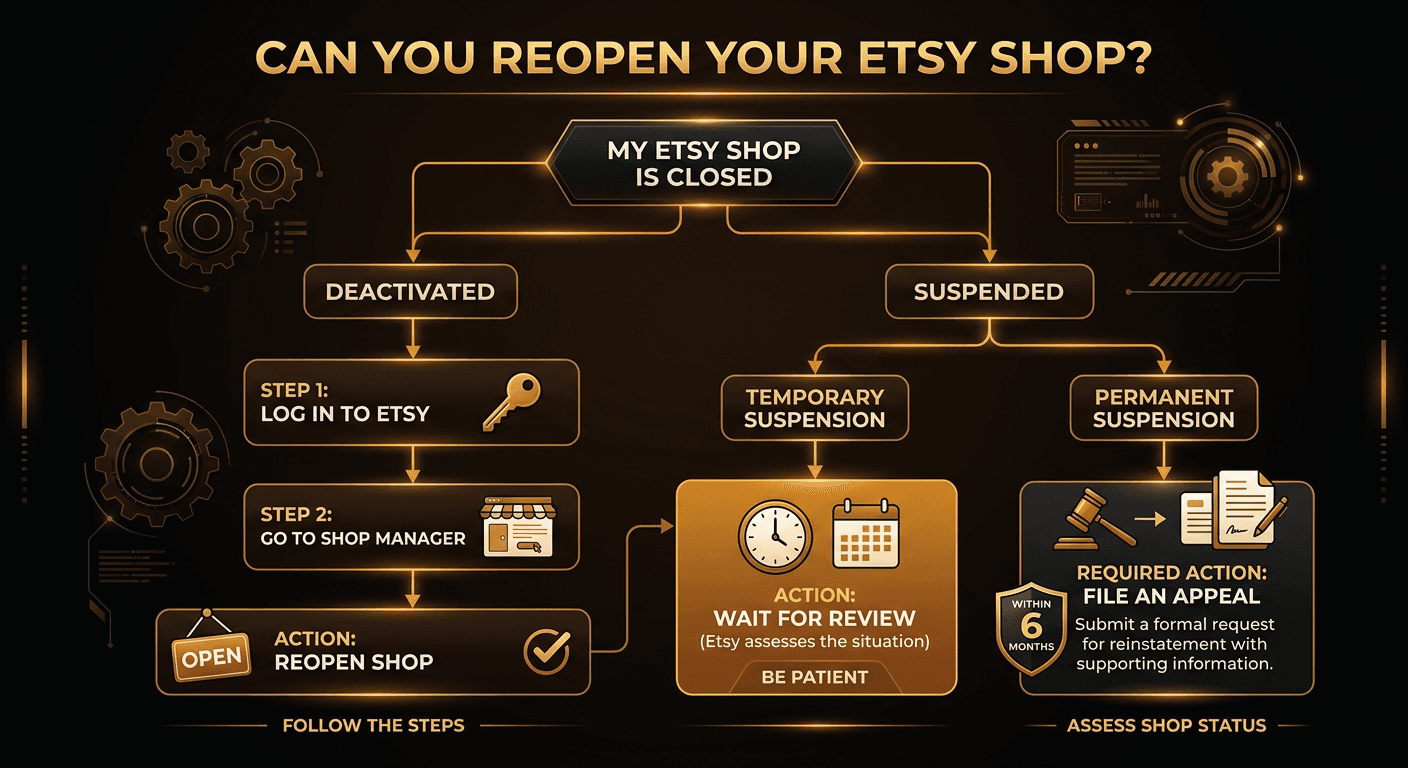
Quick Diagnostic:
- Can you log into Shop Manager? If yes and you see “Reopen Your Shop,” your shop is deactivated. Reopen it and you're done.
- Did you receive an email about a policy violation? If yes, your shop is suspended. You need to appeal.
- Can you access your shop at all? If Shop Manager shows an error or message about account privileges, your shop is suspended.
- Did you close the shop yourself? If you remember clicking “Close Shop” or “Deactivate,” it's deactivated. If you didn't, Etsy closed it for you — that's a suspension.
Vacation Mode vs Deactivation: Which Should You Use?
There's a third option many sellers forget about: vacation mode. It's different from both deactivation and suspension, and in many cases it's the better choice for short breaks.
Vacation Mode
- Shop stays visible to browsers
- Listings still appear in search (reduced over time)
- No new purchases allowed
- Custom “away” message shown
- Best for: 1-2 week breaks
Deactivation
- Shop completely hidden
- Listings removed from search entirely
- No shop page visible at all
- Data preserved but not public
- Best for: months-long breaks or permanent closure
The important distinction: vacation mode keeps your SEO juice warm. Your listings maintain some search presence, and when you come back, you don't have to rebuild your ranking from scratch. Deactivation is a full reset on search visibility. If you're planning a break shorter than a month, vacation mode is almost always the better option. For a complete walkthrough of when and how to use it, see our Etsy vacation mode guide.
Worried About Your Etsy Shop's Status?
Whether your shop is at risk of suspension or you need help getting reinstated, Unflagged has you covered. Scan your listings for policy violations before Etsy finds them, or use our AI appeal generator to write a professional reinstatement letter in minutes.
Frequently Asked Questions
Can I reopen a deactivated Etsy shop?
Yes. If you deactivated your shop voluntarily, you can reopen it at any time through Shop Manager. Go to Shop Manager > Settings > Options and click “Reopen Your Shop.” Your listings, reviews, and shop history will still be there.
How do I know if my Etsy shop is suspended or deactivated?
Check your email for a notice from Etsy. Suspended shops receive a suspension email citing the specific policy violated. Deactivated shops show a “Reopen Your Shop” option in Shop Manager. If you can't log into Shop Manager at all or see a message about policy violations, your shop is suspended.
Does deactivating my Etsy shop delete my reviews?
No. Deactivating your Etsy shop hides your listings and shop page from public view, but it does not delete your reviews, sales history, or shop data. Everything is preserved and will reappear when you reopen your shop.
Can I withdraw funds from a suspended Etsy shop?
Not immediately. When Etsy suspends your shop, your funds are typically frozen for a holding period (usually 180 days). After that period, Etsy will release the funds to your payment account on file, minus any outstanding fees or refunds owed to buyers.
Is vacation mode the same as deactivating my Etsy shop?
No. Vacation mode keeps your shop visible but prevents new purchases. Your listings still appear in search (with reduced visibility over time). Deactivation completely hides your shop and all listings from Etsy. Vacation mode is better for short breaks; deactivation is for longer pauses or permanent closure.
How long does it take to appeal an Etsy suspension?
You can submit an appeal immediately after receiving your suspension notice. Etsy typically takes 1-2 weeks to review appeals, though complex cases may take longer. You have up to 6 months from the suspension date to file your appeal. There is no way to expedite the review process.