Etsy Identity Verification 2026: Why Your Shop Is On Hold
Etsy identity verification can freeze your shop in holiday mode. The INFORM Act thresholds, real timelines, why IDs get rejected and how to get unstuck.
- 1.What Etsy Identity Verification Actually Is
- 2.The INFORM Act Thresholds That Put You In Scope
- 3.What Etsy Asks For, And What It Accepts
- 4.Forced Holiday Mode: What Happens To Your Shop
- 5.How Long Verification Really Takes
- 6.Why Documents Get Rejected, And The Fix For Each
- 7.The Escalation Ladder When You Are Stuck
- 8.How To Clear The Check Before It Clears You
- 9.Related Reading
- 10.Frequently Asked Questions
- 11.Verification Is The Check You Can Prepare For
Key takeaways
- Etsy identity verification is a legal obligation, not an Etsy policy choice. The INFORM Consumers Act pulls you in at 200 separate sales of new or unused goods and $5,000 in gross revenue in any continuous 12 months out of the last 24. Hit both and the check is mandatory.
- You get 10 days from the notice. The statute gives sellers 10 days to supply bank, tax and contact details, and requires the marketplace to suspend the account until they arrive. Etsy layers a separate 60-day window on top for the identity document itself.
- The shop goes into forced holiday mode, not suspension. Listings stay visible, new orders stop, and sellers report that pending orders get refunded to buyers if the deadline passes without a verified document.
- Etsy quotes 2 to 5 business days. Sellers report 21 days and longer. The gap between the two numbers is where most of the damage happens, because sellers wait instead of escalating.
- Etsy will not tell you which field failed. It says it is legally unable to, so the fix is to re-enter every detail so it matches the document exactly, rather than re-uploading the same ID a fourth time.
You logged in to a shop that looks fine and sells nothing. The listings are up, the photos are there, and somewhere near the top of Shop Manager is a banner about confirming your information. Etsy identity verification is the one enforcement action that does not announce itself as enforcement, and sellers routinely lose four to six weeks of trading to it because the message reads like admin rather than a countdown. It is a countdown. There is a statutory 10-day clock on the account data, a 60-day clock on the identity document, and the reasonable worst case at the end of both is refunded orders and a shop that cannot take money.
We went through the text of the INFORM Consumers Act, the Federal Trade Commission's guidance for third party sellers, Etsy's own help documentation on Persona verification, and several hundred posts from sellers who have been through the loop this year. The rules are clearer than the seller-facing messaging suggests. What follows is what triggers the check, what Etsy accepts, what actually happens to your orders, and the escalation path that moves cases when the upload screen will not.

What Etsy Identity Verification Actually Is
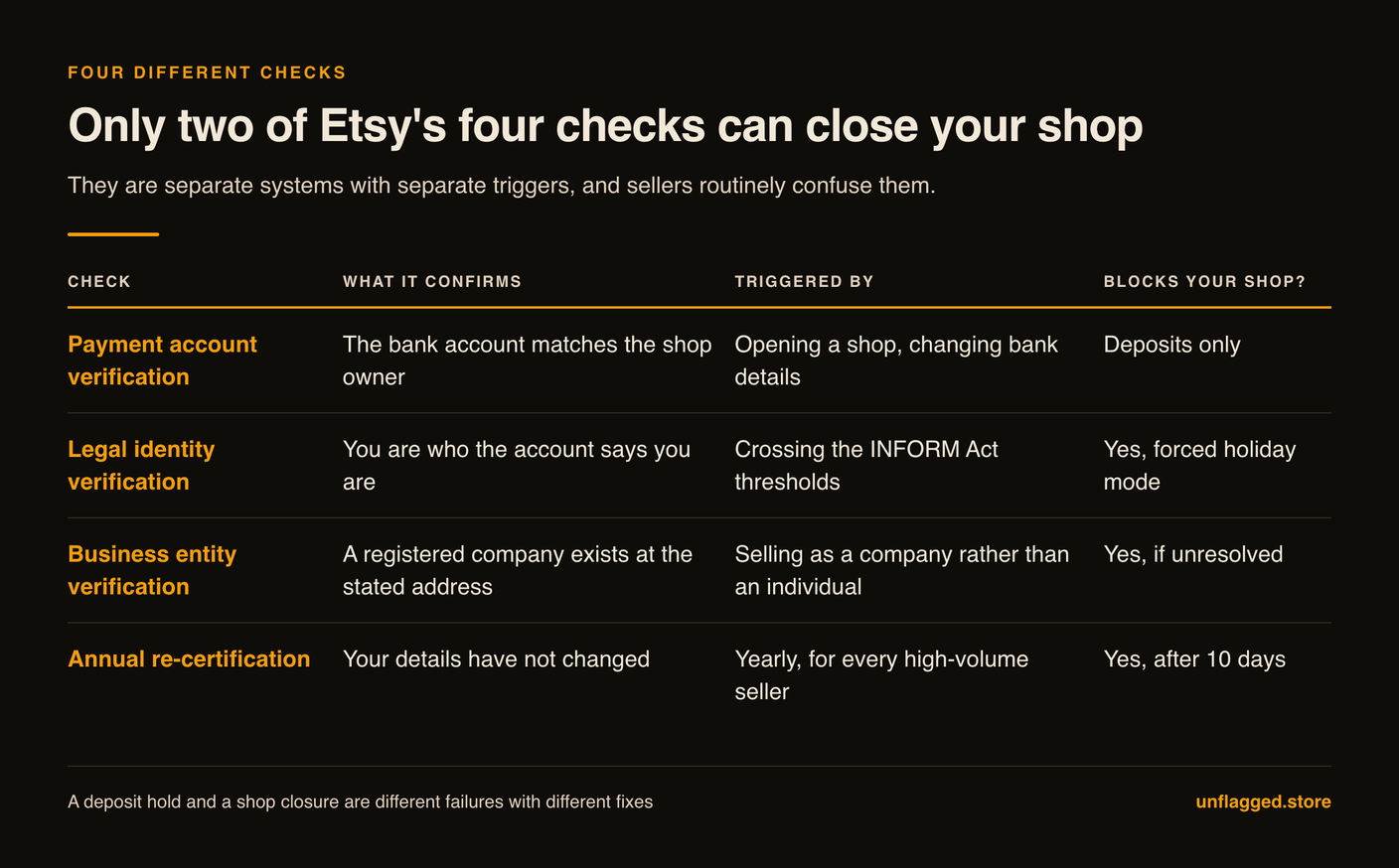
Two separate things wear the same name in Shop Manager, and confusing them wastes the clock.
The first is payment account verification, which Etsy has always run. It confirms that the bank account receiving your deposits belongs to the person named on the shop. The second, and the one behind almost every panicked forum thread since late 2025, is legal identity verification under the INFORM Consumers Act. That one is federal law. Etsy is the party being regulated, and the penalty for getting it wrong lands on Etsy, which is why the process is rigid and why support agents cannot wave it through.
Etsy runs the identity step through Persona, a third-party verification provider. Persona collects an image of a government-issued photo ID and a selfie, then compares the two. Etsy offers a non-biometric route where a support agent reviews the documents manually instead of facial-comparison technology running the match. That option is easy to miss on the upload screen and it is the right choice for anyone whose face has changed materially since their ID photo was taken.
| Check | What it confirms | Triggered by | Blocks your shop? |
|---|---|---|---|
| Payment account verification | The bank account matches the shop owner | Opening a shop, changing bank details | Deposits only |
| Legal identity verification | You are who the account says you are | Crossing the INFORM Act thresholds | Yes, forced holiday mode |
| Business entity verification | A registered company exists at the stated address | Selling as a company rather than an individual | Yes, if unresolved |
| Annual re-certification | Your details have not changed | Yearly, for every high-volume seller | Yes, after 10 days |
Only the middle two rows put a shop into holiday mode. If your banner is about a bank account, you have a slower and much less dangerous problem. The rest of this article is about the rows that stop your orders.
The INFORM Act Thresholds That Put You In Scope
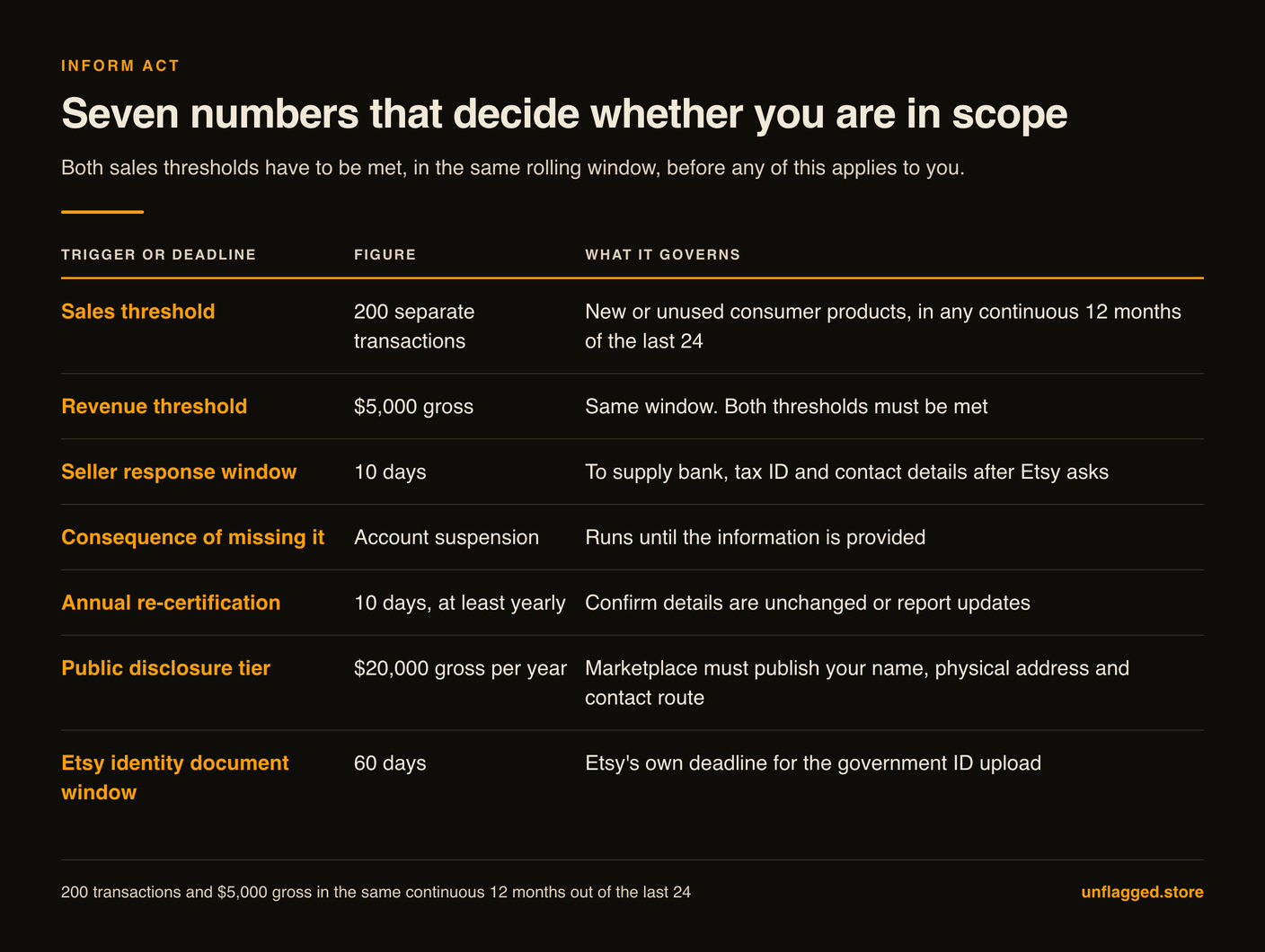
The trigger is not a judgement call by a reviewer. It is arithmetic, and you can run it yourself today.
The INFORM Consumers Act defines a high-volume third party seller as one that, in any continuous 12-month period during the previous 24 months, has had 200 or more separate sales or transactions of new or unused consumer products and $5,000 or more in gross revenue on that marketplace. Both conditions have to be true at once. A shop turning over $40,000 across 90 large custom orders is out of scope. A sticker shop with 210 sales at $25 is in scope, which surprises people who assume this is a rule for large operations.
Two details in that definition do real work. New or unused is why genuine vintage resellers often sit outside the count. And any continuous 12 months out of the last 24 means a shop that has since gone quiet can still be pulled in on the strength of a busy period that ended a year ago.
| Trigger or deadline | Figure | What it governs |
|---|---|---|
| Sales threshold | 200 separate transactions | New or unused consumer products, in any continuous 12 months of the last 24 |
| Revenue threshold | $5,000 gross | Same window. Both thresholds must be met |
| Seller response window | 10 days | To supply bank, tax ID and contact details after Etsy asks |
| Consequence of missing it | Account suspension | Runs until the information is provided |
| Annual re-certification | 10 days, at least yearly | Confirm details are unchanged or report updates |
| Public disclosure tier | $20,000 gross per year | Marketplace must publish your name, physical address and contact route |
| Etsy identity document window | 60 days | Etsy's own deadline for the government ID upload |
That last row is worth sitting with. Once a shop passes $20,000 in gross revenue in a year on a single marketplace, the platform is required to display the seller's full name, physical address and a direct contact route to buyers. Sellers working from home can request that the street address be withheld where a qualifying alternative applies, but the default is publication. If that is a problem for you, solve it before you cross the line, not after.
What Etsy Asks For, And What It Accepts
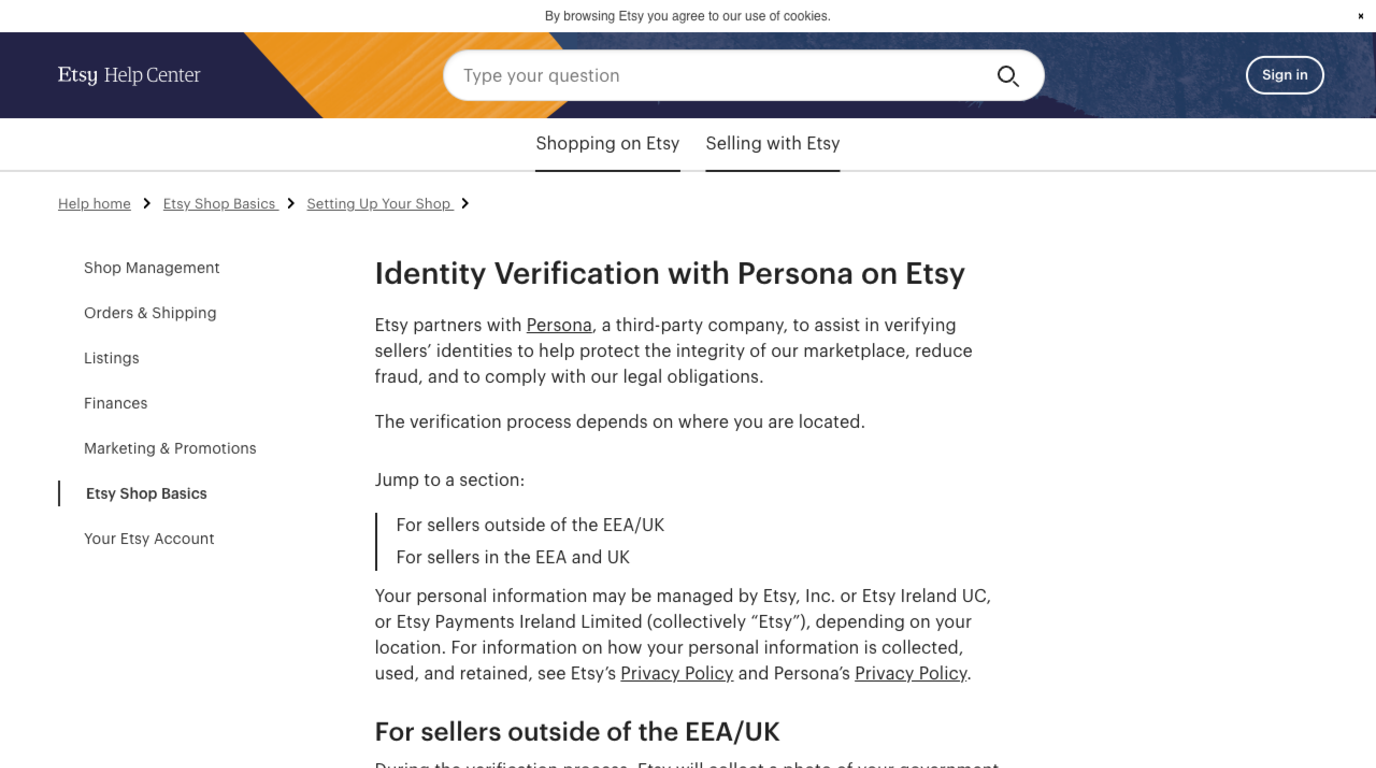
The upload screen is terse about what counts, and the rejection message is terser. Here is what Etsy and its verification partner will take.
For an individual seller, that means a valid government-issued photo ID: a passport, a driving licence, or a national identity card. For a seller registered as a business, Etsy wants official registration proof of the entity, such as a trade licence or an extract from a companies registry, and in most jurisdictions that document must be less than three months old. An expired certificate is the single most common own goal in business verification, because sellers reach for the original registration paperwork from six years ago rather than pulling a fresh extract.
| Seller type | Accepted document | Also required | Common failure |
|---|---|---|---|
| Individual, US | Passport, driving licence, state ID | Selfie via Persona, or manual agent review | Name on ID does not match the shop account name |
| Individual, non-US | Passport or national ID card | Same, plus address in a supported country | Only one side of a two-sided card uploaded |
| Sole proprietor | Personal photo ID | Taxpayer identification number | Trading name entered where the legal name is required |
| Registered company | Registry extract or trade licence, under 3 months old | Business tax ID and registered address | Document older than three months |
| Any high-volume seller | Bank account or named payee | Working email and phone number | Phone number that cannot receive a verification code |
The mechanical requirements matter more than sellers expect. Uploads are rejected for glare on a laminated card, for a cropped edge, for a photograph taken at an angle, and for a file below the minimum resolution. Photograph the document flat on a dark, plain surface in indirect daylight, capture both sides, and check the corners are inside the frame before you submit. A retry costs you days.
Forced Holiday Mode: What Happens To Your Shop
When Etsy cannot verify your details, it does not suspend the shop. It puts it into holiday mode, which is a materially different and slightly stranger state.
Your listings stay visible. Your shop page loads. Buyers can find you and cannot buy from you. Because the shop looks alive from the outside, sellers frequently do not realise for several days that nothing is coming in, and the ones who do often mistake it for a seasonal slump. Meanwhile the clock on the identity document runs.
The part that costs money: sellers report that Etsy warns pending orders will be refunded to buyers if identity cannot be verified inside the 60-day window. That is not just lost revenue on those orders. It is a block of refunds against your shop in a short period, and elevated refund activity is one of the inputs that leads to a payment account reserve on the money you do still take. The verification problem can hand you a cash-flow problem that outlives it.
Two further constraints make this worse than a normal holiday-mode period. Support agents cannot switch it off for you, because the deadline behind it is statutory rather than discretionary. And the state persists through the review, so a shop that submits documents on day three still sells nothing on day four. There is no partial reinstatement while a document is queued.
It is worth being precise about what this is not. It is not a policy strike, it does not appear on your record as a violation, and it is not the same thing as a deactivation or a suspension. Nothing you did to your listings caused it. That distinction matters when you write to support, because framing a verification hold as an appeal against a suspension sends your ticket to the wrong queue.
How Long Verification Really Takes
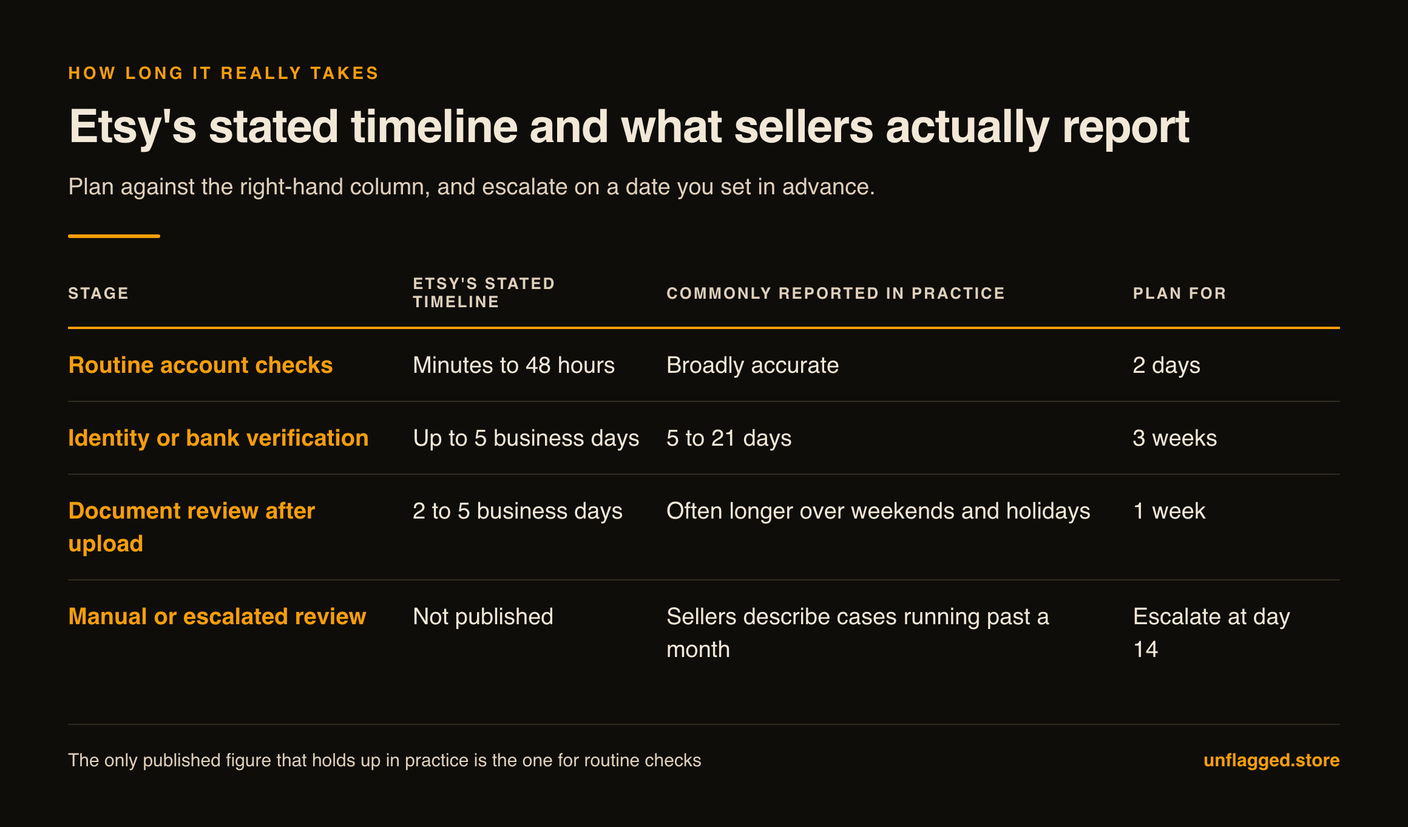
Etsy publishes timelines. Sellers report different ones. Both sets of numbers are useful, for different purposes.
| Stage | Etsy's stated timeline | Commonly reported in practice | Plan for |
|---|---|---|---|
| Routine account checks | Minutes to 48 hours | Broadly accurate | 2 days |
| Identity or bank verification | Up to 5 business days | 5 to 21 days | 3 weeks |
| Document review after upload | 2 to 5 business days | Often longer over weekends and holidays | 1 week |
| Manual or escalated review | Not published | Sellers describe cases running past a month | Escalate at day 14 |
Use Etsy's numbers to decide when something has gone wrong, and the reported numbers to decide what to do about it. If your document has been sitting unreviewed for more than 10 business days, the process has stalled and waiting politely is no longer a strategy. That is the point to start the escalation ladder below, not day 30.
One practical scheduling note: identity checks queued on a Friday or into a public holiday reliably lose several days, because part of the review is human. If you can choose when to submit, submit on a Monday morning.
Why Documents Get Rejected, And The Fix For Each
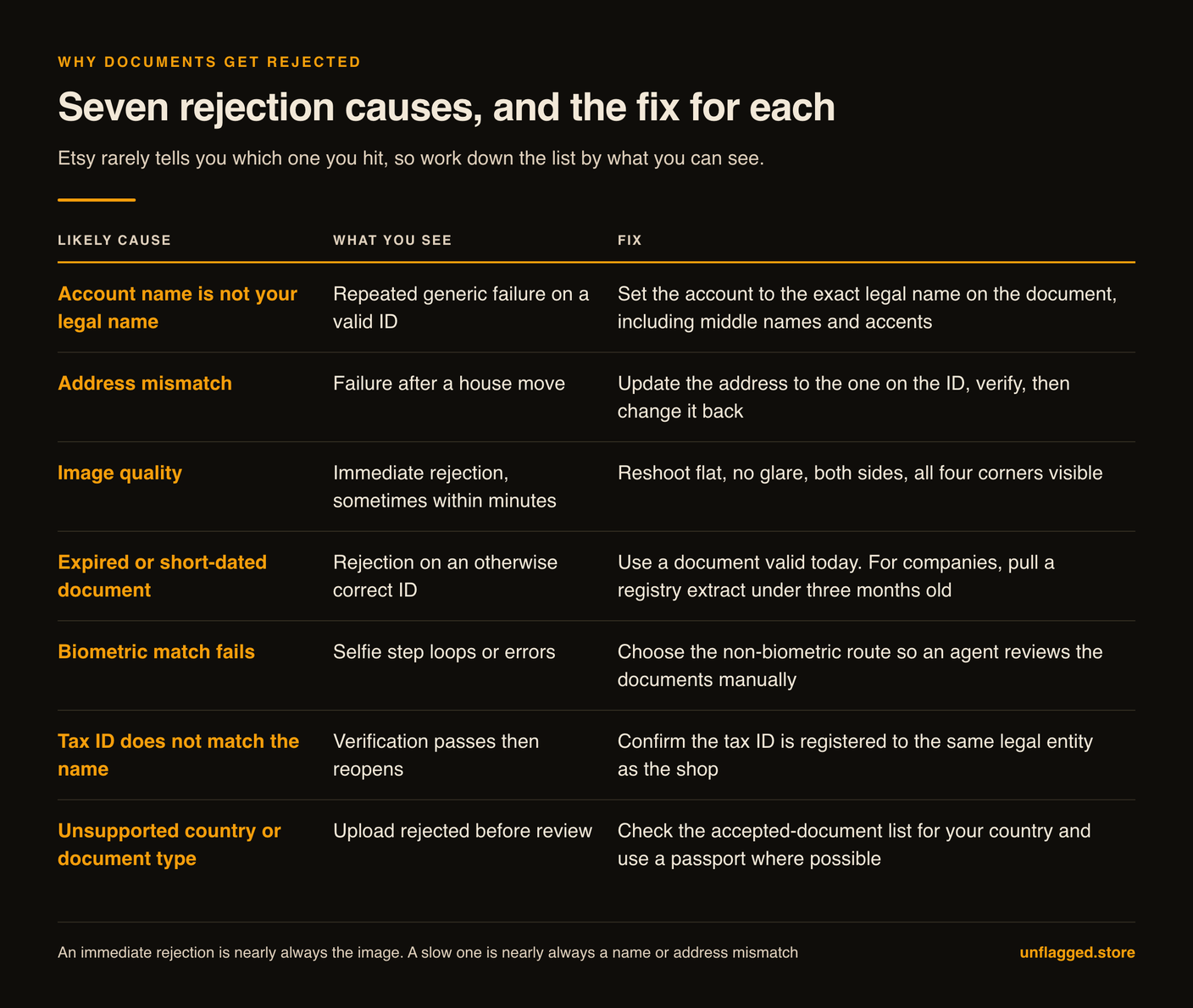
Here is the hardest part of the whole process to accept. Etsy will not tell you what failed. It states that it is legally unable to disclose which specific piece of information could not be verified, so the rejection notice is generic by design and will stay generic no matter how many times you ask.
This produces the loop that fills the forums: seller uploads ID, gets a generic failure, uploads the same ID again, gets the same failure. The way out is to stop treating it as a document problem and start treating it as a data-matching problem. In most stuck cases, the document is fine and a field in the account does not match it.
| Likely cause | What you see | Fix |
|---|---|---|
| Account name is not your legal name | Repeated generic failure on a valid ID | Set the account to the exact legal name on the document, including middle names and accents |
| Address mismatch | Failure after a house move | Update the address to the one on the ID, verify, then change it back |
| Image quality | Immediate rejection, sometimes within minutes | Reshoot flat, no glare, both sides, all four corners visible |
| Expired or short-dated document | Rejection on an otherwise correct ID | Use a document valid today. For companies, pull a registry extract under three months old |
| Biometric match fails | Selfie step loops or errors | Choose the non-biometric route so an agent reviews the documents manually |
| Tax ID does not match the name | Verification passes then reopens | Confirm the tax ID is registered to the same legal entity as the shop |
| Unsupported country or document type | Upload rejected before review | Check the accepted-document list for your country and use a passport where possible |
Work down that table in order and change one variable at a time. Changing your name, address and document in a single attempt tells you nothing when it fails again, and each cycle costs days you do not have. If two attempts pass with the data corrected, the problem is not your data, and it is time to escalate.
The Escalation Ladder When You Are Stuck
Support behaviour here is not intuitive, and the intuitive move is the one that hurts you most.
Sellers who get unstuck describe the same sequence, and the sellers who stay stuck for months describe the same mistake, which is opening a fresh ticket every few days. A new ticket starts at the back of the queue. The thread you already have carries its history and its age, and age is what eventually routes a case to a human with the authority to act on it.
- Reply in the existing thread. Same email chain, same chat. Do not open a second ticket, and do not let the thread go quiet for more than three days.
- Ask explicitly for escalation to Trust and Safety. Use those words. Frontline agents cannot clear a verification hold, but they can route it to the team that can.
- Request a phone callback. Sellers report that phone agents will open a parallel ticket on your behalf, which creates a second internal record referencing the first.
- Post in the Etsy Community forums. Community Specialists there have forwarded stalled cases to specialist teams, and it is one of the few routes that visibly moves cases that email did not.
- Keep a dated log. Every submission, every reference number, every reply. When a case finally reaches a specialist, the seller who can produce a timeline gets resolved faster than the one reconstructing it from memory.
Do not open a second shop. Every year sellers respond to a verification hold by starting a new account with the same details. Etsy links accounts by payment details, address and device, and the usual result is that both shops end up restricted instead of one. If you are weighing it up, read what actually happens when Etsy links and bans accounts first.
How To Clear The Check Before It Clears You
Verification is a fixed cost of selling at volume. What is optional is whether it arrives as a surprise.
If your shop is anywhere near 200 sales and $5,000 in a rolling year, treat the check as scheduled rather than possible, and do the preparation now while your shop is still earning. Four things, none of which take an afternoon.
- Make the account name your exact legal name. The name on the account and the name on the ID must match character for character. Trading names belong in the shop title, not the legal-name field.
- Check your ID expiry date. If the document expires within the next year, renew it before it becomes the reason your shop is closed.
- Keep a current registry extract. Company sellers should download a fresh extract every quarter so one is always inside the three-month window.
- Confirm the phone number can receive a code. An old number on the account is a silent failure point that costs a full review cycle to discover.
The wider point is that this is the same discipline that keeps a shop out of trouble generally. Identity holds, production partner registration and listing-level compliance are all versions of the same question: does what Etsy holds about you match what is true? Shops that audit that once a quarter mostly never meet the enforcement machinery at all. The complete guide to Etsy seller compliance covers the rest of that checklist.
Related Reading
- Etsy payment reserve: why your money is on hold
- What actually happens when Etsy suspends your shop
- Etsy suspension email: what it means, line by line
- Etsy vacation mode: how it works and when to use it
- Deactivated or suspended? The difference matters
- The complete guide to Etsy seller compliance
Frequently Asked Questions
Why is Etsy asking me to verify my identity?
Almost always because your shop crossed the INFORM Consumers Act thresholds: 200 or more separate sales of new or unused products and $5,000 or more in gross revenue in any continuous 12 months during the past 24. Etsy is legally required to collect and verify seller information at that point. It is not a response to anything you did wrong.
How long does Etsy identity verification take?
Etsy states that identity or bank verification can take up to five business days, and that documents are usually reviewed within two to five business days. Sellers commonly report longer, with cases running to 21 days and occasionally past a month. If nothing has moved after 10 business days, treat the case as stalled and escalate.
What happens if I do not verify in time?
Your shop stays in forced holiday mode and cannot take new orders. Sellers report that pending orders are refunded to buyers once the 60-day identity-document window passes without a verified document. Under the statute itself, failure to supply bank, tax and contact details within 10 days of the marketplace's request results in suspension until the information is provided.
Can Etsy support turn holiday mode off while I wait?
No. The deadline behind the hold is set by law rather than by Etsy, and frontline agents have no ability to lift it. What they can do is escalate a stalled case to a specialist team, which is the outcome you should be asking for.
Why does Etsy not tell me which document failed?
Etsy states it is legally unable to disclose which specific piece of information could not be verified, so rejection messages stay generic. The practical response is to assume a mismatch between your account data and your document, and to correct the account fields one at a time rather than re-uploading the same file.
Do I have to use facial recognition to verify?
No. Etsy's verification partner Persona compares a photo of your government ID with a selfie, but Etsy also offers a non-biometric option where a support agent reviews your documents manually. Choose that route if the biometric step keeps failing or if you would rather not have a face scan on file.
Does verification make my home address public?
Verification itself does not. A separate INFORM Act provision does: once a seller passes $20,000 in gross annual revenue on a marketplace, the platform must display the seller's full name, physical address and a direct contact route to buyers. Sellers who qualify for an exemption can request that the street address be withheld, but publication is the default.
Will a verification hold count as a strike against my shop?
No. A verification hold is an account-status issue, not a policy violation, and it does not sit on your record the way a listing takedown or an intellectual property claim does. Once verification clears, the shop returns to normal standing.
Verification Is The Check You Can Prepare For
Identity verification is survivable and, unlike most Etsy enforcement, entirely predictable. You know the thresholds, you know the documents, and you can have all of it correct before the banner ever appears. The checks you cannot predict are the ones that come from your listings, where a single trademarked word in a tag can take a product down without warning.
Unflagged scans your listings for what actually triggers enforcement: trademark exposure in titles, tags and descriptions, attribution that does not match how your items are made, and policy conflicts that are invisible from inside your own shop. Run a free scan to see where you stand, or create an account for ongoing monitoring. Plans and limits are on the pricing page.
The primary sources are short and worth reading once: the Federal Trade Commission's guidance on what third party sellers need to know about the INFORM Consumers Act sets out the thresholds and deadlines, the statute itself at 15 U.S.C. 45f is the binding text, and Etsy's help article on identity verification with Persona covers the biometric and non-biometric options.
Scan Your Listings Free
Check your Etsy listings for trademark violations in seconds. 3 free scans, no signup required.
Start Free ScanRelated Articles
How to Check Your Etsy Listings for Trademark Violations (2026 Guide)
Learn how to scan your Etsy listings for trademark violations before they get flagged. Step-by-step guide to protecting your shop from takedowns and suspensions.
Read moreEtsy Shop Suspended? How to Write a Winning Appeal Letter
Your Etsy shop got suspended. Here's exactly how to write an appeal letter that gets your shop reinstated, with templates and strategies that actually work.
Read more50 Words That Are Trademarked on Etsy (Stop Using These Now)
A comprehensive list of commonly trademarked words and phrases that Etsy sellers use without realizing they're violating trademark law. Check your listings now.
Read more