Etsy 1099-K 2026: The $500 Suspension Rule
The Etsy 1099-K threshold returned to $20,000 for 2026, yet Etsy still suspends shops past $500 in sales without a taxpayer ID. Here is the gap.
- 1.What the Etsy 1099-K Threshold Is in 2026
- 2.The $500 Rule That Actually Suspends Shops
- 3.Your State May Still Send You a 1099-K
- 4.What the Number on the Form Actually Contains
- 5.Backup Withholding: the 24% Nobody Budgets For
- 6.No 1099-K Does Not Mean No Tax Return
- 7.When the Form Is Wrong
- 8.How a Tax Record Turns Into an Account Problem
- 9.Frequently Asked Questions
- 10.Related Reading
- 11.The Tax Rules Are Published. Your Listing Risk Is Not.
Key takeaways
- The federal 1099-K threshold is back at more than $20,000 and more than 200 transactions. The One Big Beautiful Bill Act, signed in July 2025, killed the phase-down to $2,500 and then $600 before it ever applied. Most Etsy shops will now never see the form.
- Etsy suspends shops at $500 in calendar-year sales with no valid taxpayer ID on file, and that number did not move. The reporting threshold went up by a factor of forty; the suspension trigger stayed where it was. They are two different rules and only one of them can close your shop.
- Seven states set their own thresholds, some as low as $600. A Massachusetts, Maryland, Virginia or Vermont seller can get a state 1099-K on $700 of sales while getting nothing federally.
- Missing or mismatched taxpayer details can trigger 24% backup withholding. That is close to a quarter of your gross sent to the IRS before the money reaches you, and it is the same name-and-number check that fails an identity verification hold.
- No 1099-K does not mean no tax. The filing floor for self-employment tax is $400 of net earnings, and it never had anything to do with the 1099-K threshold.
A seller does $700 on Etsy over a summer, gets no 1099-K, assumes the tax side is someone else's problem, and finds the shop suspended in October. Nothing about that sequence is a mistake in the tax code. It is two separate rules that happen to be about the same piece of paper, and the one that gets written about is not the one that shuts shops down.
The Etsy 1099-K threshold for 2026 is more than $20,000 in gross payments and more than 200 transactions, both conditions, per platform. We checked that against the IRS's own Understanding Your Form 1099-K page rather than a tax blog, because this number has been changed, delayed and un-changed three times since 2021 and a lot of what ranks for it is stale. Then we went looking for the rule that actually generates suspension emails, and found it in a place no tax guide bothers to look: Etsy's own taxpayer-information policy, which asks at $250 and suspends at $500.
This piece is about the gap between those two numbers, who falls into it, and what a tax record has to do with whether your shop is open. If you want the deductions-and-Schedule-C version, three good ones already exist. This is the compliance version.

What the Etsy 1099-K Threshold Is in 2026
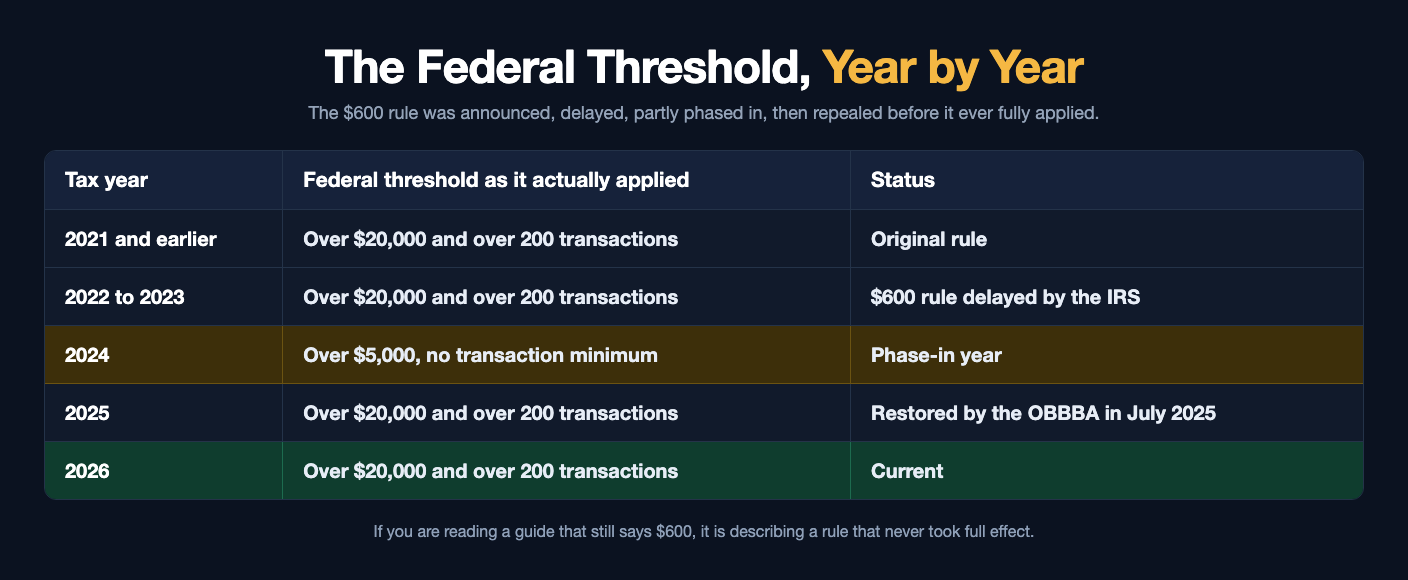
The current federal rule is the old one. A marketplace or payment app must issue Form 1099-K when payments for goods and services exceed $20,000 across more than 200 transactions in the calendar year. Both tests, not either.
The route here was messy enough to explain why so much published advice is wrong. The American Rescue Plan Act of 2021 dropped the threshold to $600 with no transaction minimum. The IRS then delayed it for three consecutive filing seasons and announced a phase-in of $5,000, then $2,500, then $600. In July 2025 the One Big Beautiful Bill Act repealed the change outright and restored the original numbers.
| Tax year | Federal threshold as it actually applied | Status |
|---|---|---|
| 2021 and earlier | Over $20,000 and over 200 transactions | Original rule |
| 2022 to 2023 | Over $20,000 and over 200 transactions | $600 rule delayed by the IRS |
| 2024 | Over $5,000, no transaction minimum | Phase-in year |
| 2025 | Over $20,000 and over 200 transactions | Restored by the OBBBA in July 2025 |
| 2026 | Over $20,000 and over 200 transactions | Current |
Two practical consequences. If you received a 1099-K for 2024 on modest sales and expected another one, you probably will not get it. And the number is per platform: $15,000 on Etsy and $15,000 on Shopify produces no federal 1099-K from either, which does not make $30,000 of income invisible.
The $500 Rule That Actually Suspends Shops
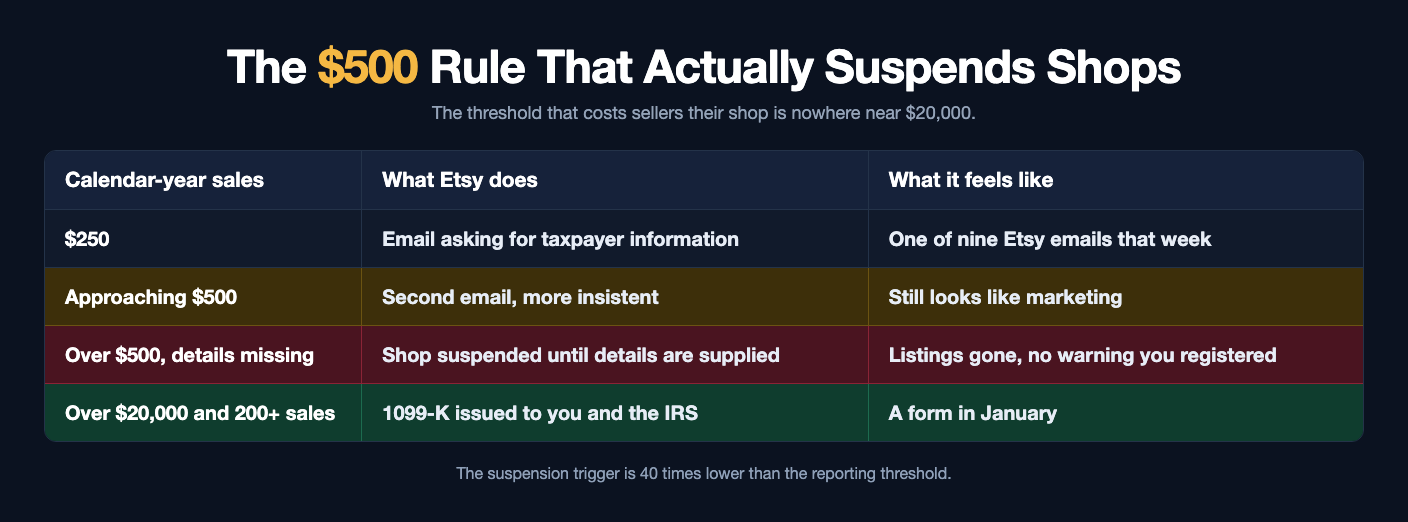
Here is the part that gets left out of every tax guide we read, and it is the only 1099-K-adjacent rule that can take your shop offline.
Etsy needs a valid taxpayer identification number on file to issue a 1099-K if one ever becomes due. It does not wait until you are close to $20,000 to collect it. Etsy emails a reminder at $250 in calendar-year sales, emails again as you approach $500, and suspends the shop once you exceed $500 without valid details on file. The suspension lifts when the information is supplied and verified.
| Calendar-year sales | What Etsy does | What it feels like |
|---|---|---|
| $250 | Email asking for taxpayer information | One of nine Etsy emails that week |
| Approaching $500 | Second email, more insistent | Still looks like marketing |
| Over $500, details missing | Shop suspended until details are supplied | Listings gone, no warning you registered |
| Over $20,000 and 200+ sales | 1099-K issued to you and the IRS | A form in January |
Read the first and last rows together. The threshold that triggers a suspension is one fortieth of the threshold that triggers the form. A seller can be suspended for the absence of a document they were never going to receive.
It hits hobby-scale sellers hardest, and they are exactly the people who read "the threshold went back to $20,000" and concluded that nothing here applies to them. Accepted figures like SSN, ITIN or EIN are the same ones you would put on a W-9. Take four minutes now and put them in under Finances, then Legal and tax information, whatever your sales are. If your shop is already suspended for this, the fix is the same four minutes, and the reinstatement is administrative rather than a judgement call, unlike most suspensions.
Your State May Still Send You a 1099-K
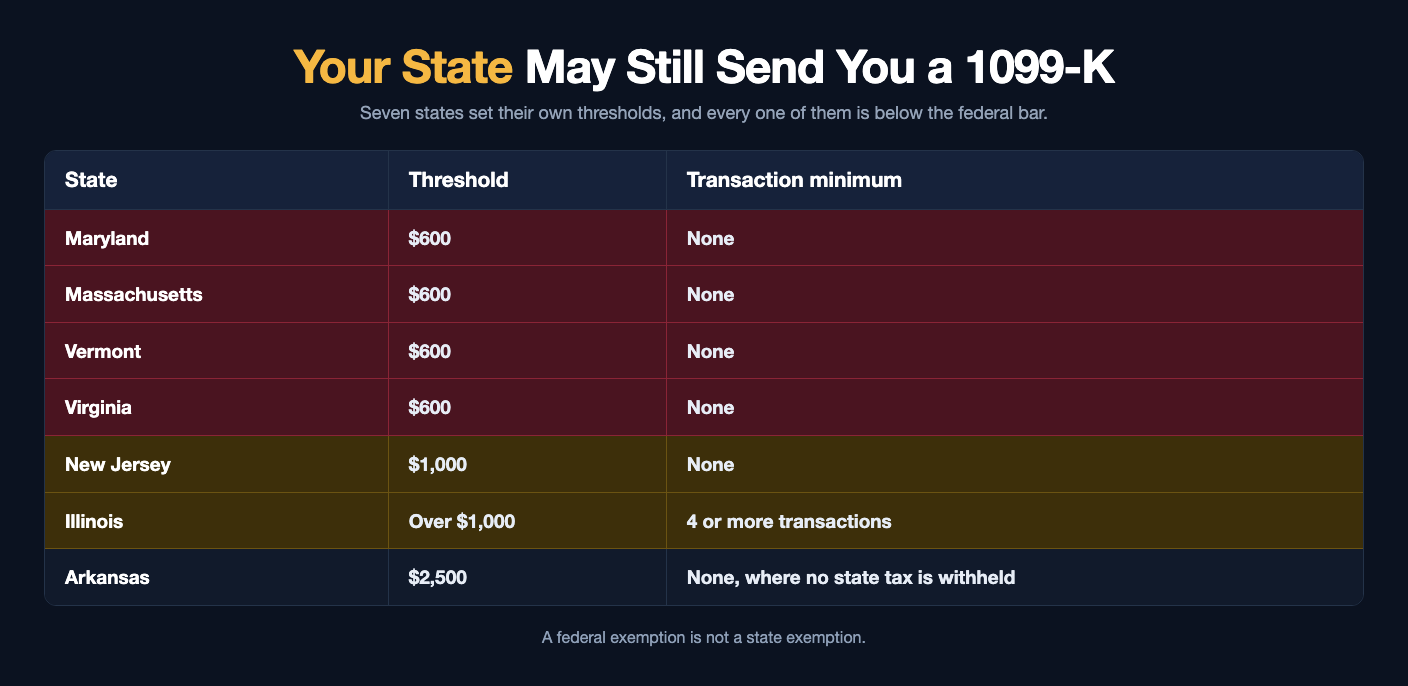
Federal thresholds do not bind states, and several never adopted the rollback. If you sell from one of these, the form can arrive on sales an order of magnitude below the federal line.
| State | Threshold | Transaction minimum |
|---|---|---|
| Maryland | $600 | None |
| Massachusetts | $600 | None |
| Vermont | $600 | None |
| Virginia | $600 | None |
| New Jersey | $1,000 | None |
| Illinois | Over $1,000 | 4 or more transactions |
| Arkansas | $2,500 | None, where no state tax is withheld |
A Massachusetts seller at $700 in sales gets a state 1099-K and no federal one. That is not an error and it is not worth calling Etsy about. Report the income either way; the form is a copy of a filing, not the thing that makes the money taxable.
These rules move. California conforms federally but keeps a separate $600 rule for app-based drivers, which does not touch Etsy sellers, and the direction of travel in state legislatures is not consistent. Check your own revenue department's current guidance before you rely on the row above, especially if you moved states this year.
What the Number on the Form Actually Contains
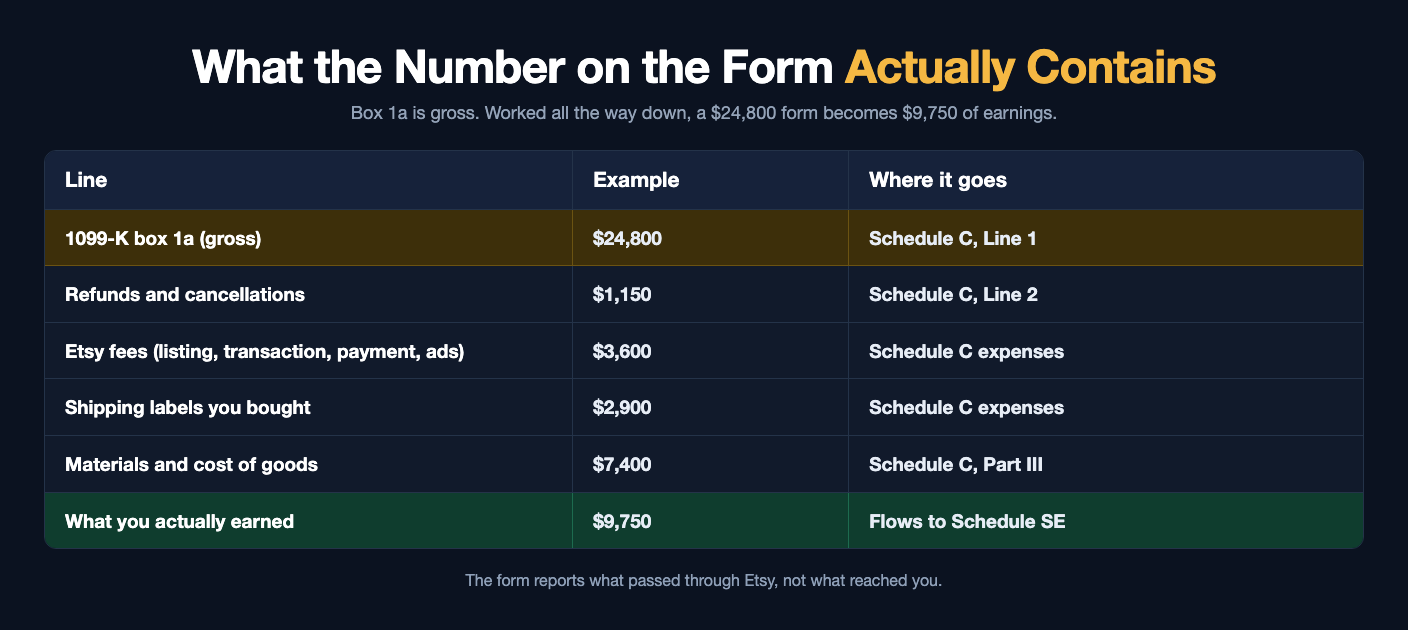
When a 1099-K does arrive, the figure on it will be larger than anything you recognise, and every year sellers panic at it. The box reports gross payments.
That means item prices plus buyer-paid shipping plus gift-wrap charges, with nothing subtracted. Etsy fees are not netted out. Refunds are not netted out. Cancelled orders are not netted out. The IRS defines the gross amount as the total without regard to adjustments for credits, discounts, fees, refunded amounts or anything else. Sales tax Etsy collects as a marketplace facilitator is excluded, which is the one thing working in your favour.
| Line | Example | Where it goes |
|---|---|---|
| 1099-K box 1a (gross) | $24,800 | Schedule C, Line 1 |
| Refunds and cancellations | $1,150 | Schedule C, Line 2 |
| Etsy fees (listing, transaction, payment, ads) | $3,600 | Schedule C expenses |
| Shipping labels you bought | $2,900 | Schedule C expenses |
| Materials and cost of goods | $7,400 | Schedule C, Part III |
| What you actually earned | $9,750 | Flows to Schedule SE |
The gap between the top row and the bottom one is the whole reason the form frightens people. Nothing above is aggressive; it is ordinary bookkeeping that only works if you kept the records. Etsy's own monthly statements and the annual CSV export are the source documents, and they are much easier to download in January than to reconstruct in April. Etsy's fee stack is the single largest of these adjustments for most shops.
Backup Withholding: the 24% Nobody Budgets For
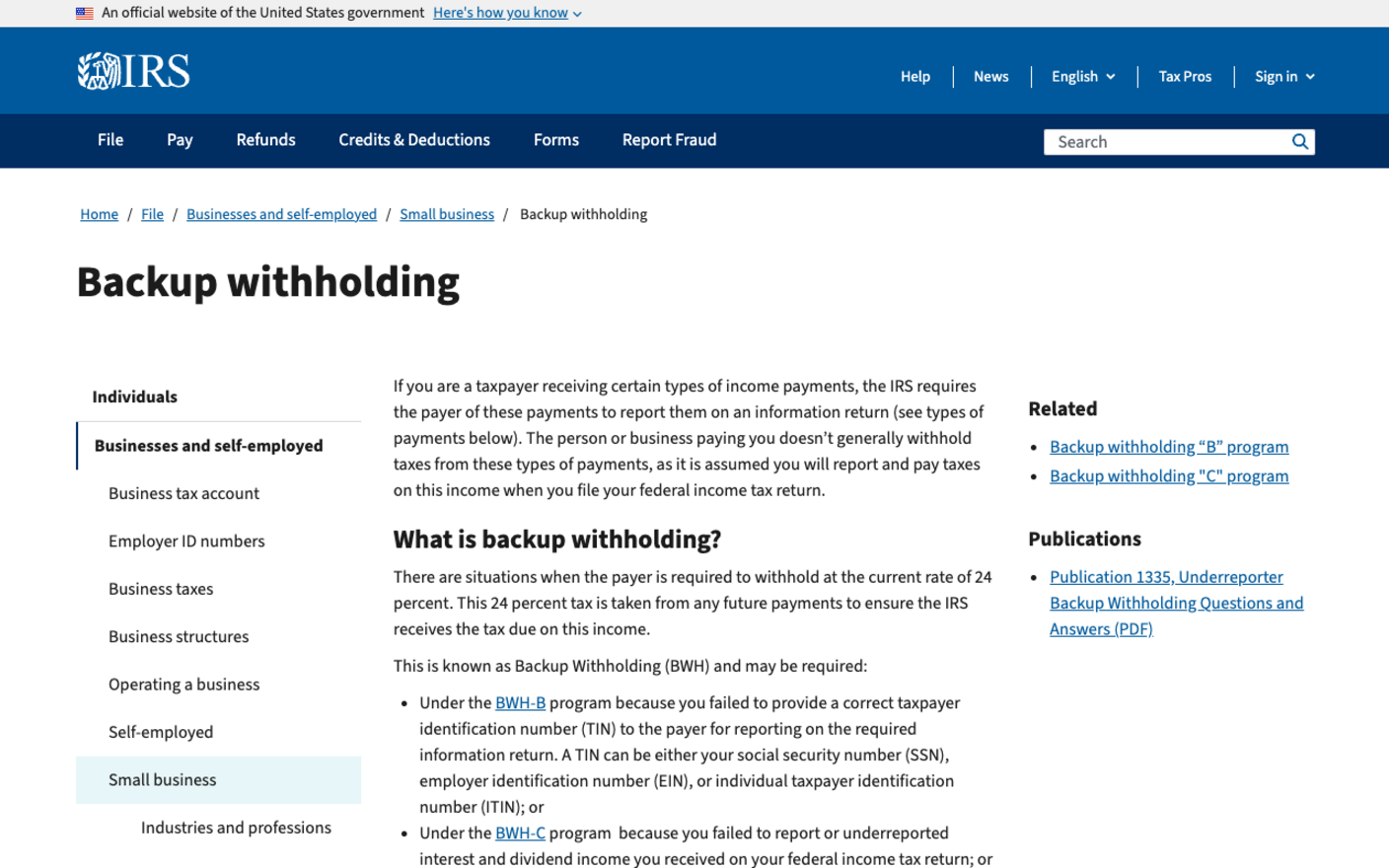
Missing or mismatched taxpayer details do not only risk a suspension. They can also trigger backup withholding, where the payer is required to withhold 24% of reportable payments and send it to the IRS.
The two triggers that matter to a marketplace seller are failing to supply a correct taxpayer identification number, and supplying one that does not match IRS records for the name given. The second is the sneaky one. It is not a missing field; it is a field you filled in that fails a match you never see run, and the first symptom is money arriving short.
| Cause | What you see | Fix |
|---|---|---|
| No TIN supplied | Reminder emails, then suspension over $500 | Add SSN, ITIN or EIN in shop settings |
| Name and TIN do not match IRS records | Deposits short by roughly a quarter; a B-notice | Match the exact name the IRS holds for that number |
| Business name used with a personal SSN | Same mismatch, harder to spot | Use the legal person for an SSN, the entity for an EIN |
| Name changed after marriage or incorporation | Passes once, then reopens later | Update the SSA or IRS record first, Etsy second |
Enter your name exactly as it appears on the Social Security card or the EIN letter. Not the trading name, not the version with the middle initial you prefer. This is the same name-and-number match that sits underneath Etsy's identity verification holds, and a mismatch tends to fail both at once.
No 1099-K Does Not Mean No Tax Return
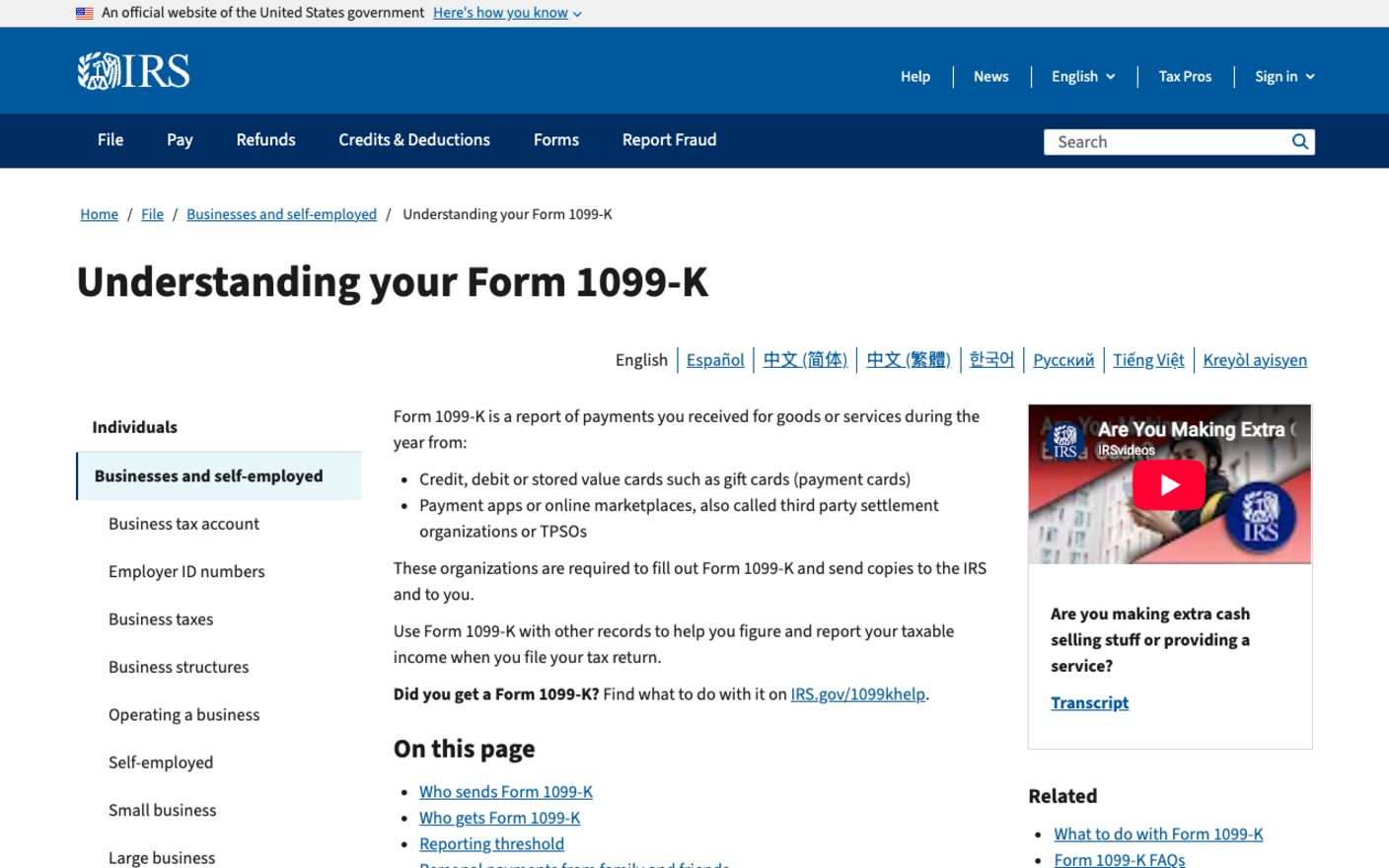
The most expensive misreading of this year's change is the assumption that a threshold going up removed an obligation. It removed a form, and a form is a copy of a report, not the report itself.
Income from selling goods is taxable whether or not any third party told the IRS about it. The number that matters for a small shop is much lower than $20,000: net earnings from self-employment of $400 or more require you to file Schedule SE. The self-employment tax rate is 15.3%, being 12.4% for Social Security and 2.9% for Medicare, on top of income tax.
| Situation | 1099-K? | Report the income? | Self-employment tax? |
|---|---|---|---|
| $700 of sales, Massachusetts | State form only | Yes | If net earnings are $400 or more |
| $4,000 of sales, Texas | No | Yes | If net earnings are $400 or more |
| $24,000 over 210 sales | Yes | Yes | Yes |
| $24,000 over 80 sales | No, fails the 200 test | Yes | Yes |
Look at the last row for a moment. A shop selling higher-value work can clear $24,000 without triggering a federal 1099-K at all, because the transaction count never gets there. Nothing about that changes what is owed, and the absence of a form is not evidence of anything.
When the Form Is Wrong
1099-Ks do arrive wrong. The usual causes are a shop sold or transferred mid-year, two shops under one taxpayer ID, a legal name that changed, or a form issued to a person who no longer runs the account.
Etsy's support team cannot edit a 1099-K after it has been generated, which puts the real deadline in December rather than February. Fix your taxpayer details before 31 December of the tax year, because after that you are working with the IRS rather than with Etsy.
| Problem | Do this | Timing |
|---|---|---|
| Details are wrong and the year is still open | Correct them in Etsy shop settings | Before 31 December |
| Form arrived with an error | Contact the issuer immediately; keep the correspondence | As soon as it arrives |
| No corrected form available | Offsetting entries on Schedule 1, lines 8z and 24z, netting to zero | At filing |
| Form covers a shop you sold | Same offsetting approach, with the sale documented | At filing |
The IRS publishes that offsetting method itself, so it is not a workaround: Part I line 8z records the amount as other income and Part II line 24z reverses it as an other adjustment, with zero net effect on adjusted gross income. Do not skip the return while you wait for a correction that may not come.
How a Tax Record Turns Into an Account Problem
This is the part that makes a tax topic an Etsy compliance topic. Every rule above is administered against one identity: a legal name, a taxpayer number and an address that Etsy holds and, in places, verifies. When that identity is wrong or absent, the consequences are not confined to tax season.
| Failure | Tax consequence | Account consequence |
|---|---|---|
| No taxpayer ID over $500 in sales | Etsy cannot issue a 1099-K | Shop suspended until supplied |
| Name and TIN mismatch | B-notice, 24% backup withholding | Verification failures; funds held |
| Legal name differs from ID documents | Nothing directly | Identity verification rejected |
| Unresolved policy violation | Nothing directly | Not in good standing; seller protections lapse |
The bottom row is worth ten minutes of anyone's evening. Good standing is a condition of Etsy Purchase Protection, so an open violation on one listing quietly removes refund cover from every order in the queue. Held funds are their own slow problem, and once money stops moving you are into payment reserve territory.
Treat the tax record and the compliance record as one record, because Etsy does. The four minutes you spend on the taxpayer field is the cheapest compliance work available to you; the rest of it lives in your listings, where it is much harder to see.
Frequently Asked Questions
What is the Etsy 1099-K threshold for 2026?
More than $20,000 in gross payments and more than 200 transactions in the calendar year, on that one platform. Both conditions must be met. The One Big Beautiful Bill Act restored these figures in July 2025, cancelling the planned drop to $2,500 and then $600.
Will Etsy suspend my shop if I have not given a taxpayer ID?
Yes. Etsy emails a reminder at $250 in calendar-year sales, emails again as you approach $500, and suspends the shop once sales exceed $500 without valid taxpayer details on file. The suspension is lifted once the correct information is supplied, so it is one of the few Etsy suspensions with a purely administrative fix.
Why did I get a 1099-K when I only sold $700?
Almost certainly a state rule. Maryland, Massachusetts, Vermont and Virginia set the threshold at $600 with no transaction minimum, New Jersey at $1,000, Illinois at four or more transactions over $1,000, and Arkansas at $2,500. These are independent of the federal threshold and were not affected by the 2025 rollback.
Do I owe tax if I do not receive a 1099-K?
Yes. Income from selling goods is taxable regardless of whether any form was issued. Net earnings from self-employment of $400 or more require a Schedule SE, which is a far lower bar than the reporting threshold and has never been connected to it.
Why is the amount on my 1099-K higher than what I was paid?
Because it reports gross payments. It includes item prices, buyer-paid shipping and gift wrap, and subtracts nothing for Etsy fees, refunds or cancelled orders. Marketplace sales tax Etsy collects is excluded. You make those subtractions yourself on Schedule C, which is why the gross figure and your bank deposits never match.
What is backup withholding and could it happen to me?
It is a mandatory 24% withholding on reportable payments, triggered when a payee fails to supply a correct taxpayer identification number or supplies one that does not match IRS records for the name given. For Etsy sellers the usual cause is a name that does not match the number exactly, such as a maiden name, a trading name, or a business name entered against a personal SSN.
My 1099-K is wrong. Can Etsy fix it?
Not after it has been generated. Correct your taxpayer details before 31 December of the tax year to prevent the problem. If a wrong form has already arrived, contact the issuer immediately, keep the correspondence, and if no corrected form comes, use the IRS's offsetting entries on Schedule 1 lines 8z and 24z, which net to zero against adjusted gross income.
Related Reading
- Etsy identity verification: why your shop is on hold
- Etsy payment reserve: why your money is on hold
- What actually happens when Etsy suspends your shop
- Etsy Purchase Protection 2026: who pays what
- The complete guide to Etsy seller compliance
- Etsy policy changes in 2026, and what they mean for sellers
The Tax Rules Are Published. Your Listing Risk Is Not.
Everything above is knowable tonight. The thresholds, the state table, the withholding rate and the December deadline are all written down, and an hour with them means the tax side of your shop will never surprise you again. The taxpayer field in particular is four minutes of work that removes an entire category of suspension.
What is not published is what is sitting in your own listings. Which title contains a mark somebody owns, which description contradicts Etsy's handmade or production partner rules, which tag would fail a review today. That is the risk that takes good standing away, and good standing is what your seller protections rest on.
Unflagged scans your listings for what actually triggers enforcement: trademark exposure in titles, tags and descriptions, attribution that conflicts with Etsy's handmade and production partner rules, and policy problems that are invisible from inside your own shop. Run a free scan to see where you stand, or create an account for ongoing monitoring. Plans and limits are on the pricing page.
Check the primary sources before you act on any of this, and treat a tax blog, including this one, as a pointer rather than an authority. The IRS's Understanding Your Form 1099-K page carries the current threshold, its guidance on an incorrect Form 1099-K sets out the Schedule 1 method, and the backup withholding page states the 24% rate and its triggers. Etsy's own 1099-K help article holds the $250 and $500 taxpayer-information thresholds, but blocks automated fetching, so open it in a browser while signed in. This article is general information about published rules, not tax advice for your situation.
Scan Your Listings Free
Check your Etsy listings for trademark violations in seconds. 3 free scans, no signup required.
Start Free ScanRelated Articles
How to Check Your Etsy Listings for Trademark Violations (2026 Guide)
Learn how to scan your Etsy listings for trademark violations before they get flagged. Step-by-step guide to protecting your shop from takedowns and suspensions.
Read moreEtsy Shop Suspended? How to Write a Winning Appeal Letter
Your Etsy shop got suspended. Here's exactly how to write an appeal letter that gets your shop reinstated, with templates and strategies that actually work.
Read more50 Words That Are Trademarked on Etsy (Stop Using These Now)
A comprehensive list of commonly trademarked words and phrases that Etsy sellers use without realizing they're violating trademark law. Check your listings now.
Read more