Etsy Trademark Scam Letters 2026
The USPTO names 101 fake trademark solicitors. We read three of them: they asked $1,650, $980 and $599. How to read an Etsy trademark scam letter.
- 1.An Etsy Trademark Scam Letter Is a Solicitation, Not a Bill
- 2.The Fine Print Is the Tell, and a Statute Put It There
- 3.Three Real Solicitations, and What They Asked For
- 4.What the USPTO Actually Charges, and When
- 5.The 2026 Variant Wants Your Identity, Not Just Your Money
- 6."If It's Not in TSDR, It's Not an Official Communication"
- 7.Someone Went to Prison for This
- 8.If You Already Paid, and Why Etsy Sellers Get These at All
- 9.Related Articles
- 10.FAQ
Key takeaways
- An Etsy trademark scam letter is a solicitation, not a bill, and the fine print has to say so. Under 39 U.S.C. §3001(d) a mailing shaped like a bill that is really an offer is nonmailable unless it says on its face that it "is a solicitation for the order of goods or services, or both, and not a bill, invoice, or statement of account due."
- The USPTO publishes 101 of these senders by name. We opened three of its exhibits. They asked for $1,650, $980 and $599.
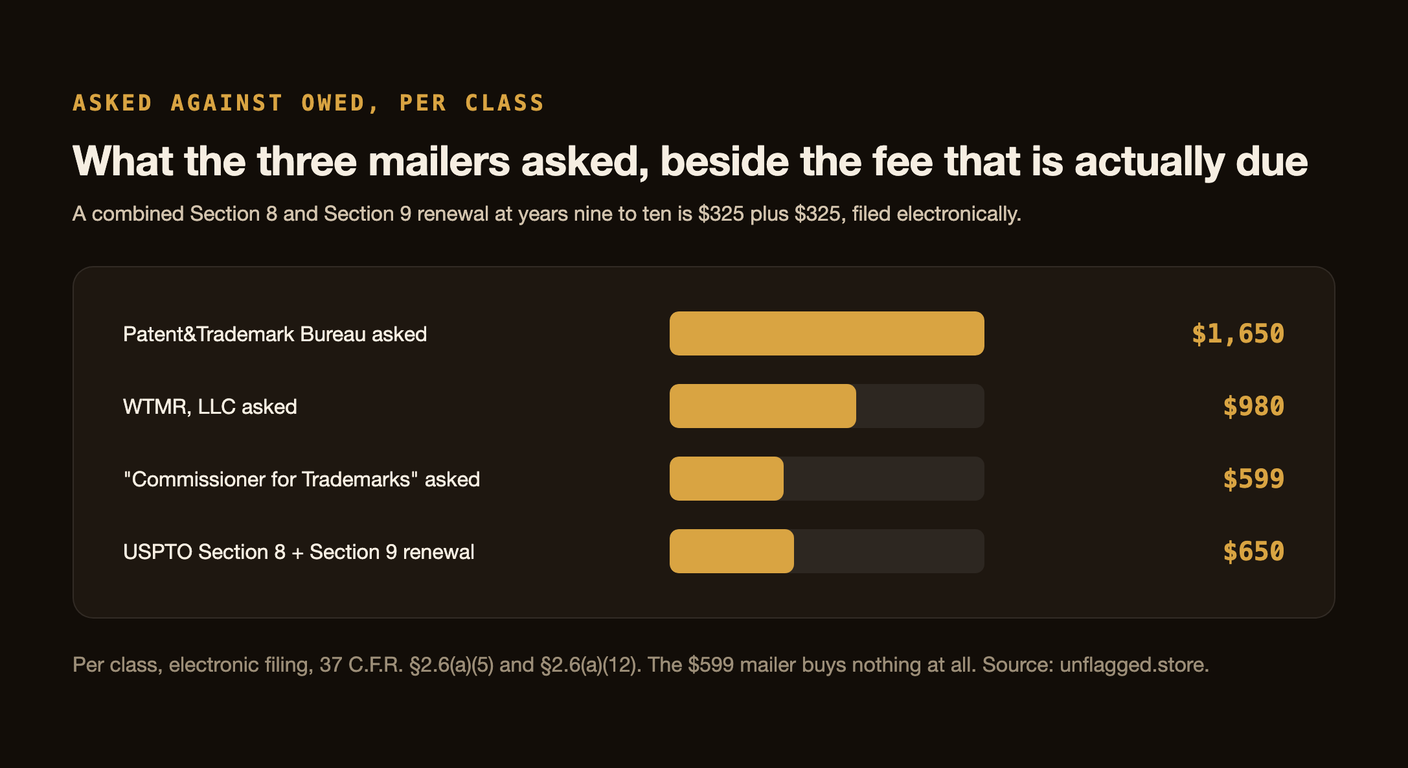
- The real number is $650. A combined Section 8 and Section 9 renewal at years nine to ten is $325 plus $325 per class filed electronically.
- One line settles almost every case. The USPTO's own wording: "If it's not in TSDR, it's not an official communication."
- This is prosecuted. Viktors Suhorukovs pleaded guilty to four counts of mail fraud for two renewal solicitation schemes and was sentenced on 20 September 2021 to more than four years in federal prison and over $4.5 million in restitution.

You registered your shop name, the registration certificate arrived, and a few weeks later so did something else: a window envelope with a seal on it, a reference number that is genuinely yours, and an amount due. Etsy trademark scam letters work because every detail on them is real except the obligation.
The amounts are not small. The three solicitations we opened for this piece asked for $1,650, $980 and $599, against a real renewal fee of $650 per class and, in two of the three cases, against no government deadline at all. One of the senders went to federal prison for it.
For this article we did not summarise the warnings. We read the statute that governs these mailings, pulled the USPTO's published list of 101 named solicitors, opened three of its scanned exhibits and read the amounts off the page, then checked each one against the current fee schedule. Every figure below comes from one of those.
An Etsy Trademark Scam Letter Is a Solicitation, Not a Bill
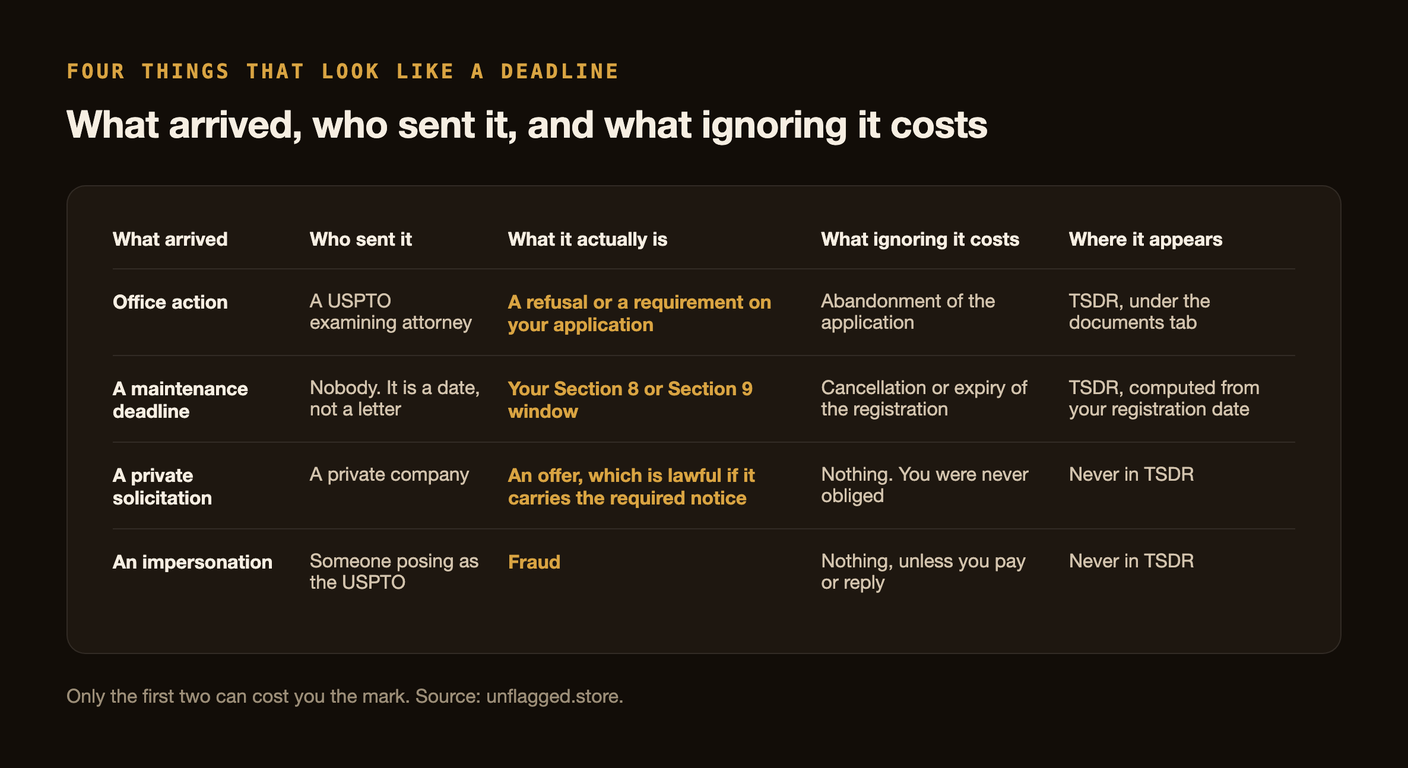
Four different things arrive after you file, and sellers routinely treat the fourth as though it were the first. The distinction is not a matter of tone. It decides whether anything happens if you bin it.
| What arrived | Who sent it | What it actually is | What ignoring it costs | Where it appears |
|---|---|---|---|---|
| Office action | A USPTO examining attorney | A refusal or a requirement on your application | Abandonment of the application | TSDR, under the documents tab |
| A maintenance deadline | Nobody. It is a date, not a letter | Your Section 8 or Section 9 window | Cancellation or expiry of the registration | TSDR, computed from your registration date |
| A private solicitation | A private company | An offer, which is lawful if it carries the required notice | Nothing. You were never obliged | Never in TSDR |
| An impersonation | Someone posing as the USPTO | Fraud | Nothing, unless you pay or reply | Never in TSDR |
Only the top two rows carry a consequence, and neither of them ever arrives as a demand for payment to a private address. Everything in rows three and four is optional, however the envelope is dressed. The rest of this piece is about telling row three and row four from row one.
The Fine Print Is the Tell, and a Statute Put It There
Here is the provision none of the pages ranking for this term mentions, and it is the one that does the work. 39 U.S.C. §3001(d) covers matter that "is in the form of, and reasonably could be interpreted or construed as, a bill, invoice, or statement of account due" but "constitutes, in fact, a solicitation for the order by the addressee of goods or services."
That matter is nonmailable. It "shall not be carried or delivered by mail, and shall be disposed of as the Postal Service directs" unless it bears on its face, "in conspicuous and legible type in contrast by typography, layout, or color with other printing on its face," a notice reading:
"This is a solicitation for the order of goods or services, or both, and not a bill, invoice, or statement of account due. You are under no obligation to make any payments on account of this offer unless you accept this offer."
The statute also allows a notice "to the same effect in words which the Postal Service may prescribe." So the mailer gets to paraphrase, but it does not get to leave the notice out.
Turn that around and you have the most reliable test available, and it is the opposite of what instinct suggests. Readers are trained to skip the small print; on these mailings the small print is the answer. A document that is lawfully in your letterbox and is not a bill is required to say so somewhere on its face. Find that sentence and the question is closed before you have checked a single fee.
Subsection (d) sets no criminal penalty of its own, incidentally. Its only consequence is that the matter cannot be carried by mail. The prison sentences in this area come from elsewhere, as the conviction further down shows.
Three Real Solicitations, and What They Asked For
The USPTO publishes a page of examples of fraudulent and misleading solicitations: 101 entries, each with the sender's name, address, country and date, and a scan of the document. The office says plainly that "none of these examples are official U.S. government or international governmental notices or offers."
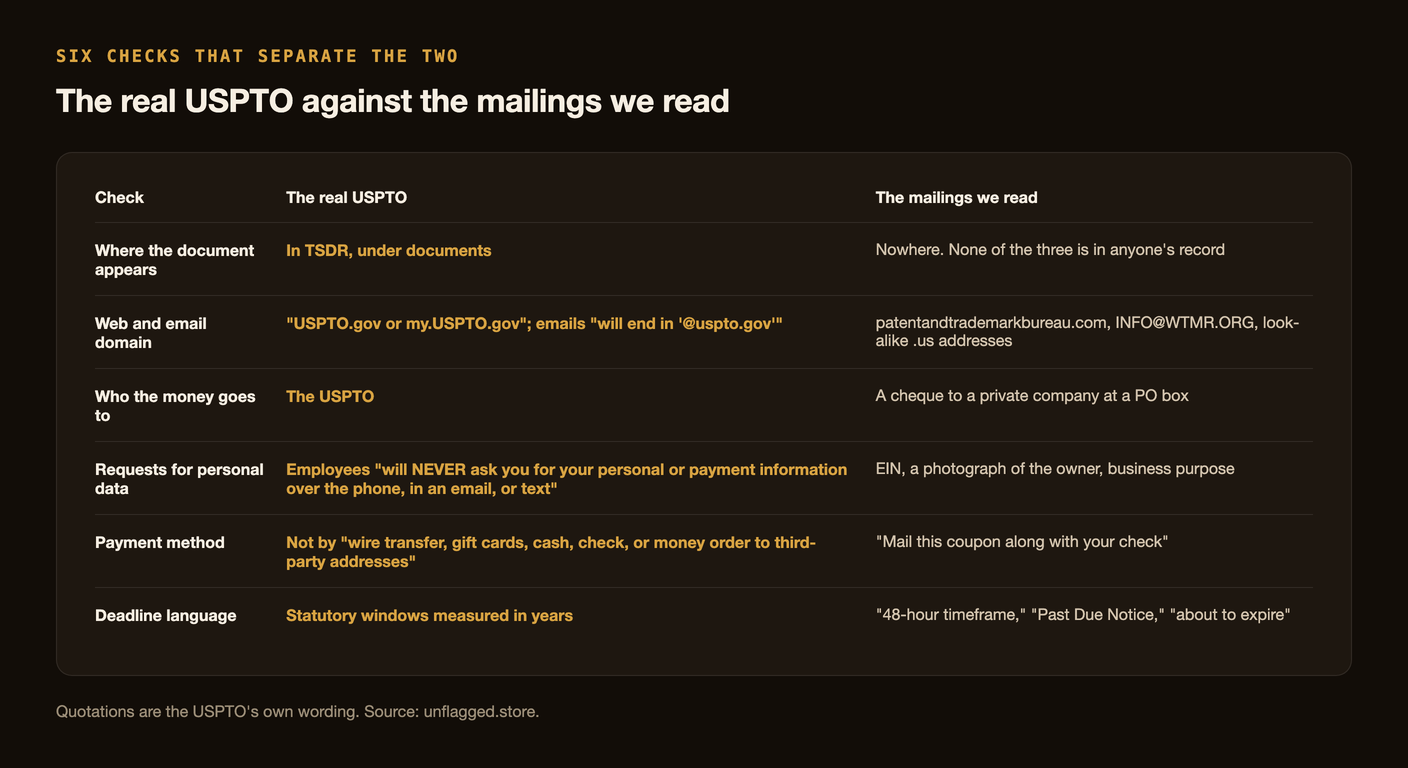
We opened three. These are the amounts as printed on the page, not ranges.
| Sender, as printed | Address on the mailer | Asked for | What the money buys |
|---|---|---|---|
| Patent&Trademark Bureau | 1500 Market Street, 12th Floor East Tower, Philadelphia, PA 19102 | $1,650 for one class, $850 for each additional class | A renewal it says it will file "on your behalf" |
| WTMR, LLC | PO Box 22546, Fort Lauderdale, FL 33335-2546 | $980.00, "DUE DATE: 12/18/20," cheque payable to WTMR, LLC | A listing in a private publication called the World Trademark Register |
| "United States Patent and Trademark Office, Office of the Commissioner for Trademarks" | None. A reply by email | $599.00 "Processing Fee," plus an EIN and a photograph, inside "the required 48-hour timeframe" | Nothing. There is no such fee and no such process |
Read the first two rows against each other, because they are different businesses. The Patent&Trademark Bureau mailing is headed REMINDER and carries its disclaimer: it "is a private business that is not endorsed by the U.S. government," and the renewal "is optional and only acts as a reminder." The WTMR mailing goes further and prints the statute itself, citing 39 U.S.C. §3001(d) on its face above the words "THIS IS NOT A BILL. THIS IS A SOLICITATION."
That is the shape of a lawful solicitation: expensive, unnecessary, and candid in a place nobody reads. It is also the reason "is it a scam?" is the wrong first question. The better one is "what does this buy, and what does the same thing cost at the source?"
What the USPTO Actually Charges, and When
Every page in this niche tells you to compare the amount demanded against the real fee. None of them prints the real fee. Here it is, from the USPTO fee schedule, effective 19 January 2025 and last revised on 1 November 2026, with the rule that sets each one.
| Filing | When it is due | Fee per class, electronic | 37 C.F.R. §2.6 code |
|---|---|---|---|
| Base application (TEAS) | At filing | $350 | 2.6(a)(1)(iii) |
| Section 8 declaration of use | Between the 5th and 6th anniversaries of registration | $325 | 2.6(a)(12)(i)-(ii) |
| Section 15 incontestability (optional) | After five years of continuous use | $250 | 2.6(a)(13)(i)-(ii) |
| Combined Section 8 and Section 9 renewal | Between the 9th and 10th anniversaries, then every 10 years | $650 ($325 + $325) | 2.6(a)(5) and 2.6(a)(12) |
| Grace period surcharge | Within six months after the deadline | $100 | 2.6(a)(6) and 2.6(a)(14) |
Now put the two tables side by side. The Patent&Trademark Bureau wanted $1,650 for one class where the office wants $650, and $850 for each additional class where the office wants the same $650. On a three-class registration that is $3,350 against $1,950, for a filing the sender does not make.
Missing the window is the thing that genuinely costs you. The USPTO's guidance is blunt about the Section 8: "failure to file a Section 8 declaration will result in cancellation of the registration." You get a six-month grace period at $100 per class, and then the registration goes. That is why the renewal mailers work, and it is also why binning them is only half the job: the deadline the letter invented is fake, the deadline in your record is not.
The 2026 Variant Wants Your Identity, Not Just Your Money
The newest exhibit on the USPTO's list, published in January 2026, is not an invoice at all. It is a forged office action, on the Department of Commerce seal, headed "United States Patent and Trademark Office, Office of the Commissioner for Trademarks," and the USPTO has stamped the word SCAM across the top and bottom of its copy.
It opens: "Congratulations! Your Application has been successfully approved and cleared the first phase. We would like to request you to proceed with the attestation process from the Federal Trade Commission (FTC) and the Department of Justice (DOJ) within the required 48-hour timeframe." It then asks for four things: an Employer Identification Number, a Business Owner Photograph, a Business Purpose, and a Processing Fee of $599.00. Non-compliance, it says, "may result in trademark application cancellation and potential legal consequences under federal law."
Two details show how much effort now goes into these. It is cc'd to real, correctly-titled USPTO officials, including the Deputy Director and the General Counsel. And it closes with the genuine USPTO declaration boilerplate, the one warning that willful false statements are punishable under 18 U.S.C. §1001, lifted verbatim from a real form.
Why this one is worse than an overpriced invoice. An EIN plus a photograph of the owner plus a business description is an identity-theft kit, and it keeps working long after a $599 payment has been charged back. There is no FTC or DOJ "attestation process" in trademark examination, no 48-hour clock anywhere in the procedure, and no USPTO fee called a processing fee. If you sent any of it, treat it as a data breach rather than a bad purchase.
"If It's Not in TSDR, It's Not an Official Communication"
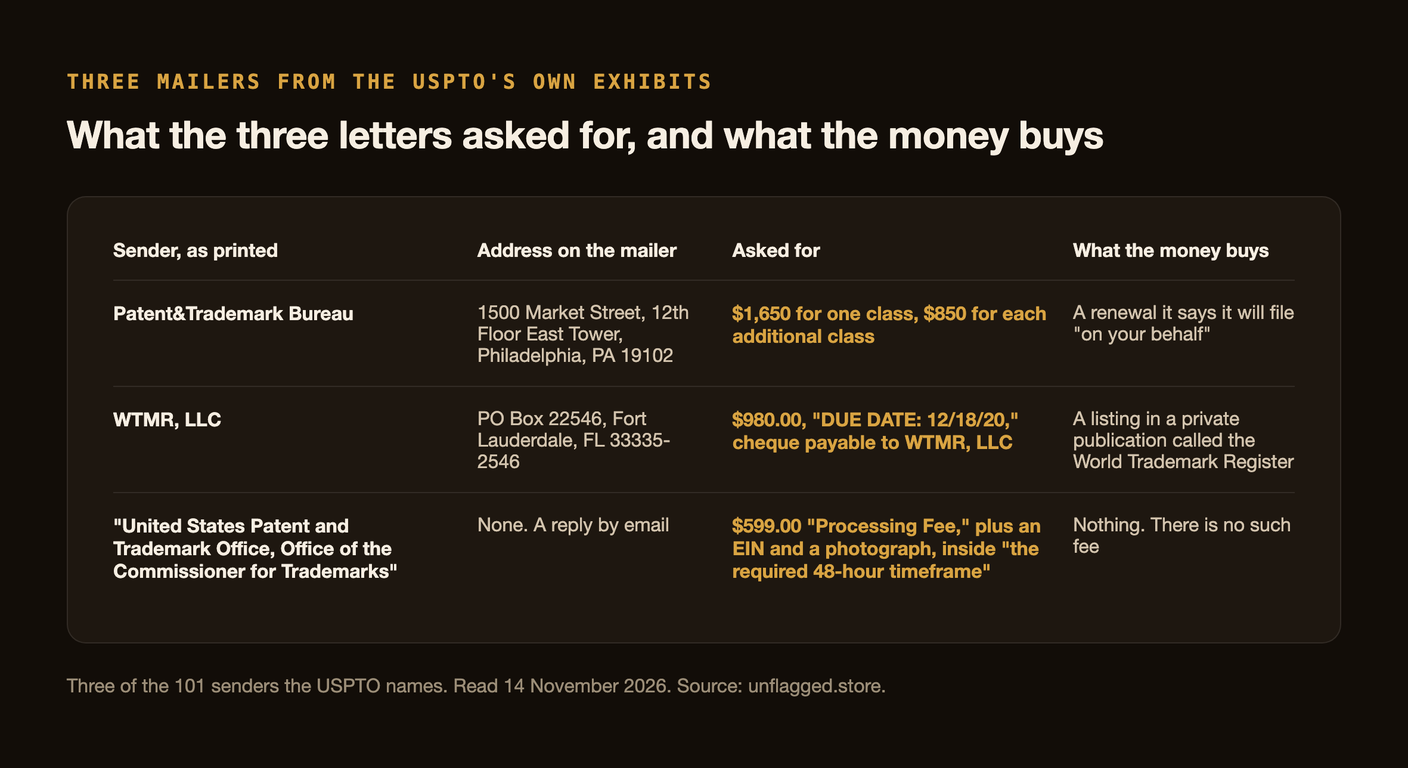
That sentence is the USPTO's, from its caution on misleading notices, and it resolves more cases than any checklist. Real office actions and real letters requesting payment are uploaded to your record under the documents tab in Trademark Status and Document Retrieval. Open the record, read the documents tab, and the question answers itself in under a minute, free and without an account.
Everything else is corroboration. Here is what the office says about itself against what the three mailings above actually did.
| Check | The real USPTO | The mailings we read |
|---|---|---|
| Where the document appears | In TSDR, under documents | Nowhere. None of the three is in anyone's record |
| Web and email domain | "USPTO.gov or my.USPTO.gov"; emails "will end in '@uspto.gov'" | patentandtrademarkbureau.com, INFO@WTMR.ORG, look-alike .us addresses |
| Who the money goes to | The USPTO | A cheque to a private company at a PO box |
| Requests for personal data | Employees "will NEVER ask you for your personal or payment information over the phone, in an email, or text" | EIN, a photograph of the owner, business purpose |
| Payment method | Not by "wire transfer, gift cards, cash, check, or money order to third-party addresses" | "Mail this coupon along with your check" |
| Deadline language | Statutory windows measured in years | "48-hour timeframe," "Past Due Notice," "about to expire" |
One more, because it closes a loop sellers fall into: the office states "we DO NOT recommend specific companies or attorneys." Any mailing that arrives as a recommendation from the USPTO is false on that basis alone. The same instinct that makes you check a mark in the register before you list is the one to use here, pointed at the sender instead of the mark.
Someone Went to Prison for This
The niche treats these mailings as a nuisance. One of them was prosecuted as mail fraud, and the USPTO has published the outcome.
Viktors Suhorukovs, a Latvian citizen, ran two trademark renewal solicitation schemes under two entity names: "Patent and Trademark Office" and "Patent and Trademark Bureau." He was arrested and charged in early 2020, pleaded guilty to four counts of mail fraud under 18 U.S.C. §1341, and on 20 September 2021 was sentenced to more than four years in federal prison and restitution of more than $4.5 million.
The mechanics match the exhibit above precisely. His mailings implied the entities were the USPTO, told registrants their registrations would expire earlier than they actually would, and charged fees "substantially higher" than the office's own. He then did not renew the registrations, and as the USPTO notes, he legally could not have.
One name on the charge sheet, Patent and Trademark Bureau, is also the name on the first exhibit in our table, though the published examples under that name run to six different addresses and we cannot tie that particular mailing to him. The useful point is narrower and holds either way: a name on these envelopes is not a company so much as a costume, reused across cities, and the $4.5 million restitution figure is the measure of how many registrants paid.
If You Already Paid, and Why Etsy Sellers Get These at All
Paying one of these does not cancel your trademark rights, and it does not put you in breach of anything. What it does is move your real deadline back into your own hands, because nobody filed anything for you. Open TSDR, read the documents tab, find the next Section 8 or Section 9 window, and diarise it.
Then report it, to the right mailbox. The USPTO runs several and they are not interchangeable:
- TMScams@uspto.gov for spoofed websites, signatures you did not personally enter, and your attorney's name used without permission.
- TEAS@uspto.gov if you get an alert about an email address change on your application that you did not authorise.
- OED@uspto.gov for attorneys letting others use their credentials or signature.
- Trademark Assistance Center, 1-800-786-9199, to confirm whether a specific email is genuine.
- ReportFraud.ftc.gov for the fraud itself, and your bank or card issuer for the payment.
As for why the letters find you so fast: a trademark file is public from the day it is filed, including the owner name and correspondence address, and these senders scrape it. That is the cost of the protection, not a sign anything went wrong. Sellers who file without an attorney get the worst of it, because there is no professional in the correspondence field to absorb the post and no baseline for what a real office communication looks like.
It is also the moment to separate two problems that feel identical in the inbox. A solicitation wants your money and has no power over your shop. A cease and desist letter is a claim against your listings from someone who may hold a real mark, and a takedown has already removed them. Only the first one can be safely ignored.
What a listing review can and cannot do here. Nothing on this page is legal advice, and no software can tell you whether a document in your post is genuine: that is a TSDR check and it is free. Unflagged does something narrower. It screens the listing text you paste in for potential concerns, including brand names and phrases that commonly draw reports, and saves the findings so you can compare revised wording. It does not search live trademark registers, read your correspondence, inspect images, or establish that a listing is safe. Start with the compliance guide if you are working through your shop rather than answering a letter.
Related Articles
- Etsy Shop Name Trademark 2026, the registration that puts you on these mailing lists
- Etsy Cease and Desist Letter 2026, when the letter is a claim rather than an invoice
- Etsy Trademark Takedown 2026, challenging a mark that should not be live
- Etsy Trademark Search Before Listing, reading a register record properly
- Etsy Identity Verification, the other place sellers are asked for documents
- Etsy's Intellectual Property Policy Explained, what the platform actually acts on
FAQ
Is a trademark renewal letter from a private company illegal?
Not necessarily. A solicitation that looks like a bill is lawful to mail if it carries the notice 39 U.S.C. §3001(d) requires, in conspicuous type contrasting with the rest of the page, saying it is a solicitation and not a bill and that you are under no obligation to pay unless you accept the offer. Both private mailers we read carry some version of it. Without that notice the matter is nonmailable. Either way you owe nothing.
How much is a real trademark renewal?
A combined Section 8 and Section 9 filing at the nine-to-ten year window is $325 plus $325 per class filed electronically, so $650 per class, under the fee schedule effective 19 January 2025 and last revised 1 November 2026. A standalone Section 8 at years five to six is $325 per class. A late filing inside the six-month grace period adds $100 per class. Anything materially above that is a private company's price, not the government's.
How do I check whether a USPTO notice is real?
Open your record in Trademark Status and Document Retrieval at tsdr.uspto.gov and read the documents tab. The USPTO's own test is that "if it's not in TSDR, it's not an official communication." Genuine office actions and letters requesting payment are uploaded there. You can also ring the Trademark Assistance Center on 1-800-786-9199 to confirm a specific email.
The letter has my serial number and filing date. Doesn't that prove it is official?
No, and this is the detail that convinces most people. Your application and registration data is public record from the day you file, including the owner name, correspondence address, mark, classes and dates. The senders scrape it, which is why a mailing can be accurate in every particular and still be an offer from a stranger.
What happens if I ignore a trademark scam letter?
Nothing happens to your registration, because the sender has no role in it and no power to cancel anything. What does not go away is your actual maintenance deadline. Missing the Section 8 window, plus its six-month grace period, results in cancellation of the registration, so bin the letter and then check the real date in TSDR.
I paid one. What should I do now?
Your trademark rights are intact; nobody filed anything, so nothing was filed wrongly. Report the mailing to TMScams@uspto.gov and the fraud to ReportFraud.ftc.gov, contact your bank or card issuer about the payment, and then find your real Section 8 or Section 9 window in TSDR and diarise it. If you also sent an EIN or a photograph, treat that as an identity exposure and monitor accordingly.
Does the USPTO ever ask for a photo or an EIN by email?
No. The office states that its employees "will NEVER ask you for your personal or payment information over the phone, in an email, or text." The January 2026 forged office action that asks for an Employer Identification Number, a photograph of the business owner and a $599 "processing fee" inside 48 hours is published on the USPTO's own examples page with the word SCAM stamped across it.
Sources. USPTO, Caution: misleading notices, for the TSDR test, the reporting mailboxes and the quoted statements about domains and payment methods. USPTO, Examples of fraudulent and misleading solicitations, 101 entries; the three exhibits read for this piece are the Patent&Trademark Bureau mailing at 1500 Market Street, the WTMR, LLC mailing, and the January 2026 forged office action, each read as the scanned page the USPTO publishes. USPTO, Criminal conviction in trademark renewal solicitation scam. USPTO fee schedule, effective 19 January 2025, last revised 1 November 2026; every fee above is from its own row. USPTO, Maintaining your trademark registration, for the windows and the grace period. 39 U.S.C. §3001, Legal Information Institute; the required notice sits in the unnumbered text following subsection (d)(2), as option (A), which is why mailings citing it as "§3001(d)(2)(A)" are citing it loosely. Dollar amounts on the exhibits are as printed on documents the USPTO has published, some of them years old, and a current mailing may ask for more. Fees change: check the schedule before filing. General information, not legal advice.
Scan Your Listings Free
Screen submitted listing text for potential concerns. 5 preliminary screens daily, shared network limits; no signup required.
Start Free ScreenRelated Articles
How to Check Your Etsy Listings for Trademark Violations (2026 Guide)
Learn how to scan your Etsy listings for trademark violations before they get flagged. Step-by-step guide to protecting your shop from takedowns and suspensions.
Read moreEtsy Shop Suspended? How to Write a Winning Appeal Letter
Your Etsy shop got suspended. Here's exactly how to write an appeal letter that gets your shop reinstated, with templates and strategies that actually work.
Read more50 Words That Are Trademarked on Etsy (Stop Using These Now)
A comprehensive list of commonly trademarked words and phrases that Etsy sellers use without realizing they're violating trademark law. Check your listings now.
Read more