Etsy Shop Name Trademark 2026: The Ornamental Trap
An Etsy shop name trademark starts at $350 a class, and Etsy rejects claims from the wrong register. Real USPTO fees, refusals and fixes for 2026.
- 1.Etsy Will Not Act Without a Registered Shop Name Trademark
- 2.What Use Alone Gets You, and What Registration Adds
- 3.What an Etsy Shop Name Trademark Application Costs in 2026
- 4.The Ten-Year Bill Nobody Quotes
- 5.The Ornamental Refusal: Your Own Name on Your Own Shirt
- 6.Five Ways Out of an Ornamental Refusal, Priced
- 7.The Specimen Most Etsy Sellers Send, and Why It Fails
- 8.Register the Shop, Not the Print
- 9.Related Articles
- 10.FAQ
Key takeaways
- Etsy will not act on a shop name the USPTO has not registered. Its published rejection reasons cover a mark that is "dead" or inactive, an application still pending, and a Supplemental Register mark with no extra proof of distinctiveness.
- The base application is $350 per class under the fee schedule revised on 1 November 2026, and two avoidable surcharges can add $100 and $200 per class before an examiner has read a word of it.
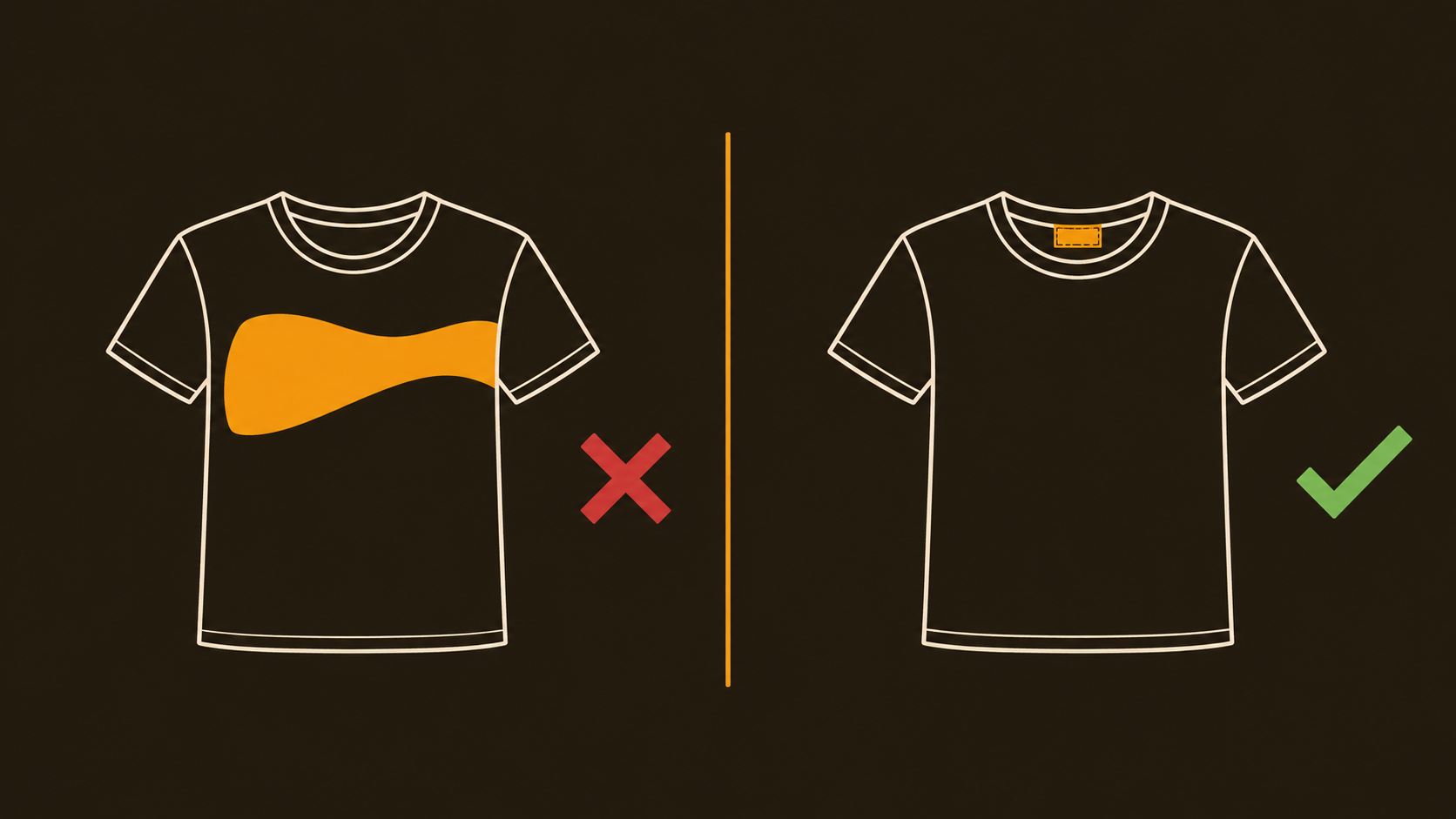
- Filing your shop name for the thing you print it on is the likeliest way to get refused. A name across the front of a shirt reads as decoration, not as a brand, and the USPTO calls that an ornamental refusal.
- The cheapest way out of that refusal is the one Etsy discounts. Amending to the Supplemental Register clears it, and 15 U.S.C. §1094 strips out the presumption of ownership, the priority date, the litigation presumptions and customs recordation.
- Keeping a registration alive costs more than getting it. Years five to six cost $575 per class combined, and each ten-year renewal is $650 per class.
An Etsy shop name trademark is the paperwork that changes what happens when somebody opens a shop using your name. Without it you can email the copycat and hope. With it you can file a report Etsy will process, because Etsy's own rejection page says a claim built on an unregistered, pending or inactive mark may not be processed at all. The cost of learning this late is a brand on your hang tags, your packaging and 400 listings, with no way to defend it.
The filing is cheaper than most sellers expect and dearer than any page ranking for this term says. For this piece we read the USPTO fee schedule as revised on 1 November 2026, the USPTO's guidance on ornamental and specimen refusals, 15 U.S.C. §1094 and 37 C.F.R. §2.56, and the two Etsy help articles that govern what a report must contain.
Then we read the pages ranking for this keyword. The strongest is about 950 words with one table, and gets the specimen advice broadly right. None of the four mentions the ornamental refusal, the Supplemental Register, or a single maintenance fee. Those omissions are the difference between a certificate and a registration Etsy will act on.
Etsy Will Not Act Without a Registered Shop Name Trademark
Start at the end of the process, because that is where the requirements are written down. Etsy's help centre publishes the reasons it rejects a notice of infringement, and read as a filing checklist it beats anything on the application side.
Three of those reasons are about the state of your registration rather than the copycat. Etsy says it "may not be able to process your trademark claim if your trademark is 'dead' or inactive." A pending application may also not be processed, and it suggests resubmitting once the application is approved. And if the mark sits on the Supplemental Register, Etsy asks for extra information showing the term is distinctive and works as a source identifier.
| Etsy rejection reason | What causes it at the USPTO | What to file instead |
|---|---|---|
| Trademark is "dead" or inactive | A missed §8 declaration or §9 renewal | Diary the year 5-6 and year 9-10 windows |
| Application still pending | Normal examination, or an unanswered office action | Wait for registration; answer office actions on time |
| Mark on the Supplemental Register | An ornamental or descriptiveness refusal cleared the cheap way | A Principal Register route, where one is available |
| Listings do not use the term as a source identifier | Not your filing; the copycat's use is decorative | Report the listings that use it as a brand |
| Report names a shop, not listings | Nothing; a reporting error | Each listing URL, as Etsy asks |
| Wrong right asserted | Nothing; a reporting error | The trademark path, not the copyright one |
Two further points from Etsy's reporting page set the frame. You must be the owner of the property or authorised to report for the owner, with a letter of authorisation if you are acting for someone else. And Etsy states that it "is unable to make legal determinations on infringement allegations or take sides in these matters." It is checking paperwork, not adjudicating, which is why the way competitors use that process works as well as it does.
What Use Alone Gets You, and What Registration Adds
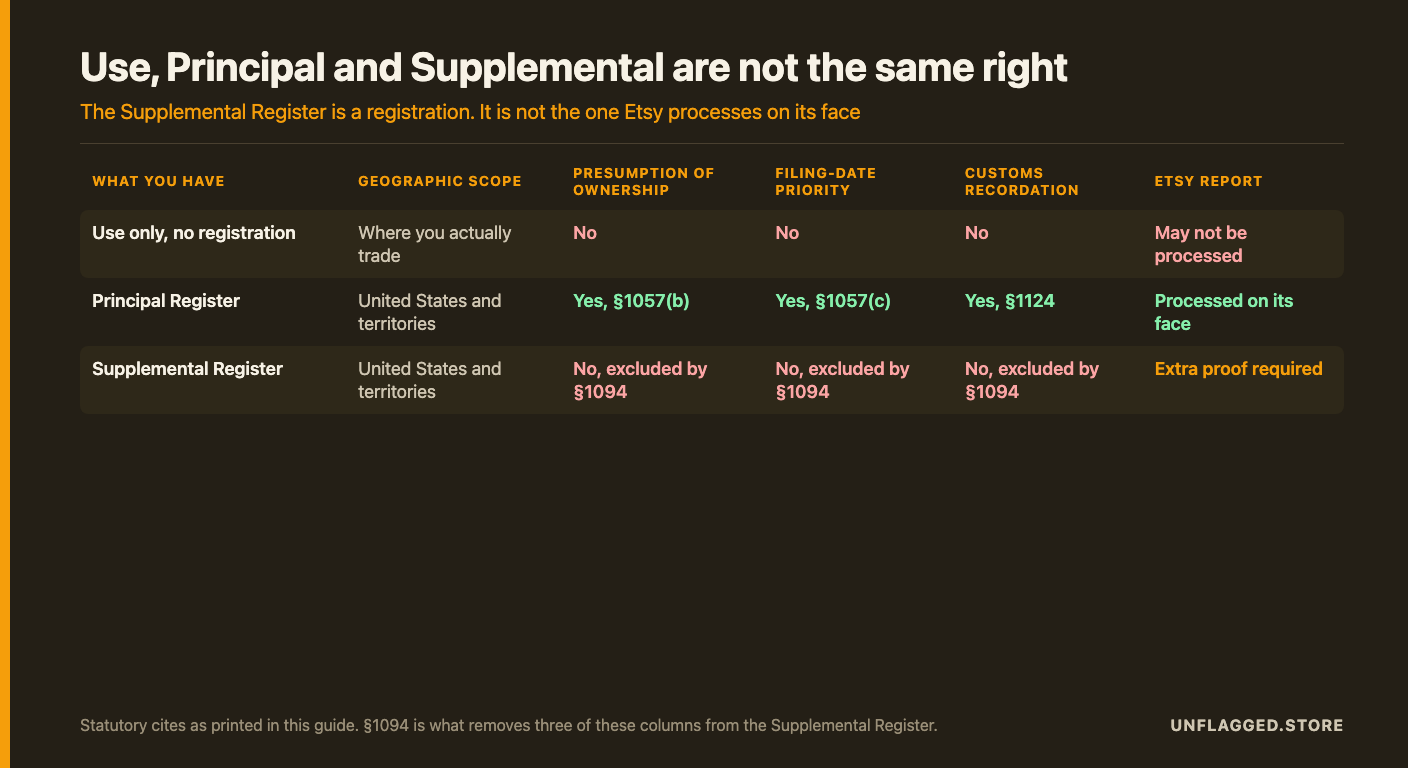
You already own something. The USPTO's own page is clear that common-law rights are "based on use of the trademark in commerce within a particular geographic area", and that where your use covers less than the whole country you "may only be able to enforce those rights in the specific areas in the United States where you use the trademark." A state registration reaches that state only, and an LLC filing or a DBA is not a trademark at all.
You will also read that the United States is a first-to-file country. Rights begin with use. What a federal application adds, once it registers on the Principal Register, is a priority date running from the filing rather than from the day examination ends, under the constructive-use provision at 15 U.S.C. §1057(c). Filing early matters for that reason, not because filing creates the right.
The three tiers are worth seeing side by side, because the gap between the second and the third is what this article exists to warn about.
| What you have | Geographic scope | Presumption of ownership | Filing-date priority | Customs recordation | Etsy report |
|---|---|---|---|---|---|
| Use only, no registration | Where you actually trade | No | No | No | May not be processed |
| Principal Register | United States and territories | Yes, §1057(b) | Yes, §1057(c) | Yes, §1124 | Processed on its face |
| Supplemental Register | United States and territories | No, excluded by §1094 | No, excluded by §1094 | No, excluded by §1094 | Extra proof required |
Registration also lists the mark in the database other sellers search, opens federal court, serves as a basis for filing abroad, and lets you use the registered symbol. What it does not do is enforce anything: the USPTO says plainly that it "is not an enforcement agency." Chasing the copycat stays your job, and searching before you commit to a name is the cheapest part of the exercise.
What an Etsy Shop Name Trademark Application Costs in 2026
The number everyone quotes is $350. It is correct, it is per class, and it is a floor rather than a price. The fee schedule was last revised on 1 November 2026, and these are its own rows.
| Filing | 37 C.F.R. | Electronic | Paper |
|---|---|---|---|
| Base application, per class | §2.6(a)(1)(iii) | $350 | not accepted |
| Base application on paper, per class | §2.6(a)(1)(i) | — | $850 |
| Insufficient information surcharge, per class | §2.6(a)(1)(iv) | $100 | $100 |
| Free-form text box instead of the ID Manual, per class | §2.6(a)(1)(v) | $200 | $200 |
| Each extra 1,000 characters in the free-form box | §2.6(a)(1)(vi) | $200 | $200 |
| Statement of use, per class | §2.6(a)(3) | $150 | $250 |
| Six-month extension to file a statement of use, per class | §2.6(a)(4) | $125 | $225 |
| Extension to answer a pre-registration office action | §2.6(a)(28)(ii) | $125 | — |
| Petition to revive an abandoned application | §2.6(a)(15)(iii)-(iv) | $250 | $350 |
The two surcharges are the interesting rows. Both are avoidable and both are per class. The $200 free-form charge applies when you describe your goods in the open text box instead of picking pre-approved wording from the USPTO's ID Manual, with another $200 for every additional 1,000 characters past the first thousand. The $100 charge applies when the application arrives missing something it should have carried. Pick ID Manual entries and a one-class filing stays at $350; write it freehand and at length and the same filing can cost $750 before examination starts.
Paper filing has not been generally available since mandatory electronic filing arrived on 15 February 2020. The $850 row covers the narrow circumstances where paper is still permitted, and sits in the table only so nobody meets that figure elsewhere and assumes it applies.
The Ten-Year Bill Nobody Quotes
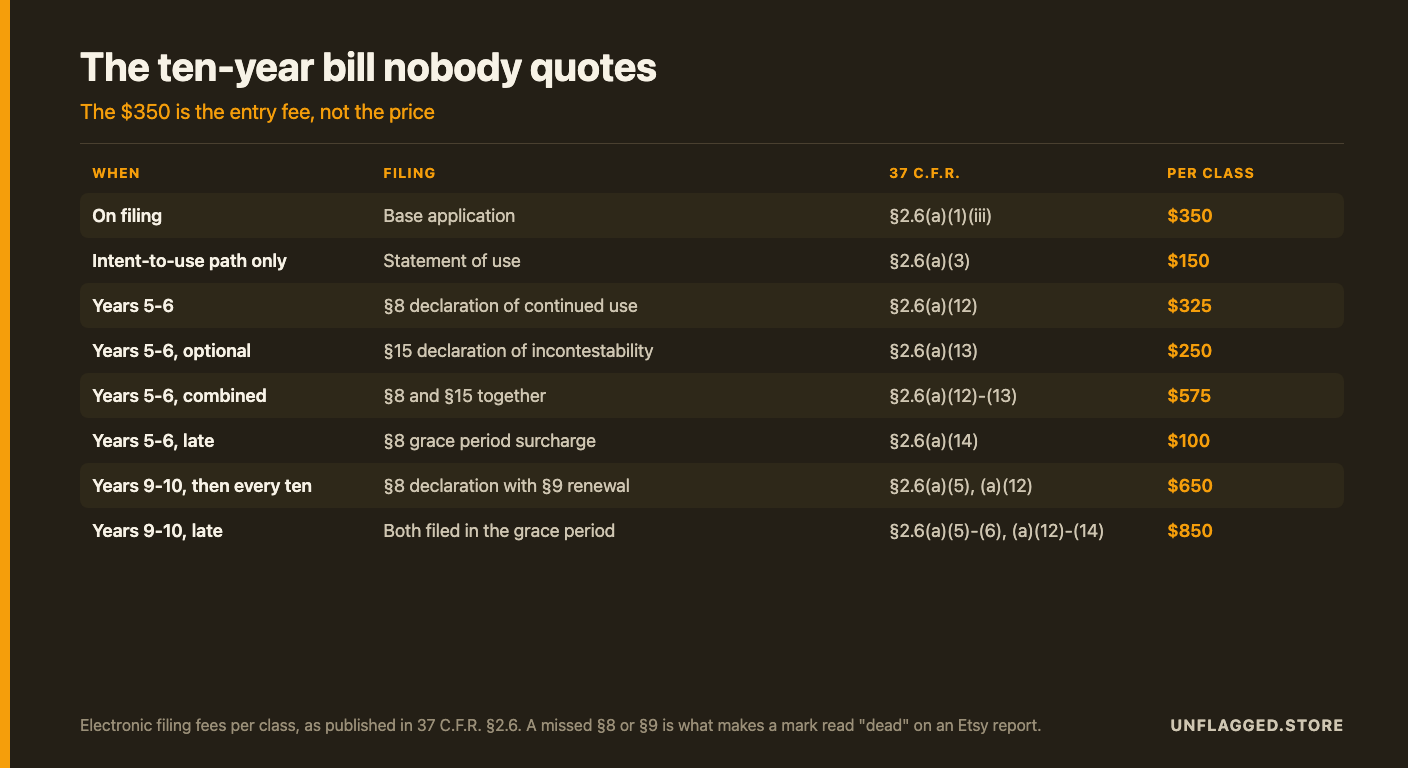
None of the four competing pages prices a maintenance filing, which makes $350 look like the cost of owning a trademark when it is the cost of applying once. A registration is a renewable term with two hard windows in it, and the fees below come from the same schedule.
| When | Filing | 37 C.F.R. | Fee per class |
|---|---|---|---|
| On filing | Base application | §2.6(a)(1)(iii) | $350 |
| Intent-to-use path only | Statement of use | §2.6(a)(3) | $150 |
| Years 5-6 | §8 declaration of continued use | §2.6(a)(12) | $325 |
| Years 5-6, optional | §15 declaration of incontestability | §2.6(a)(13) | $250 |
| Years 5-6, combined | §8 and §15 together | §2.6(a)(12)-(13) | $575 |
| Years 5-6, late | §8 grace period surcharge | §2.6(a)(14) | $100 |
| Years 9-10 and every ten years | §8 declaration with §9 renewal | §2.6(a)(5), (a)(12) | $650 |
| Years 9-10, late | Both filed in the grace period | §2.6(a)(5)-(6), (a)(12)-(14) | $850 |
Add the rows for a single-class mark taken the straightforward route and ten years of ownership is $350 plus $575 plus $650, or $1,575 in government fees. That total is arithmetic on the rows above rather than a figure the USPTO publishes, and it excludes attorney cost. Two classes doubles it, because almost every fee here is charged per class.
The deadlines are the part that bites. Miss the §8 window and the registration goes dead, the first item on Etsy's rejection list and the subject of the $400 petition that strips dead marks out of the register. A mark you stopped maintaining is one somebody else can have cancelled for a quarter of what you spent building it.
The Ornamental Refusal: Your Own Name on Your Own Shirt
Here is the refusal that catches sellers who do everything else right. You print your shop name across the chest of a shirt, photograph it, file for clothing, and the examiner refuses the application because the name is "merely ornamental or decorative" on the goods. The USPTO's own example is a slogan across the front of a t-shirt, which buyers read as decoration rather than as a sign of who made it. The case it cites is from 1973: "Swallow Your Leader" on a t-shirt, held merely ornamental.
The examiner weighs size, location, dominance and significance. Small, neat, discrete wording on a pocket or breast area can create a trademark impression; the same words enlarged across the front usually cannot. Common expressions and symbols, a peace sign or "Have a Nice Day", are normally not perceived as trademarks at all, whoever prints them.
The trap in one sentence. If the only place your shop name appears on your product is as the design, you are selling the name rather than branding the goods with it, and that is not trademark use. The fix is not better photography. It is a tag, a label, packaging, or a different filing.
This matters more on Etsy than almost anywhere else, because print-on-demand pushes sellers towards exactly this shape. The name is the artwork. There is no woven label, no printed box, no hang tag, nothing carrying the brand that is not also the product. Read the refusal before you file, not after, and read which words are safe in a listing at all alongside it.
Five Ways Out of an Ornamental Refusal, Priced
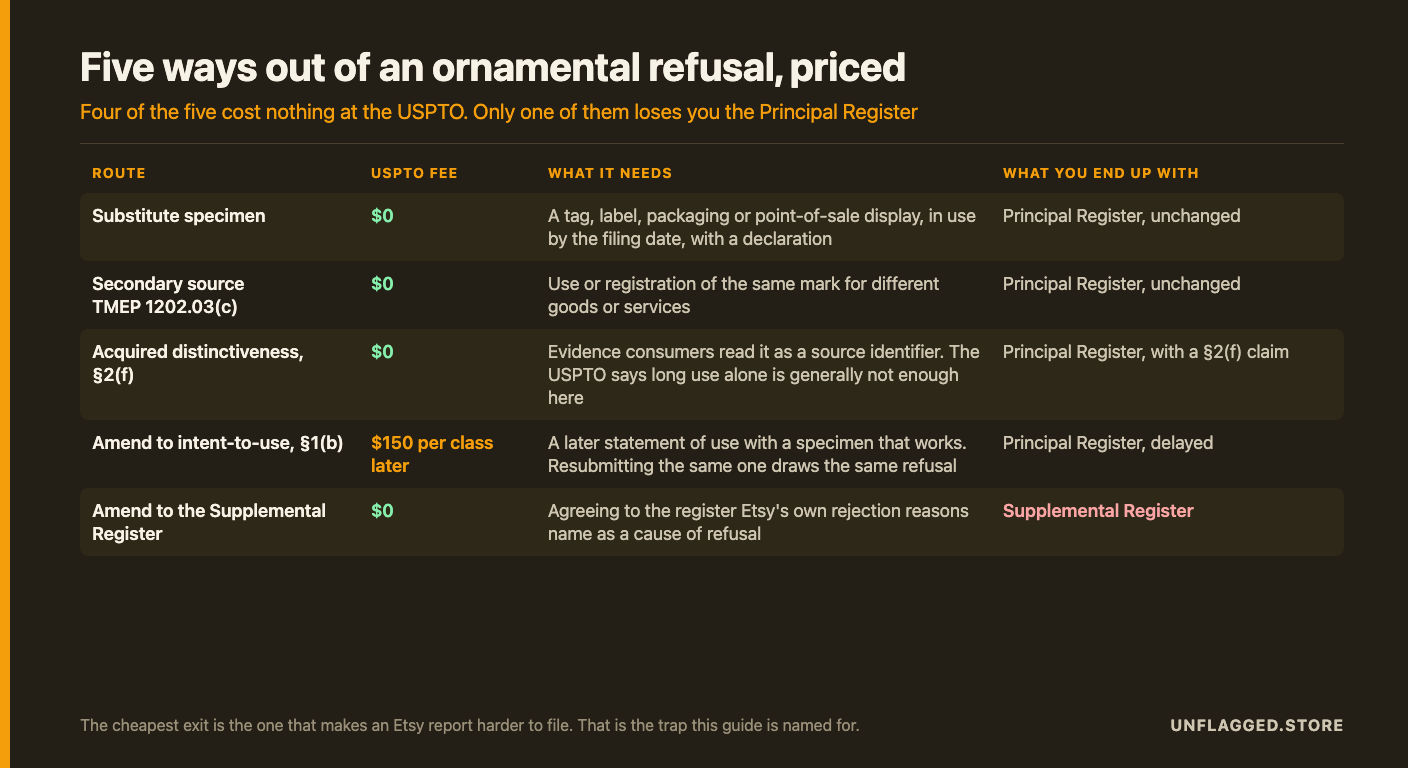
The USPTO publishes the response options with its own citations. All five are real and they are not equivalent, which is the part no competing page addresses.
| Route | USPTO fee | What it needs | What you end up with |
|---|---|---|---|
| Substitute specimen | $0 | A tag, label, packaging or point-of-sale display, in use by the filing date, with a declaration | Principal Register, unchanged |
| Secondary source, TMEP 1202.03(c) | $0 | Use or registration of the same mark for different goods or services | Principal Register, unchanged |
| Acquired distinctiveness, §2(f) | $0 | Evidence consumers read it as a source identifier; the USPTO says long use alone is generally not enough here | Principal Register, with a §2(f) claim |
| Amend to intent-to-use, §1(b) | $150 per class later | A later statement of use with a specimen that works; resubmitting the same one draws the same refusal | Principal Register, delayed |
| Amend to the Supplemental Register | $0 | Agreeing to a lesser register | A registration Etsy asks you to justify |
The last row is the trap, and it is free, which is why people take it. The refusal goes away and a certificate arrives. What §1094 withholds is the list that made registration worth having: the §1057(b) presumption that you own the mark, the §1057(c) filing-date priority, §1072 constructive notice, the §1115 litigation presumptions, and §1124, the customs provision. It also sits outside §1062(a) publication and the §1063 to §1068 Trademark Trial and Appeal Board proceedings, and §1051(b) is excluded, so you cannot get there on an intent-to-use basis at all.
Then Etsy adds its own discount. Its rejection page singles out Supplemental Register marks as needing extra proof that the term is distinctive and works as a source identifier. The free fix produces the one registration that does not do the job you filed it for, and the specimen and secondary-source routes cost nothing either while leaving you on the Principal Register.
The Specimen Most Etsy Sellers Send, and Why It Fails
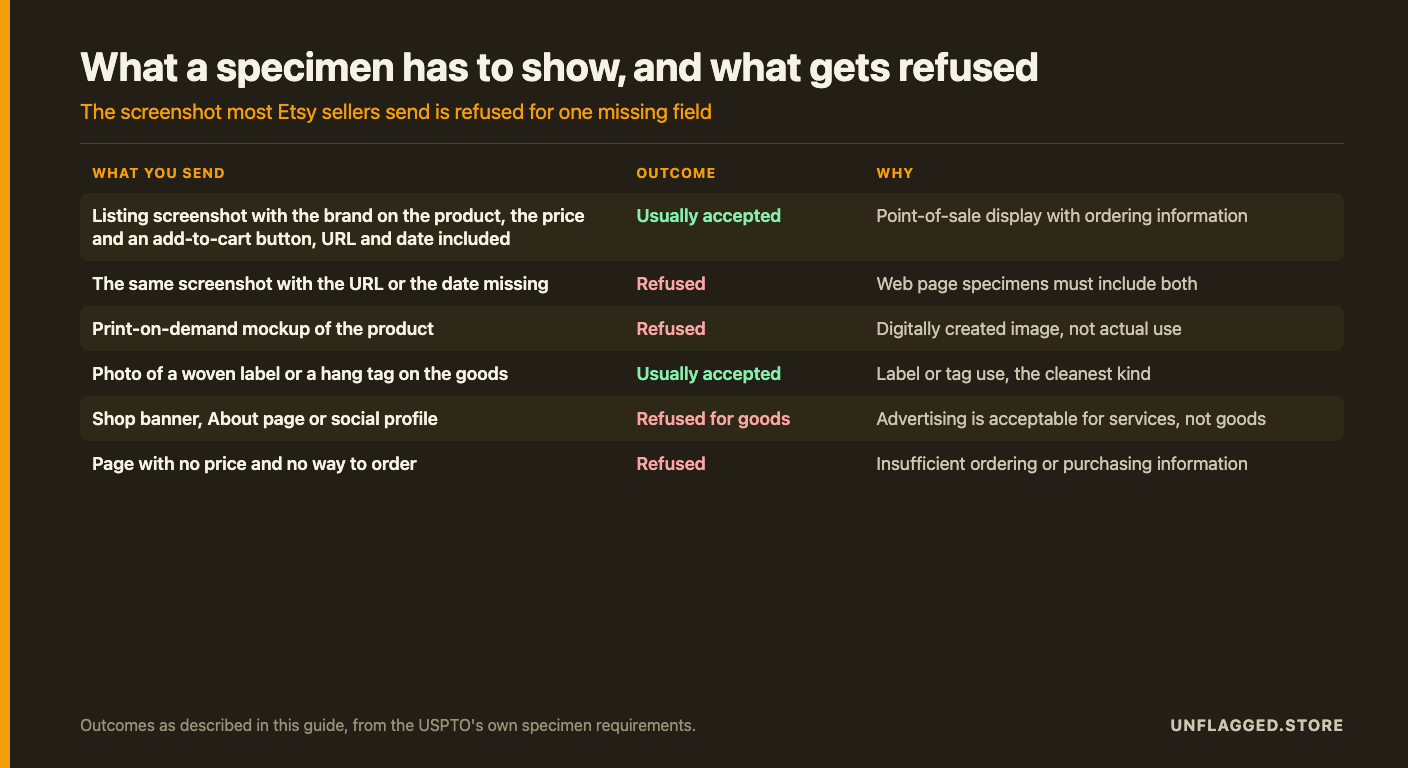
A specimen is evidence of use, and 37 C.F.R. §2.56 requires one per class showing the mark as actually used in commerce. For goods that means the mark on the goods, on containers or packaging, on labels or tags, or on a display associated with the goods that is "of a point-of-sale nature." An Etsy listing screenshot can qualify, and most sellers send one that does not.
Two rules decide it. First, the regulation excludes mockups outright: an artist's rendering, a printer's proof, a computer illustration, a digital image or similar mockup is not a specimen, and the flat-lay a print-on-demand tool generates is exactly that. Second, a web page specimen must carry the URL and the access or print date. The USPTO's guidance says so in as many words, and lets you enter both in the dedicated fields instead of cropping them into the image.
| What you send | Outcome | Why |
|---|---|---|
| Listing screenshot with the brand on the product, the price and an add-to-cart button, URL and date included | Usually accepted | Point-of-sale display with ordering information |
| The same screenshot with the URL or the date missing | Refused | Web page specimens must include both |
| Print-on-demand mockup of the product | Refused | Digitally created image, not actual use |
| Photo of a woven label or a hang tag on the goods | Usually accepted | Label or tag use, the cleanest kind |
| Shop banner, About page or social profile | Refused for goods | Advertising is acceptable for services, not goods |
| Page with no price and no way to order | Refused | Insufficient ordering or purchasing information |
| Drawing of the mark on its own | Refused | Shows the mark, not its use |
A specimen refusal is narrower than an ornamental one and usually cheaper to fix. The USPTO's listed responses include supplying the missing URL and date, sending a substitute specimen in use by the relevant date, verifying one filed without a declaration, and switching to intent-to-use. Packing slips, invoices, order forms, stationery and press releases are all on the unacceptable list, so do not reach for them next.
Register the Shop, Not the Print
The route that suits a shop name best is the one none of the competing pages names. A shop name is the name of a business that sells things, not a design printed on one of them. Under the USPTO's secondary-source option, evidence of use or registration of the same mark for different goods or services can carry the mark onto goods where it would otherwise read as decoration. The USPTO's own illustration is a university: it holds a service mark registration for educational services, and that registration supports registering its name on t-shirts.
Read that across to a shop. The name over the storefront identifies a retail operation, and advertising is acceptable as a specimen for services, the opposite of the position for goods, so the evidence a shop already generates fits that filing better than a photograph of a shirt will. Which class either falls into is a question of accepted wording, and the place to read it is the USPTO's ID Manual rather than any blog post, this one included. Which to file is where a trademark attorney earns their fee.
What a listing review can and cannot do here. Whether your shop name is registrable, and on which register, is a question for USPTO records and qualified advice. Unflagged does not answer it: it screens the listing text you paste in for potential concerns, including brand names and phrases that commonly draw reports. It does not search live trademark registers, inspect images, establish compliance or predict a removal. See what the review covers and costs.
If a report has already landed while you were deciding whether to file, deal with that first: reading the notice properly comes before anything at the USPTO.
Related Articles
- Etsy Trademark Search Before Listing, clearing a name first
- Etsy Trademark Takedown 2026, the $400 petition against an unused mark
- How Competitors Use Trademark Reports, the process pointed at you
- Etsy's Intellectual Property Policy Explained, the rules reports are filed under
- Trademarked Words on Etsy, words to keep out of listings
- Etsy Takedown Notice: What to Do, the first forty-eight hours
FAQ
Do I need a trademark to sell on Etsy?
No. The USPTO says in as many words that you are not required to register your trademark, and Etsy does not ask for one to open a shop. What registration changes is enforcement: Etsy's published rejection reasons include a claim built on a mark that is dead, inactive or still pending, so without a live registration a report about your shop name may not be processed.
How much does it cost to trademark an Etsy shop name?
The base application is $350 per class filed electronically under the fee schedule revised on 1 November 2026. Two per-class surcharges can land before examination: $100 for insufficient information and $200 for using the free-form description box instead of the ID Manual, plus $200 for each extra 1,000 characters in it. Attorney fees are separate.
What is an ornamental refusal?
A refusal on the ground that the mark appears only as a decorative feature of the goods rather than as a sign of who made them. The USPTO's example is a slogan across the front of a t-shirt. The examiner weighs size, location, dominance and significance, and a small discrete mark on a pocket reads as a brand far more readily than the same words enlarged across the chest.
Can I use an Etsy listing screenshot as my specimen?
Often, if it shows the mark with the product, a price and a way to order, and carries the URL and the date you accessed or printed it. Both of those are requirements, not preferences. A print-on-demand mockup is not acceptable at all: 37 C.F.R. §2.56 excludes digitally created or altered images. A shop banner or About page is advertising, fine for services, not for goods.
Is the Supplemental Register good enough for Etsy?
It is weaker, and Etsy says so in its own terms: its rejection page asks for extra information showing the term is distinctive and functions as a source identifier when a claim rests on a Supplemental Register mark. Under 15 U.S.C. §1094 that register also comes without the presumption of ownership, the filing-date priority, constructive notice, the litigation presumptions and the customs provision.
How long do I keep paying for a registration?
For as long as you want it. A declaration of continued use falls due between years five and six at $325 per class, or $575 combined with the optional declaration of incontestability. A renewal with its accompanying declaration then falls due between years nine and ten and every ten years after, at $650 per class. Miss a window and you are into a grace-period surcharge, then cancellation.
Will registering stop people copying my shop name?
Not by itself. The USPTO states that it is not an enforcement agency, and Etsy says it is unable to make legal determinations or take sides. What registration gives you is a report Etsy will process on its face, and a presumption of ownership if the argument outgrows Etsy. You still have to spot the copy and file, listing by listing, with each listing URL rather than the shop name.
Sources. USPTO fee schedule, effective 19 January 2025, last revised 1 November 2026; every fee above is from its own row. USPTO, "Ornamental" refusal and how to overcome the refusal. USPTO, Specimen refusal and how to overcome the refusal. USPTO, Why register your trademark. The USPTO Trademark ID Manual. 15 U.S.C. §1094 and 37 C.F.R. §2.56, Legal Information Institute. Etsy help centre: Why Was My Notice of Infringement Rejected? and How to Report Intellectual Property Infringement. Etsy's pages at etsy.com/legal return 403 to automated clients, so the Intellectual Property Policy text was not read directly and Etsy's help centre stands in its place; the Trademark Manual of Examining Procedure is cited only as the USPTO's own pages cite it. Fees change: check the schedule before filing. General information, not legal advice.
Scan Your Listings Free
Screen submitted listing text for potential concerns. 5 preliminary screens daily, shared network limits; no signup required.
Start Free ScreenRelated Articles
How to Check Your Etsy Listings for Trademark Violations (2026 Guide)
Learn how to scan your Etsy listings for trademark violations before they get flagged. Step-by-step guide to protecting your shop from takedowns and suspensions.
Read moreEtsy Shop Suspended? How to Write a Winning Appeal Letter
Your Etsy shop got suspended. Here's exactly how to write an appeal letter that gets your shop reinstated, with templates and strategies that actually work.
Read more50 Words That Are Trademarked on Etsy (Stop Using These Now)
A comprehensive list of commonly trademarked words and phrases that Etsy sellers use without realizing they're violating trademark law. Check your listings now.
Read more