Etsy Cease and Desist Letter 2026: Verify, Then Reply
An Etsy cease and desist letter is not an Etsy notice. What the law exposes you to, how to verify the sender, and how to reply without admitting anything.
- 1.An Etsy Cease and Desist Letter Is Not an Etsy Notice
- 2.What the Letter Actually Changes Is Notice
- 3.Verify the Sender Before You Answer, and Not in TESS
- 4.What the Claim Can Actually Cost You
- 5.The Copyright Claim That Cannot Reach Those Numbers
- 6.Your Five Response Options, Priced
- 7.What Not to Put in the Reply
- 8.If Etsy Has Already Removed the Listing
- 9.Related Articles
- 10.FAQ
Key takeaways
- The deadline on the letter is not a legal clock. What it changes is notice: under 15 U.S.C. §1111 a registrant who never displayed the registration symbol recovers "no profits and no damages" unless the defendant "had actual notice of the registration."
- The $200,000 and $2,000,000 figures quoted all over this niche are counterfeiting damages. §1117(c) applies only "in a case involving the use of a counterfeit mark," starts at a $1,000 floor, and is counted per mark per type of goods.
- A copyright claim can be worth nothing in statutory damages. 17 U.S.C. §412 bars them where the infringement began before registration took effect, unless the work was registered within three months of first publication.
- Verify in the right system. The USPTO has retired TESS, which the two pages ranking hardest for this term still send you to. Status, owner, register and class decide whether the claim is live.
- Etsy has no trademark counter notice. They "can be filed against reports of copyright infringement only," so a trademark removal is reversed by the reporting party, not a form.
An Etsy cease and desist letter arrives as a PDF from a firm you have never heard of, names your shop, quotes a registration number and gives you ten days. It is frightening by design, and not what most sellers take it for: no Etsy process is attached, no platform clock is running, and nobody but the sender has reviewed it.
The money it threatens is usually quoted wrong, in the claimant's favour by a factor of a thousand. Ordinary trademark infringement carries no statutory damages at all, and a copyright claim registered after the claimant found your listing cannot reach them either. For this piece we read the statutes rather than the summaries: 15 U.S.C. §§1111, 1114, 1117 and 1125, 17 U.S.C. §§412 and 504, 28 U.S.C. §2201, the USPTO's current search guidance, and the three Etsy help articles governing reports, removals and counter notices.
Then we read the pages ranking for this term. The two strongest in this niche carry no tables, cite no statute, and both send you to verify the mark in a USPTO system that no longer exists. The best law-firm page never mentions Etsy.

An Etsy Cease and Desist Letter Is Not an Etsy Notice
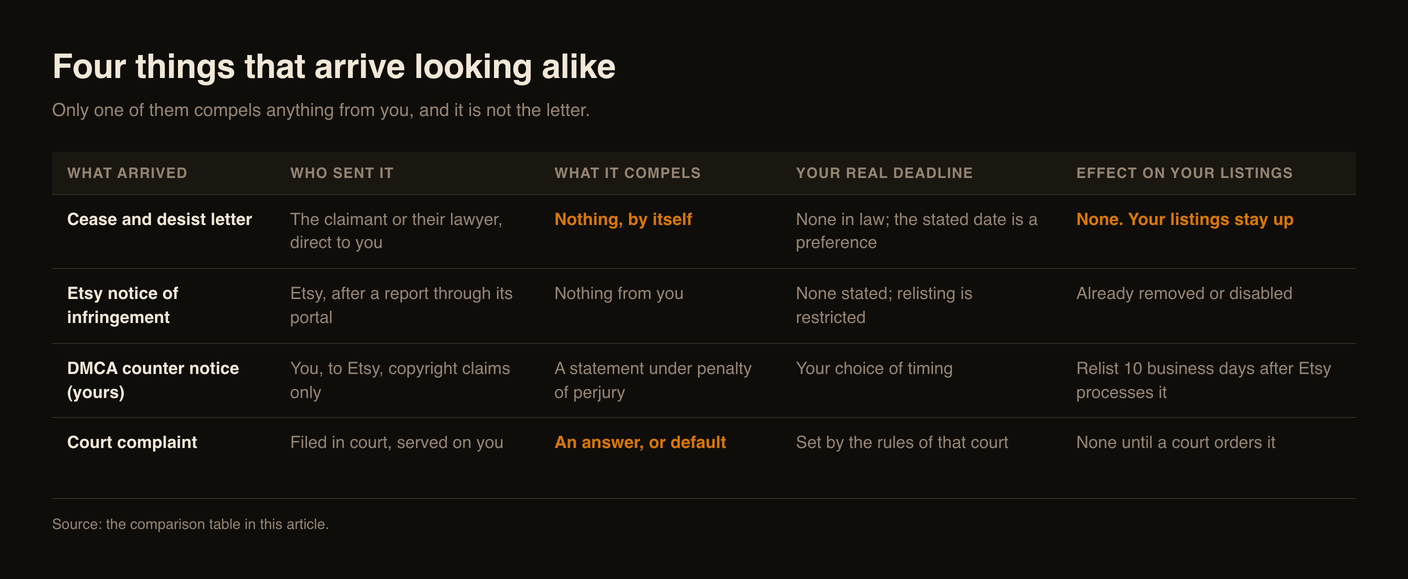
These are four separate things, and sellers routinely answer one as though it were another. A cease and desist letter is private correspondence. An Etsy notice of infringement is the output of a platform report. A complaint is a lawsuit, and only the last carries an enforceable deadline.
| What arrived | Who sent it | What it compels | Your real deadline | Effect on your listings |
|---|---|---|---|---|
| Cease and desist letter | The claimant or their lawyer, direct to you | Nothing, by itself | None in law; the stated date is a preference | None. Your listings stay up |
| Etsy notice of infringement | Etsy, after a report through its portal | Nothing from you | None stated; relisting is restricted | Already removed or disabled |
| DMCA counter notice (yours) | You, to Etsy, copyright claims only | A statement under penalty of perjury | Your choice of timing | Relist 10 business days after Etsy processes it |
| Court complaint | Filed in court, served on you | An answer, or default | Set by the rules of that court | None until a court orders it |
The sequence matters more than the labels. Etsy's reporting guidance tells rights holders that before reporting, "we recommend contacting the seller to try to resolve the issue," and only if no agreement is reached do they report. A cease and desist letter is therefore usually a pre-report step. If your listings are still live you are earlier in this process than the letter's tone suggests, with more room than a seller who has already lost theirs.
It also tells you what the sender wants. A claimant who files first is enforcing; one who writes first is asking, and an ask can be answered.
What the Letter Actually Changes Is Notice
Here is the provision no page ranking for this query mentions, and the one that makes the letter legally significant. 15 U.S.C. §1111 covers what happens when a registrant does not display the registration symbol or the words "Registered in U.S. Patent and Trademark Office" with the mark. In that case, the statute says, "no profits and no damages shall be recovered" under the chapter "unless the defendant had actual notice of the registration."
Read that against the letter in your inbox. If the claimant has been marking their registration, this changes nothing. If they have not, then until the letter arrived you had no actual notice and their recovery of profits and damages was off the table. The letter supplies it.
The practical consequence. The risk in a cease and desist letter is not the date on it. The risk is what you sell after you have read it. A seller who takes thirty days to answer carefully is in a better position than one who answers within the hour and leaves the listings running while they argue, because the second seller is accruing the exposure §1111 had been holding back.
This reframes the standard advice. "Do not panic, do not reply the same day" is sound and costs nothing. "Keep selling until they prove it" is what converts a letter into a damages claim, and it is the move sellers make while they feel they are standing firm. It is also why claimants write at all instead of simply reporting you: a report gets a listing removed, a letter builds the record of when you knew.
Verify the Sender Before You Answer, and Not in TESS
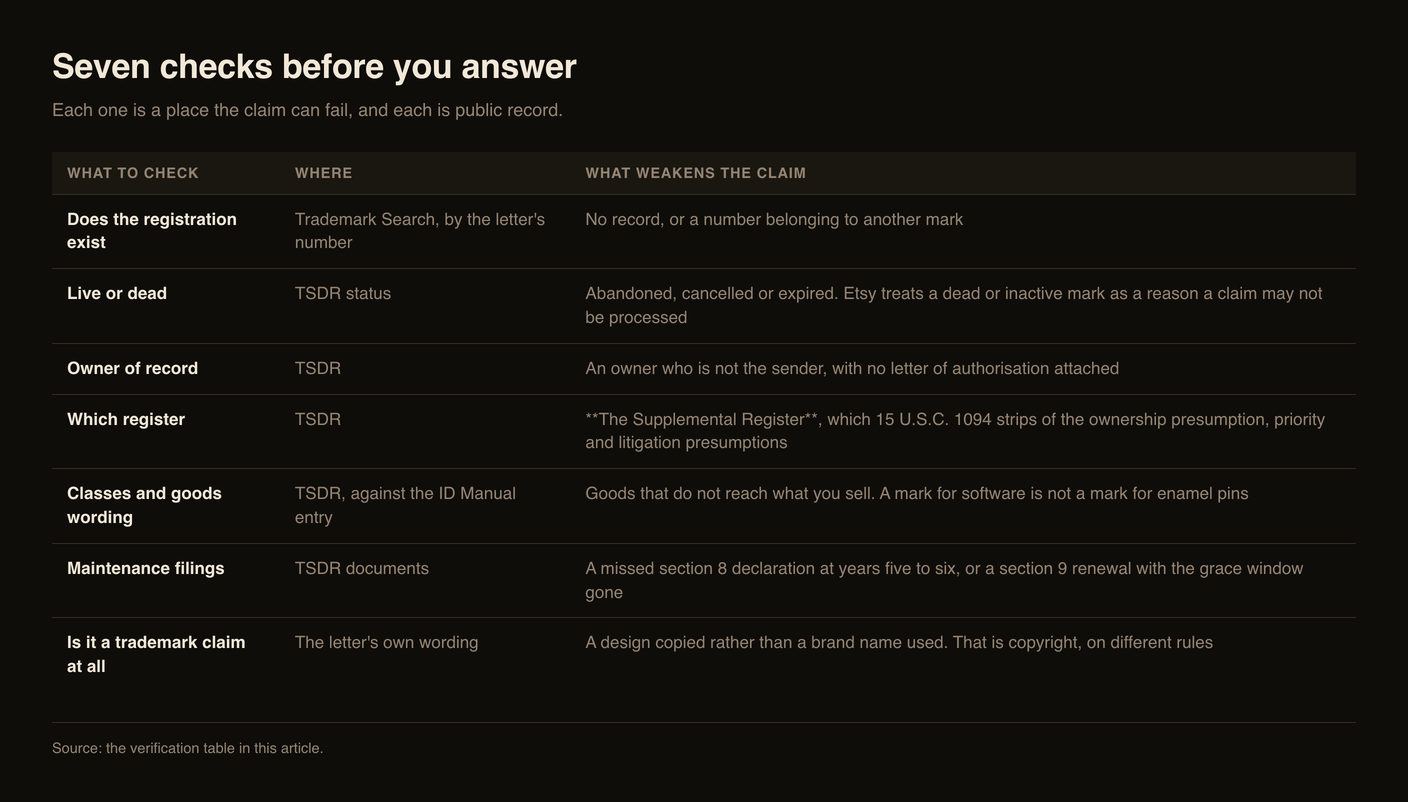
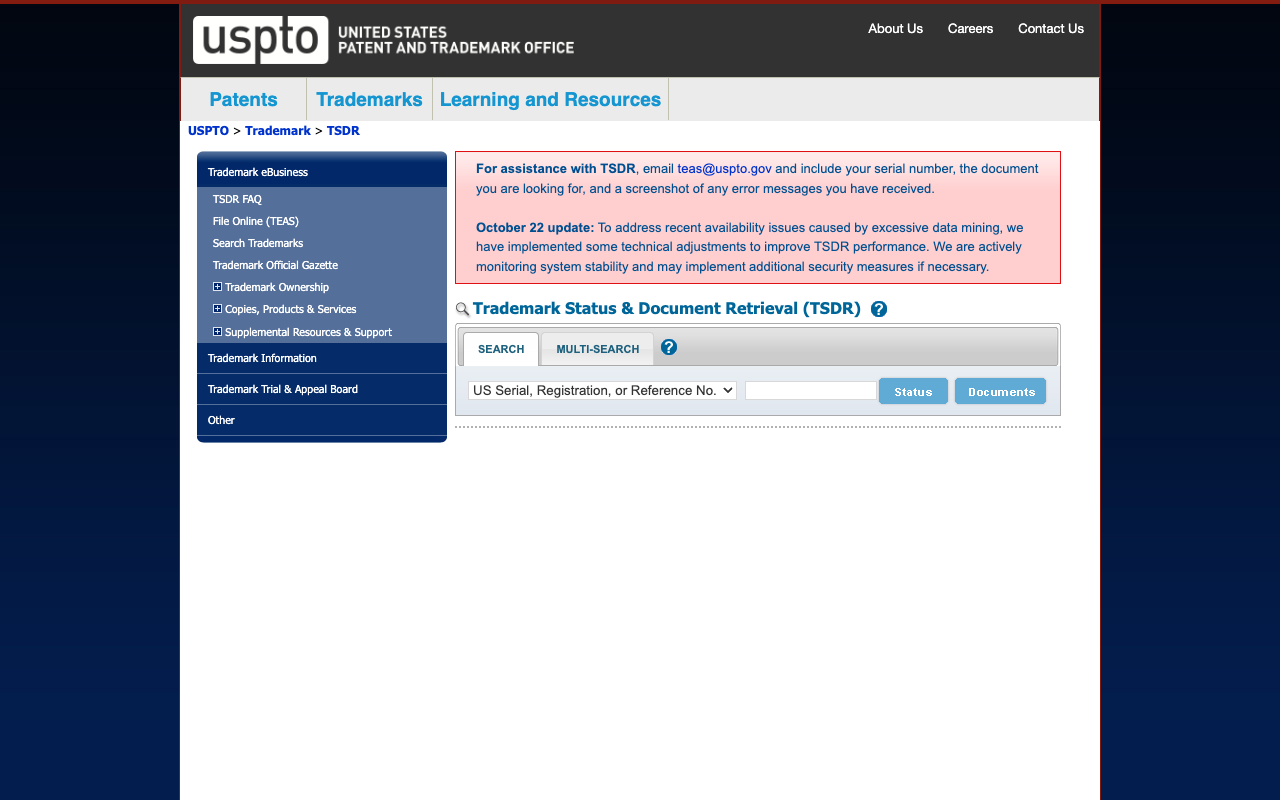
Every page ranking for this term says to check the registration. None says what to pull or how to read it, and the two Etsy-focused ones point at the wrong place: both send you to TESS. The USPTO's own transition handout is headed "Retiring the Trademark Electronic Search System (TESS)" and explains that it "relied on a proprietary search language that is no longer supported," so the office "introduced a new public trademark search system." Its search page now names only Trademark Search, at tmsearch.uspto.gov, and Trademark Status and Document Retrieval, at tsdr.uspto.gov.
Start from the serial or registration number in the letter. If it gives neither, note that in your reply.
| What to check | Where | What weakens the claim |
|---|---|---|
| Does the registration exist | Trademark Search, by the letter's number | No record, or a number belonging to another mark |
| Live or dead | TSDR status | Abandoned, cancelled or expired. Etsy treats a dead or inactive mark as a reason a claim may not be processed |
| Owner of record | TSDR | An owner who is not the sender, with no letter of authorisation attached |
| Which register | TSDR | The Supplemental Register, which 15 U.S.C. §1094 strips of the ownership presumption, priority and litigation presumptions |
| Classes and goods wording | TSDR, against the ID Manual entry | Goods that do not reach what you sell. A mark for software is not a mark for enamel pins |
| Maintenance filings | TSDR documents | A missed §8 declaration at years five to six, or a §9 renewal with the grace window gone |
| Is it a trademark claim at all | The letter's own wording | A design copied rather than a brand name used. That is copyright, on different rules |
Two cautions. No registration is not no rights: unregistered marks are enforceable under 15 U.S.C. §1125(a). And §1114 gives the infringement action to the registrant, so a reseller or licensee writing in their own name is worth a question. Searching properly before you list is the same skill applied earlier.
What the Claim Can Actually Cost You
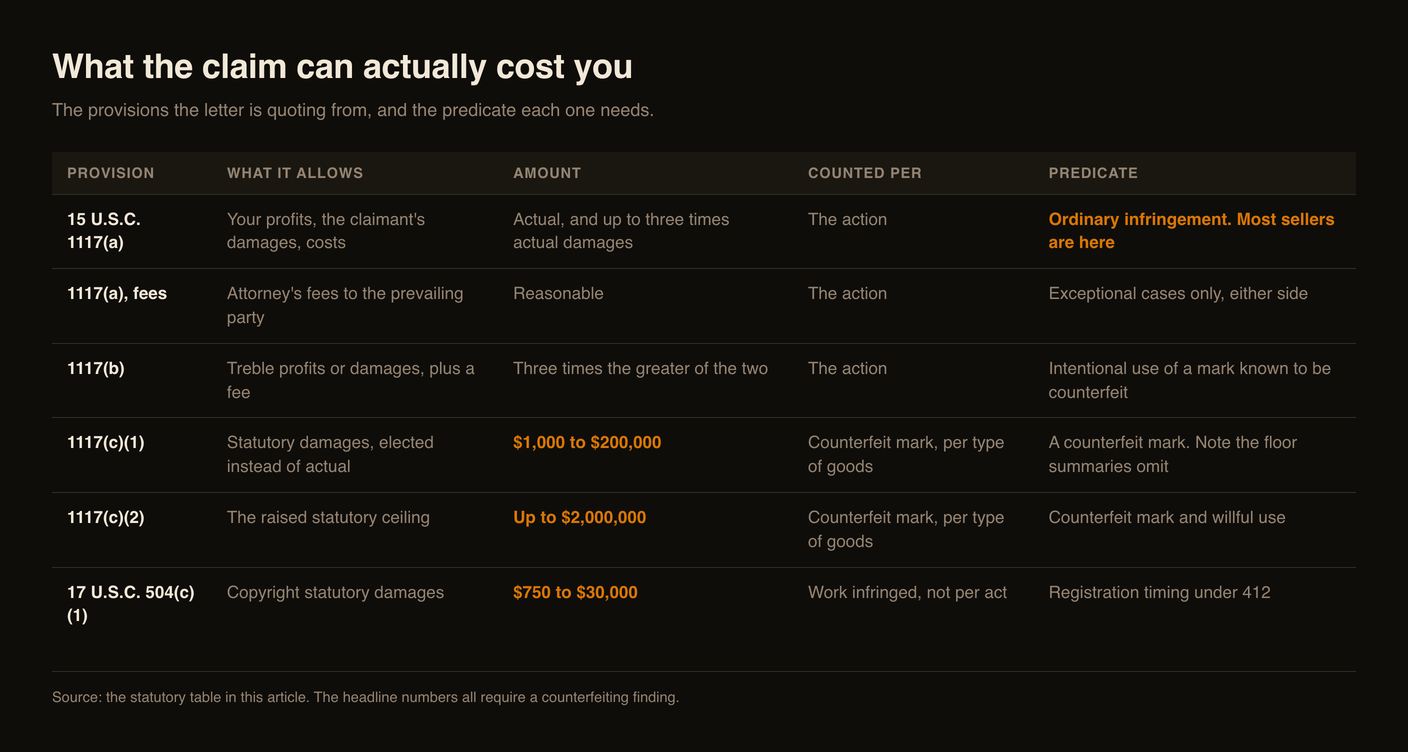
This is where the niche gets it wrong, by enough to change what a seller decides. The most-linked Etsy page on these letters states exposure as "up to $200,000 per mark" and "up to $2,000,000" for willful infringement, uncited. Those numbers exist, but they are from §1117(c), which applies only "in a case involving the use of a counterfeit mark."
Using a brand's word in your tags is not counterfeiting. Selling a fake of that brand's product with its mark on it is. That distinction decides which row you are in.
| Provision | What it allows | Amount | Counted per | Predicate |
|---|---|---|---|---|
| 15 U.S.C. §1117(a) | Your profits, the claimant's damages, costs | Actual, and up to three times actual damages | The action | Ordinary infringement. Most sellers are here |
| §1117(a), fees | Attorney's fees to the prevailing party | Reasonable | The action | "Exceptional cases" only, either side |
| §1117(b) | Treble profits or damages, plus a fee | Three times the greater of the two | The action | Intentional use of a mark known to be counterfeit |
| §1117(c)(1) | Statutory damages, elected instead of actual | $1,000 to $200,000 | Counterfeit mark, per type of goods | A counterfeit mark. Note the floor summaries omit |
| §1117(c)(2) | The raised statutory ceiling | Up to $2,000,000 | Counterfeit mark, per type of goods | Counterfeit mark and willful use |
| 17 U.S.C. §504(c)(1) | Copyright statutory damages | $750 to $30,000 | Work infringed, not per act | Registration timing under §412, below |
| §504(c)(2) | Willful, and innocent | Up to $150,000 willful; as low as $200 innocent | Work infringed | Willfulness proved by the owner, innocence by you |
Two things follow. A letter quoting $2,000,000 at a seller who put a trademarked word in a tag is quoting a provision that does not apply, and saying so calmly beats agreeing to anything. And §1117(a) fees run to "the prevailing party," so fee risk is not one-directional.
The Copyright Claim That Cannot Reach Those Numbers
If the letter is about a copied design, pattern, photograph or font rather than a brand name, it is a copyright claim, and one question decides most of its value. 17 U.S.C. §412 says "no award of statutory damages or of attorney's fees, as provided by sections 504 and 505, shall be made for" infringement of an unpublished work begun before registration took effect, or of a published work begun after first publication and before registration took effect, "unless such registration is made within three months after the first publication of the work."
So the ordinary sequence, where a creator finds your listing, registers the work, then has a lawyer write to you, forecloses statutory damages and fees for the infringement already running. What remains is actual damages and profits, which must be proved, and which for a few sales are rarely worth suing over.
What this does not mean. It is not a defence to infringing, and the dates are not yours to guess: registration effective dates and first-publication dates are facts the claimant holds. §412 also has exceptions, including preregistered works and claims under §106A(a). Treat it as the question to ask in writing before you accept a number, not a conclusion you can reach alone.
It is also why copyright and trademark letters deserve different replies. A trademark claimant's leverage grows the longer you sell. A copyright claimant's statutory leverage was mostly fixed before they contacted you, by when they filed. Our guide to copyright exposure on Etsy covers the underlying rules.
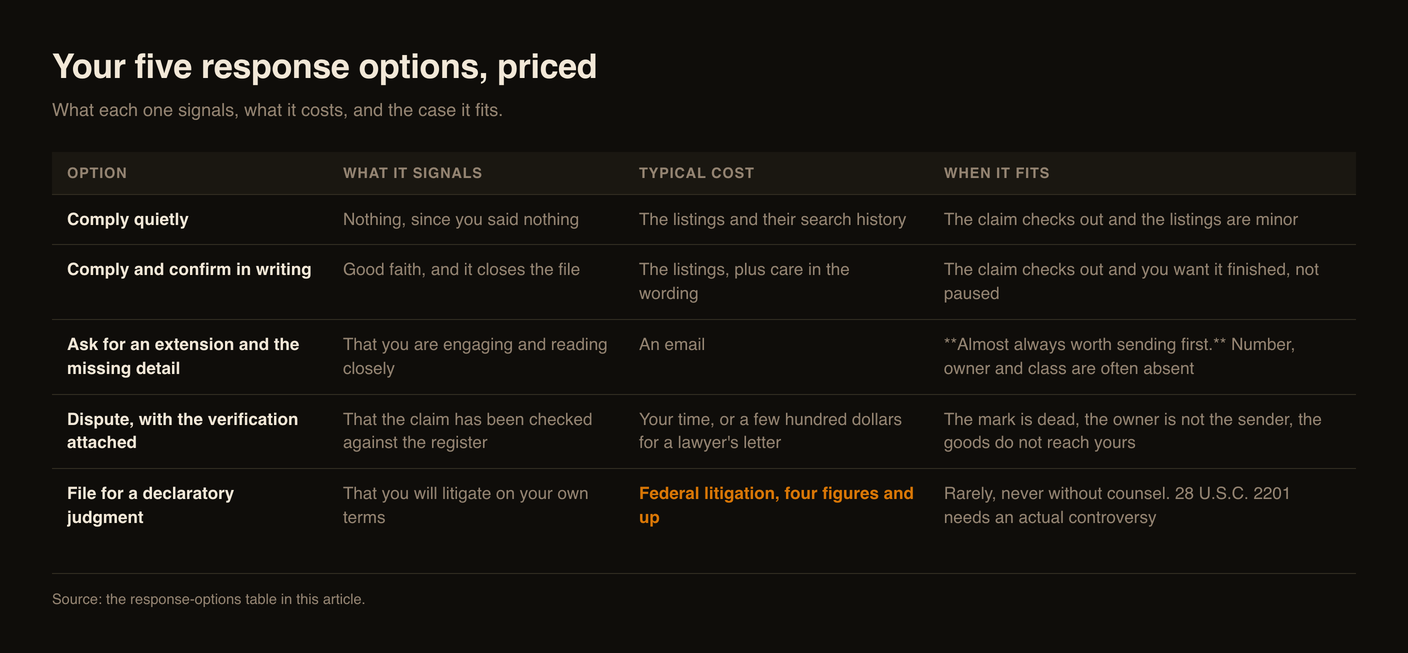
Your Five Response Options, Priced
There are five real options, not two, and the letter is written to make the first look like the only one.
| Option | What it signals | Typical cost | When it fits |
|---|---|---|---|
| Comply quietly | Nothing, since you said nothing | The listings and their search history | The claim checks out and the listings are minor |
| Comply and confirm in writing | Good faith, and it closes the file | The listings, plus care in the wording | The claim checks out and you want it finished, not paused |
| Ask for an extension and the missing detail | That you are engaging and reading closely | An email | Almost always worth sending first. Number, owner and class are often absent |
| Dispute, with the verification attached | That the claim has been checked against the register | Your time, or a few hundred dollars for a lawyer's letter | The mark is dead, the owner is not the sender, the goods do not reach yours, or counterfeiting figures over a tag |
| File for a declaratory judgment | That you will litigate on your own terms | Federal litigation, four figures and up | Rarely, never without counsel. 28 U.S.C. §2201 needs an "actual controversy," which a letter threatening suit often supplies |
The third option is the one sellers skip and the one that costs least. A letter that does not name a registration number, the owner of record or the listings at issue cannot be verified, and asking is not a concession. It also buys the days the checks above need.
The fifth deserves its warning. A declaratory judgment turns a letter into a lawsuit you are paying for: occasionally right for a business with a brand to defend, almost never for a shop with four listings. Both law-firm pages here mention it without pricing it against the other four, which is how it ends up sounding standard.
What Not to Put in the Reply
Whatever you decide, the reply is a document that can be read back to you. Willfulness is the multiplier in both statutes, §1117(b) and (c)(2) for trademarks and §504(c)(2) for copyright, and it is proved with the defendant's own words more often than anything else.
| Do not write | Why it hurts | Write instead |
|---|---|---|
| "I knew it was their brand but everyone uses it" | Knowledge plus continued sale is the willfulness finding | Nothing about your state of mind. Address the listings |
| "I have taken down all infringing listings" | Calls your own listings infringing, and promises completeness you have not verified | "The listings identified in your letter have been deactivated" |
| "I will remove anything else you find" | An open-ended undertaking over unreviewed listings | Deal with identified listings; ask for specifics |
| "I have been selling these for three years" | Volunteers the duration a damages calculation needs | Nothing about sales history unless your lawyer asks |
| "My lawyer says you have no case" | Invites escalation, and asserts advice you may not have | The verification facts: status, owner, register, class |
| Silence, with the listings still selling | The §1111 problem. Actual notice has landed and the sales continue | Pause the identified listings while you decide |
Keep every version: the letter, the email headers, screenshots of the listings as they stood, and your reply. If this reaches an Etsy appeal or a lawyer's desk that file is your whole position, and our appeal letter template shows the tone that works on a platform.
If Etsy Has Already Removed the Listing
A letter and a report are different tracks and both can be running. When a report lands, Etsy says it must "remove or disable content from Etsy shops," and that you get "an email with the contact information of the party who filed it." It is explicit about its limits: Etsy "does not make decisions about which listings infringe with intellectual property" and "can not speak on behalf of the intellectual property owner," and tells you to contact the reporting party directly.
| Copyright report | Trademark report | |
|---|---|---|
| Is there a counter notice | Yes, a DMCA counter notice | No. Etsy "cannot accept counter notices for non-copyright claims" |
| What you must believe to file | A good faith belief the removal resulted from "a mistake or misidentification" | Not applicable |
| Cost of being wrong | It carries "a statement under penalty of perjury," and Etsy warns the complaining party "may choose to file legal action against you" | Not applicable |
| Route to getting the listing back | Relist "10 business days after Etsy processes your counter notice," unless the complaining party notifies Etsy of legal action seeking a court order | The reporting party retracts. That is the only mechanism, which is why the reply matters |
| Relisting meanwhile | Do not create new listings for the same content "unless the issue is resolved with the other party," and "repeat reports of infringement may result in the loss of account privileges" | |
That last row is the one that ends shops. Losing a listing is survivable; a pattern of reports against one account reaches your selling privileges, and relisting while a dispute is open is the fastest way to build that pattern. Reading the notice properly comes first, and the policy reports are filed under sets out what Etsy checks.
One asymmetry helps if the claim is weak. Etsy publishes the reasons it rejects a notice of infringement, and several concern the claimant's paperwork rather than your listing: a dead or inactive mark, an application still pending, a Supplemental Register mark with no further proof of distinctiveness. A sender who fails those tests has a letter that reads well and a report that may not be processed.
What a listing review can and cannot do here. Nothing on this page is legal advice, and no software can tell you whether a claim against you succeeds. Unflagged does something narrower: it screens the listing text you paste in for potential concerns, including brand names and phrases that commonly draw reports. It does not search live trademark registers, inspect images, assess a letter, or establish that a listing is safe. If a letter has landed, verify it in TSDR and talk to an attorney. Use a review for the listings nobody has written to you about yet. See what the review covers and costs.
Related Articles
- Etsy Takedown Notice: What to Do, the platform-side response
- Etsy Trademark Takedown 2026, petitioning against a mark that should not be live
- Etsy Shop Name Trademark 2026, owning the right, not answering it
- How Competitors Use Trademark Reports, when the sender is not a brand
- Trademarked Words on Etsy, the words that draw letters
- Etsy's Intellectual Property Policy Explained, the rules behind a report
FAQ
Do I have to respond to a cease and desist letter?
There is no legal obligation to reply to private correspondence, and the date in the letter is the sender's preference, not a deadline a court set. What is not optional is the selling. Under 15 U.S.C. §1111 a registrant who has not displayed the registration symbol cannot recover profits or damages without the defendant's actual notice of the registration, The letter is that notice, so it is what you sell afterwards that creates exposure.
Can I ignore a cease and desist letter from a law firm?
You can decline to reply, but ignoring it and carrying on is the worst option available. A non-reply costs you the chance to ask for the registration number and owner of record, which is how most weak claims come apart, and selling on while you say nothing builds the willfulness record that multiplies damages under §1117(b) and §504(c)(2).
How much can an Etsy seller be sued for over a trademark?
For ordinary infringement, 15 U.S.C. §1117(a) allows the claimant's damages, your profits and costs, with up to three times actual damages and fees only in "exceptional cases." The widely quoted $200,000 and $2,000,000 figures come from §1117(c), which applies only "in a case involving the use of a counterfeit mark." A brand name in a tag is not a counterfeit mark.
Is a cease and desist letter the same as an Etsy infringement notice?
No. A cease and desist letter comes from the claimant with no platform mechanism attached, so your listings stay up. An Etsy notice of infringement follows a report and means the listings are already removed. Etsy's guidance tells rights holders to try contacting the seller before reporting, so a letter often arrives before any report exists.
How do I check whether their trademark is real?
Take the serial or registration number from the letter into the USPTO's Trademark Search system at tmsearch.uspto.gov, then open the record in Trademark Status and Document Retrieval at tsdr.uspto.gov. Read four things: status, owner of record, register, and the classes with their goods wording. Advice to search TESS is out of date, because the USPTO has retired it.
Can I file a counter notice for a trademark complaint on Etsy?
No. Etsy states counter notices "can be filed against reports of copyright infringement only." A trademark removal comes back only if the reporting party retracts, which is why the reply to the letter is the lever. For copyright removals a counter notice carries a statement under penalty of perjury and lets you relist 10 business days after Etsy processes it, unless the complaining party notifies Etsy of legal action seeking a court order.
What if the design they are claiming was never registered?
For copyright, registration timing caps the exposure: 17 U.S.C. §412 bars statutory damages and fees where the infringement began before registration took effect, unless the work was registered within three months of first publication. Trademarks differ, because unregistered marks are still enforceable under 15 U.S.C. §1125(a), so "no registration" does not mean "no claim."
Sources. Cornell's Legal Information Institute: 15 U.S.C. §1111 (notice of registration), §1114, §1117 (remedies), §1125, 17 U.S.C. §504, §412 and 28 U.S.C. §2201. USPTO, Search trademark database, which names Trademark Search and TSDR; the TESS retirement is quoted from the USPTO's "Transitioning from TESS" handout linked there. Etsy help centre: What to Do if You Receive a Notice of Intellectual Property Infringement, How to File a DMCA Counter Notice and How to Report Intellectual Property Infringement. Etsy's pages at etsy.com/legal return 403 to automated clients, so the help centre stands in place of the Intellectual Property Policy text. Statutes quoted as at 14 November 2026. General information, not legal advice.
Scan Your Listings Free
Screen submitted listing text for potential concerns. 5 preliminary screens daily, shared network limits; no signup required.
Start Free ScreenRelated Articles
How to Check Your Etsy Listings for Trademark Violations (2026 Guide)
Learn how to scan your Etsy listings for trademark violations before they get flagged. Step-by-step guide to protecting your shop from takedowns and suspensions.
Read moreEtsy Shop Suspended? How to Write a Winning Appeal Letter
Your Etsy shop got suspended. Here's exactly how to write an appeal letter that gets your shop reinstated, with templates and strategies that actually work.
Read more50 Words That Are Trademarked on Etsy (Stop Using These Now)
A comprehensive list of commonly trademarked words and phrases that Etsy sellers use without realizing they're violating trademark law. Check your listings now.
Read more