Etsy Trademark Takedown 2026: The $400 USPTO Fix
An Etsy trademark takedown carries no counter notice. If the mark was never used, a $400 USPTO petition can cancel it. Real fees, evidence and odds.
- 1.Why an Etsy Trademark Takedown Has No Counter Notice
- 2.What Etsy's Own Numbers Say About Trademark Reports
- 3.The Question Nobody Asks: Is the Mark Actually in Use?
- 4.Two $400 Petitions: Expungement and Reexamination
- 5.What a "Reasonable Investigation" Actually Requires
- 6.The Odds, From the USPTO's Own Data
- 7.When the TTAB Is the Right Tool Instead
- 8.What This Fixes, and What It Does Not
- 9.Related Articles
- 10.FAQ
Key takeaways
- An Etsy trademark takedown carries no counter notice, and Etsy says so itself. Its help centre: "Counter notices can be filed against reports of copyright infringement only" and "Etsy cannot accept counter notices for non-copyright claims." Trademark was 33% of Etsy's intellectual property takedowns in 2025.
- Etsy will not act on a claim built on a dead mark. Its own list of reasons a notice gets rejected includes a trademark that is "dead" or inactive. That is the one fact in this process a seller can change.
- Two USPTO petitions cost $400 per class. Expungement says the mark was never used and runs between 3 and 10 years after registration. Reexamination says it was not in use by a specific relevant date and runs in the first 5 years.
- The USPTO's own figures show it works and that almost nobody uses it. Third parties filed 608 petitions between December 2021 and May 2025. 60% were instituted, 75% of resolved proceedings ended in cancellation, and 5,908 of 6,032 challenged goods and services were struck.
- The catch is real. The decision whether to institute is final and non-reviewable, and once a proceeding starts you are not a party to it. Four in ten petitions never got through the door.
An Etsy trademark takedown lands differently from a copyright one. The listing is gone, the notice names a mark rather than an image, and every guide on the first page of results tells you to file a counter notice. Etsy's own help centre says that instrument does not exist for your claim. Meanwhile trademark accounted for 33% of the roughly 846,000 listings Etsy removed on intellectual property grounds in 2025, so this is not a rare corner of the policy.
There is a route the guides miss. It costs $400, it is filed at the United States Patent and Trademark Office rather than at Etsy, and it works on the reporter's registration instead of on your listing. For this piece we read the USPTO fee schedule as revised on 1 November 2026, the USPTO's examination guide for these proceedings, its own petition statistics through May 2025, both of Etsy's last two Transparency Reports, and the three Etsy help articles that actually govern what happens next.
Then we read the pages ranking for this term. The best of them tells you only the rights holder can reverse a removal; the next walks you through an Etsy "trademark counter notice" Etsy says it cannot accept. None mentions the USPTO proceedings, and two tell you to check whether a registration is live or dead without saying a third party can make it dead.

Why an Etsy Trademark Takedown Has No Counter Notice
The counter notice you have read about is a creature of one statute, the Digital Millennium Copyright Act, and it reaches copyright only. Etsy's help page on filing one is unambiguous on both halves: "Counter notices can be filed against reports of copyright infringement only," and "Etsy cannot accept counter notices for non-copyright claims."
Etsy is also explicit that it is not adjudicating anything. Its page for sellers who receive a notice says Etsy "does not make decisions about which listings infringe with intellectual property" and "can not speak on behalf of the intellectual property owner." What it offers instead is the reporter's contact details, a suggestion that you "directly contact the party that provided the report," and a warning that "Repeat reports of infringement may result in the loss of account privileges."
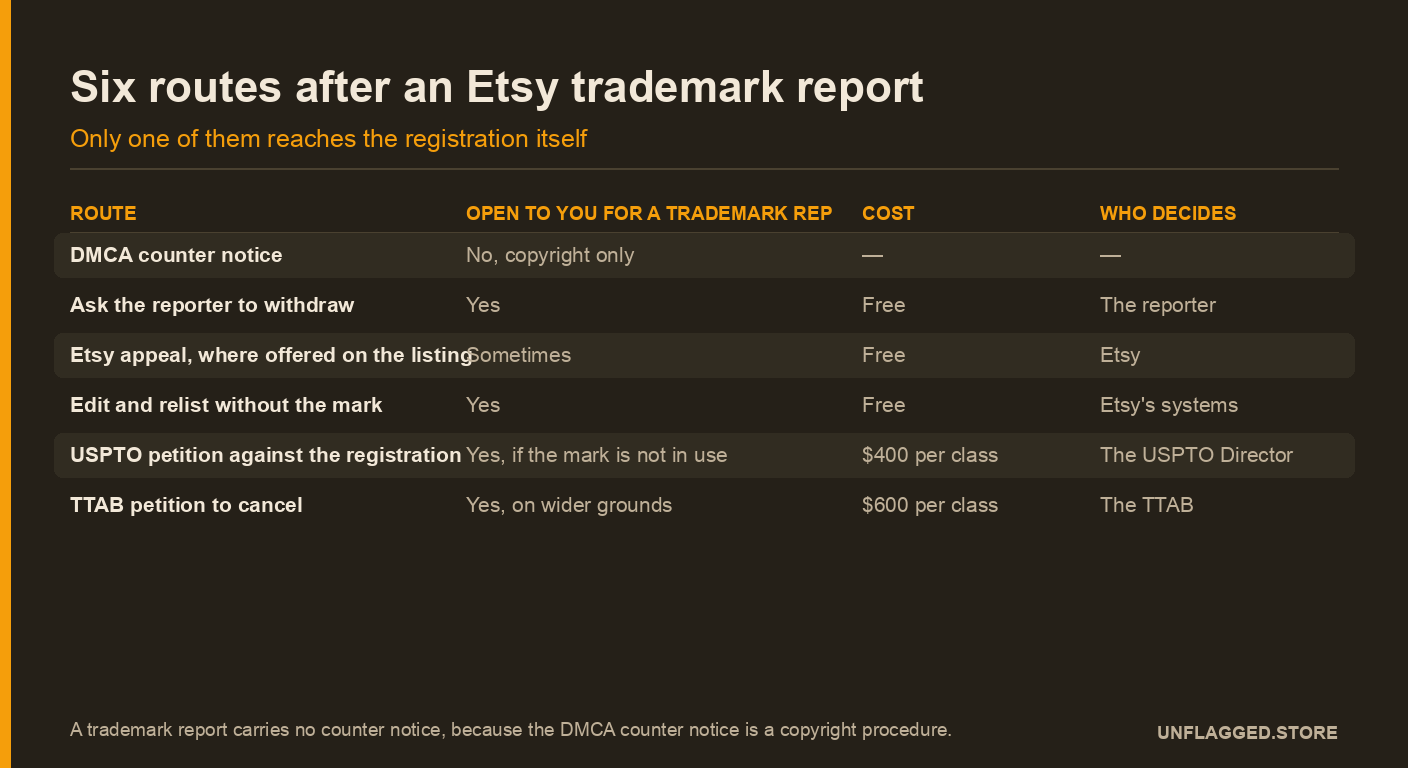
So the honest map of what is available after a trademark removal looks like this.
| Route | Open to you for a trademark report? | Cost | Who decides |
|---|---|---|---|
| DMCA counter notice | No, copyright only | — | — |
| Ask the reporter to withdraw | Yes | Free | The reporter |
| Etsy appeal, where offered on the listing | Sometimes | Free | Etsy |
| Edit and relist without the mark | Yes | Free | Etsy's systems |
| USPTO petition against the registration | Yes, if the mark is not in use | $400 per class | The USPTO Director |
| TTAB petition to cancel | Yes, on wider grounds | $600 per class | The TTAB |
Four of those six ask someone else to change their mind. Only the last two change the thing the report rests on, which is why they are worth understanding before you write another email.
What Etsy's Own Numbers Say About Trademark Reports
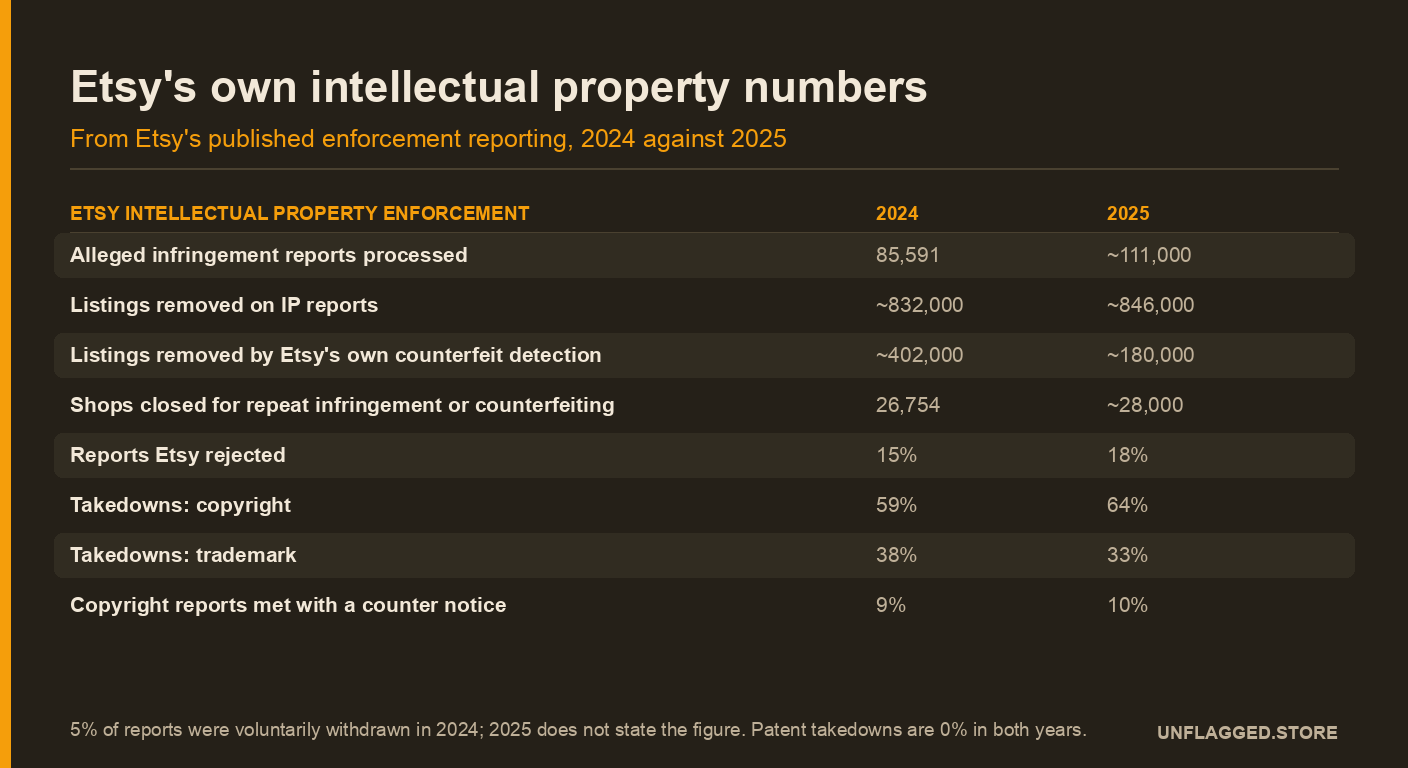
Etsy publishes an annual Transparency Report on its investor site, and it is the only public source with real figures attached to any of this. Reading the 2024 and 2025 editions side by side is more useful than either alone, because the direction of travel is not what sellers assume.
| Etsy intellectual property enforcement | 2024 | 2025 |
|---|---|---|
| Alleged infringement reports processed | 85,591 | ~111,000 |
| Listings removed on IP reports | ~832,000 | ~846,000 |
| Listings removed by Etsy's own counterfeit detection | ~402,000 | ~180,000 |
| Shops closed for repeat infringement or counterfeiting | 26,754 | ~28,000 |
| Reports Etsy rejected | 15% | 18% |
| Reports voluntarily withdrawn | 5% | not stated |
| Takedowns: copyright | 59% | 64% |
| Takedowns: trademark | 38% | 33% |
| Takedowns: patent | 0% | 0% |
| Takedowns: other | 3% | 3% |
| Copyright reports met with a counter notice | 9% | 10% |
Reports rose 30% in a year while removals stayed flat, which means the average report is being refused or withdrawn more often than before. Etsy rejected 18% of submitted reports in 2025 and attributes the improvement to tighter authorisation checks in its Reporting Portal. Roughly one report in five does not survive Etsy's own intake.
The trademark row is the one to hold on to. Etsy does not break removals down by issue, so the share has to be read across: if trademark drove 33% of takedowns, roughly 280,000 listings came down in 2025 on a ground with no counter notice. That is a proportional estimate, not a published figure: Etsy gives the percentage and the total separately and never multiplies them.
The Question Nobody Asks: Is the Mark Actually in Use?
Etsy's page on why notices get rejected is a short document that quietly contains the whole opportunity. Among the reasons Etsy gives for not processing a trademark claim: the reporter only has an application and not a registration, the listing does not actually contain the registered mark, the mark sits on the Supplemental Register without added proof of distinctiveness, and the one that matters here, that the reporter's "trademark is 'dead' or inactive."
The hinge. Everything else on that list is a fact about the reporter's paperwork or about your listing, and neither is yours to move. Whether a registration is live is also a fact, but it is a fact the USPTO maintains and that any member of the public can petition to change. A registration cancelled for nonuse is dead, and a dead mark is one Etsy says it may decline to act on.
This matters because many reports rest on registrations obtained for a generic or descriptive phrase and then barely used, or used on nothing resembling the registered goods. Our piece on how competitors use trademark reports covers why someone files one; this is about what the filing stands on.
Checking is free. Pull the registration number from the notice, read the record in the USPTO's public database, and see what goods it claims and what specimen was accepted. If it claims a shelf of categories the owner has plainly never sold, you have the start of a petition rather than of an argument.
Two $400 Petitions: Expungement and Reexamination
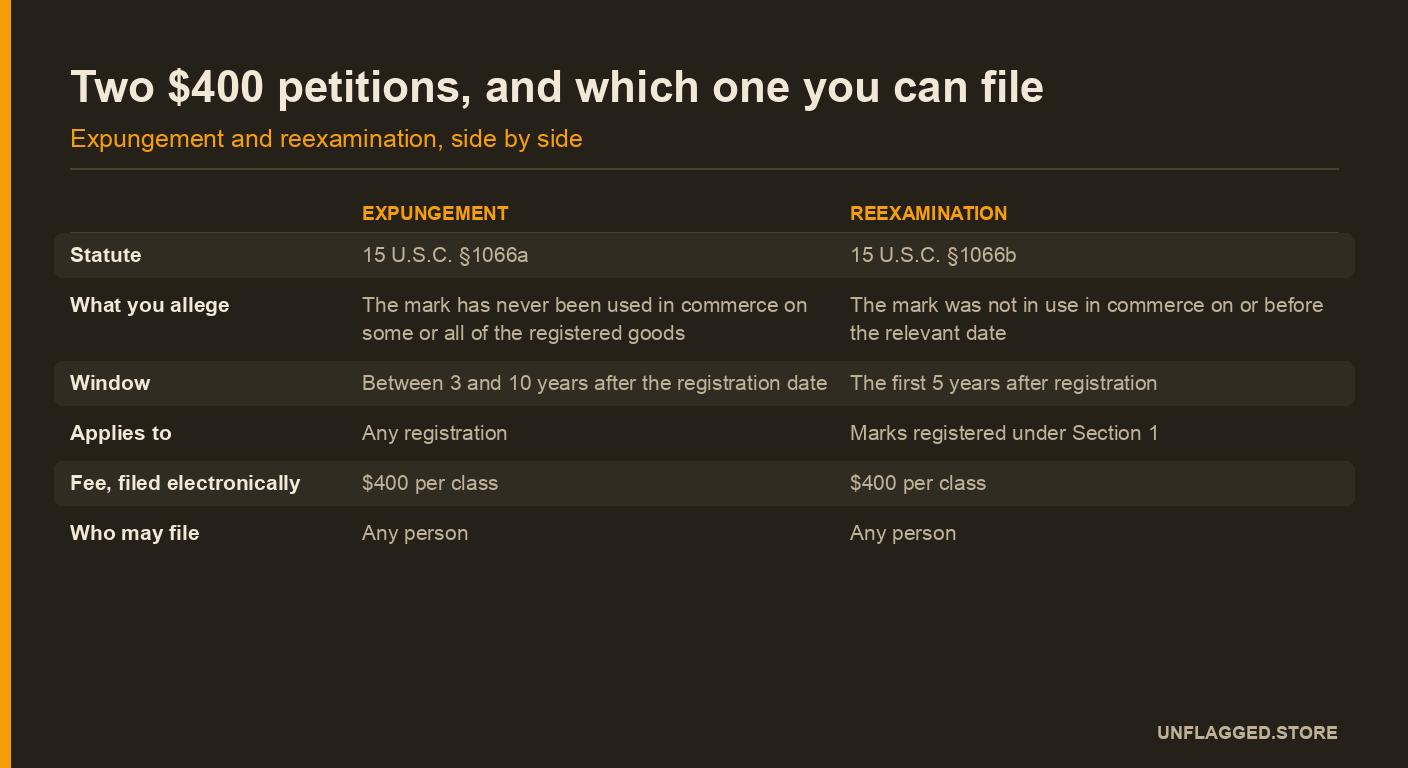
The Trademark Modernization Act of 2020 created two proceedings that took effect on 18 December 2021. Both are ex parte, meaning you file and then step back while the USPTO and the registrant deal with each other. Both exist specifically to clear registrations for marks that are not being used, and the USPTO calls that "deadwood."
| Expungement | Reexamination | |
|---|---|---|
| Statute | 15 U.S.C. §1066a | 15 U.S.C. §1066b |
| What you allege | The mark has never been used in commerce on some or all of the registered goods | The mark was not in use in commerce on or before the relevant date |
| Window | Between 3 and 10 years after the registration date | The first 5 years after registration |
| Applies to | Any registration | Marks registered under Section 1 |
| The relevant date | Not applicable | For a 1(a) use-based filing, the application date. For a 1(b) intent-to-use filing, the later of the amendment to allege use or the expiry of the statement-of-use deadline including extensions |
| Fee, filed electronically | $400 per class | $400 per class |
| Who may file | Any person | Any person |
| Scope of one petition | One registration; both types against the same registration need separate petitions | Same |
The dates usually choose for you. A four-year-old registration can only be reexamined; an eight-year-old one can only be expunged. In the three-to-five-year overlap, expungement is the heavier claim because it asserts the mark was never used at all, and reexamination the easier one because it need only defeat use as of a single date.
If the petition is granted and the registrant cannot show use, the USPTO issues an office action, the registrant has three months to respond with a one-month extension available for $125, and a final action gives three months to seek reconsideration or appeal to the Trademark Trial and Appeal Board. That deadline cannot be extended. Where use is never established, the registration is cancelled in whole or in part.
What a "Reasonable Investigation" Actually Requires
A petition is not an accusation, it is an evidence package. Under 37 C.F.R. §2.91 it must include a verified statement setting out the elements of a reasonable investigation of nonuse, an itemised index of the evidence, and the evidence itself. The USPTO's examination guide is blunt about the floor: "A single search using an internet search engine likely would not be considered a reasonable investigation."
It is equally clear that you do not have to search everything. An investigation "that produces reliable and credible evidence of nonuse during the relevant time period may be considered sufficient." The guide lists the source categories it regards as appropriate.
| Source category the USPTO names | What it looks like for a marketplace dispute |
|---|---|
| State and federal trademark records | The registration file itself, the accepted specimen, any related filings |
| Sites and media likely owned or controlled by the registrant | The owner's shop, site and social accounts, and their absence |
| Sites and publications where the goods would be advertised or sold | The marketplaces and retailers that category actually lives on |
| Print sources and pages likely to review or discuss the goods | Trade press, buyer discussion, review coverage |
| State or federal business registration and regulatory records | Entity filings, licences, agency actions |
| The registrant's marketplace activity | Attempts to contact them or to buy the goods, and what came back |
| Litigation and administrative records | Earlier proceedings bearing on use or nonuse |
| Archival evidence | Cached pages from sources such as the Wayback Machine, because nonuse is judged over a past period |
Two warnings sit around that table. Your petition and exhibits enter the registration record and are publicly viewable, so file nothing you would not want the registrant reading with your name on it. And if the petition is incomplete, the USPTO sends a 30-day letter to perfect it, but you "may not include additional evidence" in that response and anything extra will not be considered. The package you file first is the one you are judged on.
The Odds, From the USPTO's Own Data
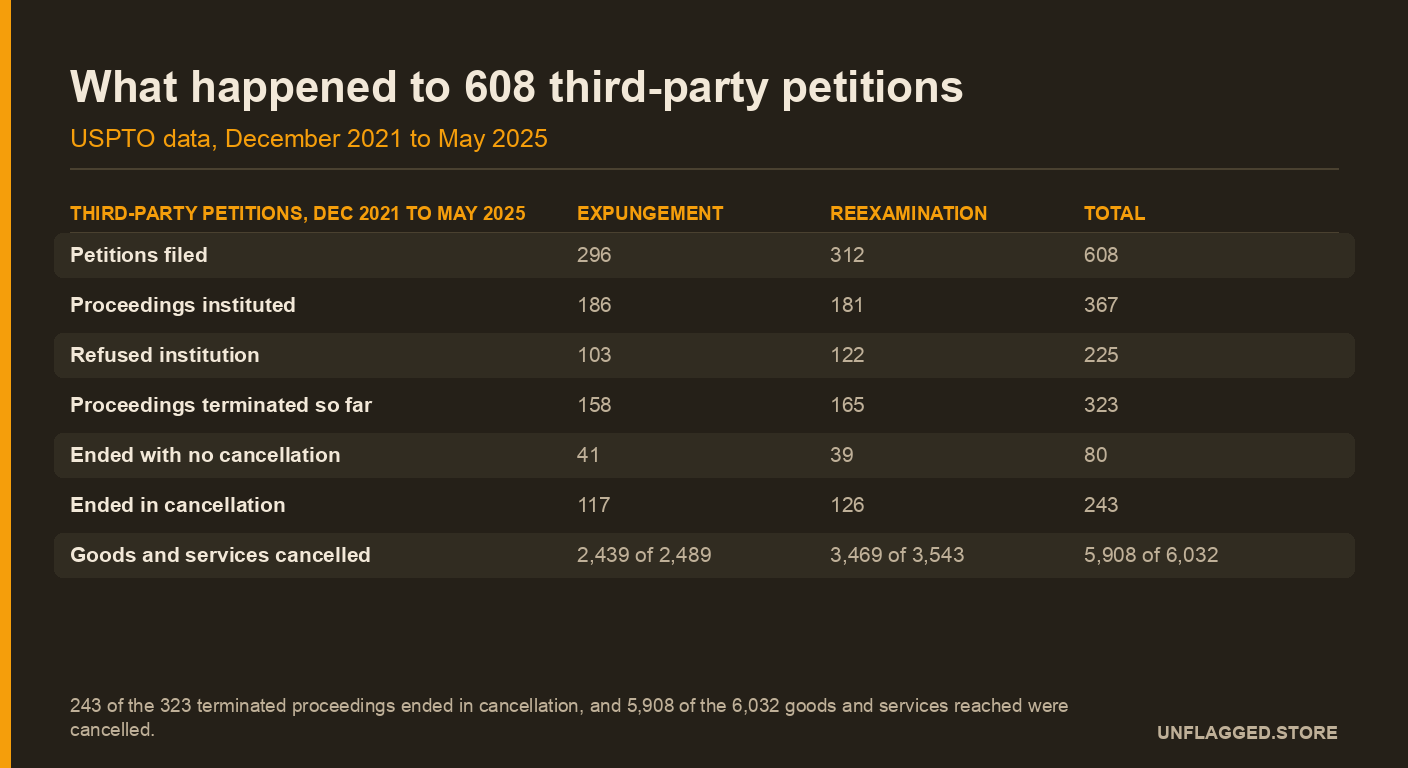
The USPTO published petition counts through May 2025 in a practitioner briefing, and the numbers are the most honest answer available to "is this worth $400."
| Third-party petitions, Dec 2021 to May 2025 | Expungement | Reexamination | Total |
|---|---|---|---|
| Petitions filed | 296 | 312 | 608 |
| Proceedings instituted | 186 | 181 | 367 |
| Refused institution | 103 | 122 | 225 |
| Proceedings terminated so far | 158 | 165 | 323 |
| Ended with no cancellation | 41 | 39 | 80 |
| Ended in cancellation | 117 | 126 | 243 |
| Goods and services cancelled | 2,439 of 2,489 | 3,469 of 3,543 | 5,908 of 6,032 |
The USPTO draws three conclusions from its own table. The institution rate is 60%. Of proceedings that have been resolved, 75% ended in cancellation. And where a proceeding was instituted, 98% of the challenged goods and services were struck. In other words the hard part is getting in, and once you are in the registrant usually cannot show the use they claimed.
Against that, the Office itself instituted 2,598 proceedings on the Director's own initiative in the same period and cancelled 47,558 of 47,625 challenged goods, a rate of 99.86%. Those ran 91% against registrants domiciled in China; third-party petitions ran 43% United States, 29% China. The tool is in heavy use by the USPTO and very light use by everyone else: 608 petitions in three and a half years, across every industry in the country.
Now the counterweight, because it is the part no page on this topic states. Under 37 C.F.R. §2.92(c)(1) any decision on whether to institute is final and non-reviewable. The 225 refused petitions had no appeal. Once a proceeding is instituted you have no further involvement in it, so you cannot argue the registrant's evidence. And estoppel bites: if the registrant proves use, no further expungement may be instituted for those goods, and a successful reexamination defence blocks both types.
When the TTAB Is the Right Tool Instead
The ex parte petitions ask one question: was the mark used. If your objection is that the mark is generic, was registered in bad faith, is confusingly similar to something you used first, or rests on a fabricated specimen, you are in Trademark Trial and Appeal Board territory, which means a contested proceeding with a defendant, discovery and a lawyer. The fees are worth seeing in one place.
| Filing | 37 C.F.R. | Electronic | Paper |
|---|---|---|---|
| Letter of protest, before publication | §2.6(a)(25) | $150 | n/a |
| Petition for expungement or reexamination, per class | §2.6(a)(26) | $400 | n/a |
| Extension to answer an office action in those proceedings | §2.6(a)(27) | $125 | n/a |
| First 30-day extension of time to oppose | §2.102(c)(1)(i) | $0 | n/a |
| First 90-day or second 60-day extension to oppose | §2.6(a)(22) | $200 | $400 |
| Final 60-day extension to oppose | §2.6(a)(23) | $400 | $500 |
| Notice of opposition, per class | §2.6(a)(17) | $600 | $700 |
| Petition to cancel, per class | §2.6(a)(16) | $600 | $700 |
| TTAB ex parte appeal, per class | §2.6(a)(18) | $225 | $325 |
| Request for an oral hearing | §2.6(a)(24) | $500 | n/a |
Two of those rows are easy to overlook and cheap. The letter of protest at $150 only works before a mark publishes, so it is a tool for the application that will become next year's takedown rather than for the registration behind today's. And the first 30-day extension of time to oppose is free, which buys a month to decide whether a $600 opposition is worth filing. If you want to catch problems at that stage rather than this one, searching before you list is the habit that puts you there.
What This Fixes, and What It Does Not
Be clear about the limits, because the gap between "the registration is cancelled" and "my listing is back" is real and nobody closes it for you.
- Cancelling a registration does not restore a listing. Etsy removed it on a report; only Etsy puts it back, and its own pages say it makes no infringement decisions. What you gain is that the reporter can no longer point to a live registration.
- These proceedings run in months, not days. Three months to respond, a possible extension, then a final action with three months more, is the registrant's clock alone. Nothing here helps a listing you need back this week.
- Do the free things first. Read the notice, identify the registration number, contact the reporter, and check whether the policy violations page offers an appeal on that listing. Reading the notice properly comes before anything you pay for.
- Do not relist unchanged while you wait. Etsy closed roughly 28,000 shops for repeat infringement or counterfeiting in 2025, and its notice page tells sellers not to create additional listings for the content until the issue is resolved.
- Get advice before you swear to anything. A petition carries a verified statement. If you are not confident the evidence supports it, that is the moment for a trademark attorney, not a cheaper shortcut.
The listing text is the part a review can help with. Whether a registration is in use is a question for USPTO records, and no text tool can answer it. Unflagged screens submitted listing text for potential concerns, including brand names and phrases that commonly draw reports, and explains the wording that needs a second look. It does not inspect images, search live trademark registers, establish compliance or predict a removal, so the decision to petition stays yours. See what the review covers and what it costs.
If your notice named neither copyright nor trademark, you may be looking at a third right, and the right of publicity piece covers that case, where even this route is unavailable.
Related Articles
- Etsy Takedown Notice: What to Do, reading the notice before you answer it
- How Competitors Use Trademark Reports, why a report gets filed in the first place
- Etsy Trademark Search Before Listing, catching this at the application stage
- Etsy's Intellectual Property Policy Explained, the rules the report is filed under
- Etsy Appeal Letter Template, the structure for a specific, evidenced appeal
- Etsy Right of Publicity, the claim with no counter notice and no USPTO route either
FAQ
Can I file a counter notice against an Etsy trademark takedown?
No. Etsy's help centre states that counter notices "can be filed against reports of copyright infringement only" and that Etsy "cannot accept counter notices for non-copyright claims." Guides describing a step-by-step Etsy trademark counter notice are describing something Etsy says it does not accept.
How much does it cost to challenge a trademark registration?
A petition for expungement or reexamination is $400 per class filed electronically. A TTAB petition to cancel or notice of opposition is $600 per class electronically, $700 on paper. A letter of protest, available only before the mark publishes, is $150. Those are USPTO fees as published on 1 November 2026 and exclude any attorney cost.
What is the difference between expungement and reexamination?
Expungement alleges the mark has never been used in commerce on some or all of the registered goods and may be requested between three and ten years after registration. Reexamination alleges the mark was not in use as of a specific relevant date and may be requested in the first five years, for marks registered under Section 1. Each needs its own petition.
What are the odds a petition succeeds?
On USPTO figures covering December 2021 to May 2025, 60% of third-party petitions were instituted. Of proceedings that had been resolved, 75% ended in cancellation, and 98% of the challenged goods and services were struck where a proceeding was instituted. The decision whether to institute is final and cannot be appealed.
Will cancelling the registration get my listing back?
Not by itself. Etsy removes listings in response to reports and says it does not decide infringement questions, so restoring a listing remains Etsy's decision. What cancellation removes is the reporter's ability to point at a live registration, which is also one of the grounds on which Etsy says it may decline to process a report.
How do I know whether the mark behind my takedown is in use?
Take the registration number from the notice and read the registration record in the USPTO's public database: the goods and services claimed, the specimen that was accepted, and the maintenance filings. Then look for the mark in the places those goods would actually be sold. The USPTO is explicit that one search-engine search is not a reasonable investigation.
Can Etsy reject a trademark report on its own?
Yes, and it does so often. Etsy rejected 18% of submitted intellectual property reports in 2025 where it could not verify the reporter's authorisation, the description of the property was insufficient, or the report otherwise failed its requirements. Its published list of rejection reasons also includes a trademark that is dead or inactive.
Sources. USPTO fee schedule, effective 19 January 2025, revised 1 November 2026. USPTO Examination Guide 1-21, Expungement and Reexamination Proceedings. USPTO, Trademark ex parte expungement and reexamination proceedings, 24 June 2025, petition counts December 2021 to May 2025. 15 U.S.C. §1066a, §1066b and §1064, Legal Information Institute. 37 C.F.R. §2.91, eCFR. Etsy 2024 and 2025 Transparency Reports. Etsy help centre: Why Was My Notice of Infringement Rejected?, What to Do if You Receive a Notice of Intellectual Property Infringement, How to File a DMCA Counter Notice. Etsy's policy pages at etsy.com/legal return 403 to automated clients, so the Intellectual Property Policy text was not read directly; Etsy's help centre and investor reports are used in its place. USPTO fees change; check the current schedule before filing. This is general information about how these processes work, not legal advice.
Scan Your Listings Free
Screen submitted listing text for potential concerns. 5 preliminary screens daily, shared network limits; no signup required.
Start Free ScreenRelated Articles
How to Check Your Etsy Listings for Trademark Violations (2026 Guide)
Learn how to scan your Etsy listings for trademark violations before they get flagged. Step-by-step guide to protecting your shop from takedowns and suspensions.
Read moreEtsy Shop Suspended? How to Write a Winning Appeal Letter
Your Etsy shop got suspended. Here's exactly how to write an appeal letter that gets your shop reinstated, with templates and strategies that actually work.
Read more50 Words That Are Trademarked on Etsy (Stop Using These Now)
A comprehensive list of commonly trademarked words and phrases that Etsy sellers use without realizing they're violating trademark law. Check your listings now.
Read more