Etsy Health Claims 2026: The FDA Line
Etsy health claims in 2026: what turns a crystal, candle or pendant into a drug or device, why the FDA disclaimer fails, and how to rewrite a listing.
- 1.Two Rulebooks Read the Same Sentence
- 2.What Turns a Crystal Into a Drug
- 3.Your Pendant May Be a Device, Not a Drug
- 4.Intended Use Is Read From Everything You Publish
- 5.The Disclaimer Does Not Work, and There Is a Source That Says So
- 6.Hedges Are Not a Fix Either
- 7.Where the Cosmetic Line Sits for Candles, Oils and Balms
- 8.What the FTC Adds on Top
- 9.Rewriting a Listing That Already Has Claims In It
- 10.Related Articles
- 11.FAQ
Key takeaways
- Etsy health claims answer to two rulebooks, and Etsy's bites first. It can deactivate a listing over implied healing language on its own policy grounds, with no federal agency involved and no appeal to the law.
- A crystal sold to treat anxiety is a drug. Not figuratively: 21 U.S.C. 321(g)(1)(B) defines a drug by what the article is intended for, and nothing in it mentions pills.
- A pendant that acts on your body without chemistry is a device. 321(h)(1) is the category for articles that do not work "through chemical action within or on the body", which is exactly what an energy claim describes.
- The FDA disclaimer does not work here. FTC's own guidance says it "won't cure an otherwise deceptive ad", and the safe harbour it comes from, 21 CFR 101.93, is a dietary-supplement rule.
- Intended use is read from everything you publish. In four warning letters FDA quoted blog posts, website category tags, Facebook posts and independent consultants' social accounts, not product labels.

A seller lists a rose quartz pendant as Anxiety Relief Crystal Necklace, Calms the Nervous System. Etsy deactivates it on a Tuesday with a one-line notice, and that is the cheap version of the problem: the same nine words make the necklace an unapproved new drug under federal law, and the agency that cares about that does not send one-line notices.
Etsy health claims are governed by two rulebooks at once, with different triggers, different evidence and penalties that are not in the same order of magnitude. A deactivated listing costs you a listing. The ceiling FTC published for civil penalties under the orders it enforces was $53,088 per violation in January 2025.
We read the statute rather than summaries of it, pulled the four FDA warning letters that cover small aromatherapy and essential-oil sellers to see where the agency actually found the offending words, and checked the disclaimer advice the top results give against the FTC guidance that addresses it directly. Here is what applies to a crystal, candle or jewelry listing, in the order it reaches you.
Two Rulebooks Read the Same Sentence
Almost every guide to this subject collapses the two layers into one, which is why its advice is unusable. Etsy's policies and federal law are enforced by different people, on different evidence, with different consequences, and a sentence can clear one and fail the other.
Etsy prohibits listings that claim an item treats, cures or mitigates a medical condition, and it separately restricts metaphysical claims on spell-work supplies such as herbs, crystals and candles. Enforcement reaches titles, tags, descriptions and photographs, and it is automated enough that sellers routinely report deactivations for phrases they considered decorative. Note that we do not quote Etsy's policy text here: etsy.com returns HTTP 403 to every automated request, so read the current Prohibited Items and Handmade policy pages yourself rather than trusting any blog's paraphrase, including this one.
| Etsy's policy layer | The federal layer | |
|---|---|---|
| Who acts | Etsy Trust and Safety, largely automated | FDA, FTC, occasionally a state AG |
| Trigger | A claim, stated or implied, anywhere in the listing | An intended use, read from any relevant source |
| Metaphysical language | Restricted in its own right | Not regulated unless it reaches health |
| First consequence | Listing deactivated, strike on the shop | Warning letter with a 15-day reply window |
| Worst case | Shop suspension, funds held | Injunction, seizure, civil penalties |
| Does a disclaimer help | No | No |
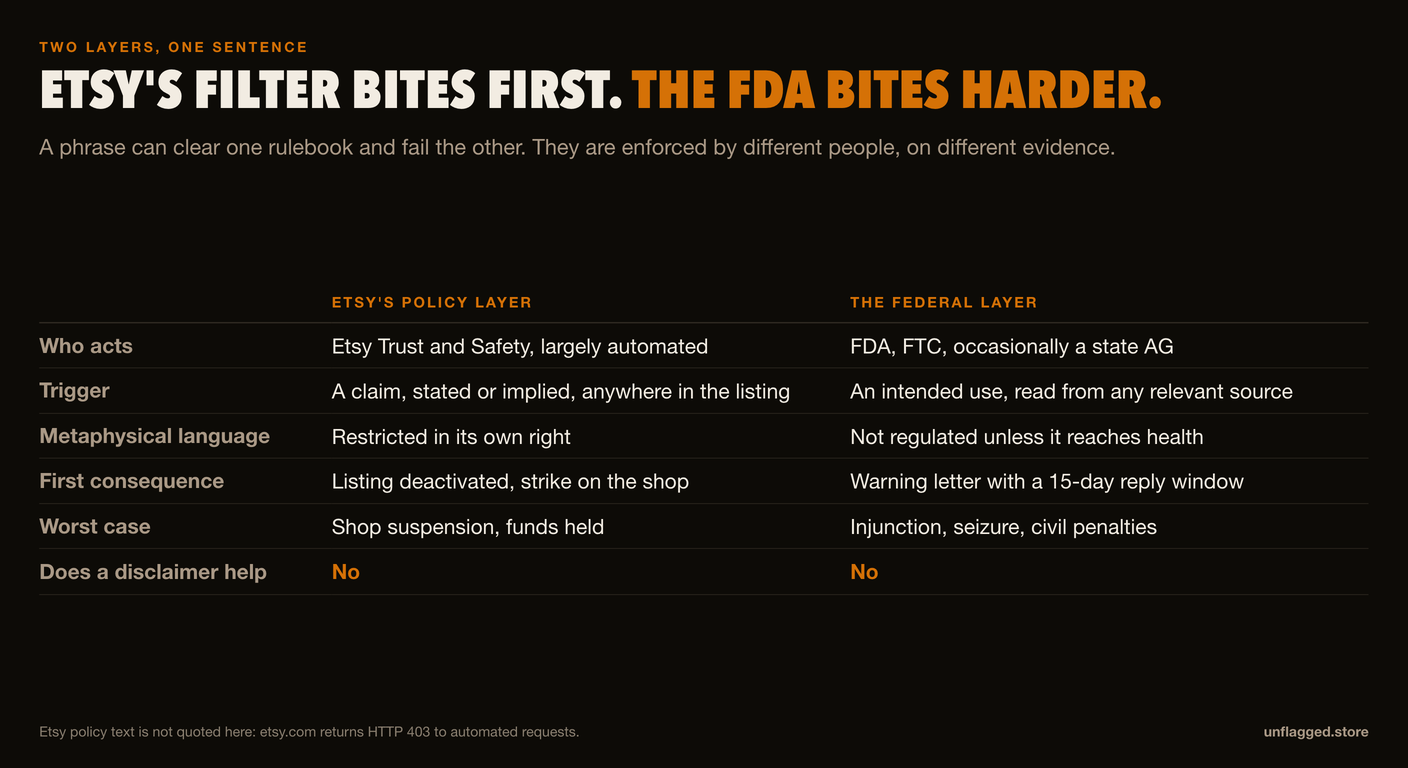
The practical upshot is that passing Etsy's filter is not compliance, and compliance will not save a listing from Etsy's filter. You have to write for both, and the federal test is the stricter of the two to reason about, so start there.
What Turns a Crystal Into a Drug
The definition is shorter than people expect and it never mentions a dosage form. Under section 201(g)(1) of the FD&C Act, a drug includes "articles intended for use in the diagnosis, cure, mitigation, treatment, or prevention of disease in man or other animals", and separately "articles (other than food) intended to affect the structure or any function of the body".
Read those two clauses against an ordinary metaphysical listing. "Relieves migraines" is clause (B), because a migraine is a disease. "Lowers cortisol", "balances hormones" and "improves circulation" are clause (C), because each names a bodily function, and clause (C) does not require a disease at all. That second clause is the one that catches sellers who carefully avoided naming an illness.
What the product is has no bearing on it. A quartz point, a soy candle, a copper bracelet and a 500 mg capsule are in the same legal position the moment the listing says they do one of those things. There is no threshold of sincerity, no exemption for small shops, and no category called "wellness" in the statute.
Three ordinary listing phrases, and where each one lands:
- "Rose quartz, 40 mm, polished, from Madagascar" is a description of an object. No intended use, no problem.
- "Rose quartz for self-love and emotional healing" is where Etsy's metaphysical rule bites and the federal line starts to blur, because "emotional healing" is close enough to a mental-health claim that it depends on the rest of the page.
- "Rose quartz to reduce anxiety and lower your heart rate" is a drug claim twice over, and the heart-rate half is the clearer of the two.
Your Pendant May Be a Device, Not a Drug
This is the part no competing guide mentions, and it changes which rules apply. A device under 321(h)(1) is an "instrument, apparatus, implement, machine, contrivance, implant, in vitro reagent, or other similar or related article" intended for the same disease or structure-function purposes as a drug, but "which does not achieve its primary intended purposes through chemical action within or on the body of man or other animals".
That final clause is not a loophole. It is the dividing line, and energy claims fall on the device side of it by construction. A pendant said to block electromagnetic radiation, a bracelet said to improve sleep through magnetism, a copper ring said to ease joint pain: none of them works by chemistry, which is precisely what makes each one a candidate device rather than a candidate drug.
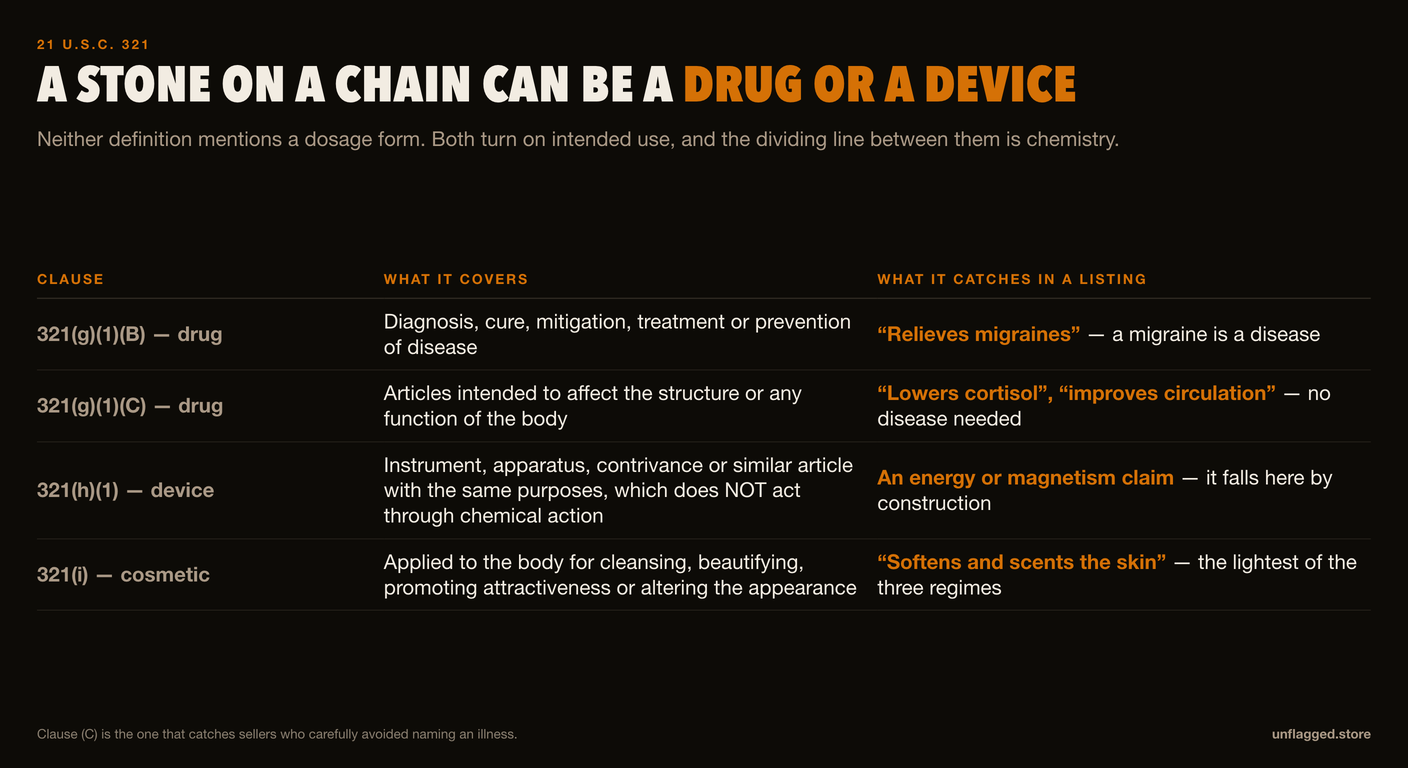
It matters because the device route carries its own registration, listing and premarket requirements, and because "it is just a rock, not a medicine" is the defence sellers reach for first. The statute anticipated it. A contrivance is a device, and a stone on a chain sold for an effect on the body is a contrivance with a claim attached.
Intended Use Is Read From Everything You Publish
Here is where Etsy health claims go wrong in a way sellers never see coming. Intended use is not what your product page says. 21 CFR 201.128, as amended by the final rule at 86 FR 41401 effective 1 September 2021, defines it as the objective intent of the people responsible for the labeling, shown by their statements, by the article's "design or composition", or by "the circumstances of its distribution". Labeling, advertising and oral or written statements are all listed as examples. 21 CFR 801.4 says the same for devices.
"Any relevant source" is not a theoretical standard. The four warning letters below show where FDA went looking, and almost none of it is a product label.
| Company | Letter date | Where FDA found the claims it quoted |
|---|---|---|
| Rooted Apothecary | 10 Oct 2019 | Website pages, including an information page about safety, plus two Facebook posts, one of them a customer's own blood-sugar result |
| VitaStik | 1 Dec 2021 | Product pages and website category tags, plus Facebook, Instagram and YouTube |
| Young Living | 10 Jun 2022 | Company websites and independent consultants' own sites and social accounts |
| MonQ | 30 Jun 2022 | Two blog posts about which oils suit which symptoms. No product page, no social media |
Translate each row into Etsy. Category tags are the thirteen tags on your listing, which sellers treat as invisible SEO filler. Blog posts about which stone helps what are the crystal-meanings page every shop links from its announcement. Independent consultants' posts are your affiliates, your Pinterest boards and the reviews you quote in your own copy. In the MonQ letter the only cited evidence was a pair of blog posts, and the products were still unapproved new drugs under sections 505(a) and 301(d).
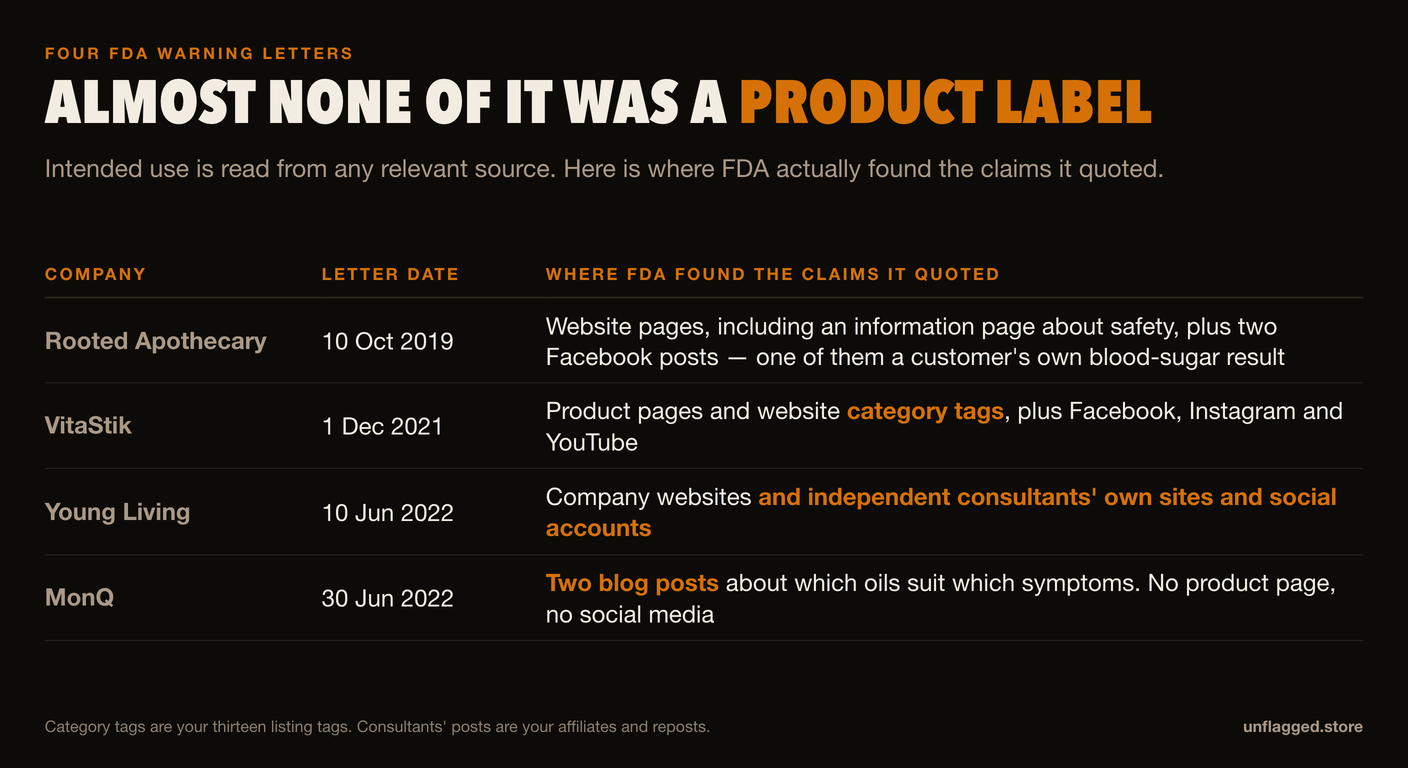
Taken together, the letters answer the question sellers actually ask, which is whether anyone reads this closely. The agency reads the whole shop, and it quotes.
The Disclaimer Does Not Work, and There Is a Source That Says So
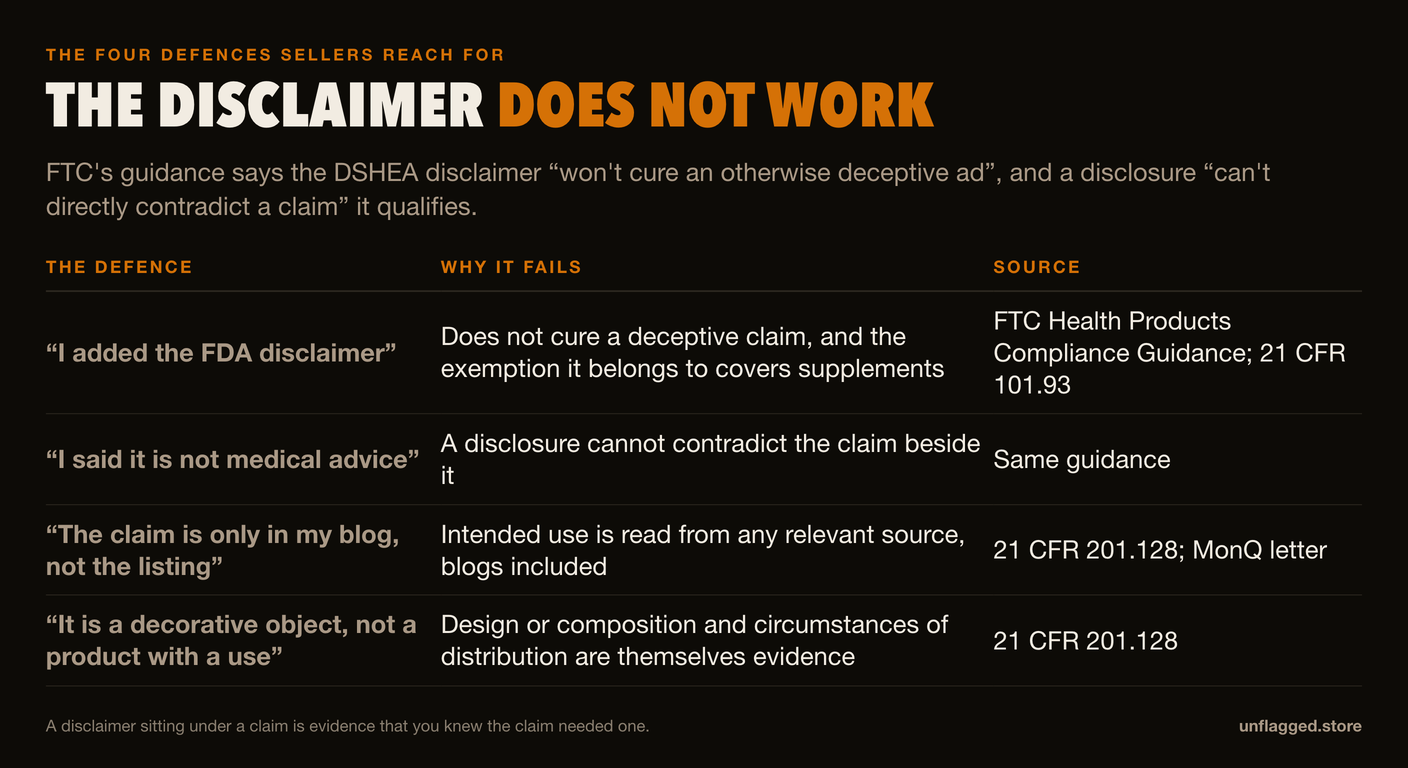
The single most common piece of advice in this niche is to paste the FDA disclaimer at the bottom of every listing. It is wrong twice, and both halves are checkable.
First, the sentence comes from a safe harbour you cannot use. Structure/function claims are permitted for dietary supplements under DSHEA, codified at 21 CFR 101.93, and the price of that permission is the disclaimer plus a notification filed with FDA "no later than 30 days after marketing" the product. A crystal is not a dietary supplement, a candle is not one either, so there is no safe harbour for the disclaimer to sit inside. You are reciting the conditions of an exemption that does not reach your product.
Second, even where it does apply, it does not launder a claim. FTC's Health Products Compliance Guidance addresses the point in terms: the DSHEA disclaimer "won't cure an otherwise deceptive ad", and a disclosure "can't directly contradict a claim" it qualifies.
| The defence | Why it fails | Source |
|---|---|---|
| "I added the FDA disclaimer" | Does not cure a deceptive claim, and the exemption it belongs to covers supplements | FTC Health Products Compliance Guidance; 21 CFR 101.93 |
| "I said it is not medical advice" | A disclosure cannot contradict the claim beside it | Same guidance |
| "The claim is only in my blog, not the listing" | Intended use is read from any relevant source, blogs included | 21 CFR 201.128; MonQ letter |
| "It is a decorative object, not a product with a use" | Design or composition and circumstances of distribution are themselves evidence | 21 CFR 201.128 |
Hedges Are Not a Fix Either
The second-most common advice is to soften the verb: "believed to support", "traditionally associated with", "said to promote". Competitor guides present this as the compliance answer. It is not one, for a reason specific to each rulebook.
Federally, the hedge does not change the intended use. You are still offering the article for the stated effect, and 201.128 looks at objective intent across the whole presentation rather than at the modality of one verb. A listing that says a stone is "believed to lower blood pressure" is selling it to lower blood pressure, and the sentence structure is not what FDA quotes.
On Etsy, the hedge is sometimes the violation. The metaphysical-claims restriction applies to the claim itself, so attributing it to tradition or belief leaves it intact and merely sources it. Sellers report that hedged healing language is removed on the same basis as unhedged language, and that is consistent with how the rule is written.
The UK is blunter still, and it matters if you ship there. The Advertising Standards Authority states on its crystal therapy guidance that "the ASA and CAP have not seen evidence that crystal therapy can be used to treat medical conditions", and that such claims are "not likely to be acceptable without a body of robust clinical trial evidence". It has ruled a general reference to the "healing power" of crystals misleading on exactly that basis.
Where the Cosmetic Line Sits for Candles, Oils and Balms
Anything you put on skin has a third option, and it is the one most sellers should aim for. A cosmetic under 321(i) is an article applied to the body "for cleansing, beautifying, promoting attractiveness, or altering the appearance". Stay inside that purpose and you are in the lightest of the three regimes.
FDA's own guidance on whether a product is a cosmetic, a drug, or both works the example that matters here: "A massage oil that is simply intended to lubricate the skin and impart fragrance is a cosmetic. But if the product is intended for a therapeutic use, such as relieving muscle pain, it's a drug." On scent specifically, it says the principle "also holds true for 'essential oils'", and that a fragrance marketed with claims "such as assertions that the scent will help the consumer sleep or quit smoking" is a drug because of its intended use.
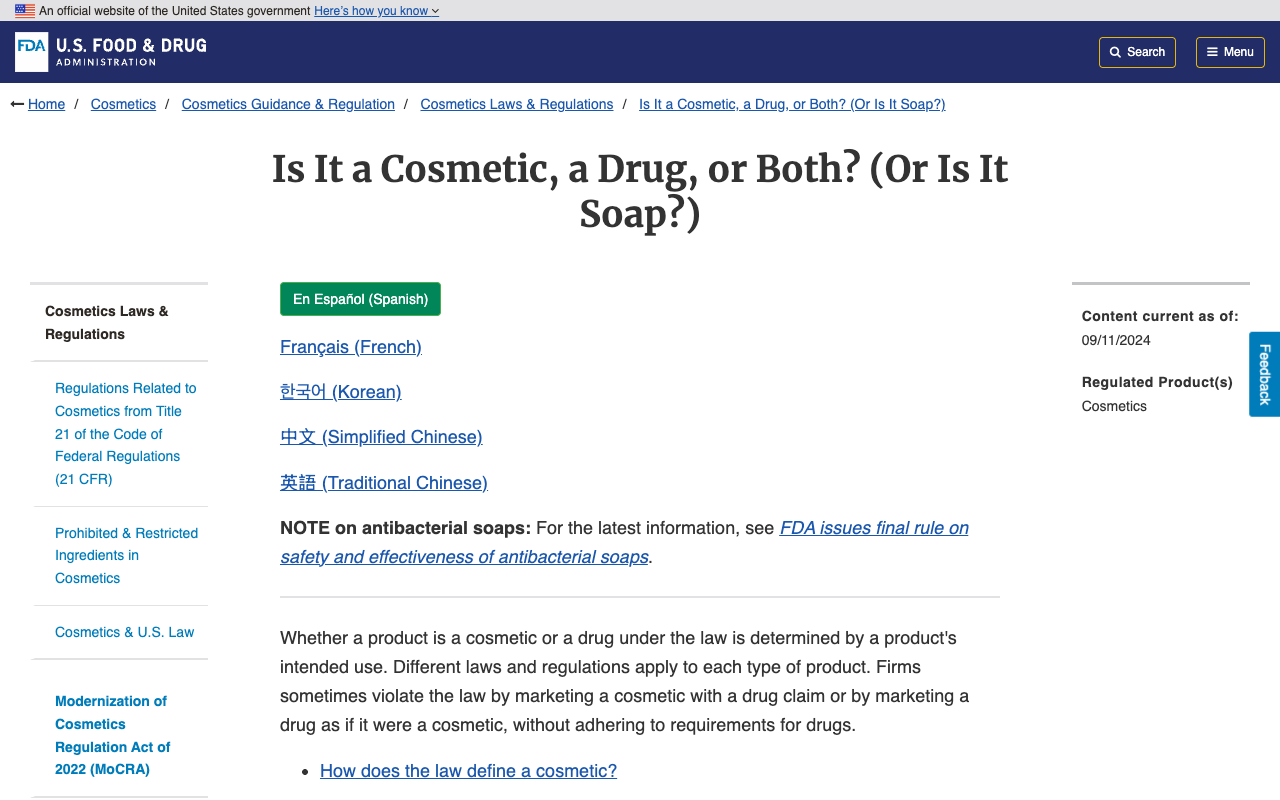
The same page lists what FDA treats as evidence of intended use, and the list is wider than labels: "Claims stated on the product labeling, in advertising, on the Internet, or in other promotional materials", plus "consumer perception, which may be established through the product's reputation". A product can also be both at once, in which case it "must comply with the requirements for both cosmetics and drugs".
| What the listing says | Category | Why |
|---|---|---|
| Lavender soy candle, 8 oz, cotton wick | Neither | An object described as an object |
| Lavender candle for a calmer bedroom | Grey | Ambience, not a bodily effect, but one word from one |
| Lavender candle to help you fall asleep | Drug | FDA's own sleep example |
| Body oil to soften and scent the skin | Cosmetic | Appearance and fragrance |
| Body oil for sore muscles after training | Drug | FDA's own muscle-pain example |
| Balm that moisturises and relieves eczema | Both | Two intended uses, two regimes |
What the FTC Adds on Top
FDA decides what your product legally is. FTC decides whether your advertising is deceptive, and it does not need your product to be a drug first. Its guidance is explicit that it is not a supplements document: "the same legal principles apply to the marketing of any health-related product", and "FTC advertising law applies to all products and claims".
The standard is "competent and reliable scientific evidence", and the guidance states that for health benefits substantiation "will need to be in the form of randomized, controlled human clinical testing". Animal studies, in vitro work, testimonials and public-health recommendations are each insufficient on their own. For crystal, candle and jewelry claims that bar is not close to reachable, which is the honest reason to describe the object instead of its effects.
The exposure is money rather than a removed listing. FTC published an increase in the maximum civil penalty from $51,744 to $53,088 for violations of sections 5(l), 5(m)(1)(A) and 5(m)(1)(B), effective on publication in the Federal Register on 17 January 2025. These amounts are adjusted for inflation periodically, so check the current figure before quoting it. The guidance itself is business guidance and does not carry the force of law, which is worth knowing in both directions.
Rewriting a Listing That Already Has Claims In It
If your shop has been running for a while, the claims are not only in your descriptions. Work outwards in this order, because that is the order the evidence is read in.
- Strip every condition name from titles, tags and descriptions. Anxiety, depression, insomnia, migraine, arthritis, inflammation, infertility, ADHD. These are clause (B) in one word.
- Strip every bodily function next, which is the step people skip. Cortisol, hormones, blood pressure, circulation, immunity, metabolism, nervous system. Clause (C) needs no disease.
- Clear the thirteen tags. FDA quoted a website's category tags in the VitaStik letter, and Etsy's filter reads tags as listing text. A clean description with "anxiety relief" in the tags is not a clean listing.
- Audit the pages around the listing. Shop announcement, FAQ sections, your crystal-meanings blog, your about page. The MonQ letter was built on two blog posts and nothing else.
- Audit other people's words that you adopted. Quoted reviews, affiliate copy, influencer captions you reposted. Young Living's letter cited independent consultants' social accounts.
- Delete the disclaimer and the hedges. They do no work, and a disclaimer sitting under a claim is evidence that you knew the claim needed one.
- Rewrite towards the object or the tradition's name without its promise. Material, size, origin, cut, colour, weight, scent notes, how it was made. "Amethyst cluster, 620 g, Uruguayan, deep saturation" sells the thing you actually have.
Check the words in your listings before Etsy's filter or a reviewer does. Unflagged scans Etsy listing text for the claim language that drives deactivations and suspensions, including the condition and body-function wording above that sellers rarely recognise as a drug claim. See what the plans include, or start with our guide to the policy violations that remove listings. Unflagged is our own product and we take no affiliate commission from anything named in this article. None of this is legal advice, and if your shop's whole premise is an effect on the body, that is an hour with an FDA regulatory attorney rather than an afternoon of rewriting.
Related Articles
- Etsy Cosmetics Rules 2026: FDA Labels - the same drug line drawn on skincare, with MoCRA registration
- Etsy Candle Labeling Rules 2026 - what has to be on the candle itself once the claims are off it
- Etsy Eco-Friendly Claims 2026: FTC Rules - the other FTC substantiation problem in the same shop
- Etsy Jewelry Labeling Requirements 2026 - metal, stone and origin disclosure for pendants and bracelets
- Etsy Prohibited Items: The Complete List - where consumables and metaphysical goods sit in Etsy's category map
- Why Etsy Removed Your Listing - the appeal route once a claim has cost you a page
FAQ
Can you sell crystals on Etsy legally?
Yes. Selling a mineral specimen is unrestricted. What creates the risk is the claim attached to it, so a listing that describes material, size, origin and appearance is in a different legal position from one that describes an effect on the buyer's body.
Does Etsy allow metaphysical claims?
Etsy permits spell-work supplies such as herbs, crystals and candles while restricting metaphysical claims made about them, and it enforces that across titles, tags, descriptions and images. Read Etsy's current policy pages directly, because etsy.com blocks automated requests and every secondary summary, including this one, is a paraphrase.
Is the FDA disclaimer enough to protect my listing?
No. FTC's Health Products Compliance Guidance says the disclaimer "won't cure an otherwise deceptive ad", and the structure/function exemption it comes from, 21 CFR 101.93, applies to dietary supplements. A crystal or candle is not a dietary supplement, so the disclaimer has no exemption to sit inside.
Can I say a crystal is "believed to" help with anxiety?
The hedge does not fix either problem. Federally, intended use is read from your whole presentation rather than from one verb, so the offer is still to supply the stone for anxiety. On Etsy, the metaphysical-claims restriction applies to the claim itself, so sourcing it to belief leaves it in place.
Can jewelry be regulated as a medical device?
It can. A device under 21 U.S.C. 321(h)(1) is an article intended to treat disease or affect the structure or function of the body "which does not achieve its primary intended purposes through chemical action". Magnetic, ionic and electromagnetic-shielding claims describe exactly that, which puts the item on the device side rather than outside regulation.
Are aromatherapy candles drugs?
Only if the listing says they do something to you. FDA's guidance treats a fragrance sold with claims that the scent will help the consumer sleep or quit smoking as a drug because of its intended use, and applies the same principle to essential oils. A candle described by scent, wax, size and burn time is not a drug.
What does the FTC require to back a wellness claim?
Competent and reliable scientific evidence, which its guidance says will need to be randomized, controlled human clinical testing for health benefits. Testimonials, animal studies and in vitro results do not meet it on their own, and the penalty ceiling FTC published for the orders it enforces was $53,088 per violation in January 2025.
Scan Your Listings Free
Check your Etsy listings for trademark violations in seconds. 3 free scans, no signup required.
Start Free ScanRelated Articles
Etsy Cosmetics Rules 2026: FDA Labels
Etsy cosmetics rules in 2026: the FDA label elements, the claims that get listings removed, and the MoCRA exemption most handmade sellers get wrong.
Read moreHow to Check Your Etsy Listings for Trademark Violations (2026 Guide)
Learn how to scan your Etsy listings for trademark violations before they get flagged. Step-by-step guide to protecting your shop from takedowns and suspensions.
Read moreEtsy Shop Suspended? How to Write a Winning Appeal Letter
Your Etsy shop got suspended. Here's exactly how to write an appeal letter that gets your shop reinstated, with templates and strategies that actually work.
Read more