Etsy Candle Labeling Rules 2026: CPSC Limits
Etsy candle labeling rules in 2026: the one federal limit that is law, the ASTM warnings stockists demand, net weight, and why recalls hit the glass.
- 1.What an Etsy Candle Label Legally Has to Carry
- 2.The One Federal Candle Rule With Teeth: Lead in Metal-Cored Wicks
- 3.Net Weight, and the Taper Exemption Nobody Cites
- 4.ASTM F2058 Is Voluntary. That Changes Less Than You Think
- 5.Every Candle Recall Since 2024 Was About the Glass, Not the Label
- 6.The 24-Hour Clock That Starts With a Customer Message
- 7.Wax Melts Are Not Candles
- 8.Selling Candles Into the EU
- 9.Where Prop 65 Fits, and Where It Does Not
- 10.The Label You Can Build This Afternoon
- 11.Related Articles
- 12.FAQ
Key takeaways
- Of all the Etsy candle labeling rules, exactly one is federal law, and it is about wicks. 16 CFR 1500.17(a)(13) bans a candle with a metal-cored wick carrying more than 0.06% lead in the core. Everything else is either a packaging statute from 1966 or a voluntary ASTM standard.
- The famous three-line warning is not legally required. ASTM F2058 is voluntary. What forces it onto your jar is a stockist's purchase order and a product-liability lawyer, not the CPSC.
- Every CPSC candle recall since August 2024 was caused by the glass or the flame, and none by a label. Five recalls, and three of the five were under 3,500 units. The smallest was 1,140 jars from a Portland maker in February 2026.
- A customer message about a cracked jar starts a 24-hour clock. 16 CFR 1115.14(e) says a report is due "immediately, that is, within 24 hours", with at most 10 days to evaluate under 1115.14(d). Late reporting is what the six-figure penalties are actually for.
A seller pours soy wax into a 9 oz jar, buys pre-waxed cotton wicks, prints a label with her shop name and a fragrance note, and lists it. She has read three guides on Etsy candle labeling rules and all three said the same thing: add the ASTM warning, a net weight, your city and state. She does. Nine months later a buyer messages that the jar cracked on the third burn.
The label was never the exposure. All five candle recalls the Consumer Product Safety Commission has announced since August 2024 were about glass breaking or a flame burning too high, and none were about labeling. Three of the five were under 3,500 units. Meanwhile the one labeling rule carrying a federal ban, the lead limit on metal-cored wicks, is the one none of those guides tells you how to certify.
We read the operative text of 16 CFR 1500.17, 501.7 and 1115.14, pulled the CPSC's business-guidance page for candles and the notice for each of the five recalls, and separated what the law requires from what the trade expects. Where a figure comes from a secondary source, this article says so.
What an Etsy Candle Label Legally Has to Carry

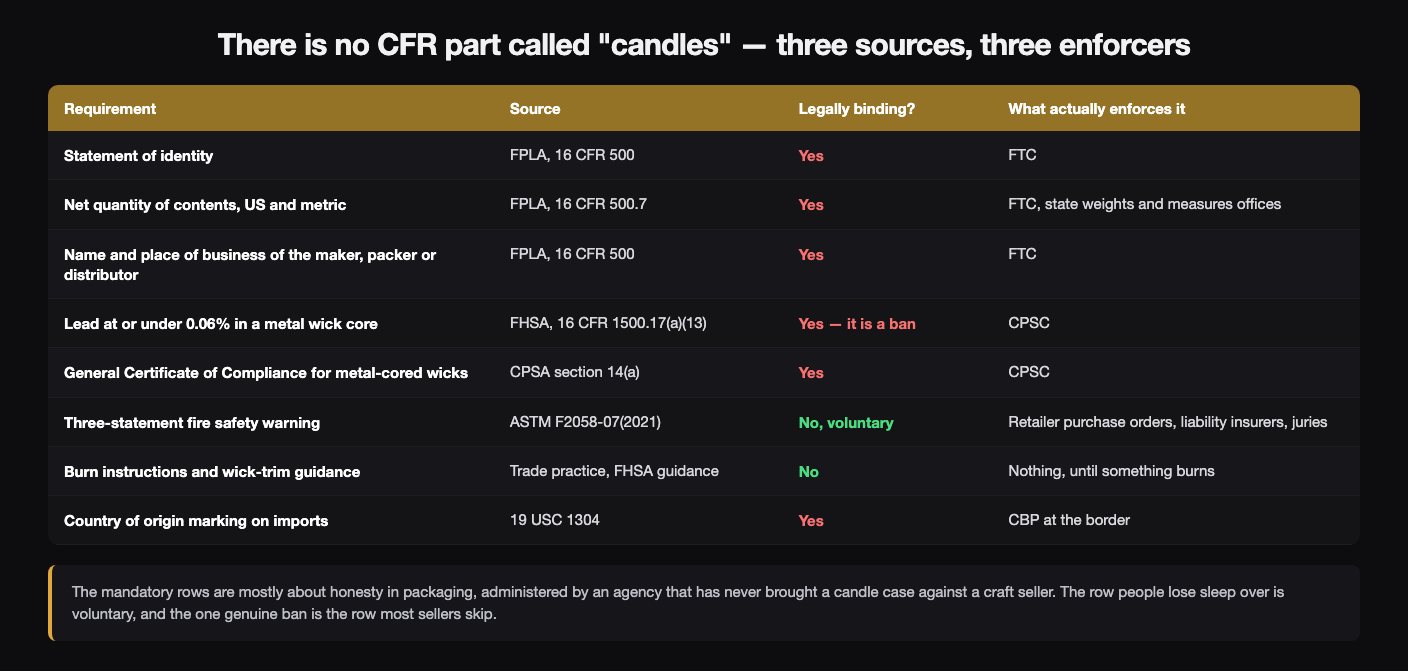
There is no Code of Federal Regulations part called "candles". The duties come from three places with three enforcers, and conflating them is why the guides contradict each other.
The Fair Packaging and Labeling Act, at 16 CFR 500, covers the package: what it is, how much there is, who is responsible. The Federal Hazardous Substances Act, through 16 CFR 1500, covers the hazard, and for candles it reaches exactly one thing. ASTM covers the fire warning, and ASTM is a standards body, not a regulator.
| Requirement | Source | Legally binding? | What actually enforces it |
|---|---|---|---|
| Statement of identity (what the product is) | FPLA, 16 CFR 500 | Yes | FTC |
| Net quantity of contents, US and metric | FPLA, 16 CFR 500.7 | Yes | FTC, state weights and measures offices |
| Name and place of business of the maker, packer or distributor | FPLA, 16 CFR 500 | Yes | FTC |
| Lead at or under 0.06% in a metal wick core | FHSA, 16 CFR 1500.17(a)(13) | Yes, it is a ban | CPSC |
| General Certificate of Compliance for metal-cored wicks | CPSA section 14(a) | Yes | CPSC |
| Three-statement fire safety warning | ASTM F2058-07(2021) | No, voluntary | Retailer purchase orders, liability insurers, juries |
| Burn instructions and wick-trim guidance | Trade practice, FHSA guidance | No | Nothing, until something burns |
| Country of origin marking on imports | 19 USC 1304 | Yes | CBP at the border |
The shape of the problem is in that table. The mandatory rows are mostly about honesty in packaging, administered by an agency that has never brought a candle case against a craft seller. The row people lose sleep over is voluntary. And the one genuine ban is the row most sellers skip, assuming it cannot apply to them.
The One Federal Candle Rule With Teeth: Lead in Metal-Cored Wicks
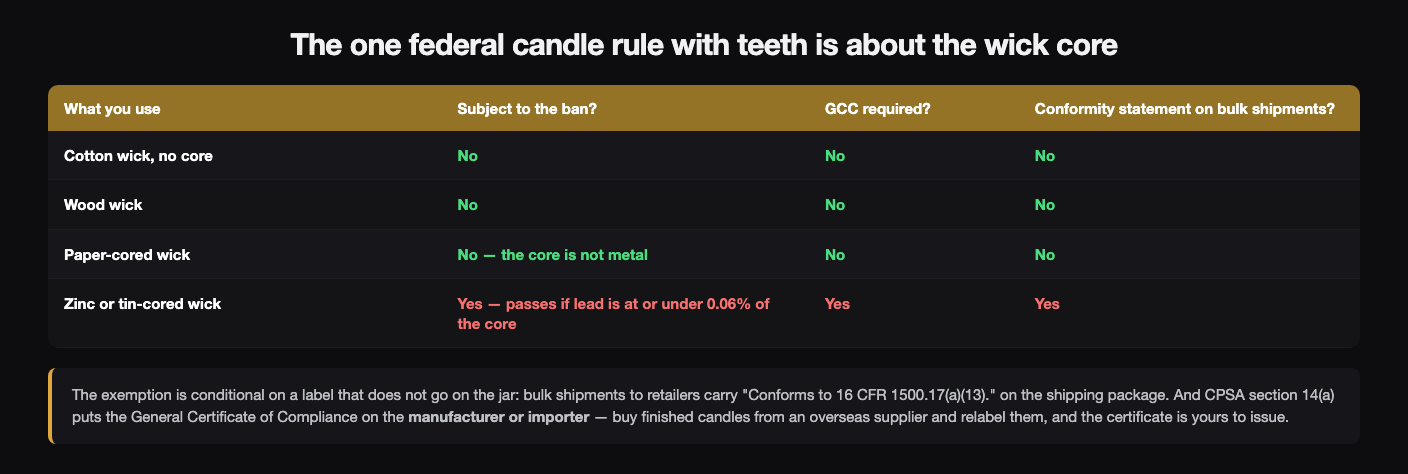
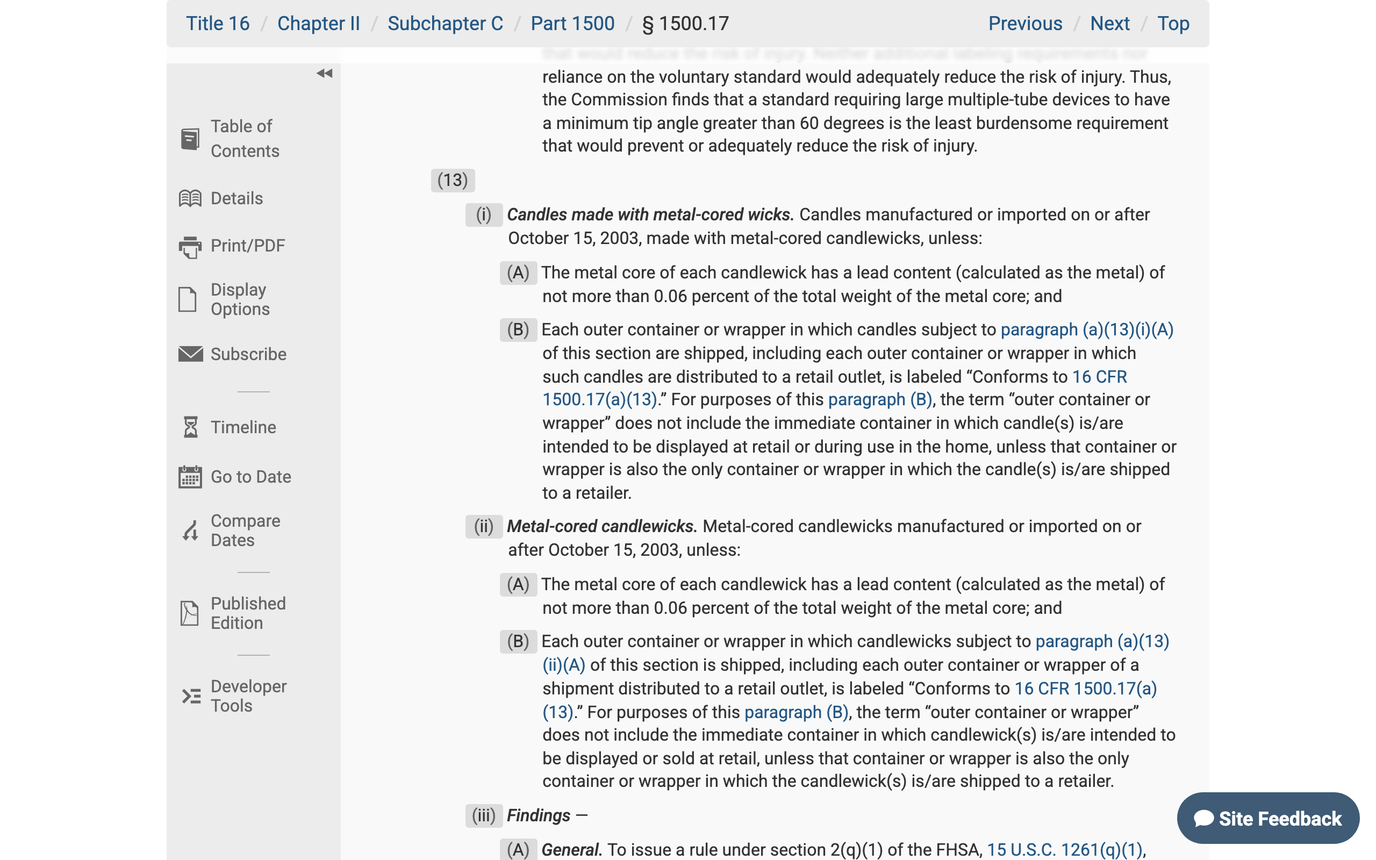
Section 1500.17(a)(13) declares a banned hazardous substance. Candles "manufactured or imported on or after October 15, 2003, made with metal-cored candlewicks" are banned unless the core carries a "lead content (calculated as the metal) of not more than 0.06 percent". The same limit covers wicks sold alone, and the threshold is measured against the metal core, not the whole wick. The 2003 final rule chose a ban over a labeling remedy.
Two things follow that nobody states plainly. First, the exemption is conditional on a label: bulk shipments to retailers must carry the statement "Conforms to 16 CFR 1500.17(a)(13)." on the shipping package or outer wrapping. CPSC guidance is explicit that this is not required on retail packaging, so the jar sticker is not where it goes.
Second, and this is the trap for an Etsy shop, section 14(a) of the Consumer Product Safety Act puts a General Certificate of Compliance on the manufacturer or importer. The CPSC gives the exact string for section 2: "16 CFR 1500.17(a)(13) - Metal-cored candlewicks". Buy finished candles from an overseas supplier and relabel them and you are the importer. The certificate is yours to issue, not your supplier's to promise.
| What you use | Subject to the ban? | GCC required? | Conformity statement on bulk shipments? |
|---|---|---|---|
| Cotton wick, no core | No | No | No |
| Wood wick | No | No | No |
| Paper-cored wick | No, the core is not metal | No | No |
| Zinc or tin-cored wick | Yes, and it passes if lead is at or under 0.06% of the core | Yes | Yes |
| Imported finished candle, metal-cored wick | Yes, and you are the importer | Yes, issued by you | Yes |
| Imported finished candle, cotton wick | No | No | No, but country-of-origin marking still applies |
The practical answer for a small shop is cotton or wood, with the supplier spec sheet on file, which removes the certification duty entirely. If you want a metal core for burn performance, you need a test report on it rather than a verbal assurance, because the certificate has to rest on something.
Net Weight, and the Taper Exemption Nobody Cites
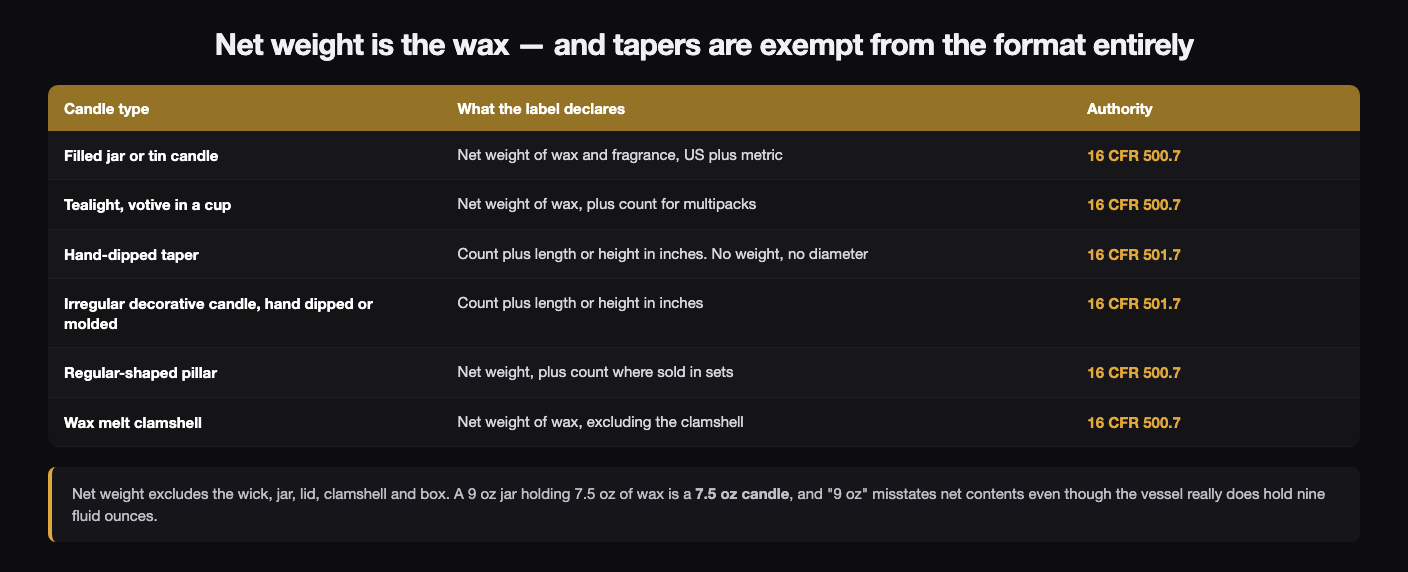
Net quantity is the requirement sellers get wrong most often, and the error is always the same: printing the weight of the finished candle. Net weight means the wax and fragrance, excluding the wick, jar, lid, clamshell and box. A 9 oz jar holding 7.5 oz of wax is a 7.5 oz candle, and "9 oz" on the label misstates net contents even though the vessel really does hold nine fluid ounces.
The declaration goes in both US customary and metric units, on the principal display panel, which for a jar candle is whichever face the buyer sees. Your name, city and state can live on the back or the warning label.
Then there is 16 CFR 501.7, written in 1971 and explained by almost no guide. It exempts tapered candles and irregularly shaped decorative candles that are either hand dipped or molded from the net-contents format in 500.7. They comply instead "by an expression of count and length or height in inches", with no diameter. Dip tapers or pour sculptural pillars and you are not weighing anything.
| Candle type | What the label declares | Authority |
|---|---|---|
| Filled jar or tin candle | Net weight of wax and fragrance, US plus metric | 16 CFR 500.7 |
| Tealight, votive in a cup | Net weight of wax, plus count for multipacks | 16 CFR 500.7 |
| Hand-dipped taper | Count plus length or height in inches. No weight, no diameter | 16 CFR 501.7 |
| Irregular decorative candle, hand dipped or molded | Count plus length or height in inches | 16 CFR 501.7 |
| Regular-shaped pillar | Net weight, plus count where sold in sets | 16 CFR 500.7 |
| Wax melt clamshell | Net weight of wax, excluding the clamshell | 16 CFR 500.7 |
Note what 501.7 does not do: it is an exemption from a format, not from labeling. A taper still needs an identity statement and a responsible party.
ASTM F2058 Is Voluntary. That Changes Less Than You Think
ASTM F2058-07(2021), Standard Specification for Candle Fire Safety Labeling, is the source of the warning block on nearly every candle sold in the United States. It is a consensus standard. The CPSC's own business guidance for candles lists it among the voluntary standards rather than incorporating it by reference, so no federal rule obliges you to carry it.
What it specifies is mostly placement and prominence. The warning must be on the unit of sale and visible at the point of sale, and it "shall not be covered, obstructed, or removed by the manufacturer, distributor or retailer". A text-only warning opens with the safety alert symbol followed immediately by WARNING in uppercase boldface. Pictograms, added as an option in the 2007 revision, supplement the written statements rather than replacing them.
The three statements the trade treats as mandatory
- Burn within sight. The one that cannot be swapped for a pictogram.
- Keep away from things that catch fire. The National Candle Association's pictogram is accepted in place of the text.
- Keep away from children. Pictogram also accepted.
Burn instructions, such as trimming the wick to a quarter inch and a maximum burn time per lighting, are trade practice rather than a requirement, and they are the sentences a defence lawyer most wants to point at.
Voluntary does not mean optional in commerce. A stockist's purchase order will require F2058 conformity, and in a fire claim the absence of a warning the whole industry carries is the first fact a plaintiff establishes. Two other ASTM documents matter and are never explained: F2417 sets fire-safety performance, covering flame height and stability, and F2179 covers annealed soda-lime-silicate glass containers made for candle use. Hold on to that last one.
Every Candle Recall Since 2024 Was About the Glass, Not the Label
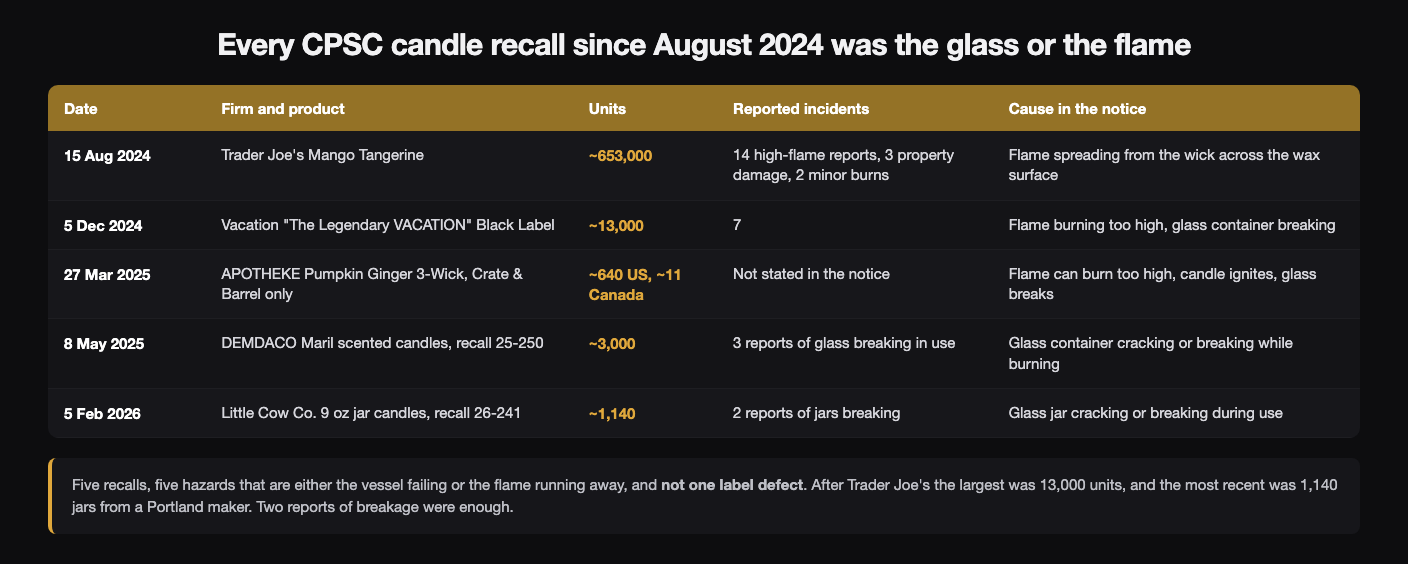
This is the part of the record no candle-labeling guide includes, and it inverts the advice. Here is every CPSC candle recall since August 2024, with what the notice says went wrong.
| Date | Firm and product | Units | Reported incidents | Cause in the notice |
|---|---|---|---|---|
| 15 Aug 2024 | Trader Joe's Mango Tangerine | ~653,000 | 14 high-flame reports, 3 property damage, 2 minor burns | Flame spreading from the wick across the wax surface |
| 5 Dec 2024 | Vacation "The Legendary VACATION" Black Label | ~13,000 | 7 | Flame burning too high, glass container breaking |
| 27 Mar 2025 | APOTHEKE Pumpkin Ginger 3-Wick, sold only at Crate & Barrel | ~640 US, ~11 Canada | Not stated in the notice | Flame can burn too high, candle ignites, glass breaks |
| 8 May 2025 | DEMDACO Maril scented candles, recall 25-250 | ~3,000 | 3 reports of glass breaking in use | Glass container cracking or breaking while burning |
| 5 Feb 2026 | Little Cow Co. 9 oz jar candles, recall 26-241 | ~1,140 | 2 reports of jars breaking | Glass jar cracking or breaking during use |
Five recalls, five hazards that are either the vessel failing or the flame running away, and not one label defect. The unit counts also kill the assumption that recalls are a big-brand problem: after Trader Joe's, the largest was 13,000 units, and the most recent was 1,140 jars from a Portland maker selling a $25 soy candle. Two reports of breakage were enough.
Look at what triggered the two most recent. DEMDACO reported after three incidents, Little Cow after two, and neither involved an injury. The remedy in both was a full refund, with Little Cow telling buyers to draw an X on the jar, cut the wicks and email a photo. That is the real cost to a small maker: refunds, stock, and a public notice with your company name in the headline.
Which is why ASTM F2179, the glass-container standard, deserves more attention than the warning text everybody obsesses over. If you pour into jars, the question that maps to the record is whether the vessel is annealed container glass sold for candle use, and whether your wick and fragrance load keep flame height inside what that glass tolerates. A supplier who cannot name their jar standard is selling you the hazard in all five notices.
The 24-Hour Clock That Starts With a Customer Message
This duty turns a complaint into a legal deadline, and no competing guide on this topic mentions it. Section 15(b) of the Consumer Product Safety Act requires manufacturers, importers, distributors and retailers to report information reasonably supporting a conclusion that a product has a defect that could create a substantial product hazard. A one-person Etsy shop pouring its own candles is the manufacturer.
The timing is in 16 CFR 1115.14. Paragraph (e), "Time to report", requires a report "immediately, that is, within 24 hours" after the firm obtains the triggering information. Paragraph (d) allows an investigation first but caps it: it "should not exceed 10 days unless a firm can demonstrate that a longer period is reasonable". And 1115.12(a) says not to delay in order to determine to a certainty that a reportable problem exists.
| What lands in your inbox | What you owe | By when | Source |
|---|---|---|---|
| One buyer says the jar cracked while burning | Investigate and evaluate reportability | Up to 10 days | 16 CFR 1115.14(d) |
| Your evaluation supports a possible substantial product hazard | File a section 15(b) report | 24 hours | 16 CFR 1115.14(e) |
| A report of death or grievous bodily injury | Report unless you have investigated and determined it is not reportable | Immediately | 16 CFR 1115.14(d) |
| You are unsure whether it is reportable | Report anyway; do not wait for certainty | 24 hours | 16 CFR 1115.12(a) |
The penalty exposure is real but widely misquoted. The 2008 CPSIA set the statutory maximums at $100,000 per violation and $15,000,000 for a related series, and the CPSC's 2021 inflation notice raised those to $120,000 and $17,150,000 for violations after 1 January 2022. A fresh schedule is due every fifth year, so in 2026, and we found no published 2026 CPSC notice. Treat $120,000 as the floor. Enforcement here is overwhelmingly about late reporting, not the defect.
Wax Melts Are Not Candles
Wax melts, warmers and reed diffusers get labeled as if they were candles, and the standards disagree. F2058 is written for candles at the unit of sale; candle accessories, where a warmer sits, have their own specification in ASTM F2601. A melt has no wick and no flame, so the three fire statements are the wrong warning set: the hazards are a hot wax pool and an electrical or tealight heat source.
| Product | US voluntary standard | FPLA net quantity | EU treatment |
|---|---|---|---|
| Jar or pillar candle | F2058 labeling, F2417 performance | Net weight of wax | GPSR, EN 15494, CLP if scented |
| Wax melt or tart | F2601 for the accessory, not F2058 | Net weight, clamshell excluded | GPSR and CLP as a scented mixture |
| Warmer or burner | F2601 | Count | GPSR, plus electrical rules if plugged in |
| Reed diffuser | No candle standard applies | Net volume of liquid | GPSR and CLP |
A melt still owes the FPLA set: identity, net weight of the wax with the clamshell excluded, and a responsible party. Put a candle fire warning on a melt and you have told the buyer something untrue about the product.
Selling Candles Into the EU
If your shop ships to the European Union, a stricter regime applies on top of everything above, and its thresholds do not care how small you are. The General Product Safety Regulation, Regulation (EU) 2023/988, has applied since 13 December 2024. It requires an EU-based responsible person named with the product, and Etsy is obliged to let you put that information on the listing.
Two EU points catch popular Etsy product shapes:
| Duty | Instrument | What it means for a candle listing |
|---|---|---|
| EU responsible person named on or with the product | GPSR, Reg. (EU) 2023/988 | A non-EU seller needs an EU economic operator before listing to EU buyers |
| Candle safety information and how it is displayed | EN 15494:2019 | The EU's own candle label standard, separate from ASTM F2058 |
| Hazard labeling for fragrance mixtures | CLP, Reg. (EC) 1272/2008 | Scented candles, melts and diffusers can need allergen and hazard statements |
| Food-imitating products prohibited | GPSR, which repealed Dir. 87/357/EEC | Dessert, fruit and food-shaped candles are a prohibited product shape |
That last row surprises people. The old EU food-imitation directive was folded into the GPSR when it took effect, and its target has always been non-food products a consumer, particularly a child, could mistake for food. Wax fruit and desserts are the textbook example: a croissant candle is unremarkable on Etsy in the US and non-compliant in the EU. Our Etsy EU compliance guide has the responsible-person mechanics.
Where Prop 65 Fits, and Where It Does Not
Candle guides that mention California Proposition 65 tend to assert that paraffin wax contains benzene and leave it there. That is a weak claim to build a label on, and it skips the threshold question that decides whether the statute reaches you.
The duty to warn applies to a "person in the course of doing business", and Health and Safety Code 25249.11(b) excludes anyone "employing fewer than 10 employees". Most Etsy candle shops sit outside the statute. What can still bind you is a contract: a stockist's vendor agreement often requires a warning with no size threshold, and that obligation is real even where the statute is not. The chemicals that show up in enforcement here are lead and toluene, not wax. Thresholds and exact wording are in our Etsy Prop 65 warnings guide.
The Label You Can Build This Afternoon
Putting the mandatory and the expected together, here is the whole job in order.
- Weigh the wax, not the jar. Filled vessel minus empty vessel and wick, in ounces and grams, is your net weight. Tapers declare count and length in inches under 501.7 instead.
- Name the product and yourself. Identity statement on the front; business name with city, state and ZIP somewhere on the package. The back of the warning label is an accepted spot.
- Choose a wick that removes a duty. Cotton or wood, with the supplier spec kept. A metal core adds a General Certificate of Compliance citing 16 CFR 1500.17(a)(13) plus a conformity statement on bulk shipments.
- Carry the F2058 block anyway. Safety alert symbol, WARNING in bold capitals, the three statements with "burn within sight" in words. Voluntary, and you want it.
- Ask your jar supplier which glass standard they meet. The step that maps to all five recalls: annealed container glass sold for candle use, and a wick size tested in that vessel.
- Decide now what you do with the first complaint. A cracked-jar message starts a clock you can only use for 10 days.
- Check the listing text, not just the sticker. An unsupportable claim in your description is a separate exposure from the label, and the one a marketplace acts on fastest.
Check the words in your listing before Etsy does. Unflagged scans Etsy listing text for the policy and compliance language that triggers takedowns and suspensions, including unsupportable safety and material claims. See what the plans include, or start with the complete Etsy seller compliance guide. Unflagged is our own product; we take no affiliate commission from any supplier, lab or standards body named in this article, and none of them paid for a mention.
Related Articles
- Etsy Prop 65 Warnings 2026: California Rules - the 10-employee threshold and the exact lawful warning strings
- Etsy Children's Products 2026: CPSIA Rules - the other CPSC regime, and the one that does require third-party testing
- Etsy EU Compliance 2026: Why Your Listings Are Hidden - GPSR responsible persons and what Etsy hides without one
- Etsy Cosmetics Rules 2026: FDA Labels - for sellers who pour candles and also make soap or balms
- Etsy Jewelry Labeling Requirements 2026: FTC Rules - the same FPLA logic applied to a different category
- Common Etsy Policy Violations - what actually gets listings pulled, ranked by frequency
FAQ
Is a warning label legally required on candles sold in the US?
No federal rule requires one. The three-statement fire warning comes from ASTM F2058, a voluntary standard the CPSC lists without incorporating it by reference. What makes it compulsory is commercial: stockists require it, insurers ask for it, and its absence is the first thing a fire claim establishes. Carry it.
What is the only mandatory federal candle regulation?
The lead limit on metal-cored wicks at 16 CFR 1500.17(a)(13). Candles made or imported on or after 15 October 2003 with metal-cored wicks are banned hazardous substances unless the core holds no more than 0.06 percent lead. Cotton, wood and paper-cored wicks are untouched by it.
Do I need a General Certificate of Compliance for my candles?
Only if the wick has a metal core. The CPSC states that non-metal-cored wicks, and candles using them, carry no certification requirement. Where a metal core is used, CPSA section 14(a) puts the certificate on the manufacturer or importer, and section 2 must cite "16 CFR 1500.17(a)(13) - Metal-cored candlewicks". Import finished candles and relabel them and you are the importer.
Does the net weight include the jar?
No. Net weight is the wax and fragrance only, excluding the wick, container, lid and outer packaging. Printing the weight of the filled vessel misstates net contents. Declare it in US and metric units on the face the buyer sees.
Do tapered candles need a net weight?
No. 16 CFR 501.7 exempts tapered and irregularly shaped decorative candles that are hand dipped or molded from the net-contents format in 500.7. They comply by stating count and length or height in inches, with no diameter. They still need an identity statement and a responsible party.
What do I do if a buyer tells me the glass cracked?
Treat it as a reporting clock, not just a refund. Under 16 CFR 1115.14(d) you may investigate, but that evaluation should not exceed 10 days. If it supports a possible substantial product hazard, 1115.14(e) requires a report "immediately, that is, within 24 hours". The recent recalls were triggered by two and three reports with no injuries, so the bar is lower than sellers expect.
Can I label wax melts the same way as candles?
You should not. ASTM F2058 is written for candles at the unit of sale; accessories such as warmers fall under ASTM F2601. A melt has no flame of its own, so the candle fire statements describe hazards it does not have. A melt owes the FPLA set: identity, net weight excluding the clamshell, and your name and place of business.
Scan Your Listings Free
Check your Etsy listings for trademark violations in seconds. 3 free scans, no signup required.
Start Free ScanRelated Articles
How to Check Your Etsy Listings for Trademark Violations (2026 Guide)
Learn how to scan your Etsy listings for trademark violations before they get flagged. Step-by-step guide to protecting your shop from takedowns and suspensions.
Read moreEtsy Shop Suspended? How to Write a Winning Appeal Letter
Your Etsy shop got suspended. Here's exactly how to write an appeal letter that gets your shop reinstated, with templates and strategies that actually work.
Read more50 Words That Are Trademarked on Etsy (Stop Using These Now)
A comprehensive list of commonly trademarked words and phrases that Etsy sellers use without realizing they're violating trademark law. Check your listings now.
Read more