Etsy Eco-Friendly Claims 2026: FTC Rules
Etsy eco-friendly claims in 2026: which green words are safe, the FTC Green Guides thresholds, Etsy's 50% recycled rule, and the new EU blacklist.
- 1.The FTC Green Guides Are Not Law, and That Is the Trap
- 2."Eco-Friendly" Is the One Claim With No Safe Short Version
- 3.The Six Numbers That Decide Every Green Claim on Etsy
- 4.Biodegradable and Compostable: One Year, and the California Wall
- 5.Recyclable, Chasing Arrows, and the Law That Was Enjoined in July
- 6."Non-Toxic" Covers the Planet, Not Just the Buyer
- 7.Etsy's Sustainability Attributes Are a Second, Separate Promise
- 8.What Enforcement Has Actually Looked Like
- 9.Selling Into the EU After 27 September 2026
- 10.The Claim Audit You Can Run This Afternoon
- 11.Related Articles
- 12.FAQ
Key takeaways
- The FTC Green Guides are not a regulation and cannot be violated. They are the FTC's published reading of one statute, FTC Act section 5. What carries a penalty is deception, up to $53,088 per violation under 16 CFR 1.98.
- "Eco-friendly" alone is the claim the FTC treats as effectively unsubstantiable. 16 CFR 260.4 calls an unqualified general benefit claim deceptive because buyers read it as promising everything and no downside. Etsy's guidance says the same.
- An unqualified "biodegradable" needs the whole item gone within one year of normal disposal (260.8(c)), and the rule says landfills, incinerators and recycling facilities do not provide those conditions. For most Etsy products the word is unusable, not merely risky.
- California's recyclability labelling law was enjoined on 14 July 2026, before its own 4 October 2026 trigger date. The injunction binds the Attorney General and may not reach district attorneys or private plaintiffs.
- Etsy's attributes are a second promise with their own numbers. Recycled content asks you to certify recycled materials are at least 50% of the item, and Etsy may ask for documentation.
A seller pours soy candles into reclaimed jars, ships in paper tape and kraft boxes, and writes what she believes: "eco-friendly, biodegradable packaging, non-toxic." All three are true in the ordinary sense, and all three are words US advertising law treats as claims she must be able to prove. The vaguest one is the hardest to defend.
Kohl's and Walmart paid $5.5 million in civil penalties in April 2022 over rayon marketed as bamboo with environmental benefits attached, twelve years after the FTC warned both of them. A one-person shop's exposure is not a penalty that size. It is a listing pulled, a buyer dispute you cannot win, and in several states a consumer-protection claim.
We read the operative text of 16 CFR 260.4, 260.7, 260.8, 260.10 and 260.12, took the penalty figure from 16 CFR 1.98, read Directive (EU) 2024/825 in the Official Journal, and traced California's two labelling statutes through this year. What follows separates the words that work with a qualifier, the words that need a certificate, and the ones not available at all.

The FTC Green Guides Are Not Law, and That Is the Trap
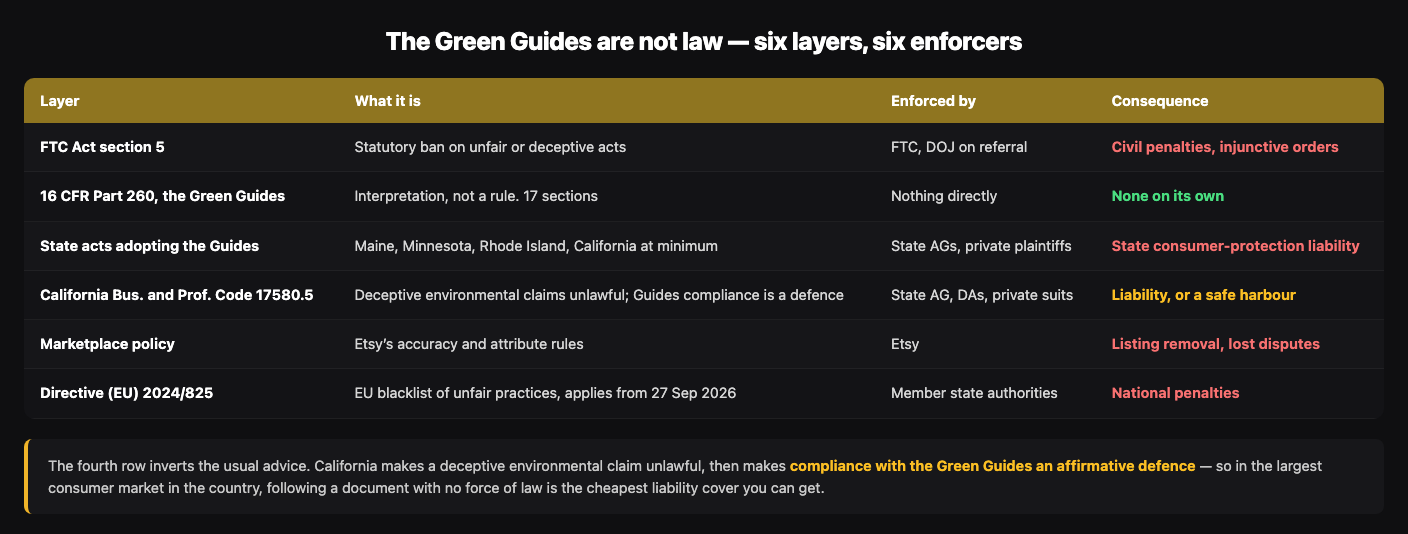
Most guides to Etsy eco-friendly claims open by calling the FTC Green Guides "the rules". They are not rules. They are administrative interpretations, first issued in 1992 and last revised in 2012, explaining how the Commission reads the FTC Act's ban on deceptive practices in environmental marketing. There is nothing in them to breach, which leaves you exposed to the open-ended deception standard underneath, with the Guides as the best map of how it gets applied.
| Layer | What it is | Enforced by | Consequence |
|---|---|---|---|
| FTC Act section 5 | Statutory ban on unfair or deceptive acts | FTC, DOJ on referral | Civil penalties, injunctive orders |
| 16 CFR Part 260, the Green Guides | Interpretation, not a rule. 17 sections | Nothing directly | None on its own |
| State acts adopting the Guides | Maine, Minnesota, Rhode Island, California at minimum | State AGs, private plaintiffs | State consumer-protection liability |
| California Bus. and Prof. Code 17580.5 | Deceptive environmental claims unlawful, Guides compliance is a defence | State AG, DAs, private suits | Liability, or a safe harbour |
| Marketplace policy | Etsy's accuracy and attribute rules | Etsy | Listing removal, lost disputes |
| Directive (EU) 2024/825 | EU blacklist of unfair practices, applies from 27 Sep 2026 | Member state authorities | National penalties |
The fourth row inverts the usual advice. California makes a deceptive environmental marketing claim unlawful, then makes compliance with the Green Guides an affirmative defence. In the largest consumer market in the country, following a document with no force of law is the cheapest liability cover you can get. Sources differ on which other states adopted the Guides: Maine, Minnesota and Rhode Island appear on every list we found, New York and Michigan on some.
One point of 2026 context: the FTC opened a review in December 2022 and took roughly 7,066 comments by April 2023. Nothing has been finalised since, so the 2012 text is still operative, and any guide promising a 2026 rewrite is speculating.
"Eco-Friendly" Is the One Claim With No Safe Short Version
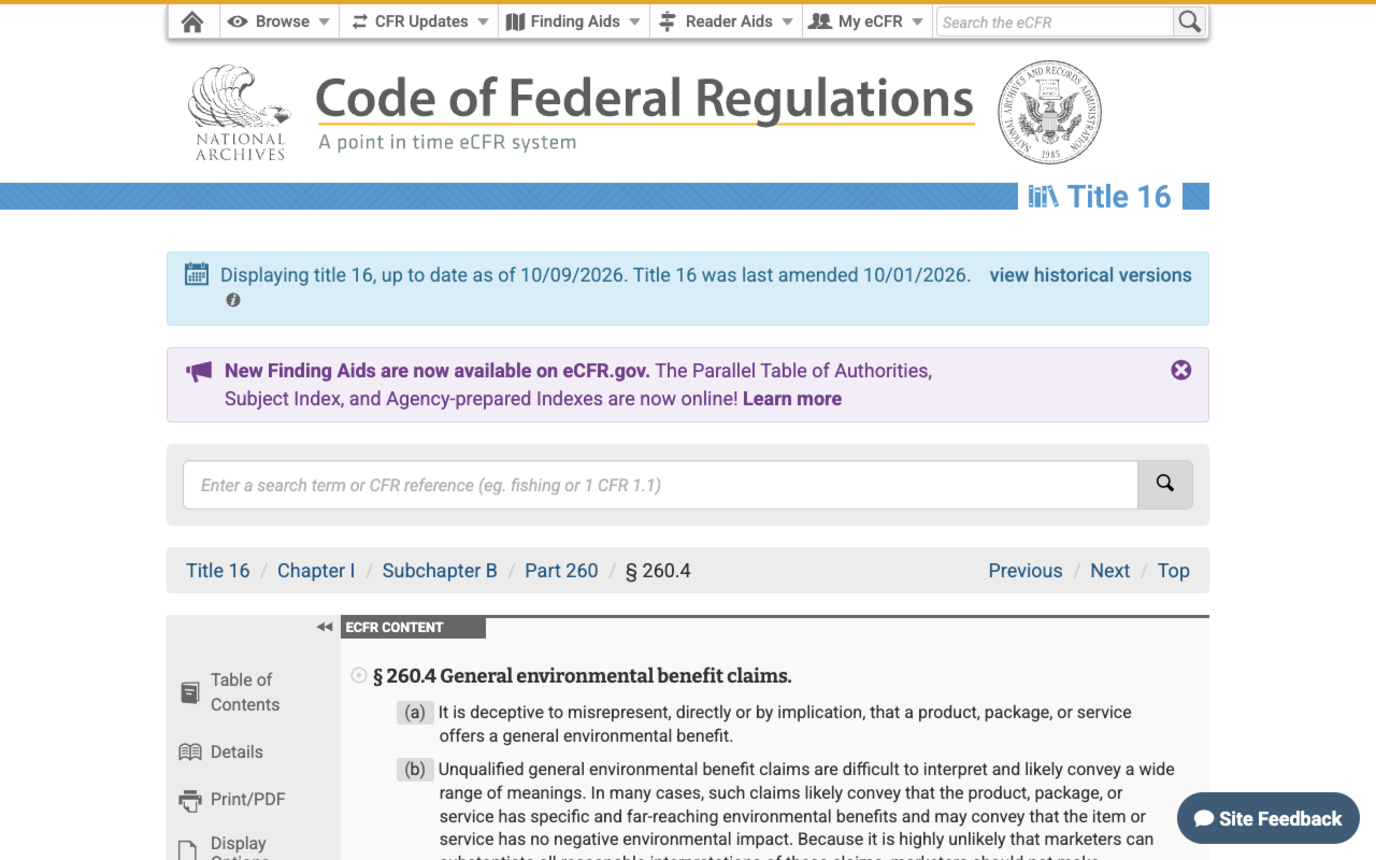
16 CFR 260.4 should change how you write listings. It says presenting a product as offering a general environmental benefit is deceptive, and explains why bluntly: terms like "eco-friendly" are so vague that buyers read them as promising far-reaching benefits and no negative impact, and a marketer is unlikely to substantiate every reasonable reading.
What 260.4's own examples turn on
- A true fact stated misleadingly still fails. "Greener than our previous packaging" was deceptive where the only change was a 15% weight reduction, because buyers assume broader improvement.
- Imagery is a claim. A printer ad showing a bird's nest and dense forest was deceptive with no environmental words at all.
- Trivial gains cannot carry big words. "Eco-smart" on a mower with a 1/10 of 1% fuel-efficiency gain is accurate and still misleading.
The third one catches honest sellers. Being literally true is not the test; what a buyer takes away is, and that example is a company that could prove its number and lost anyway. Etsy's guidance lands in the same place, and it is enforced against you fastest: avoid bare terms like "green", and state the specific environmental benefit instead.
The Six Numbers That Decide Every Green Claim on Etsy
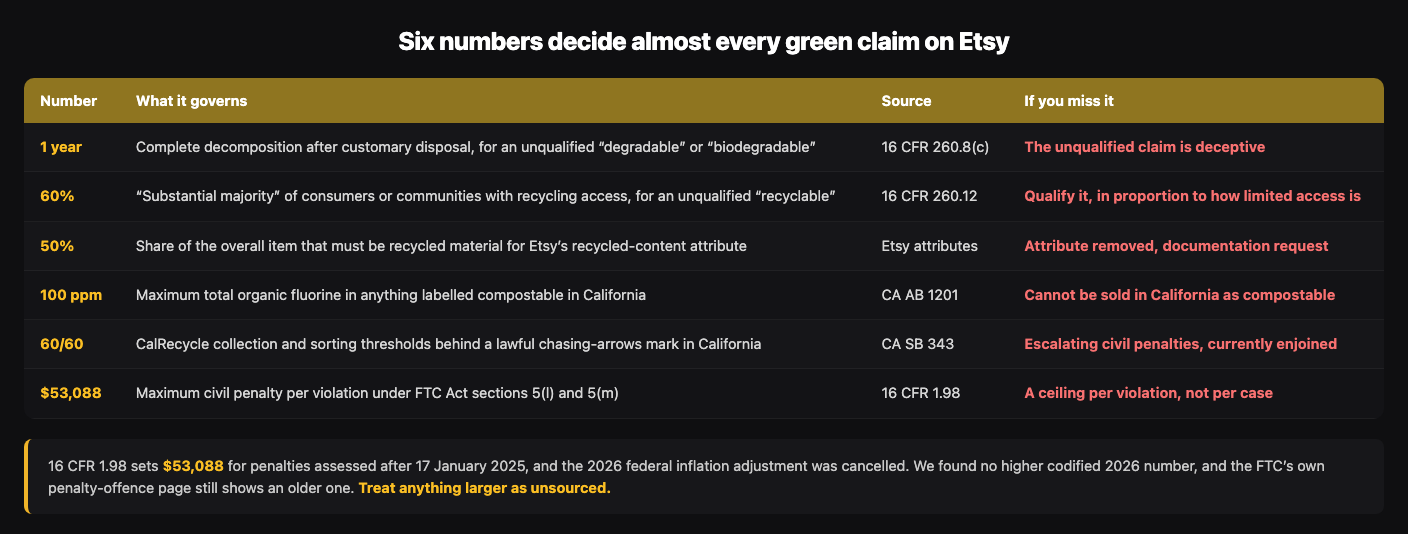
This looks like judgement until you notice how much of it is arithmetic. Six numbers do most of the work, and no competing guide we read puts them in one place.
| Number | What it governs | Source | If you miss it |
|---|---|---|---|
| 1 year | Complete decomposition after customary disposal, for an unqualified "degradable" or "biodegradable" | 16 CFR 260.8(c) | The unqualified claim is deceptive |
| 60% | "Substantial majority" of consumers or communities with recycling access, for an unqualified "recyclable" | 16 CFR 260.12 | Qualify it, in proportion to how limited access is |
| 50% | Share of the overall item that must be recycled material for Etsy's recycled-content attribute | Etsy attributes | Attribute removed, documentation request |
| 100 ppm | Maximum total organic fluorine in anything labelled compostable in California | CA AB 1201 | Cannot be sold in California as compostable |
| 60/60 | CalRecycle collection and sorting thresholds behind a lawful chasing-arrows mark in California | CA SB 343 | Escalating civil penalties, currently enjoined |
| $53,088 | Maximum civil penalty per violation under FTC Act sections 5(l) and 5(m) | 16 CFR 1.98 | A ceiling per violation, not per case |
On the last figure: 16 CFR 1.98 sets $53,088 for penalties assessed after 17 January 2025, and the 2026 federal inflation adjustment was cancelled. We found no higher codified 2026 number, and the FTC's own penalty-offence page still shows an older one. Treat anything larger as unsourced.
Biodegradable and Compostable: One Year, and the California Wall
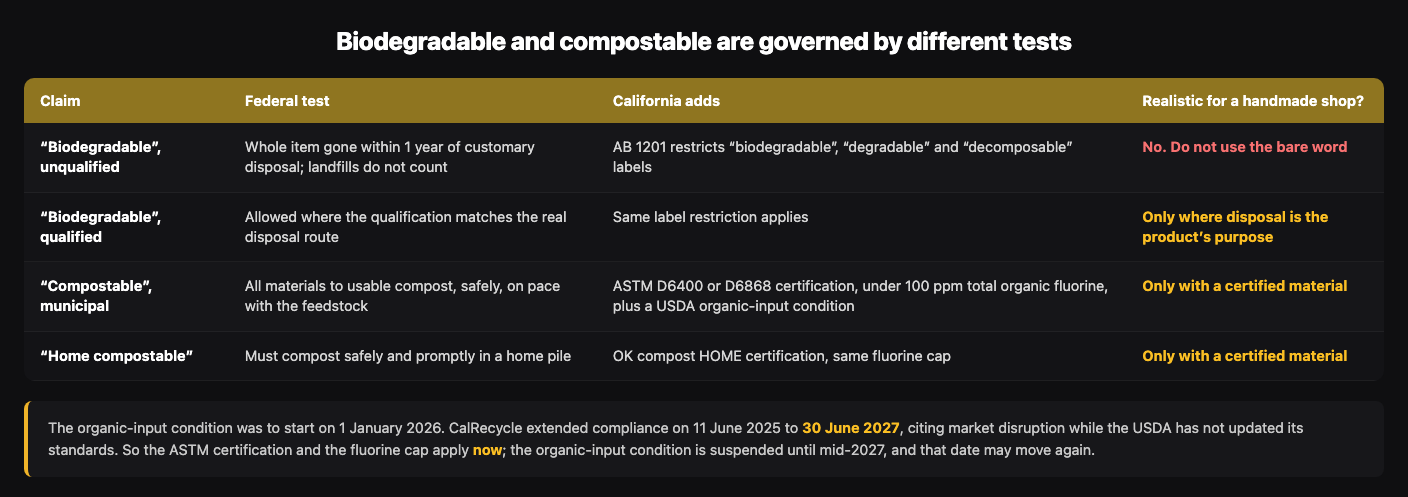
These two look like synonyms and are governed by different tests. Section 260.8 handles degradability: the entire item must completely break down and return to nature within a reasonably short period after customary disposal, and subsection (c) fixes that at one year for anything entering the solid waste stream. It then closes the escape route, stating that landfills, incinerators and recycling facilities do not provide conditions for complete decomposition within a year.
Together those sentences remove the word from most of what sells on Etsy. Your kraft mailer goes in a bin bound for a landfill, and a soil-burial test proves nothing about that, which is the point of 260.8's trash-bag example. What survives is where the disposal route is the product's purpose: the section blesses an unqualified claim for a shampoo where the ad makes clear only the shampoo and not the bottle breaks down, and for a fibre plant pot buried with the plant.
Section 260.7 handles compostability differently: scientific evidence that every material breaks down into usable compost safely and in about the same time as the materials it is composted with. Qualify it if the item cannot be composted safely at home, and again if municipal facilities are not available to a substantial majority of buyers where you sell. California adds conditions with no federal equivalent.
| Claim | Federal test | California adds | Realistic for a handmade shop? |
|---|---|---|---|
| "Biodegradable", unqualified | Whole item gone within 1 year of customary disposal; landfills do not count | AB 1201 restricts "biodegradable", "degradable" and "decomposable" labels | No. Do not use the bare word |
| "Biodegradable", qualified | Allowed where the qualification matches the real disposal route | Same label restriction applies | Only where disposal is the product's purpose |
| "Compostable", municipal | All materials to usable compost, safely, on pace with the feedstock | ASTM D6400 or D6868 certification, under 100 ppm total organic fluorine, plus a USDA National Organic Program input condition | Only with a certified material |
| "Home compostable" | Must compost safely and promptly in a home pile | OK compost HOME certification, same fluorine cap | Only with a certified material |
The organic-input condition is the one to watch, because its timing moved. It was to start on 1 January 2026; CalRecycle extended compliance on 11 June 2025 to 30 June 2027, citing market disruption while the USDA has not updated its standards. The agency may extend by up to five years in total and has used eighteen months. So: the ASTM certification and the fluorine cap apply now, the organic-input condition is suspended until mid-2027, and that date may move again.
Recyclable, Chasing Arrows, and the Law That Was Enjoined in July
Section 260.12 is more permissive than sellers expect and stricter in one place nobody anticipates. Where recycling is available to a substantial majority of consumers or communities where the item is sold, defined as at least 60%, an unqualified "recyclable" is fine. Below that you qualify, and the qualification must strengthen as access thins: "recyclable where facilities exist" is called out as deceptive for a product with limited national access, while "recyclable in the few communities with facilities" passes.
Two traps. A resin code shown conspicuously on the front of a label is a recyclability claim, while the same code on a container's base is not. And if any component significantly limits recyclability, including by shape or size, the claim is deceptive even when the material is recyclable. A recyclable mailer with a non-recyclable window is the whole problem in one object.
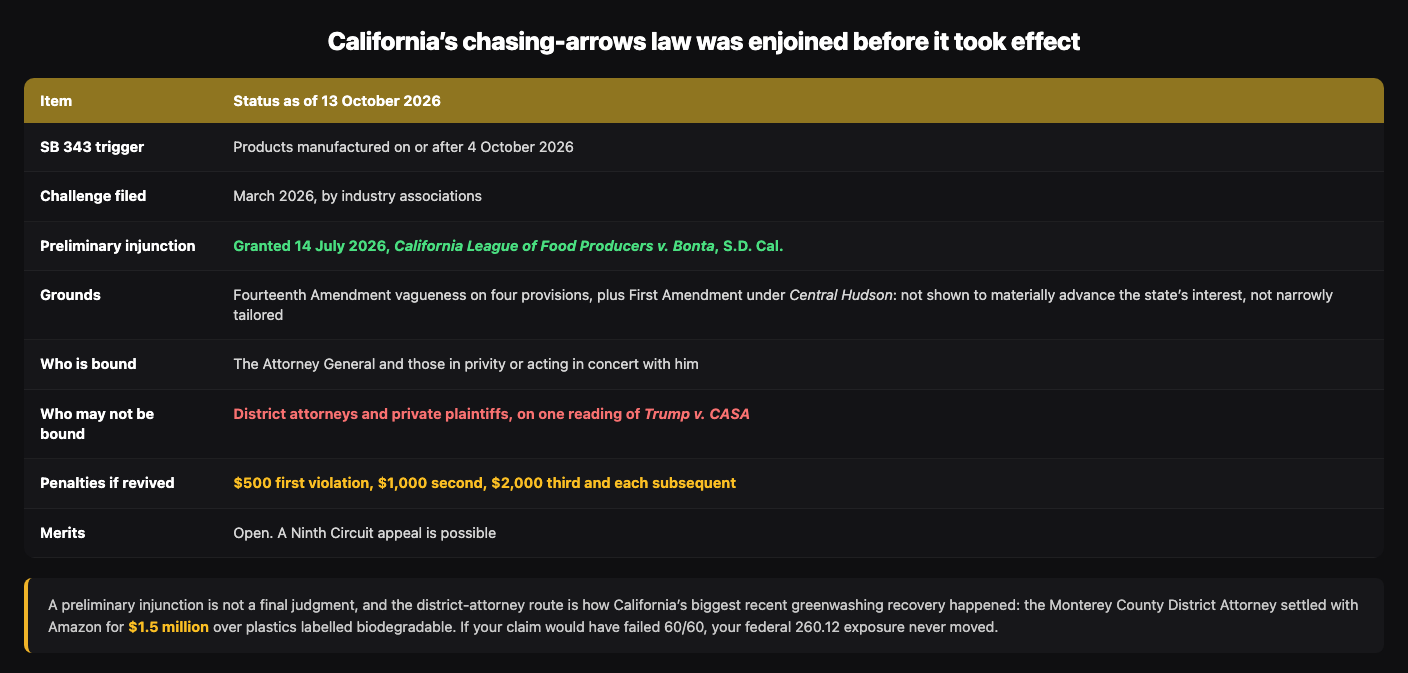
California tried to replace that judgement with a test, and the attempt is on hold. SB 343 restricted the chasing-arrows symbol and recyclability claims to materials meeting a 60/60 requirement: collected by programmes serving at least 60% of the state's population and sorted by at least 60% of its recycling programmes. The trigger was the date of manufacture, not sale.
| Item | Status as of 13 October 2026 |
|---|---|
| SB 343 trigger | Products manufactured on or after 4 October 2026 |
| Challenge filed | March 2026, by industry associations |
| Preliminary injunction | Granted 14 July 2026, California League of Food Producers v. Bonta, S.D. Cal. |
| Grounds | Fourteenth Amendment vagueness on four provisions, plus First Amendment under Central Hudson: not shown to materially advance the state's interest, not narrowly tailored |
| Who is bound | The Attorney General and those in privity or acting in concert with him |
| Who may not be bound | District attorneys and private plaintiffs, on one reading of Trump v. CASA |
| Penalties if revived | $500 first violation, $1,000 second, $2,000 third and each subsequent |
| Merits | Open. A Ninth Circuit appeal is possible |
The practical reading is narrower than "the law is dead". A preliminary injunction is not a final judgment, it binds the Attorney General rather than erasing the statute, and the district-attorney route is how California's biggest recent greenwashing recovery happened: the Monterey County District Attorney settled with Amazon for $1.5 million over plastics labelled biodegradable. If your claim would have failed 60/60, your federal 260.12 exposure never moved. For the same facts under a state statute with its own thresholds, see our Etsy Prop 65 warnings guide.
"Non-Toxic" Covers the Planet, Not Just the Buyer
Section 260.10 says a non-toxic claim is understood to cover humans and the environment in general. To use it unqualified you need competent and reliable scientific evidence of both.
Its single example is a cleaning product sold as "essentially non-toxic" and "practically non-toxic". The hedges do not help: the phrases still convey no risk to people, pets or the environment, and are deceptive where the product is safe for people but toxic to the environment. The free-of guidance in 260.9 has its own trap, since such a claim can mislead even when literally accurate, where the substance was never used in that category anyway.
"Non-toxic" sits on a huge share of handmade candles, bath products and kids' items, and almost always means "safe to be around". That is half of what a regulator reads it to mean. Say the half you can support.
Etsy's Sustainability Attributes Are a Second, Separate Promise
Everything above is advertising law. Etsy runs its own system on top of it, and that one can cost you a listing this week rather than a letter next year. Etsy's Seller Policy puts accuracy on you in terms wide enough to cover every claim here, reaching attributes, components and materials in both listings and listing photos. The attributes themselves are opt-in certifications you make, and Etsy says it monitors their use and may ask for documentation, naming receipts for sustainable materials and official certifications as acceptable proof.
| Etsy claim surface | What you are certifying | What to keep on file |
|---|---|---|
| Recycled-content attribute | Recycled materials are at least 50% of the overall item | Supplier invoices for recycled stock, with quantities that reconcile to your output |
| Ethical-gemstone attribute | All gemstones in or on the item, diamonds included | Per-stone provenance from each supplier |
| "Compostable" or "biodegradable" in listing text | Evidence the materials break down and return to nature within a year of disposal | ASTM D6400 or D6868 certificate from the material maker, or drop the word |
| "Eco-friendly" or "green" in title or tags | Nothing specific, which is the problem | Replace with the named benefit you can document |
One consequence is easy to miss and expensive: Etsy's Purchase Protection does not cover orders that differ from the listing description. An eco claim you cannot stand behind is therefore also a dispute you lose on the merits when a buyer says the item was not as described. Both rules converge on the discipline running through our complete Etsy seller compliance guide: write only what you can show.
What Enforcement Has Actually Looked Like
No competing guide we read carries a case table, which leaves sellers guessing about scale. Here is the record.
| Year | Target | Claim at issue | Outcome | Brought by |
|---|---|---|---|---|
| 2022 | Kohl's and Walmart | Rayon marketed as bamboo, with eco-friendly process claims | $2.5m and $3.0m civil penalties | FTC, via DOJ |
| 2013 | AJM Packaging | Degradability claims, breaching a 1994 order | $450,000 civil penalty | FTC |
| 2013 | Clear Choice Housewares | "Quickly biodegrades in landfills" on food containers | Order, no penalty | FTC |
| 2009 | Dyna-E International | "Biodegradable" rayon towels | Order barring the claim, no penalty | FTC |
| 2020s | Amazon | Plastic products labelled biodegradable | $1.5m settlement | Monterey County DA |
Two things there matter more than the dollar figures. The 2013 sweep established that suppliers who issue certificates of biodegradability can be liable for giving downstream sellers the means to deceive, so a supplier's assurance is not a shield. And two of five actions produced no penalty, reflecting the FTC's practice of writing to smaller businesses first, which is what Kohl's and Walmart got in 2010 and ignored. See our Etsy Made in USA claims guide for the FTC's other substantiation regime, and Etsy clothing label rules for the statute the bamboo penalties were brought under.
Selling Into the EU After 27 September 2026
If you ship to the European Union, the rules changed sixteen days before this article was written. Directive (EU) 2024/825 was adopted on 28 February 2024, had to be transposed by 27 March 2026, and member states apply it from 27 September 2026. It adds practices to the EU's blacklist, meaning they are unfair in all circumstances with no case-by-case assessment.
| Blacklist point | What it prohibits | Effect on a listing |
|---|---|---|
| Annex I, point 4a | A generic environmental claim the trader cannot show amounts to recognised excellent environmental performance relevant to the claim | "Eco-friendly" and "green" are effectively unavailable without something like an EU Ecolabel |
| Annex I, point 2a | Displaying a sustainability label not based on a certification scheme or not established by public authorities | Self-made badges and seals must come off |
Two notes. There is no transition period for existing stock, so pages already in market had to comply on day one. And the separate Green Claims Directive, often confused with this one, was withdrawn in June 2025. The responsible-person mechanics beside it are in our Etsy EU compliance guide.
The Claim Audit You Can Run This Afternoon
Putting the federal, state, marketplace and EU layers together, here is the job in order.
- Search your shop for six words. Eco-friendly, green, sustainable, biodegradable, compostable, non-toxic, across titles, tags, descriptions, announcement and photos with text on them.
- Delete every bare general claim. Replace it with the specific benefit you can document, or with nothing.
- Retire "biodegradable" unless disposal is the point. The one-year test plus the landfill exclusion defeats almost every product.
- Demand the certificate for "compostable". ASTM D6400 or D6868, or OK compost HOME, held by whoever made the material. No certificate, no word.
- Check any recyclable claim against 60%, and find the component that spoils it: a window, a liner, an adhesive, a size machinery rejects.
- Split "non-toxic" in half. If you can support human safety but not environmental safety, say so.
- Reconcile every Etsy attribute you have ticked. Recycled content means at least 50% of the item, and Etsy can ask you to prove it.
- Open a substantiation file before you need it. Spec sheets, certificates and invoices, dated, per claim. Substantiation must exist when the claim is made, not when it is challenged.
Check the words in your listings before Etsy does. Unflagged scans Etsy listing text for the policy and compliance language that triggers takedowns and suspensions, including unsupportable environmental and safety claims. See what the plans include, or start with the most common Etsy policy violations. Unflagged is our own product; we take no affiliate commission from any certifier, lab or standards body named in this article, and none of them paid for a mention. Nothing here is legal advice.
Related Articles
- Etsy Prop 65 Warnings 2026: California Rules - the other California statute, with a 10-employee exemption
- Etsy Made in USA Claims 2026: FTC Rules - the FTC's other substantiation regime, and the one it polices hardest
- Etsy Clothing Labels 2026: FTC Fiber Rules - the statute the bamboo penalties were brought under
- Etsy Cosmetics Rules 2026: FDA Labels - for soap, balms and bath products with "natural" claims
- Etsy EU Compliance 2026: Why Your Listings Are Hidden - GPSR responsible persons beside the green-claims blacklist
- Why Etsy Deactivated Your Listing - when a claim has already cost you a listing
FAQ
Can I say "eco-friendly" on an Etsy listing?
Not on its own. 16 CFR 260.4 treats an unqualified general environmental benefit claim as deceptive, because buyers read it as promising far-reaching benefits and no downside. Etsy's guidance also tells sellers to name the specific benefit instead.
Are the FTC Green Guides actually law?
No. They are administrative interpretations of FTC Act section 5, last revised in 2012, and are not independently enforceable. What is enforceable is the deception standard they interpret, plus state statutes adopting them. California makes compliance a defence to a state claim.
Why can't I call my kraft packaging biodegradable?
Because of the disposal route, not the material. 16 CFR 260.8(c) requires the entire item to decompose completely within one year after customary disposal, and says landfills, incinerators and recycling facilities do not provide those conditions. Packaging bound for a landfill fails however compostable the fibre is in a garden.
What does it take to label something compostable in California?
More than the federal test. AB 1201 requires third-party certification to ASTM D6400 or D6868, or OK compost HOME for a home claim, and under 100 ppm total organic fluorine. A USDA National Organic Program input condition was due on 1 January 2026; CalRecycle extended it to 30 June 2027.
Is California's chasing-arrows law in force?
Unsettled. SB 343 applied to products manufactured on or after 4 October 2026, but on 14 July 2026 a federal court preliminarily enjoined the Attorney General from enforcing it in California League of Food Producers v. Bonta. On one reading it does not reach district attorneys or private plaintiffs, and the merits are open.
Is "non-toxic" a safe claim for candles or bath products?
Only if you can support both halves. 16 CFR 260.10 reads a non-toxic claim as covering humans and the environment in general, so an unqualified claim needs scientific evidence for both. Hedges do not fix it: the section rejects "essentially non-toxic" where the product is safe for people but toxic to the environment.
Does any of this apply if I only sell a few items a month?
Yes. There is no small-seller exemption in Part 260 or in FTC Act section 5. What changes with size is practice, not law: the FTC commonly writes to a small business first, as it did to Kohl's and Walmart in 2010, twelve years before the penalties. Etsy's accuracy rule has no threshold.
Scan Your Listings Free
Check your Etsy listings for trademark violations in seconds. 3 free scans, no signup required.
Start Free ScanRelated Articles
How to Check Your Etsy Listings for Trademark Violations (2026 Guide)
Learn how to scan your Etsy listings for trademark violations before they get flagged. Step-by-step guide to protecting your shop from takedowns and suspensions.
Read moreEtsy Shop Suspended? How to Write a Winning Appeal Letter
Your Etsy shop got suspended. Here's exactly how to write an appeal letter that gets your shop reinstated, with templates and strategies that actually work.
Read more50 Words That Are Trademarked on Etsy (Stop Using These Now)
A comprehensive list of commonly trademarked words and phrases that Etsy sellers use without realizing they're violating trademark law. Check your listings now.
Read more