Etsy Prop 65 Warnings 2026: California Rules
Etsy Prop 65 warnings in 2026: who the 10-employee rule exempts, where the warning must sit on your listing, the exact wording, and the real cost.
- 1.Who the Etsy Prop 65 Warning Rule Actually Applies To
- 2.Etsy Has Already Lost This Fight Three Times
- 3.Where the Etsy Prop 65 Warning Has to Sit on a Listing
- 4.The Exact Wording, and the 2028 Cliff
- 5.Retail Seller or Manufacturer: Which One Are You?
- 6.Which Chemicals Actually Draw the Letters
- 7.What a 60-Day Notice Costs, and Who Keeps the Money
- 8.What Changes Next: OEHHA's Omnibus 2026 Proposal
- 9.How to Audit Your Own Listings This Week
- 10.Related Articles
- 11.FAQ
Key takeaways
- Under ten employees and Proposition 65 does not reach you. Health and Safety Code 25249.11(b) says "person in the course of doing business" excludes anyone "employing fewer than 10 employees". Most Etsy shops are outside the statute entirely, and no competitor guide leads with this.
- Etsy, Inc. has settled Proposition 65 claims three times, and every agreement hands the duty to you. The most recent one, effective 27 January 2026, says Etsy "shall not be responsible or liable for failures of any vendors or third-party sellers" to meet their own obligations.
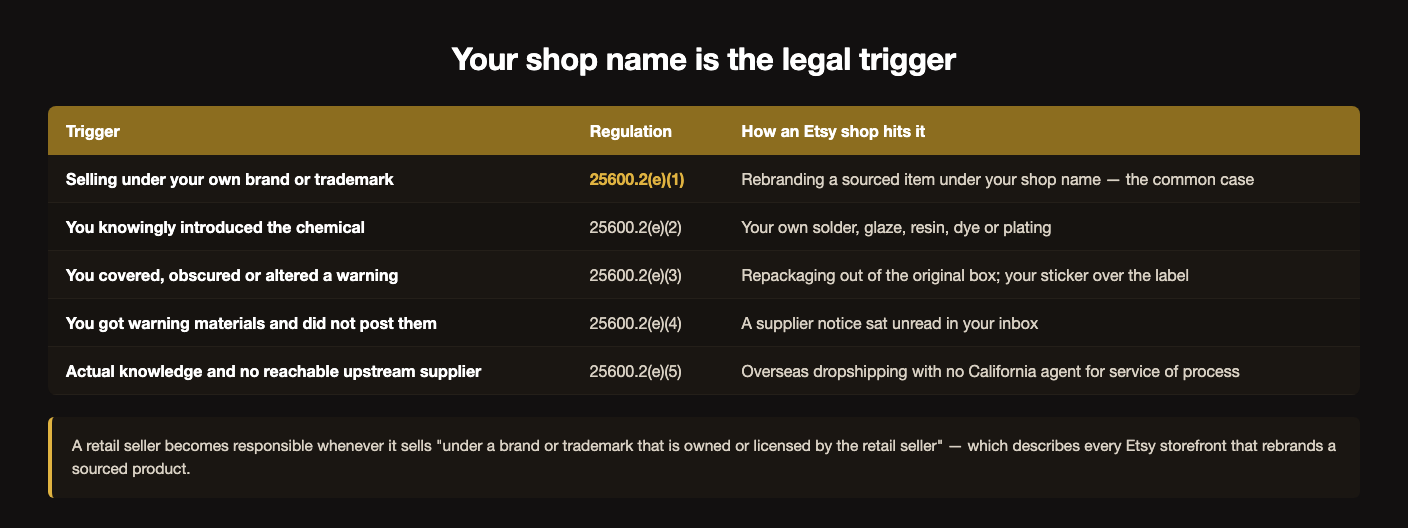
- Your shop name is a legal trigger. 16 CFR-style section 25600.2(e)(1) makes a retail seller responsible whenever it sells "under a brand or trademark that is owned or licensed by the retail seller" - which describes every Etsy storefront that rebrands a sourced product.
- The money is not the penalty. Across the 898 private settlements in the Attorney General's 2019 report, $22,676,093 of $29,810,351 - 76% - went to plaintiffs' attorney's fees, against 18% in civil penalties.
- The short-form warning now has to name a chemical. The bare "WARNING: Cancer" label is only lawful on products manufactured and labeled before 1 January 2028, whenever they sell.
A seller lists a brass pendant, a jar of cadmium-red artist paint and a tin of furniture wax. Two of those three have already produced a Proposition 65 settlement against Etsy itself, and the third is the single most-noticed chemical in California. Her shop has one employee, so the statute does not apply to her at all - but the supplier agreement she signed last month says it does, and Etsy's compliance email says it does.
That is the real shape of the Etsy Prop 65 warning problem in 2026: the law is narrower than almost every guide claims, and the private contracts stacked on top of it are much wider. Guessing wrong costs money either way. An unnecessary warning scares buyers off a product that never needed one; a missing warning on a product that did invites a notice whose average settlement runs past $33,000, most of it legal fees.
We read the operative regulations in Title 27 of the California Code of Regulations, pulled the statute from the Health and Safety Code, downloaded all three of Etsy's own settlement agreements from the Attorney General's files and totalled his 2019 settlement report line by line. Where a rule is still a proposal rather than law, this article says so.

Who the Etsy Prop 65 Warning Rule Actually Applies To
Proposition 65 is one sentence of duty and a long tail of regulation. Health and Safety Code 25249.6 bars a "person in the course of doing business" from knowingly and intentionally exposing anyone to a listed chemical without a clear and reasonable warning first.
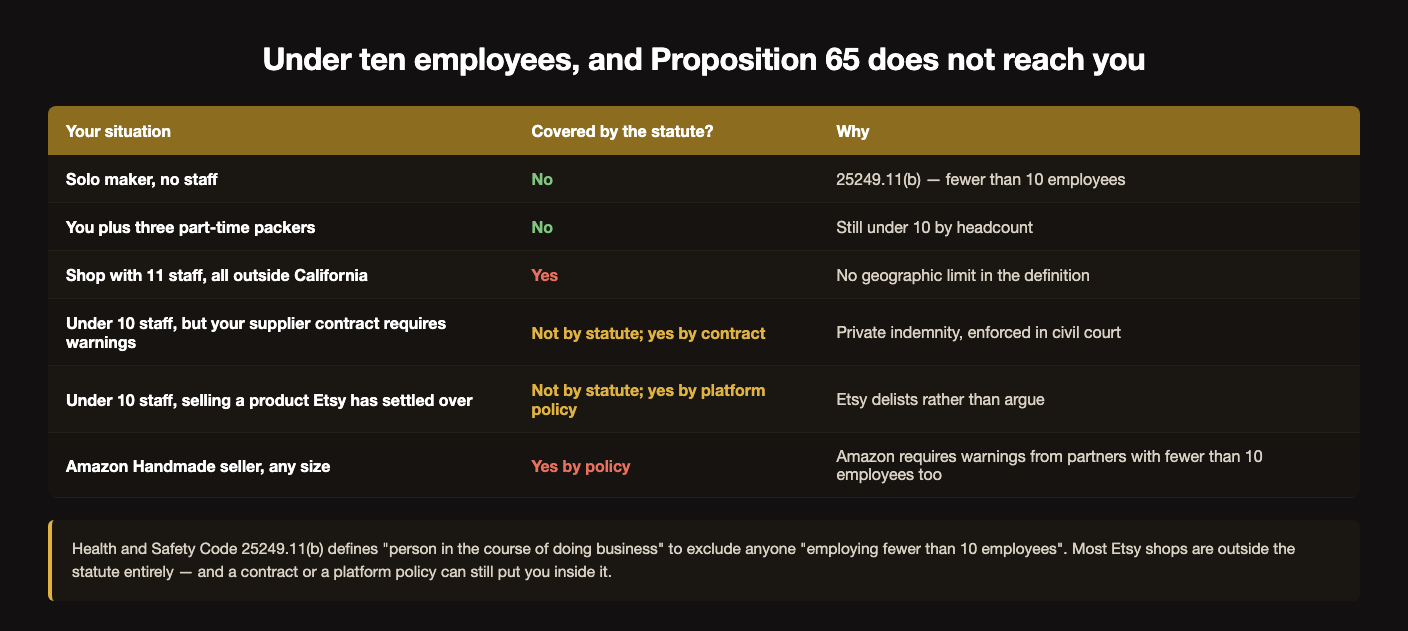
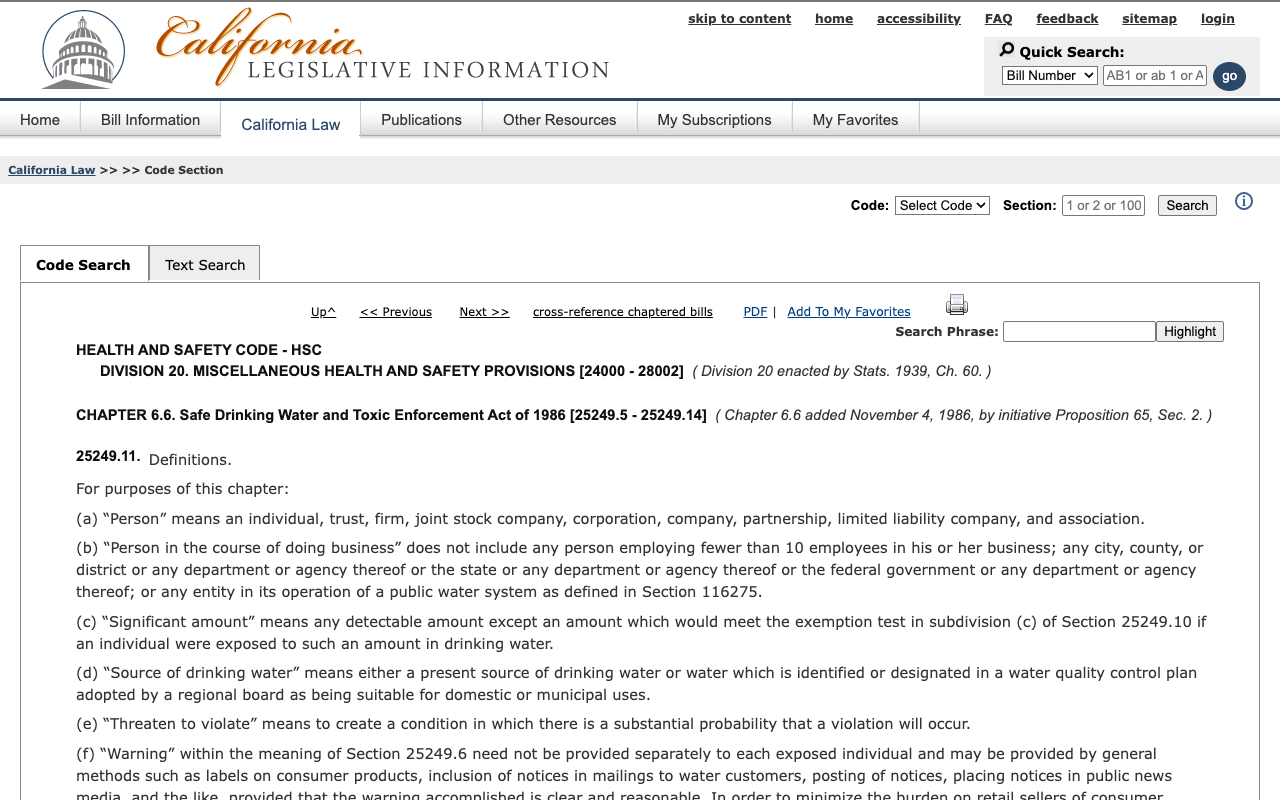
Everything turns on that quoted phrase, and 25249.11(b) defines it by subtraction: it "does not include any person employing fewer than 10 employees in his or her business". No revenue test, no units test, no California-presence test. Ten employees is the whole line.
That is why Etsy's own settlements open by pleading the point. The 2021 agreement states that "The Settling Entity has 10 or more employees"; the 2026 one says flatly, "Etsy employs ten or more persons." A private enforcer has to establish it before anything else.
| Your situation | Covered by the statute? | Why |
|---|---|---|
| Solo maker, no staff | No | 25249.11(b) - fewer than 10 employees |
| You plus three part-time packers | No | Still under 10 by headcount |
| Shop with 11 staff, all outside California | Yes | No geographic limit in the definition |
| Under 10 staff, but your supplier contract requires warnings | Not by statute; yes by contract | Private indemnity, enforced in civil court |
| Under 10 staff, selling a product Etsy has settled over | Not by statute; yes by platform policy | Etsy delists rather than argue |
| Amazon Handmade seller, any size | Yes by policy | Amazon requires warnings from partners with fewer than 10 employees too |
So the honest answer for most Etsy shops is that the state is not your problem and your contracts are. That reverses the usual advice, and it changes what you should spend money on: read your supplier terms before you pay for lab testing.
Etsy Has Already Lost This Fight Three Times
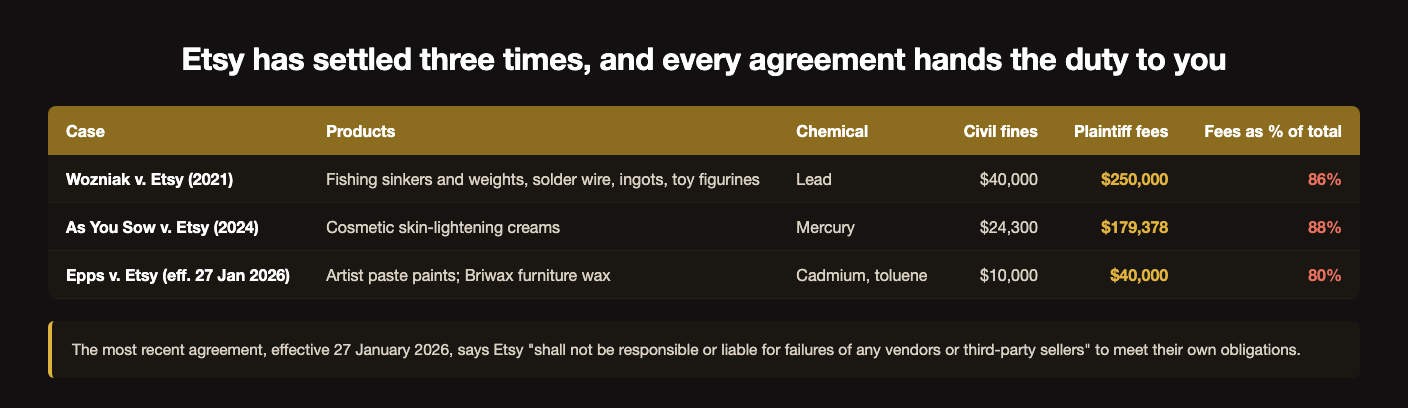
Private enforcers went after the marketplace rather than its sellers, which is why these cases matter to you even though you were not named. Each settlement is public, and each one ends by pushing the obligation onto shops like yours.
The 2026 agreement is the most explicit. Jay Epps served four notices over cadmium in artist paste paints and toluene in Briwax furniture wax, "expressly limited to items offered for sale on etsy.com". Etsy agreed to tell sellers in writing what the law requires, then disclaimed responsibility for whether they do it: "Etsy shall not be responsible or liable for failures of any vendors or third-party sellers of the Products to fulfill their independent Proposition 65 obligations."
| Case | Products | Chemical | Civil fines | Plaintiff fees | Fees as % of total |
|---|---|---|---|---|---|
| Wozniak v. Etsy (2021) | Fishing sinkers and weights, solder wire, ingots, toy figurines | Lead | $40,000 | $250,000 | 86% |
| As You Sow v. Etsy (2024) | Cosmetic skin-lightening creams | Mercury | $24,300 | $179,378 | 88% |
| Epps v. Etsy (eff. 27 Jan 2026) | Artist paste paints; Briwax furniture wax | Cadmium, toluene | $10,000 | $40,000 | 80% |
Two details are worth copying into your own process. The fines were calculated from "the number of furniture wax sold and shipped to consumers in California during the relevant period (June 3, 2021 - June 2, 2025)" - a four-year lookback drawn from sales data. And enforcement runs on a 45-day cure window: Epps must send Etsy the listing ID, product name, a screenshot and an explanation, and if the listing is fixed inside 45 days, no penalty and no fees are recoverable.
If you sell paint, wax, solder, fishing tackle, cast figurines or skin creams, your category has already been litigated on this exact platform. The FDA rules for Etsy cosmetics sit on top of the mercury case, and the lead case overlaps the metal-content rules in our Etsy jewelry labeling guide.
Where the Etsy Prop 65 Warning Has to Sit on a Listing
Section 25602 lists the methods that earn the safe harbour, and internet sales get their own subsection because the general rule does not fit them. Section 25602(a)(2) covers electronic point-of-sale notices and then excludes online buying outright: "This subsection does not apply to internet purchases, which are subject to the provisions of subsection (b)."
Subsection (b) then gives three ways to satisfy it, and you need only one - plus the content rules in 25603, which the next section covers.
| Method | Regulation | What it means on Etsy |
|---|---|---|
| Warning on the product display page | 25602(b)(1)(A) | The warning text in the listing description itself |
| Clearly marked hyperlink | 25602(b)(1)(B) | A link reading "WARNING", "CA WARNING" or "CALIFORNIA WARNING" on the listing page |
| Otherwise prominently displayed before purchase | 25602(b)(1)(C) | Anything the buyer necessarily sees pre-checkout |
| Same text as your short-form label | 25602(b)(1) | If the product carries a short-form label, the site may reuse that wording |
| Non-English listing | 25602(d) | A warning carrying consumer information in another language must appear in that language as well as English |
The sentence that catches sellers is the disqualifier: "the warning is not prominently displayed if the purchaser must search for it in the general content of the website." A shop policies tab, an FAQ section or a blanket note in your About page is not a warning for any individual listing. It has to be attached to the item.
Note the quiet grace period in 25602(b)(2) as well. For internet purchases made before 1 January 2028, a retail seller is not responsible under 25600.2(e)(4) for posting an updated warning online "until 60 calendar days after the retailer receives a warning or a written notice" bringing a legacy short-form warning up to current content. A supplier notice starts a 60-day clock, not an instant breach.
The Exact Wording, and the 2028 Cliff
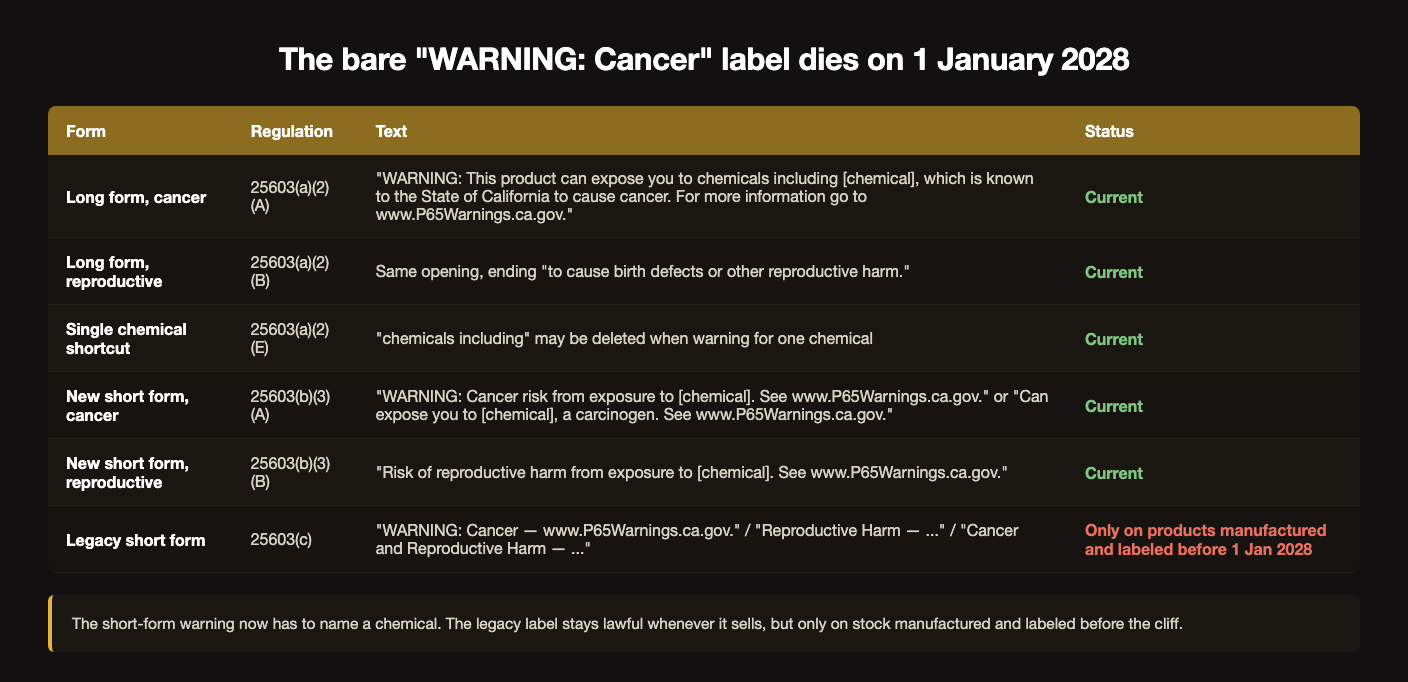
Section 25601(b) is the rule that changed things: a safe-harbour warning must include "the name of one or more of the listed chemicals". Warning for both cancer and reproductive toxicity means naming a chemical for each endpoint, unless one chemical is listed for both and you say so.
Every compliant warning also carries the symbol from 25603(a)(1): a black exclamation point in a yellow equilateral triangle with a bold black outline, left of the text, no smaller than the height of the word WARNING. Black and white is allowed only where the label is not printed in yellow at all.
| Form | Regulation | Text | Status |
|---|---|---|---|
| Long form, cancer | 25603(a)(2)(A) | "WARNING: This product can expose you to chemicals including [chemical], which is known to the State of California to cause cancer. For more information go to www.P65Warnings.ca.gov." | Current |
| Long form, reproductive | 25603(a)(2)(B) | Same opening, ending "to cause birth defects or other reproductive harm." | Current |
| Single chemical shortcut | 25603(a)(2)(E) | "chemicals including" may be deleted when warning for one chemical | Current |
| New short form, cancer | 25603(b)(3)(A) | "WARNING: Cancer risk from exposure to [chemical]. See www.P65Warnings.ca.gov." or "Can expose you to [chemical], a carcinogen. See www.P65Warnings.ca.gov." | Current |
| New short form, reproductive | 25603(b)(3)(B) | "Risk of reproductive harm from exposure to [chemical]. See www.P65Warnings.ca.gov." | Current |
| Legacy short form | 25603(c) | "WARNING: Cancer - www.P65Warnings.ca.gov." / "Reproductive Harm - ..." / "Cancer and Reproductive Harm - ..." | Only on products manufactured and labeled before 1 Jan 2028 |
The 2028 date is about manufacture, not sale. Section 25603(c) permits the legacy wording on a product "manufactured and labeled prior to January 1, 2028 ... regardless of when the product is sold to a consumer". Old stock stays sellable; new stock you label next year needs a chemical name on it.
One more limit sellers trip over: 25601(e) allows supplemental text only where it "identifies the source of the exposure or provides information on how to avoid or reduce exposure". Softening language - "trace amounts", "we believe this is safe" - is "not a substitute for the warning content required by this subarticle". A short-form label can never be smaller than 6-point type either, per 25602(a)(4).
Retail Seller or Manufacturer: Which One Are You?
Section 25600.2 allocates the duty, and it starts from a policy written into the statute itself: 25249.11(f) directs that regulations place the warning burden "on the producer or packager rather than on the retail seller", except where the retailer introduced the chemical.
If you make what you sell, you are the producer, and the question stops there. If you source and resell, 25600.2(e) lists the only five circumstances where the duty lands on you - and the first one is the trap.
| Trigger | Regulation | How an Etsy shop hits it |
|---|---|---|
| Selling under your own brand or trademark | 25600.2(e)(1) | Rebranding a sourced item under your shop name - the common case |
| You knowingly introduced the chemical | 25600.2(e)(2) | Your own solder, glaze, resin, dye or plating |
| You covered, obscured or altered a warning | 25600.2(e)(3) | Repackaging out of the original box; your sticker over the label |
| You got warning materials and did not post them | 25600.2(e)(4) | A supplier notice sat unread in your inbox |
| Actual knowledge and no reachable upstream supplier | 25600.2(e)(5) | Overseas dropshipping with no California agent for service of process |
Read (e)(1) again against your storefront. An Etsy shop exists to put a brand on things, and if you buy blanks and sell them under your own label, the regulation treats you as the responsible party even though you changed nothing chemically - the same problem described in our guide to Etsy clothing label rules.
The route out, if you source rather than make, is 25600.2(b): a supplier can discharge its own duty by sending you a written notice instead of labelling the goods. That notice must name the product or its UPC, include every piece of warning material including "warning language for products sold on the internet", and be renewed annually. Section 25600.2(c)(1) requires the supplier to collect your confirmation of receipt, and (c)(3) requires a fresh notice within 90 days if a different chemical or endpoint arises.
Which Chemicals Actually Draw the Letters
Enforcement is far more concentrated than the 900-plus chemical list suggests. Bureau Veritas tallied the 60-day notices served in the second quarter of 2025 and metals alone took 58% of them.
| Chemical or group | Q2 2025 notices | Share | Etsy-relevant sources |
|---|---|---|---|
| Metals (all) | 649 | 58% | Jewelry findings, brass, solder, glazes, cast figurines |
| Lead | 491 | Largest single chemical | Brass, plating, pottery glaze, vintage hardware |
| Cadmium | 86 | - | Red and yellow pigments, artist paint, enamel |
| Two or more metals | 67 | - | Mixed-metal assemblies |
| Phthalates | not stated | 16% | Vinyl, faux leather, soft plastic, cords |
| PFOA / PFOS / PFNA | 57 | - | Treated textiles, waterproofing |
| Bisphenol S | not stated | 13% of all notices | Thermal receipt paper and stickers |
Food and herbal supplements drew 42% of all notices that quarter - relevant if you ship edibles, and worth reading next to the Etsy cottage food rules. Children's items carry their own lead ceilings on top of the warning duty, which our CPSIA guide for Etsy sellers covers.
Two categories have been pulled out of enforcement entirely by federal courts, and no seller guide we found mentions either. On 2 May 2025 the Eastern District of California permanently enjoined enforcement of the warning requirement for dietary acrylamide as unconstitutional under the First Amendment, and on 12 August 2025 the same court did the same for listed titanium dioxide in cosmetics and personal care products. The Attorney General appealed the acrylamide order and then moved to dismiss his own appeal in May 2026.
What a 60-Day Notice Costs, and Who Keeps the Money
Section 25249.7(b)(1) caps the civil penalty at "two thousand five hundred dollars ($2,500) per day for each violation". That headline number is not where the money actually goes.
Private enforcement is the engine. Under 25249.7(d) anyone may sue "in the public interest" 60 days after serving notice on the Attorney General, the local prosecutor and you, accompanied by a certificate of merit. Section 25249.12(d) then pays that private plaintiff 25% of every penalty collected, with 75% going to the state fund.
| Where settlement money went (AG 2019 private settlements) | Amount | Share |
|---|---|---|
| Attorney's fees and costs | $22,676,093 | 76% |
| Non-contingent civil penalty | $5,441,508 | 18% |
| Payment in lieu of penalty | $1,692,750 | 6% |
| Total across 898 settlements | $29,810,351 | Average $33,196 each |
The filing is concentrated in a handful of hands, and the fee share rises with volume. These four plaintiffs accounted for 218 of the 898 settlements between them.
| Plaintiff | Settlements | Total collected | Share to attorney's fees |
|---|---|---|---|
| Ferriero, Anthony | 91 | $1,387,750 | 91% |
| Vinocur, Laurence | 57 | $1,127,724 | 87% |
| Bell, Ema | 43 | $793,000 | 91% |
| Wozniak, Paul | 27 | $475,150 | 88% |
Paul Wozniak is the same plaintiff who settled the lead case against Etsy. This is a practice, not an accident, and it explains why defendants settle: 25249.10(c) offers a defence where an exposure poses no significant risk, but puts "the burden of showing that an exposure meets the criteria of this subdivision ... on the defendant". Proving your pendant is safe costs more than the settlement. Two exemptions cost nothing to claim and are worth checking first - 25249.10(a) for federal preemption, and 25249.10(b) for any exposure less than twelve months after the chemical was listed.
What Changes Next: OEHHA's Omnibus 2026 Proposal
The state's Office of Environmental Health Hazard Assessment held a pre-rulemaking workshop on 30 July 2026 on a package it calls Omnibus 2026 and took comments until 7 September 2026. Nothing in it is law: no formal rulemaking has been noticed, and OEHHA's own slides say the text may change if items are carried into one.
Three proposals that would matter to an Etsy shop
- Two warnings instead of one. Draft 25602(b)(1) would require a seller on a website or digital application to meet the label requirement in 25602(a)(3) or (4) and one of the display-page methods. OEHHA's stated goal is that warnings "must be in two places - to purchaser and end-user", with a warning "on or with the delivered product".
- QR codes become a method. A new 25602(a)(2)(B) would define a QR code and allow it on a sign, shelf tag, label or labeling, accompanied by text such as "Proposition 65 warning for lead. For more information, scan the QR code." The chemical name still has to be on the label, which limits how much the code saves you.
- Retailer responsibility reworded. Draft 25600.2(e)(3) would shift from covering or obscuring a warning to having "failed to provide the consumer with a warning which was provided to the retailer" - a wider trigger than today's text.
Nothing to do today. The practical read is that if you are adding warnings now, put them on the packaging as well as the listing, because the proposal points that way and doing both is already compliant.
How to Audit Your Own Listings This Week
Work in this order. Most shops stop at step one.
- Count your employees. Under ten and 25249.11(b) takes you out of the statute. Write the date and headcount down; that is your answer to a notice letter.
- Read your supplier and platform terms. This is where a small shop's real obligation lives. Look for indemnity and warranty-of-compliance clauses.
- List your materials, not your products. Plating, solder, glaze, pigment, resin, dye, cord, clasp, thermal receipt paper. Metals and phthalates are three-quarters of enforcement.
- Ask each supplier for a 25600.2(b) notice in writing - the exact language, internet wording included, renewed annually.
- Put the warning on the listing page under 25602(b)(1)(A), with the symbol, a named chemical and the P65Warnings.ca.gov address. Not in shop policies.
- Keep the paperwork. The no-significant-risk defence puts the burden on you, so the test report is the asset.
Check your listings before an enforcer does. Unflagged scans Etsy listing text for the policy and compliance language that triggers takedowns and suspensions, and flags the claims most likely to draw a complaint. See what the plans include, or read the complete Etsy seller compliance guide first. Unflagged is our own product; we do not take affiliate commissions from any tool, lab or law firm named in this article.
Related Articles
- Etsy Jewelry Labeling Requirements 2026: FTC Rules - metal claims, stone naming and the lead ceilings that sit beside Prop 65
- Etsy Cosmetics Rules 2026: FDA Labels - the category behind the mercury settlement against Etsy
- Etsy Children's Products 2026: CPSIA Rules - federal lead and phthalate limits for anything aimed at under-12s
- Etsy Cottage Food Rules 2026: Shipping Limits - for the 42% of notices that land on food and supplements
- Etsy Clothing Label Rules 2026: FTC Fiber Rules - how private-label sellers inherit a manufacturer's duties
- Common Etsy Policy Violations - what actually gets listings pulled, ranked by frequency
FAQ
Do I need a Prop 65 warning on my Etsy listing if I have no employees?
Not under the statute. Health and Safety Code 25249.11(b) excludes any person "employing fewer than 10 employees" from the definition of a person in the course of doing business, and the duty to warn in 25249.6 reaches only that group. You may still owe one under a supplier contract or Etsy's policies, which have no size threshold.
Does Prop 65 apply to me if I am outside California?
Yes, if you have ten or more employees and ship into California. The definition in 25249.11(b) has no geographic qualifier, and Etsy's settlements are framed around products shipped "to an address in California". Where the buyer is matters; where you are based does not.
What exactly do I write in the listing?
Use the 25603(a) long form or the 25603(b) short form, both of which need the warning symbol, the word WARNING in capitals and bold, and at least one named chemical. A compliant short form reads: "WARNING: Cancer risk from exposure to lead. See www.P65Warnings.ca.gov." Put it on the product display page under 25602(b)(1)(A), not in your shop policies.
Can I still use the old "WARNING: Cancer" short label?
Only on products manufactured and labeled before 1 January 2028. Section 25603(c) allows that legacy wording regardless of when the item is sold, so existing stock is fine indefinitely. Anything you manufacture and label after that date needs a chemical name under 25601(b).
Is a warning in my shop policies or FAQ enough?
No. Section 25602(b)(1) is explicit that a warning "is not prominently displayed if the purchaser must search for it in the general content of the website". The warning has to be tied to the individual listing, through the display page, a clearly marked WARNING hyperlink, or something the buyer necessarily sees before completing the purchase.
What happens if I get a 60-day notice?
You have 60 days before a private plaintiff can sue: 25249.7(d)(1) requires that gap after notice is served on you, the Attorney General and the local prosecutor. Use it. Check the employee threshold, the 12-month exemption in 25249.10(b) and federal preemption in 25249.10(a), then get California counsel. Penalties run to $2,500 per day per violation, and the average 2019 private settlement was $33,196.
Should I just add a warning to everything to be safe?
It is not free. An over-warned listing loses buyers, and softening language is not allowed - 25601(e) permits extra text only to identify the source of the exposure or explain how to avoid it. Warn where a listed chemical is actually present, and keep the documentation behind either decision.
This article describes California law as it stood on 8 October 2026 and is general information, not legal advice. Proposition 65 outcomes turn on specific products and exposure levels; consult a California-qualified attorney before relying on any of it.
Sources: 27 CCR 25602 and 25600.2 (Cornell LII), Health and Safety Code 25249.11, the California Attorney General's Proposition 65 enforcement pages and his 2019 settlement report, OEHHA's Omnibus 2026 workshop slides, and the state's official warnings site at P65Warnings.ca.gov.
Scan Your Listings Free
Check your Etsy listings for trademark violations in seconds. 3 free scans, no signup required.
Start Free ScanRelated Articles
How to Check Your Etsy Listings for Trademark Violations (2026 Guide)
Learn how to scan your Etsy listings for trademark violations before they get flagged. Step-by-step guide to protecting your shop from takedowns and suspensions.
Read moreEtsy Shop Suspended? How to Write a Winning Appeal Letter
Your Etsy shop got suspended. Here's exactly how to write an appeal letter that gets your shop reinstated, with templates and strategies that actually work.
Read more50 Words That Are Trademarked on Etsy (Stop Using These Now)
A comprehensive list of commonly trademarked words and phrases that Etsy sellers use without realizing they're violating trademark law. Check your listings now.
Read more