Etsy Made in USA Claims 2026: FTC Rules
Etsy Made in USA claims in 2026: the FTC standard behind them, the enforcement sweep that changed the stakes, and the qualified wording that stays legal.
- 1.Etsy Made in USA Claims Live in Your Listing Copy
- 2.What "All or Virtually All" Means for a Handmade Shop
- 3.The 2026 Enforcement Record, in Dollars
- 4.Imported Blanks: The Claim Most Etsy Sellers Get Wrong
- 5.Qualified Claims That Are Legal, With the Wording
- 6.What Etsy Does About Made in USA Claims
- 7.A 30-Minute Origin Audit for Your Shop
- 8.Frequently Asked Questions
- 9.Related Reading
- 10.Say Less, Prove More
Key takeaways
- An Etsy listing is a label under federal law. The Made in USA Labeling Rule covers material "disseminated in print or by electronic means" that offers a product for sale, so your title, tags, description and photographs are the label the FTC reads.
- The standard is "all or virtually all", not "I put it together". Final assembly in the US is one of three conditions. All significant processing and all or virtually all components must be American too, which is where imported blanks end the argument.
- 2026 was the year enforcement arrived. An executive order in March, three settlements in April totalling $867,743, and warning letters to seven more companies in July. The dartboard case alone was $625,000.
- The exposure is per listing, not per shop. The maximum civil penalty is $53,088 per violation under 16 CFR 1.98(d), and each labelled product is its own violation.
- Etsy verifies none of this. The Creativity Standards labels say who made an item, never where its parts came from, and there is no origin badge. Executive Order 14392 asks the FTC to consider changing that.
A seller who embroiders in Ohio writes "Made in USA" in nine listing titles because it is true of her work. The blanks arrive from Bangladesh. A flag shop in Florida pays $167,743 because several of its products were imported whole from China. Neither seller thought of a listing as a label.
Federal law does. Etsy Made in USA claims fall under the Made in USA Labeling Rule, in force since August 2021, and 2026 is the year the Federal Trade Commission started spending its enforcement budget on it: an executive order in March, a three-case sweep in April, warning letters to seven companies in July. Third-party marketplace sellers are named in the policy documents, not the footnotes.
We read the rule text at 16 CFR Part 323, the FTC's own business guidance, the April and July 2026 enforcement announcements, and the letters the FTC sent to Amazon and Walmart about their third-party sellers, then mapped all of it onto the four fields an Etsy seller actually types into. This is the version for a shop with 300 listings, not a corporate compliance department.
Etsy Made in USA Claims Live in Your Listing Copy
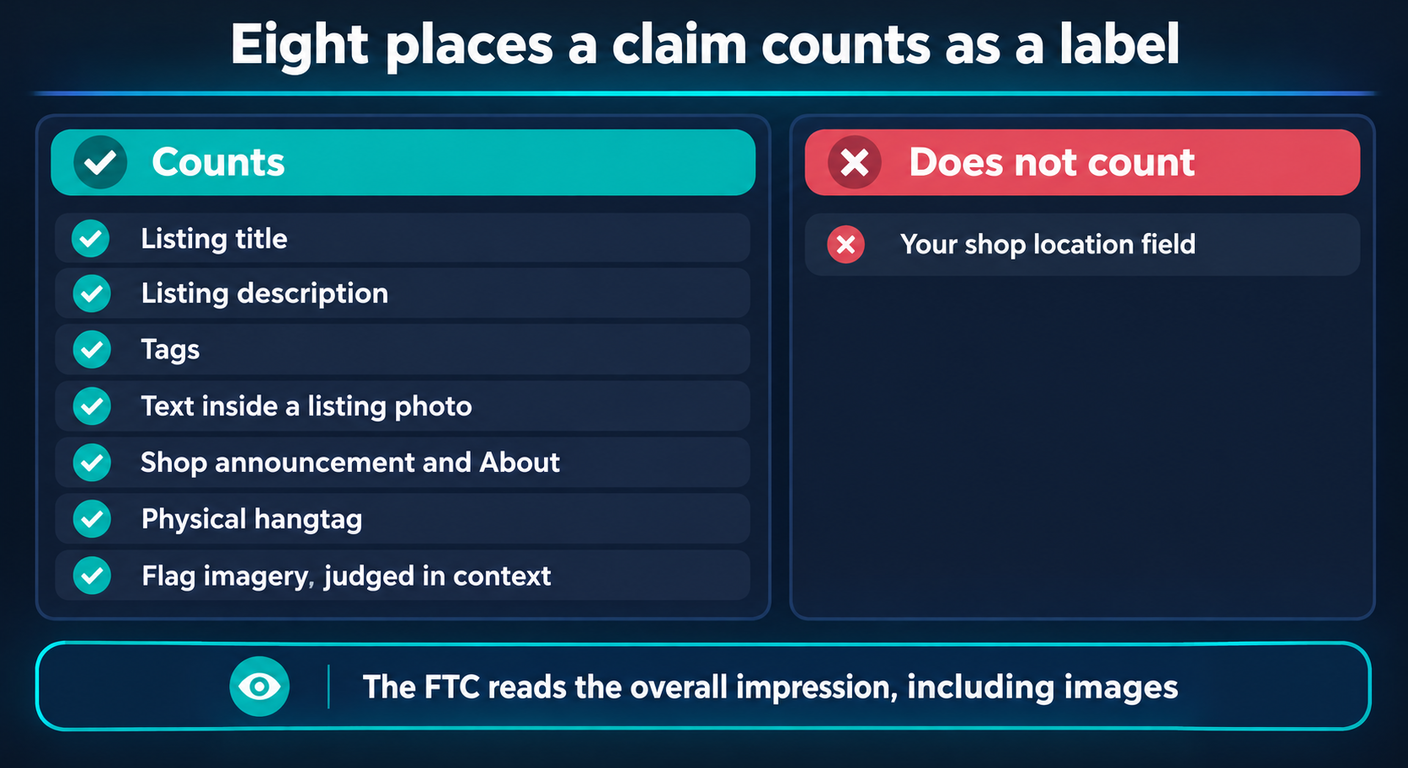
The instinct is that a label is a tag sewn into a hem. The rule is broader, and deliberately so. 16 CFR 323.1 defines "mail order catalog and mail order promotional material" as materials used in the direct sale or offering for sale of a product that are "disseminated in print or by electronic means". A product page on a marketplace is squarely inside that definition.
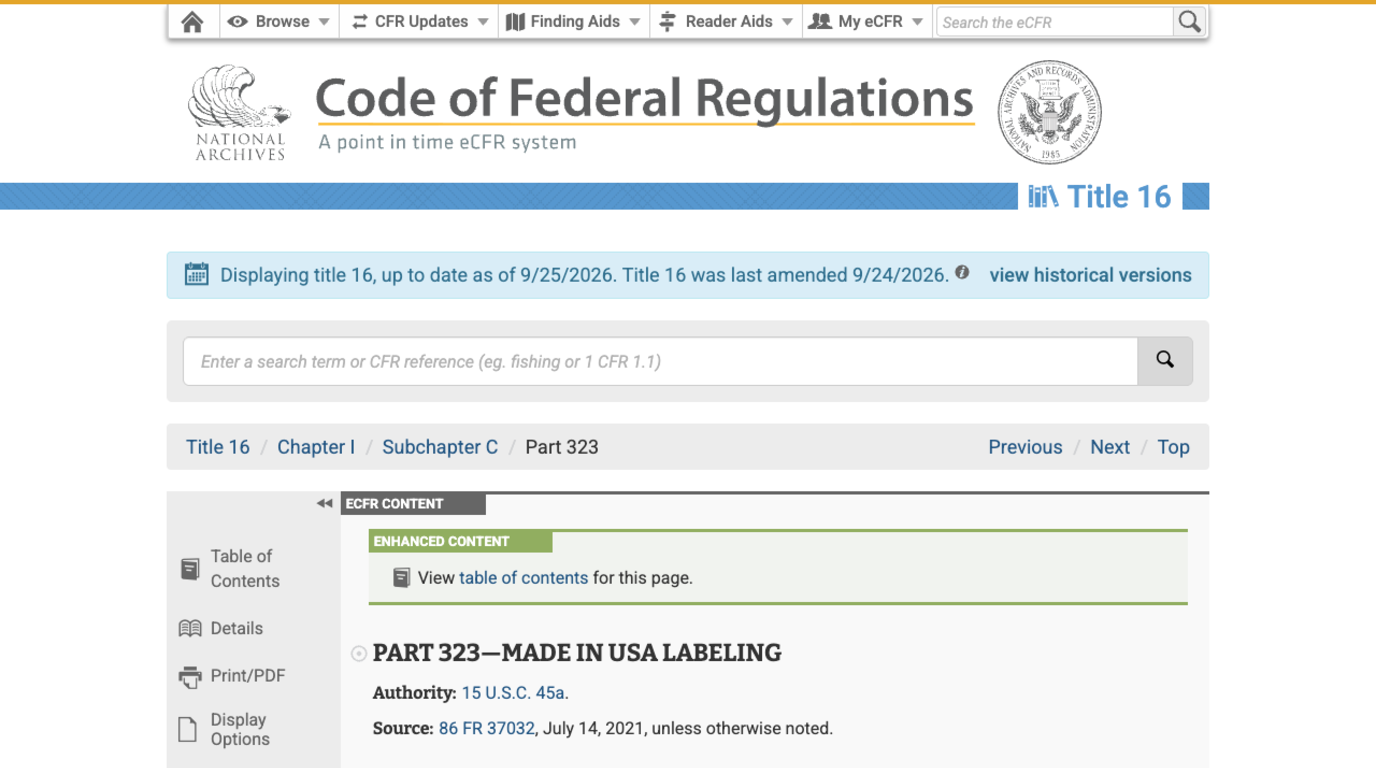
The prohibition itself, at 16 CFR 323.2, is one sentence and worth reading slowly: it is an unfair or deceptive act "to label any product as Made in the United States unless the final assembly or processing of the product occurs in the United States, all significant processing that goes into the product occurs in the United States, and all or virtually all ingredients or components of the product are made and sourced in the United States."
Three conditions joined by "and". Most sellers satisfy the first and assume they are finished.
The rule also defines "Made in the United States" broadly enough to catch phrasing that never uses those words: any unqualified representation, express or implied, that a product is of US origin. Implied is the operative word, and the FTC's guidance says it judges "the overall impression the advertising, label, or promotional material conveys". A flag in the listing photograph, a shop banner reading American Quality, a title ending in a stars-and-stripes emoji: each can be an origin claim without the word "made" appearing anywhere.
| Where you wrote it | Counts as a label? | Why |
|---|---|---|
| Listing title | Yes | Electronic promotional material offering the product for sale |
| Listing description | Yes | Same |
| Tags | Yes | Part of the listing content Etsy indexes and displays |
| Text inside a listing photo or infographic | Yes | FTC reads overall impression, including images |
| Shop announcement and About section | Yes | Promotional material for the products offered |
| Flag imagery with no origin wording | Possibly | Implied claim, judged in context |
| Physical hangtag you sew in | Yes | The conventional label, also covered |
| Your shop location field | No | States where you are, not where the product is from |
That last row is the one sellers lean on most and it protects nobody. Being in Portland is a fact about you. "Made in USA" is a claim about the object.
What "All or Virtually All" Means for a Handmade Shop
The FTC's Complying with the Made in USA Standard guidance sets the test: the product should contain no, or negligible, foreign content. The agency looks at how much of the total manufacturing cost is attributable to US parts and processing, but it says plainly that cost is not the whole answer. A cheap imported component that is essential to what the product is can sink an unqualified claim on its own.
There is a second filter that catches craft sellers specifically: how far the imported input sits from the finished product. Imported gold in a gold ring defeats the claim, because the gold is the ring. Imported petroleum in the plastic housing of a clock radio does not, because it is several transformations away. Run your own materials through that question rather than through a percentage.
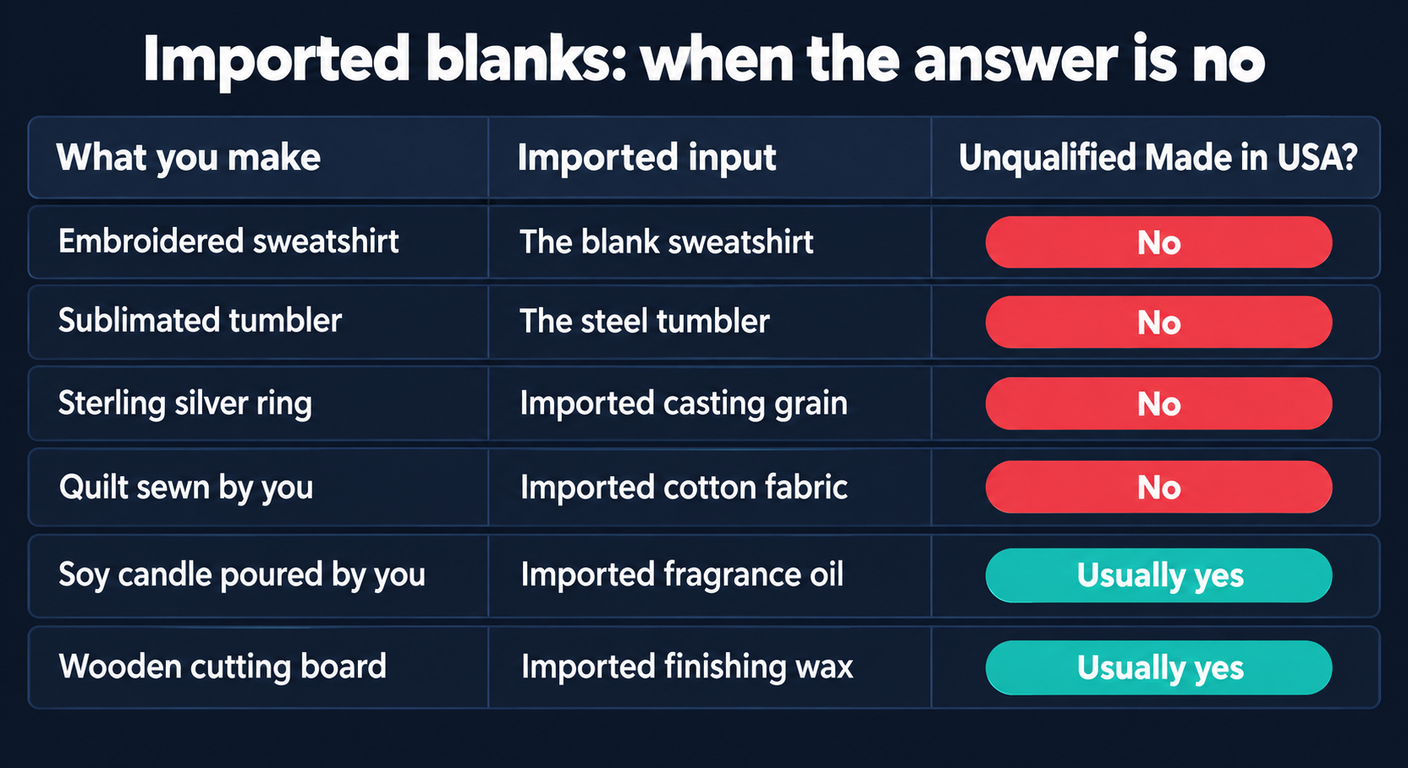
| What you make | Imported input | Unqualified "Made in USA"? | Reason |
|---|---|---|---|
| Embroidered sweatshirt | The blank sweatshirt | No | The garment is the product; you decorated it |
| Sublimated tumbler | The steel tumbler | No | Same shape of failure |
| Sterling silver ring | Imported silver casting grain | No | Material is the product, high cost share |
| Quilt sewn by you | Imported cotton fabric | No, but see the textile rule below | Fabric is one step removed and significant |
| Soy candle poured by you | Imported fragrance oil, small share | Usually yes | Negligible cost, not the essence of the product |
| Wooden cutting board | Imported finishing wax | Usually yes | Trivial cost, far from the product's identity |
| Beaded jewellery | Imported beads | No | Beads are the product |
| Printed art on US paper, US ink | None | Yes | Meets all three conditions |
"Assembled in USA" is a different and easier claim, but not a free one. The FTC allows it unqualified only when principal assembly happens in the US and that assembly is substantial, and when the last substantial transformation also occurred here. Screwdriver assembly at the end of a foreign production line does not qualify, and neither does opening a poly bag.
The 2026 Enforcement Record, in Dollars
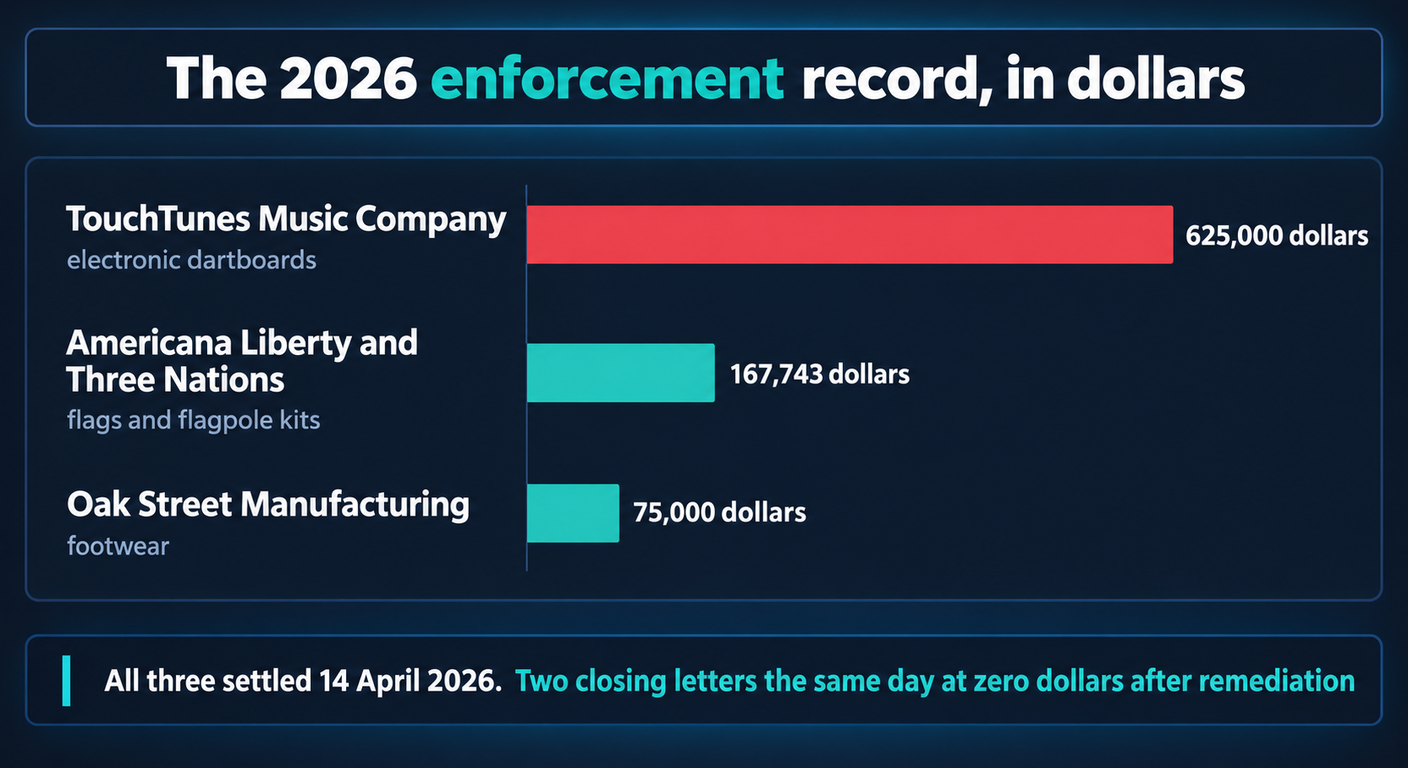
Nothing concentrates attention like a number. Here is what the FTC did in the eighteen months to July 2026, all of it on the public record.
| Date | Action | Who | Amount |
|---|---|---|---|
| 8 July 2025 | Warning letters | Four sellers, plus letters to Amazon and Walmart about their third-party sellers | None |
| 13 March 2026 | Executive Order 14392 | Directs FTC to prioritise Made in America enforcement | None |
| 14 April 2026 | Settlement | TouchTunes Music Company, electronic dartboards | $625,000 |
| 14 April 2026 | Settlement | Americana Liberty and Three Nations, flags and flagpole kits | $167,743 |
| 14 April 2026 | Settlement | Oak Street Manufacturing, footwear | $75,000 |
| 14 April 2026 | Closing letters | Marketing Holders and Lamar Trailers, after remediation | $0 |
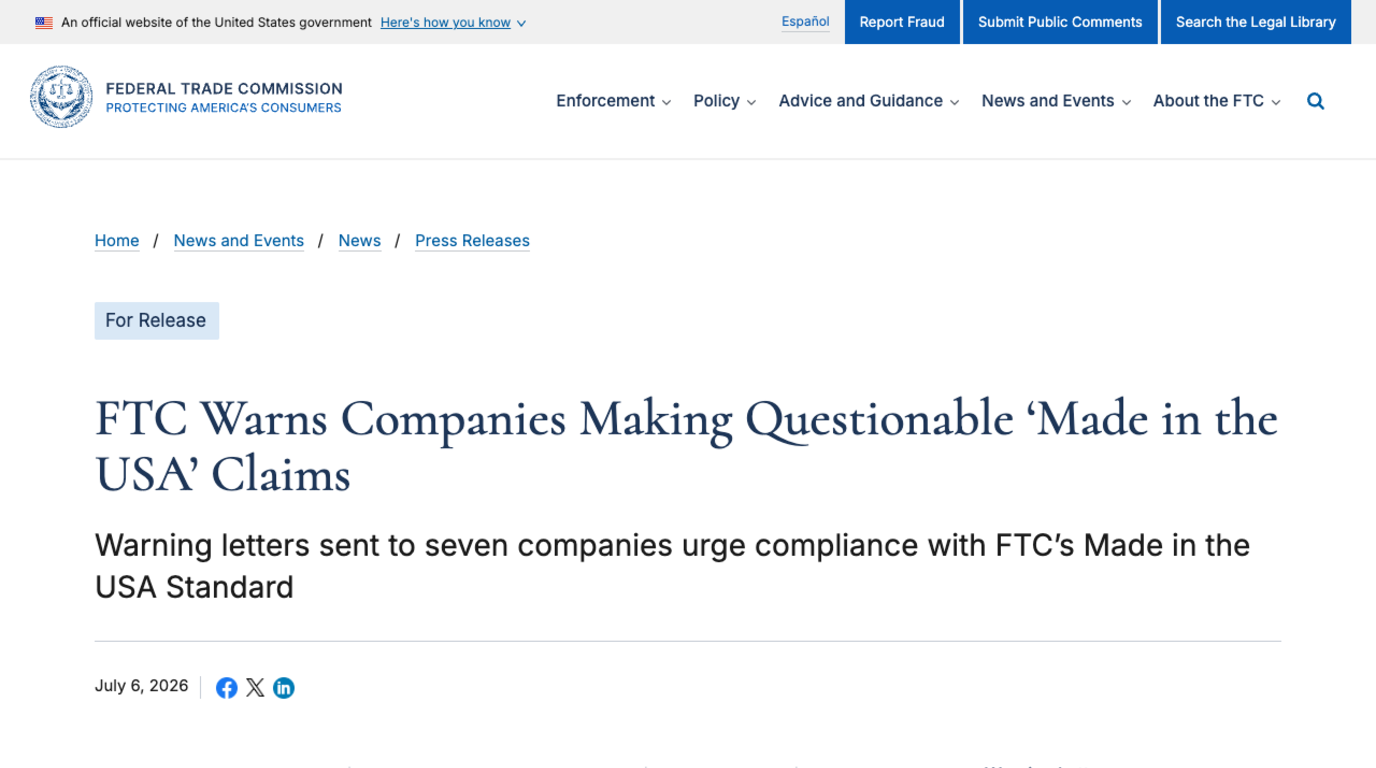
| 6 July 2026 | Warning letters | Seven companies, plus one "Made in Texas" claim | None |
Read the two zero rows next to the $625,000 one. Marketing Holders and Lamar Trailers were investigated and walked away with closing letters because they fixed their representations. Remediation is a real outcome, and it is available to you now for free, before anyone writes to you.
The claims that drew the April complaints were not subtle. Oak Street's footwear was advertised as "handcrafted 100%" in the United States and as made "from heel-to-toe, using no pre-assembled components from overseas" while components came from the Dominican Republic and Brazil. The flag sellers said "100% Made in the USA" over several products imported whole from China. But the phrases flagged in the July 2026 warning letters are exactly the ones an Etsy seller writes without thinking: "Built in the USA", "AMERICAN MADE", "designed and manufactured in the USA".
The ceiling matters too. Under 16 CFR 1.98(d) the maximum civil penalty for a rule violation is $53,088, on amounts that apply to penalties assessed after 17 January 2025. Each labelled product is a violation. A shop with forty listings carrying the same untrue line is not one problem repeated; it is forty.
Imported Blanks: The Claim Most Etsy Sellers Get Wrong
Print on demand, sublimation, vinyl and embroidery shops share one fact pattern: the object arrives finished from overseas and you decorate it. Under the three-part test, printing is not "all significant processing", and the blank is not a negligible component. It is the product.
This is the single most common honest mistake on Etsy, and it is made by sellers who are meticulous about everything else. You are not lying. You did the work you describe in Georgia. The rule simply measures a different thing than effort.
Textiles have their own regime on top, and almost no Made in USA guide mentions it. Under the Textile Fiber Products Identification Act, 16 CFR 303.33 requires textile products to disclose the country where they were processed or manufactured, and it gives the model wording for mixed cases: "Made in USA of imported fabric", "Knitted in USA of imported yarn". The origin test there is one step removed: a household product manufacturer must identify imported cloth or yarn, a cloth manufacturer must identify imported yarn. You are not required to trace the cotton back to the field, but you are required to name the thing you bought.
Then there is customs, which is a separate agency with a separate rule. Under 19 U.S.C. 1304, an imported article must be marked conspicuously, legibly, indelibly and permanently with the English name of its country of origin, so that the ultimate purchaser can read it. Since duty-free de minimis treatment was suspended for all countries on 29 August 2025, more Etsy sellers are importing through formal entry and meeting that marking requirement for the first time. Cutting the origin tag out of a blank before you embroider it is not a tidy-up. It is removing a required marking.
| Rule | Agency | What it governs | Applies to you when |
|---|---|---|---|
| 16 CFR Part 323 | FTC | Whether you may say "Made in USA" | You make any US-origin claim, anywhere |
| FTC Act Section 5 | FTC | Deceptive advertising generally, including implied claims | Always |
| 16 CFR 303.33 | FTC | Country-of-origin disclosure on textiles | You sell fabric-based goods |
| 19 U.S.C. 1304 | CBP | Marking of imported articles | You import blanks, supplies or finished goods |
| Etsy Seller Policy | Etsy | Accurate representation of origin and production | Always, and enforced fastest |
Four of those five can cost you money. The fifth costs you the listing, which for most shops is the one that actually bites. Our guide to Etsy production partner rules covers the disclosure side of the same problem.
Qualified Claims That Are Legal, With the Wording
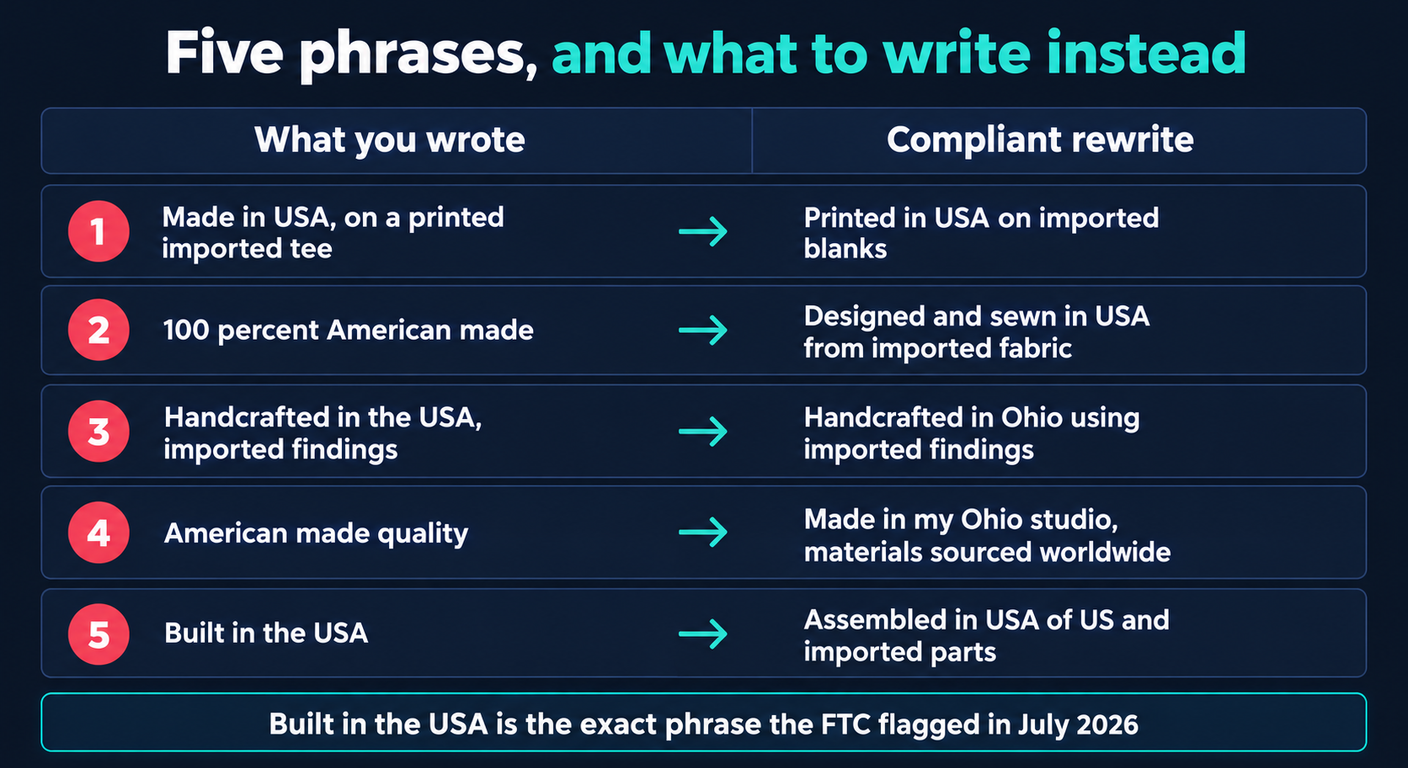
The good news buried in all of this: the FTC does not ask you to stay silent about American work. It asks you to be specific. A qualified claim describes exactly what is American and what is not, and it needs no "all or virtually all" substantiation, only truth.
| What you wrote | Why it fails | Compliant rewrite |
|---|---|---|
| Made in USA (on a printed imported tee) | Unqualified claim, imported component is the product | Printed in USA on imported blanks |
| 100% American made | Unqualified, and the intensifier raises the bar | Designed and sewn in USA from imported fabric |
| Handcrafted in the USA (imported findings) | Reads as unqualified origin claim | Handcrafted in Ohio using imported findings |
| American made quality | Implied origin claim, same standard applies | Made in my Ohio studio, materials sourced worldwide |
| Built in the USA | Exact phrase flagged by the FTC in July 2026 | Assembled in USA of US and imported parts |
| Made in USA (assembled here, foreign parts) | Fails the components condition | Assembled in USA of imported components |
| US flag emoji in the title, imported goods | Implied claim judged on overall impression | Remove it, or state the real origin plainly |
Three drafting rules make these hold up. Keep the qualifier in the same breath as the claim, not in a sentence further down, because the FTC reads impression rather than fine print. Use a real place when you can, since "sewn in Ohio" is both truer and better copy than "American made". And put the same wording in every field, because a description that qualifies properly does not rescue a title that does not.
Keep your proof where you can find it. The FTC expects a reasonable basis before the claim goes up and an ongoing duty to check it still holds. For a small shop that is a folder with supplier invoices, a note of each item's country of origin, and the date you last confirmed it. Suppliers change factories without telling you, which is how a true claim quietly becomes a false one.
What Etsy Does About Made in USA Claims
Etsy's Seller Policy requires you to accurately represent your items, including details about country of origin, provenance, attributes, components and materials, in listings and listing photos. It also requires an accurate representation of how an item was made, by whom, and where it ships from, and it requires production partner disclosure on the relevant listings.
Enforcement follows the usual ladder rather than a dedicated origin process: a listing comes down, you get a policy notice, and repeat findings escalate towards shop-level action. Etsy revised its Seller Policy effective 9 July 2026, mostly reorganising and clarifying existing rules rather than adding new ones, and is expanding listing appeals across more policy areas, with all sellers expected to have access across most areas by the end of 2026. Our piece on why Etsy deactivates listings walks through what those notices look like.
Here is the gap that matters. Etsy's Creativity Standards, introduced in July 2024, make every listing declare the seller's role with one of four labels: Made by, Designed by, Sourced by, Handpicked by. Those labels answer who. None of them answers where the components came from. There is no verified origin badge on Etsy, no "Made in USA" filter, and no check on the words you type.
| Question a buyer has | Etsy field that answers it | Verified by Etsy? |
|---|---|---|
| Who made this? | Creativity Standards label | Self-declared |
| Did a factory help? | Production partner disclosure | Self-declared |
| Where does it ship from? | Shipping origin | Yes, in effect |
| Where is the seller? | Shop location | Partly |
| Where were the components made? | None | Not collected |
| Is "Made in USA" here true? | Free text only | No |
That last row is the whole risk. Because Etsy collects nothing, the claim is yours alone, and so is the liability.
This is also the part most likely to change. On 8 July 2025 the FTC wrote to Amazon and Walmart about third-party sellers making unqualified US-origin claims on their marketplaces, noting such claims may violate the FTC Act and run afoul of the platform's own terms of service. Then Executive Order 14392, signed 13 March 2026, directed the FTC to consider proposed regulations providing that "the failure of an online marketplace to establish procedures for verifying country-of-origin claims may constitute an unfair or deceptive act or practice". If that rulemaking lands, platforms will start asking sellers to substantiate. Shops that already qualify their claims will answer in an afternoon.
A 30-Minute Origin Audit for Your Shop
You can clear most of this today, and you do not need a lawyer to do the first pass.
- Search your own shop. Use Etsy search restricted to your shop, and your listing manager's search box, for: usa, u.s.a., american, america, domestic, homegrown, stateside, and the flag emoji. Write down every listing that returns.
- Open the photographs. Claims hide in the fourth image, in a branded graphic or a photo of your packaging. Check the text inside every image on the listings you flagged.
- Check the same fields on your shop. Announcement, About section, shop title, banner graphic, FAQ.
- For each flagged listing, name the biggest component and its country. If it is not American, the unqualified claim goes.
- Rewrite rather than delete. A qualified claim keeps the keyword and the selling point: "printed in USA on imported blanks" still ranks for people searching American-made.
- Fix all fields at once. Title, tags, description and images, on the same edit.
- Start the folder. One document per supplier: what you buy, where it is made, when you last checked.
- Diary a re-check. Twice a year, or whenever a supplier changes, per the FTC's ongoing substantiation expectation.
If your shop also ships into the EU, the same audit pairs naturally with the manufacturer and safety fields covered in our Etsy EU compliance guide, since both regimes are asking a version of the same question: who really made this, and where.
Frequently Asked Questions
Can I say "Made in USA" if I assemble imported parts in my studio?
No, not unqualified. The Made in USA Labeling Rule requires final assembly in the US, all significant processing in the US, and all or virtually all components made and sourced in the US. Imported parts fail the third condition. You can say "Assembled in USA of imported components", or "Assembled in USA of US and imported parts", which are qualified claims and legal when true.
Does printing on an imported blank count as Made in USA?
No. Decoration is not "all significant processing", and the blank is the product rather than a negligible component. This catches most print on demand, sublimation, vinyl and embroidery shops. The compliant wording is a qualified claim such as "printed in USA on imported blanks", which keeps the American angle in your copy without the legal exposure.
What is the penalty for a false Made in USA claim on Etsy?
Under 16 CFR 1.98(d), the maximum civil penalty for a rule violation is $53,088, on the amounts applying to penalties assessed after 17 January 2025. Each labelled product can be counted as a separate violation. In practice small shops are far more likely to meet Etsy's own enforcement first, which means a listing removal and a policy notice rather than a fine.
Does a US flag in my listing photo count as an origin claim?
It can. The rule covers any unqualified representation of US origin, express or implied, and the FTC judges the overall impression a listing conveys rather than any single sentence. Flags, maps, patriotic phrasing and eagle imagery have all been treated as implied claims in context. If the product is imported, remove the imagery or state the real origin plainly.
Is "handmade in USA" the same as "Made in USA"?
For this rule, yes. Any unqualified representation that a product is of US origin is treated the same way, whatever the phrasing. The FTC's July 2026 warning letters flagged "Built in the USA", "AMERICAN MADE" and "designed and manufactured in the USA", none of which uses the standard phrase. Add the qualifier or name the place: "handmade in Ohio from imported findings" is both accurate and specific.
Do I have to label imported fabric on a quilt I sewed myself?
Yes, if you want to make an origin claim, and generally under the textile rules regardless. 16 CFR 303.33 requires country-of-origin disclosure for textile products and gives the model wording for mixed origin, such as "Made in USA of imported fabric". The test is one step removed, so you must identify the imported cloth or yarn you bought, not trace the fibre to its source.
Will Etsy remove my listing over an origin claim?
It can. Etsy's Seller Policy requires accurate representation of country of origin, provenance, components and materials in listings and listing photos, so an inaccurate origin claim is a policy violation in its own right, separate from anything the FTC might do. Listings usually come down first, with escalation for repeat findings, and appeals are expanding across more policy areas through the end of 2026.
Is Etsy going to start verifying Made in USA claims?
Possibly. Executive Order 14392, signed on 13 March 2026, directs the FTC to consider issuing proposed regulations providing that a marketplace's failure to establish procedures for verifying country-of-origin claims may be an unfair or deceptive act or practice. The FTC had already written to Amazon and Walmart in July 2025 about third-party sellers' claims. Nothing requires Etsy to verify today, and shops that qualify their claims now will have nothing to redo if that changes.
Related Reading
- Etsy production partner rules 2026
- Etsy EU compliance 2026: why your listings are hidden
- Etsy cosmetics rules 2026: FDA labels
- The most common Etsy policy violations
- Why Etsy deactivated your listing
- The complete guide to Etsy seller compliance
Say Less, Prove More
The sellers who got hurt in 2026 were not frauds. They were businesses with real American work in the product and a sentence that claimed more than the work supported. The fix is almost never to stop talking about where you make things. It is to say the true, specific version, which reads better anyway: sewn in Ohio beats American made quality in every way a listing can be measured.
Unflagged scans your listings for the language that triggers enforcement: origin and claim wording, trademark exposure, and the policy signals that decide whether a shop gets a notice or a closure. Run a free scan, or create an account for ongoing monitoring. Plans are on the pricing page.
Scan Your Listings Free
Check your Etsy listings for trademark violations in seconds. 3 free scans, no signup required.
Start Free ScanRelated Articles
How to Check Your Etsy Listings for Trademark Violations (2026 Guide)
Learn how to scan your Etsy listings for trademark violations before they get flagged. Step-by-step guide to protecting your shop from takedowns and suspensions.
Read moreEtsy Shop Suspended? How to Write a Winning Appeal Letter
Your Etsy shop got suspended. Here's exactly how to write an appeal letter that gets your shop reinstated, with templates and strategies that actually work.
Read more50 Words That Are Trademarked on Etsy (Stop Using These Now)
A comprehensive list of commonly trademarked words and phrases that Etsy sellers use without realizing they're violating trademark law. Check your listings now.
Read more