Etsy Pet Treat Rules 2026: AAFCO Labels
Etsy pet treat rules in 2026: the state feed licence and per-product fees, the nine label elements AAFCO requires, and the claims that make it a drug.
- 1.Dog Treats Are Animal Feed, Not Cottage Food
- 2.Your State Feed Licence Is the Real Gatekeeper
- 3.Every Flavour Is a Separate Registration, and So Is the Icing
- 4.The Nine Things Your Label Must Carry
- 5.Your Etsy Listing Text Is Part of the Label
- 6.The Product Name Rules Decide What You Can Call It
- 7.Claims That Turn a Treat Into an Unapproved Drug
- 8.What the FDA Actually Requires of a Home Kitchen
- 9.The Label Changes Again Before 2030
- 10.A Pre-Listing Check That Takes an Afternoon
- 11.Related Articles
- 12.FAQ
Key takeaways
- Dog treats are commercial feed, not cottage food. The baked-goods exemption does not carry across, and in most states a treat in a package of 10 lb or less needs its own product registration.
- Your state feed office is the gatekeeper, not the FDA. Virginia and Indiana each charge $50 for the licence plus $50 per product per year; California charges $500 per licence per location per year.
- Every flavour is a separate registration, and so is the icing. Indiana's own guidance says adding yogurt icing to an existing recipe creates a new product and another $50 fee.
- Your Etsy listing text is labelling. Indiana states it plainly: if the labelling, "including websites and social media", names a nutrient, the package must carry a guarantee for it.
- A home kitchen is not an FDA facility. 21 CFR 1.227 excludes "an individual's private residence", so the federal preventive-controls rule does not reach you until you rent commercial space.
A seller bakes peanut butter biscuits in her own kitchen and lists them as Human Grade Chicken Dog Treats. Two things in that title are already wrong: "human grade" requires four documents she does not have, and naming chicken that way means the biscuit has to be at least 95% chicken.
The Etsy pet treat rules that decide whether she keeps selling are not Etsy's. Minnesota wants $100 per product per year on top of a $75 licence, plus $100 if it finds an unlisted product in distribution. Three flavours across five ordinary states runs to roughly $1,595 in year one.
We read Virginia's and Indiana's own guidance for home-based treat makers, took the fee table from AAFCO's Official Publication rather than a blog, and settled the federal scope question against 21 CFR 1.227 and 507.3. Here is what applies to an Etsy shop, in the order you meet it.

Dog Treats Are Animal Feed, Not Cottage Food
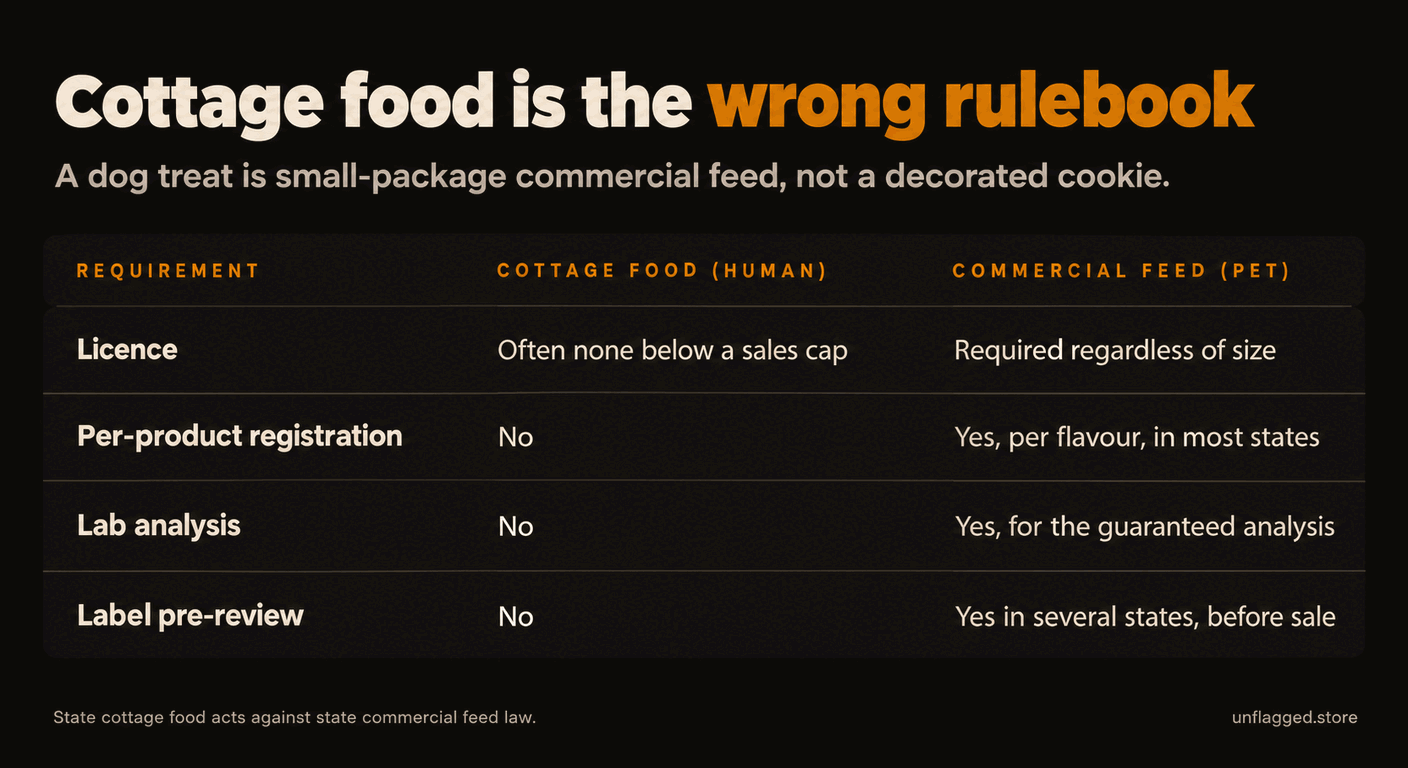
Almost every seller arrives here through cottage food law, the framework that governs jam, bread and decorated cookies sold from a home kitchen. It is the wrong rulebook. Pet treats are regulated as commercial feed, under a separate state law with its own licence, registration and label standard.
Virginia's guidance for home-manufactured pet treats puts the threshold in plain terms: feed and treats "in individual packages of 10 pounds or less are considered small package commercial feeds under the law". That one sentence is what pulls a 4 oz bag of biscuits into a regime built for feed mills.
| Cottage food (human) | Small-package commercial feed (pet) | |
|---|---|---|
| Governing law | State cottage food act | State commercial feed law |
| Licence | Often none below a sales cap | Required regardless of size or volume |
| Per-product registration | No | Yes, per flavour, in most states |
| Lab analysis | No | Yes, for the guaranteed analysis |
| Label pre-review | No | Yes in several states, before sale |
| Kitchen inspection | Sometimes | Usually not up front, but on complaint |
The Office of Indiana State Chemist is blunt about the licence: "Everyone must be licensed regardless of company size or amount distributed." No hobby tier, no grace band, no exemption for selling three bags a month. The next question is which state's office you answer to, and the answer is more than one.
Your State Feed Licence Is the Real Gatekeeper
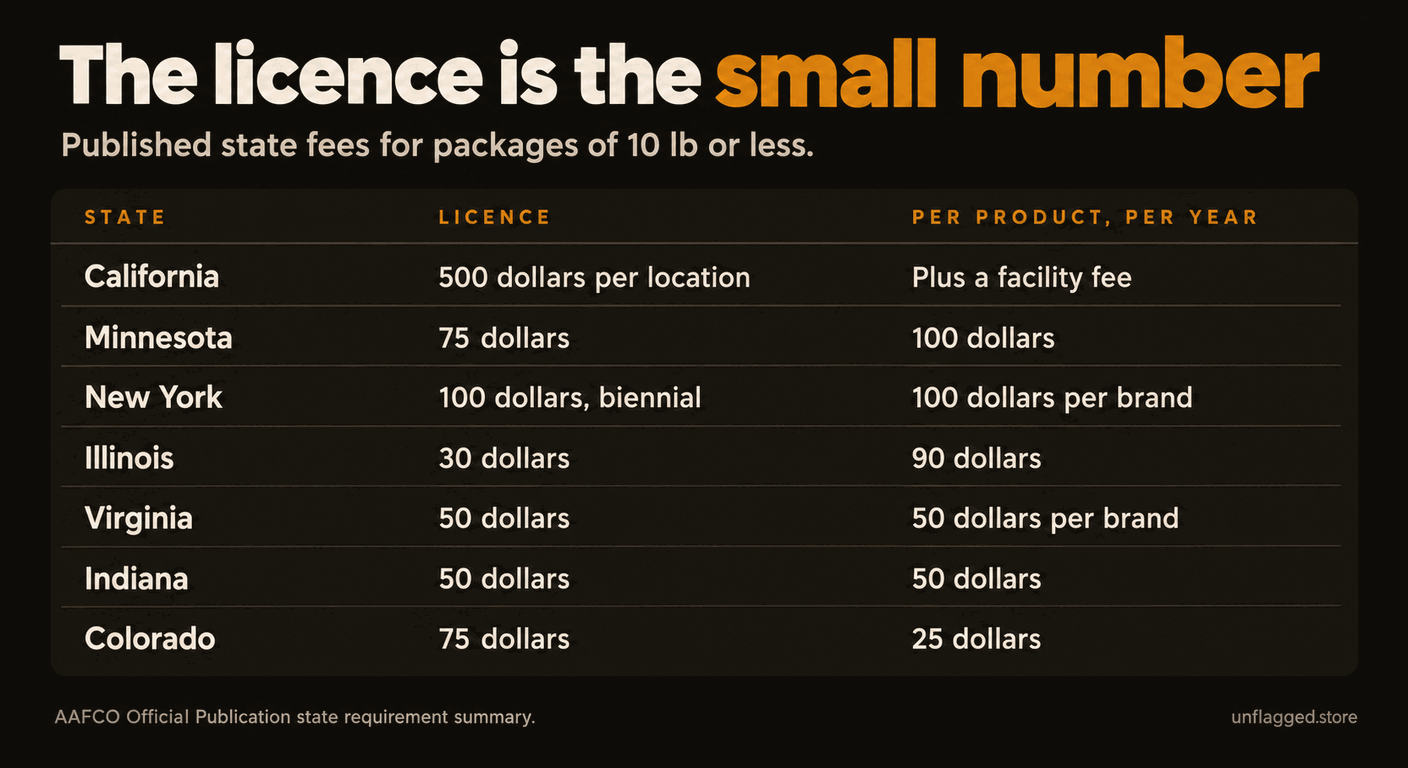
An Etsy sale is a sale of pet food into the buyer's state, so the buyer's state feed law applies and your own registration does not travel. The fees below come from AAFCO's State Regulatory Requirement Summary, Chapter Two of the 2023 Official Publication, which warns that fees are "subject to change or variance" and was last updated November 2022. Treat them as the shape of the problem, not today's invoice.
| State | Licence | Per product, packages 10 lb or less |
|---|---|---|
| California | $500 per licence per location per year | Plus $220.21 per pet food manufacturing facility per 2 yr |
| New Jersey | $250 per licence per manufacturer | Not listed |
| Minnesota | $75 | $100, in lieu of tonnage; $100 penalty for an unlisted product |
| New York | $100 per NY facility, biennial | $100 per brand, annual |
| Illinois | $30 facility licence | $90 per product per year |
| Washington | $50 per facility | $90, biennial registration |
| Virginia | $50 per facility | $50 per brand |
| Indiana | $50 per firm | $50 per product |
| Colorado | $75 company registration | $25 per product |
| Texas | $75 per facility, permanent | $50 per product, packages 5 lb or less |
| New Hampshire | Not listed | $75 per product |
| Wyoming | Not listed | $40 per product |
Two details in that table are worth more than the rest. California is the outlier at $500 per location per year, and it is widely reported elsewhere as $190, which is the figure to stop quoting. And Texas sets its small-package line at 5 lb, not 10, so a 6 oz bag that is a registrable product everywhere else sits in a different bucket there. Checking the threshold is as important as checking the fee.
Now the arithmetic nobody publishes. Three flavours registered in New York, Minnesota, Illinois, Washington and Virginia is $305 in licences and facility registrations plus $1,290 in per-product fees: $1,595 before a single biscuit ships, with Washington's and New York's registrations running two years and the rest annual. That is why most treat sellers quietly restrict shipping to their own state.
Every Flavour Is a Separate Registration, and So Is the Icing
The per-product fee sounds survivable until you see how a state counts products. Virginia's booklet works the example itself, and the answer surprises people.
| What you make | Registrations | Virginia fee |
|---|---|---|
| 3 flavours, 3 size names in the brand name (small, medium, large) | 9 | $450 |
| 3 flavours, no size in the brand name | 3 | $150 |
The $300 difference is purely a naming decision. Virginia's own advice is to drop the size indicator from the brand name and put sizing in a feeding recommendation instead, where it costs nothing.
Indiana answers the adjacent questions in the same spirit. Different shapes from one recipe are one product, because "the nutritional value and label is the same, regardless of the shape it comes in". But put yogurt icing on half the batch and you have created a second product: "you have changed the nutritional value of the treat by adding another ingredient. Therefore it is a new product", and another $50 annual fee is due.
Variety packs split the same way. Mixed loose in one bag, you label the package with one guaranteed analysis and one ingredient list "as if the contents were ground up together". In separate inner bags, each formula needs its own. Bundling raises average order value on Etsy and is the expensive instinct here.
The Nine Things Your Label Must Carry
The required elements are consistent across states, because they all follow AAFCO's model pet food regulations. What trips people up is not the list but the formatting rule attached to each item.
| Element | Where | Format rule |
|---|---|---|
| Brand name | Front | Must match the name you registered |
| Product name | Front | Governed by the percentage rules below |
| Intended species | Front | In words. "A picture is not a good enough way to identify the intended species" |
| Intended use | Front | "Treat" or "snack" on the front, or this sentence verbatim elsewhere: "This product is intended for intermittent or supplemental feeding only" |
| Quantity statement | Front | US measure followed by the metric equivalent: Net weight 8 oz. (227 g) |
| Ingredient statement | Anywhere | AAFCO ingredient names, descending order by weight, compound ingredients broken out |
| Guaranteed analysis | Anywhere | Under that heading, in this order: crude protein (min), crude fat (min), crude fiber (max), moisture (max) |
| Calorie content | Anywhere | Separate from the guaranteed analysis, headed "Calorie Content", as metabolizable energy in kcal/kg and kcal per treat |
| Manufacturer or guarantor | Anywhere | Name plus city, state and zip. Must match the name on your feed licence |
The guaranteed analysis is the one you cannot write from a recipe calculator. Virginia requires that "each treat must be submitted to a private laboratory for analysis", and neither state will run it for you or recommend a lab. Budget it per flavour, because that is how it is charged.
Compound ingredients are the quiet failure. If your recipe uses peanut butter, the label cannot say "peanut butter": it says peanuts, soybean oil, sugar, salt, or it parenthesises those under the compound name. Every component must be approved by FDA or AAFCO, and the foods safe for people but not dogs, chocolate, onion, grapes, raisins, coffee and garlic, are the first thing a reviewer checks.
Your Etsy Listing Text Is Part of the Label
This is the rule that catches Etsy sellers specifically, and no guide to selling treats online states it. "Labelling" is wider than the sticker on the bag. The Office of Indiana State Chemist gives the scope: if "the label and/or labeling (including websites and social media) references other nutrients, then guarantees must be made for the referenced nutrients".
Read that against a typical Etsy description. "Packed with omega-3 from salmon oil" is a nutrient reference, so the registered label now needs an omega-3 guarantee, which needs a lab test you did not buy. The description field is not marketing copy with a disclaimer underneath. It is part of the regulated label, and it is the part a state reviewer can read without leaving their desk.
"Human grade" costs four documents. Indiana will accept the claim on a label or in labelling, websites and social media included, only if you supply: documentation that all ingredients and the finished product are processed, handled, stored and transported in compliance with 21 CFR 507; evidence that the manufacturing facility is licensed to produce human food; supplier specification sheets for every ingredient; and letters of guarantee from each supplier that the ingredients are human food grade. A home kitchen cannot produce the second item, which is why the phrase is quietly indefensible in most Etsy listings that use it.
"All natural" is softer but not free. Indiana's position is that you may use it "if it's true", and most products will not be, because they contain minerals, vitamins and preservatives, so the claim must be qualified. Our guide to Etsy eco-friendly claims covers the same problem on the FTC side.
The Product Name Rules Decide What You Can Call It
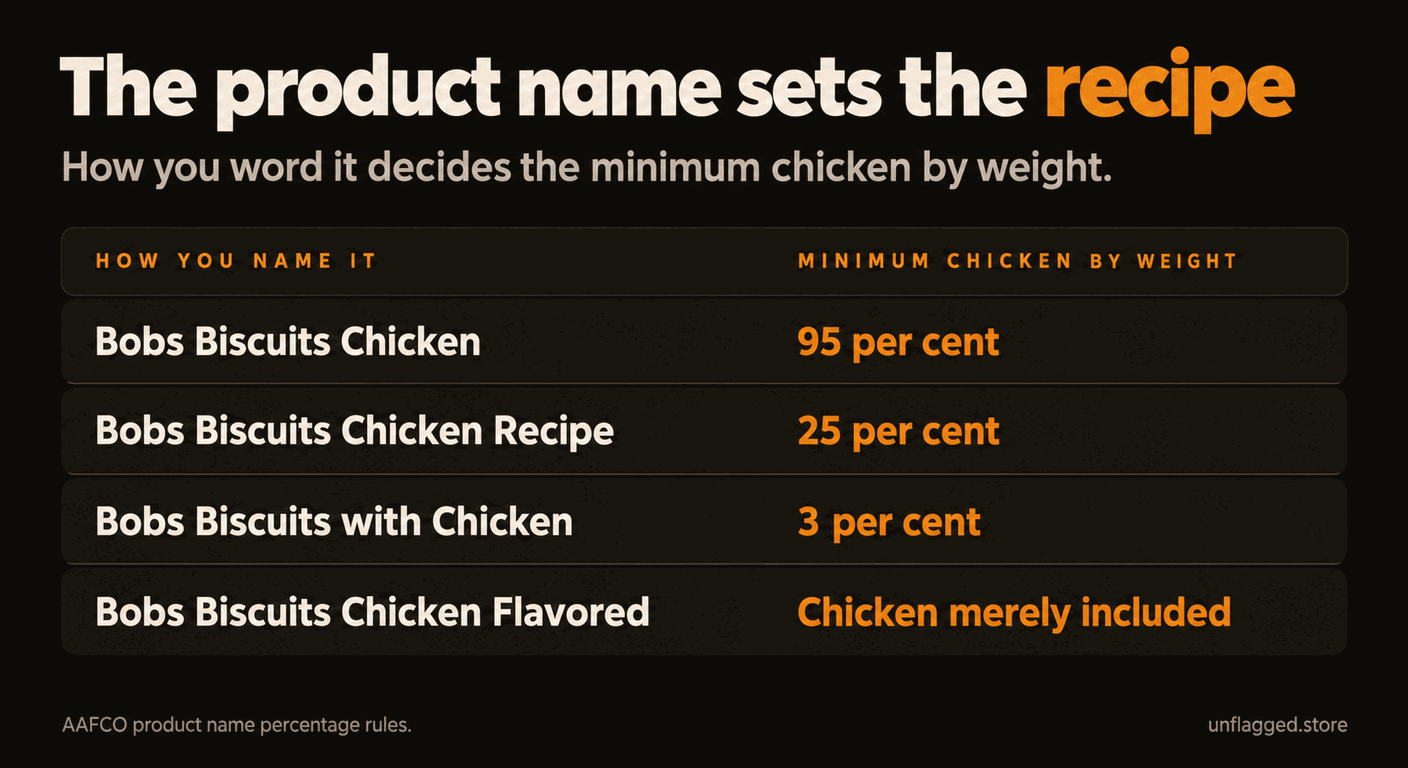
Etsy titles are written for search, which means they front-load ingredients. In pet food law a product name is a regulated statement with a minimum percentage attached, and your wording sets the number you have to hit.
| How you name it | Minimum chicken by weight |
|---|---|
| "Bob's Biscuits Chicken" | 95% |
| "Bob's Biscuits Chicken Recipe" | 25% |
| "Bob's Biscuits with Chicken" | 3% |
| "Bob's Biscuits Chicken Flavored" | Chicken merely included |
Those four tiers come from the Office of Indiana State Chemist's own guidance, and they mean "Chicken Dog Treats" as an Etsy title is a 95% claim, on a biscuit that is mostly flour. "Chicken Recipe Dog Treats" drops the bar to 25%; "Dog Treats with Chicken" drops it to 3%. One word of SEO copy separates a compliant name from a misbranded product.
Flavour claims carry their own honesty rule. Indiana confirms that if an ingredient such as beef bouillon "imparts a flavor or distinction to the treat, that may be stated", but an artificial flavour "must be stated whenever the flavor is mentioned". A treat made with pumpkin spice flavouring rather than pumpkin cannot say "Pumpkin" in the title and bury that in the ingredients.
Claims That Turn a Treat Into an Unapproved Drug
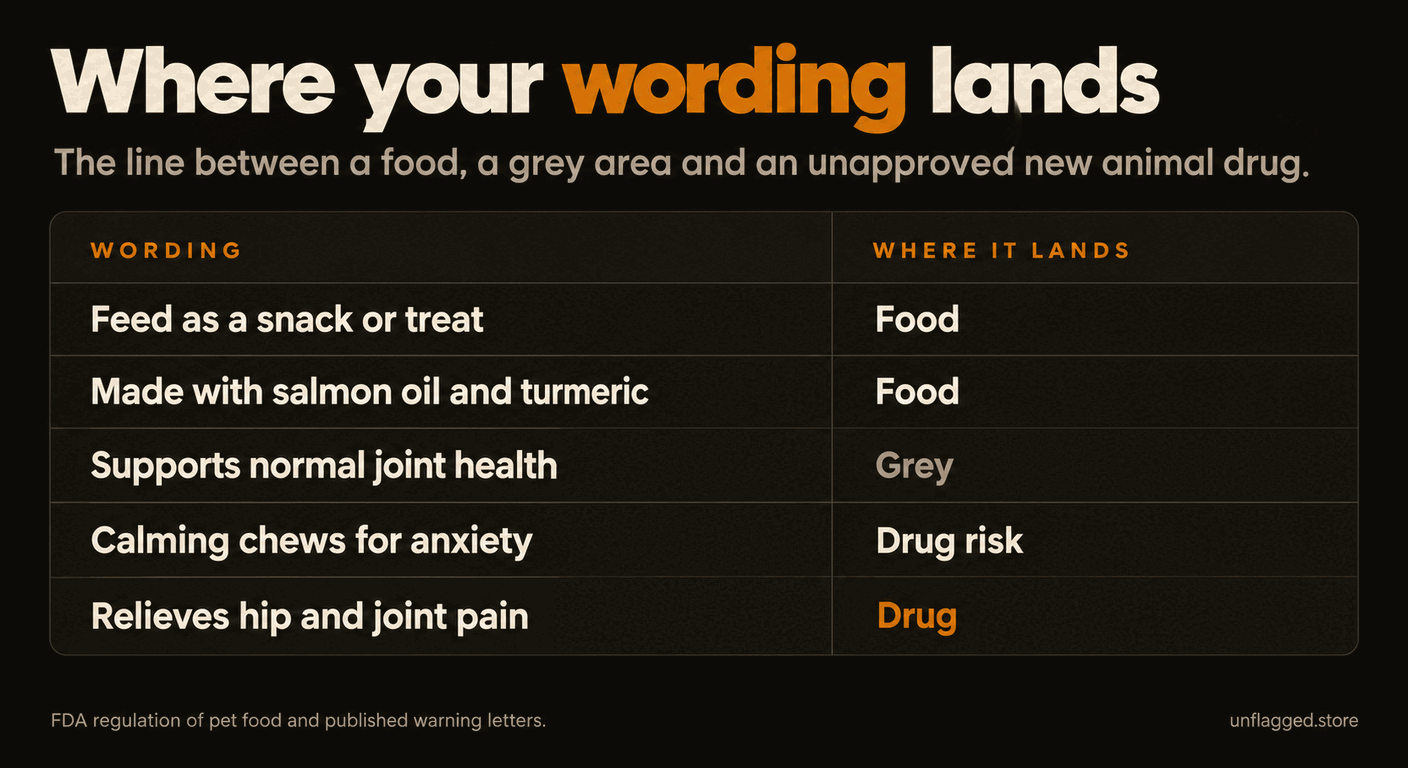
Past labelling there is a harder line. FDA treats a product as a drug when it is intended to diagnose, treat, cure or prevent disease, or to affect the body's structure or function where the effect does not come mainly from nutrition, taste or aroma. Pet products get no equivalent of the structure and function safe harbour human supplements enjoy under DSHEA, so the margin is narrower than sellers assume.
| Wording | Where it lands |
|---|---|
| "Feed as a snack or treat" | Food. The statement your label needs anyway |
| "Made with salmon oil and turmeric" | Food. An ingredient statement, not a promise |
| "Supports normal joint health" | Grey. Common in trade practice, but no exemption protects it for animal products |
| "Calming chews for anxiety" | Drug risk. Names a condition |
| "Relieves hip and joint pain", "treats arthritis" | Drug. Unapproved new animal drug |
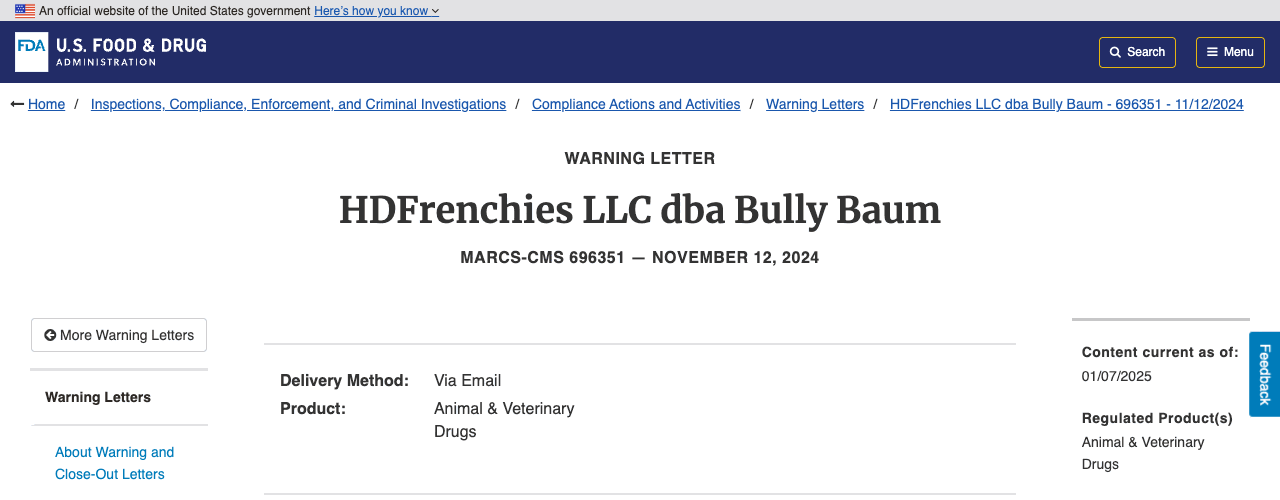
FDA enforces this against small sellers, and it does so by reading websites. On 12 November 2024 it issued a warning letter to HDFrenchies LLC, trading as Bully Baum, after reviewing the company's site that October and November. It quoted the copy back, including "Kills: Cancer and Tumors", and called three products unapproved new animal drugs: adulterated under 21 USC 351(a)(5), misbranded under 352(o) for not being made in a registered facility, and unlawful in interstate commerce under 331(a). In April 2025 it sent the same class of letter to three sellers of CBD and mushroom pet products.
The operative detail for an Etsy shop is where the claims were found: not on the package, on the listing. Our Etsy cosmetics and FDA rules guide walks the identical line on the human side.
What the FDA Actually Requires of a Home Kitchen
Here the search results are wrong, in the direction that sells services: compliance pages tell home bakers to register with FDA as a food facility. Most do not have to, and the reason is one clause.
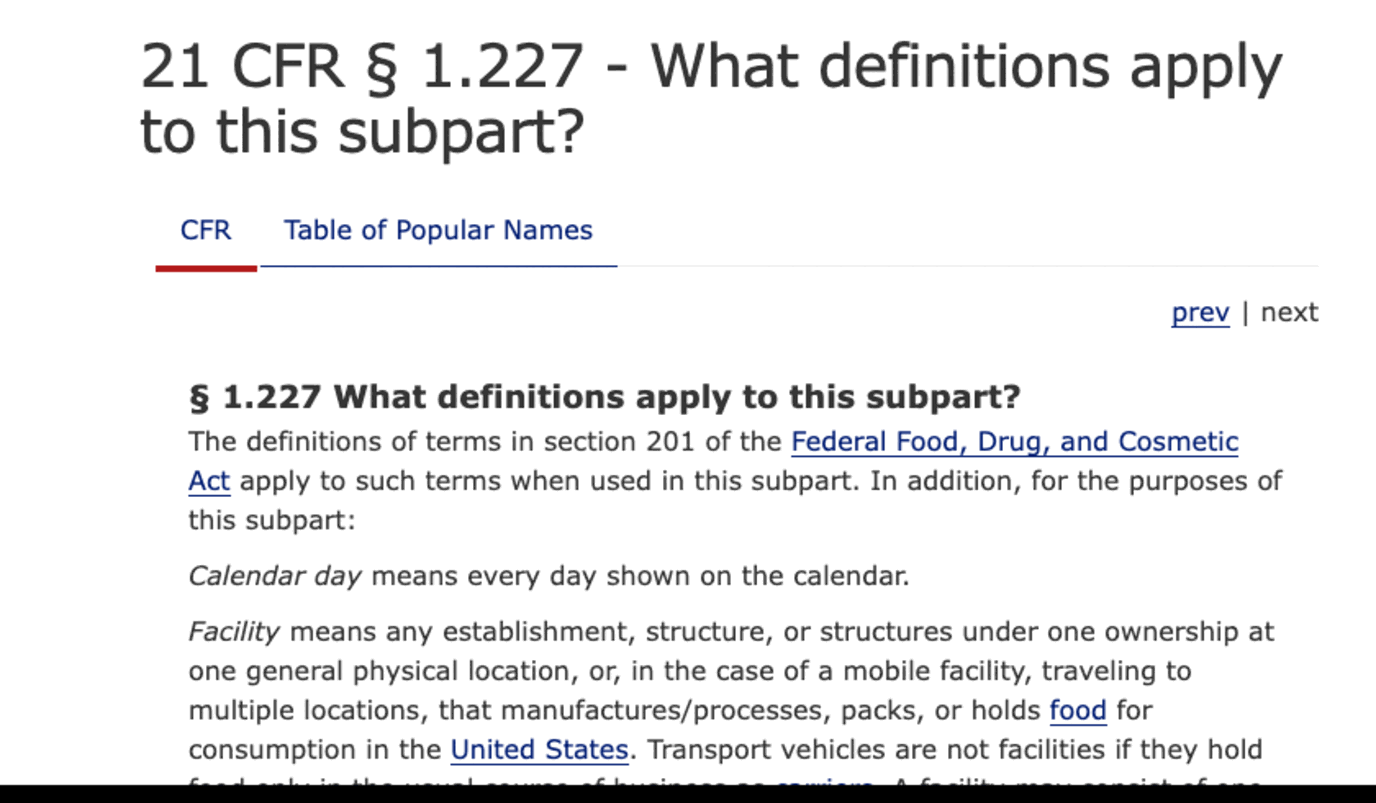
21 CFR 1.227 defines "facility" and excludes "an individual's private residence". 21 CFR 507.3 then defines a facility, for the whole animal food preventive-controls rule, as "a domestic facility or a foreign facility that is required to register under section 415". Put the two together and a genuine home kitchen is outside both. There is a second exit: 1.226(c) exempts retail food establishments, which 1.227 defines by direct-to-consumer sales exceeding sales to all other buyers. An Etsy-only shop clears that comfortably.
| Baking at home | Baking in a commercial or rented space |
|---|---|
| No FDA facility registration | Registration required, no fee, renew biennially |
| Part 507 preventive controls do not apply | Qualified facility route applies if under $2.5m |
| No Form FDA 3942b attestation | Attestation due, with a consumer notice obligation |
| FD&C adulteration and misbranding still apply | Same, plus the above |
If you have moved out of the kitchen, the timing matters right now. Renewal runs from 1 October to 31 December of every even-numbered year, and FDA confirms the 2026 window "begins October 1, 2026 and concludes on December 31, 2026", with no fee for registration or renewal. Under $2,500,000 in average annual animal food sales over the preceding three years, inflation-adjusted from a 2011 baseline, you are a very small business and so a qualified facility: subparts C and E drop away and 507.7 applies instead. Check your status by 1 July, attest on Form FDA 3942b, and resubmit every two years in the same autumn window.
One sub-clause in 507.7 is aimed squarely at online sellers. A qualified facility that attests to state-law compliance rather than to preventive controls must give consumers its name and complete business address, prominently and conspicuously, and "for internet sales, in an electronic notice". On Etsy that notice is your listing or shop page, and a shop hiding behind a brand name alone has not given it.
What applies either way is FDA's baseline for all pet food: safe to eat, produced under sanitary conditions, free of harmful substances and truthfully labelled. No premarket approval is needed unless an ingredient is a food additive, and FDA is explicit that AAFCO "itself has no regulatory authority".
The Label Changes Again Before 2030
AAFCO's Pet Food Label Modernization project rewrites the label you are about to pay to register. It replaces the guaranteed analysis with a Nutrition Facts Box styled on human food and standardises where information sits. There is no national deadline because there is no national regulator: each state adopts on its own schedule, and AAFCO's recommended transition runs about six years from its 2024 Official Publication.
The expensive detail is a different fibre test. Washington adopted the 2025 AAFCO Official Publication into chapter 16-252 WAC on 6 June 2025 and then issued policy FSCS-AF-25-0001, delaying enforcement to 1 July 2030 and listing among the new burdens "obtaining new laboratory analysis for each product to comply with the Nutrition Facts Box requirement with a change from crude fiber guarantee to dietary fiber". The guaranteed analysis you buy in 2026 measures crude fibre. The box needs dietary fibre, which is a separate assay. Washington also says it "will not accept labels that mix new requirements and old requirements, also known as hybrid labels", so you switch a product's label wholesale or not at all.
One more change sits underneath this. The memorandum of understanding under which FDA relied on AAFCO's ingredient definition process lapsed on 1 October 2024. FDA says it does not intend to act against ingredients that already went through that process, and has opened an Animal Food Ingredient Consultation route for new ones. The practical rule for a small baker is firmer than before: use ingredients already named in the AAFCO Official Publication.
A Pre-Listing Check That Takes an Afternoon
- Decide where you will ship before you register anything. Every destination state is a separate licence, and shipping in-state only is a legitimate, cheap answer.
- Call your state feed programme, not a compliance service. Virginia and Indiana both review proposed labels before you print.
- Count products the way the state counts them. Keep size words out of brand names, and treat an icing as a new product with a new fee.
- Buy the lab analysis per flavour and ask for dietary fibre too, so one invoice covers the current label and the Nutrition Facts Box.
- Audit your listing text as label copy. Delete every nutrient claim you cannot guarantee, and "human grade" unless you hold all four documents.
- Rewrite the product name to the tier you can hit. "Chicken Recipe" at 25% is honest; "Chicken" at 95% usually is not.
- Strip anything that names a condition. Anxiety, pain, arthritis, allergies, tumours. FDA finds these by reading the page.
Check the words in your listings before a state reviewer does. Unflagged scans Etsy listing text for the claim language that triggers takedowns and stop-sale orders, including nutrient and health claims that no longer survive a feed-law label review. See what the plans include, or start with our guide to Etsy cottage food rules. Unflagged is our own product and we take no affiliate commission from any laboratory or registration service named here. Nothing here is legal advice, and a multi-state registration plan is worth an hour of a feed-law attorney's time.
Related Articles
- Etsy Cottage Food Rules 2026: Shipping Limits - the human-food rules this article is constantly mistaken for
- Etsy Cosmetics Rules 2026: FDA Labels - the same drug-claim line, drawn on skincare
- Etsy Animal Products Policy 2026: Fur Ban - for treats and chews made from hide, bone or antler
- Etsy Eco-Friendly Claims 2026: FTC Rules - before calling any of this natural or sustainable
- Etsy Prohibited Items: The Complete List - where consumables sit in Etsy's own category map
- Why Etsy Removed Your Listing - the appeal route when a label call has cost you a page
FAQ
Can you sell homemade dog treats on Etsy?
Yes, but only with a state commercial feed licence and, in most states, a registration for each product. Etsy requires sellers to follow applicable law, so the licence is a condition of listing that the platform does not check for you.
Do dog treats count as cottage food?
No. Cottage food laws cover food for people. Pet treats fall under state commercial feed law, with its own licence, per-product registration and label standard, and no small-volume exemption.
Do I need an FDA licence to sell pet treats?
Not if you bake at home: 21 CFR 1.227 excludes "an individual's private residence" from the definition of a facility. Move into a commercial or rented kitchen and registration applies, renewed between 1 October and 31 December of even years.
How much does it cost to register a dog treat?
Per state, per product, per year. Virginia and Indiana charge $50 for the licence plus $50 per product, Minnesota and New York $100 per product, California $500 per licence per location. Three flavours across five states lands near $1,595 in year one.
Do I need a lab test for my dog treats?
Yes, for the guaranteed analysis, once per flavour. Virginia requires each treat to go to a private laboratory, and state programmes neither run the test nor recommend a lab. Ask for dietary fibre too, so the result survives the label change.
Can I call my dog treats human grade?
Only with documentation. Indiana requires four items, including evidence the manufacturing facility is licensed to produce human food. A home kitchen cannot supply that, so the claim should come out of the listing.
Can I say my treats help with anxiety or joint pain?
No. Naming a condition makes the product an unapproved drug in FDA's reading. Its November 2024 warning letter to Bully Baum was built on claims quoted from the company's own website, which is what an Etsy listing is.
Scan Your Listings Free
Check your Etsy listings for trademark violations in seconds. 3 free scans, no signup required.
Start Free ScanRelated Articles
How to Check Your Etsy Listings for Trademark Violations (2026 Guide)
Learn how to scan your Etsy listings for trademark violations before they get flagged. Step-by-step guide to protecting your shop from takedowns and suspensions.
Read moreEtsy Shop Suspended? How to Write a Winning Appeal Letter
Your Etsy shop got suspended. Here's exactly how to write an appeal letter that gets your shop reinstated, with templates and strategies that actually work.
Read more50 Words That Are Trademarked on Etsy (Stop Using These Now)
A comprehensive list of commonly trademarked words and phrases that Etsy sellers use without realizing they're violating trademark law. Check your listings now.
Read more