Etsy Animal Products Policy 2026: Fur Ban
Etsy's animal products policy for 2026: the August 11 fur ban, the Indigenous exemption, which feathers are illegal to sell, and what breaking it costs.
- 1.Four Rulebooks Decide What You Can List
- 2.The Fur Ban Took Effect on 11 August 2026
- 3.The Indigenous Exemption the Early Coverage Missed
- 4.Feathers Are the Real Trap, and the List Is Public
- 5.What a Found Feather Does Not Buy You
- 6.Bone, Antler, Teeth and Shell
- 7.Wood Is a Wildlife Problem Too
- 8.What It Actually Costs
- 9.A Pre-Listing Check That Takes Ten Minutes
- 10.Related Articles
- 11.FAQ
Key takeaways
- Etsy's fur ban has been in force since 11 August 2026 and reaches fur "regardless of age or origin", so vintage counts. Taxidermy, leather, sheepskin, wool and mohair are excluded.
- There is an Indigenous exemption, and most coverage predates it. Announced 10 July 2026 for sellers registered with the Indian Arts and Crafts Board. The April and May articles saying otherwise are out of date.
- Feathers are the bigger risk, and almost nobody checks. Blue Jay, Northern Cardinal and Mourning Dove are all on the federal list at 50 CFR 10.13. Selling one of their feathers is a federal offence, found on the ground or not.
- The penalty the Migratory Bird Treaty Act prints is not the one you face. Section 707(b) says $2,000 for the sale felony; 18 USC 3571(b) allows up to $250,000.
- The Lacey Act turns on $350. Below that market value a sale drops out of the felony tier, putting most handmade listings in the civil and misdemeanour range.
A seller lists earrings made from two Blue Jay feathers she found under a feeder in her own yard. She took nothing and killed nothing. Under federal law she has just offered a protected migratory bird part for sale, and that is the felony tier of the statute, not the paperwork tier.
That is the problem with the Etsy animal products policy: the rules that get a listing pulled and the rules that carry a prison term are different, and they do not line up. Etsy banned natural fur on 11 August 2026 and excluded leather. Federal law protects a Mourning Dove while leaving a Wild Turkey off its list entirely.
We read the operative text of 16 USC 707, 668, 3373 and 1371, checked the fine ceiling at 18 USC 3571, then fetched the species list at 50 CFR 10.13 and searched it species by species rather than trusting a summary. What follows is the four regimes separated out, with the species table none of the ranking pages carry.
Four Rulebooks Decide What You Can List
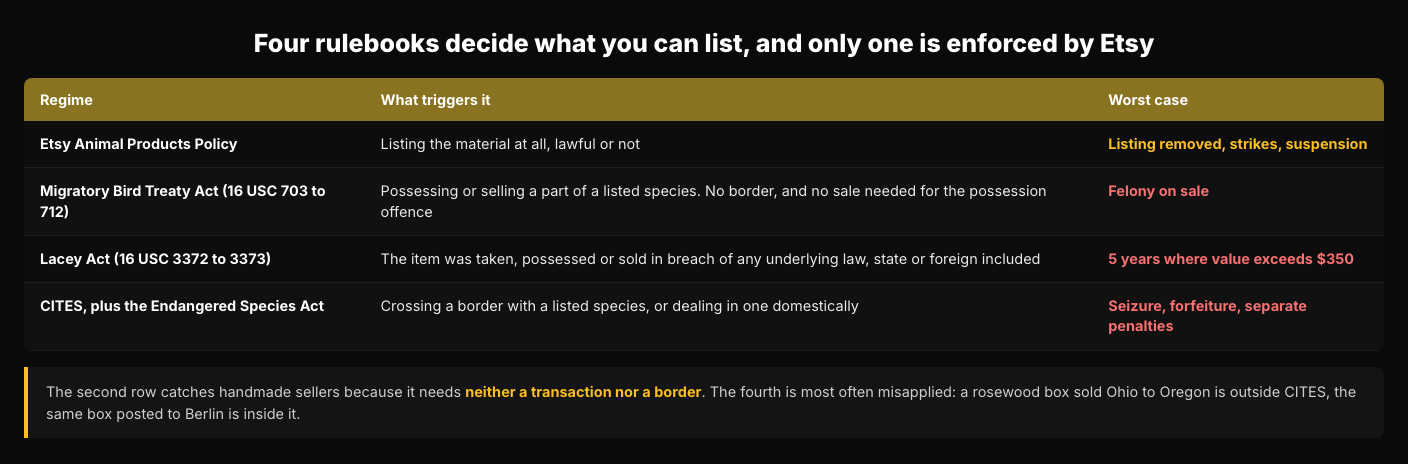
Most guides treat "banned on Etsy" and "illegal" as one category. They are four, they trigger on different facts, and only one is enforced by Etsy.
| Regime | What triggers it | Worst case |
|---|---|---|
| Etsy Animal Products Policy | Listing the material at all, lawful or not | Listing removed, strikes, suspension |
| Migratory Bird Treaty Act (16 USC 703 to 712) | Possessing or selling a part of a listed species. No border, and no sale needed for the possession offence | Felony on sale |
| Lacey Act (16 USC 3372 to 3373) | The item was taken, possessed or sold in breach of any underlying law, state or foreign included | 5 years where value exceeds $350 |
| CITES, plus the Endangered Species Act | Crossing a border with a listed species, or dealing in one domestically | Seizure, forfeiture, separate penalties |
The second row catches handmade sellers because it needs neither a transaction nor a border: possessing a part of a listed bird without a permit is already unlawful, so those earrings were a problem in the drawer. The fourth is most often misapplied, because CITES governs international trade: a rosewood box sold from Ohio to Oregon is outside it, the same box posted to Berlin is inside it. The Lacey Act borrows other laws instead, so a state game law or a foreign timber law becomes federal when you ship.
The Fur Ban Took Effect on 11 August 2026
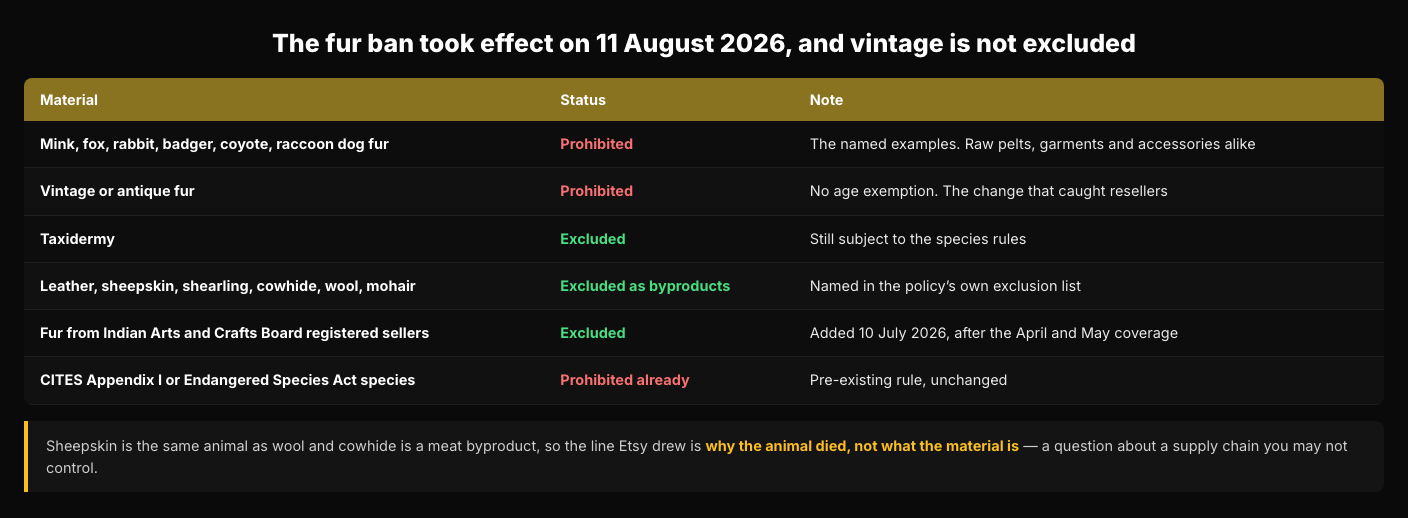
Etsy added a fur section to the policy in April 2026 and gave sellers until 11 August 2026. The operative wording, quoted consistently by the trade press that read the page before and after the change, prohibits products made from or containing natural animal fur from animals killed primarily for their pelts, regardless of age or origin.
Two phrases do the work. "Regardless of age or origin" removes the vintage defence resellers expected. "Killed primarily for their pelts" is the ambiguity, and it is unresolved: the trade press raised the obvious question of animals taken for food whose hide is a byproduct, and Etsy has not answered it.
| Material | Status | Note |
|---|---|---|
| Mink, fox, rabbit, badger, coyote, raccoon dog fur | Prohibited | The named examples. Raw pelts, garments and accessories alike |
| Vintage or antique fur | Prohibited | No age exemption. The change that caught resellers |
| Taxidermy | Excluded | Still subject to the species rules below |
| Leather, sheepskin, shearling, cowhide, wool, mohair | Excluded as byproducts | Named in the policy's own exclusion list |
| Fur from Indian Arts and Crafts Board registered sellers | Excluded | Added in July. See below |
| CITES Appendix I or Endangered Species Act species | Prohibited already | Pre-existing rule, unchanged |
Note what the exclusions imply. Sheepskin is the same animal as wool and cowhide is a meat byproduct, so the line Etsy drew is why the animal died, not what the material is. That is a question about a supply chain you may not control. If a listing has gone, our guide on Etsy listing removals covers the appeal route.
The Indigenous Exemption the Early Coverage Missed
Here the search results will mislead you. Alaska Native artists said in late April and early May 2026 that the ban discriminated against them, and the reporting from that window states plainly that there appeared to be no exception for Indigenous artists. It is accurate about April and wrong about today.
| Date | What happened |
|---|---|
| April 2026 | Etsy adds the fur section and emails sellers, citing biodiversity efforts |
| 30 April and 3 May 2026 | Alaska Native artists go public; coverage reports no Indigenous exemption. Etsy does not answer press questions |
| Before 10 July 2026 | Senator Dan Sullivan writes to Etsy's chief executive, arguing the materials are harvested as part of a subsistence lifestyle |
| 10 July 2026 | Sullivan's office announces an exemption for sellers registered with the Indian Arts and Crafts Board |
| 11 August 2026 | The ban takes effect, with the exemption in place |
The exemption keys to a registration, not to ancestry or tribal membership as such. The Indian Arts and Crafts Board is a federal body within the Department of the Interior that maintains a Source Directory of American Indian and Alaska Native owned businesses. Three limits: Etsy has not published how it verifies the registration, reporting indicates it does not extend to Indigenous producers in Canada, and it is a concession rather than a change in law.
That last point cuts the other way, because the federal position is stronger than Etsy's policy suggests. At 16 USC 1371(b) the Marine Mammal Protection Act exempts taking by an Alaska Native who dwells on the North Pacific or Arctic coast where it "is done for purposes of creating and selling authentic Alaska Native articles of handicrafts and clothing" and is not wasteful. Congress wrote a right to sell into the statute. For four months a marketplace policy sat on top of it.
Feathers Are the Real Trap, and the List Is Public
Etsy does not ban feathers. Its House Rules tell sellers of feather products to consult the Migratory Bird Treaty Act, a quiet way of saying the real constraint is federal and not Etsy's problem. Almost every competing guide repeats that pointer and stops.
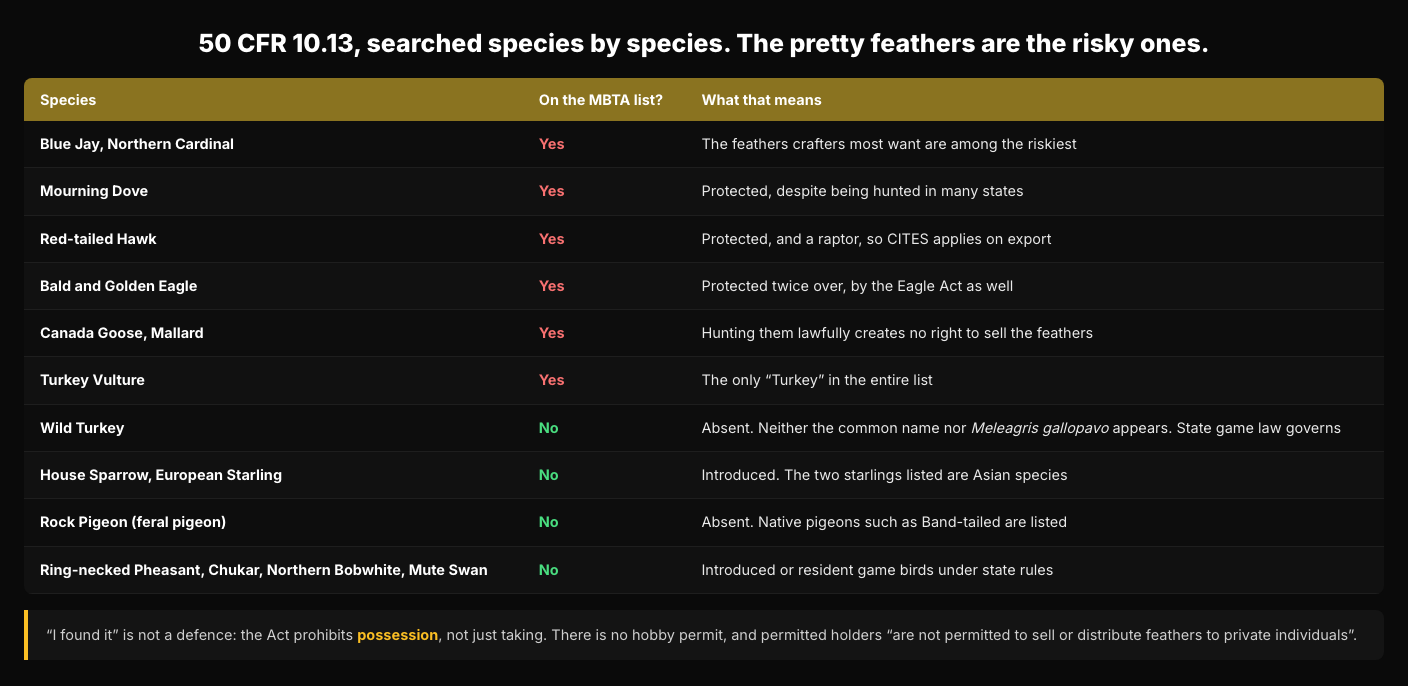
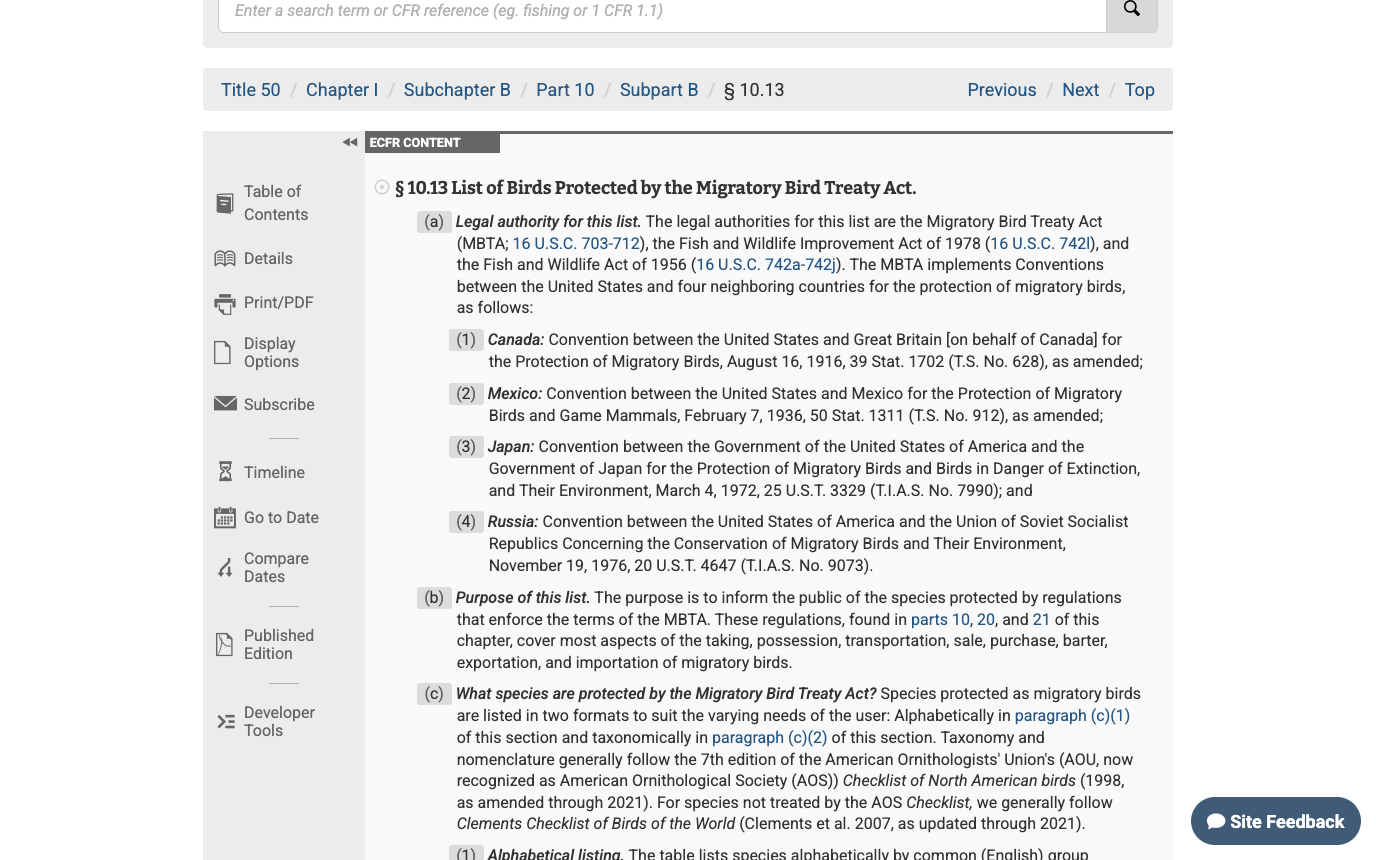
The pointer resolves to a list. 50 CFR 10.13 exists, in its own words, "to inform the public of the species protected by regulations that enforce the terms of the MBTA". It is long, searchable, and settles most questions in a minute. We searched it, and the results are not what a craft seller would guess.
| Species | On the list? | What that means |
|---|---|---|
| Blue Jay, Northern Cardinal | Yes | The feathers crafters most want are among the riskiest |
| Mourning Dove | Yes | Protected, despite being hunted in many states |
| Red-tailed Hawk | Yes | Protected, and a raptor, so CITES applies on export |
| Bald and Golden Eagle | Yes | Protected twice over, by the Eagle Act as well |
| Canada Goose, Mallard | Yes | Hunting them lawfully creates no right to sell the feathers |
| Turkey Vulture | Yes | The only "Turkey" in the entire list |
| Wild Turkey | No | Absent. Neither the common name nor Meleagris gallopavo appears. State game law governs |
| House Sparrow, European Starling | No | Introduced. The two starlings listed are Asian species |
| Rock Pigeon (feral pigeon) | No | Absent. Native pigeons such as Band-tailed are listed |
| Ring-necked Pheasant, Chukar, Northern Bobwhite, Mute Swan | No | Introduced or resident game birds under state rules |
Read the two halves together and the rule falls out. Pretty native songbird feathers are the worst thing you can list, and barnyard and introduced-species feathers are the safe ones. Domestic chicken, duck, goose, turkey and peacock, plus the ostrich and farmed pheasant plumes craft suppliers sell, are not MBTA species at all.
Two cautions, because absence from one list is not a clean bill of health. Wild Turkey and Northern Bobwhite are resident game birds under state law, and several states restrict selling parts of game taken under licence; break that and the Lacey Act picks it up when the parcel moves. Second, the Fish and Wildlife Service's Feather Atlas FAQ notes that while parrot and macaw feathers are sellable, the burden is on the seller to show they did not come from protected wild birds.
What a Found Feather Does Not Buy You
The most common belief here is the one the statute most clearly rejects. "I found it" is not a defence, because the Act prohibits possession, not just taking. A moulted feather from a protected species is a protected bird part.
The permit route does not reach you. The Fish and Wildlife Service says native North American birds may be held in captivity only by zoos, rehabilitation centres and falconers under permit, and that those holders may use moulted feathers for education but "are not permitted to sell or distribute feathers to private individuals." There is no hobby permit and no supplier who can lawfully sell you protected native feathers. If one offers them, that is evidence against both of you.
Eagles sit under a second statute on top of all this. 16 USC 668(a) reaches any bald or golden eagle "or any part, nest, or egg thereof" and prohibits selling, offering to sell, possessing and transporting, at up to $5,000 or a year for a first conviction. Tribal rights are the point most often garbled, and the misunderstanding runs in a generous-sounding direction: registered members of federally recognised tribes may possess eagle feathers for cultural and religious use, obtaining new ones through the National Eagle Repository, but the Fish and Wildlife Service states they "may not be sold or traded." A lawful religious possession is not saleable inventory.
Enforcement reaches the exact conduct a listing represents. The US Attorney's Office for the District of New Mexico indicted a man on two counts for having sold and offered for sale Red-tailed Hawk, Bald Eagle and Golden Eagle feathers on two dates in Bernalillo County. The charged act was the sale and the offer, which is what a live listing is. So your risk does not end when you stop making the item: a sold-out page that still shows it keeps the exposure open, which is the discipline behind our round-up of common Etsy policy violations.
Bone, Antler, Teeth and Shell
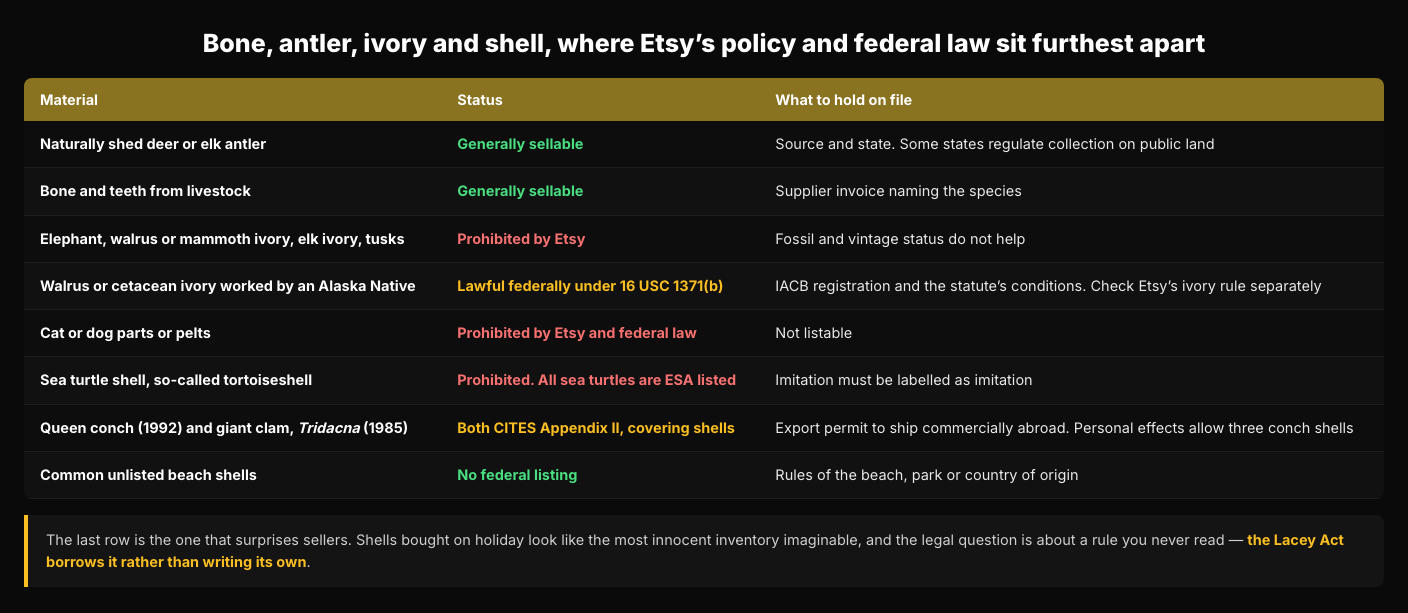
These are the categories where Etsy's policy and federal law sit furthest apart, and where every competing guide we scored either skipped the material or covered only ivory.
| Material | Status | What to hold on file |
|---|---|---|
| Naturally shed deer or elk antler | Generally sellable | Source and state. Some states regulate collection on public land |
| Bone and teeth from livestock | Generally sellable | Supplier invoice naming the species |
| Elephant, walrus or mammoth ivory, elk ivory, tusks | Prohibited by Etsy | Fossil and vintage status do not help |
| Walrus or cetacean ivory worked by an Alaska Native | Lawful federally under 16 USC 1371(b), but check Etsy's ivory rule | IACB registration and the statute's conditions |
| Cat or dog parts or pelts | Prohibited by Etsy and federal law | Not listable |
| Sea turtle shell, so-called tortoiseshell | Prohibited. All sea turtles are ESA listed | Imitation must be labelled as imitation |
| Queen conch (1992) and giant clam, Tridacna (1985) | Both CITES Appendix II, covering shells | Export permit to ship commercially abroad. Personal effects allow three conch shells |
| Common unlisted beach shells | No federal listing | Rules of the beach, park or country of origin |
The row that surprises sellers is the last one. Shells bought on holiday and resold as jewellery components look like the most innocent inventory imaginable, and the legal question is about a rule you never read: whether the country or park you collected them in permitted it. The Lacey Act borrows that rule rather than writing its own.
Wood Is a Wildlife Problem Too
Woodworkers rarely file this under animal products, which is why it belongs here: the Lacey Act was amended in 2008 to cover plants, so the statute governing a hawk feather governs a rosewood ring box.
| Scenario | Regime | Requirement |
|---|---|---|
| Rosewood item sold within the United States | Lacey Act only | Show the timber was lawfully harvested. CITES is not engaged |
| Rosewood item posted to a buyer abroad | Lacey Act and CITES | Dalbergia is Appendix II. Check Annotation 15 first |
| Finished musical instrument, part or accessory | CITES, exempted by Annotation 15 | The exemption exists because the listing caught guitar makers |
| Small finished wooden product | CITES, 10 kg allowance | See the caveat below |
| Reclaimed or salvaged domestic hardwood | Lacey Act | A lawful source still has to be demonstrable, so keep the record |
One caveat we will not paper over. The current Dalbergia annotation, in force since 23 February 2023, carries both exemptions, but sources disagree on how the 10 kg is counted: interpretive guidance reads it as the weight of each annotated species in each item of a shipment, the older CoP17 formulation as 10 kg per shipment. We could not reach cites.org to settle it, because the site refuses non-browser requests. Near the threshold, ask your national CITES management authority rather than trusting either reading, this one included. For the EU, the timber question arrives alongside the paperwork in our Etsy EU compliance guide.
What It Actually Costs
Here is the number no competing guide carries, missing because you have to read a second statute to find it.
| Statute | Tier | Text on the page | Real ceiling |
|---|---|---|---|
| MBTA, 707(a) | Misdemeanour, including possession | Up to $15,000 or six months | $15,000, the statute being above the default |
| MBTA, 707(b) | Felony: sale or offer to sell | Up to $2,000 or two years | Up to $250,000 via 18 USC 3571(b) |
| Eagle Act, 668(a) | First, then subsequent convictions | $5,000 or a year, then $10,000 or two | As printed, plus forfeiture |
| Lacey Act, 3373(d)(1) | Felony, value over $350 | Up to $20,000 or five years | Felony default applies above the printed figure |
| Lacey Act, 3373(d)(2) | Knowing violation, due-care standard | Up to $10,000 or one year | As printed |
| Lacey Act, 3373(a)(1) | Civil penalty | Up to $10,000 per violation | Capped lower under $350 where conduct is transport or receipt only |
The second row is the correction. Section 707(b) prints $2,000, and that figure is quoted across the internet as the cost of selling migratory bird parts. But 18 USC 3571(b) says an individual "may be fined not more than the greatest of" several amounts, one being "for a felony, not more than $250,000". Subsection (e) claws that back only where the offence statute "by specific reference" exempts itself, and section 707 contains no such reference. The $2,000 is a floor on the page, not the ceiling in court.
Now the number in your favour. The Lacey Act's felony tier requires a sale with market value in excess of $350. Most handmade listings are not, which puts realistic exposure for a small shop in the civil band of up to $10,000 and the one-year misdemeanour, plus forfeiture. Etsy's own consequences need no statute and no finding of intent: a listing goes, strikes accumulate, and a shop can be suspended while every legal question stays hypothetical.
A Pre-Listing Check That Takes Ten Minutes
- Name the species, not the material. "Feather earrings" is not an answer. Domestic goose and Blue Jay have opposite outcomes, and you cannot check a category.
- For any bird, search 50 CFR 10.13. Present means do not list. Absent means move to step 3 rather than relaxing.
- For an absent bird or a game animal, check your state wildlife agency on selling parts of game taken under licence. That is where the Lacey Act gets its hook.
- For fur, ask why the animal died and whether the material is on Etsy's byproduct exclusion list. Pelt fur without IACB registration is not listable at any age.
- For anything crossing a border, check CITES before you post, and price the permit in rather than discovering it at the counter.
- Write provenance into your records and reread old listings. An offer for sale is an element of the offence, so a forgotten page is still live exposure.
Check the words in your listings before Etsy does. Unflagged scans Etsy listing text for the compliance language that triggers takedowns, including species names and material claims that no longer survive the 2026 animal products policy. See what the plans include, or start with our guide to Etsy prohibited items. Unflagged is our own product; we take no affiliate commission from any supplier or agency named here. Nothing here is legal advice, and a species question with real money behind it is worth an hour of a wildlife lawyer's time.
Related Articles
- Etsy Prohibited Items: The Complete List - the wider category map this article drills into
- Etsy Children's Products 2026: CPSIA Rules - for feather and bone items marketed to children
- Etsy Prop 65 Warnings 2026: California Rules - the other statute that turns on what a material is made of
- Etsy Jewelry Labeling Requirements 2026: FTC Rules - for shell, bone and antler components
- Etsy Eco-Friendly Claims 2026: FTC Rules - before describing any of this as ethically sourced
- Why Etsy Removed Your Listing - the appeal route when a material call has cost you a page
FAQ
Can I sell feathers on Etsy in 2026?
Only from the right birds. Domestic poultry, ostrich, peacock and farmed pheasant are fine. Species on the federal list at 50 CFR 10.13, including Blue Jay, Northern Cardinal, Mourning Dove and every raptor, are not sellable.
Is it legal to sell feathers I found in my own yard?
Not if they came from a protected species. The Act prohibits possession, so how you acquired it does not matter and a moulted feather is still a protected bird part. No hobby or craft permit changes that.
When did Etsy's fur ban start, and does it cover vintage fur?
It took effect on 11 August 2026, added to the policy in April. It covers fur from animals killed primarily for their pelts "regardless of age or origin", so vintage is included. Taxidermy, leather, sheepskin, wool and mohair are excluded as byproducts.
Is there an exemption for Indigenous sellers?
Yes, since 10 July 2026, for sellers registered with the Indian Arts and Crafts Board. Coverage from April and May saying otherwise predates it. Etsy has not published how it verifies registration.
What is the penalty for selling migratory bird feathers?
Higher than the statute's page suggests. 16 USC 707(b) prints $2,000 for the sale felony, but 18 USC 3571(b) permits up to $250,000 unless the offence statute exempts itself by specific reference, and section 707 does not.
Do I need a CITES permit to sell a rosewood item?
Only if it crosses a border. CITES governs international trade, so a domestic sale raises a Lacey Act sourcing question instead. For export, Dalbergia is Appendix II, with Annotation 15 exempting finished musical instruments.
Scan Your Listings Free
Check your Etsy listings for trademark violations in seconds. 3 free scans, no signup required.
Start Free ScanRelated Articles
How to Check Your Etsy Listings for Trademark Violations (2026 Guide)
Learn how to scan your Etsy listings for trademark violations before they get flagged. Step-by-step guide to protecting your shop from takedowns and suspensions.
Read moreEtsy Shop Suspended? How to Write a Winning Appeal Letter
Your Etsy shop got suspended. Here's exactly how to write an appeal letter that gets your shop reinstated, with templates and strategies that actually work.
Read more50 Words That Are Trademarked on Etsy (Stop Using These Now)
A comprehensive list of commonly trademarked words and phrases that Etsy sellers use without realizing they're violating trademark law. Check your listings now.
Read more