Etsy Trademark Infringement: Everything Sellers Need to Know (2026)
Trademark infringement on Etsy goes far beyond selling counterfeits. A single trademarked word in your listing title can trigger an IP report, get your listing removed, and put your entire shop at risk. This guide covers exactly how Etsy's enforcement system works, the mistakes that get sellers flagged, and how to protect yourself before it's too late.
What Trademark Infringement Actually Means on Etsy
Most Etsy sellers hear “trademark infringement” and think of counterfeit goods — knock-off handbags, fake watches, bootleg merchandise. But on Etsy, the vast majority of trademark violations have nothing to do with counterfeits. They come from words.
Trademark infringement on Etsy occurs when a seller uses a registered brand name, logo, slogan, or other protected mark in a way that could confuse buyers about the source or affiliation of a product. This includes situations most sellers don't realize are violations:
- Using brand names for SEO — Typing “Stanley tumbler accessory” in your title to attract search traffic
- Fan art and character designs — Creating original artwork featuring trademarked characters like Pikachu or Mickey Mouse
- “Inspired by” products — Selling items that reference a brand with disclaimers like “inspired by Louis Vuitton”
- Trademarked generic-sounding words — Terms like “Onesie” (Gerber), “Chapstick” (Haleon), and “Band-Aid” (Johnson & Johnson) are all registered trademarks
The key legal concept is likelihood of confusion. If a reasonable buyer might think your product is made by, endorsed by, or affiliated with the trademark owner, that's infringement — regardless of your intent. Etsy doesn't care that you didn't mean to infringe. The trademark holder filed a report, and your listing is coming down.
Key distinction: Trademark infringement is about protecting brand identity (names, logos, slogans). Copyright infringement is about protecting creative works (designs, photos, written content). Both can get your Etsy listings removed, but they work through different legal frameworks. This guide focuses primarily on trademark issues, which are the most common cause of Etsy listing removals.
How Etsy's IP Reporting System Works
Understanding how infringement reports flow through Etsy's system helps you understand why enforcement feels so sudden and one-sided. Here's the process from start to finish.
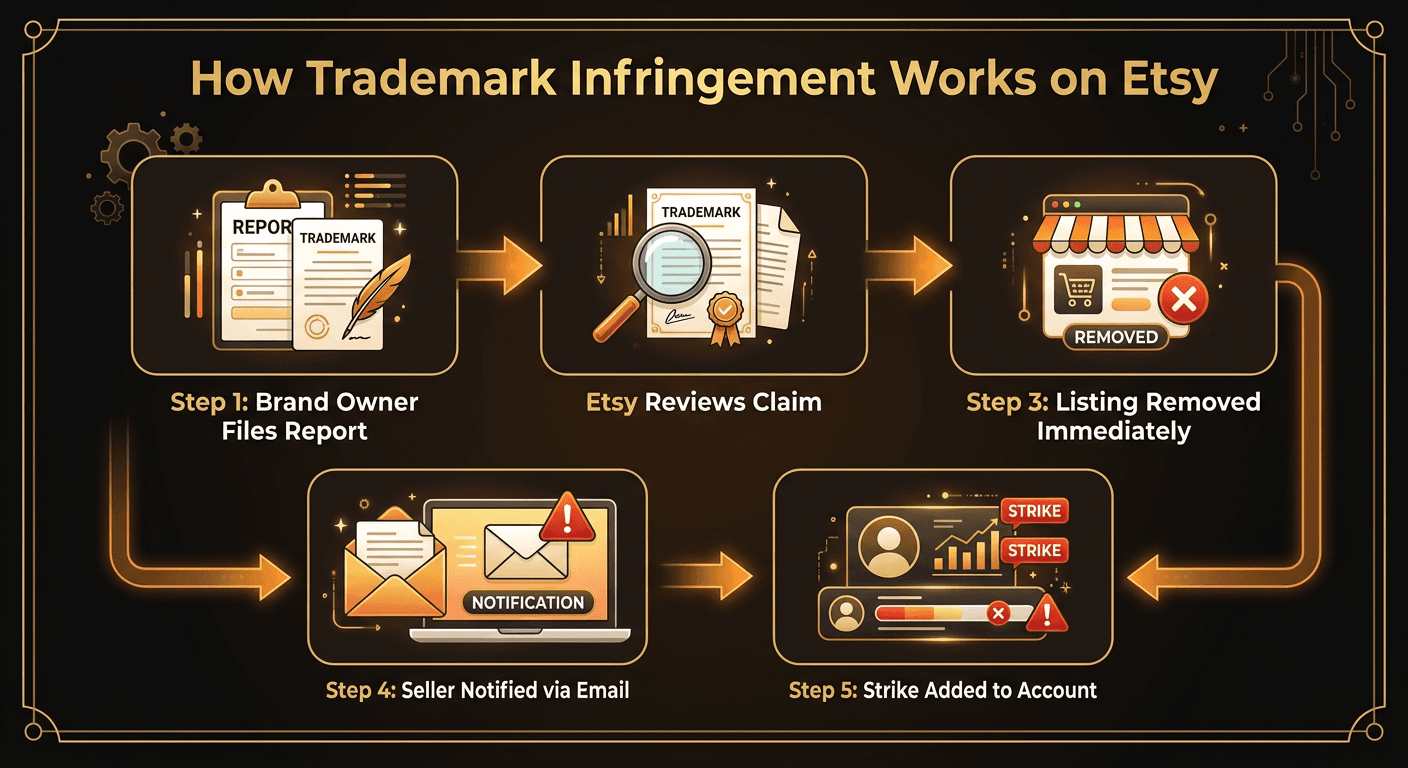
Brand Owner Files a Report
Trademark holders (or their legal representatives) submit reports through Etsy's dedicated IP Reporting Portal. Major brands like Disney, Nike, and Louis Vuitton have automated systems that scan Etsy continuously and file reports in bulk. Smaller brands file manually when they discover unauthorized use.
Etsy Reviews the Claim
Etsy's Trust & Safety team evaluates the report against their intellectual property policies. In practice, most reports from verified brand owners are processed quickly with minimal pushback. Etsy is legally obligated under the DMCA and trademark law to act on valid reports to maintain their safe harbor protection.
Listing Removed
The flagged listing is deactivated immediately. Buyers can no longer see or purchase the item. In cases involving multiple listings, Etsy may remove all related listings at once. The listing cannot be reactivated until the dispute is resolved.
Seller Notified
You receive an email from Etsy explaining which listing was removed and the reason. The notification includes the name of the reporting party and instructions on how to file a counter-notice if you believe the removal was a mistake. A strike is simultaneously added to your account.
The entire process can happen in under 24 hours. Many sellers wake up to find their listing already removed before they even knew a report was filed. In some cases, these reports come from competitors filing trademark reports rather than actual brand owners. There is no “heads up” or chance to fix the listing before removal — the listing comes down first, and you deal with the aftermath.
4 Types of IP Violations on Etsy
Intellectual property on Etsy isn't just about trademarks. There are four distinct types of IP violations, each with different triggers and consequences. Understanding the differences helps you know exactly what to avoid.
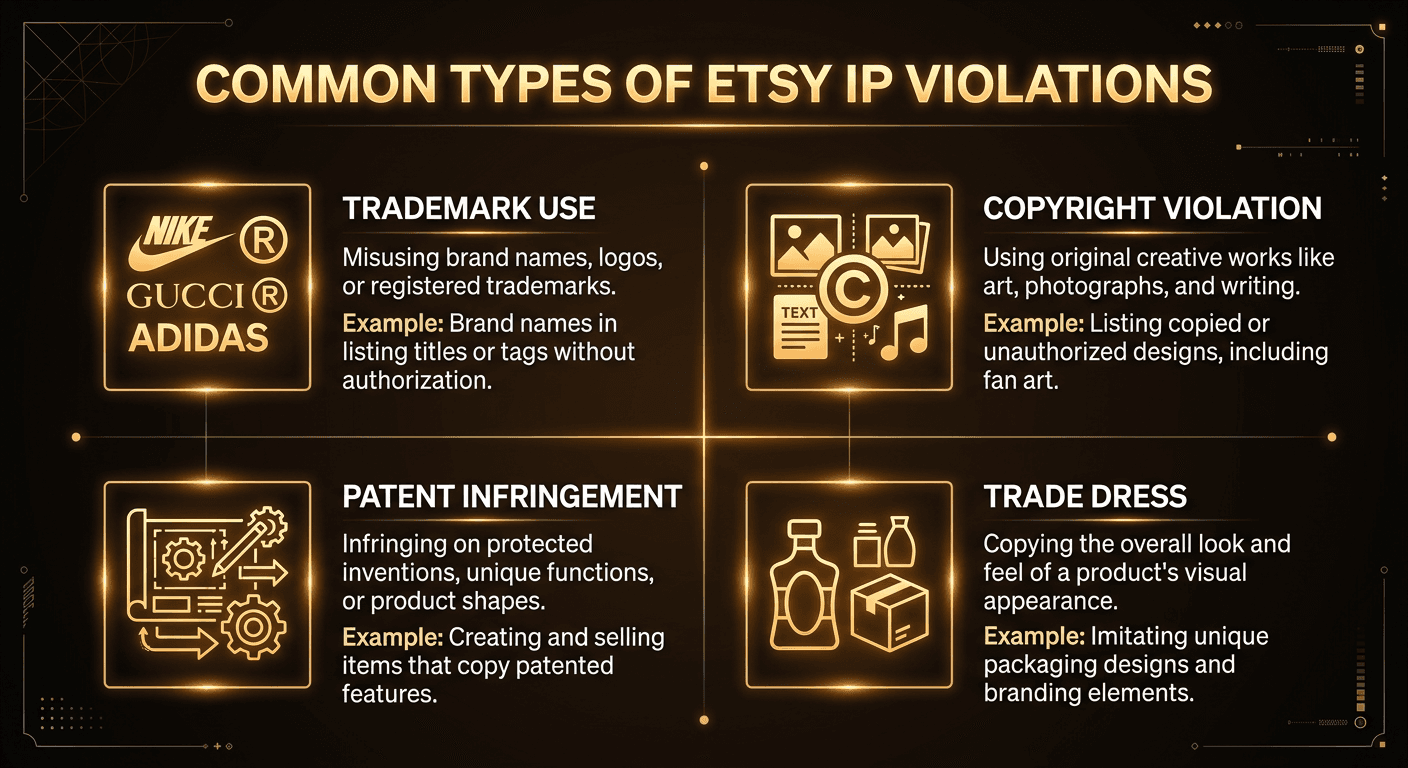
1. Trademark Violations
Using registered brand names, logos, or slogans in your listings without permission. This is the most common violation on Etsy. Examples include putting “Disney” in your title, using the Nike swoosh in product images, or tagging your listing with “Chanel” to attract searches. Even using a brand name in Etsy's search tags — where buyers don't see it — counts as infringement.
2. Copyright Violations
Copying someone else's original creative work, including designs, photographs, illustrations, patterns, and written descriptions. On Etsy, this often shows up as sellers copying another seller's product photos, replicating a popular design, or using images found on Google or Pinterest without permission. Copyright protection is automatic — the creator doesn't need to register it for protection to apply.
3. Patent Violations
Selling products that copy a patented invention or design. Design patents protect the ornamental appearance of a product, while utility patents protect how a product functions. On Etsy, this most commonly applies to unique product designs — for example, a seller creating an identical copy of a patented phone stand design. Patent claims are less common than trademark claims but carry serious legal consequences.
4. Trade Dress Violations
Copying the overall visual appearance, packaging, or “look and feel” of a branded product. Trade dress protects the distinctive visual elements that consumers associate with a brand — think Tiffany's robin egg blue box, the Coca-Cola bottle shape, or Christian Louboutin's red soles. Even without using a brand name, you can violate trade dress by creating products that look too similar to a protected brand's distinctive appearance.
Most important takeaway: Trademark violations are by far the most common type of IP issue on Etsy because they're the easiest for brand owners to detect (automated keyword scanning) and the easiest for sellers to accidentally trigger (using a brand name without thinking). The other three types typically require more deliberate copying.
The Penalty Escalation Path
Etsy doesn't shut down your shop over a single violation (in most cases). There's a progressive enforcement path, though the speed of escalation depends on the severity of the violation and which brand reported you.
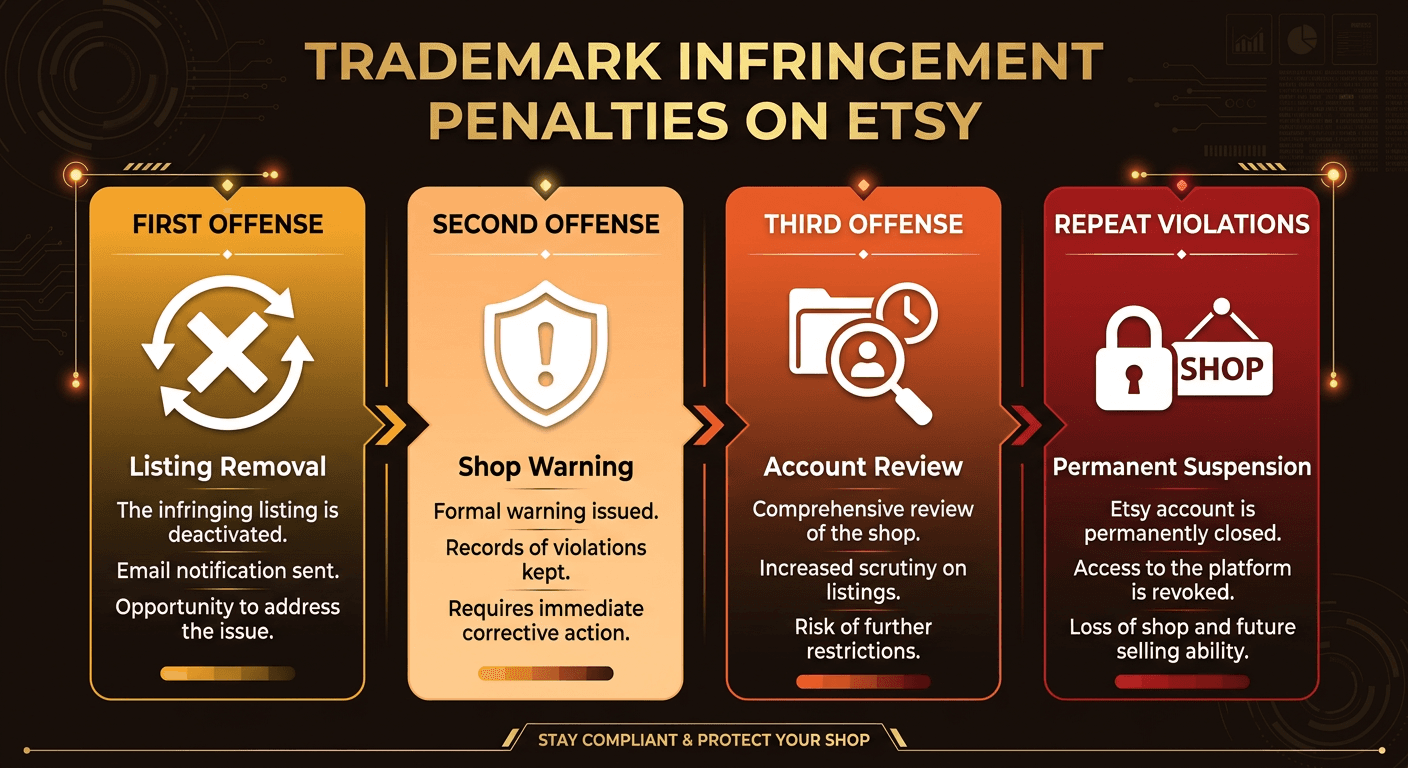
First Offense: Listing Removal
The specific listing is deactivated. You receive a notification email explaining the violation. For most first-time offenders, this comes with a warning rather than immediate account action. Your shop stays open and other listings remain active. This is your chance to audit all your listings and remove any other potential violations.
Second Offense: Formal Warning
A second listing removal comes with a more serious warning. Etsy may require you to acknowledge their IP policies before you can list new items. Your account is now on Etsy's radar, and any further violations will be treated with less leniency. At this stage, you should treat every listing in your shop as a potential risk and review them all.
Third Offense: Account Review
Your entire account enters review. Etsy's Trust & Safety team examines your shop holistically, looking at all listings, your shop history, and the pattern of violations. During review, your ability to list new items may be restricted. This is the last chance before suspension — if the review finds additional violations, suspension is almost certain.
Repeat Violations: Permanent Suspension
Your shop is permanently suspended. All listings go offline. Your funds are frozen for up to 180 days. You lose access to customer data, order history, and shop analytics. Reopening under a new account violates Etsy's terms and, if detected, results in immediate closure of the new account as well. At this point, your only option is writing a strong suspension appeal letter.
Exception: Egregious violations — such as selling obvious counterfeits, bulk infringing listings, or violating a court order — can skip the escalation path entirely and result in immediate permanent suspension on the first offense.
Most Common Trademark Mistakes Sellers Make
After analyzing thousands of Etsy IP violations, these are the mistakes that get sellers flagged most often. Every one of these feels harmless to the seller who does it — which is exactly why they're so dangerous.
1. Using Brand Names for SEO
The most common mistake. Sellers add brand names to their titles and tags to appear in searches for that brand. “Stanley tumbler boot,” “Disney party decorations,” “Cricut SVG files” — these seem like smart SEO moves, but each one is a trademark violation. The brand name draws the search traffic, and the brand owner files the report.
2. The “Inspired By” Loophole (That Doesn't Exist)
Many sellers believe that adding “inspired by,” “not affiliated with,” or “fan-made” disclaimers protects them from infringement claims. It does not. These phrases do nothing to prevent trademark detection — Etsy's automated scanner and brand-owner monitoring tools flag the trademarked word regardless of surrounding context. If anything, “inspired by [Brand]” confirms you're intentionally referencing their trademark.
3. Fan Art Misconceptions
“But it's my original artwork!” This is the argument sellers make most often — and it doesn't hold up. Even if you hand-painted a Pikachu yourself, the character Pikachu is trademarked by The Pokémon Company. Your original artistic effort doesn't override their trademark rights. Fan art of Disney, Marvel, Star Wars, Harry Potter, and other major franchises is the single biggest category of shop suspensions on Etsy.
4. Using Brand Colors, Patterns, and Visual Elements
You don't have to use a brand's name to infringe on their intellectual property. Tiffany's robin egg blue, Burberry's plaid pattern, Louis Vuitton's monogram print, and Christian Louboutin's red soles are all protected trade dress. Creating products that mimic these distinctive visual elements — even without using the brand name — can trigger a trade dress infringement claim.
What to Do If You Get an Infringement Notice
Getting your first infringement notice is alarming, but how you respond determines whether it stays a minor issue or escalates into a shop suspension. Follow these steps immediately.
Don't Panic — But Act Fast
Read the notification email carefully. Note which listing was removed, which brand filed the report, and what specific violation was cited. Save this email — you'll need it if you file a counter-notice or appeal.
Audit All Your Listings Immediately
If one listing was flagged, others using similar terms are at risk. Go through every active listing and check titles, tags, descriptions, and images for any trademarked terms. Remove them before another report comes in. A second violation shortly after the first dramatically increases your risk of suspension.
Decide: Comply or Contest
If the report is valid (you did use a trademarked term), accept the removal, learn from it, and move on. Do not relist the same item with the same terms. If you believe the removal was a mistake — for example, your use falls under nominative fair use — you can file a counter-notice (covered below).
Document Everything
Screenshot the original listing (if you still have access), save all communication from Etsy, and keep records of your sales history. If the situation escalates to suspension, this documentation will be critical for your appeal letter.
How to Avoid Trademark Infringement on Etsy
Prevention is infinitely easier than dealing with a takedown. Here are the proactive steps every Etsy seller should take before publishing any listing.
Search the USPTO TESS Database
Before using any brand-sounding word in a listing, search the USPTO Trademark Electronic Search System (TESS). Look for live registrations in your product category. Pay special attention to the goods/services description — a trademark registered for “clothing” won't necessarily apply to “home decor,” but it's still safer to avoid the term entirely.
Use Descriptive, Generic Language
Instead of “Stanley tumbler boot,” say “40oz tumbler boot.” Instead of “Cricut SVG,” say “SVG for cutting machines.” Instead of “Disney princess dress,” say “fairy tale princess costume.” Describe the product's function and style rather than referencing a brand. For a complete list of safe word swaps, see our guide on trademarked words on Etsy.
Scan Your Listings Before Publishing
Manual checking is time-consuming and error-prone. Automated trademark scanning tools like Unflagged's trademark checker analyze your entire listing — title, tags, and description — against trademark databases and flag risky terms before you publish. One automated scan catches issues that hours of manual research might miss.
Check Your Images Too
Brand owners don't just scan text — they also use image recognition to find unauthorized use of their logos, character designs, and trade dress. Make sure your product photos don't include visible brand logos, branded packaging, or recognizable trademarked design elements. Even using a branded item as a prop in your product photos can trigger a claim.
Counter-Notice: When You're Wrongly Accused
Not every infringement report is valid. Brand owners sometimes file overly broad reports, automated systems make mistakes, and legitimate uses of brand names (like nominative fair use for compatibility descriptions) get caught in the net. If you believe your listing was wrongly removed, you have the right to fight back.
How to File a Counter-Notice
- Respond to Etsy's notification email — Follow the instructions provided in the removal notice to initiate the counter-notice process
- Provide your contact information — Your full legal name, address, phone number, and email are required (this information is shared with the complainant)
- Identify the removed listing — Include the listing title, URL, and a clear description of the product
- Explain why the removal was wrong — Provide a detailed explanation of why your listing does not infringe. Cite nominative fair use, generic terms, or other legal defenses as applicable
- Include a statement under penalty of perjury — You must state that you have a good faith belief the material was removed due to mistake or misidentification
- Consent to jurisdiction — You must agree that you consent to the jurisdiction of the federal court in your district
What Evidence to Gather
- Screenshots of the original listing — Showing exactly how the term was used in context
- USPTO search results — Proving the term is generic, expired, or not registered in your product category
- Proof of nominative fair use — If you used a brand name only for compatibility (e.g., “fits Stanley 40oz”), document the context
- Prior communication with the brand — If the brand previously approved your use or you have a license
- Proof of original design — If accused of copying, show your design process, sketches, or creation dates
After you file a counter-notice, Etsy forwards it to the original complainant. They have 10 business days to file a court action. If they don't, Etsy may restore your listing. Be aware that counter-notices are serious legal documents — filing a false counter-notice carries legal consequences. When in doubt, consult an intellectual property attorney.
The Full List of Trademarked Words to Avoid
Knowing the theory behind trademark infringement is important, but what sellers really need is a concrete list of words that will get them flagged. We've compiled the most comprehensive list available — organized by category with safe alternative words for every entry.
500+ Trademarked Words Etsy Sellers Must Avoid
Our complete reference guide covers every major trademarked word that gets Etsy sellers flagged — entertainment, sports, fashion, tech, food, and more. Each entry includes the trademark owner, risk level, and safe alternative words you can use instead.
Don't Wait for a Takedown Notice
Unflagged's trademark scanner checks every word in your Etsy listings against trademark databases and flags risky terms before you publish. Catch violations before brand owners do — and keep your shop safe. If trademark risk is making you rethink platforms entirely, see how Etsy stacks up in our Etsy vs Amazon Handmade comparison.
Frequently Asked Questions
What counts as trademark infringement on Etsy?
Trademark infringement on Etsy occurs when a seller uses a registered brand name, logo, slogan, or other protected mark in their listings without authorization. This includes using brand names in titles, tags, or descriptions for SEO purposes, selling products with brand-name designs, using “inspired by” language alongside a trademarked term, and creating fan art featuring trademarked characters. Even unintentional use can result in listing removal and account strikes.
How many trademark strikes before Etsy closes your shop?
Etsy does not publish an exact number, but the general pattern is: first offense results in listing removal and a warning, second offense triggers a formal warning with account review, and by the third offense your account enters full review with possible suspension. Repeat or egregious violations can lead to permanent suspension. The severity also depends on the type of violation and whether the same brand files multiple reports against you.
Can I sell fan art on Etsy without getting flagged?
Fan art exists in a legal gray area, but on Etsy it is risky. Creating original artwork inspired by a franchise is not automatically protected by fair use. If the fan art uses trademarked character names, logos, or recognizable visual elements, brand owners can and do file takedown requests. Many sellers have lost their shops over fan art of Disney, Pokemon, and Harry Potter properties. The safest approach is to create entirely original designs that do not reference any trademarked properties.
What is the difference between trademark and copyright infringement on Etsy?
Trademark infringement involves using a registered brand name, logo, or slogan without permission (e.g., putting “Nike” in your listing title). Copyright infringement involves copying someone's original creative work, such as designs, photographs, illustrations, or written content. Both can result in listing removal and account suspension on Etsy, but they are reported through different legal frameworks. Trademark claims go through Etsy's IP reporting portal, while copyright claims follow the DMCA takedown process.
How do I file a counter-notice on Etsy if I was wrongly accused?
If you believe your listing was wrongly removed, you can file a counter-notice through Etsy's IP dispute process. You will need to provide your contact information, identify the removed listing, include a statement under penalty of perjury that you believe the removal was a mistake or misidentification, and consent to jurisdiction. Etsy then forwards your counter-notice to the original complainant, who has 10 business days to file a court action. If they do not, Etsy may restore your listing.
Does using “inspired by” protect me from trademark infringement on Etsy?
No. Adding “inspired by,” “not affiliated with,” or similar disclaimers does not protect you from trademark infringement claims on Etsy. The trademarked word itself triggers automated detection and brand-owner reports regardless of surrounding language. Etsy's system flags the trademark, not the context. The only safe approach is to avoid using trademarked terms entirely and describe your product with generic, descriptive language instead.