Etsy Design Patent Claims 2026: No Counter-Notice
A design patent report takes your Etsy listing down with no counter-notice, because that right is copyright-only. The statutes, the test, the exposure.
- 1.A Design Patent Complaint Is Not a Trademark Complaint
- 2.There Is No Counter-Notice for a Patent Claim, and the Reason Is in the Statute
- 3.The Drawings Are the Claim: How to Read an Etsy Design Patent
- 4.The Test Is an Ordinary Observer Who Knows the Prior Art
- 5.Why Your Pre-Launch Patent Search Cannot See the Patent That Hits You
- 6.What the Exposure Actually Is Under Section 289
- 7.How Long the Patent Lives, and Why It Will Not Quietly Lapse
- 8.Schedule A: When the Complaint Skips Etsy Entirely
- 9.The First 72 Hours After a Design Patent Report
- 10.What a Listing Review Can and Cannot Do Here
- 11.Related Articles
- 12.FAQ

Key takeaways
- There is no counter-notice for a patent report, and the reason is which statute it lives in. The sworn counter notification and the 10-to-14-business-day restore rule are both in 17 U.S.C. §512(g), a copyright statute. The Patent Act has no equivalent.
- The drawings are the claim, and there is only ever one. Under 37 C.F.R. §1.153(a), "More than one claim is neither required nor permitted." Solid lines are claimed; broken lines usually are not.
- Your pre-launch search could not have found it. Design applications are exempt from 18-month publication under 35 U.S.C. §122(b)(2)(A)(iv). The USPTO had 62,166 awaiting a first action on 18 May 2026, at a pendency of 14 months.
- The remedy is total profit, floor $250. 35 U.S.C. §289 is not a lost-royalty provision. Samsung v. Apple (2016) narrowed what the profit is calculated on, not the measure.
- Most mass-suit defendants never appear. Of Goldman's 3,217 "Schedule A" cases, 2,846 (over 88%) were in the Northern District of Illinois and 70% of resolved ones ended in default.
A trademark complaint you can often answer by rewriting a title. An Etsy design patent report is a different animal: the claim is not about a word in your listing but about the shape of the thing in your photographs, and editing the text answers nothing. Sellers hit by one learn two things in the same hour: the listing is already gone, and the appeal route they were told about does not exist for this report.
That is not the platform being obstructive. It is a gap in the United States Code, and once you see where it sits the rest becomes legible: what the patent covers, what the test is, why your clearance search came up empty, what the exposure really is. We read the statutes, the regulations, the USPTO's own fee schedule and examination figures, and the two Northern District of Illinois opinions pushing back on the mass suits. None of the five pages ranking for this topic cites a section of the Patent Act.
A Design Patent Complaint Is Not a Trademark Complaint
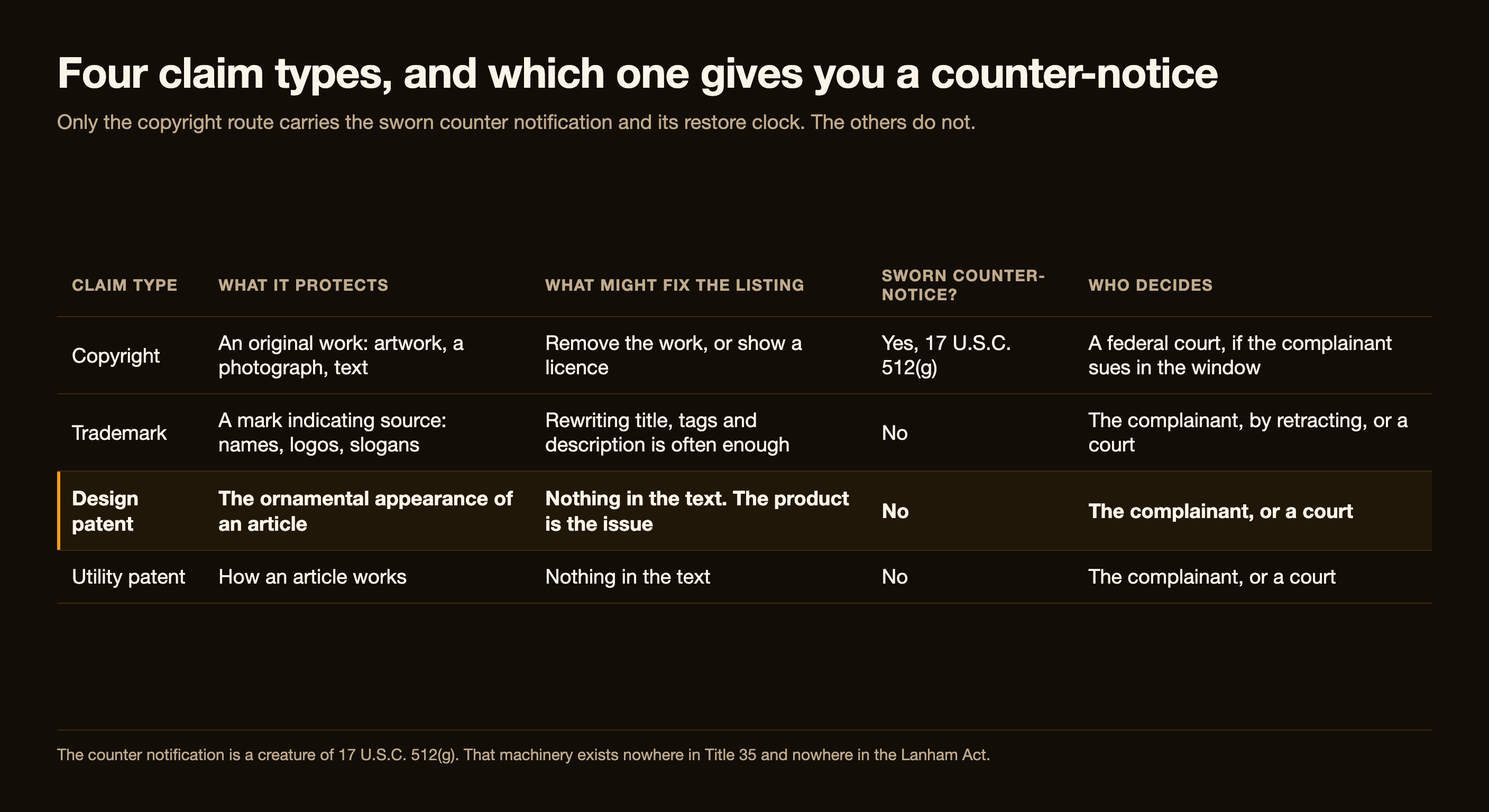
Four bodies of law reach Etsy listings, and the differences decide whether you have a procedural route at all.
| Claim type | What it protects | What might fix the listing | Sworn counter-notice? | Who decides |
|---|---|---|---|---|
| Copyright | An original work: artwork, a photograph, text | Remove the work, or show a licence | Yes, 17 U.S.C. §512(g) | A federal court, if the complainant sues in the window |
| Trademark | A mark indicating source: names, logos, slogans | Rewriting title, tags and description is often enough | No | The complainant, by retracting, or a court |
| Design patent | The ornamental appearance of an article | Nothing in the text. The product is the issue | No | The complainant, or a court |
| Utility patent | How an article works | Nothing in the text | No | The complainant, or a court |
Read down the third column. A trademark report is often a wording problem, which is why checking your listing text before Etsy does pays for itself. A design patent report never is: it covers what the statute, quoted on the USPTO's design application guide, calls a "new, original and ornamental design for an article of manufacture." Your photographs are the evidence against you, and they are accurate.
There Is No Counter-Notice for a Patent Claim, and the Reason Is in the Statute
Every seller-facing page says there is no counter-notice for a patent report. None says why, and the why tells you which routes are real. The counter notification is a creature of 17 U.S.C. §512, the DMCA safe harbour, in Title 17, the copyright title. Subsection (g)(3) sets out what the document must contain:
Your signature. Identification of the material removed and where it appeared. A statement, under penalty of perjury, that you believe in good faith it was removed by mistake or misidentification. Your name, address and phone number, consent to the jurisdiction of a federal district court, and your agreement to accept service of process from the complainant.
Subsection (g)(2) supplies the part sellers care about: the provider forwards the counter notice, tells the complainant the material goes back in 10 business days, then restores it between 10 and 14 business days after receipt unless the complainant says it has sued.
That machinery, the perjury statement and the consent and the clock, exists nowhere in Title 35 and nowhere in the Lanham Act. A platform offering no counter-notice on a patent report is not withholding a right: Congress built the restore mechanism inside the copyright safe harbour and nowhere else. A DMCA takedown is the only report with a statutory way back.
Your routes, then: persuade the complainant to retract, show the platform the report is facially defective, or litigate. There is no fourth. Any service promising a filing that forces reinstatement on a patent claim is describing the copyright process.
The Drawings Are the Claim: How to Read an Etsy Design Patent
Before arguing anything, find out what the patent covers. It is the cheapest step and the one sellers skip, because a design patent is a short document whose whole scope sits in its figures.
Under 37 C.F.R. §1.153(a) the title "must designate the particular article", "No description, other than a reference to the drawing, is ordinarily required", and, decisively, "More than one claim is neither required nor permitted." There is no list of elements to parse, only drawings whose line types carry the legal meaning.
The USPTO's examination manual, MPEP §1503.02, states that "The two most common uses of broken lines are to disclose the environment related to the claimed design and to define the bounds of the claim." Those two uses have opposite effects, which is where misreadings start.
| Line type in the figure | What it means | Effect on what you can be liable for |
|---|---|---|
| Solid line | Part of the claimed design | In scope. This is the shape being asserted |
| Broken line showing environment | Surrounding structure, not claimed | Out of scope, but "the surface which lies beneath the broken lines is part of the claimed design" |
| Broken line used as a boundary | A cut-off defining the claim's edge | "the area within the broken lines is not part of the claimed design". The claim reaches the boundary but excludes it |
So a patent on a product resembling yours may claim only a handle, a lid profile or one face. Broken lines "are not permitted for the purpose of indicating that a portion of an article is of less importance", so a dashed element is outside the claim, not merely downplayed. Design patent numbers carry a D prefix and the document is free in the USPTO's Patent Public Search. Pull the number, open the figures, mark the solid lines, before writing to anybody.
The Test Is an Ordinary Observer Who Knows the Prior Art
The standard is not "substantially the same" floating free of a source, which is how the competing pages state it. It comes from a unanimous 2008 en banc Federal Circuit decision, Egyptian Goddess, Inc. v. Swisa, Inc., 543 F.3d 665 (Fed. Cir. 2008). It rejected the "point of novelty" test as a separate requirement for proving design patent infringement and returned to the ordinary observer test of the 1871 Supreme Court decision in Gorham v. White as the sole test, with one qualification that matters enormously to defendants: the ordinary observer is treated as familiar with the prior art.
That cuts your way more often than not. In a crowded field, phone stands, tumblers, jewellery findings, dog bowls, an observer who knows the dozens of similar designs on sale notices differences a naive one would miss, so the more prior art exists the narrower any design patent's practical scope becomes. Eric Goldman puts it from the court's side in his Columbia Law Review study: design patent infringement "may require a thorough prior art review" that a rightsowner cannot be trusted to perform.
So the most valuable thing you can assemble is dated prior art, images of similar products predating the patent's filing date. In a default judgment nobody does this work at all.
Why Your Pre-Launch Patent Search Cannot See the Patent That Hits You
Here is the fact that reframes the advice every competing page gives. "Search for patents before you list" is good counsel and structurally incomplete, because the thing most likely to hit you is not searchable. Utility applications publish at 18 months; design applications do not. 35 U.S.C. §122(b)(2)(A) lists four exceptions to publication and the fourth is "an application for a design patent filed under chapter 16." A pending design application is invisible to you, to your competitors and to every clearance tool, from filing until grant.
How long is that window? The USPTO published its own figures on 19 May 2026 in an update on design examination: first-action pendency fell to 14 months, which it calls the lowest since FY 2018, down from 16.9; and 62,166 design applications were awaiting a first action on 18 May 2026, down over 28% year-to-year from more than 86,453 in January 2025.
| What you are searching for | Visible in a public search? | Why |
|---|---|---|
| A granted design patent (D number) | Yes | Published on grant, free in Patent Public Search |
| A pending design application | No | §122(b)(2)(A)(iv) exempts design applications from 18-month publication |
| A pending utility application | Usually, after 18 months | The general rule in §122(b)(1) |
| How many designs sit in the queue | In aggregate only | 62,166 awaiting first action, 18 May 2026 |
A clean search is evidence of diligence, not immunity, so keep the dated record of it. And a patent granting next spring was filed about a year earlier, so a product you launch today can be hit by one already on file that no search could have shown you.
What the Exposure Actually Is Under Section 289
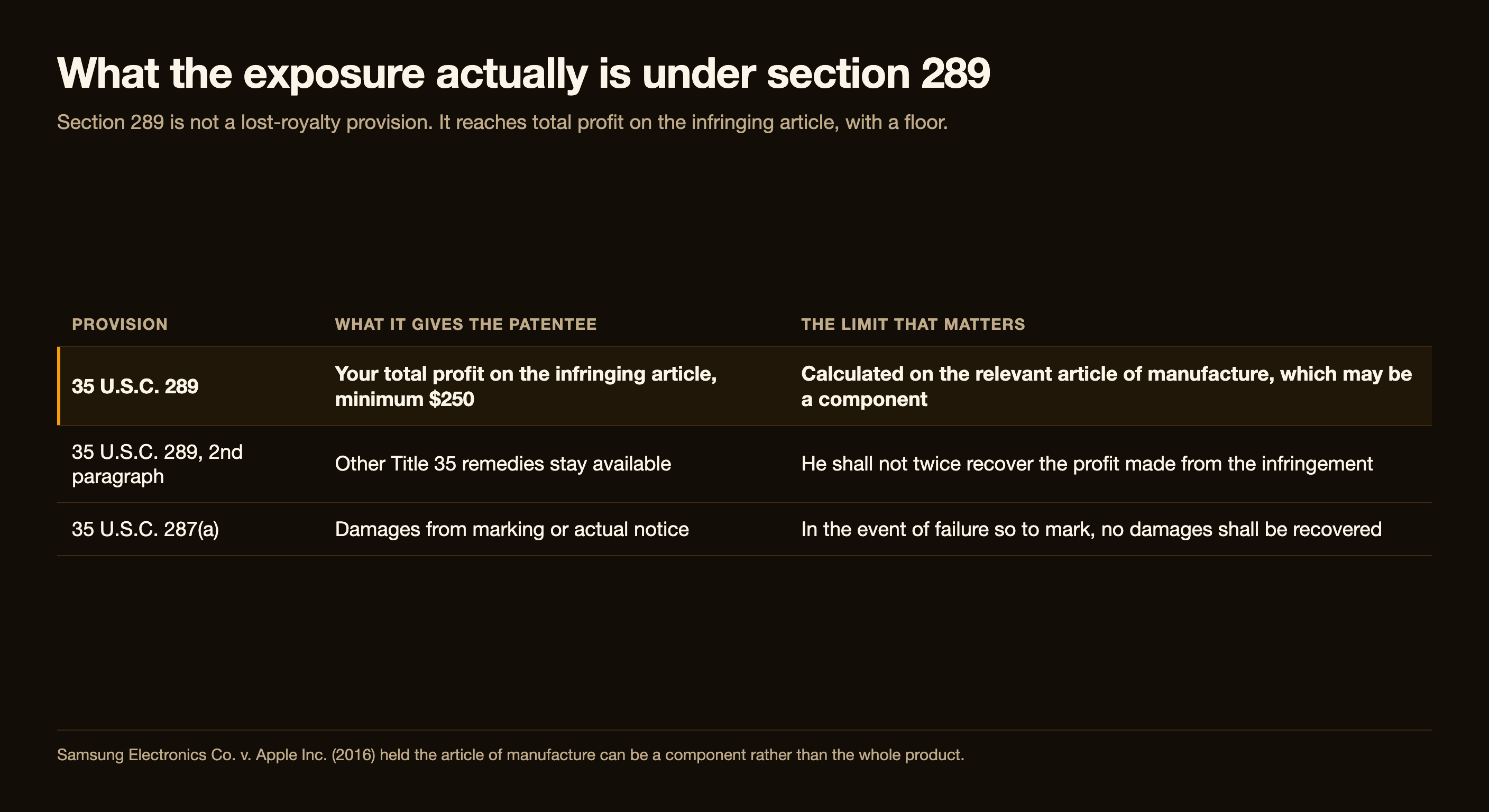
Design patents carry a remedy with no analogue elsewhere in intellectual property. 35 U.S.C. §289 makes anyone who, during the term and without licence, applies the patented design "or any colorable imitation thereof" to an article of manufacture for sale, or sells such an article, "liable to the owner to the extent of his total profit, but not less than $250." Not a royalty, not lost profits: total profit, with a statutory floor. The second paragraph preserves other remedies but bars recovering the profit twice.
| Provision | What it gives the owner | The limit a seller should know |
|---|---|---|
| §289 | Your total profit on the infringing article, minimum $250 | Calculated on the relevant "article of manufacture", which may be a component |
| §289, 2nd paragraph | Other Title 35 remedies stay available | "he shall not twice recover the profit made from the infringement" |
| §287(a) | Damages from marking or actual notice | "In the event of failure so to mark, no damages shall be recovered" |
The ceiling moved in 2016. In Samsung Electronics Co. v. Apple Inc. the Supreme Court held that "article of manufacture" in §289 covers both a complete product and a component of it, so the profit base need not be the whole end product. The award under review was roughly $399 million, equal to Samsung's entire profit on the infringing phones; the Court reversed and remanded. The measure stayed total profit; what narrowed was what it is measured on.
Then §287(a), which almost nobody mentions to sellers. Where a patentee has failed to mark its patented articles, "no damages shall be recovered by the patentee in any action for infringement", except for infringement after the infringer was notified and carried on. For a small shop the damages clock therefore often starts at the complaint rather than your first sale, which makes the notice date worth recording precisely.
How Long the Patent Lives, and Why It Will Not Quietly Lapse
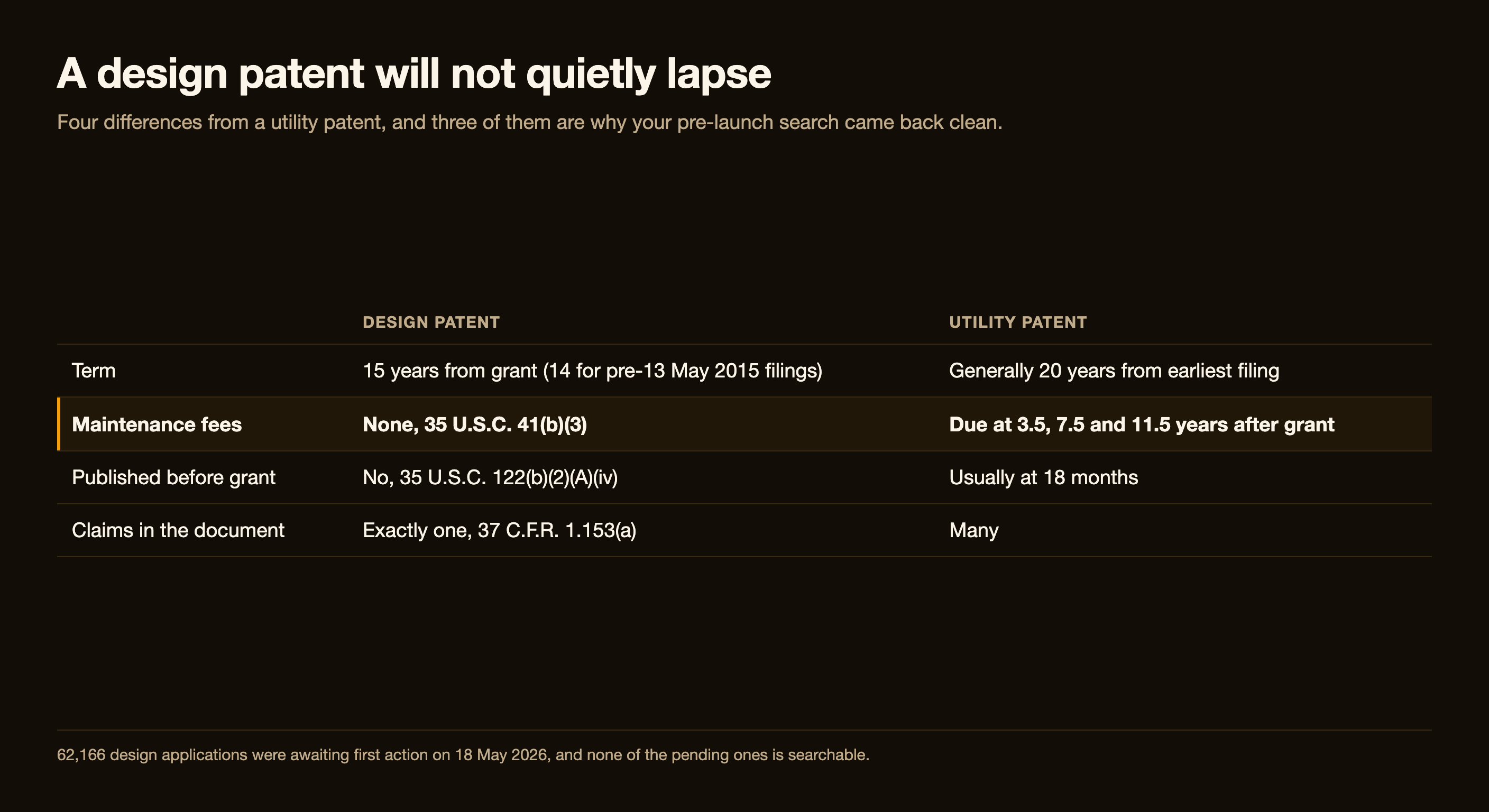
With trademarks there is a familiar hope: perhaps the registration lapsed. Marks need maintenance filings and plenty die of neglect. Design patents do not. 35 U.S.C. §173: "Patents for designs shall be granted for the term of 15 years from the date of grant." That came from a 2012 amendment and applies to certain applications filed on or after 13 May 2015; before that it was fourteen years.
And 35 U.S.C. §41(b)(3) is one sentence: "No fee may be established for maintaining a design or plant patent in force." Utility patents owe maintenance fees at 3.5, 7.5 and 11.5 years after grant and expire if those go unpaid. A design patent owes nothing and runs its full term whether or not the owner remembers it exists.
| Design patent | Utility patent | |
|---|---|---|
| Term | 15 years from grant (14 for pre-13 May 2015 filings) | Generally 20 years from earliest filing |
| Maintenance fees | None, §41(b)(3) | Due at 3.5, 7.5 and 11.5 years after grant |
| Can lapse early for non-payment | No | Yes |
| Published before grant | No, §122(b)(2)(A)(iv) | Usually at 18 months |
| Claims in the document | Exactly one, 37 C.F.R. §1.153(a) | Many |
The office-fee side is cheap, part of why there are so many of these. From the USPTO fee schedule effective 19 January 2025, last revised 1 November 2026: design filing $300, search $300, examination $700 and issue $1,300, so $2,600 from filing to issue undiscounted, $1,040 small entity, $520 micro entity, and nothing afterwards. Treat figures found elsewhere with suspicion: several widely-read fee pages still print superseded design numbers and disagree with each other.
Schedule A: When the Complaint Skips Etsy Entirely
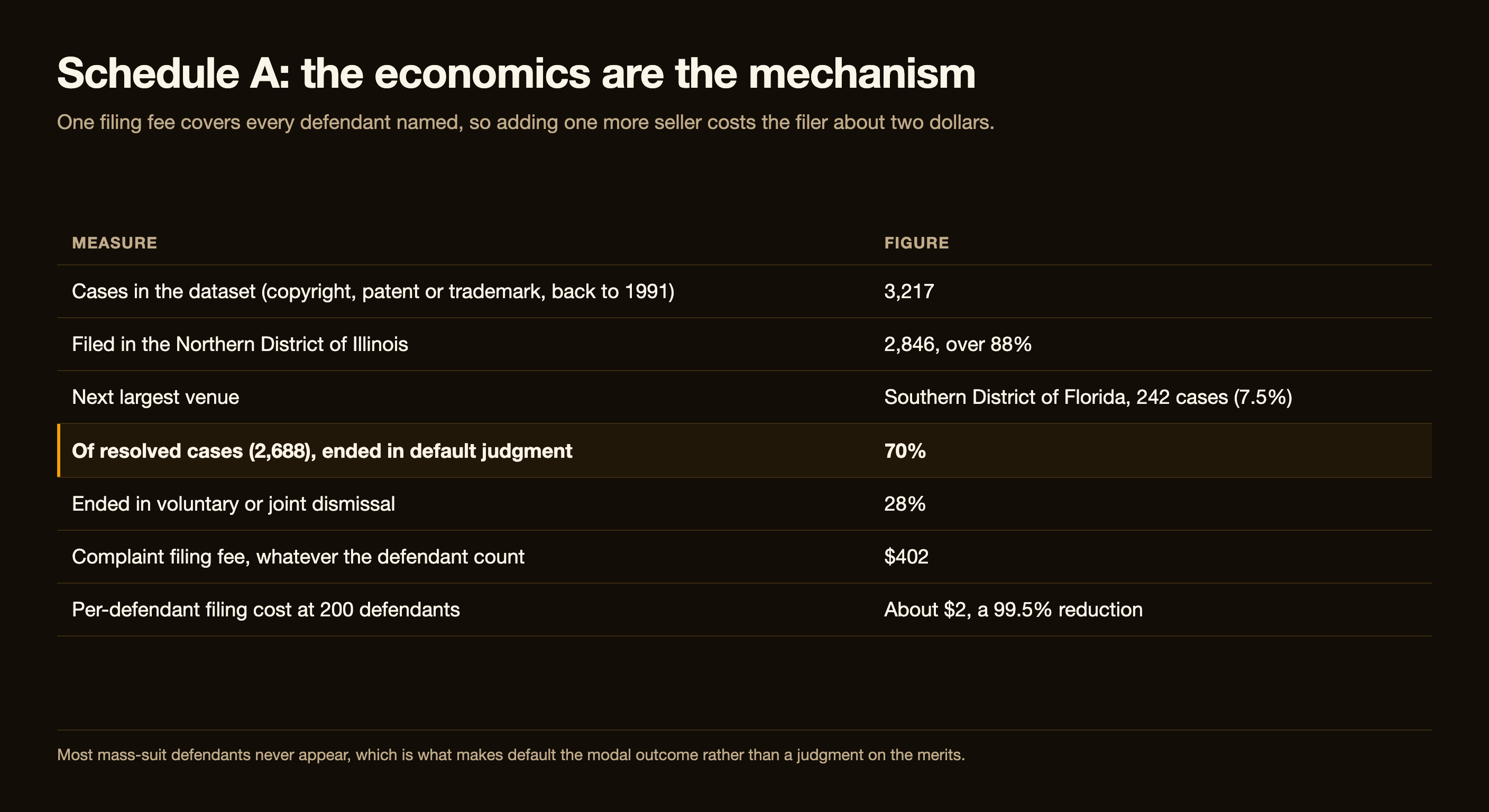
The worst version never arrives as a platform notification at all. It arrives as a frozen payment account, because a federal case was filed naming you on a sealed exhibit called Schedule A. The figures are from Goldman's A SAD Scheme of Abusive Intellectual Property Litigation, the only systematic count we found.
| Measure | Figure |
|---|---|
| Cases in the dataset (copyright, patent or trademark, back to 1991) | 3,217 |
| Filed in the Northern District of Illinois | 2,846, over 88% |
| Next largest venue | Southern District of Florida, 242 cases (7.5%) |
| Of resolved cases (2,688), ended in default judgment | 70% |
| Ended in voluntary or joint dismissal | 28% |
| Adjudication on the merits, or other | Under 2% |
| Complaint filing fee, whatever the defendant count | $402 |
| Per-defendant filing cost at 200 defendants | About $2, a 99.5% reduction |
The economics are the mechanism. One $402 fee covers every defendant named, so adding you costs the filer about two dollars, and with 70% of resolutions being defaults the model does not depend on winning arguments, only on most of the list never appearing. Where design patents are concerned there is a defence trademark defendants lack. 35 U.S.C. §299 permits joinder of accused infringers only where relief arises from the same transaction or occurrence "involving the same accused product or process" and common questions of fact arise, and subsection (b) bars joinder based "solely on allegations that they each have infringed the patent or patents in suit."
That has teeth. In Wang v. Schedule A Defendants (N.D. Ill., 24-cv-759, 24 April 2024), asserting two design patents on dining chairs and barstools, Judge Pacold found the defendants misjoined: their products were not the "same accused product", and "there are numerous substantial differences between them." The plaintiff had to dismiss the misjoined defendants or sever and pay a filing fee for each new action.
In August 2025, in Eicher Motors Ltd. v. Schedule A Defendants, Judge Kness wrote that "the Schedule A mechanism should no longer be perpetuated in its present form" and that it "works only by stretching applicable procedural rules past their breaking point." The plaintiff later dismissed the case.
If you are named in one, it is not a self-help situation: an asset freeze and a federal docket need a lawyer the same day. But knowing §299(b) exists, and that judges in the busiest Schedule A venue have used it against design patent plaintiffs, is worth a lot in that first call.
The First 72 Hours After a Design Patent Report
Order matters, because the cheap steps produce the evidence the expensive steps need.
- Establish what kind of report it is. All four look alike in the notification and only copyright has a statutory counter-notice. Read the notice for what it actually claims first.
- Pull the D number and open the figures in Patent Public Search, free. Mark the solid lines and read the specification's statement about the broken ones.
- Compare as an informed observer would. Differences in dashed-out parts are irrelevant; differences in the claimed portions are your case.
- Assemble dated prior art. Similar designs predating the patent's filing date narrow its scope under Egyptian Goddess. Nobody will do this for you.
- Check marking, record the notice date, and stop selling the item. If the patentee's own products are unmarked, §287(a) limits damages to infringement after actual notice, so write down when you were notified, to the hour. Carrying on after notice is what makes §287(a) stop helping: pausing a listing is reversible, a damages period is not.
- Approach the complainant for a retraction, in writing and without admissions. It is the only thing that reliably restores the listing, and a short factual note about dashed lines or prior art sometimes produces one. The discipline is a cease and desist letter's: answer the claim, concede nothing unverified.
- Watch the account, not just the listing. Repeat reports put account privileges at risk, so treat one deactivation as a pattern question.
What not to do. Do not file a DMCA-style counter notification against a patent report. It is sworn under penalty of perjury, and in it you consent to federal jurisdiction and agree to accept service of process, while §512 does not apply to patents at all: you concede both and buy nothing. Do not relist the product under a new listing either. That reads as evasion and does not change the product's shape.
What a Listing Review Can and Cannot Do Here
Where Unflagged fits, and where it does not. Nothing here is legal advice. Unflagged reviews the listing text you paste in for potential concerns, including brand names and phrases that commonly draw reports, and saves the findings so you can compare revised wording. It does not perform patent clearance, search live patent or trademark registers, inspect your photographs, or establish that a listing is safe. A design patent question is about the object, not the copy: it needs the D number, the drawings and, if a suit is involved, a lawyer. Where text is the issue, start with the compliance guide.
The honest answer to "can a tool stop a design patent claim?" is no. What it can do is keep the avoidable category, the wording reports, off your account, so the unavoidable ones arrive against a clean record rather than a third strike.
Related Articles
- Etsy's Intellectual Property Policy Explained, what the platform acts on and what it refuses to decide
- Etsy Takedown Notice: What to Do, reading a report for what it actually claims
- Etsy Trademark Takedown 2026, the mark-based version, where challenging the registration is an option
- Etsy Cease and Desist Letter 2026, answering a claim without conceding one
- How to Avoid Copyright Infringement on Etsy, the Title 17 side and its counter-notice
FAQ
Can I file a counter-notice against an Etsy design patent complaint?
No. The sworn counter notification and the 10-to-14-business-day restore window sit in 17 U.S.C. §512(g), a copyright provision with no equivalent in the Patent Act. Your routes are a retraction, showing the report is defective, or court.
What do the dashed lines in a design patent drawing mean?
Under MPEP §1503.02 broken lines usually show unclaimed environment or define the claim's boundary; solid lines show the claimed design. Where they define a boundary, "the area within the broken lines is not part of the claimed design"; where environment lines cross it, the surface beneath is still claimed.
Does a clean patent search mean my product is safe to sell?
It means no granted patent matched, which is not the same thing. Design applications are exempt from 18-month publication under 35 U.S.C. §122(b)(2)(A)(iv), so pending ones are invisible. With first-action pendency at 14 months, a patent granting next year was filed before you launched.
How much can a design patent holder recover from me?
Under 35 U.S.C. §289, your total profit on the infringing article, minimum $250, and not twice over. Samsung v. Apple (2016) held the "article of manufacture" can be a component rather than the whole product, narrowing the base but not the measure.
Does it matter whether the patent owner marked its products?
Often a great deal. Section 287(a) provides that where a patentee fails to mark, "no damages shall be recovered by the patentee in any action for infringement", except for infringement continuing after actual notice. For many small sellers the damages period therefore starts when the complaint arrived.
Could the design patent have expired already?
Check the grant date: 15 years from grant under §173 for applications filed on or after 13 May 2015, fourteen years for earlier ones. Do not expect a lapse for non-payment, because §41(b)(3) bars any fee for maintaining a design patent in force.
What is a Schedule A lawsuit and why is my payment account frozen?
It is a federal suit naming many online sellers at once on an exhibit the plaintiff usually asks the court to seal, often with an early asset freeze. For design patents, 35 U.S.C. §299(b) bars joinder resting solely on allegations that each defendant infringed the same patent; judges in the Northern District of Illinois applied it in Wang (2024) and criticised the mechanism in Eicher Motors (2025).
Sources. Statutes and regulations as quoted, via the Legal Information Institute: 17 U.S.C. §512(g); 35 U.S.C. §§122(b)(2)(A)(iv), 173, 41(b)(3), 287(a), 289, 299; 37 C.F.R. §1.153(a). USPTO: MPEP §1503.02 for the broken-line rules; the fee schedule effective 19 January 2025, last revised 1 November 2026, design rows 1012, 1112, 1312, 1502; and "Strong progress continues on design patent examination", 19 May 2026, for the pendency and inventory figures. Cases: Egyptian Goddess v. Swisa, 543 F.3d 665 (Fed. Cir. 2008) (en banc), via WIPO Lex, and Samsung Electronics Co. v. Apple Inc. (2016). Schedule A figures from Eric Goldman, 123 Colum. L. Rev. F. 183 (2023), read from the journal's PDF. Etsy's own intellectual property and seller handbook pages returned HTTP 403 to this research, so nothing here is attributed to them. Fees and procedures change and a dispute turns on facts specific to your product: general information, not legal advice.
Scan Your Listings Free
Screen submitted listing text for potential concerns. 5 preliminary screens daily, shared network limits; no signup required.
Start Free ScreenRelated Articles
How to Check Your Etsy Listings for Trademark Violations (2026 Guide)
Learn how to scan your Etsy listings for trademark violations before they get flagged. Step-by-step guide to protecting your shop from takedowns and suspensions.
Read moreEtsy Shop Suspended? How to Write a Winning Appeal Letter
Your Etsy shop got suspended. Here's exactly how to write an appeal letter that gets your shop reinstated, with templates and strategies that actually work.
Read more50 Words That Are Trademarked on Etsy (Stop Using These Now)
A comprehensive list of commonly trademarked words and phrases that Etsy sellers use without realizing they're violating trademark law. Check your listings now.
Read more