How to Protect Your Etsy Shop From Suspension (Proactive Guide)
Most Etsy sellers don't think about suspension until it happens to them. By then, the damage is done — lost revenue, panicked customers, and a stressful appeal process. This guide flips the script. Instead of reacting to problems, you'll build a proactive system that keeps your shop safe before violations ever occur.
Prevention Is Cheaper Than Recovery
An Etsy suspension doesn't just pause your sales. It freezes your funds, tanks your search ranking, breaks customer trust, and can take weeks — sometimes months — to resolve through the appeal process. Even if you win the appeal, the algorithm penalty from downtime can take another quarter to recover from.
The math is simple: spending 30 minutes a week on compliance costs you far less than the thousands of dollars in lost revenue from a preventable suspension. Think of it like insurance for your shop. You wouldn't run a physical store without insurance, and you shouldn't run an Etsy shop without a compliance system. And if you need a temporary break, use Etsy vacation mode instead of deactivating — it keeps your search ranking intact.
The real cost of suspension: A shop doing $5,000/month in revenue loses an average of $8,000–$15,000 by the time a suspension is resolved. That includes lost sales during the suspension, reduced visibility after reinstatement, lost repeat customers who moved to competitors, and the time spent on the appeal process instead of creating products. If you already have an Etsy account suspended, recovery is possible — but prevention is always the better strategy.
This is exactly why tools like Unflagged exist. Instead of scrambling to fix problems after Etsy flags your shop, you catch issues before they trigger enforcement. Compliance scanning, trademark checks, and policy monitoring run continuously so you can focus on what you do best — creating and selling.
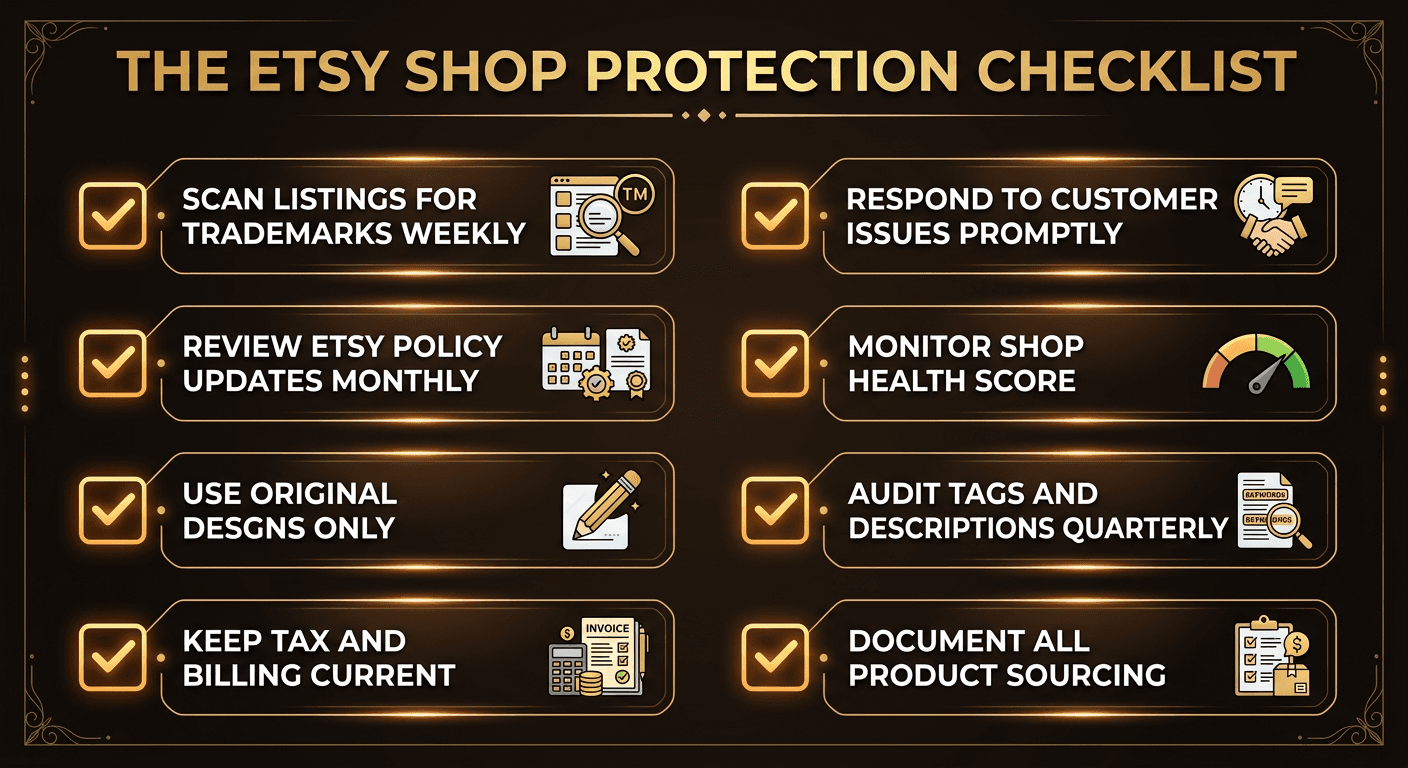
The 8-Point Shop Protection Checklist
This checklist covers every major area that can trigger an Etsy suspension. Familiarize yourself with the most common Etsy policy violations first, then work through each point systematically to close the gaps that catch most sellers off guard.
Weekly Trademark Scans
Run every listing through a trademark database check at least once a week. New trademarks are registered constantly, and a term that was safe last month might be protected today. Scan titles, tags, descriptions, and even image alt text.
Monthly Policy Reviews
Etsy updates its policies more frequently than most sellers realize. Set a monthly calendar reminder to review the Seller Handbook, or use automated policy monitoring to get notified when changes occur.
Original Designs Only
Every product in your shop must be your original work or properly licensed. This includes fonts, clip art, mockup templates, and design elements. Keep your license files organized and accessible in case Etsy asks for documentation.
Billing Current
An overdue Etsy bill is one of the fastest paths to suspension. Keep your payment method up to date, monitor your balance, and set up auto-pay if possible. Check your payment account page at least weekly.
Excellent Customer Service
Respond to every message within 24 hours. Handle refund requests professionally. A pattern of unresolved disputes and negative reviews signals to Etsy that your shop is a risk.
Health Score Monitoring
Check your shop's health metrics in Shop Manager regularly. Track your case resolution rate, shipping on-time rate, and review score. A decline in any of these metrics is an early warning sign.
Tag Audits
Review all 13 tags on every listing for trademarked terms, misleading claims, or prohibited keywords. Tags are one of the most common places where trademark violations hide unnoticed.
Sourcing Documentation
Keep records of where you source materials, production partners, and any third-party components. If Etsy questions whether your products meet the handmade or vintage criteria, documentation is your best defense.
Proactive vs. Reactive Sellers
The difference between sellers who get suspended and sellers who don't usually isn't luck — it's process. Here's how proactive and reactive sellers compare across every major compliance area.
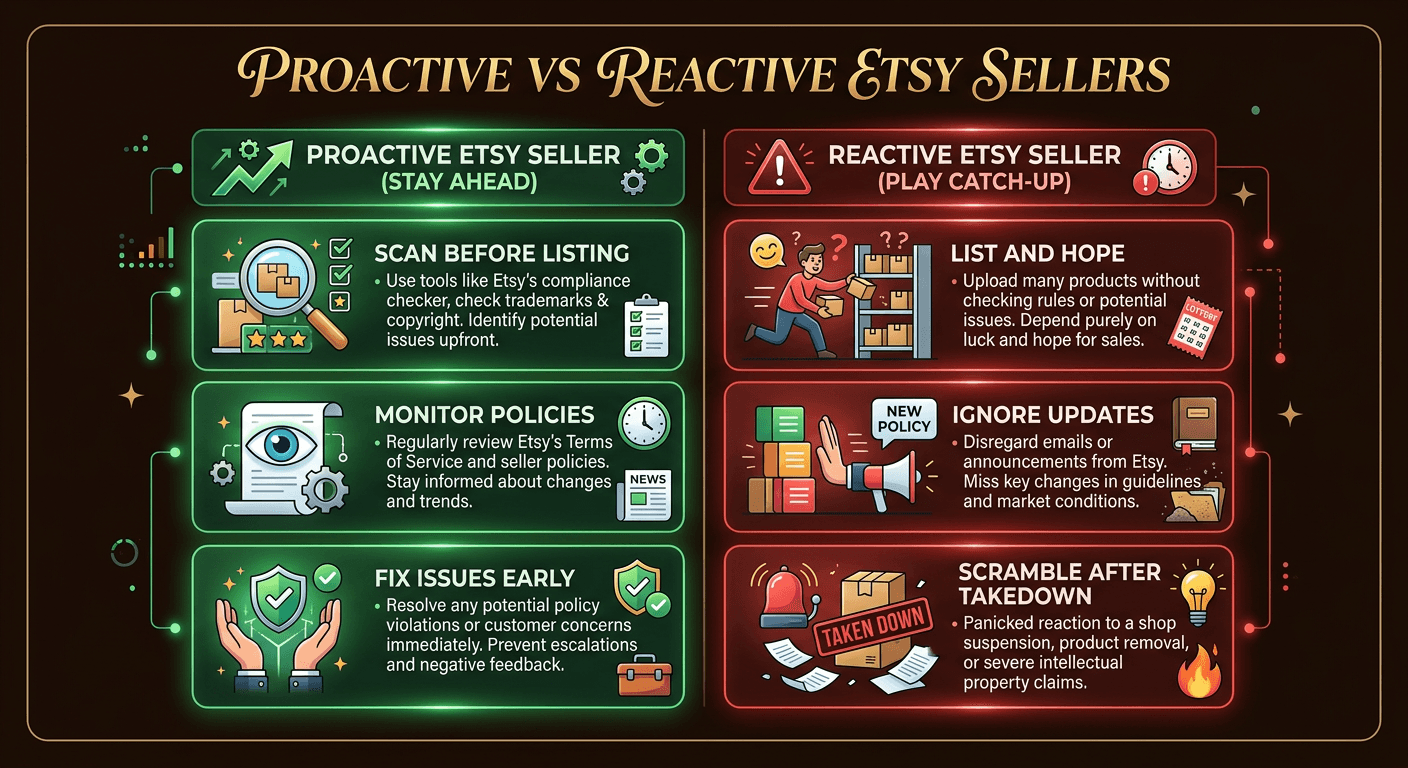
Proactive Sellers
- Scan listings before publishing
- Monitor policy changes in real time
- Respond to messages within hours
- Run weekly trademark checks
- Keep documentation organized
- Pay bills before the due date
- Fix issues before Etsy notices
Reactive Sellers
- Publish listings without checking
- Learn about policy changes after violations
- Respond to messages days later
- Never check for trademark issues
- Scramble for documentation during appeals
- Let bills go overdue
- React only after suspension
The proactive approach takes less total time. Spending 30 minutes a week on compliance beats spending 30 hours on an appeal — plus the revenue you lose while your shop is dark.
Trademark Compliance
Trademark infringement is the single most common reason Etsy suspends shops. A brand owner files an intellectual property complaint, Etsy removes the listing, and if you have multiple violations, your entire shop goes down. The worst part? Many sellers don't even realize they're infringing.
Common trademark traps include using brand names in tags to attract search traffic (“Stanley cup accessories”), describing colors or styles with trademarked terms (“Tiffany blue”), referencing characters or franchises (“inspired by Disney”), and using trademarked fonts or design elements without a license.
The fix: scan every listing before publishing
Before any listing goes live, run every word in your title, all 13 tags, and your full description through a trademark database search. This catches issues before they trigger a complaint. An Etsy trademark checker automates this process and flags risky terms with severity scores so you know which issues to fix first.
Don't just scan new listings. Go back through your existing catalog, especially listings you created months or years ago. Trademarks are registered constantly, and a term that was generic when you listed it might be protected now. Weekly scans of your full catalog are the gold standard.
Policy Compliance
Etsy's policies change more frequently than most sellers realize. In 2026 alone, there have already been major updates to creativity standards, AI content disclosure rules, and the search algorithm. Sellers who don't track these changes end up violating policies they didn't even know existed.
How to stay current with policy changes
- Bookmark the Etsy policy changes 2026 guide and check it regularly
- Subscribe to Etsy's Seller Newsletter for official announcements
- Follow the Etsy Community forums for early reports of enforcement changes
- Use automated policy monitoring tools that alert you when changes affect your listings
- Join seller groups where members share policy updates and enforcement patterns
The most dangerous policy violations are the ones you don't know about. A listing that was perfectly compliant six months ago might violate a new rule today. Automated compliance scanning with an Etsy listing compliance checker catches these gaps before Etsy's enforcement team does.
Customer Relations
Your customer service record directly impacts your shop's standing with Etsy. A pattern of unresolved cases, late responses, and negative reviews tells Etsy's algorithm that your shop is a liability. While a single bad review won't get you suspended, a pattern of poor customer interactions absolutely can.
Respond fast
Aim to respond to every message within 24 hours, ideally within a few hours during business days. Etsy tracks your response time, and it factors into your shop's overall health score. Even if you can't resolve the issue immediately, acknowledge the message and set expectations for when you'll follow up.
Handle disputes professionally
When a customer opens a case, treat it as a priority. Offer a reasonable solution quickly. Cases that escalate to Etsy for resolution count against your shop more heavily than cases you resolve directly with the buyer. Sometimes issuing a refund on a disputed order is cheaper than the impact of an unresolved case on your account health.
Avoid negative reviews proactively
Set accurate expectations in your listings. Ship on time or early. Include a thank-you note with clear care instructions and a friendly invitation to reach out if anything isn't perfect. Most negative reviews happen because of unmet expectations, not bad products.
Financial Compliance
Financial issues are among the most straightforward reasons for suspension — and the easiest to prevent. Etsy will suspend your shop if your bill goes unpaid, your payment method fails, or your tax information is incomplete.
- Pay fees on time: Set up auto-pay for your Etsy bill. If you prefer manual payments, set a weekly reminder to check your balance and pay before the due date. A single overdue payment can trigger account restrictions.
- Keep your payment method updated: If your credit card expires or your bank account changes, update it in Etsy immediately. Failed payment attempts can cascade into billing holds and then suspension.
- Tax information: Keep your taxpayer information current. Etsy is required by law to verify seller tax IDs, and incomplete or outdated information can result in account restrictions or payment holds.
- Monitor your deposit schedule: If deposits to your bank account start failing, Etsy will hold your funds. Check your deposit schedule regularly to make sure payments are processing normally.
Building a Compliance Routine
The key to staying protected is turning compliance into a habit, not a one-time project. Here's a schedule that covers all the bases without eating into your creative time.
Weekly (30 minutes)
- Run trademark scans on all active listings
- Check and respond to all customer messages
- Review shop health score and metrics
- Verify billing status and upcoming payments
- Scan new listings for compliance before publishing
Monthly (1 hour)
- Review Etsy policy updates and Seller Handbook changes
- Audit all tags across your catalog for trademarked terms
- Review and respond to any new reviews
- Check competitor listings for enforcement patterns
- Update sourcing documentation for new products
Quarterly (2 hours)
- Full compliance audit of every active listing
- Review and update shop policies (shipping, returns, privacy)
- Verify tax information is current
- Assess overall shop risk and address any weak areas
- Archive or remove underperforming listings that carry compliance risk
This schedule adds up to roughly 2.5 hours per month. Compare that to the 20–40 hours most sellers spend dealing with a suspension, and the ROI of proactive compliance is obvious.
Tools That Help
You don't have to do everything manually. The right tools automate the tedious parts of compliance so you can focus on creating products and growing your shop.
Unflagged
AI-powered compliance scanning, trademark risk scoring, one-click listing fixes, and suspension appeal letter generation. Unflagged covers the full compliance lifecycle — from prevention to recovery. It scans your listings against Etsy's current policies and the USPTO trademark database, flags issues with severity scores, and generates fix suggestions you can apply with one click.
eRank
SEO research and keyword analytics for Etsy sellers. eRank helps you find high-traffic, low-competition keywords and optimize your listings for search. While it doesn't focus on compliance directly, better SEO means less temptation to use risky trademarked terms for traffic.
Alura
Listing optimization and shop analytics. Alura provides insights into what's working in your shop and helps you optimize titles, tags, and descriptions. Pair it with a compliance tool for a complete listing management workflow.
The most effective approach is to combine these tools: use Unflagged for compliance and trademark protection, eRank for SEO research, and Alura for listing optimization. Together, they cover prevention, performance, and protection.
Protect Your Shop Before Problems Start
Unflagged scans your listings for trademark risks, policy violations, and compliance gaps — automatically. Catch issues before Etsy does, fix them with one click, and keep your shop safe with continuous monitoring.
Frequently Asked Questions
How do I avoid getting my Etsy shop suspended?
To avoid Etsy suspension, run weekly trademark scans on all listings, review Etsy policy updates monthly, use only original designs, keep billing and tax information current, respond to customer messages within 24 hours, monitor your shop health score, audit tags for trademarked terms, and maintain sourcing documentation for all products.
What is the most common reason for Etsy shop suspension?
Trademark infringement is the most common reason for Etsy shop suspension. Using trademarked brand names, logos, or phrases in your titles, tags, descriptions, or product images can trigger an intellectual property complaint that leads to listing removal or full shop suspension.
Can I get my Etsy shop back after suspension?
Yes, many sellers successfully appeal Etsy suspensions. The key is to identify the specific violation, remove or fix the offending listings, write a professional appeal letter acknowledging the issue, and outline concrete steps you have taken to prevent future violations. Tools like Unflagged can generate appeal letters tailored to your specific situation.
How often should I scan my Etsy listings for compliance issues?
At minimum, run a full compliance scan weekly and scan every new listing before publishing. After any Etsy policy update, run an immediate scan across your entire catalog. Sellers with more than 100 listings should consider automated daily scanning to catch issues before Etsy does.
Does Etsy warn you before suspending your shop?
Sometimes. Etsy may send warnings for minor policy violations or remove individual listings before escalating to a full shop suspension. However, severe violations like trademark infringement or selling prohibited items can result in immediate suspension without prior warning. This is why proactive compliance monitoring is essential.
What tools can help protect my Etsy shop from suspension?
Unflagged provides AI-powered compliance scanning, trademark risk scoring, and appeal letter generation specifically for Etsy sellers. Other helpful tools include eRank for SEO optimization, Alura for listing optimization, and Etsy's own Policy Violation Dashboard in Shop Manager. Using a combination of these tools creates a comprehensive protection layer for your shop.