Etsy vs Amazon Handmade: Which Has Stricter IP Policies?
Both Etsy and Amazon Handmade take intellectual property seriously, but they enforce their rules in fundamentally different ways. One relies on manual review and gives sellers room to respond. The other deploys automated systems that can remove your listings before you even know there's a problem. If you sell on either platform — or both — you need to understand exactly how each one handles IP complaints.
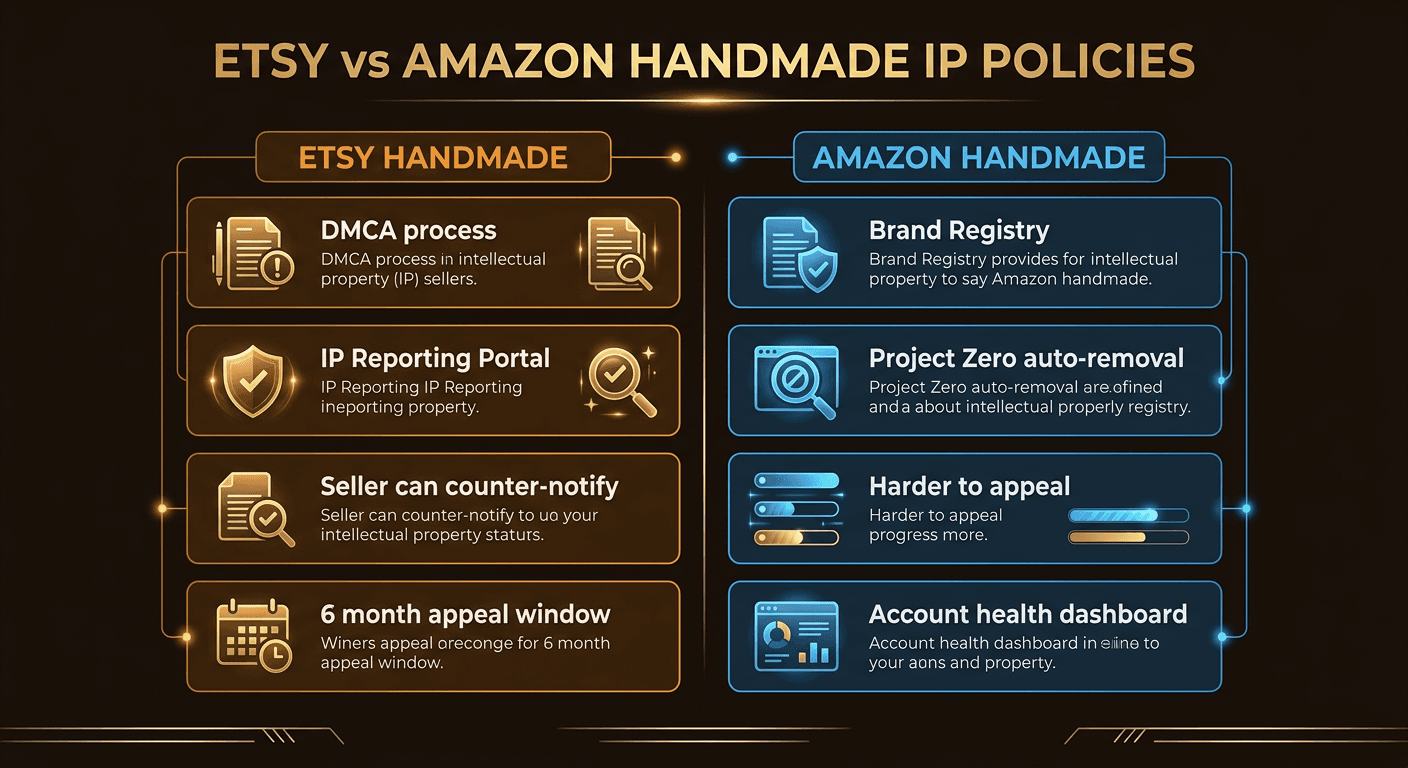
How Both Platforms Approach IP Enforcement
Etsy and Amazon Handmade are the two largest marketplaces for handmade and artisan goods. Both have legal obligations to protect intellectual property rights, and both will remove listings that violate trademark or copyright rules. But the similarities largely end there.
Etsy operates a manually-driven enforcement system. IP complaints go through a structured reporting portal, a human reviews the claim, and sellers have clearly defined options for counter-notices and appeals. The system is relatively transparent and gives sellers meaningful opportunities to defend themselves.
Amazon takes a more automated approach. Through programs like Brand Registry and Project Zero, Amazon gives trademark owners powerful self-service tools that can remove listings without prior review. The appeal process on Amazon is less structured and often more difficult to navigate. Automated systems can escalate issues quickly, sometimes before a seller has a chance to respond.
Understanding these differences is critical. A compliance strategy that works on Etsy may not be sufficient for Amazon, and vice versa. If you sell on both platforms, you need to build your IP compliance around the stricter standard — which, as we will see, is Amazon's.
Etsy's IP Enforcement System
Etsy's approach to intellectual property enforcement centers on its IP Reporting Portal. This is the primary channel through which rights holders submit complaints about trademark infringement, copyright violations, and other IP issues. Every report goes through manual review by Etsy's trust and safety team.
The IP Reporting Portal
Rights holders submit complaints through a structured online form. They must identify the specific listings they believe infringe on their IP, provide evidence of their ownership (such as trademark registration numbers), and describe the nature of the infringement. Etsy reviews each submission individually before taking action.
DMCA Process
For copyright complaints, Etsy follows the standard DMCA takedown process. A copyright holder files a formal notice, Etsy removes the listing (typically within 1 to 3 business days), and the seller is notified. The seller then has the option to file a counter-notice if they believe the takedown was filed in error.
Counter-Notice and Appeal Options
This is where Etsy's system stands out. Sellers have a clear, legally-backed counter-notice process for DMCA claims. For trademark complaints, Etsy provides a 6-month appeal window during which sellers can submit evidence that their use of the mark is legitimate. Etsy's team reviews the counter-evidence and makes a decision. This manual review process means that context matters — a seller who can demonstrate fair use or prior rights has a real chance of getting their listing restored.
Escalation Pattern
Etsy does not immediately suspend accounts for a single IP violation. The typical pattern involves listing removal, a warning, and then escalation to account review only after multiple violations. Sellers generally have time to correct course before facing suspension. That said, severe or repeated violations can and do result in permanent account closure.
Amazon Handmade's IP Enforcement System
Amazon Handmade operates under Amazon's broader seller enforcement infrastructure, which is significantly more automated and aggressive than Etsy's. Several interconnected programs work together to identify and remove IP-infringing content.
Amazon Brand Registry
Brand Registry is Amazon's flagship IP protection program. Brands with registered trademarks can enroll and gain access to enhanced reporting tools, proactive brand protections, and powerful search capabilities that scan Amazon's entire catalog for potential infringements. Brand Registry members can submit IP complaints that are processed faster than standard reports, and their complaints carry more weight in Amazon's enforcement system.
Project Zero
Project Zero takes automation to another level. Enrolled brands can directly remove counterfeit and infringing listings without waiting for Amazon to review the complaint. This self-service removal tool means listings can be taken down within hours — sometimes minutes — without any human review on Amazon's side. While Project Zero is designed for counterfeit removal, its scope can affect legitimate handmade sellers who unknowingly use similar designs, names, or descriptive terms that trigger a brand's automated scans.
Account Health Dashboard
Amazon tracks all IP complaints, policy violations, and performance metrics through the Account Health Dashboard. Every IP complaint creates a permanent record that affects your account's health score. Unlike Etsy, where individual violations are evaluated in context, Amazon's system is more formulaic. Accumulating violations degrades your account health score, and once it drops below Amazon's thresholds, suspension becomes automatic.
The Appeal Process
Appealing an IP violation on Amazon is notoriously difficult. Sellers must submit a Plan of Action (POA) that identifies the root cause of the violation, describes corrective actions taken, and outlines preventive measures. Amazon frequently rejects POAs for being insufficiently detailed, and sellers often go through multiple rounds of revision before achieving resolution. There is no equivalent to Etsy's structured counter-notice process. Instead, sellers navigate a less transparent system where the criteria for a successful appeal are not clearly defined.
Side-by-Side Comparison Table
Here is a direct comparison of how Etsy and Amazon Handmade handle IP enforcement across the key dimensions that matter most to sellers.
| Factor | Etsy | Amazon Handmade |
|---|---|---|
| Reporting Process | IP Reporting Portal with manual review | Brand Registry + Project Zero with automated tools |
| Removal Speed | 1–3 business days (manual review) | Hours or minutes (automated via Project Zero) |
| Appeal Process | DMCA counter-notice; 6-month trademark appeal window | Plan of Action required; multiple rounds common |
| Counter-Notice | Structured DMCA counter-notice with legal framework | No formal counter-notice; POA-based appeals only |
| Reinstatement | 10–14 days after counter-notice if no lawsuit filed | Weeks to months; no guaranteed timeline |
| Automation Level | Low — manual review for all complaints | High — automated scanning and self-service removals |
Which Platform Is Stricter?
Amazon Handmade is the stricter platform. The combination of automated enforcement, self-service removal tools for brand owners, and a difficult appeal process makes Amazon significantly harder to navigate after an IP complaint.
Amazon's Project Zero gives brands the ability to remove listings without any review by Amazon's team. This means a brand owner can take down your listing based on their own judgment, and you have no opportunity to present your side before the removal happens. On Etsy, every complaint goes through manual review, which provides a layer of protection against overzealous or incorrect takedowns.
The appeal process compounds the difference. Etsy's DMCA counter-notice is a well-defined legal process with specific timelines and outcomes. If you file a counter-notice and the claimant does not sue within 10 to 14 days, your listing is restored. Amazon offers no such guarantee. The Plan of Action process is opaque, and there is no statutory timeline for resolution.
Brand Registry further tips the scales. Brands enrolled in Amazon's Brand Registry have access to proactive monitoring tools that continuously scan listings for potential violations. This means issues can be flagged and escalated even if no one manually reports your listing. Etsy has no equivalent proactive scanning system for brand owners.
That said, Etsy's more seller-friendly approach has its own implications. Because Etsy relies on manual review, enforcement can be inconsistent. Some complaints take longer to process, and outcomes can vary depending on which team member reviews the case. But from a seller's perspective, this inconsistency generally works in your favor compared to Amazon's automated systems.
Selling on Both Platforms
Many handmade sellers operate on both Etsy and Amazon Handmade to maximize their reach. This is a smart business strategy, but it means your IP compliance must satisfy the requirements of both platforms simultaneously.
The practical approach is to build your compliance around Amazon's stricter standards. If your listings are clean enough for Amazon, they will almost certainly pass Etsy's review as well. The reverse is not true — a listing that coexists peacefully on Etsy may trigger automated removals on Amazon.
Cross-Platform Compliance Checklist
- Search the USPTO trademark database before using any brand-adjacent terms in titles, tags, or descriptions
- Use only original photography and design work across both platforms
- Avoid descriptive terms that are registered trademarks, even if they seem generic
- Keep documentation of your original creation process (design files, timestamps, sketches)
- Monitor your Account Health Dashboard on Amazon regularly
- Set up alerts for trademark registrations in your product category
- Maintain separate compliance audits for each platform on a monthly basis
If you receive an IP complaint on one platform, audit the same listing on the other platform immediately. The same rights holder may file complaints on both platforms, and being proactive can prevent a second takedown from catching you off guard. For a deeper look at how Etsy compares to other selling platforms, including Shopify, see our full comparison.
Unique Risks per Platform
Each platform presents risks that are specific to its enforcement model. Understanding these platform-specific dangers helps you prioritize your compliance efforts.
Etsy-Specific Risks
- Competitor abuse of the reporting system. Because Etsy's reporting process is accessible to anyone, competitors can and do file fraudulent IP complaints to sabotage rival listings. The manual review process eventually catches most bad-faith reports, but your listing may be down for days before it is restored.
- Inconsistent enforcement. Manual review means different reviewers may reach different conclusions on similar cases. A listing that was previously approved may be taken down on a subsequent review, or vice versa.
- Cumulative strike risk. Multiple IP complaints, even if individually minor, can compound and trigger a full account review. Sellers who operate in categories with frequent IP disputes (like fan art or pop culture items) face elevated cumulative risk.
Amazon Handmade-Specific Risks
- Automated false positives. Project Zero's automated scanning can flag listings based on keyword matches or visual similarity, even when no actual infringement exists. Because removals can happen without human review, legitimate sellers get caught in the net.
- Account-level consequences. Amazon ties IP violations to your overall Account Health score. A single serious violation can degrade your account health enough to trigger restrictions on your entire catalog, not just the affected listing.
- Loss of buy box and visibility. Even after resolving an IP complaint, your listing may lose its search ranking and buy box eligibility. Recovery of visibility is not guaranteed and can take weeks.
- Difficult reinstatement. If your Amazon Handmade account is suspended for IP violations, reinstatement requires a successful Plan of Action. Many sellers report that this process takes 30 to 90 days, and some accounts are never reinstated.
Stay Compliant Across Every Platform
Unflagged scans your Etsy listings for trademark risks, copyright issues, and policy violations — so you can sell with confidence on any marketplace.
Scan Your Listings Now