Etsy Public Domain 2027: What You Can Legally Sell
Works published in 1931 enter the US public domain on 1 January 2027. What Etsy sellers can list, what trademark still blocks, and how to check.
- 1.What Changes on 1 January 2027, and What Does Not
- 2.The 1931 Works Etsy Sellers Will Actually Want
- 3.Two Traps That Make the Date Wrong in Both Directions
- 4.Copyright Expired, Trademark Did Not, and Dastar Will Not Save You Here
- 5.Sound Recordings Run on a Slower Clock
- 6.A Recognisable Face Is a Third Permission
- 7.Scans, Restorations and the Edition Problem
- 8.How to Check One Work Before You List It
- 9.If Etsy Removes It Anyway
- 10.Related Articles
- 11.FAQ
Key takeaways: the Etsy public domain calendar, and the two rights it does not touch
- Works published in the United States in 1931 enter the public domain on 1 January 2027. Circular 15A, revised April 2026, puts the current line at "all works published in the United States before January 1, 1931". One more year steps over it in five weeks.
- The headline titles are Universal's Frankenstein and Dracula, both 1931. The film becomes free to copy. Jack Pierce's flat-headed makeup as a brand does not, and that distinction is where shops get reported.
- Check the copyright notice year, not the release year. Cimarron was released in 1931 but copyrighted in 1930, so it has been public domain since 1 January 2026. A seller waiting for January is a year late on it.
- Some 1931 works have been free since 1959. Under the 1909 Act a copyright ran 28 years and had to be renewed in its 28th year. If nobody renewed, it "expired at the end of the first 28-year term".
- Sound recordings run on a 100-year clock, not 95. Recordings first published in 1926 enter on 1 January 2027, while a 1931 recording of a 1931 song stays protected until 2032.
Every 1 January a year's worth of creative work stops belonging to anybody, and every 1 January a wave of Etsy listings goes up on the strength of it. Some of those shops are right. A predictable share get a takedown inside a fortnight, because Etsy public domain questions are three separate legal questions wearing one coat, and the calendar only answers the first.
The stakes are concrete: a copyright report is a strike, and strikes end shops. The promise of this piece is the part the other guides skip. We read the Copyright Office's own duration circular in its April 2026 revision, the Classics Protection and Access Act term tiers, the Supreme Court's 2003 decision on whether trademark can outlive a copyright, and Duke's record of what actually entered this year. Not one of the three pages currently ranking for this topic names 1931, mentions sound recordings, or cites a statute.

What Changes on 1 January 2027, and What Does Not
The mechanism is arithmetic, and the Copyright Office states the result plainly. A work published in the United States between 1929 and 1977 got a first term of 28 years and, if renewed, a second one. The 1976 Act lengthened the renewal term to 47 years and the 1998 Copyright Term Extension Act added 20 more, so Circular 15A describes a maximum total of "95 years (a first term of 28 years plus a renewal term of 67 years)".
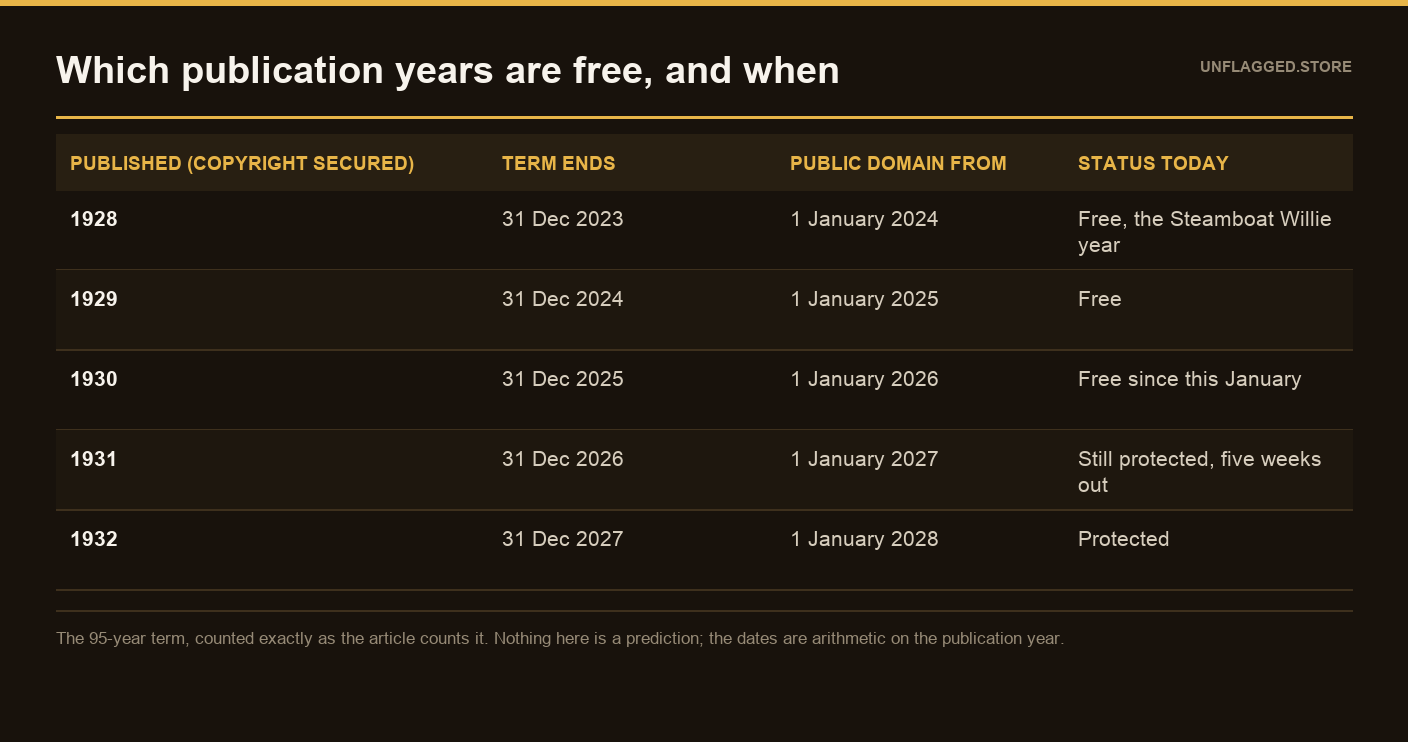
Two rules turn that into a date. Copyright terms "run through the end of the calendar year in which they expire" under 17 U.S.C. §305, and the clock starts from the end of the year the copyright was secured. So a 1931 copyright, renewed, expires on 31 December 2026 and the work is free the next morning.
| Published (copyright secured) | Term ends | Public domain from | Status today |
|---|---|---|---|
| 1928 | 31 Dec 2023 | 1 January 2024 | Free. The Steamboat Willie year |
| 1929 | 31 Dec 2024 | 1 January 2025 | Free |
| 1930 | 31 Dec 2025 | 1 January 2026 | Free since this January |
| 1931 | 31 Dec 2026 | 1 January 2027 | Still protected. Five weeks out |
| 1932 | 31 Dec 2027 | 1 January 2028 | Protected |
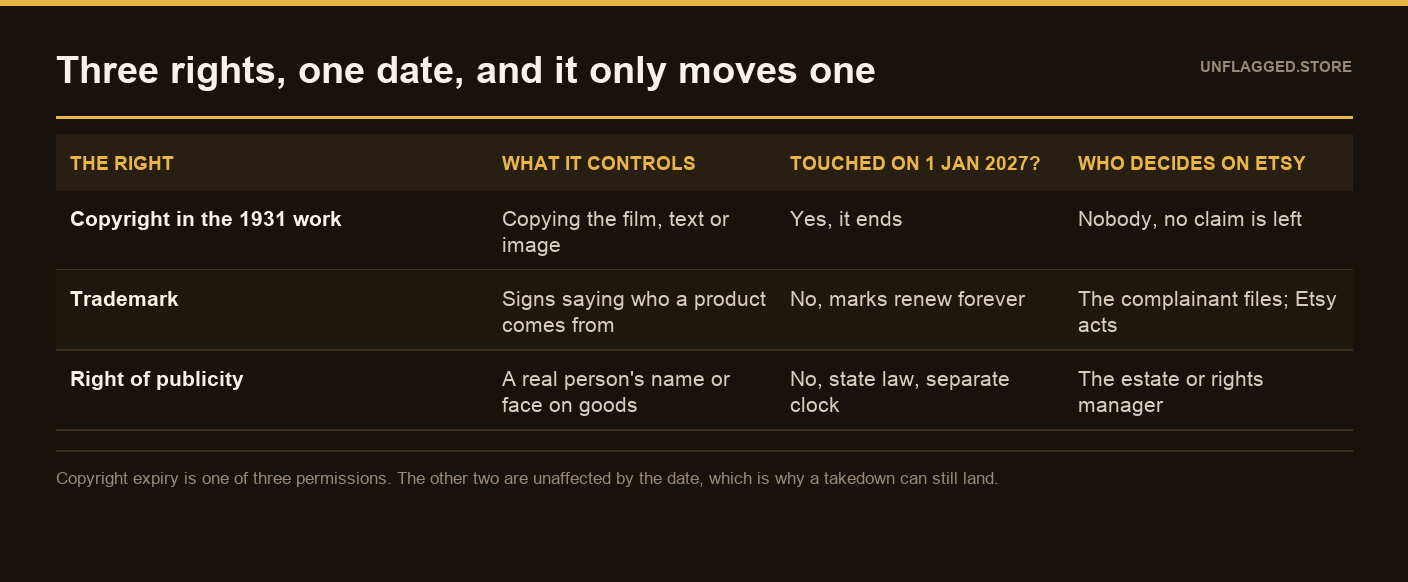
What does not change: nothing about trademarks, nothing about a living or recently dead person's likeness, and nothing about Etsy's own standards. Those three run on their own clocks and the next six sections are about them, because they are what actually removes listings.
The 1931 Works Etsy Sellers Will Actually Want
The 1931 class is unusually strong for print, sticker and apparel shops, which is exactly why it deserves care rather than enthusiasm. Universal released Dracula in February 1931 and Frankenstein on 21 November 1931. Both are horror properties with a merchandising afterlife measured in decades.
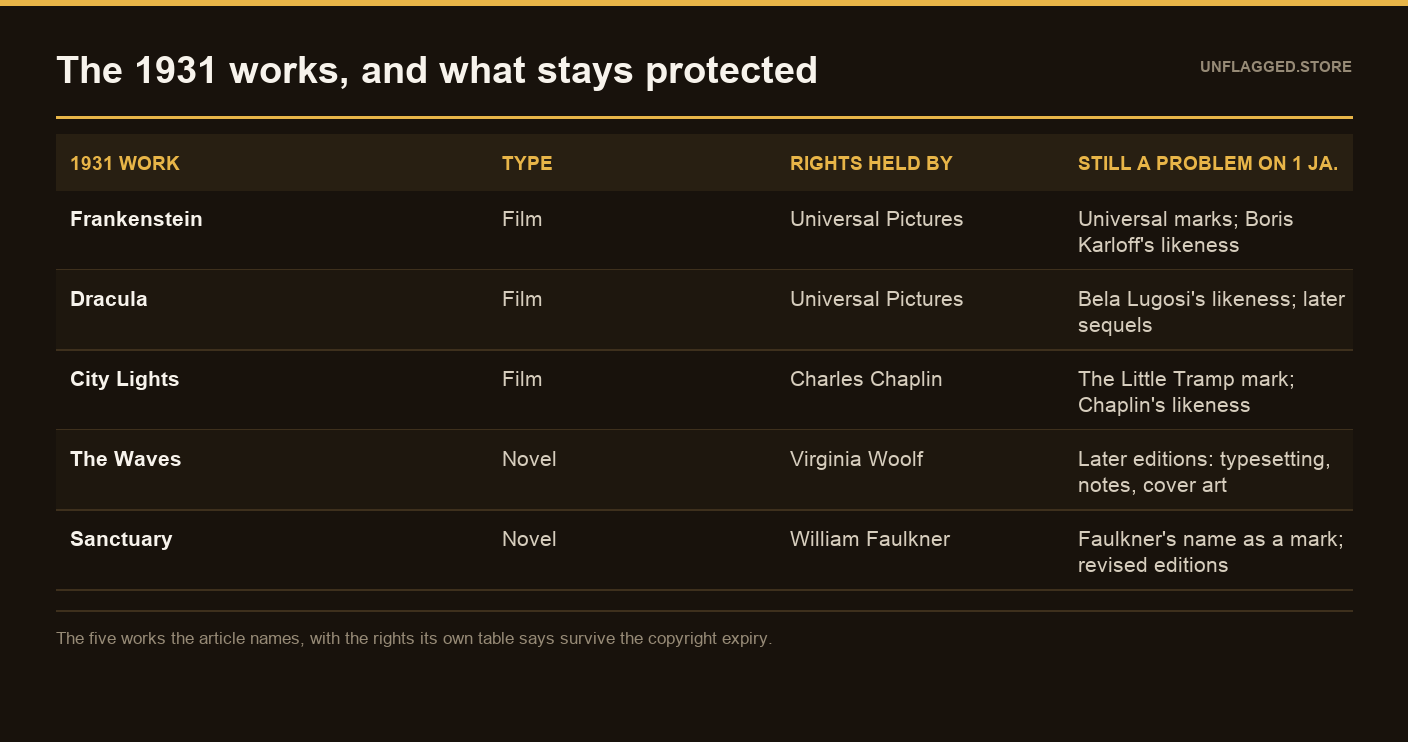
| 1931 work | Type | Rights originally held by | Free on 1 Jan 2027 | Still a problem |
|---|---|---|---|---|
| Frankenstein | Film | Universal Pictures | The film: stills, frames, dialogue, the creature as it appears on screen | Universal word and design marks on merchandise; Boris Karloff's likeness |
| Dracula | Film | Universal Pictures | The 1931 film and its imagery | Bela Lugosi's likeness; later Universal sequels and their designs |
| City Lights | Film | Charles Chaplin | The film and its frames | The Little Tramp as a registered mark; Chaplin's likeness |
| The Waves | Novel | Virginia Woolf | The 1931 text | Any later edition's typesetting, notes, introduction or cover art |
| Sanctuary | Novel | William Faulkner | The 1931 text | Faulkner's name as a mark on goods; revised later editions |
Read the fourth and fifth columns together. "The film is public domain" and "I can print this" are different sentences. The first is about copying the 1931 work. The second is about selling a product, and selling is where trademark law starts paying attention. If your plan is fan-adjacent rather than faithful, the fan art rules are the better starting point.
Two Traps That Make the Date Wrong in Both Directions
The calendar in section one is correct and it is still not the answer for a specific work, because the year that matters is the year the copyright was secured, not the year the thing came out.
Trap one: the work is already free and you are waiting for nothing. Circular 15A notes that the term "for works published with a year date in the notice that is earlier than the actual date of publication is computed from the year date in the copyright notice." Films are the common case, because a December registration precedes a January release. Cimarron is the worked example: Duke's Public Domain Day 2026 record lists it as a 1930 work, released in 1931 but copyrighted in 1930, and notes that date discrepancies are resolved in favour of the public. It went free on 1 January 2026, eleven months ago.
Trap two: the work has been free since the Eisenhower administration. This is the one no competing page mentions. Under the 1909 Act, federal copyright lasted "a first term of 28 years", was "eligible for renewal during the final, that is, 28th year", and if it was not renewed "the copyright expired at the end of the first 28-year term, and the work is no longer protected by copyright." For a 1931 work the renewal year was 1959. A great many rights holders did not bother, especially for commercially spent magazines, sheet music, pulp fiction, catalogues, postcards and photographs, which is a large slice of what sells as wall art.
What this means in practice. The 95-year headline only applies to works that were renewed. Circular 15A's "Automatic Extension" rule covers works "originally copyrighted after 1922 and renewed before 1978", which were extended to the 95-year total. An unrenewed 1931 work never reached that rule. So for anything obscure, the renewal records are worth checking before you assume you are waiting for 2027: you may be free now, and so is everyone else.
Copyright Expired, Trademark Did Not, and Dastar Will Not Save You Here
Every guide on this subject tells you trademark survives copyright, usually with Mickey Mouse as the example, and stops there. That leaves readers believing the Frankenstein monster is locked up for ever. It is not, and the Supreme Court said so.
In Dastar Corp. v. Twentieth Century Fox Film Corp., 539 U.S. 23 (2003), the Court held that "Section 43(a) of the Lanham Act does not prevent the unaccredited copying of an uncopyrighted work." Reading trademark law to reach public domain copying, it reasoned, would create "a species of perpetual patent and copyright" that Congress never authorised. The word "origin" in the Lanham Act means who produced the physical goods, not who authored the ideas in them.
So the scare version is wrong. Here is the part that matters more to your shop, and it is the half the SERP never joins to the first: Dastar is a holding about what a court will do, and an Etsy report is not a court.
| The right | What it controls | Does 1 Jan 2027 touch it? | Who decides on Etsy |
|---|---|---|---|
| Copyright in the 1931 work | Copying the film, text or image itself | Yes. It ends | Nobody. There is no claim left to make |
| Trademark | Signs that tell a buyer who a product comes from | No. Marks renew indefinitely | The complainant files; Etsy acts on the notice |
| Right of publicity | A real person's name, face or persona on goods | No. State law, separate clock | The estate or rights manager |
A report against a public domain listing can be legally weak and still cost you the listing, because the forum is a notice process with a turnaround measured in hours, not a federal action with briefing. Winning an argument you never get to make is not a plan. The practical implication is narrow and useful: use the 1931 work, and do not dress your product to look like it comes from the studio. Keep studio names and logos out of titles, tags and photographs, do not reproduce a modern merchandise style, and avoid implying a licence you do not have. Which words draw reports is a separate and much shorter list than sellers expect.
Sound Recordings Run on a Slower Clock
If your shop touches music, this section is the most expensive thing on the page, and no competing guide covers it at all. A song is two copyrights: the musical composition, and the recording of it. They do not expire together.
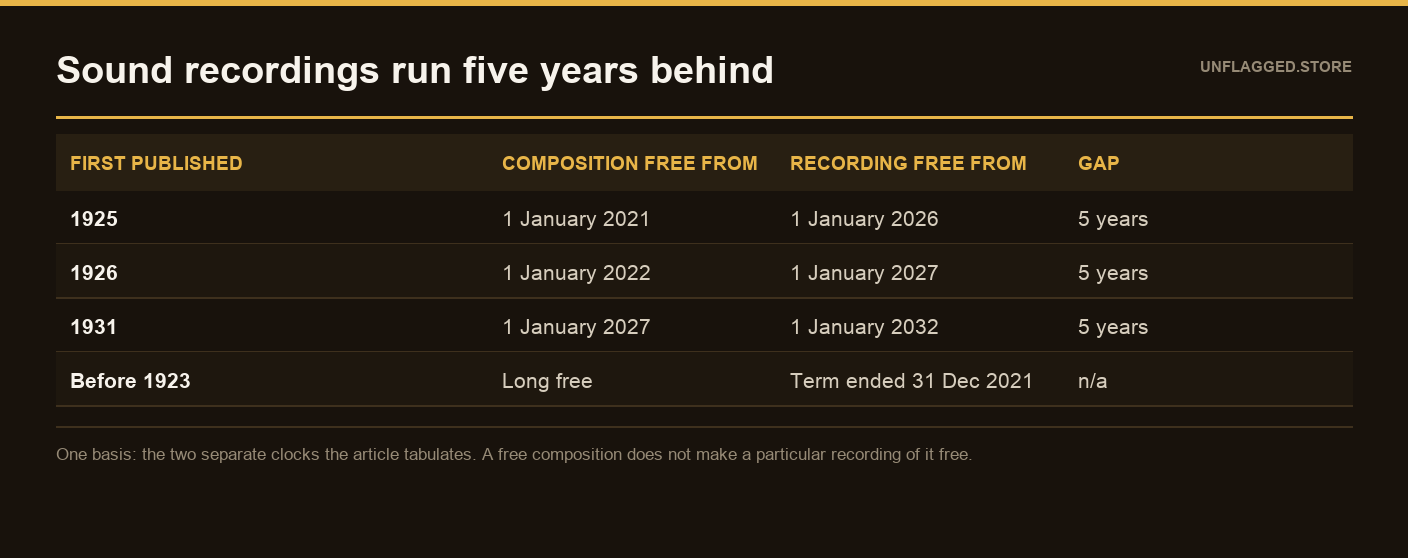
Compositions follow the schedule in section one. Recordings follow the Classics Protection and Access Act, which the Copyright Office summarises on its pre-1972 sound recordings page: federal remedies run for 95 years after the year of first publication, plus an additional period that depends on when the recording came out. For recordings first published between 1923 and 1946 that extra period is five years, which makes 100 in total.
| First published | Composition free from | Recording free from | Gap |
|---|---|---|---|
| 1925 | 1 January 2021 | 1 January 2026 | 5 years |
| 1926 | 1 January 2022 | 1 January 2027 | 5 years |
| 1931 | 1 January 2027 | 1 January 2032 | 5 years |
| Before 1923 | Long free | Term ended 31 Dec 2021 | n/a |
Read the third row twice. On 1 January 2027 the sheet music, lyrics and melody of a 1931 song become free, and the famous 1931 record of it does not, for another five years. Printing lyrics on a tea towel is fine. Selling a digital download containing the 1931 master is not, and that is a copyright claim with real statutory teeth behind it.
A Recognisable Face Is a Third Permission
Boris Karloff's performance is in the 1931 film, and the film goes free. Karloff's identity is not part of that transaction. The right of publicity is, as the Legal Information Institute puts it, "largely protected by state common or statutory law", and it notes that "Only about half the states have distinctly recognized a right of publicity", with others reaching the same result through privacy or unfair competition law. Durations differ by state, and there is no federal term that 1 January 2027 could possibly end.
The LII's summary adds the complication that matters on a marketplace: where a person's identity functions as a trademark, federal trademark law can apply as well, and the Lanham Act reaches uses that falsely suggest a product's origin or endorsement. So a portrait print of a named 1931 performer can attract a claim from an estate under state law and a claim from a mark owner under federal law, neither of which cares that the film's copyright lapsed.
The workable line: use the character as it appears in the public domain work, not the actor as a person. Do not use a performer's name as a selling point, in a title, tag or shop section. We cover the mechanics in right of publicity for Etsy sellers.
Scans, Restorations and the Edition Problem
You almost never list the 1931 work. You list a file of it, and that file may have an owner even when the underlying work does not.
Three distinctions do most of the work here. A faithful photographic reproduction of a flat public domain artwork adds no original authorship, so it attracts no new copyright of its own, and a museum's terms of use are a contract question rather than a copyright one. A restoration that makes real creative choices, recolouring, recomposing, redrawing damage, can carry a thin copyright in those additions. And a later edition is its own work: the 1931 text of The Waves is free, while a 1978 annotated edition's introduction, notes and typographic design are not.
The practical rule is to source from the oldest usable copy you can find and to document where you got it. Buying a "commercial use" bundle of public domain images from a third party proves nothing about the underlying rights, and the seller's licence cannot give you more than they had. The copyright side of Etsy listings goes through the common sourcing mistakes in more detail.
How to Check One Work Before You List It
This is the step every guide recommends and none demonstrates. It takes about ten minutes per work, and the Etsy public domain listings that survive are the ones where somebody did it.
- Find the copyright notice year, not the release year. On a film, read the notice on the title card. On a book, the verso of the title page. That year, not the year in the marketing, starts the clock.
- Apply the schedule. Before 1931 means already free. 1931 means 1 January 2027. If the notice says 1930 on a 1931 release, you are free now.
- Check whether it was renewed if the notice is 1931 or earlier and the work is at all obscure. An unrenewed work went into the public domain at the end of its 28th year, in 1959 for a 1931 work.
- Ask whether it is a foreign work. Restoration under the Uruguay Round Agreements Act revived US copyright in certain foreign works as of 1 January 1996, including some that had lost it by failing to renew. Circular 15A covers this in Circular 38B. Treat non-US works as a question, not an answer.
- Separate the recording if there is music, and apply the 100-year tier instead.
- Search the live trademark register for the title, the character name and any slogan you plan to use, in the goods classes you actually sell in. A dead copyright and a live mark routinely coexist.
- Write the listing text last, then read it as a complainant would. The question is not "is this accurate" but "does this read as officially licensed".
Steps one to five settle whether you may copy the work. Steps six and seven settle whether your listing survives contact with a rights holder's monitoring service, and they are the two sellers skip.
If Etsy Removes It Anyway
It happens, including to listings that are entirely lawful, because automated monitoring matches strings and images rather than reading Circular 15A. The response depends on which kind of report arrived, and the difference is procedural rather than rhetorical.
A copyright report is the one with a statutory route back: a sworn counter notification under 17 U.S.C. §512(g) starts a clock that restores the material unless the complainant sues. For a public domain work this is the strongest position a seller can be in, because the claim is not merely arguable, it is void. A trademark report has no counter-notice. There the work is persuading the complainant to retract or showing the platform the report is facially defective, usually by removing the wording that implied a source. Read the notice for what it actually claims before answering: what to do with a takedown notice and what Etsy decides and what it refuses to decide both turn on that one distinction.
Where Unflagged fits, and where it does not. Nothing here is legal advice. Unflagged reviews the listing text you paste in for potential concerns, including brand names and phrases that commonly draw reports, and saves the findings so you can compare revised wording. It does not determine public domain status, search live copyright renewal or trademark registers, inspect your artwork or files, or establish that a listing is safe to sell. Whether a 1931 work is free is a research question about the work; whether your listing reads as officially licensed is a question about your words, and that second one is the part we review. Start with the seller compliance guide.
The honest summary: the calendar is the easy half. Of the three rights that can take a public domain listing down, exactly one expires on 1 January 2027, and the other two are the reason this is worth ten minutes a work rather than none.
Related Articles
- How to Avoid Copyright Infringement on Etsy, the Title 17 side and its counter-notice
- Etsy Right of Publicity 2026, when a real person's face is the problem
- Etsy Trademark Takedown 2026, the mark-based report and how to answer it
- How to Sell Fan Art on Etsy, where inspiration stops and copying starts
- Etsy's Intellectual Property Policy Explained, what the platform acts on
- Etsy Design Patent Claims 2026, the fourth right, which has no counter-notice at all
FAQ
What enters the public domain on 1 January 2027?
Works published in the United States in 1931, including Universal's Frankenstein and Dracula, Chaplin's City Lights, Woolf's The Waves and Faulkner's Sanctuary. Sound recordings first published in 1926 enter on the same date, under a separate 100-year rule.
Can I sell public domain art on Etsy?
Yes, and so can everybody else, which is the commercial catch rather than the legal one. The legal catch is that public domain status ends only the copyright. A live trademark, a performer's right of publicity and Etsy's own standards all apply independently of the work's age.
Is the Frankenstein monster free to use in 2027?
The 1931 film and the creature as it appears in it are, once the copyright expires. Using the design as a badge of origin on merchandise can still draw a trademark report, and Boris Karloff's likeness is a separate state-law question with no connection to the copyright term.
How do I know if a 1931 work is already in the public domain?
Two checks. Read the copyright notice year: a 1931 release carrying a 1930 notice was already free on 1 January 2026, as with Cimarron. Then check renewal: under the 1909 Act a copyright not renewed in its 28th year, 1959 for a 1931 work, expired then and has been free since.
Does trademark law really outlast copyright for ever?
Marks can be renewed indefinitely, but they cannot be used to stop copying of a public domain work. In Dastar (2003) the Supreme Court held that Lanham Act §43(a) "does not prevent the unaccredited copying of an uncopyrighted work." What a mark still controls is use as an indicator of source, which is why your listing's wording and styling matter more than the work's age.
Can I sell a digital download of a 1931 song recording in 2027?
No. The composition becomes free on 1 January 2027, but the recording is protected for 100 years from first publication, so a 1931 master is not free until 1 January 2032. Only recordings first published in 1926 or earlier are clear by 2027.
What about public domain works from outside the United States?
Treat them as a separate question. The Uruguay Round Agreements Act restored US copyright in certain foreign works as of 1 January 1996, including some whose protection had lapsed for failure to renew, so a work free in its home country can still be protected here.
Will Etsy reinstate a listing that was public domain all along?
Often, but the route depends on the report. A copyright report can be answered with a sworn counter notification under 17 U.S.C. §512(g), which starts a restore clock. A trademark report has no counter-notice, so the work is a retraction from the complainant or a showing that the report is defective.
Sources. Duration, renewal and the 1909 Act terms from the U.S. Copyright Office, Duration of Copyright (Circular 15A, reviewed 08/2011, revised 04/2026), quoted as written, with 17 U.S.C. §305 via the Legal Information Institute for year-end expiration. Sound recording tiers from the Copyright Office's Classics Protection and Access Act page. Dastar Corp. v. Twentieth Century Fox Film Corp., 539 U.S. 23 (2003), from the LII syllabus. Right of publicity from the LII's publicity entry. Cimarron's 1930 copyright date and the 1930 and 1925 entry years from Duke University's Center for the Study of the Public Domain, Public Domain Day 2026. Frankenstein's 21 November 1931 US release date and 1 January 2027 entry date cross-checked against the film's encyclopaedia record. Etsy's own intellectual property pages returned HTTP 403 to this research, so nothing here is attributed to them. Terms, registers and state statutes change, and whether a particular work is free turns on facts specific to that work: general information, not legal advice.
Scan Your Listings Free
Screen submitted listing text for potential concerns. 5 preliminary screens daily, shared network limits; no signup required.
Start Free ScreenRelated Articles
How to Check Your Etsy Listings for Trademark Violations (2026 Guide)
Learn how to scan your Etsy listings for trademark violations before they get flagged. Step-by-step guide to protecting your shop from takedowns and suspensions.
Read moreEtsy Shop Suspended? How to Write a Winning Appeal Letter
Your Etsy shop got suspended. Here's exactly how to write an appeal letter that gets your shop reinstated, with templates and strategies that actually work.
Read more50 Words That Are Trademarked on Etsy (Stop Using These Now)
A comprehensive list of commonly trademarked words and phrases that Etsy sellers use without realizing they're violating trademark law. Check your listings now.
Read more