Etsy Offsite Ads: How They Work & Should You Opt Out? (2026)
Etsy's Offsite Ads program promotes your listings on Google, Facebook, and other platforms — and charges you a fee when those ads lead to a sale. Some sellers swear by it. Others call it a hidden tax on their revenue. Here's how offsite ads actually work, what they cost, whether you can opt out, and a formula to decide if they're profitable for your specific shop.
What Are Etsy Offsite Ads?
Etsy Offsite Ads is a program where Etsy takes your product listings and advertises them on external platforms — specifically Google Search, Google Shopping, Facebook, Instagram, Pinterest, and Bing. Etsy pays for the advertising upfront. You pay nothing unless a buyer clicks on one of those ads and then makes a purchase from your shop within 30 days.
The program launched in 2020 and replaced Etsy's older Google Shopping program. The key difference from running your own ads is that Etsy controls everything — which listings get promoted, which platforms they appear on, what the ad creative looks like, and how much gets spent. You have zero control over targeting, budget, or placement.
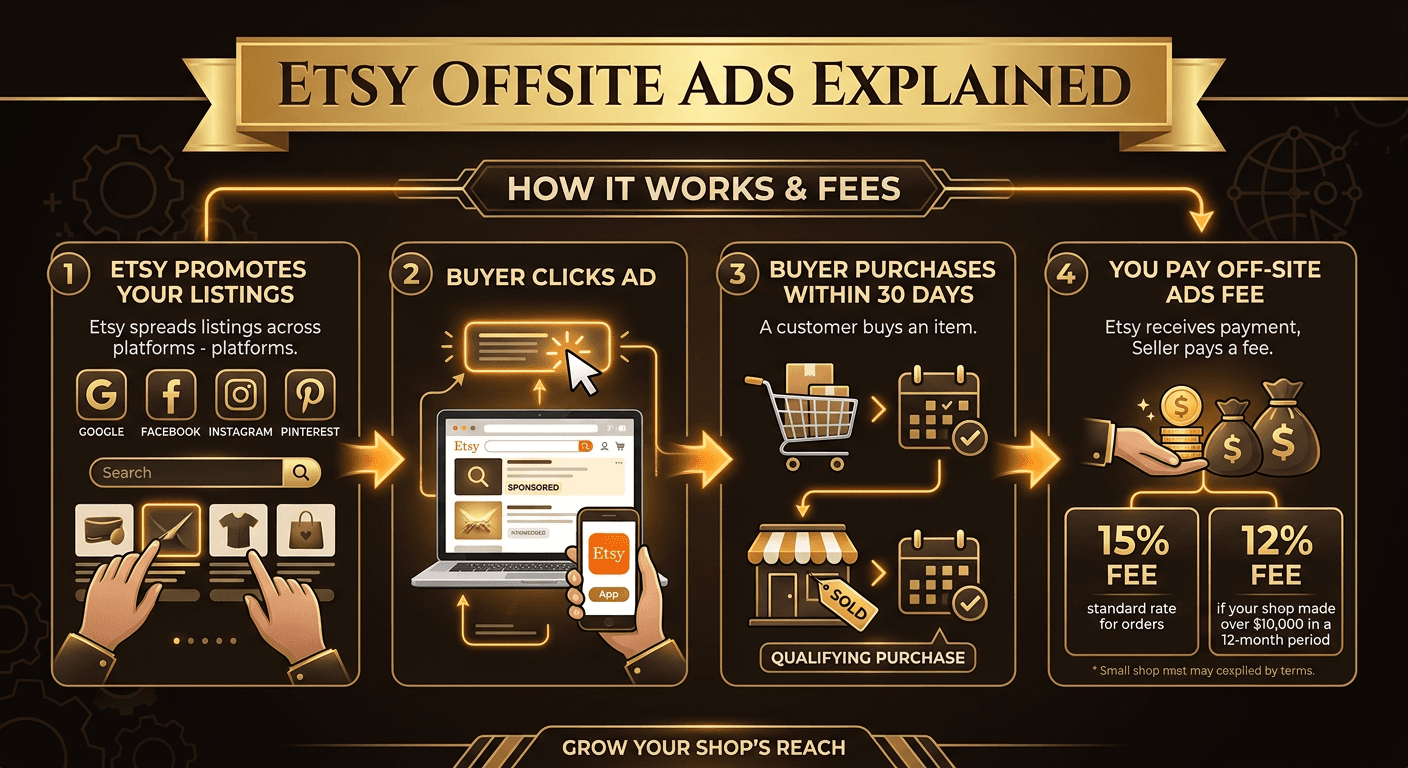
Think of it as Etsy hiring a marketing team on your behalf — except you don't get to brief them, review their work, or approve the budget. You just get the bill when it works. For some sellers, that trade-off is fine. For others, it's a dealbreaker.
How the Fee Works
The offsite ads fee is percentage-based and depends on your shop's trailing 12-month revenue. Here's the breakdown:
Under $10,000/year — 15% fee
If your shop has earned less than $10,000 in the trailing 12-month period, you pay a 15% fee on any sale attributed to an offsite ad. This is the rate most Etsy sellers pay.
Over $10,000/year — 12% fee
Shops that cross the $10,000 threshold in trailing 12-month revenue get a reduced rate of 12%. The trade-off is that once you cross $10,000 in lifetime revenue, you can never opt out of the program.
Here's the part that catches sellers off guard: the fee is calculated on the total order amount, which includes the item price, shipping cost, and any applicable tax. Not just the product price.
For example, say a buyer purchases a $40 item with $5 shipping and $3.60 in sales tax through an offsite ad. The offsite ads fee is calculated on the full $48.60. At 15%, that's a $7.29 offsite ads fee — on top of your standard Etsy transaction fee (6.5%), payment processing fee (3% + $0.25), and listing fee ($0.20).
The fee is only charged when a sale actually happens within 30 days of a buyer clicking on an offsite ad. If someone clicks but doesn't buy, or buys after the 30-day window, no fee. Etsy calls this the “attribution window” — and it's one of the most controversial aspects of the program. More on that below.
Can You Opt Out of Etsy Offsite Ads?
The short answer: it depends on your revenue. Etsy's rules create two tiers of sellers with different opt-out rights.
Under $10,000 lifetime revenue — You can opt out
If your shop has never crossed $10,000 in total revenue, you have the option to turn offsite ads off entirely. Etsy enrolls all new shops by default, but you can disable the program at any time.
Over $10,000 lifetime revenue — Mandatory enrollment
Once your shop has earned more than $10,000 in its lifetime (not per year — total lifetime revenue), you are permanently enrolled in offsite ads. There is no way to opt out. This is a condition of selling on Etsy and is written into their terms of service.
How to Opt Out (Step by Step)
If you're eligible to opt out, here's how to do it:
- Log in to your Etsy Shop Manager.
- Click Settings in the left sidebar.
- Select Offsite Ads.
- Scroll down to the bottom of the page and click Stop promoting my products.
- Confirm your choice in the pop-up dialog.
The change takes effect immediately, but any sales attributed to ad clicks that happened before you opted out will still incur the fee. The 30-day attribution window applies to clicks that already occurred.
Should You Opt Out? An Honest Analysis
This is the question that divides the Etsy seller community. Here's a balanced look at both sides.
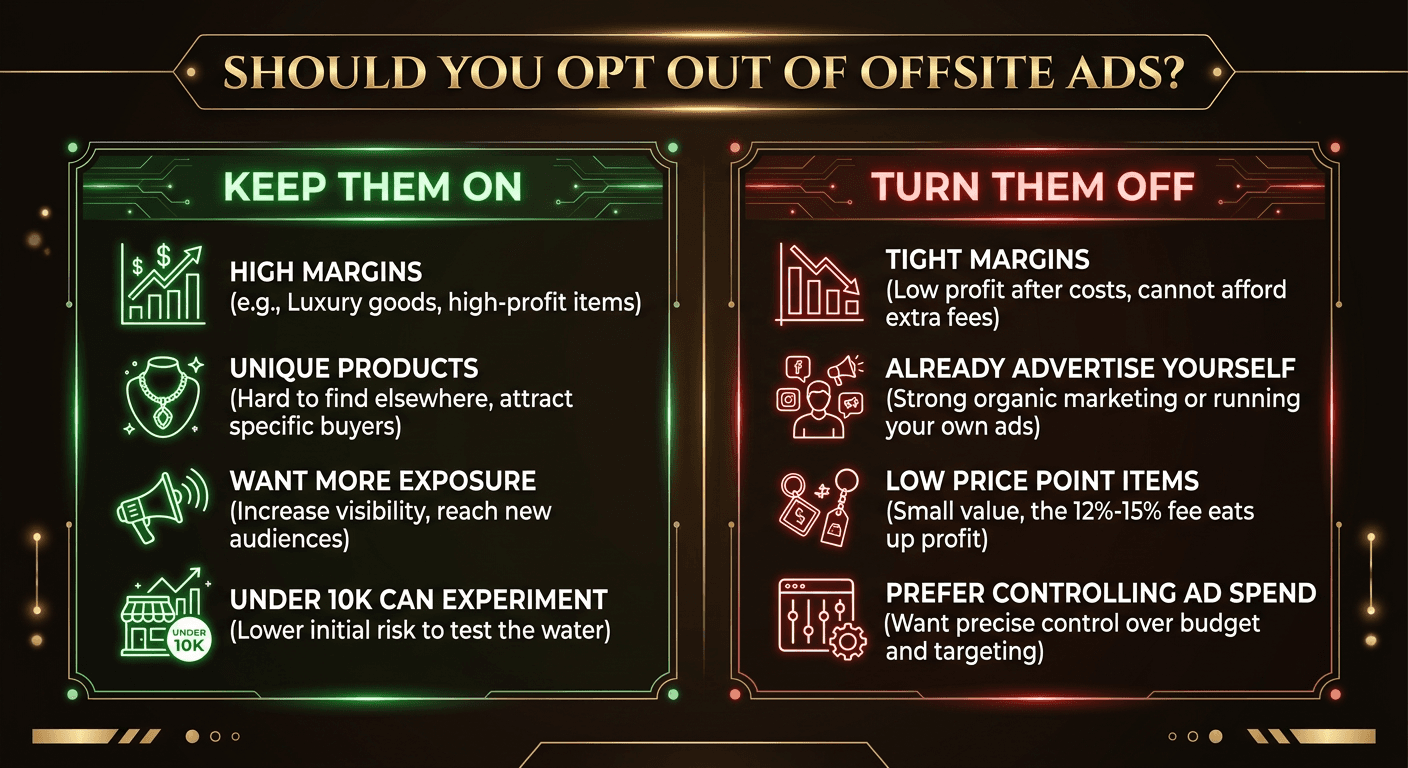
The Case for Keeping Offsite Ads On
- Free advertising with pay-for-results pricing. You never pay for impressions or clicks — only for actual sales. If an offsite ad doesn't convert, it costs you nothing. This is a model most advertising platforms don't offer.
- Etsy reports 235% average ROI. According to Etsy's data, sellers earn an average of $2.35 for every $1 spent on offsite ads. While averages can be misleading, it suggests the program is net positive for most participants.
- Exposure you cannot get yourself. Etsy has the advertising budget and data to place your products on Google Shopping, Facebook, Instagram, and Pinterest at scale. Most individual sellers cannot afford this level of cross-platform promotion, and wouldn't know how to execute it effectively.
- Incremental sales. The buyers who find you through offsite ads may never have discovered your shop otherwise. Even after paying the fee, a sale you wouldn't have gotten is better than no sale.
The Case for Opting Out
- 15% on top of existing fees eats margins. Etsy already charges a 6.5% transaction fee, 3% + $0.25 payment processing fee, and $0.20 listing fee. Add 15% for offsite ads and you're looking at roughly 25% in total Etsy fees on those orders. For low-margin products, that can turn a profitable sale into a loss. Understand all Etsy fees before making this decision.
- No control over which listings are promoted. Etsy decides which of your products to advertise. They might promote your lowest-margin item or a product that's nearly out of stock. You cannot exclude specific listings or prioritize your best sellers.
- The 30-day attribution window is too long. If a buyer clicks an offsite ad today but doesn't buy for 29 days, that sale is still attributed to the ad. The buyer may have bookmarked your shop and would have returned anyway. You're paying 15% for a sale that might have happened organically.
- Duplicate attribution with your own marketing. If you run your own Google Ads or social media campaigns, a buyer might see both your ad and Etsy's offsite ad. If they click the Etsy ad, you pay Etsy 15% even though your own marketing may have driven the purchase.
When to Keep Offsite Ads On
Offsite ads tend to work best in specific scenarios. Keep them enabled if:
- You sell high-margin products. If your profit margins are 50% or higher, paying 15% on offsite-ad-driven sales still leaves you solidly profitable. Handmade items, custom products, and digital downloads typically have the margins to absorb the fee.
- You sell unique or niche items. Products with limited competition benefit more from offsite ads because buyers searching for those specific items are highly likely to purchase when they find them. The conversion rate on niche products tends to be higher.
- You want more exposure and aren't running your own ads. If you don't have the budget, skills, or time to run your own advertising campaigns, offsite ads give you cross-platform promotion with zero upfront cost.
- You're in a testing phase. New shops or sellers launching new product lines can use offsite ads as a low-risk way to test which products attract external traffic. Since you only pay when sales happen, there's no downside to experimenting. Read more in our guide on how to increase Etsy sales.
When to Turn Offsite Ads Off
Offsite ads hurt more than they help in these situations:
- Your margins are tight. If your profit margin after materials, labor, and standard Etsy fees is already below 30%, adding a 15% offsite ads fee can push you into negative territory on those orders. Run the numbers before keeping them on.
- You already run your own ads. If you're running Google Ads, Facebook Ads, or Pinterest Ads that drive traffic to your Etsy shop, you risk paying double — once for your own ads and once for Etsy's offsite ads if the attribution overlaps.
- You sell low-price items. On a $10 item with $4 shipping, the 15% offsite ads fee is $2.10. Add the 6.5% transaction fee ($0.91), payment processing ($0.67), and listing fee ($0.20), and you're paying $3.88 in Etsy fees on a $14 order. If your cost of goods is $5 or more, you're losing money.
- Your offsite ads dashboard shows poor results. Check Shop Manager > Marketing > Offsite Ads to see your actual revenue and fees from the program. If the numbers consistently show that you're paying more in fees than the profit generated by offsite-ad-driven sales, opt out.
How to Calculate If Offsite Ads Are Profitable for Your Shop
Don't guess — calculate. Here's a simple formula to determine whether offsite ads make financial sense for a specific product.
The Profitability Formula
Step 1: Calculate your total order value (item price + shipping + tax).
Step 2: Calculate all Etsy fees — transaction fee (6.5%), payment processing (3% + $0.25), listing fee ($0.20), and offsite ads fee (15% or 12%).
Step 3: Subtract your cost of goods (materials, labor, packaging).
Step 4: What remains is your profit on an offsite-ad-driven sale.
Example: $50 Handmade Candle
Item price: $50.00
Shipping: $6.00
Sales tax: $4.48
Total order value: $60.48
Offsite ads fee (15%): −$9.07
Transaction fee (6.5% of $56.00): −$3.64
Payment processing (3% + $0.25): −$2.06
Listing fee: −$0.20
Total Etsy fees: −$14.97
Cost of goods: −$12.00
Shipping cost: −$5.50
Total costs: −$32.47
Profit: $23.53 (with offsite ads)
Without offsite ads fee: $32.60 profit
In this example, offsite ads reduce your profit by $9.07 per sale, but you still make $23.53. The question becomes: would this sale have happened without the offsite ad? If yes, you lost $9.07. If no, you gained $23.53 you wouldn't have had.
The break-even point is when your profit margin after all fees (including the offsite ads fee) drops below zero. For a deeper understanding of all the fees that factor into this calculation, read our complete Etsy fees breakdown.
Offsite Ads and Compliance: A Hidden Risk
Here's something most offsite ads guides don't mention: if your listing gets removed for a trademark violation, intellectual property complaint, or policy violation, any offsite ad spend Etsy made on that listing is wasted — and any pending attribution fees you've already incurred still apply.
Worse, Etsy may have been actively promoting a listing that contained trademarked terms or copyrighted content. When the rights holder files a complaint and Etsy removes the listing, you lose the listing, any sales from that listing, and you may face account-level consequences that affect all your other listings too.
This creates an especially frustrating scenario for sellers who rely on offsite ads for a significant portion of their revenue. A single compliance issue can disrupt both your organic sales and your offsite-ads-driven sales simultaneously.
The best way to prevent this is to proactively scan your listings for trademark risks and policy violations before Etsy or a rights holder catches them. Learn how to protect your Etsy shop from takedowns so your offsite ads investment isn't undermined by a preventable compliance issue.
Don't Let a Takedown Waste Your Ad Spend
Etsy may be spending money to promote a listing that contains trademark risks you don't know about. If that listing gets flagged, you lose the listing, the sales, and the momentum. Unflagged scans every listing for compliance issues so your offsite ads drive revenue — not risk.
Start Free Compliance ScanFrequently Asked Questions
What percentage does Etsy take for offsite ads?+
Etsy charges a 15% offsite ads fee on the total order amount (including shipping and tax) if your shop earns under $10,000 per year. Shops that exceed $10,000 in trailing 12-month revenue get a reduced rate of 12%. The fee is only charged when a sale results from a click on an offsite ad within the 30-day attribution window.
Can I opt out of Etsy Offsite Ads?+
You can opt out if your shop has earned less than $10,000 in the trailing 12-month period. To opt out, go to Shop Manager, click Settings, then Offsite Ads, and toggle the program off. If your shop has ever crossed the $10,000 lifetime threshold, you are permanently enrolled and cannot opt out.
Are Etsy Offsite Ads worth it for small sellers?+
It depends on your margins. If you sell high-margin products (50% or above), offsite ads can be profitable because 15% of a sale you would not have gotten otherwise is still net positive. If your margins are tight (under 30%), the 15% fee on top of Etsy's standard transaction and payment processing fees can wipe out your profit on those orders.
Do Etsy Offsite Ads actually work?+
Etsy reports that offsite ads generate a return of about 235% on average, meaning sellers earn $2.35 for every $1 Etsy spends on ads. However, this is an average across all sellers and all product categories. Your individual results depend on your product type, price point, margins, and competition. Some sellers see strong returns while others find the fees eat into already thin margins.
Where do Etsy Offsite Ads appear?+
Etsy places offsite ads on Google Search, Google Shopping, Facebook, Instagram, Pinterest, and Bing. Etsy decides which listings to promote and where to place them. You have no control over which specific listings are advertised or which platforms they appear on.
How is the Etsy offsite ads fee calculated?+
The fee is calculated on the total order amount, which includes the item price, shipping cost, and any applicable tax. For example, if a buyer purchases a $40 item with $5 shipping and $3.60 tax through an offsite ad, the fee is calculated on the full $48.60. At 15%, that would be a $7.29 offsite ads fee on top of your standard Etsy fees.