Are Etsy Ads Worth It in 2026? Honest Analysis + Strategy
Etsy Ads promise more visibility and more sales — but they're also one of the fastest ways to drain your budget if you don't know what you're doing. Here's an honest look at whether Etsy Ads are worth the money in 2026, a formula to calculate your return, and the strategy that separates profitable sellers from those lighting cash on fire.
What Are Etsy Ads?
Etsy Ads are pay-per-click (PPC) advertisements that promote your listings within Etsy's own search results. When a shopper searches for something on Etsy, promoted listings appear alongside organic results with a small “Ad” badge in the corner. You set a daily budget, Etsy shows your listings to relevant shoppers, and you pay each time someone clicks on your ad.
This is different from Etsy Offsite Ads, which promote your listings on external platforms like Google and Facebook. Etsy Ads stay entirely within the Etsy marketplace. You control which listings to promote and how much to spend per day. Etsy controls everything else — including the cost-per-click, which you cannot set manually.
Think of Etsy Ads as paying for a better spot in Etsy search. Instead of relying purely on Etsy SEO to rank your listings, you're bidding for visibility. The question isn't whether ads can get you more clicks — they can. The question is whether those clicks turn into sales that justify the spend.
How Etsy Ads Work
The mechanics are straightforward, but there are some details that catch sellers off guard.
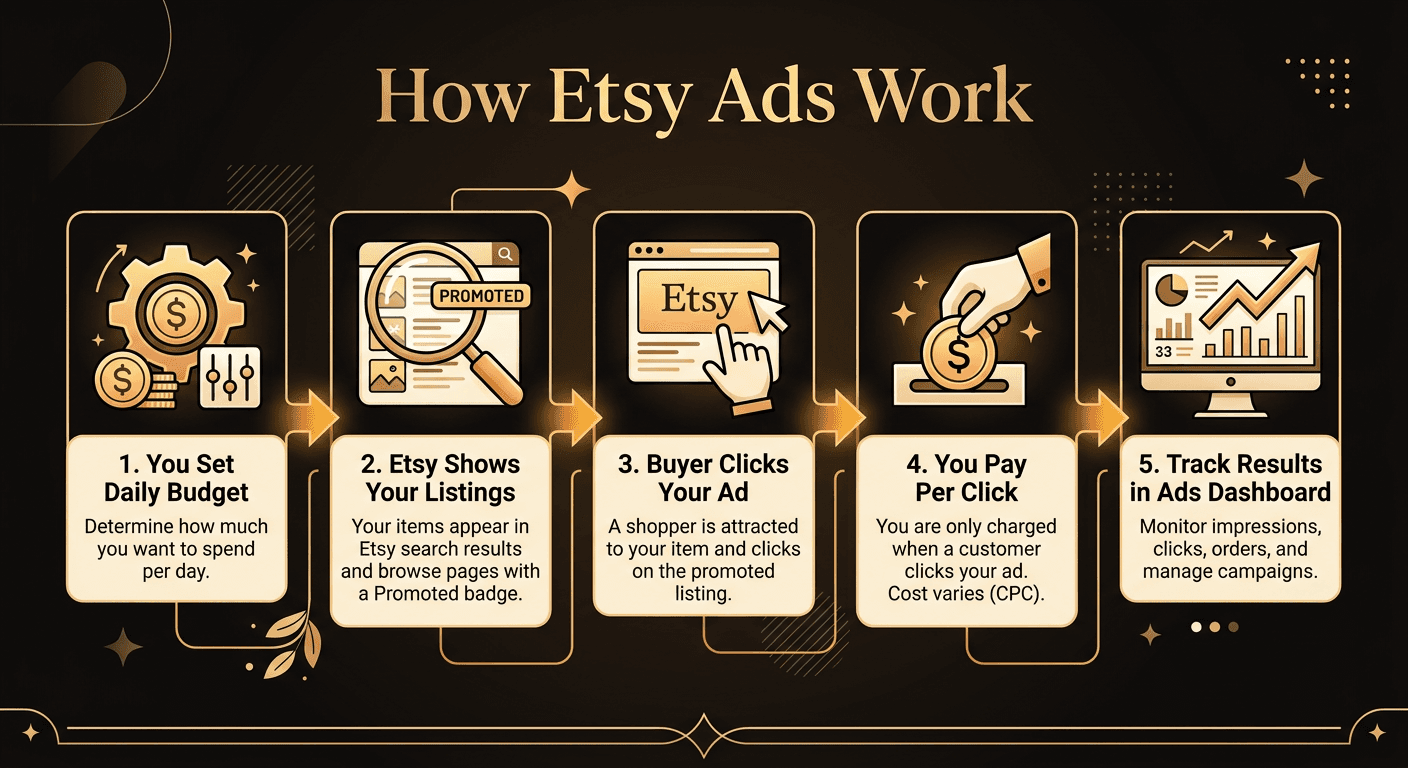
You Set a Daily Budget
Etsy lets you set a daily budget starting at $1 per day, with no maximum cap. Most sellers start between $1 and $25 per day. Your budget controls the total amount you're willing to spend on clicks in a given day — once the budget is exhausted, your ads stop showing until the next day.
Etsy Sets the Cost Per Click
Unlike Google Ads or Facebook Ads, you cannot set a maximum cost-per-click (CPC) on Etsy. Etsy's algorithm determines the CPC for each listing based on competition in your category, search volume, and other factors. CPCs typically range from $0.20 to $0.80, but competitive categories can see higher costs.
Your Listings Appear With an “Ad” Badge
Promoted listings show up in Etsy search results with a small “Ad” label. They appear in the same grid as organic results, so shoppers see them alongside non-promoted listings. Your ad competes for the same shopper attention as every other listing on the page.
You Choose Which Listings to Promote
By default, Etsy advertises all of your active listings. You can (and should) turn off ads for specific listings and only promote the ones that have the best chance of converting. This is one of the most important levers you have.
The key thing to understand is that Etsy Ads are a volume game. You're paying for more eyeballs on your listings. If your listings convert well, more eyeballs means more sales. If your listings don't convert, you're just paying for clicks that go nowhere. To understand the full cost picture, read our complete Etsy fees breakdown.
Are Etsy Ads Worth It? The Honest Answer
The honest answer: it depends. Etsy Ads are not universally good or bad. They're a tool, and like any tool, they work well in the right hands and waste money in the wrong ones. Here are the scenarios where they make sense and where they don't.
When Etsy Ads ARE Worth It
- Bestsellers with proven conversion rates. If a listing is already converting organic traffic into sales, ads amplify what's already working. You're putting fuel on a fire that's already burning. A listing with a 3-5% conversion rate and strong reviews is your best candidate for ads.
- Competitive niches where organic ranking is tough. Categories like jewelry, stickers, digital downloads, and wedding items have thousands of sellers competing for the same keywords. If you're struggling to crack the first page organically, ads can give you the visibility you need while you build your Etsy SEO.
- Seasonal pushes and holiday sales. Running ads during high-traffic periods like Black Friday, Christmas, Mother's Day, or Valentine's Day can maximize revenue when buyer intent is at its peak. Shoppers are actively looking to buy, so your conversion rate naturally goes up.
- New listings that need initial traction. A brand-new listing has zero sales, zero reviews, and no organic ranking history. Running ads for the first 7-14 days can kickstart the sales velocity that Etsy's algorithm uses to determine organic ranking. Think of it as paying for a head start.
When Etsy Ads Are NOT Worth It
- Unproven products with no sales history. If a listing has never sold organically, running ads on it is gambling. You don't know if the product, price, or photos resonate with buyers. Fix the listing first, get a few organic sales, then consider ads.
- Low-margin items where ad costs eat the profit. If you sell a $10 item and the CPC is $0.40, you need at least 1 in 5 clicks to convert just to break even on ad spend — before accounting for Etsy fees and product costs. Low-margin items rarely justify ad spend.
- Listings with bad photos or weak SEO. Ads drive clicks, not conversions. If shoppers click your ad but see blurry photos, a generic title, or a poorly written description, they leave without buying. You pay for the click either way. Optimize your listing before you spend on ads. Our guide on how to increase Etsy sales covers the fundamentals.
- You're already ranking #1 organically. If a listing is already at the top of search results for its main keywords, running ads on it often means you're paying for clicks you would have gotten for free. Your ad competes with your own organic listing. In this case, redirect ad budget to listings that need the visibility boost.
How to Calculate Your ROAS
ROAS (Return on Ad Spend) is the single most important metric for evaluating Etsy Ads. It tells you how much revenue you earn for every dollar you spend on advertising. If you're not tracking ROAS, you're flying blind.
The ROAS Formula
ROAS = Revenue from Ads ÷ Ad Spend
A ROAS of 3:1 means you earn $3 for every $1 spent on ads. That's generally the minimum target for profitability after factoring in product costs and Etsy fees.
Example: Handmade Candle at $35
Scenario: You spend $50 on Etsy Ads over 7 days promoting your bestselling candle ($35 each).
Total ad spend: $50.00
Clicks received: 120
Sales from ads: 5
Revenue from ads: 5 × $35 = $175.00
ROAS = $175 ÷ $50 = 3.5:1
At 3.5:1, this is a profitable campaign. You earned $3.50 for every $1 spent. After subtracting product costs (~$8 per candle) and Etsy fees (~$4 per sale), you still come out ahead.
What ROAS to Target
Below 2:1: Almost certainly unprofitable. Pause ads and fix the listing.
2:1 to 3:1: Breakeven territory. May or may not be profitable depending on your margins.
3:1 to 5:1: Profitable. This is the sweet spot for most Etsy sellers.
Above 5:1: Highly profitable. Consider increasing your daily budget on these listings.
You can find your ROAS data in Etsy's Shop Manager under Marketing > Etsy Ads. Look at the “Revenue” and “Spend” columns for each listing. Divide revenue by spend to get the ROAS for each promoted listing.
Etsy Ads Best Practices
These are the tactics that separate sellers who profit from Etsy Ads from those who waste money. Follow them in order.
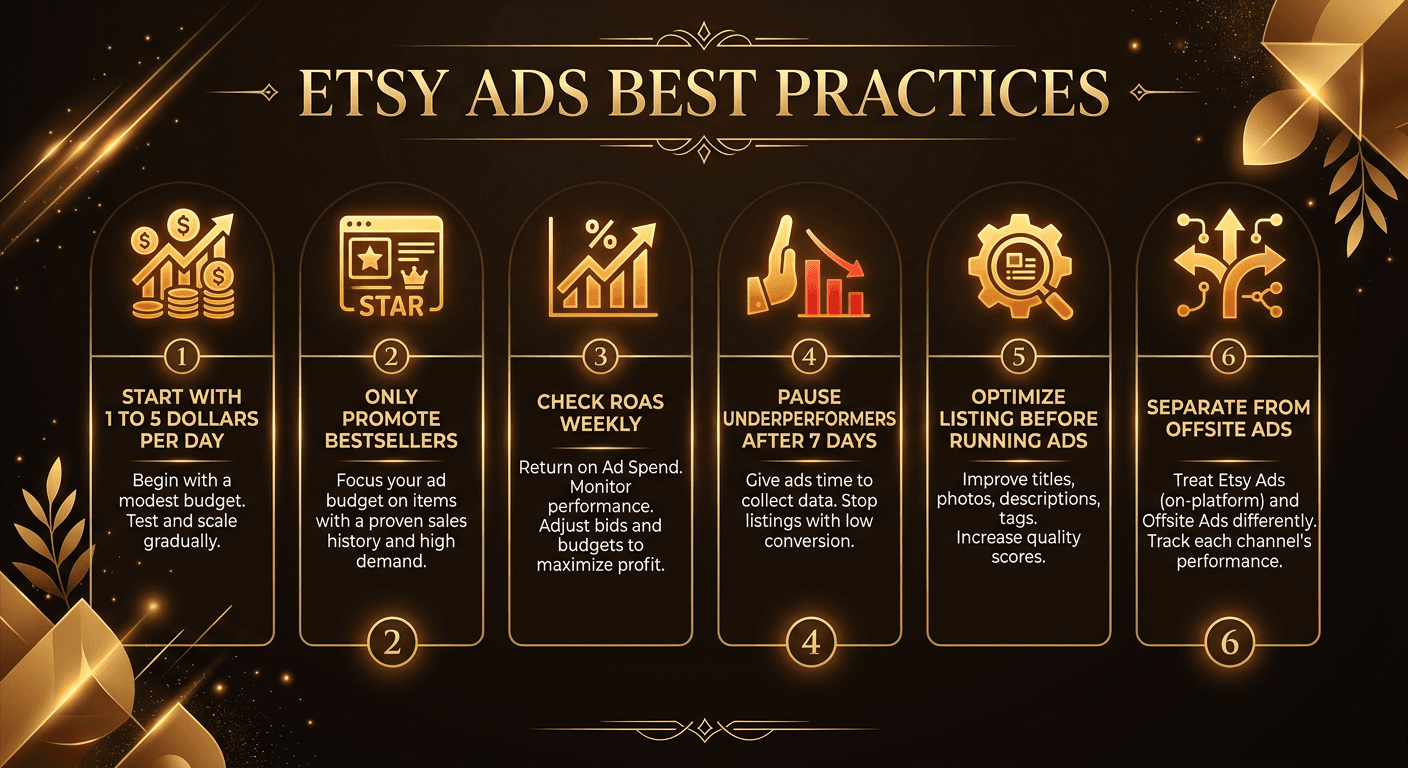
Start With $1–$5 Per Day
Don't throw $25/day at ads on day one. Start small to collect data. At $1-$5/day, you'll spend $7-$35 in a week — enough to see which listings get clicks and which convert. Scale up only after you have data showing which listings are profitable.
Only Promote Listings That Already Convert
Go into your Etsy Ads settings and turn off ads for every listing that hasn't made a sale in the last 30 days. Focus your budget on listings with proven conversion rates and positive reviews. Ads amplify existing performance — they don't fix broken listings.
Review Performance Weekly
Set a weekly reminder to check your Etsy Ads dashboard. Look at ROAS, click-through rate, and cost-per-click for each listing. Market conditions change, seasonal trends shift, and what worked last month may not work this month.
Pause Underperformers After 7 Days
If a listing has received clicks but generated zero sales after 7 days of running ads, pause it. Don't keep spending hoping it will turn around. Instead, optimize the listing — better photos, a more compelling title, competitive pricing — and then try again.
Optimize the Listing BEFORE Running Ads
Ads send traffic. Your listing converts that traffic. If your photos are mediocre, your title is stuffed with keywords, or your pricing is off, no amount of ad spend will fix it. Before turning on ads, make sure every promoted listing has professional-quality photos, a clear title, a compelling description, and competitive pricing. Check our Etsy SEO guide for optimization tips.
Common Mistakes That Waste Your Budget
These are the errors we see most often from sellers who complain that “Etsy Ads don't work.” In most cases, the ads aren't the problem — the strategy is.
Promoting Every Listing in Your Shop
The default setting advertises all your active listings. This spreads your budget across dozens (or hundreds) of listings, including ones that have never sold, have bad photos, or are in low-demand categories. Your $5/day budget gets split 20 ways and accomplishes nothing. Be selective.
Not Tracking ROAS
If you don't know your return on ad spend, you have no idea whether ads are making you money or losing it. Many sellers look at total sales and assume ads are working without checking whether the ad-driven sales are actually profitable after costs. Track ROAS per listing, not just overall.
Running Ads on Bad Listings
A listing with one blurry photo, a keyword-stuffed title, and no reviews will not convert no matter how many people see it. Running ads on it just means you pay for clicks that bounce. Fix the listing first. Then advertise.
Never Pausing Underperforming Ads
Some sellers turn on ads and never look at the data again. They run ads on the same listings for months, even when those listings generate clicks with zero conversions. Set a rule: if a listing has spent more than $20 on ads without a sale, pause it and re-evaluate.
Etsy Ads vs. Offsite Ads: Key Differences
Sellers often confuse these two programs. They're completely separate with different cost models, different levels of control, and different opt-out rules.
Etsy Ads (On-Site)
Where: Within Etsy search results
Cost model: Pay-per-click (CPC)
Budget: You set a daily budget ($1–$25+)
Control: You choose which listings to promote
Opt out: Optional — turn on or off anytime
Offsite Ads
Where: Google, Facebook, Instagram, Pinterest, Bing
Cost model: Percentage of sale (12–15%)
Budget: No budget — Etsy pays for the ads
Control: None — Etsy chooses which listings to promote
Opt out: Only if under $10K lifetime revenue
You can run both programs simultaneously, and many sellers do. The important thing is to track the costs separately and understand that they have completely different economics. For a deep dive into how offsite ads work, read our full guide on Etsy Offsite Ads.
Ads + Compliance: The Hidden Risk Nobody Talks About
Here's a scenario that happens more often than you'd think: a seller runs Etsy Ads on a listing for weeks, builds up sales velocity and reviews, and then the listing gets removed for a trademark violation or policy issue. All that ad spend? Gone. The sales momentum? Destroyed. The reviews? Lost.
When you're paying to promote a listing, you're investing in that listing's success. A compliance issue doesn't just remove the listing — it wipes out the return on every dollar you spent promoting it. And if the violation is severe enough, it can trigger account-level consequences that affect your entire shop.
The smart move is to scan your listings for trademark risks and policy violations before you spend a dollar on ads. If a listing contains trademarked terms, copyrighted designs, or prohibited content, fix it first. Running ads on a listing that's at risk of removal is the most expensive mistake you can make on Etsy.
Scan Before You Spend
Don't waste ad budget promoting a listing that's at risk of being removed. Unflagged scans your listings for trademark violations, policy issues, and compliance risks so every dollar you put into Etsy Ads drives sales — not suspensions.
Start Free Compliance ScanFrequently Asked Questions
Are Etsy Ads worth it for new sellers?+
Etsy Ads can help new sellers gain initial traction on listings that already have strong photos, titles, and pricing. However, running ads on unproven listings with no reviews or sales history usually results in wasted budget. A better approach is to get a few organic sales first, then use ads to amplify listings that are already converting.
How much should I spend on Etsy Ads per day?+
Start with $1 to $5 per day. This gives you enough data to evaluate performance without significant risk. Once you identify which listings deliver a 3:1 ROAS or better, you can gradually increase your budget on those specific listings. Avoid jumping to $25/day or higher before you have performance data.
Can I set a max cost-per-click on Etsy Ads?+
No. Unlike Google Ads or Facebook Ads, Etsy does not let you set a maximum cost-per-click. Etsy's algorithm determines the CPC for each listing based on competition, category, and search volume. You can only control your daily budget and which listings are promoted.
What is a good ROAS for Etsy Ads?+
A good ROAS (Return on Ad Spend) for Etsy Ads is 3:1 or higher, meaning you earn $3 in revenue for every $1 spent on ads. Anything below 2:1 is usually unprofitable after factoring in product costs and Etsy's standard transaction and payment processing fees.
What is the difference between Etsy Ads and Etsy Offsite Ads?+
Etsy Ads are pay-per-click ads that promote your listings within Etsy search results. You set a daily budget and pay each time someone clicks. Etsy Offsite Ads promote your listings on external platforms like Google and Facebook, and you pay a 12–15% fee only when a sale results from an offsite ad click. They are two separate programs with different cost structures. Read our full Etsy Offsite Ads guide for details.
How long should I run Etsy Ads before deciding if they work?+
Give each listing at least 7 days of ad data before making a decision. If a listing has received clicks but zero sales after 7 days, pause ads on that listing and optimize the listing itself (photos, pricing, description). Some sellers wait 14 days for higher-priced items that have a longer buyer decision cycle.