How Competitors Use Trademark Reports to Get Your Etsy Shop Suspended
Your best-selling listing disappears overnight. No policy change, no algorithm update. A competitor filed a trademark report, and Etsy pulled the trigger before asking questions. This is not a rare edge case. It is a deliberate strategy some sellers use to eliminate competition, and understanding how it works is the first step to defending yourself.
The Dirty Secret: Weaponized Trademark Reports
Etsy's intellectual property reporting system exists for a legitimate purpose: protecting trademark owners from unauthorized use of their brands. But like any system built on good faith, it can be exploited. And some sellers have figured out exactly how to do it.
The playbook is simple. A competitor identifies your top-performing listings, files a trademark complaint through Etsy's IP reporting form, and watches as Etsy removes your listing within hours. No investigation. No warning. No chance to respond before the damage is done. Your listing vanishes, your sales momentum breaks, and a strike lands on your account.
This is not speculation. Etsy seller forums are filled with stories of shops receiving trademark complaints from direct competitors. Some sellers report receiving multiple complaints in quick succession, all targeting their best-performing products, all filed by accounts selling nearly identical items. The pattern is unmistakable.
The most frustrating part is that many of these complaints have no legal merit. The filer may not own a trademark at all, or the trademark may not cover the products in question. But none of that matters in the moment. Etsy removes first and sorts out the details later, and by then, the damage is already done.
How the Attack Works Step by Step
Understanding the mechanics helps you recognize the attack early and respond effectively. Here is the typical sequence when a competitor weaponizes Etsy's trademark reporting system.
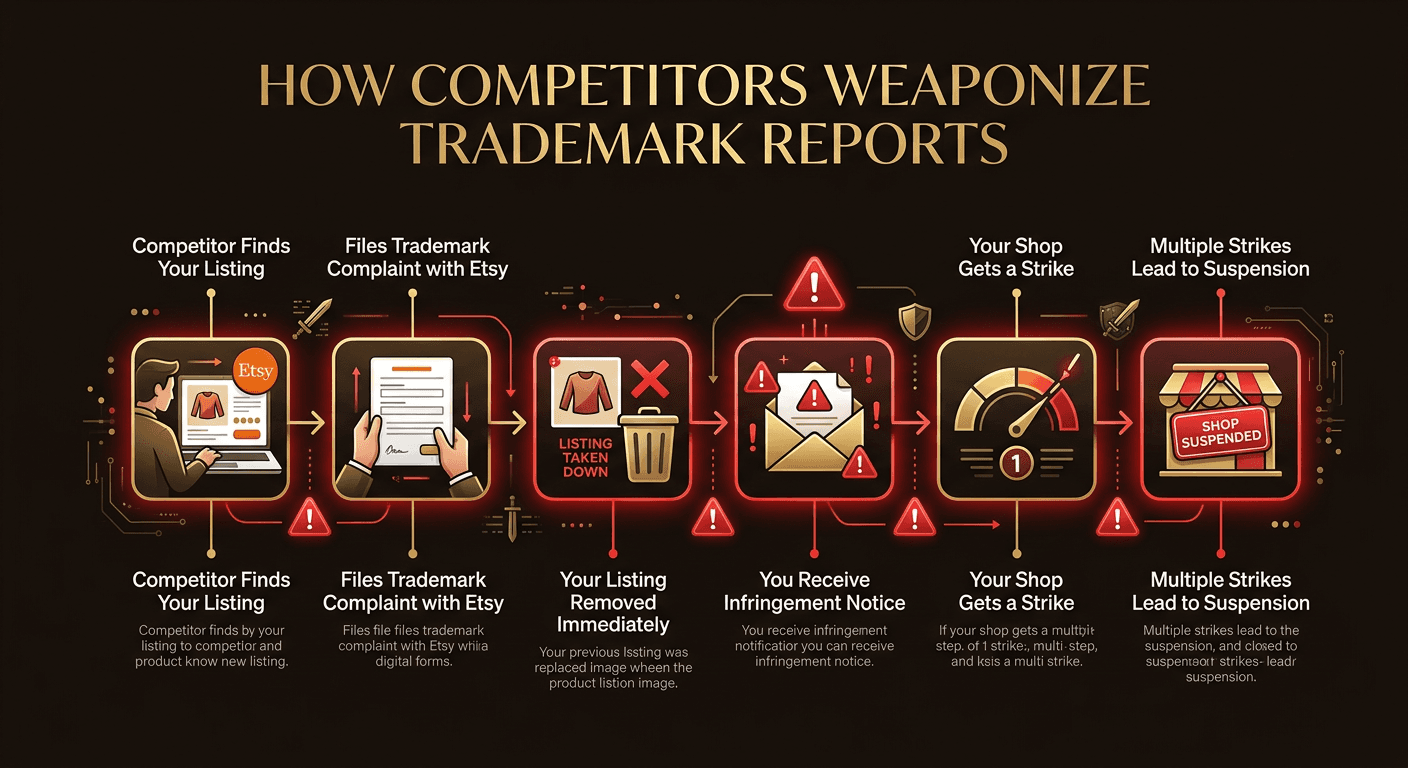
Step 1: The competitor identifies your listing. They search for products in your niche, find your high-ranking or best-selling listings, and decide to target them. Often they will pick listings that directly compete with their own products.
Step 2: They file a trademark complaint. Using Etsy's IP reporting form, they submit a complaint claiming your listing infringes on their trademark. The complaint may reference a real trademark they own, a trademark they do not own, or even a term that is not trademarked at all. Etsy's initial review does not verify ownership.
Step 3: Etsy removes your listing immediately. Etsy's policy is to act quickly on IP complaints. Your listing is deactivated, typically within hours. You receive an email notification after the fact. The listing is already gone by the time you read it.
Step 4: You receive a strike on your account. Each trademark complaint counts as an IP violation on your account. Accumulate enough strikes and Etsy will suspend your entire shop. Some competitors file multiple complaints against different listings to accelerate this process.
Step 5: The competitor captures your market share. With your listing gone and your shop potentially at risk of suspension, the competitor's similar products rise in search results. They have effectively eliminated competition without improving their own products.
Why Etsy Removes First and Asks Later
Etsy's shoot-first approach is not arbitrary. It is a legal necessity. As an online marketplace, Etsy benefits from safe harbor protections under the Digital Millennium Copyright Act (DMCA) and similar frameworks for trademark complaints. These protections shield Etsy from liability for infringing content uploaded by its users, but only if Etsy acts promptly when notified of potential violations.
If Etsy ignored or delayed acting on IP complaints, they could lose their safe harbor status and face direct liability for every instance of infringement on their platform. The financial and legal exposure would be enormous. So Etsy errs heavily on the side of removal.
This creates an inherent imbalance. The burden falls on you, the accused seller, to prove your innocence after the fact. The system is designed to protect trademark owners and the platform, not sellers. Understanding this dynamic is critical because it means you cannot rely on Etsy to filter out bad-faith complaints before they affect your shop. Your defense must be proactive, not reactive.
It also means that even a completely baseless complaint will cause real damage. Your listing will be removed. Your sales will drop. Your account will receive a mark. You can fight it and often win, but you cannot prevent the initial impact. The only real prevention is making sure your listings give competitors nothing legitimate to report.
Legitimate vs. Abusive Reports: How to Tell the Difference
Not every trademark complaint is an attack. Some are entirely legitimate, and if you are actually using someone's trademark without authorization, the right move is to fix the issue, not fight the complaint. The key is knowing how to distinguish between legitimate protection and competitive abuse.
Signs of a Legitimate Trademark Report
- The filer owns a registered trademark (verifiable on the USPTO database)
- Your listing actually uses their brand name, logo, or trademarked phrase
- The trademark registration covers the product category you are selling in
- The filer is the brand owner or an authorized legal representative
- The complaint cites specific trademark registration numbers
Signs of an Abusive Trademark Report
- The filer sells competing products on Etsy or other marketplaces
- The claimed trademark does not exist in the USPTO database
- The trademark exists but does not cover your product category
- The complaint targets your best-selling or highest-ranking listings
- Multiple complaints arrive in rapid succession from the same filer
- The term they claim as trademarked is generic or descriptive
- The filer has a history of reporting multiple different sellers
If you are genuinely using someone's trademark, the situation calls for immediate cleanup rather than a fight. Review our guide on Etsy trademark infringement to understand what constitutes unauthorized use and how to make your listings compliant. If the report is abusive, the next sections cover your defense options.
How to Protect Yourself Proactively
The strongest defense against competitor trademark reports is a clean shop. If your listings contain no trademark violations, abusive reports become easier to fight and harder for competitors to justify. Here is how to eliminate the ammunition before they pull the trigger.
Ensure your listings are genuinely clean
Go through every listing title, tag, description, and image. Remove any brand names, trademarked phrases, or registered slogans you do not have explicit permission to use. This includes common mistakes like using brand names in tags for SEO purposes, which Etsy explicitly prohibits. Our guide on Etsy trademark checking walks through the specific areas to audit.
Scan for trademark issues proactively
Do not wait for a complaint to discover a problem. Search the USPTO database for terms you use in your listings. Pay attention to recently filed trademarks that may affect terms you currently use. A word that was generic last month could become someone's registered trademark today.
Document your original designs
Keep your original design files, sketches, and creative process documentation organized and timestamped. If a competitor claims your original design infringes on their trademark, these records become your primary evidence. Save PSD, AI, or SVG source files. Take screenshots of your design software showing layers and creation dates. Back everything up with cloud storage that timestamps uploads.
Keep records of your creative process
Beyond design files, maintain a paper trail of your product development. Save supplier invoices, material purchase receipts, and prototype photos with dates. If you hired a designer, keep the contract and correspondence. If you created a design from scratch, keep the iterations. This documentation is not just useful for trademark disputes. It is essential for protecting your shop across all IP claim types, as covered in our comprehensive Etsy shop protection guide.
What to Do If You Are Targeted
You have received a trademark complaint notification from Etsy. Your listing is already down. Here is exactly what to do, in order, starting right now.
1. Evaluate the claim objectively
Before you react, determine whether the complaint has any merit. Search the USPTO database for the trademark cited in the complaint. Check who owns it and whether the registration covers your product category. Look at the filer's Etsy shop (if they have one) and note whether they sell competing products. Be honest with yourself about whether your listing actually uses their trademark.
2. Gather your evidence immediately
Whether the claim is legitimate or not, start collecting evidence. Screenshot the complaint email. Save your original listing content (title, description, tags, images). Pull up your design files and creation records. If the competitor has an Etsy shop, screenshot their listings for comparison. Time matters because evidence can be altered or removed.
3. Decide your response strategy
If the complaint is legitimate, accept it. Remove the trademarked content from all your listings, not just the one that was flagged. Clean up your entire shop to prevent additional complaints. If the complaint is bogus, proceed to filing a counter-notice.
4. Check your other listings
Whether the initial complaint was valid or abusive, audit every listing in your shop for similar issues. If a competitor is targeting you, they may file additional complaints against other listings. Proactively fixing any genuine issues removes their ability to escalate. Our guide on handling Etsy DMCA takedowns covers the broader process for responding to all types of IP complaints.
Filing a Counter-Notice Against a False Report
If you have determined that the trademark complaint is baseless, you have the right to challenge it. The counter-notice process is your formal mechanism to dispute the claim and request that Etsy restore your listing.
What to include in your counter-notice
- Your full legal name and contact information
- Identification of the listing that was removed
- A clear explanation of why the trademark claim is invalid
- Evidence that the trademark does not exist, does not apply, or is not owned by the filer
- Screenshots from the USPTO database showing the trademark status
- Your original design files with timestamps if applicable
- A statement that you consent to the jurisdiction of the appropriate federal court
- Your physical or electronic signature
How to submit it
Contact Etsy's Trust and Safety team through your Shop Manager. Navigate to the case associated with the complaint and submit your counter-notice with all supporting evidence. Be factual, specific, and professional. Emotional responses weaken your position. Stick to the evidence.
What happens next
Etsy reviews your counter-notice and may forward it to the original complainant. The complainant then has an opportunity to respond or pursue legal action. If they do not take further action within the specified timeframe, Etsy should restore your listing. Be aware that the process can take several weeks, during which your listing remains down and you continue to lose sales.
Reporting Abusive Filers to Etsy
Filing a false trademark report is a violation of Etsy's terms of service. If you have evidence that a competitor is abusing the IP reporting system, you should report them to Etsy. This serves two purposes: it protects your shop from future attacks, and it helps Etsy identify serial abusers who undermine the integrity of their platform.
Evidence to collect before reporting
- Screenshots of the competitor's shop showing they sell similar products
- USPTO search results proving the claimed trademark does not exist or does not belong to the filer
- A timeline showing the filer's pattern of targeting your listings or multiple sellers
- Any direct communication from the competitor that suggests bad faith
- Evidence that your listing was original and did not use any trademark
How to report
Contact Etsy's Trust and Safety team directly through your Shop Manager or via email. Present your evidence clearly and request that Etsy investigate the filer for abuse of the IP reporting system. Be specific about which complaints you believe were filed in bad faith and why. Include all supporting documentation in a single, organized submission.
Etsy will not share the outcome of their investigation with you, but reports of abuse do factor into their evaluation of future complaints from the same filer. If multiple sellers report the same abuser, Etsy is more likely to take action against them.
The Proactive Defense: Compliance Scanning
Every strategy in this guide is reactive. You get hit, you respond, you fight back. But the most effective defense is one that prevents the attack from succeeding in the first place. That means eliminating every genuine trademark issue in your listings so that when a competitor files a report, it has zero merit and is easy to overturn.
Compliance scanning works by checking every word in your listing titles, tags, and descriptions against active trademark databases. It flags terms that could trigger a legitimate complaint, identifies brand names you might not realize are trademarked, and catches new trademarks that were recently registered. The goal is simple: remove the ammunition before competitors can use it.
When your listings are genuinely clean, several things happen. Legitimate trademark holders have no reason to file complaints against you. Abusive complaints from competitors become easier to dispute because you can demonstrate that your listing contained no trademarked terms. And Etsy's Trust and Safety team is more likely to side with you when they can see a clear pattern of compliance.
Manual trademark checking is possible but impractical at scale. The USPTO database alone contains millions of active trademarks, and new ones are registered daily. A word that was safe to use in January might become a registered trademark by March. Automated scanning catches these changes in real time, giving you a continuous defense rather than a one-time audit.
Stop Giving Competitors Ammunition
Unflagged scans your Etsy listings for trademark risks before competitors find them. Clean listings mean baseless reports, and baseless reports are easy to fight.
Scan Your Listings Now