Etsy Copyright Violation: What Counts and How to Avoid It (2026)
Copyright violations are one of the fastest ways to lose listings — and eventually your entire shop — on Etsy. Unlike trademark issues that revolve around brand names, copyright violations involve your photos, designs, descriptions, and digital files. This guide breaks down exactly what counts as a copyright violation on Etsy, how the DMCA process works, and how to protect yourself.
What Copyright Violation Means on Etsy
A copyright violation on Etsy happens when a seller uses someone else's original creative work without permission. This is different from trademark infringement, which deals with brand names and logos. Copyright covers the creative output itself — the design, the photograph, the written words, the illustration, the pattern.
Copyright protection is automatic. The moment someone creates an original work — snaps a photo, writes a product description, draws an illustration — that work is protected by copyright. The creator does not need to register it, file paperwork, or add a copyright symbol. If they made it, they own it.
This catches many Etsy sellers off guard. They assume that if an image doesn't have a watermark or a © symbol, it's free to use. It isn't. They assume that if they found a design on Pinterest, it's in the public domain. It isn't. They assume that if they modify someone else's work enough, it becomes their own. It doesn't.
Key point: Copyright infringement on Etsy is handled through the DMCA (Digital Millennium Copyright Act), not through Etsy's standard IP reporting portal. This is a different legal process than trademark infringement, with different procedures and different timelines. Understanding which process applies to your situation is critical.
Copyright vs Trademark: Know the Difference
Sellers frequently confuse copyright and trademark because both fall under “intellectual property” and both can result in listing removals. But they protect fundamentally different things, follow different legal processes, and require different strategies to avoid.
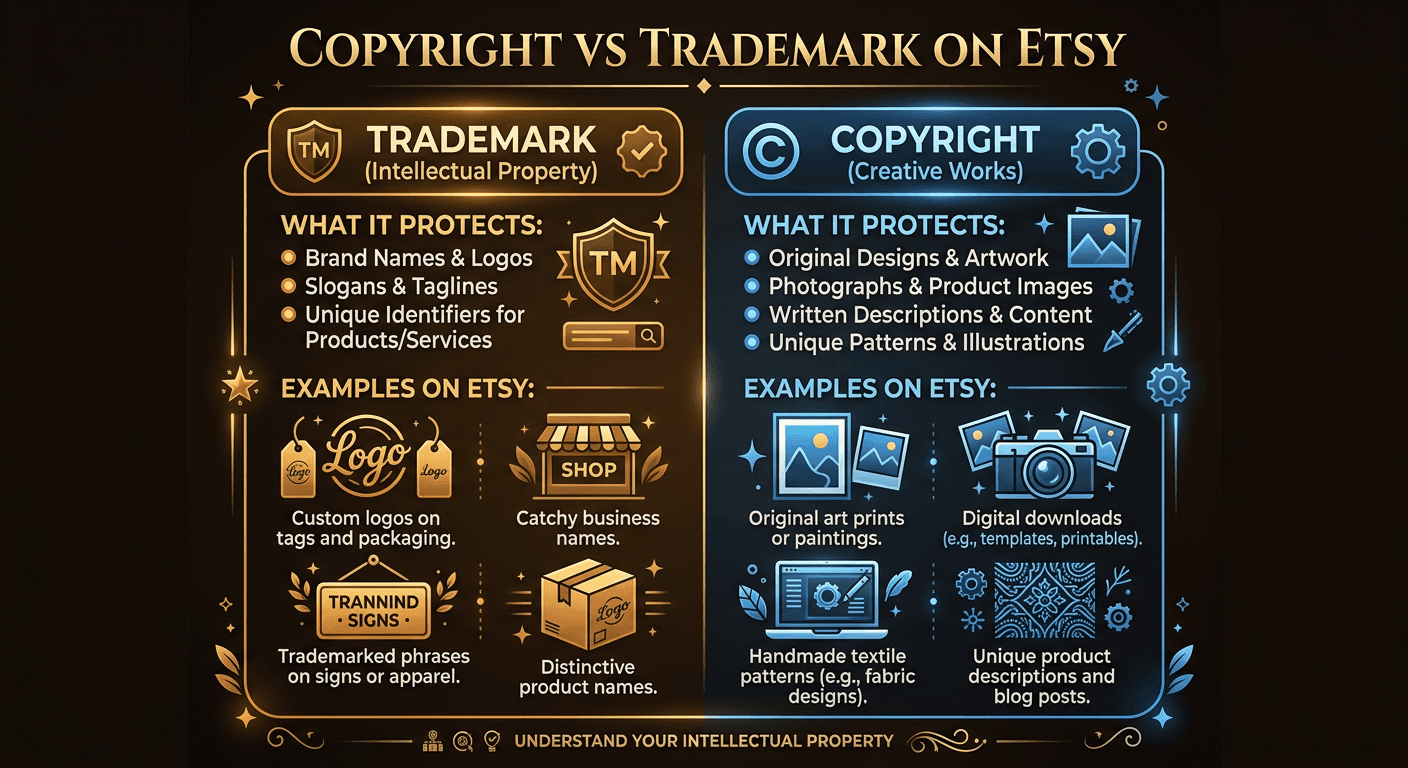
Copyright Protects Creative Works
- What it covers: photographs, illustrations, graphic designs, written descriptions, patterns, music, and videos
- How it's created: automatically, the moment the work is created — no registration required
- How it's enforced: through DMCA takedown notices
- Duration: life of the creator plus 70 years
Trademark Protects Brand Identifiers
- What it covers: brand names, logos, slogans, and distinctive trade dress
- How it's created: through registration with the USPTO (or through commercial use for common law marks)
- How it's enforced: through Etsy's IP reporting portal
- Duration: indefinite, as long as the mark is actively used and renewed
The practical difference matters. If someone reports you for using their brand name in your listing title, that's a trademark claim. If someone reports you for using their product photo in your listing, that's a copyright claim. The same listing can trigger both types of violations simultaneously. For a deep dive on the trademark side, read our guide on Etsy trademark infringement.
5 Most Common Copyright Violations on Etsy
These are the copyright violations that get Etsy sellers flagged most often. Every one of them feels harmless to the seller who does it — and every one can result in a DMCA takedown and account strikes.
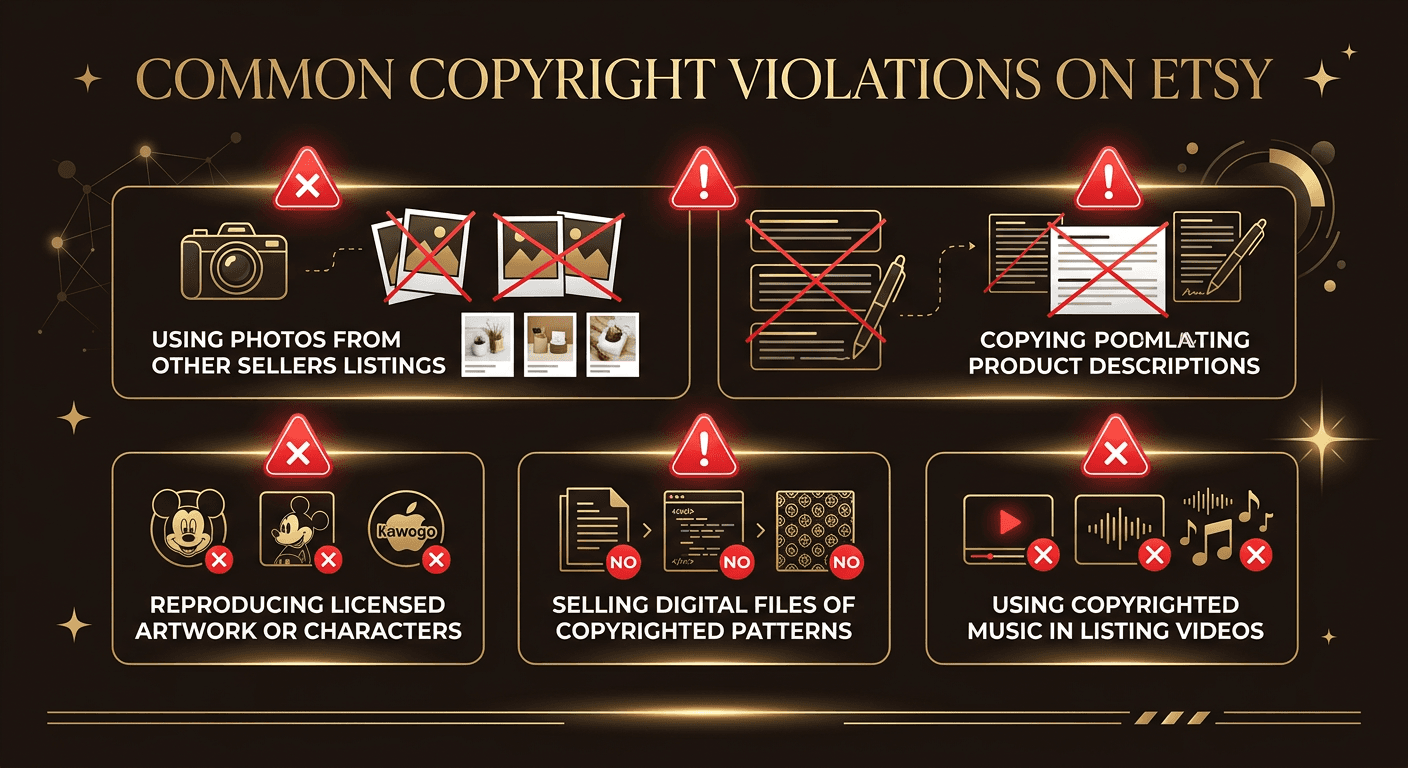
1. Using Other Sellers' Product Photos
The most common copyright violation on Etsy. Sellers find a competitor's listing with great photos, download them, and use them in their own listings. This includes using photos found on Google Image Search, Pinterest boards, or supplier websites. Even if you sell the exact same generic product, you cannot use someone else's photographs. The photographer owns the copyright to those specific images, regardless of what's in the photo. Cropping, adding filters, or overlaying text does not make the photo yours.
2. Copying Product Descriptions
Written text is copyrighted from the moment it's created. Copying another seller's product description — even partially — is copyright infringement. This happens frequently with dropshipping sellers who copy supplier descriptions, or sellers who find a well-performing competitor and duplicate their listing copy word for word. Paraphrasing substantial portions of someone's description can also constitute infringement if the structure and expression remain substantially similar.
3. Reproducing Licensed or Copyrighted Artwork
Printing copyrighted artwork onto products — mugs, t-shirts, phone cases, wall art — without a license is one of the most heavily enforced violations on Etsy. This includes reproducing artwork by contemporary artists, using clip art or illustrations from paid design packs beyond their license terms, and recreating recognizable artwork in a “similar style.” The original artist does not need a registered copyright to file a DMCA claim — they just need to prove they created the original work first.
4. Selling Copyrighted Digital Files
Etsy's digital download marketplace is a hotspot for copyright violations. Our digital downloads compliance guide covers the full risk checklist. Sellers upload SVG files, PNG designs, printable planners, and digital art that they did not create. Common scenarios include reselling designs purchased from another marketplace without the proper resale license, distributing modified versions of someone else's digital files, and using AI-generated art that was trained on and closely resembles copyrighted works. Even “PLR” (Private Label Rights) content has limitations that sellers frequently exceed.
5. Using Copyrighted Music in Listing Videos
Etsy now supports video in listings, and sellers often add background music without considering copyright. Popular songs, stock music used beyond its license, and even royalty-free tracks with restrictions on commercial use can all trigger copyright claims. Music publishers actively monitor platforms like Etsy for unauthorized use. The safest approach is to use music from libraries that explicitly allow commercial use in product listings, or skip background music entirely.
How Etsy Handles Copyright Claims (DMCA Process)
Copyright claims on Etsy follow the DMCA (Digital Millennium Copyright Act) framework. This is a federal law that governs how online platforms must handle copyright complaints. Etsy is legally required to follow this process to maintain its “safe harbor” protection — which means they act quickly and tend to side with the complainant. For a detailed breakdown, see our guide on the Etsy DMCA takedown process.
Copyright Holder Files a DMCA Notice
The copyright owner (or their authorized agent) submits a formal DMCA takedown notice to Etsy. This notice must identify the copyrighted work, the infringing listing, and include a statement under penalty of perjury that the complainant is the copyright holder. Unlike trademark reports, DMCA notices come directly from creators — often other Etsy sellers who discover their photos or designs being used without permission.
Etsy Reviews and Removes the Listing
Etsy's legal team reviews the DMCA notice for completeness. If the notice meets the legal requirements, Etsy removes the listing — typically within 24 to 48 hours. Etsy does not evaluate whether the claim is actually valid. They verify the notice is properly formed and then act. This “notice and takedown” approach protects Etsy from liability but puts the burden on sellers to fight back.
Seller Receives a Takedown Notification
You receive an email from Etsy notifying you that a DMCA takedown has been filed against your listing. The email includes the name of the complainant, the listing that was removed, and instructions for filing a counter-notice. A copyright strike is added to your account. Multiple strikes can lead to account suspension under Etsy's repeat infringer policy.
Counter-Notice Window Opens
If you believe the takedown was a mistake, you have the option to file a DMCA counter-notice. This is a formal legal response that tells Etsy you dispute the claim. Once you file a counter-notice, the complainant has 10 to 14 business days to file a lawsuit. If they don't, Etsy may restore your listing. This process is covered in detail in the counter-notice section below.
What Happens When You Get a Copyright Notice
Receiving a DMCA takedown notification feels alarming, but understanding the consequences helps you respond appropriately. Here's what happens at each stage.
First Copyright Strike
The specific listing is removed. You get a warning and a strike on your account. Your shop stays open and other listings are unaffected. This is your opportunity to audit all listings for any content you didn't create yourself. Take it seriously — a second strike escalates quickly.
Second Copyright Strike
Another listing is removed and your account is flagged for review. Etsy may restrict your ability to publish new listings or require you to acknowledge their IP policies. At this point, Etsy's Trust & Safety team is actively watching your account for further violations.
Third Strike and Beyond: Suspension
Etsy's repeat infringer policy kicks in. Your shop may be permanently suspended, funds frozen for up to 180 days, and all listings deactivated. Reopening under a new account is against Etsy's terms and will be detected. Your only recourse at this point is filing a formal appeal.
Important: Copyright strikes from DMCA notices are tracked separately from trademark strikes, but they both contribute to your overall account health. A combination of copyright and trademark violations can accelerate the path to suspension even if neither category alone would have triggered it.
How to File a Counter-Notice If Wrongly Accused
Not every DMCA takedown is legitimate. Competitors sometimes file false claims to knock down rival listings. Automated systems make mistakes. And some complainants misunderstand copyright law — they claim copyright over generic designs, common phrases, or public domain works. If you believe your listing was wrongly taken down, you have the legal right to fight back with a DMCA counter-notice.
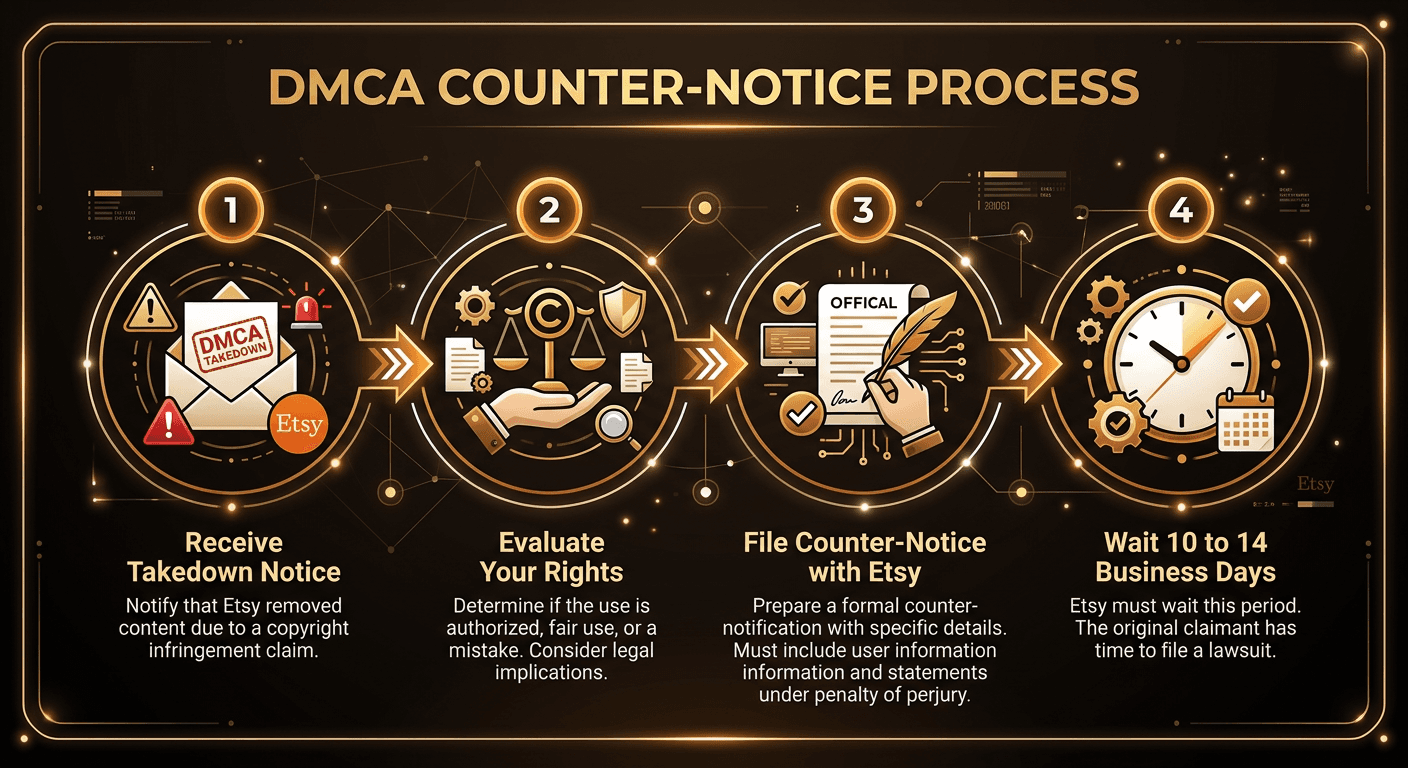
What Your Counter-Notice Must Include
- Your full legal name and contact information — Your name, physical address, phone number, and email. This information will be shared with the person who filed the original DMCA notice
- Identification of the removed listing — The title, URL, and a description of the listing that was taken down
- A statement under penalty of perjury — You must state that you have a good faith belief the material was removed due to mistake or misidentification of the material
- Consent to jurisdiction — You must consent to the jurisdiction of the federal court in your judicial district (or any judicial district where Etsy may be found if you are outside the US)
- Your physical or electronic signature — This formalizes the counter-notice as a legal document
What Happens After You File
- Etsy forwards your counter-notice to the original complainant
- The complainant has 10–14 business days to file a court action against you
- If they do not file suit, Etsy may restore your listing
- If they do file suit, the listing remains down and the dispute moves to court
Warning: A DMCA counter-notice is a legal document filed under penalty of perjury. Filing a false counter-notice can result in legal consequences. Only file a counter-notice if you genuinely believe the takedown was a mistake — for example, the content is your original work, falls under fair use, or is in the public domain. When in doubt, consult an intellectual property attorney before filing.
How to Avoid Copyright Violations on Etsy
Avoiding copyright violations comes down to one principle: use only content you created yourself or have explicit permission to use. Here's how to put that into practice across every part of your Etsy listings.
Take Your Own Product Photos
Photograph every product yourself. Even a smartphone photo you took is infinitely safer than a professional image you downloaded. If you use a product photographer, make sure your contract specifies that you own the copyright to the images (work-for-hire), or secure an explicit license for use on Etsy. Never pull images from Google, Pinterest, supplier websites, or competitor listings.
Create Original Designs
Every design you sell must be your own original creation. This means starting from a blank canvas — not modifying, tracing, or closely referencing someone else's work. If you use design elements like fonts, clip art, or illustrations, verify their license allows commercial use on products sold on Etsy. Many “free” design resources have restrictions on commercial use that sellers overlook.
Write Unique Product Descriptions
Write every product description from scratch. Do not copy descriptions from competitors, suppliers, manufacturers, or other marketplaces. Even if you sell the same generic product as another seller, your description needs to be your own words. This also benefits your SEO — duplicate content hurts your search ranking on Etsy, so original descriptions improve both compliance and visibility.
Verify Licenses for Everything You Use
If you use any third-party content — stock photos, fonts, clip art, digital assets — read the license carefully. Many licenses allow personal use but not commercial use. Some allow commercial use but not on products for resale. Some allow use on physical products but not digital downloads. Keep records of every license you purchase. If you ever receive a DMCA claim, having proof of your license is your best defense.
Scan Your Listings Before Publishing
Beyond copyright, your listings can also contain trademarked words that trigger IP reports. Automated scanning tools like Unflagged check your titles, tags, and descriptions against trademark databases before you publish — catching issues that manual review might miss.
Fair Use on Etsy: What It Is and Why It Rarely Applies
“Fair use” is the most misunderstood concept in copyright law, and it's the defense most sellers reach for when they get a DMCA notice. In almost every case on Etsy, fair use does not apply. Here's why.
What Fair Use Actually Is
Fair use is a legal defense — not a right — that allows limited use of copyrighted material without permission for purposes like commentary, criticism, parody, education, and news reporting. Courts evaluate fair use using four factors:
- The purpose and character of the use — Is it commercial or educational? Transformative or a direct copy?
- The nature of the copyrighted work — Is the original creative (more protection) or factual (less protection)?
- The amount used — Did you use the whole work or just a small portion?
- The effect on the market — Does your use compete with or diminish the value of the original?
Why Fair Use Almost Never Works on Etsy
Selling products on Etsy is inherently commercial. This immediately weakens any fair use claim. Consider the typical scenarios where Etsy sellers invoke fair use:
- “I transformed it” — Putting a copyrighted design on a different product (mug, shirt, tote bag) is not transformative use. You're using the work for its original purpose: visual appeal
- “I only used part of it” — Using the most recognizable part of a work (the part that makes it valuable) can be worse than using the whole thing
- “It's a parody” — True parody comments on the original work itself. Putting a funny caption on someone else's art is not parody — it's modification
- “I credited the artist” — Attribution is not a defense to copyright infringement. Giving credit does not create a license to use someone's work commercially
The bottom line: if you're selling a product on Etsy that incorporates someone else's creative work, fair use is almost certainly not going to protect you. The only reliable protection is creating original work or obtaining explicit permission from the copyright holder.
Protect Your Etsy Shop Before It's Too Late
Copyright violations aren't the only risk to your shop. Trademarked words hiding in your titles, tags, and descriptions can trigger IP reports just as fast. Unflagged scans every listing against trademark databases and flags risky terms before you publish.
Frequently Asked Questions
What is a copyright violation on Etsy?
A copyright violation on Etsy occurs when a seller uses someone else's original creative work without permission. This includes copying another seller's product photos, reproducing copyrighted artwork or illustrations, using copyrighted text in descriptions, selling digital files containing copyrighted designs, and using copyrighted music in listing videos. Copyright protection is automatic — the creator does not need to register it for protection to apply.
What is the difference between copyright and trademark on Etsy?
Copyright protects original creative works like designs, photographs, illustrations, written text, and music. Trademark protects brand identifiers like names, logos, slogans, and trade dress. On Etsy, copyright claims go through the DMCA takedown process, while trademark claims go through Etsy's IP reporting portal. Both can result in listing removal and account suspension, but they involve different legal frameworks and different response procedures.
How does Etsy handle copyright claims?
Etsy follows the DMCA (Digital Millennium Copyright Act) process. A copyright holder submits a DMCA takedown notice identifying the infringing content. Etsy reviews the notice for legal sufficiency, removes the identified listing, and notifies the seller. The seller can then file a DMCA counter-notice if they believe the takedown was a mistake. Etsy is legally required to act on valid DMCA notices to maintain its safe harbor protection.
Can I use images from Google or Pinterest in my Etsy listings?
No. Images found on Google, Pinterest, or any other website are not free to use. They are protected by copyright the moment they are created, regardless of whether they have a copyright notice or watermark. Using someone else's photos in your Etsy listings — even if you edit or crop them — is copyright infringement. Always use your own original photography or properly licensed stock images.
Does fair use protect me from copyright claims on Etsy?
Fair use rarely applies to Etsy listings. Fair use is a legal defense for commentary, criticism, education, parody, and news reporting. Selling a product for commercial profit almost never qualifies as fair use, even if you transformed the original work. Courts consider four factors: the purpose of use, the nature of the copyrighted work, the amount used, and the effect on the market value. Commercial use on Etsy fails most of these tests.
How do I file a DMCA counter-notice on Etsy?
To file a DMCA counter-notice on Etsy, respond to the takedown notification email and provide your full legal name and contact information, identify the removed listing, include a statement under penalty of perjury that you believe the removal was a mistake or misidentification, and consent to the jurisdiction of your local federal court. Etsy forwards your counter-notice to the original complainant, who has 10 to 14 business days to file a court action. If they do not, Etsy may restore your listing.