How to Sell Fan Art on Etsy Without Getting Flagged (2026 Guide)
Fan art is one of the most searched product categories on Etsy — and one of the fastest ways to lose your shop. This guide breaks down the real legal risks, what actually gets sellers flagged, the safe alternatives that let you sell art without IP violations, and why going original is the smarter business move in 2026.
The Hard Truth About Fan Art on Etsy
Let's start with what nobody in the Etsy seller community wants to hear: most fan art sold on Etsy is technically illegal. It is copyright infringement, trademark infringement, or both. Full stop.
If you search Etsy right now, you'll find thousands of shops selling art featuring characters from Disney, Pokémon, Studio Ghibli, Marvel, Star Wars, and every other major franchise. Many of these shops have been open for years, have thousands of sales, and five-star reviews. This creates a dangerous illusion — that selling fan art is safe because everyone does it.
It's not safe. Those sellers survive because rights holders haven't gotten to them yet. When a brand does decide to enforce — and they do, constantly — the result is swift and devastating. Listings removed overnight. DMCA takedown notices with no warning. Account strikes. Shop suspensions. And in some cases, legal action.
Reality check: Disney alone files thousands of IP enforcement actions on Etsy every year. Nintendo, Warner Bros., and major sports leagues have dedicated legal teams whose entire job is scanning marketplaces for unauthorized use of their characters and brands. The fact that your neighbor's shop selling anime stickers hasn't been flagged yet means nothing about your risk.
What Fan Art Actually Is — Legally
Fan art is a derivative work — art that is based on, derived from, or inspired by existing copyrighted characters, worlds, or designs created by someone else. Under U.S. copyright law (and similar laws worldwide), only the original copyright holder has the right to create or authorize derivative works.
This means when you draw your own version of Pikachu, paint a watercolor of Hogwarts, or design a sticker featuring Baby Yoda, you are creating a derivative work of someone else's copyrighted property. The fact that you drew it yourself, in your own style, with your own hands, does not transfer the intellectual property rights to you.
Fan art sits at the intersection of two separate IP frameworks:
Copyright
Protects the creative work itself — character designs, visual elements, storylines, and artistic expressions. Drawing someone else's character is creating an unauthorized derivative work, which is copyright infringement.
Trademark
Protects brand identity — character names, franchise names, logos, and catchphrases. Using “Pokémon” or “Harry Potter” in your listing is trademark infringement.
Most fan art on Etsy triggers both types of infringement simultaneously. The artwork itself infringes copyright, and the listing titles and tags referencing franchise names infringe trademarks. This double exposure is why fan art sellers face higher risk than many realize.
Fan Art Risk Levels: High, Medium, and Lower
Not all fan art carries the same enforcement risk. Understanding where your work falls on this spectrum helps you make informed decisions about what you sell on Etsy — though it's important to understand that even “lower risk” does not mean “no risk.”
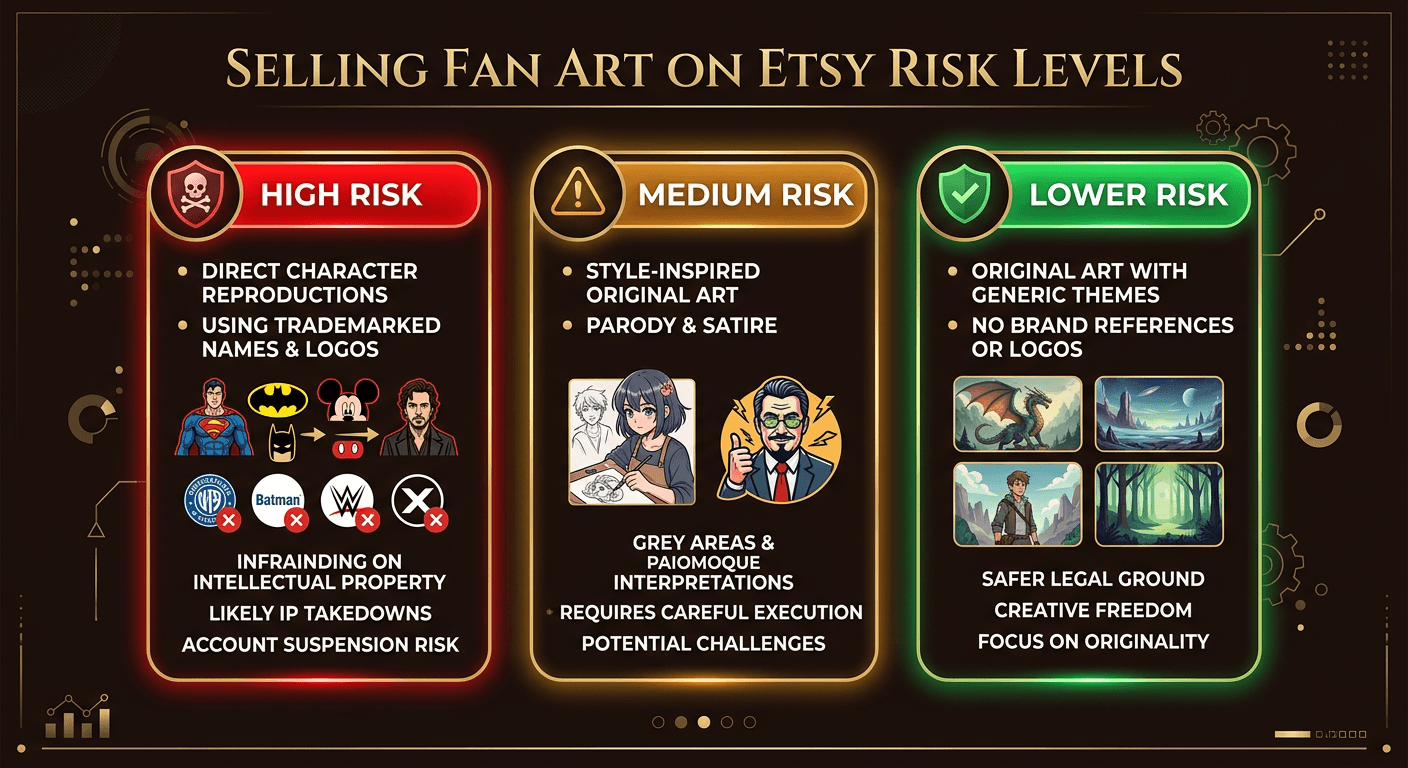
Direct Character Reproduction
- Exact or recognizable depictions of copyrighted characters (Mickey Mouse, Pikachu, Spider-Man)
- Brand logos, team emblems, or franchise insignias on products
- Products featuring exact character likeness in any art style — realistic, chibi, minimalist, silhouette
- Merchandise that clearly identifies a specific copyrighted character even without naming them
Enforcement likelihood: Near certain for major franchises. Disney, Nintendo, and Marvel have automated scanning systems. It's only a matter of time.
Style-Inspired Work That References a Franchise
- Original characters drawn in a recognizable franchise style (e.g., “anime-style” pets that look like Pokémon)
- Products that reference a franchise through visual cues without exact character reproduction
- Parody designs that clearly comment on or satirize the original work
- Mashup art combining elements from multiple franchises into something new
Enforcement likelihood: Depends on the rights holder. Some brands aggressively pursue anything adjacent; others focus only on direct reproduction. Parody has some legal protection but is expensive to defend.
Original Art with Similar Aesthetic
- Original character designs in a genre style (fantasy warrior, space explorer, magical creature) with no franchise references
- Genre-inspired art — dark fantasy landscapes, cyberpunk cityscapes, cottagecore scenes — without referencing specific IPs
- Art that captures a mood, genre, or aesthetic without reproducing any copyrighted elements
- No brand names, character names, or franchise references anywhere in the listing
Enforcement likelihood: Very low. You own the IP. No one can file a valid takedown against original work. This is where you want to be.
Why Some Fan Art Sellers Survive (For Now)
If fan art is illegal, why do so many shops get away with it? The answer is not that it's secretly fine — it's that rights holders pick their enforcement battles.
Even the largest media companies cannot enforce against every single seller on every marketplace. They prioritize based on several factors:
- Revenue threshold — Sellers generating significant revenue from infringing products are more likely to attract legal attention
- Brand confusion potential — Products that could reasonably be mistaken for official merchandise get flagged faster
- Upcoming releases — Enforcement ramps up around movie premieres, game launches, and product drops when brands are actively monitoring
- Competitor reports — Other sellers sometimes report fan art shops to eliminate competition, triggering enforcement that wouldn't have happened otherwise
The survivorship bias trap: You see the fan art shops that are still open. You don't see the thousands of shops that have been shut down, suspended, or had their best-selling listings wiped overnight. The shops that survive are not evidence that it's safe — they're just the ones who haven't been caught yet. Building a business on borrowed IP is building on a foundation you don't control.
The Safe Alternatives That Actually Work
The good news: you can build a thriving art business on Etsy without touching anyone else's intellectual property. These approaches let you tap into the same audiences who buy fan art — while owning everything you sell.
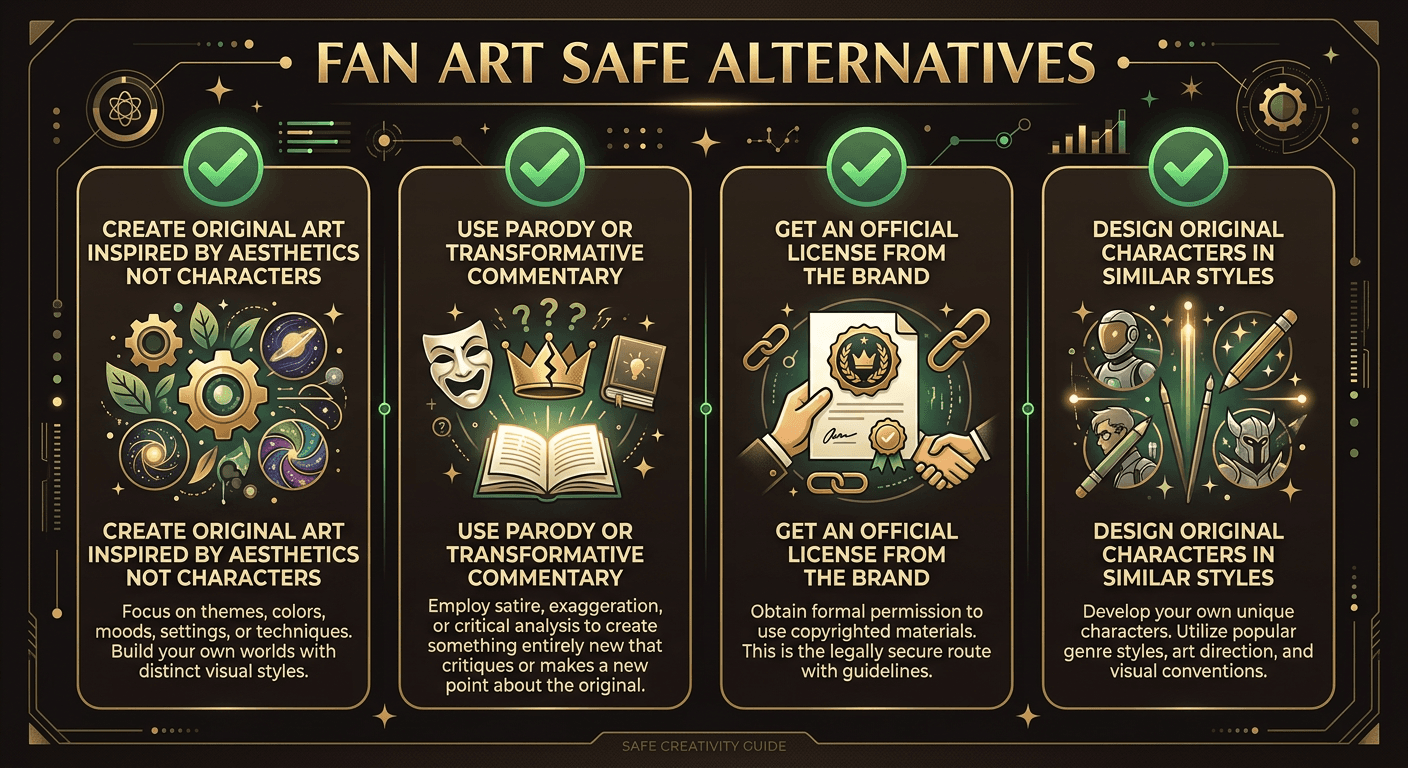
1. Create Original Characters in Similar Styles
Art styles are not copyrightable. You can create original characters drawn in anime style, Pixar style, comic book style, or any other aesthetic without infringing on anyone's IP. Design your own creatures, heroes, and worlds. The audience who loves Pokémon art also loves well-designed original creature art — and you'll own every piece of IP you create.
2. Genre-Inspired Art Without Character References
Fantasy landscapes, sci-fi cityscapes, cyberpunk street scenes, cozy cottage interiors — genres belong to everyone. A dark fantasy forest painting appeals to the same audience as Lord of the Rings fan art without referencing any specific IP. Focus on the mood and aesthetic, not the franchise.
3. Public Domain and Mythology
Greek mythology, Norse legends, classic fairy tales, Lovecraftian cosmic horror (Lovecraft's works are public domain), Alice in Wonderland (original), Sherlock Holmes — there is an enormous library of public domain characters and stories you can use commercially. Just verify that the specific version you're referencing is actually in the public domain, as modern interpretations (like Disney's versions) may still be protected.
4. Get an Official License
Some rights holders offer licensing programs for independent artists. Redbubble and some print-on-demand platforms have fan art programs with specific brands. On Etsy, you would need to secure your own license directly from the rights holder. This is the only way to legally sell fan art — with written permission from the IP owner. It's difficult for individual sellers, but not impossible for established artists with a track record.
What “Transformative” and “Parody” Actually Mean
Every fan art discussion eventually turns to fair use. Sellers claim their work is “transformative” or “parody” and therefore protected. Let's be clear about what these terms actually mean legally — and why they almost never protect Etsy sellers.
Transformative Use
For a work to be “transformative” under fair use doctrine, it must add new meaning, expression, or message to the original. Courts ask: does the new work merely supersede the original, or does it use the original as raw material to create something with a fundamentally different purpose?
Drawing a copyrighted character in a different art style (chibi, watercolor, minimalist) is not transformative. You're still reproducing the character for the same purpose — aesthetic enjoyment and commercial sale. Changing the medium doesn't change the purpose.
Parody
Parody is a specific form of commentary that uses elements of the original work to criticize or comment on that specific work. A parody of Mickey Mouse would need to say something about Mickey Mouse or Disney as its core purpose — not just be a funny drawing of Mickey.
Even genuine parody is a defense you raise in court after being sued. On Etsy, it doesn't prevent a takedown. If Disney files a report, your listing comes down whether it's parody or not. You would need to file a counter-notice, potentially face litigation, and prove your parody defense in court. That costs tens of thousands of dollars. For most Etsy sellers, the economics make no sense.
Bottom line: Fair use is a legal defense, not a license. It protects you in court, not on Etsy. Even if your work genuinely qualifies as transformative or parody (which is rare for commercial fan art), Etsy will still remove your listing when the rights holder files a report. You would then need to fight it through the legal system at your own expense.
What Happens When You Get Caught
Enforcement is not hypothetical. Here's the step-by-step process that plays out when a rights holder targets your fan art listings.
DMCA Takedown or Trademark Report
The rights holder (or their legal team) files a report through Etsy's IP Reporting Portal. Copyright claims follow the DMCA takedown process; trademark claims go through Etsy's trademark reporting system. Major brands often file reports in bulk, targeting dozens of sellers simultaneously.
Listing Removed Immediately
Etsy removes the flagged listing without advance notice to you. You receive an email notification after the fact. There is no pre-removal review or opportunity to modify the listing first. The removal is instant and non-negotiable at this stage.
Account Strike
Each valid IP report adds a strike to your account. Strikes are cumulative and do not expire quickly. Two or three strikes from different rights holders can trigger an account-level review. A single report that covers multiple listings counts as multiple violations.
Shop Suspension or Permanent Deactivation
Repeated violations or a single egregious infringement can result in your entire shop being suspended or permanently deactivated. At this point, you lose access to all your listings, reviews, sales history, and customer relationships. Funds may be held for up to 180 days. Recovery is extremely difficult.
In severe cases, rights holders pursue legal action beyond Etsy. While rare for small sellers, it does happen — especially when a seller has generated significant revenue from infringing products. Statutory damages for willful copyright infringement can reach up to $150,000 per work infringed.
The Business Case for Going Original
Beyond the legal risks, there is a strong business case for creating original art instead of fan art. Sellers who make the switch often find their business actually grows.
Why Original Art Wins Long-Term
- No IP risk — You never wake up to a takedown notice or shop suspension. Your business is built on a foundation you fully control.
- Buildable brand — When you create original characters and worlds, you are building your own intellectual property. Fans of your work become fans of your brand, not a franchise you're borrowing from.
- Higher margins — Original art can command premium pricing because it's unique. Fan art competes on price against thousands of other sellers making the same characters, driving margins down.
- Licensing potential — If your original characters gain a following, you can license them. You become the rights holder instead of the infringer.
- Platform independence — Original IP can move with you to Shopify, your own website, print-on-demand platforms, or wholesale partnerships. Fan art locks you into the tolerance of both the marketplace and the rights holder.
The artists who build sustainable six-figure Etsy shops are overwhelmingly selling original work. Fan art might generate quick initial sales, but original art builds a real business. Make the transition now — your future self will thank you.
Not Sure If Your Listings Are at Risk?
Unflagged scans your Etsy listings for trademarked character names, franchise references, and high-risk keywords that trigger IP reports. Find out what's putting your shop at risk before a rights holder does.
Frequently Asked Questions
Is selling fan art on Etsy illegal?
Technically, yes. Fan art is a derivative work of copyrighted characters, worlds, or designs. Selling it without a license from the rights holder is copyright infringement, and if the characters or franchise names are trademarked, it is also trademark infringement. Many sellers get away with it because rights holders choose not to enforce against every individual seller, but that does not make it legal. You are always one takedown report away from losing your listings or your shop.
Can I sell fan art if I draw it myself?
Drawing a character yourself does not make it legal to sell. Copyright protects the character itself, not just specific images of it. If you draw your own version of a trademarked character like Mario, Pikachu, or Darth Vader, the rights holder can still file a takedown because the character design is their intellectual property. Your original artistic effort does not transfer the IP rights to you.
What happens if I get caught selling fan art on Etsy?
The typical enforcement path starts with a DMCA takedown or trademark report filed by the rights holder. Etsy removes the flagged listing immediately and issues a strike on your account. Multiple strikes lead to account review, suspension, or permanent deactivation. In rare but real cases, rights holders have pursued legal action against individual sellers for damages, especially when the seller was generating significant revenue from the infringing work.
Does fair use protect fan art on Etsy?
Almost never. Fair use is a legal defense that applies in specific circumstances, primarily for commentary, criticism, education, or parody. Selling commercial products on Etsy is rarely considered fair use because the primary purpose is commercial profit, not commentary. Courts have consistently ruled that simply drawing a character in a new style or on a new product is not transformative enough to qualify as fair use.
Can I use character names or franchise names in my Etsy tags?
No. Using trademarked character names, franchise names, or brand names in your Etsy tags, titles, or descriptions is trademark infringement regardless of what you are actually selling. Etsy's automated systems and brand enforcement teams specifically scan for these terms. Even if your art is entirely original, using a trademarked name for SEO purposes can trigger a takedown and account strike.
What can I sell instead of fan art on Etsy?
The safest and most profitable alternative is creating original art inspired by the aesthetics, genres, or visual styles you love without reproducing specific characters or trademarked elements. You can create original characters in similar art styles, design genre-inspired pieces like fantasy landscapes or sci-fi cityscapes, develop your own signature style that attracts the same audience, or explore public domain characters and mythology that are free to use commercially.