Digital Downloads on Etsy: Hidden Compliance Risks Most Sellers Miss
Digital downloads seem like the safest product category on Etsy — no shipping headaches, no inventory management, no returns. But beneath the surface, digital products carry unique compliance risks that most sellers never think about until a listing disappears or their account gets flagged. This guide covers the six hidden risks and how to protect yourself.
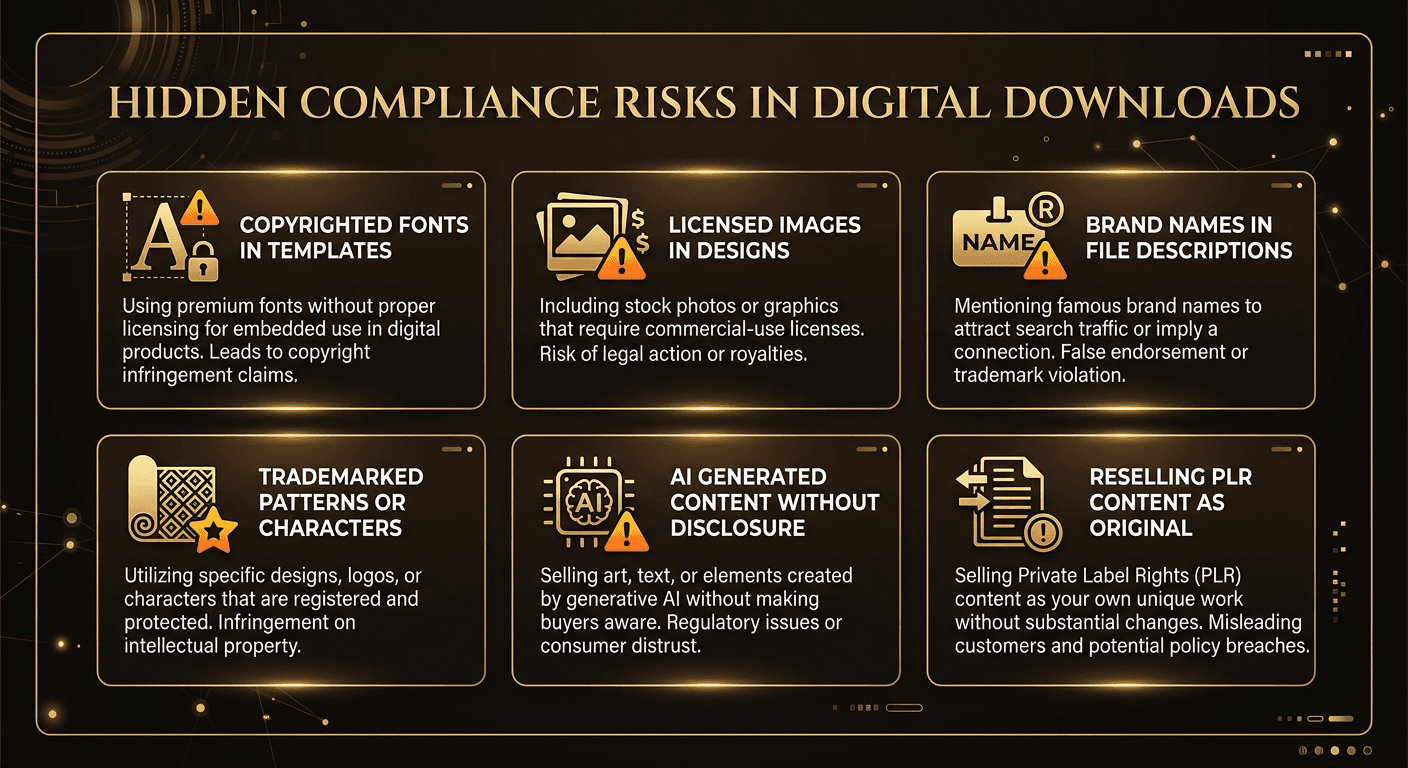
The False Sense of Safety with Digital Downloads
Digital downloads are the fastest-growing category on Etsy. Planners, templates, printable art, SVG files, social media kits, resume templates, wedding invitations — the list keeps expanding. Sellers love them because there are no shipping costs, no physical inventory, and near-infinite margins. A product created once can sell thousands of times.
That simplicity creates a dangerous assumption: if there's no physical product, there's nothing to get flagged for. No counterfeit goods to worry about, no safety regulations, no customs issues. Many digital sellers operate for months — sometimes years — without thinking about compliance at all.
Then a listing gets removed. Or a DMCA notice arrives. Or worse, their entire shop gets suspended with thousands of dollars in withheld funds. The compliance risks in digital products are different from physical ones, but they are just as real — and in some ways harder to spot. If you're selling digital downloads on Etsy, understanding these risks is not optional.
Font Licensing Deep Dive
Font licensing is the compliance issue that catches the most digital sellers by surprise. The logic seems simple: you downloaded a font for free, so it must be free to use. But “free to download” and “free to use commercially” are two completely different things.
Every font comes with a license that specifies what you can do with it. Some common license types include:
Safe for Etsy Digital Downloads
- Google Fonts — SIL Open Font License, fully free for commercial use including embedding in products for sale
- SIL-licensed fonts — any font with the SIL Open Font License allows commercial use, modification, and redistribution
- Fonts with explicit commercial licenses — purchased from foundries like MyFonts, Creative Market, or FontSpring with a license that covers products for resale
Not Safe Without Additional Licensing
- Adobe Fonts — included with Creative Cloud, but the license restricts embedding in products for sale. You can use them in your own designs but cannot distribute the font files or embed them in editable templates sold to others
- DaFont / FontSquirrel personal-use fonts — many fonts on these sites are labeled “free for personal use” only. Commercial use requires contacting the author or purchasing a separate license
- Fonts bundled in design software — fonts included with Photoshop, Illustrator, or other software often have licenses tied to that software's subscription and may not cover commercial redistribution
Pro tip: Keep a spreadsheet of every font you use with the license type, source, and date acquired. If a font foundry files a complaint, having proof of your license is your best defense. If you cannot find the license for a font, replace it with a Google Font before it becomes a problem.
Image Licensing: What You Can and Cannot Sell
Images in digital downloads are a minefield. The license that governs a stock photo or illustration determines whether you can include it in a product you sell. Not all “royalty-free” licenses are created equal, and “royalty-free” does not mean “free to use however you want.”
Unsplash
Free for commercial use. No attribution required. However, you cannot sell unmodified Unsplash photos as standalone products. They must be incorporated into a larger design. Selling an Unsplash photo as a printable wall art download without significant modification violates their terms.
Shutterstock
Standard licenses do not allow use in products for resale or distribution. You need an Enhanced License to use Shutterstock images in digital downloads sold on Etsy. Enhanced licenses cost significantly more and have specific terms about print runs and distribution.
Canva Pro
Canva Pro elements can be used in designs you sell, but the final product must be a flattened, unique design. You cannot sell editable Canva templates or distribute Canva elements in their original form. Canva's license is more restrictive than many sellers realize.
Creative Commons
CC licenses vary wildly. CC0 is public domain and safe. CC-BY requires attribution. CC-BY-NC prohibits commercial use entirely. CC-BY-SA requires derivative works to carry the same license. Always check the specific CC license type before using any Creative Commons content.
The safest approach is to create your own images and illustrations from scratch. If that is not possible, use images from sources with licenses that explicitly permit commercial redistribution, and keep proof of every license. Stock photo agencies have been known to use reverse image search tools to find unlicensed usage on Etsy.
AI-Generated Digital Products
The explosion of AI image generators, AI writing tools, and AI design assistants has transformed the digital downloads market on Etsy. Sellers can now produce clip art sets, coloring pages, journal prompts, planner layouts, and wall art at a speed and scale that was impossible before. But with that speed comes a new set of compliance requirements.
Etsy's 2026 policy update requires sellers to disclose when AI tools are used in the creation of a product. This applies to:
- Images generated or substantially modified by AI (Midjourney, DALL-E, Stable Diffusion, Adobe Firefly)
- Text content written or substantially edited by AI (ChatGPT, Claude, Jasper)
- Designs created using AI-powered layout or composition tools
- Any product where AI was a primary creative tool rather than a minor editing aid
Key requirement: You must select the appropriate production method in your listing details and include a disclosure statement in your product description. Saying “hand-drawn” or “original artwork” when AI generated the images is a direct policy violation. For a full breakdown of the rules, see our guide on Etsy's handmade policy and AI.
Beyond Etsy's own rules, there are also intellectual property questions around AI-generated content. The U.S. Copyright Office has stated that purely AI-generated images are not copyrightable. This means your AI-generated digital downloads may not have the same legal protections as hand-created work, and another seller could potentially create something nearly identical without infringing your rights. The legal landscape is still evolving, but sellers should be aware of this limitation.
PLR and Template Reselling: The Handmade Policy Trap
PLR (Private Label Rights) content is sold by creators who grant buyers the right to rebrand and resell the material. It's popular in the planner, journal, and printable markets. Sellers buy a pack of 50 planner pages, slap their shop name on them, and list them on Etsy.
The problem is Etsy's handmade policy. Etsy requires that items be made, designed, or curated with significant creative input from the seller. Changing a cover color and swapping a title does not constitute “significant creative input.” Etsy has been aggressively removing listings and suspending shops that are essentially reselling identical PLR packs available on dozens of other Etsy stores.
How to Use PLR Content Without Getting Flagged
- Use PLR as a starting framework, not a finished product
- Redesign every page with your own layout, fonts, and color scheme
- Add original content — your own prompts, your own illustrations, your own structure
- Ensure the final product is not recognizable as the original PLR source
- Document your design process in case Etsy asks for proof of original creation
If your product looks identical to what ten other shops are selling because you all bought the same PLR pack, Etsy will eventually notice. Buyer complaints, competitor reports, and Etsy's own algorithmic detection all contribute to PLR-based listings being flagged.
How to Audit Your Digital Listings
If you are selling digital downloads on Etsy, you should audit every product in your shop against the risks outlined above. Here is a checklist you can run through for each listing.
Per-Product Compliance Checklist
Font Audit
- List every font used in the product
- Verify each font has a commercial-use license
- Confirm the license covers products sold for download
- Replace any fonts with unclear licensing with Google Fonts
Image Audit
- List every image, illustration, and graphic element
- Verify the license for each allows commercial resale
- Check for stock photo restrictions on digital distribution
- Confirm no copyrighted characters or trademarked designs are included
Brand Reference Audit
- Review title, description, and tags for trademarked brand names
- Remove or rephrase any unnecessary brand references
- Use generic descriptors instead of brand names where possible
AI Disclosure Check
- Identify any AI-generated or AI-assisted content in the product
- Add disclosure statement to the listing description
- Select the correct production method in listing details
- Remove any misleading claims like “hand-drawn” if AI was used
Originality Check
- Confirm the product is not unmodified PLR or white-label content
- Verify your design is substantially different from the source material
- Document your creative process for potential Etsy review
Running this audit manually takes time, especially if you have dozens or hundreds of digital listings. But the alternative — a surprise DMCA takedown, an IP complaint, or an account suspension — is far worse. For guidance on staying within Etsy's listing rules more broadly, see our Etsy listing compliance checker guide.
Scan Your Digital Listings for Hidden Risks
Don't wait for a DMCA notice or an account flag to discover compliance issues in your digital downloads. Unflagged scans your listings for trademark risks, licensing red flags, and policy violations — before Etsy does.
Start Your Free Compliance ScanFrequently Asked Questions
Can I use free fonts in my Etsy digital downloads?+
Not all free fonts are licensed for commercial use. Google Fonts are safe because they use the SIL Open Font License, which allows commercial use. However, many free font sites bundle fonts with personal-use-only licenses. Always check the license file that comes with a font. If a font does not explicitly state that commercial use is allowed, do not use it in products you sell on Etsy.
Do I need to disclose AI-generated content on Etsy?+
Yes. As of 2026, Etsy requires sellers to disclose when AI tools were used to create or substantially modify a product. This includes AI-generated art, AI-written text in planners or journals, and AI-assisted design elements. The disclosure must appear in your listing description and you must select the appropriate production method. Failure to disclose can result in listing removal or account suspension.
Can I sell PLR templates on Etsy?+
Selling unmodified PLR content on Etsy violates the handmade policy. Etsy requires that items be made, designed, or significantly curated by the seller. If you purchase PLR templates and resell them without substantial modification and original creative input, your listings can be flagged and removed. You must add significant original value to any PLR base to comply with Etsy's policies.
Are Canva Pro elements safe to use in Etsy digital downloads?+
Canva Pro elements can be used in digital downloads you sell on Etsy, but with restrictions. You cannot sell standalone Canva templates where the buyer simply downloads your Canva design. You cannot sell individual Canva elements as-is. The elements must be incorporated into a unique, flattened design where they are not individually extractable. Always check Canva's current content license agreement for the latest terms.
What happens if Etsy finds unlicensed content in my digital downloads?+
If a rights holder files a DMCA takedown or intellectual property complaint, Etsy will remove the listing immediately and issue a strike against your account. Multiple strikes can lead to permanent account suspension. Additionally, the rights holder may pursue legal action for damages. Font foundries, stock photo agencies, and design studios actively monitor Etsy for unlicensed use of their assets.
How do I check if my digital downloads are compliant?+
Audit each digital product by checking four areas: font licenses (verify every font has a commercial-use license), image licenses (confirm all photos and illustrations are properly licensed for resale), brand references (remove any trademarked names from titles, tags, and descriptions), and AI disclosure (add proper disclosure if AI tools were used). Use a compliance scanner tool to automate this process and catch issues before Etsy does.